North-Holland Publishing Company © Academia, 1982
L E X I C A L P A R A L L E L I S M IN T E X T S T R U C T U R E D E T E R M I N A T I O N A N D C O N T E N T A N A L Y S I S
Y o s h i y u k i S a k a m o t o
E l e c t r o t e c h n i c a l L a b o r a t o r y T s u k u b a , J a p a n
T e t s u y a O k a m o t o
U n i v e r s i t y o f E l e c t r o c o m m u n i c a t i o n s T o k y o , J a p a n
ABSTRACT
In this paper the problem is discussed about the text structure determination and content analysis by lexical
parall~lism, o r the repetition of lexical items.
Intersentential relations are determined through the
identical, partly identical or lexico-semantic repetition in
Japanese scientific texts. Lexical parallelism ratio and
lexical parallelism indicator distance are obtained on
computer and by hand. And the application of the
characteristics to automatic content analysis is dicsussed.
I. INTRODUCTION
Lexical parallelism, that is, the
repetition of lexical items, is a n
important device for indicating the
sentence connections in a
text(discouse). The recurrent lexical items, or lexical equivalents need not have the same syntactic function or parts of speech in the two sentences
in which they occur. T h e y may be
identical in form and in meaning, or they may be related by lexico-semantic
relationship, such as synonymy,
hyponymy, antonymy. In a special case
they may be partly identical both in
form and in meaning, as in ~
(ultrasonic wave), ~ ( s o u n d wave)
and ~ (sound).
Another device for indicating the
sentence connections is a syntactic
device, such as substitutes, logical
connecters, time and place relaters
and structural parallelism [I]. For
example, in Japanese substitutes---
~ / C ~ (this), ~_.__~__~ (here),
~ (we/our), ~_____~ (it), time
relaters--- ~ (next), ~ (above
mentioned), and logical connecters---
~ (and), ~ ( o r ) , m--~
(secondly) belong t o t h i s device. Sevbo studied l e x l c a l p a r a l l e l i s m in normalized text, where substitutes
were replaced b y their lexical
equivalents and complex sentences were
decomposed into successive simple
sentences(clauses).
She traced the repetition patterns of lexical items in Subject/Predicate
oppossitio n. She assumes here that
the syntactic subject or its
dependent, direct or indirect,
corresponds to "Subject(old
information) of elementary thought" and the syntactic predicate or its
dependent to "Predicate(new
information) of elementary
thought"J2].
In Japanese, sentence components
occur in any positions before
predicate and old information or topic
is placed, as a rule, at/near the
beginning of a sentence[3]. In the
following discussion we analyze the
repetition of lexical items in an
unnormalized text without regard to their syntactic functions, parts of speech and topic/comment distinctions, assuming that the lexical equivalents at/near the beginning of the sentences function as the keywords in indicating
the sentence connections and the
contents of a text.
Nouns do not inflect and most verbs and adjectives have the unchanging stems and inflectional suffixes in Japanese. The important concepts and
technical terms (noun, verb or
340 Y. SAKAMOTO and T. OKAMOTO
adjective stems) are written in Kanji
(Chinese ideographs) or
Katakana(square Japanese syllabary).
Katakana is used to transcribe foreign
technical terms. Hiragana(Japanese
cursive syllabary), on the other hand,
is used to write post-positional
particles and suffixes, denoting case,
topic, mood, tense aspect etc. In
view of these facts we define lexical
items as a word or phrase in Kanji and Katakana.
We have studied lexical
parallelisms in a short tale[4], in
technical and scientific texts[5,6],
based upon Sevbo's approach. The
purpose of the present paper is to
obtain the characteristics of lexical
parallelism in Japanese technical and
scientific texts and to explore the
possibilities of utilizing these
characteristics for automatic content
analysis.
Five text samples are used for
experiment and discussion. They are
the essays on " Ultrasonic
amplification"(Text A), "Brain and
automaton"(Text B), "Petrochemical
industry"(Text C), "Chemical industry
in Japan"(Text D) and "Between
organism and inanimate matter"(Text
E).
2. LEXICAL PARALLELISM RATIO
is t~e determinable maximum number of
the ~entence connections in a text, N
being the total number of the
sentences in the text: t is type of
lexical repetition and w is the
position, i.e. the sequence number
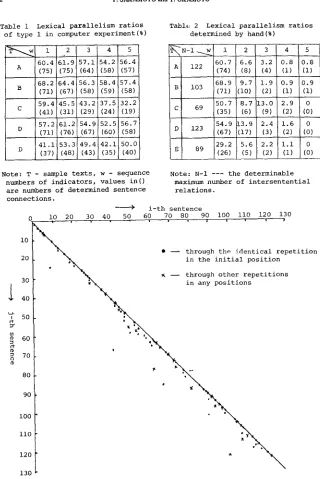
from the beginning of the sentence. The experiments were carried out to
obtain the characteristics of the
lexical parallelism in sample texts on computer and by hand.
In eomputer experiment lexieal
items, i.e. the sequence in Kanji or
Katakana, were identified and
segmented by machine character codes
without syntactic and morphological
analysis. Then the sentence
connections of type 1(identical
repetition) are determined in each
p o s i t i o n and lexical parallelism
ratios are obtained(Table I). On the
same samples the optimal sentence
connections are determined manually
and the lexical parallelism ratios
were calculated(Table 2). Except for
Text E, the totals of the ratios
amount to 72-83%(cf. Table 2) and in
computer experiment the ratios of type
I in the initial position amount to
57-68%(0f. Table I). And moreover,
the initial lexieal items(w=1) show
the maxima in most samples in Table I
and by far the highest value in all
samples in Table 2, and they decrease
with increasing w in Table 2. It is
The sentence connection of type t clear from the results that lexical
in position w is determined between parallelism plays an important role in
the given j-th sentence Sj and the the intersentential dependency and
i-th sentence Si( i < j ), if and only lexical items at the beginning of the
if Si is the nearest preceding sentences are the most relevant
sentence which contains the lexical lexical parallelism indicators.
item, lexically equivalent to the w-th
lexical item from the beginning of the 3. LEXICAL PARALLELISM INDICATOR
given sentence Sj through the type t DISTANCE
repetition( t = 1,2,3; w = 1,2,3,4,5).
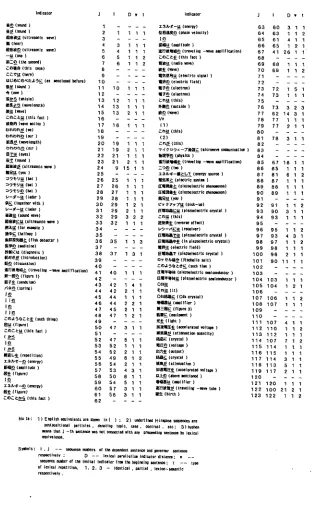
The repetitions of type 1,2,3 As an example, intersentential
correspond to the identical, partly dependency determined manually in Text
identical, lexico-semantic A, which is the essay on "Ultrasonic
repetitions, respectively, amplification" with 1 2 3 s e n t e n c e s in
The lexical equivalents in SJ and four paragraphs, is shown in Table 3
Si are called lexieal parallelism and Figure I. The lexical parallelism
indicators, and Sj is called a indicator distances are shown as well.
dependent on Si. Lexical parallelism indicator
Lexical parallelism ratio of type t distance is defined as follows:
in position w is defined as follows: t
t D : j - i
= ( n / N - 1 ) * I00 w,j
w
where n is the number of the where D is lexical parallelism
LEXICAL PARALLELISM IN TEXT STRUCTURE DETERMINATION 341
lexical repetition: w is position of the lexical indicator: i and j are
sequence numbers of the governor
sentence and dependent sentence
respectively.
The distance is supposed to
represent the semantic extent of the
lexical parallelism indicators, or
better the concepts referred by them.
In Figure I a diagonal unit
distance line indicates the
hypothetical situation, where every
sentence depends on the immediately
preceding sentence. Data show a
tendency to distribute near this line in all samples.
Lexical parallelism indicators show the progress of the author's thought in the text in Table 3. Sevbo pointed out the significance of the indicators
with large D in indicating the
contents of paragraphs and texts. The
lexical items with large D are
supposed to be the important topics,
to which the author of the text
returnes after commenting on another
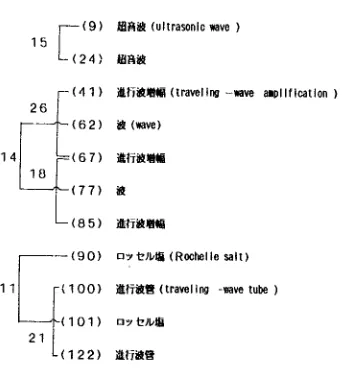
topics. In the example the items with
large D(D>IO) were shown in Figure 2. These indicators are distributed
among paragraphs. For example, the
indicator ~ i ~ ( u l t r a s o n i c wave)
extends over 15 sentences(from 9th to
24th) within
paragraph
2, which rangesfrom 2nd to 4Oth sentence, and the
indicator ~ (traveling-wave
tube) extends over 22
sentences(100th-122nd) within
paragraph 4(85th-123rd) as well. The
indicator ~ m (traveling-wave
amplification) covers paragraph 3
completely, ranging from the 41th
sentence, or the first sentence of the paragraph, through the 67th sentence
to 85th sentence, or the first
sentence of the next paragraph. In
short, these indicators divide the text into the three paragraphs.
In addition, they reflect
appropriately the contents of
paragraphs in the sample text, as
suggested by the fact that they are partly identical with the following
paragraph names:
"Introduction"(paragraph I), "What is the ultrasonic wave?"(paragraph 2),
"Microwave and traveling-wave
tube"(paragraph 3) and "Ultrasonic
wave and traveling-wave
amplification"(paragraph
4).These data suggest that the
indicator with large D may be useful as keywords to the contents of a text.
4. CONCLUSION
Lexlcal parallelism plays an
important role in the intersentential
dependency, or text Structure and
lexieal items at the beginning of the
sentences are the most relevant
lexical parallelism indicators.
The initial lexical parallelism
indicators with long lexical
parallelism indicator distances
reflect the contents of paragraphs and may be useful keywords in information retrieval.
The partly identical repetition and lexico-semantic repetition through the lexical items at/near the beginning of
the sentence,firstly, intersentential
dependency by syntactic device,
secondly, the recognition of
topic/comment opposition in the
sentence, thirdly, and lastly, the
application to automatic keyword or
key-sentence extraction in content
analysis depend on the future
researches.
REFERENCE
[i] Quirk, R., Greenbaum, S., Leech,
G., and Svartvik, J., A grammar of
contemorary English (Longman, London, 1972).
[2] Sevbo, I.N., Struktura svjaznovo
teksta i avtomatizatsija (Nayka, M., 1969).
[3] Maklno, S., Grammar of repetition (Taisyukan, Tokyo, 1980).
[4] Okamoto, T., Text structure
determination and content analysis by lexical parallelism, Proceeding of the
Univ. of Electro-Communications,
voi.24(1973), no. I, 177-190.
[5] Okamoto, T., Structure analysis of
Japanese text, Mathematical
linguistics, No.62(1972), 1-11. [6] Sakamoto, Y., Okamoto, T., Yatsu, N., Text structure and a model of
discourse understanding by lexical
342 Y. SAKAMOTO and T. OKAMOTO
Table 1 L e x i c a l p a r a l l e l i s m ratios of type 1 in c o m p u t e r experiment(%)
1 2 3 4 5
60.4 61.9 57.1'54.2 56.4
A (75) (75)!(64) (58) (57)
68.2 64.4 56.3 58.4 57.4
B (71) (67) (58) (59) i(58)
5 9 . 4 ! 4 5 . 5 43.2 37.5 32.2 C
(41) (31) (29) ( 2 4 ) ( 1 9 )
D 57.2i61.2 54.9 52.5 56.7
(71) (76) (67) (60) (58)
4 1 . i i 5 3 . 3 49.4 42.1 50.0 D
(37) (48) (43) (35) (40)
Table 2 L e x i c a l p a r a l l e l i s m ratios d e t e r m i n e d by hand(%)
~ N - I ~ _ ~ 1 5
60.7 0.8
A 122
(74) (i)
68.9 0.9
B 103
(71) (i)
5O.7 0
C 69
(35) (0)
D 5 4 . 9 0
123 (67) (0)
29.2 0
E l 89 ](26) (0)
2 3 4
6.6 3.2 0.8
(8) (4) (i)
9.7 1.9 0.9
(i0) (2) (i)
8.7 13.0 2.9
(6) (9) (2)
13.9 2.4 1.6
(17) (3) (2)
5.6 2,2 i.i
(5) (2) (I)
Note} T - sample texts, w - sequence Note: N - I --- the d e t e r m i n a b l e
n u m b e r s of indicators, v a l u e s in() m a x i m u m n u m b e r of i n t e r s e n t e n t i a l are n u m b e r s of d e t e r m i n e d s e n t e n c e relations.
connections.
- - 9 i-th s e n t e n c e
0 i0 20 30 40 50 60 70 80 90 i00 ii0 120 130
• ~ t h r o u g h the ~dentical r e p e t i t i o n
20 ~ , ~ in the initial p o s i t i o n
' ~ " ~ - - t h r o u g h o t h e r r e p e t i t i o n s
GG
30 " ~ [ ~ in a n y p o s i t i o n s
[ 4o
\
~ t ~ 5o
60
~ 7o
8O
• ~
9O
1 0 0
1 1 0
1 2 0
130
[image:4.612.162.482.151.630.2]T a b l e 3 L e x i c o - s e m a n t i c i n t e r s e t e n t i a l d e p e n d e n c y i n s a m p l e t e x t A
I~]cator
f f ~ (sound)
J~illU, (ultra~0~]¢ vra~e)
m (hear)
M ~ (ultrasonic ~ave) - ~ (one) ~ - - O (the seooM)
,~OM~" (this raze) ~.T~ (here)
=t;~Ce),,:~,~-)E (as lel~tlonnd before)
M~ (s~Jnd)
~ ( r m ) ~tP5 (fflisle) ~ J : ~ Oevelength)
~-O)~.&l~ (thls fact ) 16
0 ~ 0 0 . ~ (',,e) 1 8
t~fubt~_ (our } 19
i l ~ t~ ( ~ l e ~ t h ) 20
mT~ (eyes) 22
]~T (sound) 23
M l i l ~ (ultrasonic mw ) 2 4
MS~_~ ( ~ ) 25
: : } 9 ~ U ~ (bat) 2 6
~ U _ ¢ _ (bat) 27
DO=~U0) (bat) 28
b ' - ~ & = (ladar) 29
~ (to~et~r wlth ) 3 0
I~-~t--~_ H=dar ) 31
M~I= (sound ,,ave) 3 2
B I ] i l l [ ~ (ultrasonic ~ ) 3 3
M~_. (tot exm~le ) 3 4
]~q=~- (hetftey) 3 5
~E~t~ (~lcme) 3 7
~ l ~ k ~ (diagnosis) 3 9
i ~ e ~ (Introduction) 3 9
~ 0 (discussion) 4 0
] A ~ i ~ : (travelll~ -w~e ~pllflcatlo~) 43
M - - ~ . . (fl~re 1) 4 2
~ (penOulul) 4 3
; t : ~ ( s~rl~ ) 4 4
1 ~ 4 5
] I ~ 4 6
I ~ 47
I I_~ 48
~_~J:'~t~.&~ (SUch thll~) 4 9
B ~ (figure) 5 0
~-O~-~W. (this fact ) 51
t ~__~_ 52
I°) 53
M~b~ (re=etltlo~) 55
B ~ ( a l p l l t ~ e ) 5 7
+e.~ ( fl~re~ 5 8
Io) 5 9
:[ #,,'v# - ~ (e~er~) 6 0
~-OC~:~__~_ (this fact ) 6 2
J I D W t indicator J I D • t
1 . . . . z ~ / v - ¢ - ~ (ener¢/) 6 3 6 0 3 1 1
2 1 I 1 1 ~ ] ~ ¢ 9 (¢k~se velocity) 64 63 1 1 2
3 . . . . 10) 65 61 4 1 1
4 3 1 1 1 IE(du.(a=lltude) 6 6 6 5 1 2 1
5 4 1 1 1 ~ t ~ o ) ( t r s v e l l ~ -~vea~,oltflcation) 67 41 2 6 1 1"
6 5 1 1 2 E~C~:~ (this fact ) 6 8 . . . .
7 6 1 I 2 ~ i ~ _ (rndlo wave) 6 9 68 1 1 1
8 . . . . ~_~ (ta~e) 7 0 69 1 1 2
9 . . . . ~ (electPi¢ slo~i ) 71 . . . .
10 . . . . ~ (electric field) 72 . . . .
11 10 1 1 1 IE~O) (electro~) 73 72 1 $ 1
12 - - - I : } ' o (electron) 74 73 1 1 1
13 12 1 1 1 ~ ' . ~ ( t h l s ) 75 . . . .
14 13 1 1 1 ~ l l ~ ( o ~ t s l h e ) 76 73 3 2 3
13 2 1 1 ~cJ(~am) 77 62 14 3 1
- - - Ve 78 77 1 1 1
16 1 1 1 ( 1 ) 79 77 2 1 1
- - - ~.t¢l~ (this) 8 0 . . . .
. . . . ( 2 ) 81 78 3 1 1
19 1 1 1 C . ~ (~hls) 82 . . . .
19 2 1 i w ' n ' h m h = - - ~ t ~ ; c (|icrol~ve ~=~Jni=tl:lr~ ) 8 3 . . . .
21 1 1 1 ~]M"J#~(W P/slcs ) 84 - - -
21 2 I 1 ~ 1 ~ ( t ~ l l ~ -~vea,~llflcatlm) 8 5 67 "i8 1 1
9 15 1 1 _ - O O ( t ~ ) 8 6 8 5 1 1 1
. . . . x:~m-~-MJcL,~(enerc/~rce) 8 7 81 6 1 2
25 1 1 1 t ~ ( e l e c t r i c c t s t e l ) 8 8 87 1 1 1
26 1 1 1 E l l l ] l l l ~ (pieZOelectric phenw~on) 8 9 9 8 1 1 1
27 1 1 1 EtaUl~j~(I)lezoelectrloC~el~R.non) 9() 8 9 1 1 1
28 1 1 1 M~l,l((yee ) 91 - - -
29 1 2 1 ~ ' ~ 7 ~ ( P l d ~ - u ~ ) 9 2 91 1 1 2
29 2 1 1 BE~lt~ltkt (piezoelectric crystal ) 9 3 9 0 3 1 1
29 3 2 2 J - ~ ( t h l s ) 94 9 3 1 1 1
3 2 1 1 1 ~ j ~ (re~rse effect) 9 5 . . . .
- - - I~-*'~Ek¢ (receiver) 9 6 9 5 1 1 2
- - - E~K~,T~(plez~electrlccrtstal ) 9 7 9 3 4 3 1
3 5 1 1 3 f~IIJW~T" ( in ~tezoeleCttic crystal) 9 8 9 7 1 1 2
- - - t~Rt.~ (electric field) 9 9 98 1 1 1
3 7 1 3 1 BEIII~41,Z" (pieZOelectric cwstal ) 1 0 0 9 8 2 1 1
. . . . c ~ , ~ , , l ~ ( R o c h e l i e s a l t ) 101 9 0 11 1 1
. . . . CO~'~P~'IC (such tll~ ) 1 0 2 . . . .
4 0 1 1 1 EIl-~f~{$ (pieZOelectric SellcoMuct0r ) 1 0 3 . . . .
. . . . R:1¢~!¢$~ (piezoelectric t~lcm~uetor ) 1 0 4 1 0 3 1 1 1
4 2 1 4 1 CdSU, 1 0 5 1 0 4 1 2 1
4 2 2 1 1 T~__~(lt) 1 0 6 . . . .
4 4 1 1 1 CdSI~hIC ( Cds crystal ) 1 0 7 1 0 6 1 1 2
44 2 2 1 q~(41S~(aspllfieP ) 1 0 8 1 0 7 1 1 1
4 5 2 1 1 M----B~(fl~ro3) 1 0 9 . . . .
47 1 2 1 IU~lc(e~ul~me~t) 1 1 0 . . . .
. . . . ~ ( I t o h | ) 111 1 0 7 4 1 1
4 7 3 1 1 ~l~E~(~oeeteratnd~Oltaoe) 1 1 2 1 1 0 1 1 2
. . . . • ~ i ~ (atte~tloe ~ n t l t y ) I 13 1 1 2 1 1 1
47 5 1 1 I ~ , E ( c r y s t a l ) 1 1 4 1 0 7 7 1 2
52 1 1 1 IEEo(,~ltaue) 1 1 5 1 1 4 1 1 1
52 2 1 1 f l ~ ( 0 ~ t m t ) 1 1 6 1 1 5 1 1 1
4 9 6 1 2 ~dC(¢rystal ) 1 1 7 1 1 4 3 1 1
54 2 1 1 N(Mt~(attenmtto~) 1 1 8 1 1 3 5 1 1
53 4 3 1 ~;~I~E~ (~¢eleratnd ~ l t ~ e ) 1 1 9 1 1 7 2 1 1
5 0 8 1 1 CLhO)(abovelentlo~d ) 1 2 0 . . . .
54 5 1 1 M t l ~ ( u c l l t t e r ) 121 1 2 0 1 1 1
5 7 3 1 1 ~ _ t ~ ( t r a v e l l n ~ t - ~ v ~ t u h e ) 1 2 2 1 0 0 21 2 1
58 3 1 1 L ~ ( h l r t h ) 1 2 3 1 2 2 1 1 2
N o t e : 1)Er¢llsheQulvalentsaresho~m in( ) ; 2) underllnndHIr~a~ass¢~Jencesare
I~Stposltlonal particles, de~otl~ topic, case, contrast, et¢: 3)byehen
lear~ that J - t h tentence ~s not ¢onoectnd with any hrecoedlr# Sentence by lexlcal e?Jlvelenoe.
Syl~ols : I . J - - ~ e l ~ = r~lb~rs of the depenhe~t ~e~terce and povemor =enten~
res~ctlVely ; D - - lexlCal parallel[s= Indicator d[=tance: • - -
[image:5.612.117.437.179.690.2]344 Y. SAKAMOTO.and T. OKAMOTO
15 ~ - ( 9 ) ~]Pii~(ultrasonlc~ave )
L ( 2 4 ) El~i~
26 ~-(41 ) ~=~-~IBIM (traveling -~ave amplification )
~ - ~ - ( 6 2 ) . ( . v e )
4 iii i .-
~tii~mq~
- - ( 9 o ) n.:,~)bt~ (Rochelle salt) 1 1 1 i { 1 0 0 ) ~ i ~ ( t r a v e l l n g -~vetube)~Lt:Tig~t
Fig. 2 Dlstrl~tlon of long distance Indicator (D> 1 O)
[image:6.612.230.405.159.345.2]