A Comparative Study of Embedding Models in Predicting the
Compositionality of Multiword Expressions
Navnita Nandakumar Bahar Salehi Timothy Baldwin
School of Computing and Information Systems The University of Melbourne
Victoria 3010, Australia
[email protected] {salehi.b,tbaldwin}@unimelb.edu.au
Abstract
In this paper, we perform a compara-tive evaluation of off-the-shelf embedding models over the task of compositional-ity prediction of multiword expressions (“MWEs”). Our experimental results sug-gest that character- and document-level models do capture some aspects of MWE compositionality and are effective at mod-elling varying levels of compositionality, but ultimately are not as effective as a sim-ple word2vec baseline. However they have the advantage over word-level models that they do not require token-level identifica-tion of MWEs in the training corpus.
1 Introduction
In recent years, the study of the semantic id-iomaticity of multiword expressions (“MWEs”: Baldwin and Kim (2010)) has focused on com-positionality prediction, a regression task involv-ing the mappinvolv-ing of an MWE onto a continuous scale, representing its compositionality either as a whole or for each of its component words (Reddy et al.,2011;Ramisch et al.,2016;Cordeiro et al., to appear). In the case of couch potato“an idler who spends much time on a couch (usually watch-ing television)”, e.g., on a scale of[0,1]the over-all compositionality may be judged to be 0.3, and the compositionality of couch and potato as 0.8 and 0.1, respectively. The main motivation for the study of compositionality is to better understand the semantic of the compound and the semantic relationships between the component words of the MWEs, which has applications in various infor-mation retrieval and natural language processing tasks (Venkatapathy and Joshi,2006;Acosta et al., 2011;Salehi et al.,2015b).
Separately, there has been burgeoning interest
in learning distributed representations of words and their meanings, starting out with word em-beddings (Mikolov et al.,2013;Pennington et al., 2014) and now also involving the study of character- and document-level models (Baroni et al., 2014;Le and Mikolov, 2014; Bojanowski et al.,2017;Conneau et al.,2017). This work has been applied in part to predicting the composition-ality of MWEs (Salehi et al.,2015a;Hakimi Parizi and Cook, 2018), work that this paper builds on directly, in performing a comparative study of the performance of a range of off-the-shelf representa-tion learning methods over the task of MWE com-positionality prediction.
Our contributions are as follows: (1) we show that, despite their effectiveness over a range of other tasks, recent off-the-shelf character- and document-level embedding learning methods are inferior to simpleword2vec at modelling MWE compositionality; and (2) we demonstrate the util-ity of using paraphrase data in addition to simple lemmas in predicting MWE compositionality.
2 Related work
The current state-of-the-art in compositionality prediction involves the use of word embeddings (Salehi et al., 2015a). The vector representa-tions of each component word (e.g. couch and
potato) and the overall MWE (e.g.couch potato) are taken as a proxy for their respective meanings, and compositionality of the MWE is then assumed to be proportional to the relative similarity be-tween each of the components and overall MWE embedding. However, word-level embeddings re-quire token-level identification of each MWE in the training corpus, meaning that if the set of MWEs changes, the model needs to be retrained. This limitation led to research on character-level models, since character-level models can
itly handle an unbounded vocabulary of compo-nent words and MWEs (Hakimi Parizi and Cook, 2018). There has also been work in the extension of word embeddings to document embeddings that map entire sentences or documents to vectors (Le and Mikolov,2014;Conneau et al.,2017).
3 Embedding Methods
We use two character-level embedding models (fastText and ELMo) and two document-level models (doc2vecandinfersent) to compare with word-levelword2vec, as used in the state-of-the-art method ofSalehi et al.(2015a). In each case, we use canonical pre-trained models, with the ex-ception ofword2vec, which must be trained over data with appropriate tokenisation to be able to generate MWE embeddings, as it treats words atomically and cannot generate OOV words.
3.1 Word-level Embeddings
Word embeddings are mappings of words to vec-tors of real numbers. This helps create a more compact (by means of dimensionality reduction) and expressive (by means of contextual similarity) word representation.
word2vec We trained word2vec (Mikolov et al., 2013) over the latest English Wikipedia dump.1 We first pprocessed the corpus, re-moving XML formatting, stop words and punc-tuation, to generate clean, plain text. We then iterated through 1% of the corpus (following Hakimi Parizi and Cook(2018)) to find every oc-currence of each MWE in our datasets and con-catenate them, assuming every occurrence of the component words in sequence to be the compound noun (e.g. every couch potato in the corpus be-comescouchpotato). We do this because instead of a single embedding for the MWE, word2vec generates separate embeddings for each of the component words, owing to the space between them. If the model still fails to generate embed-dings for either the MWE or its components (due to data sparseness), we assign the MWE a default compositionality score of 0.5 (neutral). In the case of paraphrases, we compute the element-wise av-erage of the embeddings of each of the component words to generate the embedding of the phrase.
1Dated 02-Oct-2018, 07:23
3.2 Character-level Embeddings
In a character embedding model, the vector for a word is constructed from the character n-grams that compose it. Since character n-grams are shared across words, assuming a closed-world al-phabet,2 these models can generate embeddings for OOV words, as well as words that occur infre-quently. The two character-level embedding mod-els we experiment with arefastText (Bojanowski et al., 2017) and ELMo (Peters et al., 2018), as detailed below.
fastText We used the 300-dimensional model pre-trained on Common Crawl and Wikipedia us-ing CBOW. fastText assumes that all words are whitespace delimited, so in order to generate a rep-resentation for the combined MWE, we remove any spaces and treat it as a fused compound (e.g.
couch potato becomes couchpotato). In the case of paraphrases, we use the same word averaging technique as we did inword2vec.
ELMo We used the ElmoEmbedder class in Python’s allennlp library.3 The model was pre-trained over SNLI and SQuAD, with a dimension-ality of 1024.
Note that the primary use case of ELMo is to generate embeddings in context, but we are not providing any context in the input, for consis-tency with the other models. As such, we are knowingly not harnessing the full potential of the model. However, this naive use ofELMo is not inappropriate as the relative compositionality of a compound is often predictable from its compo-nent words only, even for novel compounds such asgiraffe potato(which has a plausible composi-tional interpretation, as a potato shaped like a gi-raffe) vs.couch intelligence(where there is no nat-ural interpretation, suggesting that it may be non-compositional).
3.3 Document-level Embeddings
Document-level embeddings aim to learn vec-tor representations of documents (sentences or even paragraphs), to generate a representation
2Which is a safe assumption for languages with small-scale alphabetic writing systems such as English, but po-tentially problematic for languages with large orthographies such as Chinese (with over 10k ideograms in common use, and many more rarer characters) or Korean (assuming we treat each Hangul syllable as atomic).
3options file = https://bit.ly/2CInZPV,
of its overall content in the form of a fixed-dimensionality vector. The two document-level embeddings used in this research aredoc2vec(Le and Mikolov,2014) andinfersent(Conneau et al., 2017), as detailed below.
doc2vec We used the gensim implementation of doc2vec (Lau and Baldwin, 2016; Reh˚uˇrekˇ and Sojka,2010), pretrained on Wikipedia data us-ing theword2vecskip-gram models pretrained on Wikipedia and AP News.4
infersent We used two versions of in-fersent of 300 dimensions, using the inbuilt infersent.build vocab k words func-tion to train the model over the 100,000 most popular English words, using: (1) GloVe (Pennington et al., 2014) word embeddings (“infersentGloVe”); and (2) fastText word embeddings (“infersentfastText”).
4 Modelling Compositionality
In order to measure the overall compositionality of an MWE, we propose the following three broad approaches.
4.1 Direct Composition
Our first approach is to directly compare the em-beddings of each of the component nouns with the embedding of the MWE via cosine similar-ity, in one of two ways: (1) pre-combine the em-beddings for the component words via element-wise sum, and compare with the embedding for the MWE (“Directpre”); and (2) compare each
in-dividual component word with the embedding for the MWE, and post-hoc combine the scores via a weighted sum (“Directpost”). Formally:
Directpre = cos(mwe,mwe1+mwe2)
Directpost=αcos(mwe,mwe1)+
(1−α) cos(mwe,mwe2)
where: mwe,mwe1, andmwe2 are the
embed-dings for the combined MWE, first component and second component, respectively;5mwe1+mwe2
is the element-wise sum of the vectors of each of the component words of the MWE; andα∈[0,1] is a scalar which allows us to vary the weight of
4
https://github.com/jhlau/doc2vec/ blob/master/README.md
5Noting that all MWEs are binary in our experiments, but equally that the methods generalise trivially to larger MWEs.
Emb. method Directpre Directpost
word2vec 0.684 0.710(α= 0.3)
fastText 0.223 0.285 (α= 0.3)
ELMo 0.056 0.399 (α= 0.0)
doc2vec −0.049 0.025 (α= 0.0)
infersentGloVe 0.413 0.500 (α= 0.5) infersentinfersent 0.557 0.610 (α= 0.5)
Table 1: Pearson correlation coefficient for com-positionality prediction results on the REDDY
dataset.
the respective components in predicting the com-positionality of the compound. The intuition be-hind both of these methods is that if the MWE ap-pears in similar contexts to its components, then it is compositional.
4.2 Paraphrases
Our second approach is to calculate the similar-ity of the MWE embedding with that of its phrases, assuming that we have access to para-phrase data.6 We achieve this using the following three formulae:
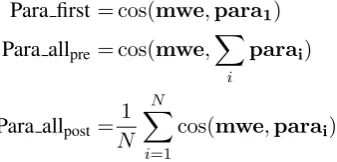
Para first = cos(mwe,para1)
Para allpre = cos(mwe,
X
i
parai)
Para allpost =
1 N
N X
i=1
cos(mwe,parai)
wherepara1andparaidenote the embedding for
the first (most popular) and i-th paraphrases, re-spectively.
We apply this method to RAMISCH only, since REDDY does not have any paraphrase data (see Section5.1for details).
4.3 Combination
Our final approach (“Combined”) is based on the combination of the direct composition and para-phrase methods, as follows:
Combined=βmax Directpre,Directpost
+ (1−β) max Para first,Para allpre,
Para allpost
whereβ ∈[0,1]is a scalar weighting factor to bal-ance the effects of the two methods. The choice
Emb. method Directpre Directpost Para first Para allpre Para allpost Combined
word2vec 0.667 0.731(α= 0.7) 0.714 0.822 0.880 0.880(β= 0.0)
fastText 0.395 0.446 (α= 0.7) 0.569 0.662 0.704 0.704 (β= 0.0)
ELMo 0.139 0.295 (α= 0.0) 0.367 0.642 0.664 0.669 (β= 0.2)
doc2vec −0.146 0.048 (α= 1.0) 0.405 0.372 0.401 0.419 (β= 0.3)
infersentGloVe 0.321 0.427 (α= 0.7) 0.639 0.704 0.741 0.774 (β= 0.5) infersentfastText 0.274 0.380 (α= 0.8) 0.615 0.781 0.783 0.783 (β= 0.0)
Table 2: Pearson correlation coefficient for compositionality prediction results on the RAMISCHdataset.
of the max operator here to combine the sub-methods for each of the direct composition and paraphrase methods is that all methods tend to un-derestimate the compositionality (and empirically, it was superior to taking the mean).
5 Experiments
5.1 Datasets
We evaluate the models on the following two datasets, which are comprised of 90 English bi-nary noun compounds each, rated for composi-tionality on a scale of 0 (non-compositional) to 5 (compositional). In each case, we evaluate model performance via the Pearson’s correlation coeffi-cient (r).
REDDY This dataset contains scores for the compositionality of the overall MWE, as well as that of each component word (Reddy et al.,2011); in this research, we use the overall compositional-ity score of the MWE only, and ignore the compo-nent scores.
RAMISCH Similarly to REDDY, this dataset
contains scores for the overall compositionality of the MWE as well as the relative composition-ality of each of its component words, in addi-tion to paraphrases suggested by the annotators, in decreasing order of popularity (Ramisch et al., 2016); in this research, we use the overall compo-sitionality score and paraphrase data only.
5.2 Results and Discussion
The results of the experiments on REDDY and
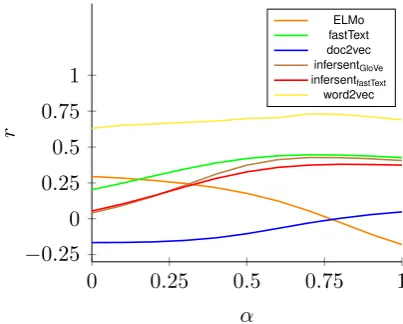
RAMISCH are presented in Tables 1 and 2, re-spectively. In this work, we simplistically present the results for the best α and β values for each method over a given dataset, meaning we are ef-fectively peaking at our test data. Sensitivity of theα hyper-parameter is shown in Figures1 and
0 0.25 0.5 0.75 1 −0.25
0 0.25 0.5 0.75 1
α
r
ELMo fastText doc2vec infersentGloVe
infersentfastText
word2vec
Figure 1: Sensitivity analysis ofα(REDDY)
0 0.25 0.5 0.75 1 −0.25
0 0.25 0.5 0.75 1
α
r
ELMo fastText doc2vec infersentGloVe
infersentfastText
word2vec
Figure 2: Sensitivity analysis ofα(RAMISCH)
2, for the REDDY and RAMISCHdatasets, respec-tively.
using ELMo naively, in not including any con-text when generating the embeddings for the com-ponent words and, more importantly, the overall MWE. The results show that doc2vec performs better when representing paraphrases, and strug-gles with compounds without sentential context.
In Table1, we find Directpostto produce a higher
correlation in all cases, withαranging from 0.0 to 0.5, suggesting that the second element (= head) contributes more to the overall compositionality of the MWE than the first element (= modifier); this is borne out in Figure1.
In Table2, on the other hand, we find that, with the exception of ELMo, theα values favour the modifier of the MWE over the head (i.e.α >0.5; also seen in Figure 2), implying that the former is more significant in predicting the composition-ality of the MWE. The reason for the mismatch between the two datasets is not immediately clear, other than the obvious data sparsity.
We also see that the paraphrases achieve a higher correlation across all models, suggesting this is a promising direction for future study. The low β values for Combined also confirm that the paraphrase methods have greater predic-tive power than the direct composition methods. Among the paraphrase experiments, we find that Para allpost— the average of the similarities of the
MWE with each of its paraphrases — consistently achieves the best results. We hypothesize that the paraphrases provide additional information re-garding the compounds that further help determine their compositionality.
6 Conclusions and Future Work
This paper has investigated the application of a range of embedding generation methods to the task of predicting the compositionality of an MWE, either directly based on the MWE and its component words, or indirectly based on para-phrase data for the MWE. Our results show that modern character- and document-level embedding models are inferior to the simple word2vec ap-proach at the task. We also show that paraphrase data captures valuable data regarding the compo-sitionality of the MWE.
Since we have achieved such promising results with the paraphrase data, it might be interesting to consider other possible settings in future tests. While none of the other approaches could outper-formword2vec, it is useful to note that they were
pretrained and, as such, did not require any manip-ulation of the training corpus in order to generate vector embeddings of the MWEs. This means they can be applied to new datasets without the need for retraining and are, therefore, more robust.
In future work, we intend to train the models used in our study on a fixed corpus, to compare their performance in a more controlled setting. We will also do proper tuning of the hyperparameters over held-out data, and plan to experiment with other languages.
References
Otavio Acosta, Aline Villavicencio, and Viviane Mor-eira. 2011. Identification and treatment of multi-word expressions applied to information retrieval. In Proceedings of the Workshop on Multiword Ex-pressions: from Parsing and Generation to the Real World. Portland, USA, pages 101–109.
Timothy Baldwin and Su Nam Kim. 2010. Multiword expressions. In Nitin Indurkhya and Fred J. Dam-erau, editors, Handbook of Natural Language Pro-cessing, CRC Press, Boca Raton, USA. 2nd edition.
Marco Baroni, Georgiana Dinu, and Germ´an Kruszewski. 2014. Don’t count, predict! a systematic comparison of context-counting vs. context-predicting semantic vectors. InProceedings of the 52nd Annual Meeting of the Association for Computational Linguistics (ACL 2014). Baltimore, USA, pages 238–247.
Piotr Bojanowski, Edouard Grave, Armand Joulin, and Tomas Mikolov. 2017. Enriching word vectors with subword information. Transactions of the Associa-tion for ComputaAssocia-tional Linguistics5:135–146.
Alexis Conneau, Douwe Kiela, Holger Schwenk, Lo¨ıc Barrault, and Antoine Bordes. 2017. Supervised learning of universal sentence representations from natural language inference data. InProceedings of the 2017 Conference on Empirical Methods in Nat-ural Language Processing. pages 670–680.
Silvio Cordeiro, Aline Villavicencio, Marco Idiart, and Carlos Ramisch. to appear. Unsupervised composi-tionality prediction of nominal compounds. Compu-tational Linguistics.
Ali Hakimi Parizi and Paul Cook. 2018. Do character-level neural network language models capture knowledge of multiword expression compositional-ity? InProceedings of the Joint Workshop on Lin-guistic Annotation, Multiword Expressions and Con-structions (LAW-MWE-CxG-2018). pages 185–192.
Quoc Le and Tomas Mikolov. 2014. Distributed repre-sentations of sentences and documents. In Proceed-ings of the 31st International Conference on Ma-chine Learning (ICML 2014). Beijing, China, pages 1188–1196.
Tomas Mikolov, Kai Chen, Greg Corrado, and Jeffrey Dean. 2013. Efficient estimation of word represen-tations in vector space. InProceedings of Workshop at the International Conference on Learning Repre-sentations.
Jeffrey Pennington, Richard Socher, and Christo-pher D. Manning. 2014. GloVe: Global vectors for word representation. InEmpirical Methods in Nat-ural Language Processing (EMNLP). pages 1532– 1543.
Matthew Peters, Mark Neumann, Mohit Iyyer, Matt Gardner, Christopher Clark, Kenton Lee, and Luke Zettlemoyer. 2018. Deep contextualized word rep-resentations. In Proceedings of the 2018 Confer-ence of the North American Chapter of the Associ-ation for ComputAssoci-ational Linguistics: Human Lan-guage Technologies, Volume 1 (Long Papers). pages 2227–2237.
Carlos Ramisch, Silvio Cordeiro, Leonardo Zilio, Marco Idiart, and Aline Villavicencio. 2016. How naked is the naked truth? a multilingual lexicon of nominal compound compositionality. In Proceed-ings of the 54th Annual Meeting of the Association for Computational Linguistics (Volume 2: Short Pa-pers). pages 156–161.
Siva Reddy, Diana McCarthy, and Suresh Manandhar. 2011. An empirical study on compositionality in compound nouns. In Proceedings of 5th Interna-tional Joint Conference on Natural Language Pro-cessing. pages 210–218.
Radim ˇReh˚uˇrek and Petr Sojka. 2010. Software frame-work for topic modelling with large corpora. In Pro-ceedings of the LREC 2010 Workshop on New Chal-lenges for NLP Frameworks. pages 45–50.
Bahar Salehi, Paul Cook, and Timothy Baldwin. 2015a. A word embedding approach to predicting the com-positionality of multiword expressions. In Proceed-ings of the 2015 Conference of the North Ameri-can Chapter of the Association for Computational Linguistics: Human Language Technologies. pages 977–983.
Bahar Salehi, Nitika Mathur, Paul Cook, and Timothy Baldwin. 2015b. The impact of multiword expres-sion compositionality on machine translation eval-uation. In Proceedings of the NAACL HLT 2015 Workshop on Multiword Expressions. Denver, USA, pages 54–59.