Presenting a New Dataset for the Timeline Generation Problem
The timeline generation task summarises an entity’s biography by selecting stories representing key events from a large pool of relevant documents. This paper ad-dresses the lack of a standard dataset and evaluative methodology for the problem.
We present and make publicly available a new dataset of 18,793 news articles cover-ing 39 entities. For each entity, we provide a gold standard timeline and a set of entity-related articles. We propose ROUGE as an evaluation metric and validate our dataset by showing that top Google results outper-form straw-man baselines.
1 Introduction
Information is more readily available in greater quantities than ever before. Timeline generation is a recent method for summarising data – tak-ing a large pool of entity-related documents as in-put and selecting a small set that best describe the key events in the entity’s life. There are several challenges in evaluation: (1) finding gold-standard timelines, (2) finding corpora from which to draw documents to build timelines, and (3) evaluating system timelines.
Standard practice for the first challenge is to make use of existing timelines produced by news agencies (Chieu and Lee, 2004; Yan et al., 2011a), but these are constrained by the tight editorial fo-cus on prominent entities and depends on well-funded news agencies. Another approach is to an-notate new timelines from the web for domains of choice. Wang (2013) do this, but do not make their data available for direct comparison. Regard-ing the second challenge, access to the document pool used during the annotation process is also im-portant, as any system must have a reasonable set from which to choose.
Previous approaches have used drawn on work-ing in document summarisation, uswork-ing ROUGE (Lin, 2004) to evaluate timeline generation (Chieu and Lee, 2004; Yan et al., 2011a; Yan et al., 2011b; Ahmed and Xing, 2012; Wang, 2013). This is con-venient as each element in a timeline can repre-sent a storywhich can be equivalently described by many different documents. However, previous work has not validated the use of ROUGE for eval-uating timeline generation.
We present a general framework for creating a crowd-sourced datasets for evaluating timeline generation, including choosing a set of entities, deriving articles for annotation from Wikipedia, and annotating these articles to generate a gold standard.
The dataset covers a broad range of entities with different levels of news-coverage or public-ity. We provide gold-standard timelines for each entity, as well as a larger pool of topically-linked documents for further development. We anal-yse the dataset, showing some interesting arti-facts of crowd-worker importance judgements and use ROUGE evaluation to verify that the crowd-annotations correlate well with Google News1 rankings. This reflects favourably on Google News, suggesting that it is a strong baseline for timeline generation. We release the dataset gener-ated through this process in the hope that it will be useful in providing common benchmarks for fu-ture work on the timeline generation task.2
2 Data Collection
We now detail how we choose entities and col-lect a corpus for annotating gold-standard time-lines and evaluating models. We have taken care to design a general experimental protocol that can be used to generate entities from a range of domains.
1
https://news.google.com
2https://github.com/xavi-ai/
We begin by choosing a domain (politics) and two regions (The USA/Australia). We motivate this choice of domain by noting its large media in-terest, polarising entities and diverse range of top-ics. We choose several entities from each region a priori – 39 in total. The rest of our entity-set is then generated through a process of bootstrap-ping. At each iteration, we use our current enti-ties as seeds. For each seed-entity, we performed a Google News query. An entity name was defined as either the title of the entity’s Wikipedia page or{#Firstname #Lastname}if they did not have a Wiki. We choose five articles from the first page of results. For each article we manually identify all other previously unseen entities and add them to our set. We continue this process of bootstrap-ping, using our newly included entities as seeds for the next iteration. Once we have a sufficient number of entities, we terminate the process.
This process can be viewed as bootstrap sam-pling, weighted by the probability an entity occurs in one of the articles we retrieve. By doing so we provide a realistic set of entities with varying lev-els of popularity and coverage. In Section 4 we show that this process results in a wide distribu-tion of mendistribu-tions and reference-timeline sizes.
As well as relevant entities, we also provide a corpus of relevant documents from which we can construct their timelines. Each document in the corpus includes URL, publishing date and other metadata. These were obtained by performing Google News queries on our entities, and retriev-ing the resultretriev-ing URLs. As our timelines should cover a wide range of time, we set the time-range on the query to ‘archives’. This has the effect of returning articles from a broader period of time, mitigating the default recency bias.
In total, there are 15,596 articles. The mini-mum, median and maximum number of articles per entity was 54, 464 and 985 respectively. By including this corpus with our gold-standards we aim to provide a complete dataset for the timeline generation task.
3 Data Annotation and Gold-Standards
We present a general framework for formulating gold-standard timeline generation as an annota-tion task. This involves two components – using Wikipedia to generate a minimal set of sufficient links, and the formulation of the problem as an an-notation task.
3.1 Article Selection
Annotation is cost-sensitive to the size of the task. As such, attempting to annotate the whole corpus of over 15,000 articles is infeasible. We propose a method to reduce the size of our task while main-taining the quality of the underlying timeline. For our article selection process, we need to fulfil the following criteria:
• Coverage: Our set of articles should have good coverage. Timelines should cover a broad range of time-periods and events. As such, the dataset we derive our reference timelines from must also share this property.
• Manageability: Each entity-article pair will be subject to a number of crowd-judgments. As such, it’s important to balance coverage with total data-set size.
• Informativeness: Ideally we desire the arti-cles to be of a high quality.
To meet these criteria, we scrape the exter-nal (non-Wiki) links from an entity’s Wikipedia page. We motivate this decision by first noting the Wikipedia guidelines on verifiability3:
Attribute all quotations and any ma-terial challenged or likely to be chal-lenged to a reliable, published source using an inline citation. The cited source must clearly support the material as pre-sented in the article.
These standards of verifiability are not univer-sally followed. Nevertheless, where they are we expect reasonable entity coverage and informa-tiveness. After removing invalid URLS, we iden-tify 3,197 articles for annotation.
3.2 Crowd-task Formulation
We formulate timeline generation as an annota-tion task by reducing it to a simple classificaannota-tion problem. A single judgment is on the level of an entity-article pair. An annotator is given the first paragraph of, and a link to, the entity’s Wikipedia page. They then follow a given link, and perform a two-stage classification task.
The annotators first determine whether a link is valid. A valid article is one that covers a single
event in the target entity’s life. They then indi-cate the importance of an article’s when consider-ing the story of the entity. There was a choice of three labels:
• Very important: key events which would be included in a one-page summary or brief of the entity.
• Somewhat important: newsworthy events that might make it into a broader Biography, but not of critical relevance.
• Not important: events which are mundane or unimportant.
For our annotations, we use the CrowdFlower4 platform. On average, three judgments by a trusted user were made per row. A trusted user was one whose annotations agreed with our ex-pert’s across a validation set (n = 48) at least 80% of the time. This was then aggregated into a classification label. In addition, CrowdFlower also provides a confidence measure on each judgment – a score of agreement, weighted by trust of the crowd-worker. Gold standard timelines comprise the articles that are judged to be both ‘valid’ and ‘very important’. There were 2,601 ‘valid articles’ and 217 ‘very important’.
4 Analysis of Gold-Standards
We see that particularly prominent entities are responsible for a large portion of the articles. ‘Barack Obama’ and ‘Donald Trump’ each have over four hundred articles each. In fact, the six most prominent entities account for over half of all total articles (Figure 1).
Very Important Articles The ‘very important’ articles make up our gold-standard timelines. The mean and median number of articles per entity is 5.56 and 2 respectively.
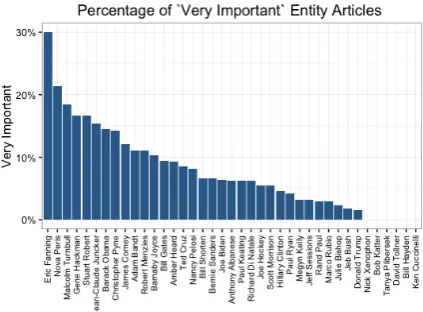
There are some interesting properties that emerge. ‘Barack Obama’ and ‘Donald Trump’ each have around the same number of articles. The former has 14.6% articles deemed ‘very impor-tant’ – the latter only 1.5% (Figure 2). It is a given that certain entity’s will be involved in more news-worthy events than others. However, to have such a large5 discrepancy – considering to that all arti-cles were deemed necessary to reference in an en-tity’s Wiki – is curious. We believe the proportion
4
https://www.crowdflower.com
5Or tremendous?
Figure 1: Number of different articles by entity. A small number of entities are responsible for a large number of articles.
Figure 2: Percentage of very important articles by entity.
of ‘very important’ articles for a given entity is an interesting avenue of future research.
Figure 3: Distribution of confidence for three dif-ferent levels of article importance. Mean-values are indicated by a dashed line.
Figure 4: Percentage of ‘very important’ articles meeting a given confidence threshold.
5 Evaluation
For our evaluation pipeline, we adopt the approach of a number of papers in the field (Wang, 2013; Yan et al., 2011a; Yan et al., 2011b) in using the ROUGE metric (Lin, 2004). ROUGE was first used in automatic summarisation evaluation. It is similar to the BLEU measure for machine transla-tion (Papineni et al., 2002). In terms of timeline evaluation, quality is measured by the amount of overlapping units (e.g. word n-grams) between ar-ticles in a system timeline and arar-ticles in a refer-ence timeline. For details on how ROUGE scores are calculated, please refer to the original paper (Lin, 2004). For our purposes, articles annotated as ‘valid’ and ‘very important’ are taken to be components of an entity’s reference timeline. We use the ROUGE-F measure over unigrams and
bi-Figure 5: Google search rank for a given article vs. ROUGE score. Each point is an average across entities. The intensity of the point is a measure of confidence
grams (n= 1,2).
6 Benchmarks and System Validation
In this section we use our supplemental dataset of articles generated by Google News to validate and benchmark the task.
ROUGE vs. Search Rank For a given news query, an article’s rank is a signal of its important and centrality. It is reasonable to expect then that the better an article’s search-rank, the more likely it is to appear in an entity’s timeline. This appears to be the case. For both the ROUGE-1 and -2 mea-sures, there is a clear negative correlation between an article’s average score and index (Figure 5).
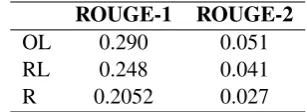
ROUGE-1 ROUGE-2
OL 0.290 0.051
RL 0.248 0.041
R 0.2052 0.027
Table 1: F-Scores for Benchmark Systems
Figure 6: Benchmark performance. As expected, OL outperforms RL which in turn outperforms R for both ROUGE-1 and -2.
15 highest ranked articles for an entity are cho-sen. Reassuringly, we see that OL outperforms RL which outperforms R for both ROUGE-1 and ROUGE-2 scores (Figure 6). OL received scores of 0.290 (ROUGE-1) and 0.051 (ROUGE-2) (Ta-ble 1). This can be taken as a strong benchmark for future timeline generation models trained and evaluated using this dataset.
7 Conclusion and Future Work
In this paper we have developed, analysed and justified a new dataset for the timeline genera-tion problem. There are several interesting av-enues for future work. The most obvious is the development of new timeline-generation systems using this dataset. There are also still problems to be solved with the process of evaluating timeline models, but we hope that the framework described above allow researchers to easily generate evalua-tion datasets for timeline generaevalua-tion.
References
Amr Ahmed and Eric P Xing. 2012. Timeline: A Dynamic Hierarchical Dirichlet Process Model for Recovering Birth/Death and Evolution of Topics in Text Stream. CoRR abs/1203.3463.
Hai Leong Chieu and Yoong Keok Lee. 2004. Query based event extraction along a timeline. ACM, New York, New York, USA, July.
Chin-Yew Lin. 2004. Rouge: A package for auto-matic evaluation of summaries. In Stan Szpakowicz Marie-Francine Moens, editor, Text Summarization Branches Out: Proceedings of the ACL-04 Work-shop, pages 74–81, Barcelona, Spain, July. Associa-tion for ComputaAssocia-tional Linguistics.
Kishore Papineni, Salim Roukos, Todd Ward, and Wei-Jing Zhu. 2002. Bleu: a method for automatic evaluation of machine translation. InProceedings of 40th Annual Meeting of the Association for Com-putational Linguistics, pages 311–318, Philadelphia, Pennsylvania, USA, July. Association for Computa-tional Linguistics.
Tao Wang. 2013. Time-dependent Hierarchical Dirichlet Model for Timeline Generation. arXiv preprint arXiv:1312.2244.
Rui Yan, Liang Kong, Congrui Huang, Xiaojun Wan, Xiaoming Li, and Yan Zhang. 2011a. Timeline Generation through Evolutionary Trans-Temporal Summarization. EMNLP, pages 433–443.