A Recorded Debating Dataset
Shachar Mirkin
1, Michal Jacovi
1, Tamar Lavee
1,2, Hong-Kwang Kuo
2, Samuel Thomas
2,
Leslie Sager
3, Lili Kotlerman
1, Elad Venezian
1, Noam Slonim
11IBM Research – Haifa, Israel,2IBM Watson – Yorktown Heights, New York, USA,3Tadiad, Tel Aviv, Israel {shacharm,michal.jacovi,lili.kotlerman,eladv,noams}@il.ibm.com, [email protected],
{hkuo,sthomas}@us.ibm.com,[email protected]
Abstract
This paper describes an English audio and textual dataset of debating speeches, a unique resource for the growing research field of computational argumentation and debating technologies. We detail the process of speech recording by professional debaters, the transcription of the speeches with an Automatic Speech Recognition (ASR) system, their consequent automatic processing to produce a text that is more “NLP-friendly”, and in parallel – the manual transcription of the speeches in order to produce gold-standard “reference” transcripts. We release 60 speeches on various controversial topics, each in five formats corresponding to the different stages in the production of the data. The intention is to allow utilizing this resource for multiple research purposes, be it the addition of in-domain training data for a debate-specific ASR system, or applying argumentation mining on either noisy or clean debate transcripts. We intend to make further releases of this data in the future.
Keywords:debating technologies, computational argumentation, argumentation mining, automatic speech recognition
1.
Introduction
Computational argumentation and debating technologies aim to automate the extraction, understanding and gene-ration of argumentative discourse. This field has seen a surge in research in recent years, and involves a variety of tasks, over various domains, including legal, scientific wri-ting and education. Much of the focus is on argumentation mining, the detection of arguments in text and their classi-fication (Palau and Moens, 2009), but many other tasks are being addressed as well, including argument stance classifi-cation (Sobhani et al., 2015; Bar-Haim et al., 2017), the au-tomatic generation of arguments (Bilu and Slonim, 2016), identification of persuasive arguments (Wei et al., 2016), quality assessment (Wachsmuth et al., 2017a) and more. Multiple datasets are available for such research, mostly in English, such as the Internet Argument Corpus (Walker et al., 2012), that consists of numerous annotated political discussions in internet forums, ArgRewrite (Zhang et al., 2017), a corpus of argumentative essay revisions, and the datasets released by IBM Research as part of the Debater Project (Rinott et al., 2015; Aharoni et al., 2014). Lippi and Torroni (2016) list several additional such datasets. Furt-her, Wachsmuth et al. (2017b) have released an argument search engine over multiple debating websites, and Aker and Zhang (2017) have initiated the projection of some da-tasets to languages other than English, such as Chinese. All of the above are based on written texts, while datasets of spoken debates, outside of the political domain, are scarce. A spoken debate differs from a written essay or discussion not only in structure and content, but also in style as in any other case of spoken vs. written language. Zhang et al. (2016) made available transcripts from the Intelligence Squared1debating television show2. The transcripts of the
show are available on the show’s site, and while they are of high quality, they do not match the audio recordings
preci-1http://www.intelligencesquaredus.org 2
http://www.cs.cornell.edu/˜cristian/ debates/
sely, requiring substantial additional effort, if one wishes, for example, to use them as ASR training data.
With this paper we release a dataset of 60 audio speeches, recorded specifically for debating research purposes. We describe in detail the process of producing these speeches and their automatic and manual transcripts. This is a first batch of a larger set of recordings we intend to produce and release in the future.
2.
Recording the Speeches
We recorded short speeches about debatable topics, with experienced speakers. This section describes the recording process.
Recruiting and training the speakers Our team of spea-kers are all litigators or debaters, fluent or native English speakers, experienced in arguing about any given topic. The recruitment and training of the speakers included se-veral steps. First, we interviewed potential speakers to eva-luate their ability to argue about a topic when given only a short time to prepare. Then, we provided candidates with an essay to read aloud and record. Candidates were given technical guidelines to ensure high recording quality, inclu-ding microphone configuration instructions and recorinclu-ding best-practices such as to record in a quiet environment, to use an external microphone and to maintain a fixed distance from the microphone while speaking. After listening to these recordings, we provided the speakers with feedback and repeated the process until the essay recordings were of good quality for the naked ear. Next, we provided each can-didate with two motions (e.g. “we should ban boxing”) and asked them to record a spontaneous speech supporting each motion, after a 10 minute preparation.
in-sertion error rates) for each speech, and accepted candida-tes for whom the WER was below a pre-defined threshold of 10%. That, to make sure that our ASR system is reaso-nably successful on their speeches.
The recording process All speakers received a list of motions, each with an ID and a short name (to be easily identified by human readers), and background information extracted from Debatabase3 or Wikipedia. The speakers
were directed to spend up to 10 minutes reviewing the mo-tion’s topic and preparing their arguments, and then im-mediately start recording themselves arguing in its favor for 4-8 minutes. The speakers were instructed not to se-arch for further information about the topic beyond the provided description. The idea is to prevent multiple de-baters who record a speech about the same topic from rea-ching the same resources (in particular debating websites), which may reduce the diversity of the ideas presented in the speeches. Example 1 shows a part of background informa-tion for the topic “doping in sports”.
Example 1 (Topic background information)
At least as far back as Ben Johnson’s
steroid scandal at the 1988 Olympics, the use of performance-enhancing drugs in sports had entered the public psyche.
Johnson’s world record sprint, his win, and then, the stripping of his gold medal made
news around the world. However,
performance-enhancing drugs in sports do
not begin with Johnson ...
3.
Automatic Speech Processing
Every recorded speech was automatically transcribed by a speaker-independent deep neural network ASR system. The system’s acoustic model was trained on over 1000 hours of speech from various broadband speech corpora in-cluding broadcast news shows, TED talks4and Intelligence
Squared debates5. We used a4-gram language model with a
vocabulary of 200K words, trained on several billion words that include transcripts of the above speech corpora and va-rious written texts, such as news articles.
The ASR system we used is similar to those described in (Soltau et al., 2013; Soltau et al., 2014). We trained speaker-independent convolutional neural network (CNN) models on 40 dimensional log-mel spectra augmented with delta and double delta features. Each frame of speech is also appended with a context of 5 frames. The first CNN layer of the model has 512 nodes attached with9×9filters. Outputs from this layer are then processed by a second fea-ture extraction layer, also with 512 nodes but using a set of
4×3filters. The outputs from the second CNN layer are finally passed to 5 fully connected layers with 2048 hid-den units each, to predict scores for 7K context-depenhid-dent states. This speaker-independent ASR system performs on average at 8.4% WER on the speeches we release with this paper.
3http://idebate.org/debatabase 4https://www.ted.com/
5We semi-automatically aligned the transcripts and the audio,
to overcome the inconsistency problem mentioned in Section 1.
Once a speech has been automatically transcribed, we obtain a text in the format shown in Example 2. Each token (including sentence boundary and silence markers
<s>,<s/>,˜SIL) is followed by the start and end time of its utterance, in seconds, relative to the beginning of the recording segment.
This format is the basis for two versions of the data that we release for each speech: an automatically processed “clean” ASR version, and a manually transcribed one. The steps for obtaining the former are described in Section 3.1. The production of manual transcripts is described in Section 4.
Example 2 (Raw ASR output)
<s>[0.000,0.660] we[0.660,0.830] should [0.830,1.060] allow[1.060,1.470] doping
[1.470,2.010] in[2.010,2.240] sports [2.240,2.920] </s>[2.920,3.100] so
[3.100,3.280] by[3.280,3.390] this [3.390,3.580] we[3.580,3.710] mean [3.710,4.110] </s>[4.110,4.140] steroids
[4.140,4.950] </s>[4.950,5.080] human [5.080,5.390] growth[5.390,5.680] hormone
[5.680,6.150] and[6.150,6.290] other [6.290,6.500] similar[6.500,6.960] drugs
[6.960,7.490] ˜SIL[7.490,7.670] should [7.670,7.890] be[7.890,8.000] allowed
[8.000,8.330] in[8.330,8.430] pro [8.430,8.840] and[8.840,9.010] amateur [9.010,9.400] sports[9.400,10.030] </s
>[10.030,10.070]
3.1.
ASR transcripts
To obtain a “clean” version of the raw ASR output stream, we post-process it, as detailed below. After this processing, the text in Example 2 is converted to the text in Example 3.
• Removal of timing information.
• Removal of non-textual tokens: Silence markers,
˜SIL, appear whenever a relatively long pause has been detected in the speech; sentence boundary tags,
<s>and</s>, denote predicted beginnings and ends of sentences. These are the result of the fact that the ASR language model was trained not only on spoken language transcripts, but also on written texts that con-tain punctuation marks. We have experimentally de-termined that, for our data, these predictions are not reliable enough to be utilized for sentence splitting on their own and used a dedicated method for this pur-pose, as described below. We also remove tags such as %hes, denoting unspecified speaker’s hesitation, as well as other tokens denoting hesitation that were transcribed explicitly, such asah,umoruh.
• Abbreviations reformatting:The ASR-produced un-derscored abbreviation (initialism) format (i_b_m) is replaced with the standard all-caps one (IBM).
main goal is to disambiguate between periods that mark end-of-sentence and those denoting abbreviati-ons, here the text contains no periods, hence a different method is required. We employed a bidirectional Long Short-term Memory (LSTM) network (Hochreiter and Schmidhuber, 1997) to predict commas and end-of-sentence periods over the ASR output. This neural network was trained on debate speeches, like the ones we share in this paper, and on TED talks, taken from the English side of the French-English parallel corpus from the IWSLT 2015 machine translation task (Cet-tolo et al., 2012).6
• Capitalization:We apply basic truecasing to the text: capitalizing sentences’ first letters and occurrences of “I”. We have experimented with more sophisticated truecasing tools and abstained from employing them to the released texts due to mixed results.
Example 3 (Clean ASR output)
We should allow doping in sports.
So by this, we mean steroids, human growth
hormone and other similar drugs should be allowed in pro and amateur sports.
4.
Manual Transcription
As mentioned, the ASR process produces imperfect texts. In order to obtain a “reference” text – a precise transcript of the speech – we employ human transcribers to post-edit the automatic transcript, i.e. correct its mistakes.
Transcribers selection and training We invited 15 can-didates to train as transcribers, all of which are native or flu-ent English speakers, experienced in linguistic annotation tasks. As a first test, we asked them to transcribe the same four speeches, after carefully reading the guidelines. We used their outcomes for creating ground-truth transcripts: for each speech, we compared its transcripts pair-wise, lis-tened carefully to points of differences, and created a “gold-transcript” that resolved all differences between the indivi-dual transcripts. Using these four gold-transcripts, we sco-red the work of the individual transcribers, and accepted as transcribers nine of the candidates whose transcripts were at least 98% accurate. They were further trained by transcri-bing ten speeches each, and getting feedback on them upon our review. Once done, we considered them “experienced transcribers”.
Transcription methodology In our experience, starting from initial transcripts produced by ASR can halve the time necessary to produce reference transcripts, while maintai-ning similar transcript quality. This is particularly true if the ASR is highly accurate since it reduces the number of cor-rections the human transcriber has to make. One should be aware, however, that this procedure can introduce bias, de-pending on how conscientious the human transcriber is. An inexperienced or less conscientious transcriber may neglect to correct some ASR mistakes.
It is also easier for human transcribers to process shorter segments of speech, especially if they have to listen mul-tiple times to unclear segments. Hence, to speed up the
6
This is a simplified version of (Pahuja et al., 2017).
process of human transcription, the audio and transcript are first segmented by cutting them at silences longer than 500ms. Excessively long audio segments are then further divided at their longest silences, which must be at least 100ms. Note that the resulting segments do not necessarily correspond to linguistic boundaries or to where punctuation marks should be placed. Instead, in spontaneous speech, a person may pause in the middle of a sentence when faced with an increased cognitive load, e.g. when trying to recall a word. Similar methods of using ASR output as a basis for manual transcription were applied, e.g., by (Park and Zeanah, 2005) and (Matheson, 2007), for the purpose of transcribing interviews for interview-based research. The human transcribers used Transcriber7, a tool for assis-ting manual annotation of speech signals through a graphi-cal user interface. The tool synchronizes the text with the audio, and allows the human transcriber to review the text while listening to the audio, and easily pause, fix, annotate, and continue listening from a selected segment.
On average, the time needed for manual transcription by ex-perienced transcribers was approximately five times the du-ration of the audio file. An example of the input to the tool – the output of the above-mentioned segmentation process – is presented in Example 4. The output of the post-edition, which uses the same format, is shown in Example 5. The guidelines used for manual transcription explain how to deal with cases such as speaker hesitation, repetitions and utterance of incomplete words, what punctuation marks to use8, how to write abbreviations, numbers, etc. The main principles are that the transcripts should be accurate with respect to the source, capture as much signal as possible, and that they should maintain a uniform format that can be easily parsed in subsequent processing.9
Example 4 (Input for manual transcription)
<Sync time="18.020"/>
doping is the use of performance enhancing drugs
<Sync time="21.290"/> at what i
<Sync time="22.030"/>
am talking about sports i am of course
referring to
<Sync time="25.015"/> a competitive sports
<Sync time="26.630"/> for example the olympics
<Sync time="28.320"/>
or other kinds of competitions
<Sync time="30.040"/> like a true the fonts <Sync time="31.800"/>
and etcetera
7http://trans.sourceforge.net/en/
presentation.php; We used version 1.5.1
8The ASR does not produce punctuation marks; it turned out
that the transcribers preferred adding them, as it made the text more readable. Punctuation also makes the texts more accessible for analysis and annotation and may be helpful for some automatic processing tasks.
9
Example 5 (Output of manual transcription)
<Sync time="18.020"/>
doping is the use of performance enhancing
drugs .
<Sync time="21.290"/> uh when i
<Sync time="22.030"/>
am talking about sports i am of course
referring to
<Sync time="25.015"/>
uh competitive sports , <Sync time="26.630"/>
for example the olympics <Sync time="28.320"/>
or other kinds of competitions
<Sync time="30.040"/> like uh tour de france
<Sync time="31.800"/> uh etcetera ,
4.1.
Reference Transcripts
Some of the annotations in the post-edited transcripts are mostly useful for ASR training, as in the case of word mi-spronunciation and its correction (e.g. “lifes/lives”), while others contain signals that may also be useful for down-stream text processing.
Our approach in producing the reference transcripts was to remove all non-textual annotations, producing a text-only version of the transcription, that can be used as-is, e.g. for argument extraction. From the Transcriber’s output, we first removed all SGML tags and merged the lines into a single stream. We then removed incomplete words and mi-spronounced words (replacing them with the correct pro-nunciation); similarly to the raw ASR post-processing, we removed annotations, hesitations, reformatted abbreviati-ons and applied basic truecasing. Then, we detokenized the text, i.e. removed any unnecessary spaces between tokens, for example, before a punctuation mark. Lastly, we applied automatic spell-checking to detect typos and formatting er-rors, and sent the identified instances of possible typos for review. Example 6 shows the text segment from Example 5 after going through this cleaning.
Example 6 (Clean reference transcript)
Doping is the use of performance enhancing drugs.
When I am talking about sports I am of course referring to competitive sports, for
example the olympics or other kinds of competitions like tour de france etcetera,
5.
Dataset
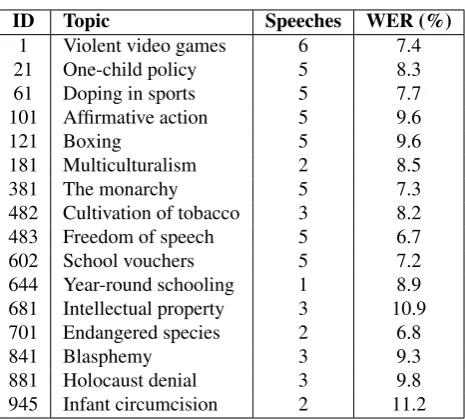
The dataset we created was generated through the process described in the previous sections. We release all file ty-pes, including raw and clean versions, to enable research based on various signals, including audio-based ones, such as prosody or speech rate, and to allow performing diffe-rent post-processing. Table 1 summarizes the files that are obtained and released for each debatable topic.
Extension Description wav Recorded speeches asr Raw automatic transcripts asr.txt Clean automatic transcripts trs Manual transcripts
trs.txt Clean manual transcripts (references)
Table 1: Summary of the dataset file types.
ID Topic Speeches WER (%)
1 Violent video games 6 7.4 21 One-child policy 5 8.3 61 Doping in sports 5 7.7 101 Affirmative action 5 9.6
121 Boxing 5 9.6
181 Multiculturalism 2 8.5
381 The monarchy 5 7.3
482 Cultivation of tobacco 3 8.2 483 Freedom of speech 5 6.7 602 School vouchers 5 7.2 644 Year-round schooling 1 8.9 681 Intellectual property 3 10.9 701 Endangered species 2 6.8
841 Blasphemy 3 9.3
881 Holocaust denial 3 9.8 945 Infant circumcision 2 11.2
Table 2: List of motion topics in our dataset, and the num-ber of speeches per topic. The right column shows the average WER across speeches of the topic, when using the speaker-independent ASR model.
The dataset we release includes 60 speeches for 16 motions from (Rinott et al., 2015), recorded by 10 different spea-kers.10 Table 2 provides details about the recordings
inclu-ded in the dataset.
There is a large variance in WER across different debate re-cordings, and between different speakers. The WER of any specific debate can vary depending on the degree of misma-tch with the ASR acoustic and language models. Examples of mismatch include differences in speaker voice, speaking style and rate, audio capture (microphone type and place-ment), ambient noise, word choice and phrasing, etc. By reducing mismatch through model adaptation of speaker-dependent acoustic models, the WER can be significantly reduced. For instance, with adaptation using about 15 mi-nutes of a speaker’s data, WER of a speech from topic 61 was reduced from 12.9% to 8.6%, and of a speech from topic 483, from 12.2% to 9.7%.
The dataset is freely available for research at
https://www.research.ibm.com/haifa/ dept/vst/mlta_data.shtml.
6.
Acknowledgements
We wish to thank the many speakers and transcribers that took part in the effort of creating this dataset.
10Currently, the list contains only a single female speaker; we
7.
Bibliographical References
Aker, A. and Zhang, H. (2017). Projection of argumenta-tive corpora from source to target languages. In
Procee-dings of the 4th Workshop on Argument Mining, pages
67–72.
Bar-Haim, R., Edelstein, L., Jochim, C., and Slonim, N. (2017). Improving claim stance classification with lexi-cal knowledge expansion and context utilization. In
Pro-ceedings of the 4th Workshop on Argument Mining,
pa-ges 32–38.
Bilu, Y. and Slonim, N. (2016). Claim synthesis via predi-cate recycling. InProceedings of the 54th Annual
Meet-ing of the Association for Computational LMeet-inguistics,
page 525.
Hochreiter, S. and Schmidhuber, J. (1997). Long short-term memory.Neural Comput., 9(8):1735–1780. Lippi, M. and Torroni, P. (2016). Argumentation mining:
State of the art and emerging trends. ACM Trans. Inter-net Technology, 16:10:1–10:25.
Matheson, J. L. (2007). The voice transcription technique: Use of voice recognition software to transcribe digital in-terview data in qualitative research. Qualitative Report, 12(4):547–560.
Pahuja, V., Laha, A., Mirkin, S., Raykar, V., Kotlerman, L., and Lev, G. (2017). Joint learning of correlated se-quence labelling tasks using bidirectional recurrent neu-ral networks. InProceedings of INTERSPEECH, Stock-hold, Sweden.
Palau, R. M. and Moens, M.-F. (2009). Argumentation mi-ning: the detection, classification and structure of argu-ments in text. InProceedings of the 12th international conference on artificial intelligence and law, pages 98– 107. ACM.
Park, J. and Zeanah, A. E. (2005). An evaluation of voice recognition software for use in interview-based research: a research note. Qualitative Research, 5(2):245–251. Rinott, Ruty and Dankin, Lena and Perez, Carlos Alzate
and Khapra, Mitesh M and Aharoni, Ehud and Slonim, Noam. (2015). Show Me Your Evidence-an Automatic
Method for Context Dependent Evidence Detection.
As-sociation for Computational Linguistics (ACL).
Sobhani, P., Inkpen, D., and Matwin, S. (2015). From ar-gumentation mining to stance classification. In Procee-dings of the 2nd Workshop on Argumentation Mining,
ArgMining@HLT-NAACL, pages 67–77.
Soltau, H., Kuo, H., Mangu, L., Saon, G., and Beran, T. (2013). Neural network acoustic models for the DARPA RATS program. InProceedings of Interspeech. ISCA. Soltau, H., Saon, G., and Sainath, T. (2014). Joint training
of convolutional and non-convolutional neural networks.
InProceedings of ICASSP. IEEE.
Wachsmuth, H., Naderi, N., Habernal, I., Hou, Y., Hirst, G., Gurevych, I., and Stein, B. (2017a). Argumentation qua-lity assessment: Theory vs. practice. InProceedings of the 55th Annual Meeting of the Association for Compu-tational Linguistics (Volume 2: Short Papers), volume 2, pages 250–255.
Wachsmuth, H., Potthast, M., Al Khatib, K., Ajjour, Y., Puschmann, J., Qu, J., Dorsch, J., Morari, V.,
Beven-dorff, J., and Stein, B. (2017b). Building an argument search engine for the web. In Proceedings of the 4th
Workshop on Argument Mining, pages 49–59.
Wei, Z., Liu, Y., and Li, Y. (2016). Is this post persuasive? ranking argumentative comments in the online forum. In
The 54th Annual Meeting of the Association for Compu-tational Linguistics, page 195.
Zhang, J., Kumar, R., Ravi, S., and Danescu-Niculescu-Mizil, C. (2016). Conversational flow in Oxford-style debates. InProceedings of HLT-NAACL.
Zhang, F., B. Hashemi, H., Hwa, R., and Litman, D. (2017). A corpus of annotated revisions for studying argumentative writing. In Proceedings of the 55th An-nual Meeting of the Association for Computational
Lin-guistics (Volume 1: Long Papers), pages 1568–1578,
Vancouver, Canada, July. Association for Computational Linguistics.
8.
Language Resource References
Aharoni, Ehud and Polnarov, Anatoly and Lavee, Tamar and Hershcovich, Daniel and Levy, Ran and Rinott, Ruty and Gutfreund, Dan and Slonim, Noam. (2014). A ben-chmark dataset for automatic detection of claims and evidence in the context of controversial topics. Associ-ation for ComputAssoci-ational Linguistics (ACL).
Mauro Cettolo and Christian Girardi and Marcello Fede-rico. (2012). WIT3: Web Inventory of Transcribed and
Translated Talks. The European Association for
Ma-chine Translation (EAMT).
Rinott, Ruty and Dankin, Lena and Perez, Carlos Alzate and Khapra, Mitesh M and Aharoni, Ehud and Slonim, Noam. (2015). Show Me Your Evidence-an Automatic
Method for Context Dependent Evidence Detection.
As-sociation for Computational Linguistics (ACL).
Marilyn Walker and Jean Fox Tree and Pranav Anand and Rob Abbott and Joseph King. (2012). A Corpus for
Re-search on Deliberation and Debate. European Language