Competence and Performance Grammar
in Incremental Processing
Vincenzo Lombardo
Dipartimento di Informatica Universit`a di Torino
c.so Svizzera, 185 10149, Torino, Italy [email protected]
Alessandro Mazzei
Dipartimento di Informatica Universit`a di Torino
c.so Svizzera, 185 10149, Torino, Italy
Patrick Sturt
Department of Psychology University of Glasgow
58 Hillhead Street Glasgow, G12 8QB, UK
Abstract
The goal of this paper is to explore some conse-quences of the dichotomy between competence and performance from the point of view of in-crementality. We introduce a TAG–based for-malism that encodes a strong notion of incre-mentality directly into the operations of the formal system. A left-associative operation is used to build a lexicon of extended elementary trees. Extended elementary trees allow deriva-tions in which a single fully connected struc-ture is mantained through the course of a left-to-right word-by-word derivation. In the paper, we describe the consequences of this view for semantic interpretation, and we also evaluate some of the computational consequences of en-larging the lexicon in this way.
1 Introduction
Incremental processing can be achieved with a combination of grammar formalism and deriva-tion/parsing strategy. In this paper we explore some of the computational consequences of de-riving the incremental character of the human language processor from the competence gram-mar. In the following paragraphs, we assume that incremental processing proceeds through a sequence of processing steps. Each step consists of a configuration of partial syntactic structures (possibly connected into only one structure) and a configuration of semantic structures (again, possibly connected into one single expression). These semantic structures result from the ap-plication of the semantic interpreter to the syn-tactic structures in the same processing step. Depending on the semantic rules, some syntac-tic structures may not be interpretable—that is, some processing steps do not involve an up-dating of the semantic representation. In the view we present here, competence grammar is responsible for the definition of both the set of well-formed sentences of the language and the set of possible partial structures that are yielded
by the derivation process. According to this view, the performance component is responsible for other aspects of language processing, includ-ing ambiguity handlinclud-ing and error handlinclud-ing. The latter issues are not addressed in this paper.
In the psycholinguistic and computational lit-erature, many models for incremental process-ing have been discussed. These models can be characterized in terms of the location of the bor-der between competence and performance. In particular, we discuss the relative responsibility of the competence and performance components on three key areas of syntactic processing: a) the space of well-formed partial syntactic struc-tures; b) the space of the possible configurations of partial syntactic structures at each process-ing step; c) the sub-space of partial structures that can actually be interpreted.
The definition of well-formedness is almost universally assigned to the competence compo-nent, whether in a direct implementation of the grammar formalism (cf. the Type Transparency hypothesis (Berwick and Weinberg, 1984)) or a compiled version of the competence grammar (e.g. LR parsing (Shieber and Johnson, 1993)). The space of the possible configurations of partial structures refers to those partial syntac-tic structures that are built and stored during parsing or derivation. Different algorithms re-sult in different possibilities for the configura-tions of partial structures that the parser builds. For example, a bottom–up algorithm will never build a partial structure with non–terminal leaf nodes. The standard approach is to assign this responsibility to the parsing algorithm, whether the grammar is based on standard context-free formalisms (Roark, 2001), on generative syntac-tic theories based on a context-free backbone (Crocker, 1992), or on categorial approaches,
like e.g. Combinatory Categorial Grammar
(CCG – (Steedman, 2000)). A different method is to assign this responsibility to the
possible configurations of partial structures is constrained by the grammatical derivation pro-cess itself, and the parsing algorithm needs to be aligned with these requirements. This ap-proach is exemplified by the works of Kempson et al. (2000) and Phillips (2003), who argue that many problems in theoretical syntax, like the definition of constituency, can be solved by extending this responsability to the competence grammar.
This issue of constituency is also relevant in the third key area, which is the definition of the space of interpretable structures. The assign-ment of responsibility with respect to current approaches usually depends on the implementa-tion of the incremental technique. Approaches based on a coupling of syntactic and seman-tic rules in the competence grammar (Steed-man, 2000; Kempson et al., 2000) adhere to the
so-called Strict Competence Hypothesis
(Steed-man, 2000), which constrains the interpreter to deal only with grammatical constituents, so the responsibility for deciding the interpretable
par-tial structures is assigned to competence1
. In contrast, approaches that are based on com-petence grammars that do not include seman-tic rules, like CFG, implement semanseman-tic inter-preters that mimic such semantic rules (Stabler, 1991), and so they assign the responsibility for deciding the interpretable partial structures to performance.
In this paper we explore the empirical con-sequences of building a realistic grammar when the formalism constrains all these three areas,
as is the case with Kempson et al. (2000)
and Phillips (2003). The work relies upon the Dynamic Version of Lexicalized Tree Adjoin-ing Grammar (DV–TAG), introduced in (Lom-bardo and Sturt, 2002b), a formalism that
en-codes adynamic grammar(cf. (Milward, 1994))
in LTAG terms (Joshi and Schabes, 1997). The consequence of encoding a dynamic grammar is that the configurations of partial structures discussed above are limited to fully connected structures, that is no disconnected structures are allowed in a configuration. In particular, the paper focuses on the problem of building a realistic DV–TAG grammar through a conver-sion from an LTAG, in order to maintain the
1
Notice that these approaches may, however, differ in the time-course with which semantic rules are applied in the interpreter, and this issue depends directly on the space of configurations of partial structures discussed above
linguistic significance of elementary trees while extending them to allow the full connectivity.
2 Dynamic Version of Tree Adjoining Grammar
This section reviews the major aspects of the Dynamic Version of Tree Adjoining Grammar (DV–TAG), with special reference to similari-ties and differences with respect to LTAG.
Dynamic grammars define well-formedness in terms of states and transitions between states. They allow a natural formulation of incremental
processing, where each word wi defines a
tran-sition from Statei−1, also called theleft context,
to Statei (Milward, 1994). The states can be
defined as partial syntactic or semantic struc-tures that are “updated” as each word is recog-nized; roughly speaking, two adjacent states can be thought of as two parse trees before and af-ter the attachment of a word, respectively. The derivation process proceeds from left to right by extending a fully connected left context to include the next input word.
Like an LTAG (Joshi and Schabes, 1997), a Dynamic Version of Tree Adjoining Grammar (DV–TAG) consists of a set of elementary trees, divided into initial trees and auxiliary trees, and attachment operations for combining them. Lexicalization is expressed through the
associ-ation of a lexical anchor with each elementary
tree. The anchor defines the semantic content of the elementary tree: the whole elementary tree
can be seen as an extended projection of the
an-chor (Frank, 2000). LTAG is said to define an
extended domain of locality –unlike context-free grammars, which use rules that describe one– branch deep fragments of trees, TAG elemen-tary trees can describe larger structures (e.g. a verb, its maximal S node and subject NP node). In figures 1(a) and 2(a) we can see the ele-mentary trees for a derivation of the sentence
Bill often pleases Sue for LTAG and DV–TAG respectively. Auxiliary trees in DV–TAG are
split into left auxiliary trees, where the lexical
anchor is on the left of the foot node, andright
auxiliary trees, where the lexical anchor is on the right of the foot node. The tree anchored by often in fig. 2(a) is a left auxiliary tree.
no-Bill often pleases Sue.
NNP Sue
NP ADV often ADVP
VP
VP*
NP
NNP Sue S
V pleases NP
VP NNP
Bill ADV often ADVP
VP V
pleases NP$ NP$
S
VP
adjunction
Bill pleases
Sue often
(a)
(b)
(c)
substitution
NNP Bill
NP
substitution
Bill
pleases
often
Sue
Figure 1: The LTAG derivation of the sentence
Bill often pleases Sue.
NNP Sue
NP(Sue)
ADV often ADVP(often)
VP(_j)
VP*(_j)
NP(Sue)
NNP Sue S(pleases)
V pleases NP(Bill)
VP(pleases) NNP
Bill ADV often ADVP(often)
VP(pleases) V(_i) NP$(_k) NNP
Bill NP(Bill)
S(_i)
VP(i)
pleases likes eats plays …
1. adjunction from the left
2. shift
Bill pleases
Sue often
(a)
(b)
(c)
3. substitution
Figure 2: The DVTAG derivation of the
sen-tence Bill often pleases Sue.
tion of derivation–dependency tree (see below).
If several unheaded nodes share the same lexical head, they are all co-indexed with a head
vari-able (e.g. iin the elementary tree anchored by
Bill in figure 2(a)); the head variable is a
vari-able in logic terms: i will be unified with the
constant (“lexical head”) pleases.
In both LTAG and DV–TAG the lexical an-chor does not necessarily provide the head fea-ture of the root of the elementary tree. This is trivially true for auxiliary trees (e.g. the tree
anchored often in figure 1(a) and figure 2(a)).
However, in DV–TAG this can also occur with
initial trees (e.g. the tree anchored by Bill in
figure 2(a)), because initial trees can include not only the head projection of the anchor, but also other higher projections that are required to account for the full connectedness of the par-tial parse tree. The elementary tree anchored
byBill is linguistically motivated up to the NP
projection; the rest of the structure depends on
connectivity. These extra nodes are called
pre-dicted nodes. A predicted preterminal node is referred by a set of lexical items. In the sec-tion 3 we illustrate a method for building such extended elementary trees.
The derivation process in LTAG and DV–
TAG builds aderived tree by combining the
ele-mentary trees via some operations that are illus-trated below. DV–TAG implements the
incre-mental process by constraining the derivation
processto be a series of steps in which an ele-mentary tree is combined with the partial tree spanning the left fragment of the sentence. The result of a step is an updated partial structure.
Specifically, at the processing step i, the
ele-mentary tree anchored by the i-th word in the
sentence is combined with the partial structure
spanning the words from 1 to i−1 positions;
the result is a partial structure spanning the
words from 1 to i. In contrast, LTAG does
not pose any order constraint on the deriva-tion process, and the combinatorial operaderiva-tions are defined over pairs of elementary trees. In DV–TAG the derivation process starts from an elementary tree anchored by the first word in the sentence and that does not require any at-tachment that would introduce lexical material on the left of the anchor (such as in the case that a Substitution node is on the left of the anchor). This elementary tree becomes the first left context that has to be combined with some elementary tree on the right.
Since in DV–TAG we always combine a left context with an elementary tree, the number of attachment operations increases from two in LTAG to six in DV–TAG. Three operations (substitution, adjunction from the left and
ad-junction from the right) are called forward
elemen-tary tree into the left context; two other oper-ations (inverse substitution and inverse
adjunc-tion) are calledinverse operations because they
insert the left context into the current elemen-tary tree; the sixth operation (shift) does not involve any insertion of new structural material. The first operation in DV–TAG is the
stan-dard LTAG substitution, where some
elemen-tary tree replaces a substitution node in another tree structure (see fig. 2(a)).
Standard LTAG adjunction is split into two
operations: adjunction from the left and
ad-junction from the right. The type of adjunction depends on the position of the lexical material introduced by the auxiliary tree with respect to the material currently dominated by the ad-joined node (which is in the left context). In figure 2(a) we have an adjunction from the left in the case of the left auxiliary tree anchored by
often.
Inverse operations account for the insertion of the left context into the elementary tree. In
the case of inverse substitution the left context
replaces a substitution node in the elementary
tree; in the case of inverse adjunction, the left
context acts like an auxiliary tree, and the el-ementary tree is split because of the adjoining of the left context at some node. In (Lombardo and Sturt, 2002b) there is shown the importance of the latter operation to obtain the correct de-pendencies for cross-serial Dutch dede-pendencies in DV–TAG.
Finally, theshift operation either scans a
lex-ical item which has been already introduced in the structure or derives a lexical item from some predicted preterminal node.
It is important to notice that, during the derivation process, not all the nodes in the left context and the elementary tree are accessible
for performing some operation: given thei−
1-th word in 1-the sentence we can compute a set
of accessible nodes in the left context (theright
fringe); also, given the lexical anchor of the el-ementary tree, that in the derivation process
matches the i-th word in the sentence, we can
compute a set of accessible nodes in the
elemen-tary tree (theleft fringe).
At the end of the derivation process the left context structure spans the whole sentence, and
is called thederived tree: in the figures 1(c) and
2(c) there are the derived trees for Bill often
pleases Suein LTAG and DV–TAG respectively.
A key device in LTAG is the derivation tree
(fig. 1(b)). The derivation tree represents the
history of the derivation of the sentence: it de-scribes the substitutions and the adjoinings that occur in a sentence derivation through a tree structure. The nodes of the derivation tree are identifiers of the elementary trees, and one edge represents the operation that combines two ele-mentary trees. Given an edge, the mother node identifies the elementary tree where the elemen-tary tree identified by the daughter node is sub-stituted in or adjoined to, respectively. The derivation tree provides a factorized representa-tion of the derived tree. Since each elementary is anchored by a lexical item, the derivation tree also describes the syntactic dependencies in the
sentence in the terms of adependency–style
rep-resentation (Rambow and Joshi, 1999) (Dras et al., 2003).
The notion of derivation tree is not ade-quate for DV–TAG, since the elementary trees contain unheaded predicted nodes. For
exam-ple, the elementary tree anchored by Bill
ac-tually involves two anchors, Bill and pleases,
even if the latter anchor remains unspecified until it is scanned/derived in the linear or-der. We introduce a new word–based structure that represents syntactic dependencies, namely aderivation-dependency tree.
A derivation-dependency tree is ahead-based
version of the derivation tree. Each node in an elementary tree is augmented with the lexical head that projects that node. The derivation-dependency tree contains one node per lexi-cal head, and a lexilexi-cal head dominates another when the corresponding projections in the de-rived tree stand in a dominance relation. Each elementary tree can contain only one overtly marked lexical head, that represents the seman-tic unit, but the presence of predicted nodes
in the partial derived tree corresponds to
pre-dicted heads in the derivation-dependency tree. In figure 3 is depicted the evolution of the
derivation–dependency tree for the sentenceBill
often pleases Sue.
The DV–TAG derivation process requires the full connectivity of the left context at all times. The extended domain of locality provided by LTAG elementary trees appears to be a desir-able feature for implementing full connectivity. However, each new word in a string has to be connected with the preceding left context, and
there is noa priorilimit on the amount of
struc-ture that may intervene between that word and the preceding context. For example, in a DV–
!! "#$&%(' )+*,-. ,(.
/102 3546789: ;< =
>5?A@CBDEFDF GH<JICKLMCNLN
O5P(Q5RCSTA<U VXW YZ[[
\](^A_``
Figure 3: The DVTAG derivation of the
sen-tence Bill often pleases Sue.
were on sale, the adjective tasty cannot be di-rectly connected with the S node introduced by
that; there is an intervening NP symbol that
has not yet been predited in the structure. An-other example is the case of an intervening mod-ifier between an argument and its predicative
head, like in the example Bill often pleases Sue
(see figure 2), where in order to scan often we
need a VP adjunction node that the NP pro-jection cannot introduce. So, the extended do-main of locality available in LTAG has to be
further extended. In particular, some
struc-tures have to be predicted as soon as there is some evidence from arguments or modifiers on
the left. In other approaches this extension
is implemented via top-down predictions (see e.g. Roark (2001)) during the parsing process. This can lead to a high number of combinations that raise the degree of local ambiguity in the derivation process. In fact, in the case of Roark (2001), the method to reduce this problem has been to use underspecification in the right part of the cf rules.
In the remainder of this paper we address the issue of building a wide coverage DV–TAG grammar where elementary trees extend the do-main of locality given by the argumental struc-ture, and we provide an empirical evaluation of the possible combinatorial problems that can raise with such extended structures.
3 Building a DV-TAG lexicon
The method used to build a wide coverage DV– TAG grammar is to start with an existing LTAG grammar, and to extend the elementary trees through a closure of a left–associative operation. First, the LTAG elementary tree nodes have to be augmented with the lexical head informa-tion through a percolainforma-tion procedure that takes into account the syntactic projections.
Then, the elementary trees must be extended
to account for the full connectivity. Given that one step of the derivation process is a combi-nation of a left context and an elementary tree, we have that the rightmost symbol of the left context and the leftmost anchor of the elemen-tary tree (the current input word) must be ad-jacent in the sentence. However, it is possible (as we have illustrated above) that the left con-text and the elementary tree cannot be com-bined through none of the five DV–TAG oper-ations. But if the combination between the left context and the elementary tree can occur once we assume some intervening structure, we can
build asuperstructurethat includes the
elemen-tary tree and extends it until either the left con-text can be inserted in the left fringe of the new superstructure or the new superstructure can be inserted in the right fringe of the left context. In building the superstructures, we require that the linguistic dependencies posed by the LTAG elementary trees over the lexical heads in the derivation/dependency tree are maintained, in order not to disrupt the semantic interpretation process.
Since no new symbol can intervene between the rightmost symbol of the left context and the leftmost anchor of the elementary tree (the current input word), the elementary tree must be extended in ways that do not alter such lin-ear order of the terminal symbols. This means that the elementary tree must be extended with-out introducing any further structure that can in turn derive terminal symbols on the left of the leftmost anchor. In order to satisfy such a
constraint, the elementary tree has to be left–
anchored, i.e. the leftmost symbol of the ele-mentary tree, but possibly the foot node in case of a right auxiliary tree, is an anchor. Then, the operation that extends the left–anchored
el-ementary trees is the left association. The left
association starts from the root of the tary tree and combines it with another elemen-tary tree on the right through through either
in-verse operation (see above)2
; this combination
is iterated as far as possible through atransitive
closure of left association (see below). All the combinations are stored in the extended lexicon. Since the individual elementary trees that form a superstructure through left association are not altered in this process, linguistic
depen-2
! #" $!%#&
'!(
)!)!*
+-,/.10
2
34
5
6789:
;!<#= >!?
@!@!A
[image:6.595.324.533.75.359.2]B-C/D1E
Figure 4: Example of the left association oper-ation: the trees on the top are, respectively, the
Base tree and the Raising tree; the tree on the
bottom is theRaised tree
dencies are kept unchanged. Left association can be performed during the parsing/derivation process (i.e. on–line) or with the goal to extend the lexicon (i.e. off–line). Since we are explor-ing the consequences of increasexplor-ing the role of the competence grammar, we perform this op-eration off–line (see the next section).
Each left association operation takes in
in-put two trees: a left–anchored Base tree and a
Raising tree, and produces in output a new left–
anchoredRaised tree. A Base treeα can be any
left–anchored elementary tree or a Raised tree.
A Raising tree is any elementary treeβ that
al-lows α to combine on its left via either inverse
substitution or adjunction. A Raised tree is a
tree such thatαhas been attached toβ
accord-ing to inverse substitution or inverse adjunction. The application of the transitive closure of left association occurs with the termination con-dition of minimal recursive structure, that is the non repetition of the root category in the
sequence of Raising trees (henceforth root
se-quence). So, if the original Base tree or some Raising tree already employed have a root X, we cannot use a Raising tree rooted X anymore for the same superstructure.
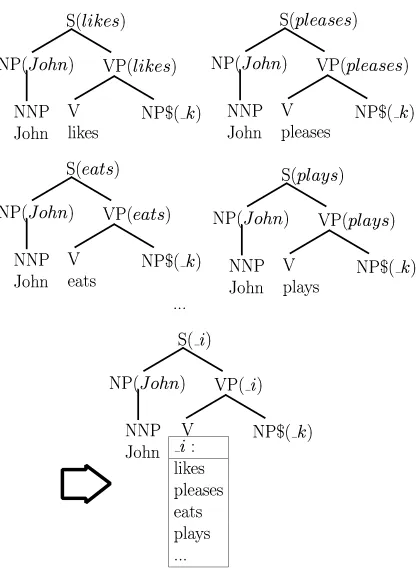
Considering that LTAG is a lexicalized for-malism, we immediately realize that a super-structure is multiply anchored. As an example, consider the left association illustrated in
fig-ure 4: we substitute the tree anchored by John
into the tree anchored bylikes, yielding a larger
elementary structure multiply anchored byJohn
and likes at the same time (the lexical head in-formation for each node has been omitted).
Q!RTSUKVWPXZYPWPY[
\
]Z^_`Pa_a
bcedgf hHi jkTlmon-p1qr
sst
uPv-w/x
yHz{P|/}~P
!T P
eg H To-1
P¡-¢/£
¤H¥¦K§¨/©1ªP«
¬!T®¯K°±²1³P´
µ
¶Z·¸¹gº
»¼e½g¾ ¿HÀ ÁÂTÃÄoÅ-Æ1ÇÈ
ÉÉÊ
ËPÌ-Í/Î ÏHÐÑÓÒÔ1ÕPÖ×
Ø!ÙTÚÛÓÜÝ1ÞßPà
áâãä
åæ
çèeégê ëHì íîTïðoñ-ò1óô
õõö
÷Pø-ù/ú
ûûû
üHý þÿ
!#" $%&')(+*-,/.
001
[image:6.595.116.241.78.224.2]243+576
Figure 5: Schema of the left association oper-ation, followed by the factorization in template trees.
Multiple anchoring, when not linguistically motivated like in the case of idioms or specific subcategorization constraints, leads to some po-tential problems. The first is the theoretical is-sue of semantic compositionality, because the superstructures do not reflect the incremental process in the semantic composition once words are not the minimal semantic units anymore (as assumed in LTAG). The second is a practical is-sue of duplicating the stored information for all the verbs sharing the predicate–argument struc-ture. For example, in the previous example, all the transitive verbs have a tree structure
iden-tical to the elementary tree of likes (see fig. 5).
These two problems can be solved by intro-ducing the notion of template, already present in the practical implementations of wide cov-erage LTAG systems (Doran et al., 2000). A
the leftmost anchor is lexically realized; all the
other anchors are replaced by variables with
re-ferring word lists that explicitly state the range of variation of the variables themselves. A vari-able replaces each occurrence of the lexical item in the original elementary structure: once a shift operation matches the current input word with one of the words in the associated list, we also have to unify the lexical head variables that aug-ment non terminal symbols with the current in-put word. For instance, on the bottom of fig-ure 5, there is the template obtained by the left association of the elementary tree anchored by
John with all the equal elementary trees of
tran-sitive verbs.
A further problem is a possible combinatorial explosion of the size of the lexicon: this prob-lem has to be tackled in an empirical way on a wide coverage grammar (it could be that a large number of the theoretically possible combina-tions do not occur in practice; in fact, empirical work by (Lombardo and Sturt, 2002a) indicates that there is an empirical bound on the size of expanded elementary trees necessary to main-tain connectedness).
4 Empirical tests
In order to estimate whether the combinato-rial explosion has a dramatic effect on the lex-icon we have run two tests, implementing the transitive closure of the left association. The first test was performed on a realistic grammar from the XTAG system (Doran et al., 2000), and the second test was performed on an au-tomatically extracted grammar from an Italian treebank (Mazzei and Lombardo, 2004).
In the implementation of the recursive pro-cedure, the left-association operation takes as input two templates: a left-anchored template,
that we call base template, and another
tem-plate, that cannot be a left–anchored temtem-plate,
that we call raising template. In every step
of the algorithm, the base template is taken from the subset of left-anchored templates and the raising template is picked from the whole lexicon. Since the algorithm builds only left– anchored templates, the output template is in-serted in the left-anchored subset.
The grammar used in the first test has 628 tree templates representing one half of the hand-written XTAG grammar, with the same distri-bution of template families as the overall XTAG grammar. This size is a realistic grammar size (consider that the XTAG lexicon, the widest
LTAG grammar existing for English, 1227 plates). 140 out of 628 were left–anchored tem-plates, and the transitive closure from these
base templates produces 176,190 raised
tem-plates, with a maximum of 7 left associations, and a distribution of trees that reaches its max-imum at 4 left associations (140 base
tem-plates, 3,033 twice raised templates, 24,855
three-times raised, 62,970 four times raised,
59,908 five times, 22,454 six times, 2,970 seven
times). Similar distributional results have been produced for subsets of the grammar and with restrictions on root categories. The number of raised templates drastically reduces when we forbid raising to verbal projections (S, VP and V), thus cutting one of major sources of the ex-plosion. In this case we go from 717 non ver-bal base templates in the XTAG grammar to
only 24,468 raised templates, again with a
max-imum of 7 raisings (notice that the base lexicon is larger than the test above).
In the second test we used a LTAG grammr
extracted from the 45,000 word TUT (Turin
University Treebank). The number of extracted tree templates was 1283. In this case, as the grammar was relatively large, we decided to im-pose an extra condition on the closure for left association procedure. We estimated the maxi-mum number of trees that need to be composed
to create any one left associated tree. This
was done by inspecting the derivation trees for each sentence of the treebank, and looking at the leftmost child of each level of the deriva-tion tree. It was found that no left-associated tree needed to be composed of more than three elementary trees, in order to create a covering DV–TAG for the treebank. This replicates a previous result of Lombardo and Sturt (2002a). Moreover, of the 800 mathematically possible
root sequences3
only 67 were present in the tree-bank. We decided to allow left association only for root sequences that actually appeared in the treebank. This resulted in a total of 706,866 left associated trees. Of these, 988 were base tem-plates, 87,245 were raised twice, and 618,654 were raised three times.
The combinatorial explosion seen in the two experiments suggests the use of underspecifi-cation techniques before applying DV–TAG in a realistic setting (see Roark (2001) for one method applied to Context Free Grammar). However, in order to estimate the amount of
3
ambiguity that can arise in a parsing process we need to refer to some specific parsing model. Also selective strategies on categories and re-striction to empirically observed root sequences can be effective. However, in order to make a full evaluation of these strategies, it is desirable to perform further coverage tests.
5 Conclusion
This paper has explored some consequences of building an incremental grammar that con-strains the possible configurations of partial structures and the possible interpretable partial structures.
We have introduced a TAG–based formalism that encodes a strong notion of incrementality directly into the operations of the formal sys-tem.
A left-associative type-raising operation has been used to build a DV–TAG realistic lexi-con from a LTAG lexilexi-con. The left–association operation can be viewed as a sort of chunking of linguistic knowledge: this chunking could be useful in the definition of a language model in which specific combinations of elementary trees that have been successful in the past experience become part of the lexicon.
As shown in the empirical tests ofn English and Italian, the left–association closure can lead to severe computational problems that suggest the adoption of some form of underspecification.
References
R. Berwick and A. Weinberg. 1984. The
gram-matical basis of linguistic performance: lan-guage use and acquisition. MIT Press.
M. W. Crocker. 1992. A Logical Model of
Com-petence and Performance in the Human Sen-tence Processor. Ph.D. thesis, Dept. of Ar-tificial Intelligence, University of Edinburgh, UK.
C. Doran, B. Hockey, A. Sarkar, B. Srinivas, and F. Xia. 2000. Evolution of the xtag sys-tem. In A. Abeill´e and O. Rambow,
edi-tors, Tree Adjoining Grammars, pages 371–
405. Chicago Press.
M. Dras, D. Chiang, and W. Schuler. 2003. On relations of constituency and dependency
grammars. Language and Computation, in
press.
R. Frank. 2000. Phrase structure
composi-tion and syntactic dependencies.
Unpub-lished Manuscript.
A. Joshi and Y. Schabes. 1997. Tree-adjoining grammars. In G. Rozenberg and A.
Salo-maa, editors,Handbook of Formal Languages,
pages 69–123. Springer.
R. Kempson, W. Meyer-Viol, and D. Gabbay.
2000. Dynamic Syntax: the Flow of Language
Understanding. Blackwell, Oxford, UK. V. Lombardo and P. Sturt. 2002a.
Incremen-tality and lexicalism: A treebank study. In
S. Stevenson and P. Merlo, editors, Lexical
Representations in Sentence Processing. John Benjamins.
V. Lombardo and P. Sturt. 2002b. Towards a
dynamic version of tag. InTAG+6, pages 30–
39.
A. Mazzei and V. Lombardo. 2004. Building
a large grammar for italian. In LREC04. in
press.
David Milward. 1994. Dynamic
depen-dency grammar. Linguistics and Philosophy,
17:561–604.
C. Phillips. 2003. Linear order and
con-stituency. Linguistic Inquiry, 34:37–90.
O. Rambow and A. Joshi. 1999. A formal look at dependency grammars and phrase struc-ture grammars, with special consideration of
word-order phenomena. In Recent Trends in
Meaning-Text Theory, pages 167–190. John Benjamins, Amsterdam and Philadelphia. B. Roark. 2001. Probabilistic top-down parsing
and language modeling. Computational
Lin-guistics, 27(2):249–276.
S. M. Shieber and M. Johnson. 1993.
Varia-tions on incremental interpretation. Journal
of Psycholinguistic Research, 22(2):287–318.
E. P. Stabler. 1991. Avoid the
pedestri-ans’ paradox. In R. C. Berwick, S. P.
Ab-ney, and C. Tenny, editors, Principle-based
parsing: computation and psycholinguistics, pages 199–237. Kluwer, Dordrecht: Holland.
M. J. Steedman. 2000. The syntactic process.