Lexical and Structural Biases for Function Parsing
Gabriele Musillo
Depts of Linguistics and Computer Science University of Geneva
2 Rue de Candolle 1211 Geneva 4 2 Rue de Candolle
1211 Geneva 4 Switzerland
Abstract
In this paper, we explore two extensions to an existing statistical parsing model to produce richer parse trees, annotated with function labels. We achieve significant improvements in parsing by modelling di-rectly the specific nature of function la-bels, as both expressions of the lexical se-mantics properties of a constituent and as syntactic elements whose distribution is subject to structural locality constraints. We also reach state-of-the-art accuracy on function labelling. Our results sug-gest that current statistical parsing meth-ods are sufficiently robust to produce ac-curate shallow functional or semantic an-notation, if appropriately biased.
1 Introduction
Natural language processing methods producing shallow semantic output are starting to emerge as the next step towards successful developments in natural language understanding. Incremental, robust pars-ing systems will be the core enablpars-ing technology for interactive, speech-based question answering and di-alogue systems. In recent years, corpora annotated with semantic and function labels have seen the light (Palmer et al., 2005; Baker et al., 1998) and semantic role labelling has taken centre-stage as a challenging new task. State-of-the-art statistical parsers have not yet responded to this challenge.
State-of-the-art statistical parsers trained on the Penn Treebank (PTB) (Marcus et al., 1993)
pro-S
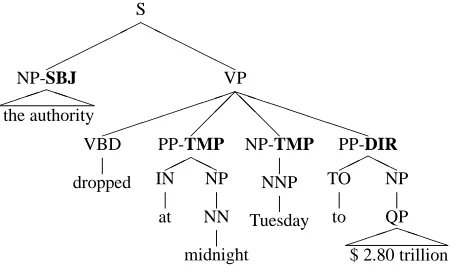
Figure 1: A sample syntactic structure with function labels.
duce trees annotated with bare phrase structure la-bels (Collins, 1999; Charniak, 2000). The trees of the Penn Treebank, however, are also decorated with function labels, labels that indicate the grammatical and semantic relationship of phrases to each other in the sentence. Figure 1 shows the simplified tree representation with function labels for a sample sen-tence from the PTB corpus (section 00) The
Gov-ernment’s borrowing authority dropped at midnight Tuesday to 2.80 trillion from 2.87 trillion. Unlike
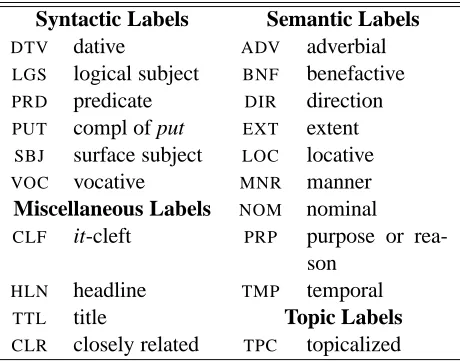
phrase structure labels, function labels are context-dependent and encode a shallow level of phrasal and lexical semantics, as observed first in (Blaheta and Charniak, 2000). For example, while the authority in Figure 1 will always be a Noun Phrase, it could be a subject, as in the example, or an object, as in the sentence They questioned his authority, depend-ing on its position in the sentence. To some extent, function labels overlap with semantic role labels as defined in PropBank (Palmer et al., 2005). Table 1
Syntactic Labels Semantic Labels
DTV dative ADV adverbial
LGS logical subject BNF benefactive PRD predicate DIR direction
PUT compl of put EXT extent
SBJ surface subject LOC locative
VOC vocative MNR manner
Miscellaneous Labels NOM nominal
CLF it-cleft PRP purpose or
rea-son
HLN headline TMP temporal
TTL title Topic Labels
CLR closely related TPC topicalized
Table 1: Complete set of function labels in the Penn Treebank.
illustrates the complete list of function labels in the Penn Treebank, partitioned into four classes. 1
Current statistical parsers do not use or output this richer information because performance of the parser usually decreases considerably, since a more complex task is being solved. (Klein and Manning, 2003), for instance report a reduction in parsing ac-curacy of an unlexicalised PCFG from 77.8% to 72.9% if using function labels in training. (Blaheta, 2004) also reports a decrease in performance when attempting to integrate his function labelling system with a full parser. Conversely, researchers interested in producing richer semantic outputs have concen-trated on two-stage systems, where the semantic la-belling task is performed on the output of a parser, in a pipeline architecture divided in several stages (Gildea and Jurafsky, 2002; Nielsen and Pradhan, 2004; Xue and Palmer, 2004). See also the com-mon task of (CoNLL, 2004; CoNLL, 2005; Sense-val, 2004), where parsing has sometimes not been used and has been replaced by chunking.
In this paper, we present a parser that produces richer output using information available in a corpus incrementally. Specifically, the parser outputs addi-tional labels indicating the function of a constituent in the tree, such as NP-SBJ or PP-TMP in the tree
1(Blaheta and Charniak, 2000) talk of function tags.We will
instead use the term function label, to indicate function identi-fiers, as they can decorate any node in the tree. We keep the word tag to indicate only those labels that decorate preterminal nodes in a tree – part-of-speech tags – as is standard use.
shown in Figure 1.
Following (Blaheta and Charniak, 2000), we con-centrate on syntactic and semantic function labels. We will ignore the other two classes, for they do not form natural classes. Like previous work, con-stituents that do not bear any function label will re-ceive aNULLlabel. Strictly speaking, this label
cor-responds to twoNULLlabels: theSYN-NULLand the
SEM-NULL. A node bearing theSYN-NULLlabel is a node that does not bear any other syntactic label. Analogously, theSEM-NULL label completes the set of semantic labels. Note that both the SYN-NULL
label and theSEM-NULL are necessary, since both a
syntactic and a semantic label can label a given con-stituent.
We present work to test the hypothesis that a cur-rent statistical parser (Henderson, 2003) can out-put richer information robustly, that is without any degradation of the parser’s accuracy on the original parsing task, by explicitly modelling function labels as the locus where the lexical semantics of the ele-ments in the sentence and syntactic locality domains interact. Briefly, our method consists in augmenting the parser with features and biases that capture both lexical semantics projections and structural regulari-ties underlying the distribution of sequences of func-tion labels in a sentence. We achieve state-of-the-art results both in parsing and function labelling. This result has several consequences.
2005), showing that parsing is beneficial.
On the other hand, function labelling while pars-ing opens the way to interactive applications that are not possible in a two-stage architecture. Because the parser produces richer output incrementally at the same time as parsing, it can be integrated in speech-based applications, as well as be used for language models. Conversely, output annotated with more in-formative labels, such as function or semantic labels, underlies all domain-independent question answer-ing (Jijkoun et al., 2004) or shallow semantic inter-pretation systems (Collins and Miller, 1998; Ge and Mooney, 2005).
2 The Basic Architecture
To achieve the complex task of assigning function labels while parsing, we use a family of statisti-cal parsers, the Simple Synchrony Network (SSN) parsers (Henderson, 2003), which do not make any explicit independence assumptions, and are there-fore likely to adapt without much modification to the current problem. This architecture has shown state-of-the-art performance.
SSN parsers comprise two components, one which estimates the parameters of a stochastic model for syntactic trees, and one which searches for the most probable syntactic tree given the parame-ter estimates. As with many other statistical parsers (Collins, 1999; Charniak, 2000), SSN parsers use a history-based model of parsing. Events in such a model are derivation moves. The set of well-formed sequences of derivation moves in this parser is defined by a Predictive LR pushdown automaton (Nederhof, 1994), which implements a form of left-corner parsing strategy.
This pushdown automaton operates on config-urations of the form (Γ, v), where Γ represents the stack, whose right-most element is the top, and v the remaining input. The initial configu-ration is (ROOT, w) where ROOT is a distin-guished non-terminal symbol. The final configu-ration is (ROOT, ). Assuming standard notation for context-free grammars (Nederhof, 1994), three derivation moves are defined:
shift
([B →β], av)`([B →β][A→a], v)
whereA → aandB → βCγ are productions such thatAis a left-corner ofC.
project
([B →β][A→α], v)`
([B →β][D →A], v)
whereA → α,D → Aδ and B → βCγ are productions such thatDis a left-corner ofC.
attach
([B →β][A→α], v)`([B →βA], v)
where bothA→αandB →βAγare produc-tions.
The joint probability of a phrase-structure tree and its terminal yield can be equated to the probability of a finite (but unbounded) sequence of derivation moves. To bound the number of parameters, stan-dard history-based models partition the set of well-formed sequences of transitions into equivalence classes. While such a partition makes the problem of searching for the most probable parse polyno-mial, it introduces hard independence assumptions: a derivation move only depends on the equivalence class to which its history belongs. SSN parsers, on the other hand, do not state any explicit indepen-dence assumptions: they use a neural network ar-chitecture, called Simple Synchrony Network (Hen-derson and Lane, 1998), to induce a finite his-tory representation of an unbounded sequence of moves. The history representation of a parse history
d1, . . . , di−1, which we denote h(d1, . . . , di−1), is
assigned to the constituent that is on the top of the stack before theith move.
The representation h(d1, . . . , di−1) is computed
from a setf of features of the derivation movedi−1
and from a finite setD of recent history representa-tions h(d1, . . . , dj), wherej < i−1. Because the
history representations. (Henderson, 2003) exploits this bias by directly inputting information which is considered relevant at a given step to the history representation of the constituent on the top of the stack before that step. To determine which history representations are input to which others and pro-vide SSNs with a linguistically appropriate induc-tive bias, the setD includes history representations which are assigned to constituents that are struc-turally local to a given node on the top of the stack. In addition to history representations, the inputs to
h(d1, . . . , di−1)include hand-crafted features of the
derivation history that are meant to be relevant to the move to be chosen at stepi. For each of the ex-periments reported here, the set D that is input to the computation of the history representation of the derivation movesd1, . . . , di−1 includes the most
re-cent history representation of the following nodes:
topi, the node on top of the pushdown stack
be-fore the ith move; the left-corner ancestor of topi
(that is, the second top-most node on the parser’s stack); the leftmost child of topi; and the most
re-cent child oftopi, if any. The set of features f
in-cludes the last move in the derivation, the label or tag of topi, the tag-word pair of the most recently
shifted word, and the leftmost tag-word pair that
topi dominates. Given the hidden history
represen-tationh(d1,· · ·, di−1)of a derivation, a normalized
exponential output function is computed by SSNs to estimate a probability distribution over the possible next derivation movesdi.2
The second component of SSN parsers, which searches for the best derivation given the parame-ter estimates, implements a severe pruning strategy. Such pruning handles the high computational cost of computing probability estimates with SSNs, and renders the search tractable. The space of possible derivations is pruned in two different ways. The first pruning occurs immediately after a tag-word pair has been pushed onto the stack: only a fixed beam of the 100 best derivations ending in that tag-word pair are expanded. For training, the width of such beam is set to five. A second reduction of the search space prunes the space of possible project or attach
deriva-2
The on-line version of Backpropagation is used to train SSN parsing models. It performs the gradient descent with a maximum likelihood objective function and weight decay regu-larization (Bishop, 1995).
tion moves: the best-first search strategy is applied to the five best alternative decisions only.
3 Learning Lexical Projection and Locality Domains of Function Labels
Recent approaches to functional or semantic labels are based on two-stage architectures. The first stage selects the elements to be labelled, while the sec-ond determines the labels to be assigned to the se-lected elements. While some of these models are based on full parse trees (Gildea and Jurafsky, 2002; Blaheta, 2004), other methods have been proposed that eschew the need for a full parse (CoNLL, 2004; CoNLL, 2005). Because of the way the problem has been formulated, – as a pipeline of parsing feeding into labelling – specific investigations of the inter-action of lexical projections with the relevant struc-tural parsing notions during function labelling has not been studied.
The starting point of our augmentation of SSN models is the observation that the distribution of function labels can be better characterised struc-turally than sequentially. Function labels, similarly to semantic roles, represent the interface between lexical semantics and syntax. Because they are pro-jections of the lexical semantics of the elements in the sentence, they are projected bottom-up, they tend to appear low in the tree and they are infrequently found on the higher levels of the parse tree, where projections of grammatical, as opposed to lexical, elements usually reside. Because they are the inter-face level with syntax, function and semantic labels are also subject to distributional constraints that gov-ern syntactic dependencies, especially those govgov-ern- govern-ing the distribution of sequences of long distance elements. These relations often correspond to top-down constraints. For example, languages like Ital-ian allow inversion of the subject (the Agent) in transitive sentences, giving rise to a linear sequence where the Theme precedes the Agent (Mangia la
mela Gianni, eats the apple Gianni). Despite this
generalisa-PSfrag replacements
α β γ δ
ζ η θ
φ1
φ2
. . . .
. . . . . .
S
VP
C-COMMAND
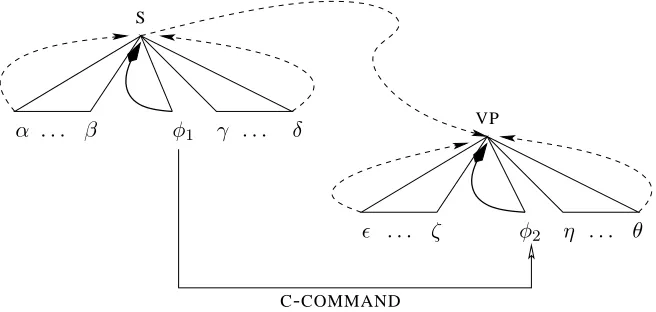
Figure 2: Flow of information in an SSN parser (dashed lines), enhanced by biases specific to function labels to capture the notion of c-command (solid lines).
tion better than a model based on a linear sequence.
In our augmented model, inputs to each history representation are selected according to a linguis-tically motivated notion of structural locality over which dependencies such as argument structure or subcategorization could be specified. We attempt to capture the sequence and the structural position by indirectly modelling the main definition of syntac-tic domain, the notion of c-command. Recall that the c-command relation defines the domain of in-teraction between two nodes in a tree, even if they are not close to each other, provided that the first node dominating one node also dominates the other. This notion of c-command captures both linear and hierarchical constraints and defines the domain in which semantic role labelling applies, as well as many other linguistic operations.
In SSN parsing models, the set D of nodes that are structurally local to a given node on the top of the stack defines the structural distance between this given node and other nodes in the tree. Such a no-tion of distance determines the number of history representations through which information passes to flow from the representation assigned to a nodeito the representation assigned to a nodej. By adding nodes to the set D, one can shorten the structural distance between two nodes and enlarge the locality domain over which dependencies can be specified. To capture a locality domain appropriate for func-tion parsing, we include two addifunc-tional nodes in the setD: the most recent child oftopilabelled with a
syntactic function label and the most recent child of
topi labelled with a semantic function label. These
additions yield a model that is sensitive to regulari-ties in structurally defined sequences of nodes bear-ing function labels, within and across constituents. First, in a sequence of nodes bearing function labels within the same constituent – possibly interspersed with nodes not bearing function labels – the struc-tural distance between a node bearing a function la-bel and any of its right siblings is shortened and con-stant. This effect comes about because the represen-tation of a node bearing a function label is directly input to the representation of its parent, until a far-ther node with a function label is attached. Second, the distance between a node labelled with a function label and any node that it c-commands is kept con-stant: since the structural distance between a node
[A → α] on top of the stack and its left-corner an-cestor[B →β]is constant, the distance between the most recent child node of B labelled with a func-tion label and any child ofAis kept constant. This modification of the biases is illustrated in Figure 2.
di-rectly flows to that constituent. In the figure above, only the information conveyed by the nodes α and
δ is directly input to the node S. Similarly, the only bottom-up information directly input to the VP node is conveyed by the child nodesandθ. In both the no-biases and H03 models, nodes bearing a function label such asφ1andφ2are not directly input to their
respective parents. In our extended model, informa-tion conveyed byφ1andφ2directly flows to their
re-spective parents. So the distance between the nodes
φ1and φ2, which stand in a c-command relation, is
shortened and kept constant.
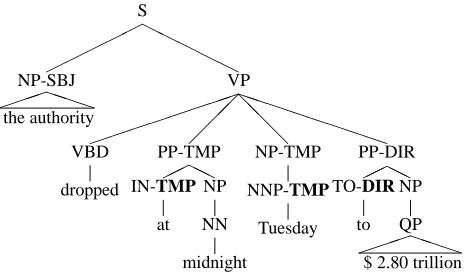
As well as being subject to locality constraints, functional labels are projected by the lexical seman-tics of the words in the sentence. We introduce this bottom-up lexical information by fine-grained mod-elling of function tags in two ways. On the one hand, extending a technique presented in (Klein and Man-ning, 2003), we split some part-of-speech tags into tags marked with semantic function labels. The la-bels attached to a non-terminal which appeared to cause the most trouble to the parser in a separate ex-periment (DIR,LOC,MNR, PRPorTMP) were prop-agated down to the pre-terminal tag of its head. To affect only labels that are projections of lexical se-mantics properties, the propagation takes into ac-count the distance of the projection from the lexical head to the label, and distances greater than two are not included. Figure 3 illustrates the result of the tag splitting operation.
On the other hand, we also split the NULL label
into mutually exclusive labels. We hypothesize that the label NULL(ie. SYN-NULLandSEM-NULL) is a mixture of types, some of which of semantic nature, such as CLR, which will be more accurately learnt separately. The NULL label was split into the mu-tually exclusive labels CLR, OBJand OTHER. Con-stituents were assigned the OBJ label according to the conditions stated in (Collins, 1999). Roughly, an
OBJnon-terminal is an NP, SBAR or S whose parent
is an S, VP or SBAR. Any such non-terminal must not bear either syntactic or semantic function labels, or theCLRlabel. In addition, the first child following
the head of a PP is marked with the OBJlabel. (For more detail on this lexical semantics projection, see (Merlo and Musillo, 2005).)
We report the effects of these augmentations on parsing results in the experiments described below.
S
Figure 3: A sample syntactic structure with function labels lowered onto the preterminals.
4 Experiments and Discussion
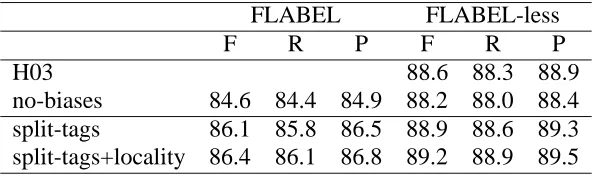
To assess the relevance of our fine-grained tags and history representations for functional labelling, we compare two augmented models to two baseline models without these augmentations indicated in Ta-ble 2 as no-biases and H03. The baseline called H03 refers to our runs of the parser described in (Hen-derson, 2003), which is not trained on input anno-tated with function labels. Comparison to this model gives us an external reference to whether function labelling improves parsing. The baseline called no-biases refers to a model without any structural or lexical biases, but trained on input annotated with function labels. This comparison will tell us if the biases are useful or if the reported improvements could have been obtained without explicit manipu-lation of the parsing biases.
All SSN function parsers were trained on sec-tions 2-21 from the PTB and validated on section 24. They are trained on parse trees whose labels include syntactic and semantic function labels. The mod-els, as well as the parser described in (Henderson, 2003), are run only once. This explains the little dif-ference in performance between our results for H03 in our table of results and those cited in (Henderson, 2003), where the best of three runs on the valida-tion set is chosen. To evaluate the performance of our function parsing experiments, we extend stan-dard Parseval measures of labelled recall and preci-sion to include function labels.
FLABEL FLABEL-less
F R P F R P
H03 88.6 88.3 88.9
no-biases 84.6 84.4 84.9 88.2 88.0 88.4 split-tags 86.1 85.8 86.5 88.9 88.6 89.3 split-tags+locality 86.4 86.1 86.8 89.2 88.9 89.5
Table 2: Percentage F-measure (F), recall (R), and precision (P) of the SSN baseline and augmented parsers.
of lowering the five function labels, 83 new part-of-speech tags were introduced to partition the original tag set. SSN parsers do not tag their input sentences. To provide the augmented models with tagged input sentences, we trained an SVM tagger whose features and parameters are described in detail in (Gimenez and Marquez, 2004). Trained on section 2-21, the tagger reaches a performance of 95.8% on the test set (section 23) of the PTB using our new tag set.
Both parsing results taking function labels into account in the evaluation (FLABEL) and results not taking them into account in the evaluation (FLABEL-less) are reported in Table 2, which shows results on the test set, section 23 of the PTB. Both the model augmented only with lexical in-formation (through tag splitting) and the one aug-mented both with finer-grained tags and represen-tations of syntactic locality perform better than our comparison baseline H03, but only the latter is sig-nificantly better (p < .01, using (Yeh, 2000)’s ran-domised test). This indicates that while information projected from the lexical items is very important, only a combination of lexical semantics information and careful modelling of syntactic domains provides a significant improvement.
Parsing results outputting function labels (FLA-BEL columns) reported in Table 2 indicate that pars-ing function labels is more difficult than parspars-ing bare phrase-structure labels (compare the FLABEL col-umn to the FLABEL-less colcol-umn). They also show that our model including finer-grained tags and lo-cality biases performs better than the one including only finer-grained tags when outputting function la-bels. This suggests that our model with both lex-ical and structural biases performs better than our no-biases comparison baseline precisely because it is able to learn to parse function labels more accu-rately. Comparisons to the baseline without biases
indicates clearly that the observed improvements, both on function parsing and on parsing without taking function labels into consideration would not have been obtained without explicit biases.
Individual performance on syntactic and seman-tic function labelling compare favourably to previ-ous attempts (Blaheta, 2004; Blaheta and Charniak, 2000). Note that the maximal precision or recall score of function labelling is strictly smaller than one-hundred percent if the precision or the recall of the parser is less than one-hundred percent. Follow-ing (Blaheta and Charniak, 2000), incorrectly parsed constituents will be ignored (roughly 11% of the to-tal) in the evaluation of the precision and recall of the function labels, but not in the evaluation of the parser. Of the correctly parsed constituents, some bear function labels, but the overwhelming major-ity do not bear any label, or rather, in our notation, they bear a NULL label. To avoid calculating ex-cessively optimistic scores, constituents bearing the
NULLlabel are not taken into consideration for com-puting overall recall and precision figures. NULL -labelled constituents are only needed to calculate the precision and recall of other function labels. For example, consider the confusion matrix M in Ta-ble 3 below, which reports scores for the semantic labels recovered by the no-biases model. Precision
is computed as P
i∈{ADV···TMP}M[i,i]
P
j∈{ADV···TMP}M[SUM,j]
. Recall is
computed analogously. Notice thatM[n, n], that is the[SEM-NULL,SEM-NULL]cell in the matrix, is never taken into account.
ASSIGNEDLABELS
ADV BNF DIR EXT LOC MNR NOM PRP TMP SEM-NULL SUM
ADV 143 0 0 0 0 0 0 1 3 11 158
BNF 0 0 0 0 0 0 0 0 0 1 1
DIR 0 0 39 0 3 4 0 0 1 51 98
EXT 0 0 0 37 0 0 0 0 0 17 54
ACTUAL LOC 0 0 1 0 345 3 0 0 15 148 512
LABELS MNR 0 0 0 0 3 35 0 0 16 40 94
NOM 2 0 0 0 0 0 88 0 0 4 94
PRP 0 0 0 0 0 0 0 54 1 33 88
TMP 18 0 1 0 24 11 0 1 479 105 639
SEM-NULL 12 0 13 5 81 28 12 24 97 20292 20564 SUM 175 0 54 42 456 81 100 80 612 20702 22302
Table 3: Confusion matrix for the no-biases baseline model, tested on the validation set (section 24 of PTB).
of function labels, reaching an F-measure of 98.7% for syntactic labels and 83.4% for semantic labels as best accuracy measure. Previous work that uses, like us, a single model for both types of labels reaches an F measure of 95.7% for syntactic labels and 79.0% for semantic labels (Blaheta and Charniak, 2000).
Although functional information is explicitly an-notated in the PTB, it has not yet been exploited by any state-of-the-art statistical parser with the notable exception of the second parsing model of (Collins, 1999). Collins’s second model uses a few func-tion labels to discriminate between arguments and adjuncts, and includes parameters to generate sub-categorisation frames. Subsub-categorisation frames are modelled as multisets of arguments that are sisters of a lexicalised head child. Some major differ-ences distinguish Collins’s subcategorisation para-meters from our structural biases. First, lexicalised head children are not explicitly represented in our model. Second, we do not discriminate between ar-guments and adjuncts: we only encode the distinc-tions between syntactic function labels and seman-tic ones. As shown in (Merlo, 2003; Merlo and Esteve-Ferrer, 2004) this difference does not corre-spond to the difference between arguments and ad-juncts. Finally, our model does not implement any distinction between right and left subcategorisation frames. In Collins’s model, the left and right sub-categorisation frames are conditionally independent and arguments occupying a complement position (to the right of the head) are independent of arguments occurring in a specifier position (to the left of the head). In our model, no such independence assump-tions are stated, because the model is biased towards
phrases related to each other by the c-command re-lation. Such relation could involve both elements at the left and at the right of the head. Relations of functional assignments between subjects and ob-jects, for example, could be captured.
The most important observation, however, is that modelling function labels as the interface between syntax and semantics yields a significant improve-ment on parsing performance, as can be verified in the FLABEL-less column of Table 2. This is a crucial observation in the light of the current ap-proaches to function or semantic role labelling and its relation to parsing. An improvement in parsing performance by better modelling of function labels indicates that this complex problem is better solved as a single integrated task and that current two-step architectures might be missing on successful ways to improve both the parsing and the labelling task.
In particular, recent models of semantic role la-belling separate input indicators of the correlation between the structural position in the tree and the semantic label, such as path, from those indicators that encode constraints on the sequence, such as the previously assigned role (Kwon et al., 2004). In this way, they can never encode directly the constraining power of a certain role in a given structural position onto a following node in its structural position. In our augmented model, we attempt to capture these constraints by directly modelling syntactic domains.
sparseness is due to the occurrence of intermediate nodes that are not relevant for the syntactic relations between an argument and its predicate. Our model of domains is less noisy, because it can focus only on c-commanding nodes bearing function labels, thus abstracting away from those nodes that smear the pertinent relations.
(Yi and Palmer, 2005) share the motivation of our work, although they apply it to a different task. Like the current work, they observe that the distributions of semantic labels could potentially interact with the distributions of syntactic labels and redefine the boundaries of constituents, thus yielding trees that reflect generalisations over both these sources of in-formation.
Our results also confirm the importance of lexi-cal information, the lesson drawn from (Thompson et al., 2004), who find that correctly modelling se-quence information is not sufficient. Lexical infor-mation is very important, as it reflects the lexical se-mantics of the constituents. Both factors, syntactic domains and lexical information, are needed to sig-nificantly improve parsing.
5 Conclusions
In this paper, we have explored a new way to im-prove parsing results in a current statistical parser while at the same time enriching its output. We achieve significant improvements in parsing and function labelling by modelling directly the specific nature of function labels, as both expressions of the lexical semantics properties of a constituent and as syntactic elements whose distribution is subject to structural locality constraints. Differently from other approaches, the method we adopt integrates function labelling directly in the parsing process. Future work will lie in exploring new ways of cap-turing syntactic domains, different from the ones at-tempted in the current paper, such as developing new derivation moves for nodes bearing function labels. A more detailed analysis of the parser will also shed light on its behaviour on sequences of function la-bels. Finally, we plan to extend this work to learn Propbank-style semantic role labels, which might re-quire explicit modelling of long distance dependen-cies and syntactic movement.
Acknowledgements
We thank the Swiss National Science Foundation for supporting this research under grant number 101411-105286/1. We also thank James Henderson for allowing us to use his parser and James Hender-son and Mirella Lapata for useful discussion of this work. All remaining errors are our own.
References
Collin F. Baker, Charles J. Fillmore, and John B. Lowe. 1998. The Berkeley FrameNet project. In Chris-tian Boitet and Pete Whitelock, editors, Proceedings of the Thirty-Sixth Annual Meeting of the Association for Computational Linguistics and Seventeenth In-ternational Conference on Computational Linguistics (ACL-COLING’98), pages 86–90, Montreal, Canada. Morgan Kaufmann Publishers.
Christopher M. Bishop. 1995. Neural Networks for Pat-tern Recognition. Oxford University Press, Oxford, UK.
Don Blaheta and Eugene Charniak. 2000. Assigning function tags to parsed text. In Proceedings of the 1st Meeting of North American Chapter of Associa-tion for ComputaAssocia-tional Linguistics (NAACL’00), pages 234–240, Seattle, Washington.
Don Blaheta. 2004. Function Tagging. Ph.D. thesis, Department of Computer Science, Brown University.
Eugene Charniak. 2000. A maximum-entropy-inspired parser. In Proceedings of the 1st Meeting of North American Chapter of Association for Computational Linguistics (NAACL’00), pages 132–139, Seattle, Washington.
Michael Collins and Scott Miller. 1998. Semantic tag-ging using a probabilistic context-free grammar. In Proceedings of the Sixth Workshop on Very Large Cor-pora, pages 38–48, Montreal, CA.
Michael John Collins. 1999. Head-Driven Statistical Models for Natural Language Parsing. Ph.D. thesis, Department of Computer Science, University of Penn-sylvania.
CoNLL. 2004. Eighth conference on
com-putational natural language learning (conll-2004). http://cnts.uia.ac.be/conll2004.
CoNLL. 2005. Ninth conference on
Ruifang Ge and Raymond J. Mooney. 2005. A statistical semantic parser that integrates syntax and semantics. In Proceedings of the Ninth Conference on Computa-tional Natural Language Learning (CONLL-05), Ann Arbor, Michigan.
Daniel Gildea and Daniel Jurafsky. 2002. Automatic la-beling of semantic roles. Computational Linguistics, 28(3):245–288.
Daniel Gildea and Martha Palmer. 2002. The necessity of parsing for predicate argument recognition. In Pro-ceedings of the 40th Annual Meeting of the Associa-tion for ComputaAssocia-tional Linguistics (ACL 2002), pages 239–246, Philadelphia, PA.
Jesus Gimenez and Lluis Marquez. 2004. Svmtool: A general POS tagger generator based on Support Vec-tor Machines. In Proceedings of the 4th International Conference on Language Resources and Evaluation (LREC’04), Lisbon, Portugal.
James Henderson and Peter Lane. 1998. A connec-tionist architecture for learning to parse. In Proceed-ings of 17th International Conference on Computa-tional Linguistics and the 36th Annual Meeting of the Association for Computational Linguistics (COLING-ACL‘98), pages 531–537, University of Montreal, Canada.
Jamie Henderson. 2003. Inducing history representa-tions for broad-coverage statistical parsing. In Pro-ceedings of the Joint Meeting of the North American Chapter of the Association for Computational Lin-guistics and the Human Language Technology Con-ference (NAACL-HLT’03), pages 103–110, Edmonton, Canada.
Valentin Jijkoun, Maarten de Rijke, and Jori Mur. 2004. Information extraction for question answering: Im-proving recall through syntactic patterns. In Proceed-ings of COLING-2004, Geneva, Switzerland.
Dan Klein and Christopher D. Manning. 2003. Accu-rate unlexicalized parsing. In Proceedings of the 41st Annual Meeting of the ACL (ACL’03), pages 423–430, Sapporo, Japan.
Namhee Kwon, Michael Fleischman, and Eduard Hovy. 2004. Senseval automatic labeling of semantic roles using maximum entropy models. In Senseval-3, pages 129–132, Barcelona, Spain.
Mitch Marcus, Beatrice Santorini, and M.A.
Marcinkiewicz. 1993. Building a large annotated corpus of English: the Penn Treebank. Computational Linguistics, 19:313–330.
Paola Merlo and Eva Esteve-Ferrer. 2004. PP attachment and the notion of argument. University of Geneva, manuscript.
Paola Merlo and Gabriele Musillo. 2005. Accu-rate function parsing. In Proceedings of the Human Language Technology Conference and Conference on Empirical Methods in Natural Language Processing (HLT/EMNLP 2005), Vancouver, Canada.
Paola Merlo. 2003. Generalised PP-attachment disam-biguation using corpus-based linguistic diagnostics. In Proceedings of the Tenth Conference of The European Chapter of the Association for Computational Linguis-tics (EACL’03), pages 251–258, Budapest, Hungary.
Mark Jan Nederhof. 1994. Linguistic Parsing and Pro-gram Transformations. Ph.D. thesis, Department of Computer Science, University of Nijmegen.
Rodney Nielsen and Sameer Pradhan. 2004. Mixing weak learners in semantic parsing. In Proceedings of the Conference on Empirical Methods in Natural Language Processing (EMNLP-2004), pages 80–87, Barcelona, Spain, July.
Martha Palmer, Daniel Gildea, and Paul Kingsbury. 2005. The Proposition Bank: An annotated corpus of semantic roles. Computational Linguistics, 31:71– 105.
V. Punyakanok, D. Roth, and W. Yih. 2005. The neces-sity of syntactic parsing for semantic role labeling. In Proc. of the International Joint Conference on Artifi-cial Intelligence (IJCAI’05).
Senseval. 2004. Third international workshop on the evaluation of systems for the semantic analysis of text (acl 2004). http://www.senseval.org/senseval3.
Cynthia Thompson, Siddharth Patwardhan, and Carolin Arnold. 2004. Generative models for semantic role labeling. In Senseval-3, Barcelona, Spain.
Nianwen Xue and Martha Palmer. 2004. Calibrating features for semantic role labeling. In Proceedings of the 2004 Conference on Empirical Methods in Nat-ural Language Processing (EMNLP-2004), pages 88– 94, Barcelona, Spain.
Alexander Yeh. 2000. More accurate tests for the statis-tical significance of the result differences. In Procs of the 17th International Conf. on Computatioal Linguis-tics, pages 947–953, Saarbrucken, Germany.