Generating Patent Claims From Interactive Input
•
Svetlana Sheremetyeva I Sergei Nirenburg 1 Irene Nlrenburg-
[email protected] [email protected] [email protected]
lComputing Research Laboratory, New Mexico State University, Las Cruces, NM 88003, (505) 646-5466 2Carnegie Group, Inc., 5 PPG Place, Pittsburgh, PA 15222
Abstract
Patent claims are the subject of legal protection. They must be formulated according to a set of precise syntactic, lexical and stylistic guidelines. Composing patent claims is a complex task, even for experts. In this paper we report about an tmplemented system for supporting authoring claims for patents describing apparatuses. The system generates claim texts from the input specified partly by the stored conceptual text schemata and partly by the input from the user. The result of the interactive content acquisition stage is a shaUow-level representation which can be considered a draft to be automatically revised into the final text of the claim.
1 Introduction
Patent law guidelines impose rather rigid con- stra~ats on the structural composition of the text of the informationally central and legally crucial part of a patent disclosure, the claim. Figure 1 illus- trates a rather simple claim text (claims can be over a page long). The claim must consist of a single, albeit possibly very complex, sentence with a well- specified conceptual, syntactic and stylistic/rhetori- cal structure. For instance, if the invention is an apparatus it must be described in a static state, without reference to its operation.
A cassette for holding excess lengths of light waveguides in a splice area comprising
a cover part and a pot-shaped bottom part having a bot- tom disk and a rim extending
perpendicular to said bottom disk, said cover and bottom parts are superimposed to enclose jointly an area forming a magazine for excess lengths of waveguides, said cover part being rotatable in said bottom part.
two guide slots formed in said cover part. said slots being approximately radially directed,
guide members disposed on said cover part,
a splice holder mounted on said cover part to form a rotatable splice holder.
Figure 1. The text of the example claim generated by the system.
As can be seen from the figure, composing claims can be a difficult task even for a patent expert, let alone an inventor who is typically an engineer and not a technical writer. Note that the difficulty of the task is not constrained to syntax and style. A claim must be composed so as to make patent infringe- ment difficult. We have developed a system which helps an inventor to compose patent claims. The system has an interactive and an automatic compo- nents. Knowledge about the invention is elicited from the inventor interactively. Most of text plan- ning and realization is carried out automatically.
Superficially, the architecture of our system con- forms to the standard emerged in natural language generation (NLG) (as expressed, for instance in Reiter, 1994) in that it includes the stages of con- tent specification, text planning and surface gener- ation (realization). However, there are some important differences. Unlike the typical content
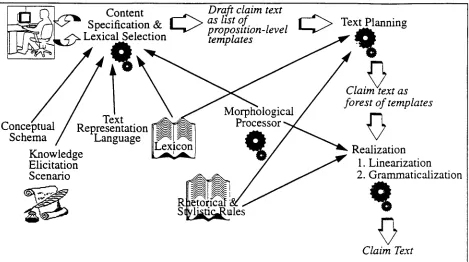
specification modules (e.g., Kukich, 1983; Kit- tredge et al. 1986), our system relies on an author- ing workstation environment equipped with a knowledge elicitation scenario for joint human- computer content specification (see Sheremetyeva et al., submitted 1996, for the details of the knowl- edge elicitation scenario). Lexical selection and some other text planning tasks are interleaved with the process of content specification. The latter results in the production of a "draft" claim. This draft, while not yet an English text, is a list of prop- osition-level structures ("templates") specifying the proposition head and case role values filled by POS-tagged word strings. The draft is then submit- ted to an automatic text planner which outputs an hierarchical structure of templates which is ordered according to rhetorical and stylistic requirements. This process resembles revision-oriented genera- tion (Meteer, 1991, Robin, 1994, Gabriel, 1988, Inui et al., 1992). Using the set of distinctions by Robin, our approach is content-preserving (no extra content is added) and performs revisions on a shallow representation. The realization stage lin- earizes the plan and takes care of the ellipsis, con- joined structures, punctuation and morphological forms. The architecture of the system is illustrated in Figure 2. In what follows we describe each stage of our system in turn and illustrate it with a single example of generating the claim of Figure 1.
2 Content Specification
~ , ~ / / / / / Content
Draft claim text
Specification & ~
~Srol~ots°ltfion_leve
I ~
Text PlanningLexical Selection
templates
~
~ l t
lai
t as
/ / / ~ ~ M o ~ h o l o ~ i c a l /
forest of templates
/ , /
Text ~ M~r~ot~ls~goirC_m /t..onceptual
/
R e p / e s e n t a t i o n F ~ . ~ 7 , , , , ~ . . . . . 7 , . , , ,Schema / "Language 117~?1='%~1
/
. . . . ~Lex!conl ~ / ~ Realization
r~.now~eoge ~ g / ~,, .
Elicitation ~ / Z 1. Lineanzatxon
Scenario ~
/
/
2. Grarnmaticalizationq
0
[image:3.596.52.521.65.327.2]Claim Text
Figure 2. The architecture
Content specification in our system is a process of interactive traversal of a conceptual schema of pat- ents about apparatuses. We built a representation of this schema based on our study of a training corpus of U.S. patents. Patent law prescribes that an inven- tion is described by specifying, in order, a) the title of invention; b) its components (and components of components, as required); c) properties ("attributes") of components (shape, material, dimensions, etc.); and d) relations among the com- ponents (spatial, connection, purpose, etc.). In graphical terms, this schema can be represented as a tree, with nodes representing invention compo- nents and arcs, the basic meronymic ("has-as- part") relations. Every concrete invention is repre- sented as an instance of the general schema. The schema for our example invention is illustrated in Figure 3.
cover part bottom
/ ~ b o t t o m p a r t - . ~ • disk ca¢~,~tt~ ~¢.-" ~ n m
. . . ~ t w o guide slots ~ g u i d e members
"~ splice holder
Figure 3. Instance of the conceptual schema tree.
of the patent claim generator.
Using common graphical user interface tools (such as dialogue boxes, menus, templates, slide bars etc.), the system guides the user through the paces of describing every essential feature of the inven- tion. Language support is provided through access to vocabularies of suggested verbs and terminolog- ical nominal compounds. The inclusion of a human into the process simplifies the task of the system. Notably, it allows us to avoid using a deep knowl- edge representation language for describing the invention. It is easier for users to manipulate natu- ral and not artificial language. The knowledge elic- itation scenario consists in the system requesting the user, in English, to supply information about the invention, its components, their properties and relations among them. The user-supplied informa- tion is recorded using a simple text representation language:
text ::= ( t e m p l a t e } { t e m p l a t e } *
t e m p l a t e ::= (label p r e d i c a t e - c l a s s p r e d i c a t e ( { c a s e - r o l e } ( c a s e - role}*)
c a s e - r o l e ::= (rank ((label-string)
v a l u e ) )
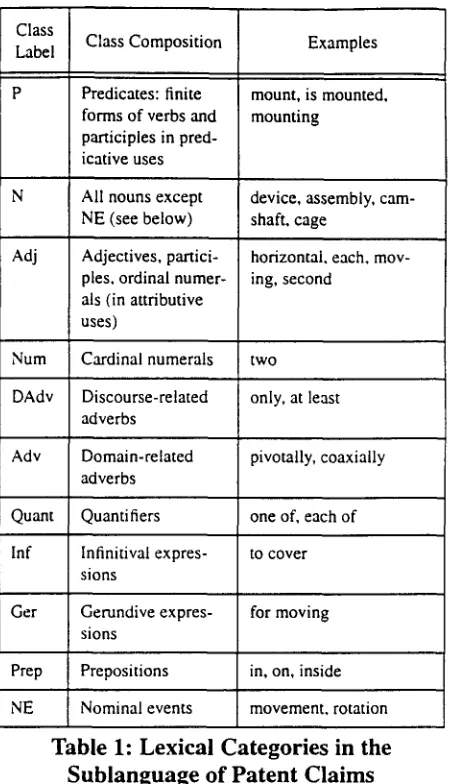
cate), predicate-class is the label of a synonym set of predicate-type words, see below, predicate is a string corresponding tO one of the predicates from the system lexicon, case roles are ranked 1 based on their frequency of cooccurrence with each predi- cate in the training corpus 2 and value is the string which fills a case role. A label-string consists of a grammatical class symbol (see Table 1) and a unique ordinal number for each distinct string. Labels are assigned by a morphological analysis module to strings in input templates and nodes in conceptual schema instances. (see Figure 4 and compare it with Figure 3).
Figure 5 illustrates an input template. The labels are used so that we can operate with words and phrases irrespective of the actual inflectional form in which they appear in the user-supplied input or will appear in the final text. All manipulations at the text planning stage are performed on labels. It is at the realization stage that we reintroduce the actual strings and determine their required inflec- tional forms.
In order to assign label strings to case role values, the values must be analyzed morphologically. As a result of morphological analysis, The interactive input specification (knowledge elicitation) stage provides information about the boundaries of case role values, which makes it possible to use special simplifying morphological rules (thus, for instance, if the filler of the theme case role consists of a single word, it must be a noun). The output of the morphological analysis involves the assignment of the word class and an inflectional form.
Class Label
Adj
Num
DAdv
Adv
Quant
lnf
Ger
Prep
NE
Class Composition Examples
Predicates: finite mount, is mounted, forms of verbs and mounting
participles in pred- icative uses
All nouns except device, assembly, cam- NE (see below) shaft, cage
Adjectives, partici- horizontal, each. mov- pies, ordinal numer- ing, second
als (in attributive uses)
Cardinal numerals two
Discourse-related adverbs
Domain-related adverbs
Quanti tiers
Infinitival expres- sions
Gerundive expres- sions
Prepositions
Nominal events
only, at least
pivotally, coaxially
one of, each of
to cover
for moving
in, on, inside
movement, rotation
Table 1: Lexical Categories in the
Sublanguage of Patent Claims
N2 N3
J v N4 N10
N4 N3 ~ N11
N1 N u m l N5 N6
N5 N7 N8 N9
1. Case roles are labeled in the lexicon entry for a particu- lar predicate and the correspondence between the la- bel and the rank for this word is established there, see description of lexicon entry below. The list of case roles for the sublanguage is as follows: agent, theme, co-theme, place, manner, purpose, means, con- dition, time.
2. A training corpus of over 1,000 U.S. patents was used in this work.
Figure 4. Labeling the conceptual s c h e m a t r e e .
[image:4.596.305.531.81.473.2]of the content to be conveyed. Once a predicate is selected, the system proceeds requesting informa- tion about the values of the case roles of this predi- cate. The values of these case roles are supplied by the user.l This division of labor makes our system immediately practical, because it need not rely on a very large lexicon of terminological terms in the subject area. The internal lexicon of the system must include only a detailed specification of pred- icative words (mostly, verbs) and some closed- class items, such as prepositions and conjunctions. The following considerations guided our lexicon work.
(P6 3 "is mounted"
(1 ((N8 N9) "the splice holder")) (2 ((Prep2 N2 N3) "on the cover part"))
(4 ((Infl Adjl N8 N9) "to form a rotatable splice holder")))
Figure 5. A sample template using "mounted:'
The patent sublanguage is a union of a legal sub- language and a sublanguage of the domain of the invention. Our system is devoted to patents about apparatuses. Therefore, its technological sublan- guage is that of machines and mechanisms. The sublanguage for such a system has two crucial peculiarities. First, the number of senses for each lexeme is, on average, much smaller than in lan- guage as a whole. This is a property of any sublan- guage. The second peculiarity seems inherent only to the legal sublanguage. So as best to protect the rights of the inventor, it is desirable to use lexical units whose meanings are as broad as possible (see, e.g., Lawson, 1983) without making untrue statements about the invention. Therefore, at the lexical selection stage of the generation of a patent claim the system must be able to choose that mem- ber of the synonym set of candidates whose mean- ing is the broadest, For our system we determined the breadth of meaning of word senses by calculat- ing the relative occurrence frequencies of every word sense the training corpus. Our hypothesis was that this measure is appropriate because the patents were written by expert patent specialists who actu-
1. The system includes a number of additional knowl- edge sources to help the user in the choice of the responses, including access to a world model, or ontology (see Mahesh et al., 1995).
ally used the words with broadest senses. These frequencies are marked in the system's dictionary only for verbs and take the form of the verb's rank in its semantic class. For example, if the synonym set for lexical selection is as follows: engage, hold, attach, lock, join, clamp, fasten, the system will present this list to the user in the descending order of frequencies, with the idea that the user would prefer to select the first applicable word on the list.
Verb entries in the system's lexicon consist of a number of zones as follows:
• Zone I lists all morphological forms of the verb in which it is expected to occur in patent texts. The most frequent form is marked. • Zone 2 contains the verb's semantic class
label. The classes defined for claims about apparatuses include: meronymy, spatial, connection, change-state, change-location, apply-force, purpose and others.
• Zone 3 lists the verb's frequency rank in the list of all the verbs belonging to its semantic class. It is necessary to motivate the order of verb realization in the text at the generation stage.
• Zone 4 contains the correspondence between the verb's case frame labels and their ranks. • Zone 5 contains a frequency-ordered list of linearized cooccurrences of the verb with a particular subset of case roles. Thus, in Figure 4 the linearization pattern (1 * 2 4) (where I, 2 and 4 are case role ranks and "*" shows the position of the predicate) will match, for example, the following phrase from an actual claim: (1: the splice holder) is mounted (2: on the cover part) (4: to form a rotatable splice holder).
A sample lexicon entry is illustrated in Figure 6.
MOUNTED 2
Zone 1: MOUNTED(*), IS MOUNTED, ARE MOUNTED, BEING MOUNTED
Zone 2: spatial Zone 3:1
Zone 4: I agent; 2 place; 3 manner; 4 purpose; 5 means
Zone 5: (l * 2), ( 1 3 * 2), (1* 2 4), (l * 2 3), (l * 3), (l * 4),
(1 * 2 5 )
Figure 6. The lexicon entry for "mounted."
The output of the content specification stage (and input into the generation stage) consists of a list of filled templates in which the templates with the title of the invention in their subject slot are marked. A subset of the templates created for our example is given in Figure 7. The set of templates can be considered a draft text of the patent claim. If an English version is generated directly, it will pro- duce a list of individual sentences describing the invention. In fact, our system performs this kind of generation for the purposes of allowing the user to check the draft before it is submitted to the claim generation stage (in this way it is guaranteed that the list of templates contains all the required infor- mation). However, we do not use this list of simple sentences in our generation (or revision). This situ- ation is akin to the one described by Meteer (1990) in her Spokesman system design. We use the draft as the input to the process of stylistic and rhetorical text planning and realization.
(pl 2 "comprises" (1 ((NI)
"A cassette for holding excess
lengths of light waveguides in a splice area")) (2 ((N2 N3) "a cover part")
((N4 N3) "a bottom part") ((Num 1 N5 N6 ) "two guide slots") ((N5 N7)"guide members") ((N8 N9) "a splice holder")))
(p21 "is pot-shaped"
(1 ((N4 N3) "the bottom part")))
(p33 "are directed"
(1 ((Numl N5 N6) "the two guide slots")) (3 ((Advl Adv2) "approximately radially")))
(p47 "is rotatable"
(1 ((N2 N3) "the cover part"))
(2 ((Prepl N4 N3)"in the bottom part")))
(p52 "'has"
(1 ((N4 N3)"the bottom part")) (2 ((N4 N10) "a bottom disk")
((N11) "and a rim")))
(p63 "is mounted"
(1 ((N8 N9) "the splice holder")) (2 ((Prep2 N2 N3) "on the cover part"))
(4 ((Infl Adj I N8 N9) "to form a rotatable
splice holder")))
(p73 "extends" (1 ((NI 1) "the rim"))
(3 ((Adv3 N4 N10) "perpendicular to the
bottom disk")))
(p83 "'are superimposed" (1 ((N2 N3) "the cover part")
((N4 N3) "the bottom part")) (2 ((Adv4 Inf2 N12) " to jointly enclose
an area")))
(p9 11 "'forms" (1 ((NI2) "the area")) (2 ((N13)"'a magazine")))
(pl010 "for"
(1 ((N 13) "'the magazine"))
(2 ((Adj2 N 14 Prep3 N 15) "excess lengths of waveguides")))
(pl I 3 "'are disposed"
(I ((N5 N7) "the guide members")) (2 ((Prep2 N2 N3) "on the cover part")))
(pI23 "are formed"
(1 ((Numl N5 N6) "the two guide slots")) (2 ((Prepl N2 N3) "in the cover part")))
F i g u r e 7. T h e t e m p l a t e s for t h e e x a m p l e c l a i m .
3 Claim Text Planning
3.1 Clustering templates at conceptual schema nodes
This step is not straigtltforward because a template can be connected to its conceptual schema through more than one case role value string, so that a pref- erence method must be suggested for these cases. For instance, Template P4 (see Figure 7) can be connected to its corresponding node of the concep- tual schema, realized as Template P1, either through case role value (N2 N3) or case role value (N4 N3). We define four levels o f preference, based on the quality of match between the node label and a string in a template case role (case roles can have a set of strings as their values; such values are
called
compound).
(In the description below thetemplate for which linking is attempted is referred to as "current.")
• Quality I match occurs when a) the string in
the tree node is
identical
to a case-role stringin the current template and b) the rank of the case role in the current template is I;
• Quality II match occurs when a) the two
strings have a nonempty intersection which includes the last element of the string 1 and b) the rank of the case role in the current
template is 1 (if the procedure finds more than one match of Quality II, it will select the one with the largest intersection);
• Quality III match occurs when a) the two
strings are identical and b) the rank of the case role in the current template is not I;
• Quality IV match occurs when a) the two
strings have a nonempty intersection, as in Quality II match, and b) the rank of the case role in the current template is not 1.
The procedure applies to simple case role values or to components o f the compound case role values. The latter can occur both in the conceptual schema tree nodes and in the values of the template slots.
If there is a single candidate, the procedure finds it. If there is more than one candidate, the procedure finds the best one. If no match is possible with con- ceptual schema node labels, the procedure matches
1. In our system the last w o r d in a string is practically always the syntactic head of the phrase.
the candidate template case role not with a concep- tual schema tree node label but rather with case roles of templates in each cluster, in turn. This activity is based on the expectation that the exposi- tion in a patent claim is one coherent entity, with- out a possibility o f unconnected threads.
3.2 From the Conceptual Schema to a Text Plan
This stage marks the shift from the concelStual to the rhetorical. The conceptual schema tree is trans- formed into a text plan tree representing the rhetor- ical structure of the claim text. The nodes in the text plan tree are labeled with the input templates, not invention components. We transform every, node from the conceptual schema tree into a sub- tree whose nodes are templates and whose struc- ture is determined by stylistic and rhetorical considerations typical o f text planning. The sub- trees are connected into the text plan tree following the links established in the conceptual schema tree, only these links will be between case role values in the templates which are the content of the nodes in the text plan tree.
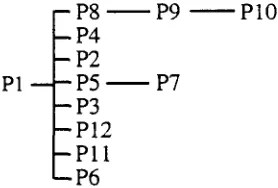
The cluster-level subtrees of the text plan tree are organized by grouping the templates into what will become sets of siblings at different levels in the text plan tree. Templates which were assigned to a cluster through a match against the same string (either the label o f the conceptual schema node or a case role in one of the templates inside the cluster) 2 are grouped into sets of siblings. The hierarchical structure among these sets is established based on the position in the tree of the template against which this match occurred. For example (see Fig- ure 7), the templates P4 and P8 are siblings because they contain a case role value (N2 N3) which represents a node in the conceptual schema (see Figures 4 and 3).
Next, the procedure orders the siblings left to right, in preparation for eventual linearization. The sort- ing function used for ordering is based on heuris- tics such as: "the statement which describes more
2. To be precise, in the case of c o m p o u n d case role values the m a t c h m a y have occurred with the
than one component of the invention should appear as early as possible," "if a content element is described by a single template, it might be amena- ble to realization as a prenominal modifier; such elements should appear as early as possible," etc. A full set of heuristics see in Sheremetyeva et al.,
1996.
After the initial sorting, the procedure checks for occurrence in the sibling templates of the same predicates. If found, they are all moved to form a continuous string at the position of the rightmost occurrence. This is done in expectation of an ellip- tical realization. The procedure also moves all tem- plates whose predicates are prepositions to the leffmost positions in the string, in order to facilitate their realization without introducing a full clause. The actual text plan tree for our example is illus- tratzd in Figure 8.
P 1 - - - P 8 - P 4 - P2 - P 5 - P 3 - P 1 2 - P l l - P 6
P 9 ~ P 1 0
P7
Figure 8. T h e text plan tree for o u r example.
The final step of the creation of the text plan tree is to test this tree for complexity and depth. The rea- soning behind this is stylistic and syntactic, as claim texts must be both legible and syntactically unambiguous. If either the nesting depth or the number of potentially conjoined structures becomes excessive, the procedure reorders the sub- trees of the text plan tree to produce te of accept- able-length and complexity output text chunks. The "counter" of complexity is incremented during the linearization stage and a text chunk is "wrapped up" at the point when the counter reaches a maxi- mum and linearization starts a new text chunk.
4 Realization
4.1 T r a v e r s a l a n d l i n e a r i z a t i o n o f t h e t r e e s
This stage takes as input a forest of templates and results in the production of a bracketed string of predicate and case role symbols. Two procedures are involved. First, every template is linearized, that is an order of appearance its predicate and case roles is established. Second, the order of templates in the output string is established. The text plan tree is traversed in a top-down, depth-first fashion. Templates can be concatenated to the end of the string which resulted from the linearization process of the template processed immediately before the current one or inserted into the string correspond- ing to its parent template, immediately following the case role of the parent template on which the child is linked. In the final string, the boundaries between the templates are retained (the string is bracketed). The result of linearization for our example is illustrated in Figure 9.
[ I:N1 P1 2:N2N3 2:N4N3 [ P2 I:N4N3]
[ l:N4N3 P5 2:N4NI0 2:N11 [ I:N11 P7/3:ADV3N4NI0]]
[ I :N2N3 I:N4N3 P8 2:INF2ADV4N12 [ l:Nl2 P9 2:N13
[ l:NI3 P10 2:ADJ2N14PREP3N15]
[ 1 :N2N3 P4 2:PREP1N4N3]]] 2:NUM1N5N6 [ 1 :NUM1N5N6 P12 2:PREP1N2N3]
[ I:NUM1N5N6 P3 3:ADVIADV2 P3] 2:N5N7 [ 1 :N5N7 P l l 2:PREP2N2N3] 2:N8N9
[ 1 :N8N9 P6 2:PREP2N2N3
4:INF1ADJINSN9]]
Figure 9. A l i n e a r i z e d tree for a c l a i m text. T h e n u m b e r s m a r k e d with colons are case roles ranks.
4 . 2 G r a m m a t i c a l i z a t i o n
[image:8.596.89.228.336.430.2]ellipsis (our system does not use definite descrip- tions); and c) to realize discourse relations through inserting punctuation, and conjunctions. Corre- spondingly, the right-'hand sides of the realization rules include instructions to carry out the above types of actions.
Realization is carried out left to right segment by segment. A segment is a substring between any two brackets, whether opening or closing. The property determining realization is adjacency, not hierarchi- cal relations; therefore, the orientation of the brackets and their nesting is immaterial. In fact, the first action of this procedure is to substitute demar- cation points for any cluster of brackets in the string. Realization of a segment (So) depends on its similarities to its preceding segment S.i (occasion- ally, two preceding segments, S.l and S.2) as well as on the actual realization of the preceding seg- ment(s). The first segment is realized in a standard fashion --- the predicate is always realized as the present participle and no pronominalization or ellipsis occurs.
The left-hand sides of the realization rules contain:
I. contextual constraints in the form of patterns for two (seldom, three) consecutive segments of linearized trees, a c o n t e x t of the rule (for
instance, the case role values at the end of one segment and at the beginning of the other are identical);
2. lexical constraints in the form of knowledge from dictionary entries for predicates (for instance, that the most frequent form of a predicate is a present participle); and
3. control constraints in the form of knowledge about the system's prior decisions (for instance, that the predicate processed immediately before the current one was realized as a past participle).
The contexts are characterized by a) existence of matching elements in the two segments; b) quality of the match; c) the position in the segments of the matching elements and d) the relative position of partially matched strings. Ten distinct context types were defined for English. A few sample rules are illustrated below.
Rule 1 :
Contextual Constraint:
Lexical Constraint:
Control Constraint: Action:
Rule 2:
Contextual Constraint:
Lexical Constraint:
Control Constraint:
Action:
the segments S O and S. t do not have case roles with identical values the most frequent form of the current predicate is present simple, passive voice
n o n e
realize the predicate as a verb in present simple, passive voice
the first case role value of segment S O matches, at Quality I, the last case role value of segment S. t
the most frequent form of the current predicate is past participle
there is no conjunction and between S. 2 and S.i
realize the predicate as a past partici- ple: remove brackets between the seg- ments and delete the matching case role value in the current segment
5 Conclusion and Future
Developments
We have described an implemented generation sys- tem with an interactive content specification stage which operates in a conceptually and stylistically constrained environment. Text planning in this sys- tem can be considered as content-preserving revi- sion of a shallow "draft" representation produced by content specification. Lexical choice is interac- tively carried out during content specification, with the system offering the user several kinds of aid in the choice of terminological entities and the lexical realization of relations among them.
A distinguishing feature of this system is its par- tially interactive character. Borrowing a type dis- tinction from the area of machine translation (MT), we can classify this system as that of human-aided NLG as opposed to fully-automatic NLG.
retrieval and extraction infrastructure developed in the TIPSTER project (Grishman, 1995); and c) combine the claim tex.t generator with the analysis mc 5ules of the MikroKosmos project (Onishkevich et al., 1994) to develop a system of automatic translation of patent claims.
References
Gabriel, R. 1988. Deliberate writing. In D.D. McDonald
and Bolc L., editors, Natural Language Generation Sys-
terns. Springer-Verlag, New york, NY.
Grishman, R. 1995. Tipster Phase II Architecture Design Document, version 1.52, TIPSTER Architecture Working Group.
Inui, K., Tokunaga, T., and Tanaka, H. 1992. Text revi- sion: amodel and its implementation. In Dale, R., Hovy,
E., Roesner, D., and O. Stock, editors, Aspects of Auto-
mated Natural Language generation, pages 215-230. Springer-Verlag.
Kittredge, R., Polguere, A., and Goldberg, E. 1986. Syn-
thesizing weather forecasts from formatted data. In Pro-
ceedings of the 11th International Conference on Computational Linguistics, pages 563-565. COLING. Lawson, V. The Language of Patents. 1983. A Typology of Patents, with Particular Reference to Machine Trans-
lation. In Lebende Sprachen Nr.2, pages 58-61.
McDonald, D. 1993 Issues in the Choice of a Source for
Natural Language generation. In Computational Lin-
guistics (19)I, pages 191-197.March 1993.
Kukich, K. 1983. Knowledge-Based report generation:
a knowledge engineering approach to natural language report generation. Ph.D. thesis, University of Pitts- burgh.
Mahesh, K. and Nirenburg, S. 1995. A situated ontology
for practical NLP. In Proceedings of the Workshop on
Basic Ontological Issues in Knowledge Sharing, Inter- national Joint Conference on Artificial Intelligence (IJCAI-95), Montreal, Canada, August 1995.
Meteer, M.W. 1990. The generation gap: the problem of
expressibility in text planning. Ph.D. thesis, University of Massachusetts at Amherst. Also available as BBN technical report No. 7347.
Meteer, M.W. 1991. The implications of revisions for
natural Language generation. In Paros, C., Swartout. W.,
and Mann, C., editors, Natural Language Generation in
Artificial Intelligence and Computational Linguistics.
Kluwer Academic Publishers, Boston.
Onyshkevych, B., and Nirenburg S. The Lexicon in the Scheme of KBMT Things. Thecnical Report MCCS-94- 227. US Delzartment of Defense and Carnegie Mellon University. Computing Research Laboratory. New Mex- ico State University
Paris, C., K. Vander Linden, M.Fischer, A.Hartley, L.Pemberton, R.Power and D.Scott. 1995. A Support Tool for Writing Multilingual Instircutions. Proceedings of IJCAI-95, pages 1398 - 1404.
Reiter, E.B. 1994. Has a consensus natural language generation architecture appeared and is it psycholinguis-
tically plausible? In Proceedings of the 7th International
Workshop on Natural Language Generation, pages 163- 170.
Robin, J. 1994. Revision-Based Generation of Natural Language Summaries Providing Historical Background. Corpus-Based Analysis, Design, Implementation and Evaluation. Technical Report CUCS-034-94.
Sheremetyeva, S., and Nirenburg S. 1996. Interactive Knowledge Elicitation in a Patent Expert's Workstation.
Submitted to International Journal of Corpus Linguis-
tics.