Inverse Document Frequency (IDF):
A Measure of Deviations from Poisson
Kenneth W. Church William A. Gale AT&T Bell Laboratories Murray Hill, NJ, USA 07974
kwc @research.att.com
Abstract
Low frequency words tend to be rich in content, and vice versa. But not all equally frequent words are equally mean!ngful. We will use
inverse document frequency
(IDF), a quantity borrowed from Information Retrieval, to distinguish words likesomewhat
andboycott.
Bothsomewhat
andboycott
appeared approximately 1000 times in a corpus of 1989 Associated Press articles, but boycott is a better keyword because its IDF is farther from what would be expected by chance (Poisson).1. Document frequency is similar to word frequency, but different
Word frequency is commonly used in all sorts of natural language applications. The practice implicitly assumes that words (and ngrams) are distributed by a single parameter distribution such as a Poisson or a Binomial. But we find that these distributions do not fit the data very well. Both the Poisson and Binomial assume that the variance over documents is no larger than the mean, and yet, we find that it can be quite a bit larger, especially for interesting words such as
boycott
where there are hidden variables such as topic that conspire to undermine the independence assumption behind the Poisson and the Binomial. Much better fits are obtained by introducing a second parameter such asinverse
document frequency (IDF).
Inverse document frequency (IDF) is commonly used in Information Retrieval (Sparck Jones, 1972). IDF is defined as
-log2dfw/D,
where D is the number of documents in the collection anddfw
is the document frequency, the number of documents that contain w. Obviously, there is a strong relationship between document frequency,dfw,
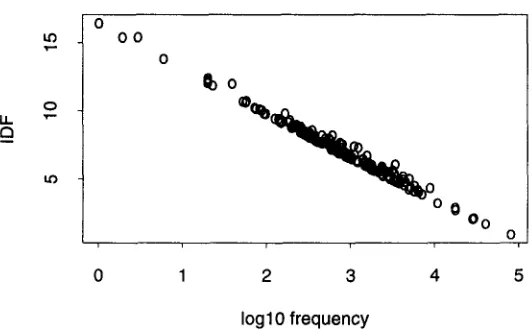
and word frequency, fw. The relationship is shown in Figure 1, a plot of iog]0fw and IDF for 193 words selected from a 50 million word corpus of 1989 Associated Press (AP) Newswire stories (D = 85,432 stories).Although log lofw is highly correlated with IDF (p = - 0 . 9 9 4 ) , it would be a mistake to assume that the two variables are completely predictable from one another. Indeed, the experience of the Information Retrieval community has indicated that IDF is a very useful quantity. Attempts to replace IDF with fw (or some simple transform offw) have not been very successful.
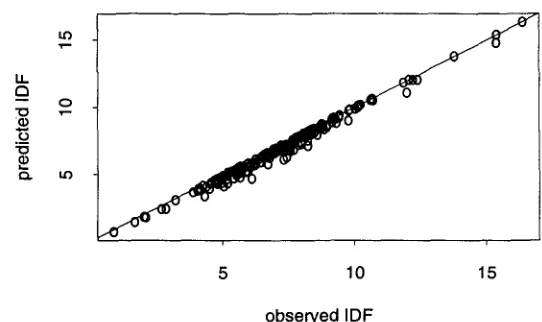
Figure 2 shows one such attempt. It compares the observed
IDF
withII~F, an
estimate based on f Assume that a document is merely a "bag of words" with no interesting structure (content). Words are randomly generated by a Poisson process, n. The probability of k instances of a word w is n ( 0 , k )fw
e-O O k
n ( 0 , k ) - for k = 0,1, • • • Poisson
k!
In particular, the probability that w will not be found in a document is n ( 0 , 0 ) . Conversely, the probability of at least one w is 1 - n ( 0 , 0 ) . And therefore, IDF ought to be:
119F = - log 2 ( 1 - rt (0,0) ) = - log 2 ( 1 - e - 0 ) Predicted IDF Figure 2 compares I D F with Ii)F. Note that I1)F is systematically too low, indicating that the predictions are missing crucial generalizations. Documents are more than just a bag of words.
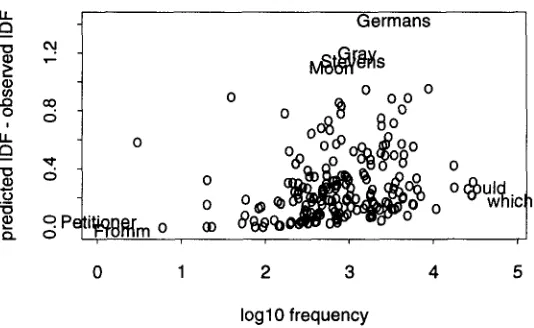
The prediction errors are shown in more detail in Figure 3, which plots the residual IDF (difference between predicted and observed) as a function of log lofw for the same 193 words shown in Figure 2. The prediction errors are relatively large in the middle of the frequency range, and smaller at both ends. Unfortunately, we believe the words in the middle are often the most important words for Information Retrieval purposes.
U. E3
tO
0
to 0
O 0
I b o
0 Oo
o
i
0 1 2 3 4 5
IoglOfrequency
Figure 1" IDF is highly correlated with log frequency (p = - 0 . 9 9 4 ) . The circles show lOgl0f and IDF for 193 words selected from a corpus of
1989 Associated Press Newswire stones (D = 85,432).
2. A Good Keyword is far from Poisson
[image:2.612.163.429.351.516.2]tO
"O
"O
5 10 15
observed IDF
Figure 2: The observed IDF is systematically lower than what would be expected under a Poisson, - log2 ( 1 - e -ff/D ). All but 6 o f the circles fall below the x = y line. The data are the same as in Figure 1.
W h y is IDF such a useful quantity? One might try to answer the question in terms o f information theory (Shannon, 1948). IDF can be thought o f as the usefulness in bits o f a k e y w o r d to a k e y w o r d retrieval system. I f we tell you that the d o c u m e n t that we are looking for has the k e y w o r d boycott, then we have narrowed the search space d o w n to just 676/D documents.
But, this answer d o e s n ' t explain the fundamental difference between boycott and somewhat, boycott
has an IDF o f - l o g 2 6 7 6 / D = 7 . 0 bits, only a little more than somewhat, which has an IDF o f
- log 2 9 7 9 / D = 6.4. And yet, boycott is a reasonable k e y w o r d and somewhat is not.
A good keyword, like boycott, picks out a very specific set o f documents. The problem with somewhat
is that it behaves almost like chance (Poisson). Under a Poisson, the 1013 instances o f somewhat
should be found in approximately D ( 1 - n ( 0 , 0 ) ) = D ( 1 - n ( 1 0 1 3 / 8 5 4 3 2 , 0 ) ) = 1007 documents. In fact,
somewhat was f o u n d in 979 documents, only a little less than what would have been expected by chance. G o o d k e y w o r d s tend to bunch up into many f e w e r documents, boycott, for example, bunches up into only 676 documents, much less than chance ( D ( 1 - r r ( 1 0 0 9 / 8 5 4 3 2 , 0 ) ) = 1 0 0 3 ) . Almost all words are more " i n t e r e s t i n g " in this sense than Poisson, but good k e y w o r d s like boycott are a lot more interesting than Poisson, and c r u m m y ones like somewhat are only a little more interesting than Poisson.
There is a weak tendency for nouns to appear higher on the list than non-nouns, though tendency is too weak to explain the pattern of the systematic deviations from Poisson. In addition, there are plenty of exceptions in both directions: raPe, pool, grants, code and premier are not necessarily nouns, and sweeping, leads, bound and worry
[image:3.612.145.416.168.329.2]u_ C~
O 9
.Q CO
o d
i
u_ C~
d .ca ID
q P~ Q. 0
Germans
o o
o o o
o 8o o
o o^ ° c9 o 9 ~ ° ~ o
0',~ oo_ ~ " ' ~ o
o , - m , _ ~ ~ _tg^o
o o ° o o %ic,
titl~8~" m o m 8 ~ 9 % l;l~dpr'llg'°
0 1 2 3 4 5
I o g l O f r e q u e n c y
Figure 3: The Prediction errors are systematically positive. The errors tend to be larger in the middle of the frequency range (Germans), and smaller at both ends (Fromm, which). The data are the same as in Figures 1-2.
On this account, a good keyword is one that behaves very differently from the null hypothesis (Poisson). We conjecture that the best keywords tend to be found toward the middle of the frequency range, where there are relatively large deviations from Poisson, as illustrated in Figure 3. This hypothesis runs counter to the standard practice in Information Retrieval of weighting words by IDF, favoring extremely rare words, no matter how they are distributed.
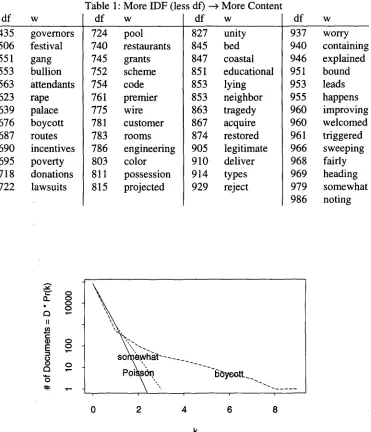
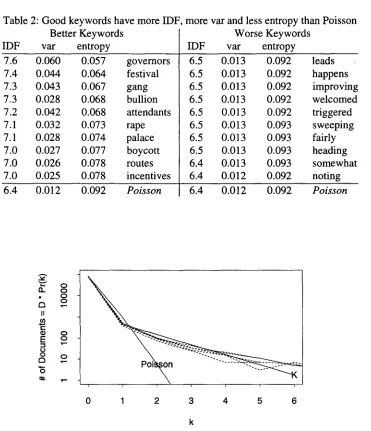
Of course, IDF is but one of many ways to show deviations from chance. Figure 4 shows the distributions for boycott and somewhat. Note that somewhat is much " c l o s e r " to Poisson in almost any sense of closeness that one might consider. Three measures of "closeness" are presented in Table 2: IDF, variance (o2), and entropy (H). Table 2 compares the top 10 words in Table 1 (labeled "better keywords") with the bottom 10 words in Table 1 (labeled "worse keywords"). The better keywords have more IDF, more variance and less entropy than what would be expected under a Poisson with O= f /D= 1000/85,432=0.012.
3. H o w r o b u s t are these deviations f r o m chance?
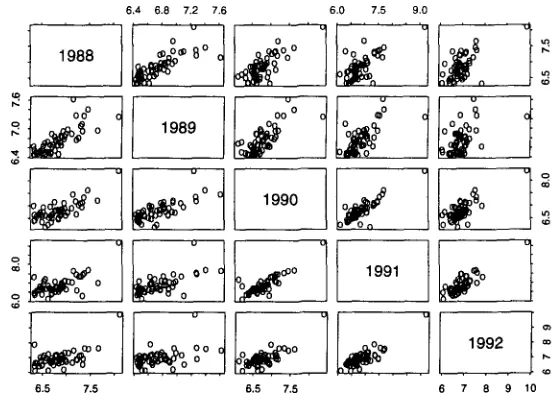
We were concerned that the crucial deviations from Poisson behavior might not hold up if we looked at another corpus of similar material. Figure 5 shows the word boycott in five different years of the AP news. The "fat tails" show up in each of the five years. Clearly, the non-Poisson phenomenon is robust.
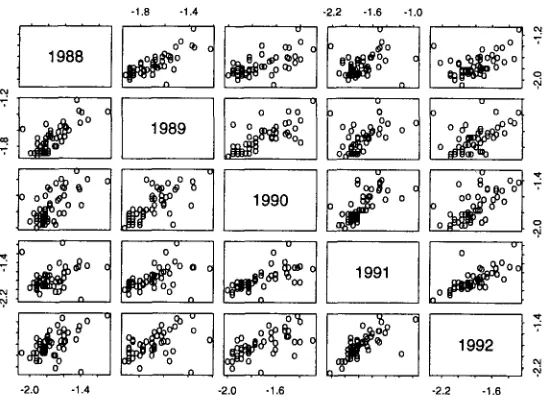
Figures 6 and 7 compare IDF and log 10 o 2 for the 53 words in Table 1, and find that IDF and log lo (I2
are reasonably stable across years. The correlations of IDF and log 10 (y2 across years are presented in
[image:4.612.164.431.162.326.2]df 435 506 551 553 563 623 639 676 687 690 695 718 722 W governors festival gang bullion attendants rape palace boycott routes incentives poverty donations lawsuits
Table 1: More IDF (less df)
df w df
724 pool 740 restaurants 745 grants 752 scheme 754 code 761 premier 775 wire 781 customer 783 rooms 786 engineering 803 color 811 possession 815 projected
More Content W
827 unity 845 bed 847 coastal 851 educational 853 lying 853 neighbor 863 tragedy 867 acquire 874 restored 905 legitimate 910 deliver 914 type s 929 reject
df 937 940 946 951 953 955 960 960 961 966 968 969 979 986 W worry containing explained bound leads happens improving welcomed triggered sweeping fairly heading somewhat noting II E 0 o
P0i~6n ... ...
6by¢.ott.h~al
"--.. ...
0 2 4 6 8
Figure 4: Most words have a fatter tail than Poisson (solid line). The deviations from Poisson are more salient for good keywords like boycott, than for crummy keywords like somewhat.
surprising given that empirical estimates of variance are notoriously subject to outliers. None of the correlations in Tables 3 and 4 can be attributed to word frequency effects since the 53 words were all chosen with almost the same 1989 frequency.
[image:5.612.109.480.110.542.2]Table 2: Good keywords have more IDF. more var and less entropy than Poisson
Better Keywords Worse Keywords
IDF var entropy
7.6 0.060 0.057 governors 7.4 0.044 0.064 festival
7.3 0.043 0.067 gang
7.3 0.028 0.068 bullion 7.2 0.042 0.068 attendants
7.1 0.032 0.073 rape
7.1 0.028 0.074 palace 7.0 0.027 0.077 boycott 7.0 0.026 0.078 routes 7.0 0.025 0.078 incentives
6.4 0.012 0.092 Poisson
IDF var entropy
6.5 0.013 0.092 leads
6.5 0.013 0.092 happens
6.5 0.013 0.092 improving
6.5 0.013 0.092 welcomed
6.5 0.013 0.092 triggered 6.5 0.013 0.093 sweeping 6.5 0.013 0.093 fairly 6.5 0.013 0.093 heading
6.4 0.013 0.093 somewhat
6.4 0.012 0.092 noting
6.4 0.012 0.092 Poisson
a. 8
h
II
"E e £
:3
t J
0
o £ "5
4 I T I [ I I
0 1 2 3 4 5 6
Figure 5: The strong deviations from Poisson for the word boycott show up very clearly in the AP in 1988, 1989, 1990, 1991 and 1992 (dotted lines). Katz' K-mixture (Katz, personal communication), the solid line labelled " K , " fits the data better than the Poisson.
[image:6.612.126.497.87.518.2]i
1988
o
°~o~)
°
6 . 5 7 . 5
6.4 6.8 7,2 7.6 6.0 7.5
o
,~ g
o
%0
1989
u
•
% B °° ~ °°
°°
1990 l ~ o ~
u
o OOo
6.5 7.5
1991
9.0
°_,~°
~ X o
1992 ®
7 8 9 10
Figure 6: IDF in one year of the AP is very predictive of IDF in another (for the 53 words in Table 1). Each scatter plot compares IDF in one year with IDF in another. The fact that most of the points line up fairly well indicates that IDF values are strongly correlated across years. The correlations are shown in Table 3.
4. Katz' K-mixture
Clearly, the Poisson does not fit our data very well, especially for good keywords like
boycott.
however, a negative result. Can we say something more constructive?
This is,
Katz (personal communication) proposed the following alternative to the Poisson.
Prg(k)
is the probability of k instances of w in a document.o~ 13 k
Prg(k)
= ( l - c 0 ~k,0 + ~ - ( ~ - ) K-mixture5k,0 is 1 when k = 0 , and 0 otherwise. Katz' K-mixture distribution can be thought of as a mixture of Poissons. Suppose that, within documents,
boycott
is distributed by a Poisson process, but, across documents, the Poisson parameter 0 is allowed to vary from one document to another depending on how much the document is about boycotts. In other words,Prg(k)
can be expressed as a convolution of Poissons with a density function ~:oo
Pr(k) = f ~(0) n(O,k)dO
for k = 0, 1, • • • Poisson Mixture0
[image:7.612.152.428.140.337.2]l 1988
o o
u o
° ~ o o o ~
o o
. O . 0 .
-2.0 -1.4
-1.8 -1.4
'u
-2.2 -1.6 -1.0
. . . . t
. . . ol
o o~ o ~ ~o I o oo °
8_°~o °80 o°-~°o ~ o o,d,l,,~o
t
o o o o o
o 7O t
1990 : o ~ o o |o~:lYYt'~ I
1991 ~ °o°
o
o 1992
1 . . . o,i
-2.2 -1.6
u o
C o
o ~
-2.0 - 1.6
1989
o o O o ~
0 v
n
(y2
Figure 7: log 10 is also predictable from one year to the next, though maybe not as predictable as IDF (for the 53 words in Table 1). The correlations are shown in Table 4.
Table 3: Correlations o f I D F across years
1988 1989 1990 1991 1992
1988 1989 1990 1991 1992 Tabh 1988 1989 1990 1991 1992
0.80 0.76 0.68 0.60
0.80 0.75 0.67 0.48
0.76 0.75 0.85 0.76
0.68 0.67 0.85 0.84
0.60 0.48 0.76 0.84 4: Correlations of log var across years
1988 1989 1990 1991 1992
0.74 0.61 0.25 0.67
0.74 0.73 0.42 0.51
0.61 0.73 0.50 0.61
0.25 0.42 0.50 0.62
0.67 0.51 0.61 0.62
Table 5: Correlations of IDF, log var and H in 1989 with log f in other years 1988 log f 1990 log f 1991 log f 1992 log f 1989 IDF
1989 log var 1989 H
-0.18 -0.14 -0.20
-0.13 -0.11 -0.14
0.17 0.15 0.20
In the case of Katz' K-mixture, ~ ( 0 ) is assumed to be (1 - ~ ) 5 ( 0 ) + - ~ - e function, oo when k = 0, and otherwise, 0.
-0.17 -0.12 0.16
0
[image:8.612.169.442.129.328.2] [image:8.612.137.513.375.688.2]Katz' K-mixture has two parameters, cc and [3. The ~ parameter determines the fraction of relevant and irrelevant documents. 1 - cx of the documents have no chance of mentioning boycott (0 = 0) because they are totally irrelevant to boycotts. The [3 parameter determines the average 0 among the relevant documents.
The two parameters, tx and [3, can be fit from almost any pair of variables considered thus far, e.g., f, IDF, t~ 2, H. We have found t h a t f a n d IDF are particularly easy to work with, and are more robust than some others such as ~2.
~ : f 21DF - 1
f 1
( Z . ~ h
-D[3
It has been our experience that Katz' K-mixture fits the data much better than the Poisson, as can be seen in Figure 5. Unlike the Poisson, the K-mixture has two parameters, tx and [3, and can therefore account for the fact that IDF and f a r e not completely predictable from one another.
In related work (Church and Gale, submitted), we looked at a number of different Poisson mixtures, and found that our data can also be fit by a negative binomial, which can be viewed as a Poisson mixture where Oun (0) is a Gamma distribution (Johnson and Kotz, 1969). See Mosteller and Wallace (1964) for an example of how to use the negative binomial in a Bayesian discrimination task. It is straightforward to generalize the Mosteller and Wallace approach to use Katz' K-mixture or any other mixture of Poissons.
5. Conclusions
Documents are much more than just a bag of words. The Poisson distribution predicts that lightning is unlike to strike twice in a single document. We shouldn't expect to see two or more instances of boycott in the same document (unless there is some sort of hidden dependency that goes beyond the Poisson). But when it rains, it pours. If a document is about boycotts, we shouldn't be surprised to find two boycotts or even a half dozen in a single document. The standard use of the Poisson in modeling the distribution of words and ngrams fails to fit the data except where there are almost no interesting hidden dependencies as in the case of somewhat.
Why are the deviations from Poisson more salient for "interesting" words like boycott than for "boring" words like somewhat? Many applications such as information retrieval, text categorization, author identification and word-sense disambiguation attempt to discriminate documents on the basis of certain hidden variables such as topic, author, genre, style, etc. The more that a keyword (or ngram) deviates from Poisson, the stronger the dependence on hidden variables, and the more useful the keyword (or ngram) is for discriminating documents on the basis of these hidden dependences. Similar arguments apply in a host of other important applications such as text compression and language modeling for speech recognition where it is desirable for word and ngram probabilities to adapt appropriately to frequency changes due to various hidden dependencies.
correlated (p = - 0.994), it would be a mistake to try to model one with a simple transform of the other. Figure 5 showed one such attempt, where f was transformed into a predicted IDF by introducing a Poisson assumption: I / ) F = - l o g 2 ( l - e - ° ) , with 0=--.fw Unfortunately, the prediction errors were
D
relatively large for the most important keywords, words with moderate frequencies such as Germans.
To get a better look at the subtle differences between document frequency and word frequency, we focused our attention on a set of 53 words that all had approximately the same word frequency in a corpus of 1989 AP stories. Table 1 showed that words with larger IDF tend to have more content. boycott, for example, is a better keyword than somewhat because it bunches up into a relatively small set of documents. Table 2 showed that variance and entropy can also be used as a measure of content (at least among a set of words with more or less the same word frequency). A good keyword like boycott is farther from Poisson (chance) than a crummy keyword like somewhat by almost any sense of closeness that one might consider, e.g., IDF, variance, entropy. These crucial deviations from Poisson are robust. We showed in section 4 that deviations from Poisson in one year of the AP can be used to predict deviations in another year of the AP.
Acknowledgments
This work benefited considerably from extensive discussions with Slava Katz.
References
Church, K., and Gale, W. (submitted) Poisson Mixtures.
Johnson, N., and Kotz, S. (1969) Discrete Distributions, Houghton Mifflin, Boston. Katz, S. (in preparation).
Mosteller, Fredrick, and David Wallace (1964) Inference and Disputed Authorship: The Federalist, Addison-Wesley, Reading, Massachusetts.
Salton, G. (1989)Automatic Text Processing, Addison-Wesley.
Shannon, C. (1948) " T h e Mathematical Theory of Communication," Bell System Technical Journal.
Sparck Jones, K. (1972) " A Statistical Interpretation of Term Specificity and its Application in Retrieval," Journal of Documentation, 28:1, pp. 11-21.