University of Windsor University of Windsor
Scholarship at UWindsor
Scholarship at UWindsor
Electronic Theses and Dissertations Theses, Dissertations, and Major Papers
2011
Efficient Motion Estimation and Mode Decision Algorithms for
Efficient Motion Estimation and Mode Decision Algorithms for
Advanced Video Coding
Advanced Video Coding
Mohammed Golam SarwerUniversity of Windsor
Follow this and additional works at: https://scholar.uwindsor.ca/etd
Recommended Citation Recommended Citation
Sarwer, Mohammed Golam, "Efficient Motion Estimation and Mode Decision Algorithms for Advanced Video Coding" (2011). Electronic Theses and Dissertations. 439.
https://scholar.uwindsor.ca/etd/439
Efficient Motion Estimation and Mode Decision
Algorithms for Advanced Video Coding
by
Mohammed Golam Sarwer
A Dissertation
Submitted to the Faculty of Graduate Studies
through the Department of Electrical and Computer Engineering in Partial Fulfillment of the Requirements for
the Degree of Doctor of Philosophy at the University of Windsor
Windsor, Ontario, Canada
© 2011, Mohammed Golam Sarwer
All Rights Reserved. No part of this document may be reproduced, stored or otherwise
retained in a retrieval system or transmitted in any form, on any medium by any means
Declaration of Co-Authorship / Previous Publication
I. Co-Authorship Declaration
I hereby declare that this thesis incorporates material that is result of joint research, as follows:
This thesis also incorporates the outcome of a joint research undertaken by me under the supervision of Professor Dr. Jonathan Wu. The collaboration is covered in Chapter 3, 4, 5, 6, and 7 of the thesis. In all cases, the key ideas, primary contributions, experimental designs, data analysis and interpretation, were performed by the author, and the
contribution of co-author was primarily through the provision of valuable suggestions and helping in comprehensive analysis of the simulation results for publication.
I am aware of the University of Windsor Senate Policy on Authorship and I certify that I have properly acknowledged the contribution of other researchers to my thesis, and have obtained written permission from each of the co-author(s) to include the above
material(s) in my thesis.
I certify that, with the above qualification, this thesis, and the research to which it refers, is the product of my own work.
II. Declaration of Previous Publication
This thesis includes 16 original papers that have been previously published/submitted for publication in peer reviewed journals and conferences, as follows:
Thesis Chapter
Publication title/full citation Publication
status* Mohammed Golam Sarwer, and Q.M. Jonathan Wu
“Efficient Two Step Edge based Partial Distortion Search for Fast Block Motion Estimation” IEEE Transactions on Consumer Electronics, Vol. 55, No. 4, Nov. 2009, pp. 2154-2162.
published
Mohammed Golam Sarwer, and Q.M. Jonathan Wu, “Fast Block Motion Estimation by edge based partial distortion search”, Proceedings of the IEEE International Conference on Image Processing 2009 (ICIP-2009), Cairo, Egypt, November 7-10, 2009, pp. 1573 - 1576.
published
Chapter 3
Mohammed Golam Sarwer, and Q.M. Jonathan Wu, “Efficient Partial Distortion Search Algorithm for Block based Motion Estimation”, Proceedings of the IEEE CCECE 2009, St John’s, NL, pp. 890-893.
published
Mohammed Golam Sarwer, and Q.M. Jonathan Wu “Adaptive Variable Block-Size Early motion estimation
termination algorithm for H.264/AVC Video Coding
Standard.” IEEE Transaction on Circuit and System for Video Technology, volume 19, number 8, August 2009, pp 1196-1201.
Mohammed Golam Sarwer, Thanh Minh Nguyen and Q.M. Jonathan Wu, “Fast Motion estimation of H.264/AVC by adaptive early termination”, Proceedings of the 10th IASTED International Conference SIP 2008, HI, USA, pp. 140-145.
published
Chapter 4
Mohammed Golam Sarwer, and Q.M. Jonathan Wu, “Region Based Searching for Early Terminated Motion Estimation Algorithm of H.264/AVC Video Coding Standard”, Proceedings of the IEEE CCECE 2009, St John’s, NL, pp. 468-471.
published
Mohammed Golam Sarwer, and Q.M. Jonathan Wu, " An Efficient search range Decision Algorithm for Motion Estimation of H.264/AVC, " International Journal of Circuits, Systems and Signal Processing, vol. 3, issue 4, pp. 173-180, 2009.
published
Chapter 5
Mohammed Golam Sarwer, and Q.M. Jonathan Wu, “Adaptive Search Area Selection of Variable Block-Size Motion Estimation of H.264/AVC Video Coding Standard”, IEEE International Symposium on Multimedia ISM 2009, San Diego, California, USA, December 14-16, 2009, pp. 100-105.
published
Mohammed Golam Sarwer, and Q.M. Jonathan Wu
“Improved Intra Prediction of H.264/AVC” accepted in the book "Video Coding", ISBN 978-953-7619-X-X, IN-TECH publisher.
In Press
Mohammed Golam Sarwer, and Q.M. Jonathan Wu, “Enhanced Intra Coding of H.264/AVC Advanced Video Coding Standard with Adaptive Number of Modes”, International Conferences on Active Media Technology (AMT 2010), Toronto, Canada, LNCS 6335, pp. 361–372, August 2010.
published
Mohammed Golam Sarwer, and Q.M. Jonathan Wu, “A Novel Bit Rate Reduction Method of H.264/AVC Intra Coding”, International Congress on Image and Signal Processing (CISP'10), 16-18 October 2010, Yantai, China, pp. 24-28.
published
Mohammed Golam Sarwer, and Q. M. Jonathan Wu, " Improved DC Prediction for H.264/AVC intra Coding " 2011 International Conference on Communication and Electronics Information - ICCEI 2011, Haikou, China.
Accepted Chapter 6
Advanced Video Coding Standard”. Submitted to Journal of
Visual Communication and Image Representation. Mohammed Golam Sarwer, and Q.M. Jonathan Wu
“Enhanced SATD based Cost Function for Mode Selection of H.264/AVC Intra Coding”. Submitted to Springer Journal of Signal, Image and Video Processing.
Submitted Chapter 7
Mohammed Golam Sarwer, and Q.M. Jonathan Wu
“Enhanced low complex cost function of H.264/AVC intra mode decision”. International Conference on Multimedia and Signal Processing (CMSP'11), China,
Accepted
Mohammed Golam Sarwer, Q.M. Jonathan Wu, X. P Zhang “Efficient rate-distortion optimization of H.264/AVC intra coder”. Submitted to International Conference on Image Proceeding, 2011
Submitted
I certify that I have obtained permission from the copyright owner(s) to include the above published material(s) in my thesis. I certify that the above material describes work completed during my registration as graduate student at the University of Windsor.
I declare that, to the best of my knowledge, my thesis does not infringe upon anyone’s copyright nor violate any proprietary rights and that any ideas, techniques, quotations, or any other material from the work of other people included in my thesis, published or otherwise, are fully acknowledged in accordance with the standard referencing practices. Furthermore, to the extent that I have included copyrighted material that surpasses the bounds of fair dealing within the meaning of the Canada Copyright Act, I certify that I have obtained a written permission from the copyright owner(s) to include such material(s) in my thesis.
ABSTRACT
H.264/AVC video compression standard achieved significant improvements in coding
efficiency, but the computational complexity of the H.264/AVC encoder is drastically
high. The main complexity of encoder comes from variable block size motion
estimation (ME) and rate-distortion optimized (RDO) mode decision methods.
This dissertation proposes three different methods to reduce computation of motion
estimation. Firstly, the computation of each distortion measure is reduced by proposing
a novel two step edge based partial distortion search (TS-EPDS) algorithm. In this
algorithm, the entire macroblock is divided into different sub-blocks and the calculation
order of partial distortion is determined based on the edge strength of the sub-blocks.
Secondly, we have developed an early termination algorithm that features an adaptive
threshold based on the statistical characteristics of rate-distortion (RD) cost regarding
current block and previously processed blocks and modes. Thirdly, this dissertation
presents a novel adaptive search area selection method by utilizing the information of
the previously computed motion vector differences (MVDs).
In H.264/AVC intra coding, DC mode is used to predict regions with no unified
direction and the predicted pixel values are same and thus smooth varying regions are
not well de-correlated. This dissertation proposes an improved DC prediction (IDCP)
mode based on the distance between the predicted and reference pixels. On the other
hand, using the nine prediction modes in intra 4x4 and 8x8 block units needs a lot of
overhead bits. In order to reduce the number of overhead bits, an intra mode bit rate
reduction method is suggested. This dissertation also proposes an enhanced algorithm to
estimate the most probable mode (MPM) of each block. The MPM is derived from the
prediction mode direction of neighboring blocks which have different weights according
to their positions. This dissertation also suggests a fast enhanced cost function for mode
decision of intra encoder. The enhanced cost function uses sum of absolute
Hadamard-transformed differences (SATD) and mean absolute deviation of the residual block to
estimate distortion part of the cost function. A threshold based large coefficients count is
Dedicated to
my mother FIROJA BEGUM, and
my wife DILSHAD HUSSAIN
ACKNOWLEDGEMENT
I would like to express my sincere appreciation to Professor Jonathan Wu, my advisor,
for his excellent guidance and invaluable support, which helped me accomplish the
doctorate degree and prepared me to achieve more life goals in the future. His total
support of my dissertation and countless contributions to my technical and professional
development made for a truly enjoyable and fruitful experience. Special thanks are
dedicated for the discussions we had on almost every working day during my research
period and for reviewing my dissertation.
I would also like to thank my doctoral committee members Dr. Imran Ahmad, Dr. Esam
Abdel-Raheem and Dr. Kemal Tepe for their valuable comments and suggestions. Also,
thanks to all my colleagues and friends at Computer Vision and Sensing System
Laboratory of University of Windsor.
I am indebted to my immediate family and extended family; all of them have patiently
supported me throughout my entire academic journey. It is impossible to express my
love and appreciation to my wife Dilshad Hussain in a word. Finally my deepest
gratitude goes to my father (in the heaven) and mother who have devoted their
TABLE OF CONTENTS
DECLARATION OF CO-AUTHORSHIP/PREVIOUS PUBLICATION…...………...iv
ABSTRACT ..………vii
DEDICATION………viii
ACKNOWLEDGEMENT………ix
LIST OF TABLES…...………...xiii
LIST OF FIGURES…….………...………xv
LIST OF ABBREVIATIONS……….…….xvii
CHAPTERS 1. INTRODUCTION………1
1.1 Video compression standards...2
1.2 Statement of the problem ...5
1.3 Contribution of the dissertation ...7
1.4 Organization of the dissertation ...9
2. OVERVIEW OF H.264/AVC………..….12
2.1 History... 12
2.2 Terminology ... 13
2.3 H.264/AVC Profiles ... 16
2.4 Block diagram of H.264/AVC... 18
2.5 Intra Prediction ... 19
2.5.1 Intra 4x4 Prediction ... 21
2.5.2 Intra 8x8 Prediction ... 22
2.5.3 Intra 16x16 Prediction ... 23
2.5.4 Intra Croma Prediction... 23
2.6 Inter Prediction ... 24
2.6.1 Basic assumptions of motion estimation ... 25
2.6.2 Block based Motion Estimation ... 26
2.6.3 Variable Block size Motion Estimation... 28
2.6.4 Sub-Pixel Motion Estimation... 29
2.6.5 Multiple Reference Frame Motion Compensation…... 30
2.6.7 Rate-distortion optimized Motion estimation ... 31
2.7 Integer Transform and Quantization... 32
2.8 Entropy Coding ... 34
3. EDGE BASED PARTIAL DISTORTION SEARCH………..36
3.1 Literature Review ... 37
3.2 Partial Distortion Search (PDS) ... 40
3.3 Normalized Partial Distortion Search (NPDS)... 42
3.4 Proposed Edge based Partial Distortion Search (EPDS) ... 43
3.4.1 EPDS... 43
3.4.2 Enhanced EPDS ... 46
3.5 Two-step Edge based Partial Distortion Search (TS-EPDS) ... 48
3.6 Simulation Results ... 55
3.6.1 Experiments in Motion Estimation Package ... 55
3.6.2 Experiments in H.264/AVC ... 58
3.7 Summary ... 61
4. EARLY TERMINATED MOTION ESTIMATION………...62
4.1 Challenges and Literature Survey... 63
4.2 Algorithm of Proposed Early Termination ... 65
4.3 Statistical Analysis of RD Cost function ... 66
4.4 Threshold Selection ... 71
4.5 Region-based Search Order for Full Search ME... 75
4.6 Search Point reduction of Multi-Hexagon Grid Search... 81
4.7 Simulation Results ... 83
4.7.1 Experiments with Full Search (FS) ME... 85
4.7.2 Experiments with UMHS... 86
4.8 Summary ... 89
5. ADAPTIVE SEARCH AREA SELECTION………90
5.1 Literature Review ... 91
5.2 Proposed Adaptive Search Area Selection... 92
5.3 Simulation Results ... 96
5.3.1 Comparison with full search ME... 97
5.3.2 Comparison with other methods... 102
5.4 Summary ... 103
6.2 Review of H.264/AVC Intra Prediction... 108
6.3 Proposed Improved DC Prediction for 4x4 block ... 111
6.4 Proposed Intra Mode Bit Reduction (IMBR) for 4x4 and 8x8 block ... 114
6.4.1 Adaptive numbers of modes (ANM) ... 114
6.4.1.1 Case 1 ... 115
6.4.1.2 Case 2 ... 117
6.4.2 Selection of Most Probable Mode (MPM)... 123
6.5 Simulation Results ... 126
6.5.1 Experiments with 4x4 intra modes only ... 127
6.5.2 Experiments with all intra modes ... 132
6.6 Summary ... 133
7. ENHANCED SATD BASED COST FUNCTION………..…134
7.1 Cost functions of H.264/AVC intra prediction ... 135
7.2 The Cause of Sum of Square Differences (SSD) ... 140
7. 3 Enhanced SATD based Cost Function... 141
7. 4 Simulation Results ... 146
7.4.1 Rate-distortion performance comparison... 147
7.4.2 Complexity comparison ... 149
7.4.3 Comparison with other method ... 151
7. 5 Summary ... 152
8. CONCLUSION AND FUTURE WORKS………..……..….153
8.1 Concluding Remarks... 153
8.2 Future Works... 157
REFERENCES... 158
APPENDICES A. Encoder Configuration... 175
LIST OF TABLES
1.1 Encoding time of different video coding standards [20] ...7
2.1 Features of different profiles ... 17
2.2 Nine intra 4x4 prediction modes ... 21
2.3 Four intra 16x16 prediction modes... 23
2.4 Multiplication factor MF [17] ... 33
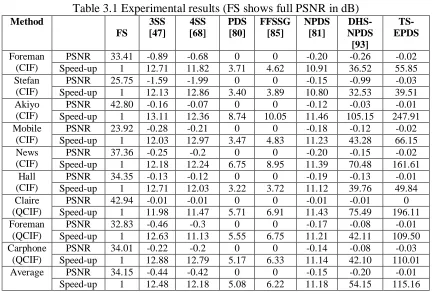
3.1 Experimental results (FS shows full PSNR in dB)... 55
3.2 Experimental results in H.264/AVCB ... 59
4.1 (a) RD cost correlation between 16x16 mode of current MB and 16x16 mode of the candidate MB ... 68
4.1 (b) RD cost correlation of 16x8 block size motion estimation ... 68
4.1 (c) RD cost correlation of 8x16 block size motion estimation... 68
4.1(d) RD cost correlation of 8x8 block size motion estimation ... 69
4.1(e) RD cost correlation of 8x4 block size motion estimation ... 69
4.1(f) RD cost correlation of 4x8 block size motion estimation ... 70
4.1(g) RD cost correlation of 4x4 block size motion estimation ... 70
4.2 value of A , B and Dof (4.8) for different video sequences ... 75
4.3 % of the event “MV at target mode=MV with previously calculated mode”... 77
4.4 Selection of most probable region ... 78
4.5 Percentage of most probable region ... 78
4.6 Rate of four different hexagons % (order: inner to outer) ... 81
4.7 Simulation conditions ... 83
4.8 Comparison with full search motion estimation... 85
4.9 Comparison with UMHS ... 87
4.10 Comparison with other methods at 30 fps ... 88
weighting factors ( Wi) of equation (5.1) and (5.2) ... 93
5.2. Simulation Conditions ... 97
5.3 Comparison with full search ME with IPPP.. sequences... 101
5.4 Comparison with full search ME with IPBPBP.. sequences... 101
5.5 (a) Comparison with [104] ... 103
5.5 (b) Comparison with [106]... 103
6.1 Value of m and n of (2) with different predicted pixels ... 112
6.2 Value of Cr with different values of r ... 114
6.3 Binary representation of modes of case 2 ... 118
6.4 Prediction modes recording of the proposed method ... 120
6.5 Percentage of different MBs ... 120
6.6 (a) Percentage of different categories of 4x4 blocks (only 4x4 mode is enabled) .... 121
6.6 (b) Percentage of different categories of 8x8 blocks (only 8x8 mode is enabled) .... 121
6.7 Mode directions (θm ) ... 123
6.8(a) PSNR performances of proposed methods (only 4x4 modes, All I frames) ... 128
6.8(b) Bit rate performances of proposed methods (only 4x4 modes, All I frames) ... 128
6.8(c) Encoder Complexity comparisons of proposed methods (only 4x4 modes, All I frames) ... 129
6.8(d) Decoder Complexity comparisons of proposed methods (only 4x4 modes,All I frames) ... 129
6.9 Experimental results of proposed methods (All I frames, all Intra modes) ... 132
7.1 Quantization step sizes Qstep in H.264/AVC codec ... 144
7.2 PSNR and bit rate Comparison ... 148
7.3 Complexity comparison ... 150
LIST OF FIGURES
1.1 Progression of the ITU-T Recommendations and MPEG standards ...3
2.1 Block diagram of H.264/AVC encoder ... 18
2.2 (a) Prediction samples of a 4x4 block... 20
2.2 (b) Nine prediction mode of a 4x4 block ... 20
2.3 Intra 16x16 prediction modes... 23
2.4 The luminance component of ‘Stefan’ at (a) frame 70, and (b) frame 71. The residual pictures by subtracting the frame 70 from frame 71 (c) without motion compensation, and (d) with motion compensation. ... 24
2.5 Block matching motion estimation... 26
2.6 a search point in a search window ... 27
2.7 Block sizes for motion estimation of H.264/AVC ... 28
2.8 CABAC encoder block diagram... 35
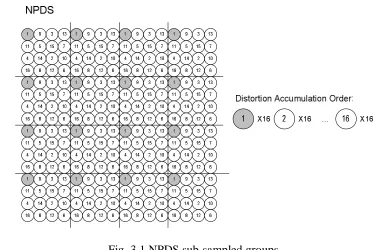
3.1 NPDS sub-sampled groups ... 42
3.2 (a) Partition of a MB (b) Pixels of a 4x4 sub-block. ... 43
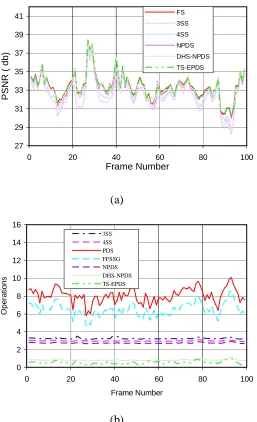
3.3 Number of total operation of each frame of the tested algorithms of Foreman (X-axis: Frame number; Y-(X-axis: No. of operation in 107) ... 46
3.4 Flow diagram of enhanced EPDS algorithm... 47
3.5 A plot of SAD values over the search area ... 49
3.6 Selected search points in the proposed method... 49
3.7 Probability distribution of differential MVs ... 50
3.8. Plot of SADmin vs ES ... 53
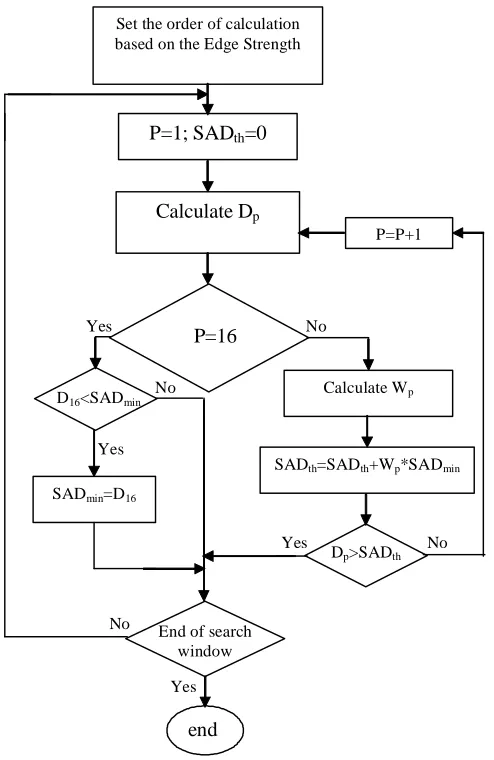
3.9 Overall algorithm of the proposed TS-EPDS... 54
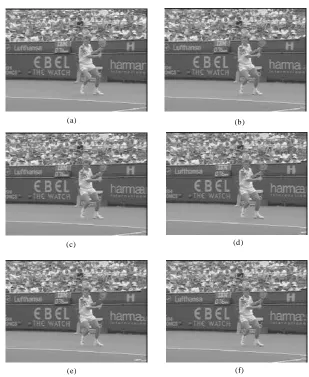
PSNR = 25.05 dB; (d) DHS-NPDS, PSNR = 24.28 dB; (e) 3SS, PSNR =
24.96 dB; and (f) TSEPDS, PSNR = 25.29 dB... 58
3.12 RD curves of FS and proposed method ... 60
4.1 Neighboring and collocated blocks ... 67
4.2 Variation of γ with Cm at QP=28 (a) Foreman (b) Akiyo ... 74
4.3 41 motion vectors of a MB... 76
4.4 Partitioned search range ... 76
4.5 Proposed search pattern ... 82
4.6 RD curves of full search method and proposed early termination method... 86
4.7 RD curves of FME and proposed method... 88
5.1 Proposed search area with (a) most probable quadrant = 1, (b) most probable quadrant = 2, (c) most probable quadrant = 3, (d) most probable quadrant =4 95 5.2 Frame by frame comparison of the proposed method with FS motion estimation of Flower video sequence (a) PSNR Comparison (b) Bit rate Comparison ... 98
5.3 Rate-distortion (RD) curves of different sequences with IPPP.. frames ... 99
5.4 Rate-distortion (RD) curves of different sequences with IPBPBPB.. frames... 100
6.1 (a) Prediction samples of a 4x4 block (b) direction of prediction modes of 4x4 and 8x8 blocks (c) prediction samples of a 8x8 block... 109
6.2 Case 1: All of the reference pixels have similar value ... 115
6.3 Variation of threshold T1 with QP... 116
6.4 Case 2: The reference pixels of up and up-right block have similar value... 117
6.5 Flow diagram of proposed intra mode bits reduction (IMBR) method ... 118
6.6 Current and neighboring blocks ... 123
6.7 RD curves of proposed method (only 4x4 mode, all I frames) ... 131
7.1 Computation of Rate-distortion (RD) cost function ... 136
7.2 Zig-zag scan and corresponding frequency of H... 145
LIST OF ABBREVIATIONS
DVD Digital Versatile Disk
DSL Digital Subscriber Line
ITU-T International Telecommunications Union, Telecommunication
Standardization Sector
VCEG Video Coding Expert Group
ISO International Organization for Standardization
MPEG Moving Picture Expert Group
VCD Video CD
CD-ROM Compact Disc Read Only Memory
PSTN Public Switched Telephone Network
AVC Advanced Video Coding
DMB Digital Multimedia Broadcasting
DVB-H Digital Video Broadcasting-Handheld
SD Standard-Definition
HD High-Definition
DCT Discrete Cosine Transform
CABAC Context-adaptive binary arithmetic coding
RD Rate-Distortion
RDO Rate-Distortion Optimization
ME Motion Estimation
QCIF Quarter Common Intermediate Format
CIF Common Intermediate Format
MVD Motion Vector difference
MPM Most Probable Mode
BMA Block-Matching Algorithm
FBMA Fast Block-Matching Algorithm
JVT Joint Video Team
TML Test Model Long-Term
JM Joint Model (H.264/AVC)
SVC Scalable Video Coding
MVC Multi-view Video Coding
3D Three Dimension
MB Macroblock
BP Baseline Profile
MP Main Profile
XP Extended Profile
BDM Block Distortion Measure
SAD Sum of Absolute Differences
SSD Sum of Squared Differences
MV Motion Vector
QP Quantization Parameter
MF Multiplication Factor
VLC Variable Length Coding
CAVLC Context-Adaptive Variable Length Coding
FS Full Search
PDS Partial Distortion Search
NPDS Normalized Partial Distortion Search
EPDS Edge based Partial Distortion Search
3SS Three Step Search
4SS Four Step Search
DS Diamond Search
NDS New Diamond Search
HEXBS Hexagon Based Search
CDS Cross Diamond Search
APDS Adjustable Partial Distortion Search
PSNR Peak Signal to Noise Ratio
HPDS Hadamard transform based Partial Distortion Search
DHS-NPDS Dual halfway stop Normalized Partial Distortion Search
FFSSG Fast Full Search with Sorting by Gradient
TS-EPDS Two-step Edge based Partial Distortion Search
UMHS Unsymmetrical-cross Multi-hexagon Grid Search
ET Early Termination
VBME Variable Block size Motion Estimation
MVP Motion Vector Predictor
ASR Adaptive Search Range
BIP Bi-directional Intra Prediction
DWP Distance based Weighted Prediction
IBS Intra mode Bits Skip
ANM Adaptive Numbers of Modes
IMBR Intra Mode Bit Reduction
FHT Fast Hadamard Transform
SAITD Sum of Absolute Integer Transform Differences
ESATD Enhanced Sum of Absolute Integer Transform Differences
IPTV Internet TV
1. Introduction
Chapter 1
Introduction
Digital video has taken the place of traditional analogue video in a wide range of
applications due to its compatibility with other types of data (such as voice and text).
However, digital video contains huge amount of data and despite the increases in
processor speed and disc storage capacity. For example, using a video format of
352x240 pixels with 3 bytes of color data per pixel, playing at 30 frames per second, 7.6
Megabytes of disc space is needed for one second of video and it is only feasible to store
around 10 minutes of video in a 4.3 Gigabytes Digital Versatile Disk (DVD). When it is
transmitted in real time through the internet, it requires a channel with 60.8 mbps. But
the data throughput of consumer DSL services typically ranges from 256 Kb/s to 20
Mbit/s in the direction to the customer (downstream), depending on DSL technology,
line conditions, and service-level implementation [32].
Video compression technologies are about reducing and removing redundant video data
so that a digital video file can be effectively sent over a network and stored on computer
1. Introduction
achieved with little or no adverse effect on the visual quality. There are two classes of
techniques for image and video compression: lossless coding and lossy coding [1].
Lossless coding techniques compress the image and video data without any loss of
information and the compressed data can be decoded exactly the same as original data;
however, these techniques obtain a very low compression ratio and result in large files.
Consequently, they are appropriate for applications requiring no loss introduced by
compression, for example, medical image storage. On the other hand, lossy coding
methods sacrifice some image and video quality to achieve a significant decrease in file
size and a high compression ratio. Lossy coding techniques are widely used in digital
image and video applications due to the high compression ratio provided. The goal of a
video compression algorithm is to achieve efficient compression as well as minimizing
the distortion introduced by the compression process [2].
1.1 Video compression standards
There are two main standardization bodies for video technology. Firstly, there is a
division of the International Telecommunication Union known as the ITU-T. The
specific division within the ITU-T which is in charge of multimedia data compression is
called Video Coding Experts Group (VCEG). The second organization is the
International Organization for Standardization (ISO). Within the ISO, the specific
committee which is responsible for data compression is the Moving Picture Experts
1. Introduction
The ITU-T video coding standards are called recommendations, and they are denoted
with H.26x (e.g., H.261, H.262, H.263 and H.264). The ISO/IEC standards are denoted
with MPEG-x (e.g., MPEG-1, MPEG-2 and MPEG-4). VCEG and MPEG have
researched the video coding techniques for various applications of moving pictures since
the early 1985s. Fig. 1.1 shows the progression of video coding standards.
Fig. 1.1 Progression of the ITU-T Recommendations and MPEG standards
Recommendation H.261 [4] was adopted as an international standard by the ITU-T in
1990. It was designed for use in video-conferencing applications at bit rates which are
integer multiples of 64 kbps. H.261 operates with very little encoding delay and minimal
computing overhead.
In 1992, MPEG released their first standard MPEG-1 [5]. The motivation behind
MPEG-1 was the efficient storage and retrieval of video and audio data from a
CD-ROM. Video CD (VCD) is a popular implementation of MPEG-1. MPEG-1 also
provided the well known audio compression format MPEG-1 Layer 3 (MP3).
In 1994, both VCEG and MPEG jointly developed MPEG-2 [6] as the standard for
1. Introduction
designed to handle higher resolutions than MPEG-1, as well as interlaced frames
(although progressive video is also supported). MPEG-2 borrows many techniques from
MPEG-1, with some modifications to handle interlacing. It supports bit-rates in the
range of 2 to 10 Mbps. Since MPEG-2 is the standard which is used for encoding
Digital Versatile Disks (DVDs), it is perhaps the most widely used multimedia data
compression standard.
Following advances in video coding, the ITU-T released H.263 [7] as a standard for use
in video telephony in 1995. It is a video coding standard for low bit rate video
communication over Public Switched Telephone Network (PSTN) and mobile networks
with transmission bit rates of around 10-24kbps or above. H.263 also offers rate, spatial
and temporal scalability in a similar way to MPEG-2. Two more versions of H.263 have
followed H.263+ [8] in 1998 and H.263++ [9-11] in 2000. While the H.263 series has
not been as widely recognized as MPEG, many products use it. For example, many
digital cameras use H.263 for capturing video.
The MPEG-4 [12, 13] standard was developed with the goal of being more than just an
incremental improvement on the previous two standards. MPEG-4 supports a wide
range of bit-rates, but is mainly focused on low bit-rate video. The first version of the
standard provides a very low bit-rate video coding, which is actually very similar to
baseline H.263 [14]. A fundamental concept in MPEG-4 is the idea of object-based
coding. This allows a scene to be described in terms of foreground and background
objects, which may be coded independently. However, since the standard only defines
1. Introduction
segmenting a scene into its constituent objects. This has resulted in a slow uptake in the
use of object-based coding for practical applications.
The ITU-T and ISO established a Joint Video Team to develop a new video
compression standard using a “back to basics” approach [15]. In 2003, they proposed
the H.264 standard [16-18], which has also been incorporated into MPEG-4 under the
name of Advanced Video Coding (AVC). The goal was to compress video at twice the
rate of previous video standards while retaining the same picture quality. Due to its
improved compression quality, H.264/AVC is quickly becoming the leading standard; it
has been adopted in many video coding applications such as the iPod and the Playstation
Portable, as well as in TV broadcasting standards such as Digital Video
Broadcasting-Handheld (DVB-H) and Digital Multimedia Broadcasting (DMB). Portable applications
primarily use the Baseline Profile up to standard-definition (SD) resolutions, while
high-end video coding applications such as set-top boxes, Blu-ray and high definition DVD
(HD-DVD) use the Main or High Profile at HD resolutions. The Baseline Profile does
not support interlaced content; the higher profiles do.
1.2 Statement of the problem
H.264/AVC is the newest international video compression standard. H.264/AVC has
been demonstrated to provide significant rate-distortion gains over previous standards,
and it is widely accepted as the state-of-the-art in video compression [17, 19].
H.264/AVC has many similar characteristics to previous standards, but some of the
1. Introduction
• Up to five reference fames may be used for motion estimation (as opposed to the
one or two frames used in previous standards).
• For each 16 × 16 macro-block, variable block size motion estimation is used.
This allows a range of different block sizes for motion compensation — from 16
× 16 down to 4 × 4 pixels. Using seven different block sizes and shapes can
translate into bit rate savings of more than 15% as compared to using only a
16x16 block size [21]. However, computational complexity of this method is
extremely high.
• Motion vectors can be specified to one-quarter pixel accuracy (or one eighth
pixel in the case of chrominance components).
• Intra-frame coding is performed using 4×4 blocks, based on a fast integer
approximation of the DCT. Spatial prediction within frames is also used to
achieve additional de-correlation.
• An adaptive de-blocking filter is used within the motion compensation loop in
order to improve picture quality.
• Context-adaptive binary arithmetic coding (CABAC) is employed
All of the above new features improve rate-distortion (RD) performance of the encoder
with the expense of extremely high computations. Among the several new features
which are introduced by H.264/AVC, the motion estimation (ME) and mode decision
process is highly computationally intensive than traditional algorithms. Therefore, the
development of efficient algorithms for the ME and mode decision of H.264/AVC is one
1. Introduction
that total encoding time of H.264/AVC baseline profile is around 106 times of H.263+.
It is easy to foresee that the computational complexity will further increase dramatically
if higher picture resolutions, for instant CIF (352x288) and CCIR-601 (720x480), are
required. Therefore, algorithms to reduce the computational complexity of H.264/AVC
without compromising the coding efficiency are indispensable for real time
implementation.
Table 1.1: Encoding time of different video coding standards [20] Standard-compliant encoder Total encoding time (second)
MPEG-1 26.65
H.263 66.37
H.263+ 126.70
H.264 Baseline Profile 13387.83
H.264 Main Profile 19264.53
H.264 Extended Profile 20713.22
The main purpose of this dissertation is to propose some fast motion estimation and
mode decision algorithms to reduce the complexity of the H.264/AVC encoder, at the
same time without degrading the picture quality as compared to original method.
1.3 Contribution of the dissertation
Within H.264/AVC video coding, motion estimation and rate-distortion optimized mode
decisions contributes to the largest gain in compression but both of these are also the
most computationally intensive parts. In motion estimation, similarities between
different video frames are searched and identified; redundant data are then eliminated or
minimized to reduce temporal redundancy within a video sequence. Many fast motion
estimation methods have been developed over the last decade, many of these methods
1. Introduction
computation of motion estimation module of H.264/AVC, following contributions has
been made.
• This dissertation proposes a novel edge based partial distortion search (EPDS)
algorithm [94] which reduces the computation of each distortion measure by
using partial distortion search.
• In order to reduce number of search points of EPDS algorithm, two step EPDS is
also developed [95].
• An adaptive early termination algorithm is developed to reduce the number of
search points that features an adaptive threshold based on the statistical
characteristics of rate-distortion (RD) cost function [73].
• A region-based searching strategy based on the orientation of the previously
calculated motion vectors is also suggested to further reduce the computation
requirement for full search ME [96].
• A search point reduction scheme for the fast motion estimation of H.264/AVC is
introduced [73].
• This dissertation also presents a novel adaptive search area selection method by
utilizing the information of the previously computed motion vector differences
(MVDs) [97].
Rate-distortion optimized intra mode decision is also one of the important coding tools
of H.264/AVC encoder. In order to improve performance of conventional intra coding,
this dissertation also developed following algorithms.
1. Introduction
• In order to reduce the number of overhead bits and computational cost, an intra
prediction method is also proposed in this dissertation. In this method, the
number of prediction modes for each 4x4 and 8x8 block is selected adaptively
[99].
• This thesis also proposes an algorithm to estimate the most probable mode
(MPM) of each 4x4 or 8x8 block [100].
• Finally, an enhanced low complexity rate-distortion cost function is introduced
for 4x4 intra mode decision of H.264/AVC encoder.
1.4 Organization of the dissertation
In chapter 2, a more detailed survey on the new video coding standard H.264/AVC is
provided. In this chapter, H.264/AVC profiles, intra and inter Prediction, variable block
size motion estimation, transform coding, quantization, discrete cosine transform
(DCT), entropy coding method are discussed. This chapter also reviewed sub pixel
motion estimation and rate distortion optimized motion estimation technique adopted
by H.264/AVC.
In chapter 3, a novel edge based partial distortion search (EPDS) algorithm which
reduces the computation of each distortion measure by using partial distortion search is
proposed. In this algorithm, the entire macroblock is divided into different sub-blocks
and the calculation order of partial distortion is determined based on the edge strength of
sub-blocks. A lossy algorithm is also presented that adaptively changes the early
termination threshold for every accumulated partial sum of absolute difference. In this
1. Introduction
vectors. The proposed method is compared with some well known methods and
simulation results are presented.
In chapter 4, an early termination algorithm with adaptive threshold is proposed to
reduce the number of search points of motion estimation module of H.264/AVC
encoder. The adaptive threshold is developed based on the statistical characteristics of
rate-distortion (RD) cost of the current block with that of previously processed block
and modes. This chapter also proposed a region based search to further reduce the
computation of full search motion estimation. A search point reduction scheme of fast
motion estimation of H.264/AVC is also introduced in this chapter.
Chapter 5 presents a novel adaptive search area selection method by utilizing the
information of the previously computed motion vector differences (MVDs). The
direction of picture movement of the previously computed blocks is also considered for
search area selection. In this algorithm, narrow search ranges are chosen for areas in
which little motion occurs and wide ranges are chosen for areas of significant motion.
Chapter 6 proposes an improved DC prediction (IDCP) mode based on the distance
between the predicted and reference pixels. In order to reduce the number of overhead
bits and computational cost, an intra prediction method is also proposed in this chapter.
This chapter also proposes an algorithm to estimate the most probable mode (MPM) of
each block. A comparison of the rate-distortion performance and speed between
different conventional algorithms are also conducted.
In chapter 7, we propose an enhanced low complexity cost function for H.264/AVC
1. Introduction
function uses sum of absolute Hadamard-transformed differences (SATD) and mean
absolute deviation of the residual block to estimate distortion part of the cost function. A
threshold based large coefficients count is also used for estimating the bit-rate part. The
proposed cost function is compared with traditional fast cost functions used in
H.264/AVC.
Lastly, conclusions and future research directions of this dissertation are given in
2. Overview of H.264/AVC
Chapter 2
Overview of H.264/AVC
To provide better compression of video compared to previous standards, H.264/ AVC
[16, 27] video coding standard was recently developed by the JVT (Joint Video Team)
consisting of experts from VCEG and MPEG. H.264/AVC fulfills significant coding
efficiency, simple syntax specifications, and seamless integration of video coding into
all current protocols and multiplex architectures. Thus, H.264/AVC can support various
applications like video broadcasting, video streaming, video conferencing over fixed,
and wireless networks and over different transport protocols [29]. In this chapter, the
main features of the H.264/AVC are summarized.
2.1 History
In early 1998 the Video Coding Experts Group (VCEG - ITU-T SG16 Q.6) issued a call
for proposals on a project called H.26L [22,23], with the target to double the coding
2. Overview of H.264/AVC
applications. The first draft (Test Model Long-Term TML-1) design for that new
standard was adopted in August 1999 [24]. In December 2001, the Moving Pictures
Experts Group (MPEG) joined the standardization process in the Joint Video Team
(JVT) to finalize the joint recommendation/standard H.264/AVC. The development
started off with the Joint Test Model JM-1 [26]. The JM-1 departed from TML-9 [25].
The status of a Final Draft International Standard was reached in March 2003 [27]. In
June 2004, the Fidelity range extensions (FRExt) project was finalized [28]. From
January 2005 to November 2007, the JVT was working on an extension of H.264/AVC
towards scalability by an Annex (G) called Scalable Video Coding (SVC). From July
2006 to November 2009, the JVT worked on Multiview Video Coding (MVC), an
extension of H.264/AVC towards free viewpoint television and 3D television.
2.2 Terminology
Some of the important terminology adopted in the H.264/AVC standard is as follows.
Pictures, frames and fields:
A coded video sequence in H.264/AVC consists of a sequence of coded pictures. A
coded picture can be represented either an entire frame or a single field [18]. There are
two types of video supported in H.264/AVC; interlaced and progressive [30]. In
interlaced video, each video frame is divided into two fields. The first field consists of
odd numbered picture line ( 1,3,5,…) and second field is formed by taking the even
lines ( 2,4,6,….). A progressive video frame is not divided into any sections, the entire
2. Overview of H.264/AVC
YCbCr color space and 4:2:0 sampling:
The human visual system (HVS) is less sensitive to color than to luminance (brightness)
[18]. Video transmission systems can be designed to take advantage of this. The video
color space used by H.264/AVC separates a color representation into three components
called Y, Cb, and Cr. Component Y is called luma, and represents brightness. The two
chroma components Cb and Cr represent the extent to which the color deviates from
gray toward blue and red, respectively. In H.264/AVC as in prior standards, a YCbCr
color space is used to reduce the sampling resolution of the Cb and Cr chroma
information [17].
4:4:4 sampling means that the three components (Y, Cb and Cr) have the same
resolution and hence a sample of each component exists at every pixel position. In the
popular 4:2:0 sampling format , Cb and Cr each have half the horizontal and vertical
resolution of Y . Because each color difference component contains one quarter of the
number of samples in the Y component, 4:2:0 YCbCr video requires exactly half as
many samples as 4:4:4 video. H.264 supports coding and decoding of 4:2:0 progressive
or interlaced video and the default sampling format is 4:2:0 progressive frames.
Example
Image resolution: 720 × 576 pixels, Y resolution: 720 × 576 samples, each represented
with eight bits
4:4:4 Cb, Cr resolution: 720 × 576 samples, each eight bits, total number of bits: 720 ×
2. Overview of H.264/AVC
4:2:0 Cb, Cr resolution: 360 × 288 samples, each eight bits, total number of bits: (720 ×
576 × 8) + (360 × 288 × 8 × 2) = 4 976 640 bits
The 4:2:0 version requires half as many bits as the 4:4:4 version.
Macroblock and slices:
H.264/AVC uses block based coding schemes. In these schemes, the pictures are
sub-divided into smaller units called macroblocks that are processed one by one, both by the
decoder and the encoder. A macroblock ( MB) contains coded data corresponding to a
16 × 16 sample region of the video frame (16 × 16 luma samples, 8 × 8 Cb and 8 × 8 Cr
samples) . MBs are numbered (addressed) in raster scan order within a frame.
A video picture is coded as one or more slices, each containing an integral number of
MBs from 1 (1 MB per slice) to the total number of MBs in a picture (1 slice per
picture). The number of MBs per slice need not be constant within a picture. There is
minimal inter-dependency between coded slices which can help to limit the propagation
of errors. There are five types of coded slice and a coded picture may be composed of
different types of slices [18].
• I (Intra) slice: Contains only I MBs. Each block or all MBs is predicted from
previously coded data within the same slice.
• P (Predicted) slice: In addition to the coding types of the I slice, some MBs of
the P slice can also be coded using inter prediction with at most one motion
2. Overview of H.264/AVC
• B (Bi-predictive): In addition to the coding types available in a P slice, some
MBs of the B slice can also be coded using inter prediction with two motion
compensated prediction signals per prediction block.
• SP (Switching P): A so-called switching P slice that is coded such that efficient
switching between different precoded pictures becomes possible [31].
• SI (Switching I): A so-called switching I slice that allows an exact match of a
MB in an SP slice for random access and error recovery purposes [31].
2.3 H.264/AVC Profiles
While H.264/ AVC standard contains a rich set of video coding tools, not all the coding
tools are required for all applications. For example, error resilience tools may not be
needed for video stored on a compact disk or on networks with very few errors [33].
Therefore, the standard defines subsets of coding tools intended for different classes of
applications. These subsets are called Profiles. There are three Profiles in the first
version: Baseline (BP), Main (MP), and Extended (XP) [29]. Baseline Profile is to be
applicable to real-time conversational services such as video conferencing and
videophone. Main Profile is designed for digital storage media and television
broadcasting. Extended Profile is aimed at multimedia services over Internet. Also there
are four High Profiles defined in the fidelity range extensions [34] for applications such
as content-contribution, content-distribution, and studio editing and post-processing:
High ( Hi), High 10 (Hi10), High 4:2:2 (Hi422), and High 4:4:4 (Hi444). High Profile is
2. Overview of H.264/AVC
High 10 Profile is to support the 4:2:0 sampling with up to 10 bits of representation
accuracy per sample. High 4:2:2 Profile is to support up to 4:2:2 chroma sampling and
up to 10 bits per sample. High 4:4:4 Profile is to support up to 4:4:4 chroma sampling,
up to 12 bits per sample, and integer residual color transform for coding RGB signal.
Table 2.1 shows the features supports in different profiles.
Table 2.1 Features of different profiles
Feature BP MP XP Hi Hi10 Hi422 Hi444
B slices No Yes Yes Yes Yes Yes Yes
SI and SP slices No No Yes No No No No
Flexible macroblock
ordering (FMO) Yes No Yes No No No No
Data partitioning No No Yes No No No No
Interlaced coding No Yes Yes Yes Yes Yes Yes
CABAC entropy
coding No Yes No Yes Yes Yes Yes
8×8 vs. 4×4 transform adaptivity
No No No Yes Yes Yes Yes
Quantization
scaling matrices No No No Yes Yes Yes Yes
Separate Cb and Cr
QP control No No No Yes Yes Yes Yes
Monochrome
(4:0:0) No No No Yes Yes Yes Yes
Chroma formats 4:2:0 4:2:0 4:2:0 4:2:0 4:2:0 4:2:0/4:2:2 4:2:0/4:2:2/4:4:4
Sample depths (bits) 8 8 8 8 8 to 10 8 to 10 8 to 14
Separate color
plane coding No No No No No No Yes
Predictive lossless
2. Overview of H.264/AVC
2.4 Block diagram of H.264/AVC
H.264/AVC uses hybrid video scheme [18][35] structure. Fig. 2.1 shows the block
diagram of H.264/AVC codec. An input frame Fn is processed in units of a macroblock.
Each macroblock is coded in intra or inter mode and, for each block in the macroblock,
a predicted block P is formed from samples in the current slice that have previously
encoded, decoded and reconstructed (uF’n). In inter mode, prediction is formed by
motion-compensated prediction from previous reconstructed frames. Motion estimation
and motion compensation [36][37] play very important roles in the hybrid coding
scheme, since they can greatly reduce the temporal redundancy between adjacent video
frames. Generally speaking, the adjacent pictures always share much similar MBs; thus,
the current MB can be presented by the other one in the previous frame with very little
difference.
Fig. 2.1 Block diagram of H.264/AVC encoder
The predicted block is subtracted from the current block to produce residual block Dn.
The residual data is then discrete cosine transformed (DCT) [38], [39] and quantized for
lossy compression to give X which contains the quantized DCT coefficients [40]. The
2. Overview of H.264/AVC
The encoder decodes a macroblock to provide a reference for further predictions. The
coefficients X are scaled (Q-1) and inverse transformed (T-1) to produce a difference block D’n. The predicted block P is added to D’n to create a reconstructed block uF’n. A
filter is applied to reduce the effect of blocking distortion and reconstructed reference
picture is created from a series of block F’n.
2.5 Intra Prediction
Intra coding refers to the case where only spatial redundancies within a video picture are
exploited. The resulting frame is referred to as an I-frame. I-frames are typically
encoded by directly applying the transform to the different macroblocks ( MBs) in the
frame. Consequently, encoded I-pictures are large in size since a large amount of
information is usually present in the frame, and no temporal information is used as part
of the encoding process. In order to increase the efficiency of the intra coding process in
H.264/AVC, spatial correlation between adjacent MBs in a given frame is exploited
[21]. The idea is based on the observation that adjacent MBs tend to have similar
properties. Therefore, as a first step in the encoding process for a given MB, one may
predict the MB of interest from the surrounding MBs (typically the ones located on top
and to the left of the MB of interest, since those MBs would have already been
encoded). The difference between the actual MB and its prediction is then coded, which
results in fewer bits to represent the MB of interest as compared to when applying the
transform directly to the MB itself.
For the luma samples, the prediction block may be formed for each 4x4 subblock, each
2. Overview of H.264/AVC
prediction modes for each 4x4 and 8x8 luma blocks; 4 modes for a 16x16 luma block;
and 4 modes for each chroma block.
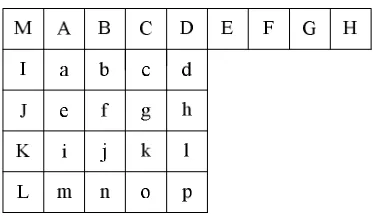
Fig. 2.2 (a) Prediction samples of a 4x4 block
2. Overview of H.264/AVC
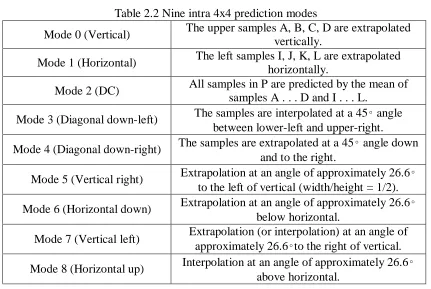
Table 2.2 Nine intra 4x4 prediction modes
Mode 0 (Vertical) The upper samples A, B, C, D are extrapolated vertically.
Mode 1 (Horizontal) The left samples I, J, K, L are extrapolated horizontally.
Mode 2 (DC) All samples in P are predicted by the mean of samples A . . . D and I . . . L.
Mode 3 (Diagonal down-left) The samples are interpolated at a 45◦ angle between lower-left and upper-right.
Mode 4 (Diagonal down-right) The samples are extrapolated at a 45◦ angle down and to the right.
Mode 5 (Vertical right) Extrapolation at an angle of approximately 26.6◦ to the left of vertical (width/height = 1/2).
Mode 6 (Horizontal down) Extrapolation at an angle of approximately 26.6◦ below horizontal.
Mode 7 (Vertical left) Extrapolation (or interpolation) at an angle of approximately 26.6◦to the right of vertical.
Mode 8 (Horizontal up) Interpolation at an angle of approximately 26.6◦ above horizontal.
2.5.1 Intra 4
×4 Prediction
Fig. 2.2 (a) shows a 4x4 luma block that is to be predicted. For the predicted samples
[a, b, . . . ,p] of the current block, the above and left previously reconstructed samples
[A, B, . . . ,M] are used according to direction modes. The arrows in Fig. 2.2 (b) indicate
the direction of prediction in each mode.
For mode 0 (vertical) and mode 1 (horizontal), the predicted samples are formed by
extrapolation from upper samples [A, B, C, D] and from left samples [I, J, K, L],
respectively. For mode 2 (DC), all of the predicted samples are formed by mean of
upper and left samples [A, B, C, D, I, J, K, L]. For mode 3 (diagonal-down-left), mode 4
(diagonal-down-right), mode 5 (vertical-right), mode 6 (horizontal-down), mode 7
2. Overview of H.264/AVC
weighted average of the prediction samples A–M. For example, in the case where Mode
3 (Diagonal-Down-Left prediction) is chosen, the values of a to p are given as follows:
• a is equal to (A+2B+C+2)/4
• b, e are equal to (B+2C+D+2)/4
• c, f, i are equal to (C+2D+E+2)/4
• d, g, j, m are equal to (D+2E+F+2)/4
• h, k, n are equal to (E+2F+G+2)/4
• l, o are equal to (F+2G+H+2)/4, and
• p is equal to (G+3H+2)/4.
The remaining modes are defined similarly according to the different directions as
shown in Fig. 2.2(b) and Table 2.2. Note that in some cases, not all of the samples above
and to the left are available within the current slice: in order to preserve independent
decoding of slices, only samples within the current slice are available for prediction. The
encoder may select the prediction mode for each block that minimizes the residual
between the block to be encoded and its prediction.
2.5.2 Intra 8
×8 Prediction
Similar to intra 4x4 block, 8x8 luma block also has 9 prediction mode based on the
direction of Fig. 2.2 (b). For prediction of each 8x8 luma block, one mode is selected
2. Overview of H.264/AVC
2.5.3 Intra 16
×16 Prediction
In Intra 16x16 block, there are four prediction modes: Vertical, Horizontal, DC and
Plane prediction, which are listed in Fig. 2.3 and Table 2.3. The 16x16 intra prediction
works well in a gently changing area.
Fig. 2.3 Intra 16x16 prediction modes
Table 2.3 Four intra 16x16 prediction modes Mode 0 (Vertical) Extrapolation from upper samples (H) Mode 1 (Horizontal) Extrapolation from left samples (V)
Mode 2 (DC) Mean of upper and left-hand samples (H + V)
Mode 3 (Plane)
A linear ‘plane’ function is fitted to the upper and left-hand samples H and V. This works well in areas of smoothly-varying luminance.
2.5.4 Intra Croma Prediction
Each chroma component of a macroblock is predicted from chroma samples above
and/or to the left that have previously been encoded and reconstructed. The chroma
prediction is defined for three possible block sizes, 8x8 chroma in 4:2:0 format, 8x16
chroma in 4:2:2 format, and 16x16 chroma in 4:4:4 format [29]. The 4 prediction modes
for all of these cases are very similar to the 16x16 luma prediction modes, except that
the order of mode numbers is different: mode 0 (DC), mode 1 (horizontal), mode 2
2. Overview of H.264/AVC
(a) (b)
(c) (d)
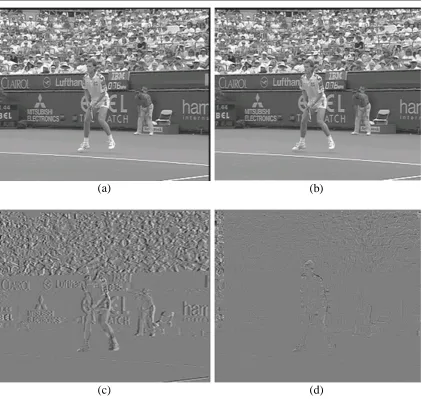
Figure 2.4 The luminance component of ‘Stefan’ at (a) frame 70, and (b) frame 71. The residual pictures by subtracting the frame 70 from frame 71 (c) without motion compensation, and (d) with motion compensation.
2.6 Inter Prediction
Inter-prediction is used to reduce the temporal correlation with help of motion
estimation and compensation. Motion estimation and compensation play an important
role in video compression. In general, they can improve the compression efficiency by
2. Overview of H.264/AVC
the pictures in (a) and (b) are the frame 70 and 71 captured from the sequence ‘Stefan’.
To observe the two pictures carefully, we can see that the frame 71 has a small amount
of shift to the left due to the camera panning. Though the two pictures are very similar,
if the frame 71 is encoded with reference to frame 70, a large amount of residual data
will be left without motion compensation, as shown in Figure 2.4 (c). However, if the
panning motion is compensated by finding the displacement with motion estimation, the
remaining residual data will be very little, as shown in Figure 2.4 (d). For this reason,
the necessary information to be coded is substantially reduced, and the huge volume of
video data can be effectively compressed in a very high compression ratio.
2.6.1 Basic assumptions of motion estimation
Motion estimation is a procedure to locate an object of a current frame from a reference
frame. The object size can be as small as a pixel, or as large as a frame, but typically a
rectangular block of medium size is used. The shift of the object is basically induced by
the motion field which can be estimated by the information in spatial and temporal
domains, such as the variances of illumination, the orientation of edges, the distribution
of colors, and so on [20]. In general, there are some basic assumptions that most motion
estimation algorithms count on:
1. the illumination is constant along the motion path; and
2. the occlusion problem is not present.
These two assumptions confine the complex interactions between motion and
illumination to a simple model. The former ignores the problem of illumination
2. Overview of H.264/AVC
neglects the typical problems of scene change and uncovered background in which the
optical flow is interrupted and not exist for reference. Although the simplified model is
not perfect for real-world video contents, the assumptions still hold in most cases.
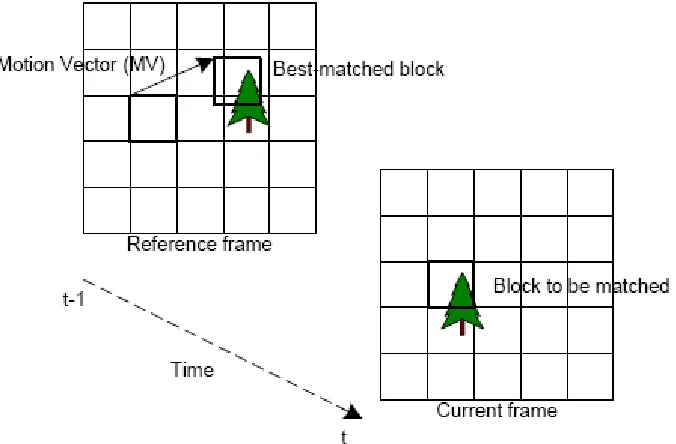
Figure 2.5 Block matching motion estimation.
2.6.2 Block based Motion Estimation
Block based motion estimation is the most popular and practical motion estimation
method in video coding. Standards like the H.26X series and the MPEG series use block
based motion estimation. Fig. 2.5 shows how it works. Each frame is divided into square
blocks. For each block in the current frame, a search is performed on the reference
frame to find a matching based on a block distortion measure (BDM). One of the most
popular BDMs is the sum of absolute differences (SAD) between current block and
2. Overview of H.264/AVC
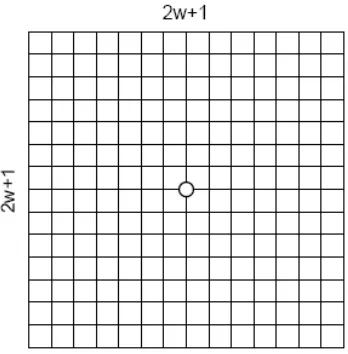
confine the search. Suppose a MB has size N×N pixels and the maximum allowable
displacement of a MV is ± w pixels in both horizontal and vertical directions, there are
2
(2w+1) possible candidate blocks inside the search window. Fig. 2.6 shows a search
point inside a search window.
Figure 2.6 a search point in a search window
A matching between the current MB and one of the candidate MBs is referred as a point
being searched in the search window. If all the points in a search window are searched,
the finding of a global minimum point is guaranteed. The MV pointing to this point is
the optimum MV because it provides the optimum block distortion measure (BDM).
This is the simplest block matching algorithm (BMA) and is named Full Search (FS) or
exhaustive search. To calculate the BDM of 1 search point using Sum of Absolute
Differences (SAD), for a MB of size 16×16 pixels, 3×16×16-1=767 operations are
needed (subtract, absolute, and add for each pixel). If FS is used to search all the points
2. Overview of H.264/AVC
H.264/AVC, which uses variable block-size encoding and multiple reference frames, the
number of operations for motion estimation will be even larger.
1 6 x 1 6 B lo c k 1 6 x 8 B lo c k s 8 x 1 6 B lo c k s 8 x 8 B lo c k s
8 x 4 B lo c k s 4 x 8 B lo c k s 4 x 4 B lo c k s M o d e 1 M o d e 2 M o d e 3 M o d e 4
M o d e 5 M o d e 6 M o d e 7
Fig. 2.7 Block sizes for motion estimation of H.264/AVC
2.6.3 Variable Block size Motion Estimation
In order to best represent the motion information, H.264/AVC allows partitioning a
macroblock (MB) into several blocks with variable block size, ranging from 16 pixels to
4 pixels in each dimension. For example, one MB of size 16x16 may be kept as is,
decomposed into two rectangular blocks of size 8x16 or 16x8, or decomposed into four
square blocks of size 8x8. If the last case is chosen (i.e. four 8x8 blocks), each of the
four 8x8 blocks can be further split to result in more sub-macroblocks. There are four
choices again, i.e. 8x8, 8x4, 4x8 and 4x4. The possible modes of different block sizes
are shown in Fig. 2.7. Each block with reduced size can have its individual motion
2. Overview of H.264/AVC
motion vectors, they allow more accurate prediction in the motion compensation process
and consequently the residual errors can be considerably reduced, which are usually
favorable for the final RD performance.
2.6.4 Sub-Pixel Motion Estimation
The inter-prediction process can form segmentations for motion representation as small
as 4 x 4 luma samples in size, using motion vector accuracy of one-quarter of the luma
sample. Sub-pel motion compensation can provide significantly better compression
performance than integer-pel compensation, at the expense of increased complexity.
Quarter-pel accuracy outperforms half-pel accuracy. Especially, sub-pel accuracy would
increase the coding efficiency at high bitrates and high video resolutions. In the luma
component, the sub-pel samples at half-pel positions are generated first and are
interpolated from neighboring integerpel samples using a 6-tap FIR filter with weights
(1, -5, 20, 20, -5, 1)/32. Once all the half-pel samples are available, each quarter-pel
sample is produced using bilinear interpolation between neighboring half- or integer-pel
samples. For 4:2:0 video source sampling, 1/8 pel samples are required in the chroma
components (corresponding to 1/4 pel samples in the luma). These samples are
interpolated (linear interpolation) between integer-pel chroma samples. Sub-pel motion
vectors are encoded differentially with respect to predicted values formed from nearby
encoded motion vectors. Detail of sub-pel motion estimation is found in reference [17]
2. Overview of H.264/AVC
2.6.5 Multiple Reference Frame Motion Compensation
As the name implies, this concept uses more than one reference frame for prediction. In
H.264/AVC, each MB can be predicted using any previously decoded frame in the
sequence, which enlarged the search space two to five times. This new feature is very
effective for inter frame prediction of the following cases:
1. Motion that is periodic in nature. For example, a flying bird with its wings going
up and down. The wings are best predicted from a picture where they are in
similar position, which is not necessarily the preceding picture.
2. Alternating camera angles that switch back and forth between two different
scenes.
3. Occlusions: once an object is made visible after occlusion, it is beneficial to do
prediction from the frame where the object was last visible.
2.6.6 Motion vector prediction
Since the encoder and decoder both have access to the same information about the
previous motion vectors, the encoder can take advantage of this to further reduce the
dynamic range of the motion vector it sends. Encoding a motion vector for each
partition can cost a significant number of bits, especially if small partition sizes are
chosen. Motion vectors for neighboring partitions are often highly correlated and so
each motion vector is predicted from vectors of nearby, previously coded partitions. A