Page
1
of
32
Development and Synthesis of a Native Freshwater Mussel Toxicity Database
By
Rebecca Bryan
Submitted to the Graduate Faculty of
North Carolina State University
in partial fulfillment of the
requirements for the Degree of
Master of Environmental Assessment
Raleigh, NC
2016
Approved by advisory committee:
Dr. Catherine LePrevost
Dr. W. Gregory Cope
Dr. Linda Taylor
Page
2
of
32
ACKNOWLEDGMENTS
The author would like to thank Drs. Catherine LePrevost (NCSU), Greg Cope (NCSU), and Tom
Augspurger (US Fish and Wildlife Service) for their support and expertise during the
Page
3
of
32
ABSTRACT
BRYAN, REBECCA. MASTER OF ENVIRONMENTAL ASSESSMENT. DEVELOPMENT
AND SYNTHESIS OF A NATIVE FRESHWATER MUSSEL TOXICITY DATABASE
A database of native freshwater mussel toxicity test results was developed based on a literature
search and review of 125 published articles and other available data. The database includes
quantitative results from toxicity studies published from 1991 to 2014. The number of data results
compiled in the database for metals were 10 for mercury, 22 for lead, 138 for zinc, 169 for
cadmium, and 199 for copper. An extended analysis of the copper data indicates that there were
99 acute LC
50/EC
50results conducted according to American Society of Testing and Materials
Page
4
of
32
TABLE OF CONTENTS
ACKNOWLEDGMENTS………...2
ABSTRACT………..………... 3
INTRODUCTION………..………....5
MATERIALS AND METHODS………..……….... 5
Description of Literature Search
………..……….... 5
Database Development Method
………..………... 6
Data Included in Database
………..………... 6
Exclusion criteria
………..………... 8
RESULTS………..………... 8
Database Development Results
………..………...8
Database Analysis
………..………...11
Metals
………..………... 11
Copper Analysis
………..………... 12
Pesticides
………..………...13
DISCUSSION………..………... 14
REFERENCES………..………...16
TABLES
Table 1: List of Freshwater Mussel Species in Database………..………...7
Table 2. ASTM Acceptability Requirements for Database………..………... 8
Table 3: Database References………..………... 9
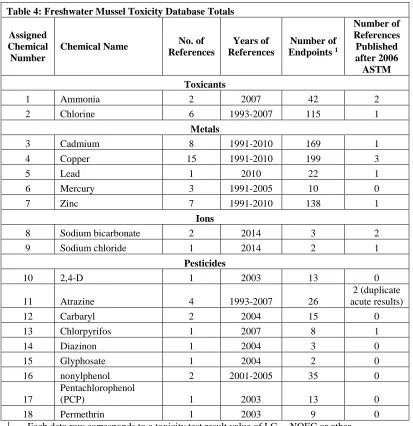
Table 4: Freshwater Mussel Toxicity Database Totals…………..………... 11
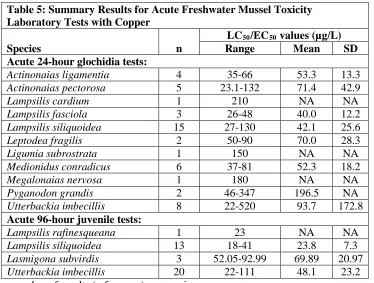
Table 5: Summary Results for Acute Freshwater Mussel Toxicity Laboratory Tests
with Copper………..………...…13
FIGURES
Figure 1: Chemicals Presented in Database by Type………..………...…... 10
Figure 2: Number of Database Results by Chemical Type ………..………...10
Figure 3: Number of References for Metals………..………...…... 12
Figure 4: Number of Database Results per Metal………..………...…... 12
Figure 5: Number of References for Pesticides………..………...…... 14
Page
5
of
32
TABLE OF CONTENTS, continued
APPENDICES
Page
6
of
32
INTRODUCTION
The North American freshwater mussel (superfamily Unionidae) populations are in decline and
are threatened by various factors, including decreased habitat quality due to pollution
(
Augspurger et al. 2007, Cope et al 2008,
Williams et al. 1993). More than 70% of the 300
native unionid species are listed as endangered, threatened, or of special concern (Augspurger
2003, Cope 2007, Williams et al. 1993, Williams and Neves 1995). The study of anthropogenic
pollution sources and the resulting chemical contaminants are important for the protection and
conservation of native freshwater mussel species. Based on toxicological data published in the
early 1990’s, early life stages of freshwater mussels are among the most sensitive aquatic
organisms when exposed to various toxicants, including metals (Keller and Zam, 1991; Jacobson
et al. 1993), chlorine (Goudreau et al. 1993), and ammonia (Goudreau et al. 1993). Early
published toxicity studies conducted with a subset of organic solvents and pesticides indicated
freshwater mussels were relatively tolerant to some chemical contaminants (Augspurger 2003;
Keller 1993; Keller and Ruessler 1997).
An accurate and updated database of mussel toxicity results from laboratory tests of specific
pollutants is critical to the risk analysis and protection of freshwater mussels. The amount of
reliable quantitative data from toxicity tests with freshwater mussels has increased over time
since the approval of the American Society of Testing and Materials (ASTM) guideline
“Standard Guide for Conducting Laboratory Toxicity Tests with Freshwater
Mussels” in 2006
(E2455- 06
;
reapproved 2013; https://www.astm.org/Standards/E2455.htm). This guideline
provides methods for acute and chronic laboratory studies with freshwater mussels, but there are
currently no United States Environmental Protection Agency (EPA) Office of Chemical Safety
and Pollution Prevention (OCSPP) FIFRA (Fungicide, Insecticide Rodenticide Act) guidelines
for the review or submission of freshwater mussel toxicity data for pesticide registration. Prior
to 2006, data captured from published literature and other sources included variable amounts of
useful quantitative toxicity data, in which some, but not all, aspects of the ASTM guideline
requirements were met in published articles. Using ASTM method E2455-06 as the standard,
additional reliable toxicological information is available from more recent tests conducted with
early life stages of freshwater mussels to a variety of toxicants, including ammonia, chlorine,
major ions, and pesticides (Cope 2007; Bringolf et al. 2007; Farag and Harper 2014; Fritts et al.
2014; Harper 2014; Wang et al. 2007a, 2007 b, and 2010).
The purpose of this project was to conduct an extensive literature search for published journal
articles containing any available freshwater mussel toxicity data, to develop a database from
these articles that includes reported laboratory methods and quantitative toxicity test results, and
to synthesize and summarize the findings.
MATERIALS AND METHODS
Page
7
of
32
Google Scholar
(
http://scholar.google.com/) web search engines were used to locate, download,
and evaluate articles for database criteria. The search terms and keywords utilized were
combinations of the following:
freshwater mussels, freshwater mollusks, Unionidae, acute
toxicity, chronic toxicity, ecotoxicology, LC
50values, and NOEC values.
Toxicity data were
collected from downloaded articles, as well as from Dr. W. Gregory Cope’s office files of
published articles stored at North Carolina State University (Raleigh, NC) and from digital files
supplied by Dr. Tom Augspurger from his research at U.S. Fish and Wildlife Service (Raleigh,
NC). For most recent available freshwater mollusk literature, the “2015 Freshwater Mollusk
Bibliography” written by
Kevin S. Cummings from Illinois Natural History Survey (Champaign,
IL) was searched from the Unionoida subject heading list for articles containing toxicity data
(Cummings K. 2016.
http://molluskconservation.org/PUBLICATIONS/ELLIPSARIA/EllipsariaJune2016.pdf). A total
of 125 freshwater mussel toxicity references were reviewed in the literature search portion of this
project and are presented in
Appendix A
.
Database Development Method
: The publications and sources containing quantitative toxicity
data for freshwater mussels were included in the database and were dated from 1991 to 2014. A
template for the database had been created and maintained at U.S. Fish and Wildlife Service,
Raleigh Ecological Services Field Office using Microsoft® Excel® spreadsheets, and initially
included tests with chlorine, cadmium, copper, mercury, and zinc. The template had not been
updated in recent years. This template database was compiled from the published peer-reviewed
literature, university theses and dissertations, and other gray literature.
For the database
developed for this project, additional chemicals were added to the existing spreadsheets based on
the current literature search results, and the database design with all information collected for
each toxicity test result is presented in
Appendix B
.
Data Included in Database:
The database includes the chemical name and purity of the test
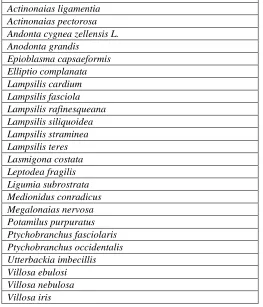
chemical (if reported). The test species name is reported in the database and 25 different
Unionidae freshwater mussel species of the almost 300 North American species were used in the
toxicity tests (see
Table 1
). The test method information collected included life stages of
Page
8
of
32
Table 1: List of Freshwater Mussel Species in Database
Actinonaias ligamentia Actinonaias pectorosa Andonta cygnea zellensis L. Anodonta grandis
Epioblasma capsaeformis Elliptio complanata Lampsilis cardium Lampsilis fasciola Lampsilis rafinesqueana Lampsilis siliquoidea Lampsilis straminea Lampsilis teres Lasmigona costata Leptodea fragilis Ligumia subrostrata Medionidus conradicus Megalonaias nervosa Potamilus purpuratus Ptychobranchus fasciolaris Ptychobranchus occidentalis Utterbackia imbecillis Villosa ebulosi Villosa nebulosa Villosa iris
Based on available data provided in journal articles, the parameters added to the template
database spreadsheets included chemical purity (%); the laboratory environmental endpoints of
temperature (°C), hardness (mg/L), pH, and alkalinity (mg/L) of test water; and determination if
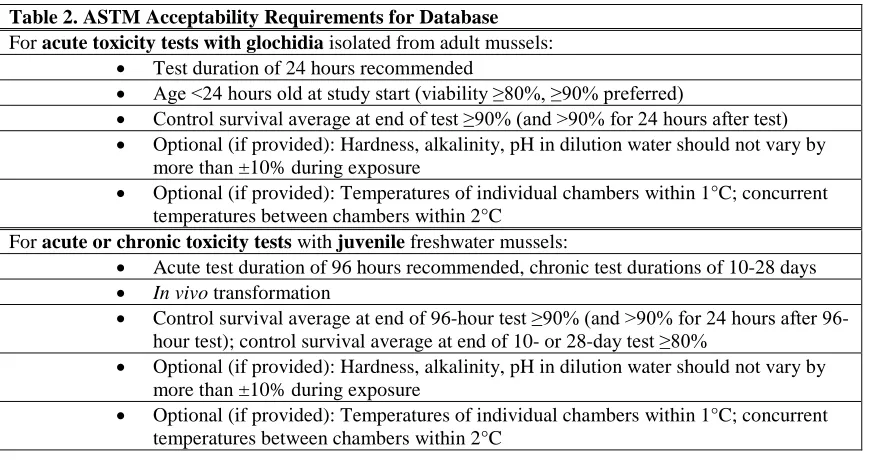
the test generally followed current ASTM guidelines for acute or chronic toxicity tests (see
Table 2
). Some of the database toxicity tests conducted prior to the 2006 ASTM guideline met
most of the acceptability requirements based on reported test data, and were, therefore,
Page
9
of
32
Table 2. ASTM Acceptability Requirements for Database
For acute toxicity tests with glochidia isolated from adult mussels:
• Test duration of 24 hours recommended
• Age <24 hours old at study start (viability ≥80%, ≥90% preferred)
• Control survival average at end of test ≥90% (and >90% for 24 hours after test)
• Optional (if provided): Hardness, alkalinity, pH in dilution water should not vary by more than ±10% during exposure
• Optional (if provided): Temperatures of individual chambers within 1°C; concurrent temperatures between chambers within 2°C
For acute or chronictoxicity tests with juvenile freshwater mussels:
• Acute test duration of 96 hours recommended, chronic test durations of 10-28 days
• In vivo transformation
• Control survival average at end of 96-hour test ≥90% (and >90% for 24 hours after 96-hour test); control survival average at end of 10- or 28-day test ≥80%
• Optional (if provided): Hardness, alkalinity, pH in dilution water should not vary by more than ±10% during exposure
• Optional (if provided): Temperatures of individual chambers within 1°C; concurrent temperatures between chambers within 2°C
The toxicity test results included in the database were control survival (%); observation endpoint
of survival, length, or other-genotoxicity; and the results endpoints of median lethal or median
effective (LC
50or EC
50) concentration, no observed effect concentration (NOEC), lowest
observed effect concentration (LOEC), inhibition concentrations (IC10, IC20, or IC25), chronic
value (ChV), or species mean acute value (SMAV). There is one quantitative result endpoint for
each database row entry, and one toxicity test could have multiple rows based on number of
reported results.
Exclusion criteria
: All articles were reviewed during the literature search, but not all were
included in database. Reasons for exclusion were the quantitative acute or chronic result
endpoints were not reported (only qualitative data), no original data were presented (review
article), data were duplicated results from another article, and QA/QC of reported data was
inadequate. Freshwater mussel toxicity studies conducted with boron (Soucek et al. 2011; US
EPA 2010), perfluorooctane sulfonate (PFOS) and perfluorooctanoate (PFOA) (Hazelton et al.
2012), polycyclic aromatic hydrocarbons (PAHs) (Prochazka et al. 2012; Wang 2013),
pharmaceuticals (Bringolf et al. 2012; Gilroy et al. 2014; Hazelton et al. 2013 and 2014),
pesticides (Boogaard et al. 2011; parts of Bringolf et al. 2007a, 2007b and 2007c; Köprücü et al.
2008), and herbicides specifically (Archambault et al. 2014) were found during the literature
search of articles published after the approval of the 2006 ASTM guidelines, but were excluded
from the database for one or more of the above-mentioned reasons.
RESULTS
Database Development Results:
Page
10
of
32
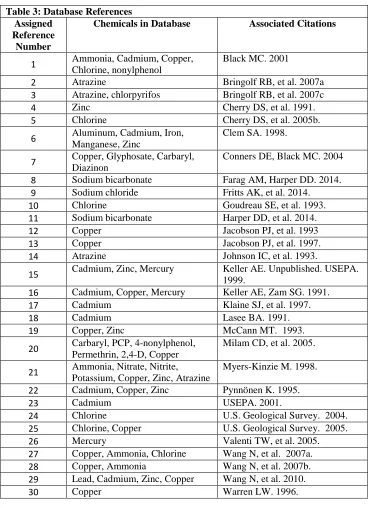
Table 3: Database References Assigned
Reference Number
Chemicals in Database Associated Citations
1 Ammonia, Cadmium, Copper, Chlorine, nonylphenol Black MC. 2001
2 Atrazine Bringolf RB, et al. 2007a
3 Atrazine, chlorpyrifos Bringolf RB, et al. 2007c
4 Zinc Cherry DS, et al. 1991.
5 Chlorine Cherry DS, et al. 2005b.
6 Aluminum, Cadmium, Iron, Manganese, Zinc Clem SA. 1998.
7 Copper, Glyphosate, Carbaryl, Diazinon Conners DE, Black MC. 2004 8 Sodium bicarbonate Farag AM, Harper DD. 2014.
9 Sodium chloride Fritts AK, et al. 2014.
10 Chlorine Goudreau SE, et al. 1993.
11 Sodium bicarbonate Harper DD, et al. 2014.
12 Copper Jacobson PJ, et al. 1993
13 Copper Jacobson PJ, et al. 1997.
14 Atrazine Johnson IC, et al. 1993.
15 Cadmium, Zinc, Mercury Keller AE. Unpublished. USEPA. 1999. 16 Cadmium, Copper, Mercury Keller AE, Zam SG. 1991.
17 Cadmium Klaine SJ, et al. 1997.
18 Cadmium Lasee BA. 1991.
19 Copper, Zinc McCann MT. 1993.
20 Carbaryl, PCP, 4-nonylphenol, Permethrin, 2,4-D, Copper Milam CD, et al. 2005.
21 Ammonia, Nitrate, Nitrite, Potassium, Copper, Zinc, Atrazine Myers-Kinzie M. 1998. 22 Cadmium, Copper, Zinc Pynnönen K. 1995.
23 Cadmium USEPA. 2001.
24 Chlorine U.S. Geological Survey. 2004.
25 Chlorine, Copper U.S. Geological Survey. 2005.
26 Mercury Valenti TW, et al. 2005.
27 Copper, Ammonia, Chlorine Wang N, et al. 2007a.
28 Copper, Ammonia Wang N, et al. 2007b.
29 Lead, Cadmium, Zinc, Copper Wang N, et al. 2010.
30 Copper Warren LW. 1996.
Page
11
of
32
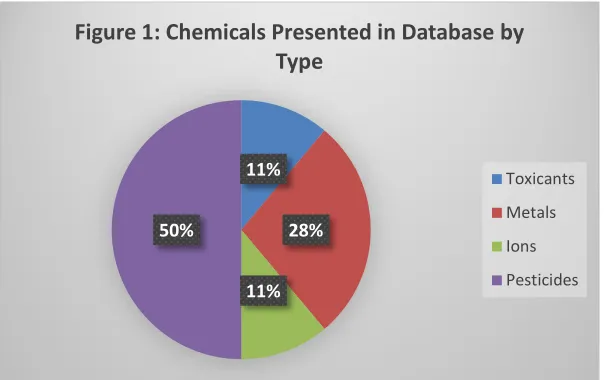
11%
28%
11% 50%
Figure 1: Chemicals Presented in Database by
Type
Toxicants Metals Ions Pesticides
19%
65% 1% 15%
Figure 2: Number of Database Results by
Chemical Type
Page
12
of
32
Table 4: Freshwater Mussel Toxicity Database Totals
Assigned Chemical Number
Chemical Name No. of
References
Years of References
Number of Endpoints 1
Number of References Published after 2006 ASTM Toxicants
1 Ammonia 2 2007 42 2
2 Chlorine 6 1993-2007 115 1
Metals
3 Cadmium 8 1991-2010 169 1
4 Copper 15 1991-2010 199 3
5 Lead 1 2010 22 1
6 Mercury 3 1991-2005 10 0
7 Zinc 7 1991-2010 138 1
Ions
8 Sodium bicarbonate 2 2014 3 2
9 Sodium chloride 1 2014 2 1
Pesticides
10 2,4-D 1 2003 13 0
11 Atrazine 4 1993-2007 26
2 (duplicate acute results)
12 Carbaryl 2 2004 15 0
13 Chlorpyrifos 1 2007 8 1
14 Diazinon 1 2004 3 0
15 Glyphosate 1 2004 2 0
16 nonylphenol 2 2001-2005 35 0
17
Pentachlorophenol
(PCP) 1 2003 13 0
18 Permethrin 1 2003 9 0
1 Each data row corresponds to a toxicity test result value of LC
50, NOEC or other.
Database Analysis:
The seven articles published after the 2006 ASTM guidance was developed
include Bringolf et al. 2007, Farag and Harper 2014, Fritts et al. 2014, Harper 2014, and Wang et
al. 2007a, 2007 b, and 2010. These studies refer to the ASTM guidelines and contain acute
and/or chronic toxicity test results with various freshwater mussel species.
Metals:
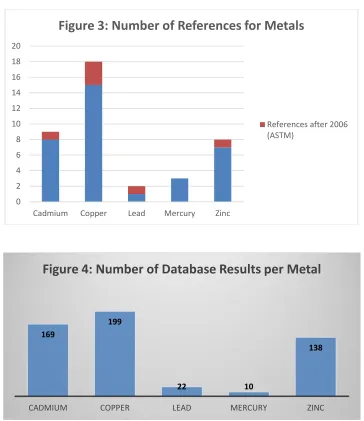
For the five metal contaminants included in the database, results were based on 1
lead reference, 3 mercury references, 7 zinc references, 8 cadmium references, and 15
Page
13
of
32
acute studies. Overall, the number of toxicity test results complied in the database by metal
included 10 for mercury, 22 for lead, 138 for zinc, 169 for cadmium, and 199 for copper (see
Figure 4
).
Copper Analysis
: The toxicity test results compiled for copper have the most entered
database results with 99 acute test results conducted according to ASTM guideline
recommendations (see
Table 2
). The LC
50/EC
50results are reported from 62 acute
24-hour glochidia tests and 37 acute 96-24-hour juvenile tests, allowing for comparisons
between study types and freshwater mussel species (see
Table 5
). For acute 24-hour
glochidia tests with copper, the LC
50/EC
50survival results were highly variable among
the 11 species types and within the same species in tests with different environmental
conditions; usually differences in water hardness or alkalinity were observed in the
database. The acute 96-hour juvenile tests with copper were conducted using 5 different
0 2 4 6 8 10 12 14 16 18 20
Cadmium Copper Lead Mercury Zinc
Figure 3: Number of References for Metals
References after 2006 (ASTM)
169
199
22 10
138
CADMIUM COPPER LEAD MERCURY ZINC
Page
14
of
32
freshwater mussel species, and the variability in test results appears less than in the acute
glochidia tests included in the database.
Intra- and inter-laboratory variability of acute toxicity results with glochidia and juvenile
unionid mussels was assessed in a recent (2016) article by Raimondo et al. In their
article, increased inter-laboratory variability in glochidia acute tests was reported
compared to juvenile acute tests. The intra-laboratory variability for EC
50values
averaged about 2-fold for both life stages, but the inter-laboratory variability averaged
3.6-fold for juvenile mussels and 6.3-fold for glochidia. The glochidia and juvenile EC
50values were within a factor of 2 of each other for 50% of paired records among chemicals
assessed. The juveniles were more sensitive than glochidia by more than 2-fold for 33%
of the comparisons made between life stages.
Table 5: Summary Results for Acute Freshwater Mussel Toxicity
Laboratory Tests with Copper
Species
n
LC50/EC50
values (µg/L)
Range
Mean
SD
Acute 24-hour glochidia tests:
Actinonaias ligamentia
4
35-66
53.3
13.3
Actinonaias pectorosa
5
23.1-132
71.4
42.9
Lampsilis cardium
1
210
NA
NA
Lampsilis fasciola
3
26-48
40.0
12.2
Lampsilis siliquoidea
15
27-130
42.1
25.6
Leptodea fragilis
2
50-90
70.0
28.3
Ligumia subrostrata
1
150
NA
NA
Medionidus conradicus
6
37-81
52.3
18.2
Megalonaias nervosa
1
180
NA
NA
Pyganodon grandis
2
46-347
196.5
NA
Utterbackia imbecillis
8
22-520
93.7
172.8
Acute 96-hour juvenile tests:
Lampsilis rafinesqueana
1
23
NA
NA
Lampsilis siliquoidea
13
18-41
23.8
7.3
Lasmigona subvirdis
3
52.05-92.99
69.89
20.97
Utterbackia imbecillis
20
22-111
48.1
23.2
n=number of results (references) per species
NA=Not applicable; ≤2 test results
Page
15
of
32
permethrin, 13 for 2,4-D and PCP, 15 for carbaryl, 26 for atrazine, and 35 for
nonylphenol (see
Figure 6
).
DISCUSSION
The freshwater mussel toxicity studies identified through a literature search were included in a
database that contains quantitative endpoints that will assist in future risk assessment analysis
0 1 2 3 4 5 6
Number of References for Pesticides
References after 2006 (ASTM)
13
26
15
8 3 2
35
13 9
Page
16
of
32
and/or regulatory decisions. Currently, the database includes the toxicants of ammonia and
chlorine; the metals of cadmium copper, lead, mercury, and zinc; the major ions of sodium
bicarbonate and sodium chloride; and the pesticides 2,4-D, atrazine, carbaryl, chlorpyrifos,
diazinon, glyphosate, nonylphenol, PCP, and permethrin. The toxicity data collected in the
database includes published articles and sources from the gray literature dating from 1991 to
2014. The ASTM guidelines (E2455- 06
;
reapproved 2013) were first published starting in
2006, and provided useful guidance in the conduct of laboratory toxicity tests with freshwater
mussels. The more recently published articles reference the ASTM guideline and provide more
dependable results for analysis.
For metals, data results compiled in the database are most numerous for copper (199). An
extended analysis of copper data indicates that nearly half represent acute LC
50/EC
50results
conducted according to ASTM guideline recommendations, with 62 acute 24-hour glochidia test
results and 37 acute 96-hour juvenile results. Based on the variable acute test results for copper
among species in the database, the use of more than one freshwater mussel species in laboratory
toxicity testing is important in determining impacts to mussels with different habitat and life
history requirements. However, restricting the number of species recommended for test types
will provide more reproducible laboratory data for comparisons and effect determinations.
According to Raimondo et al. (2016), glochidia and juvenile mussel acute tests should be
performed on a chemical-by-chemical basis, and the commonly tested mussel species of
L.
siliquoidea, U. imbecillis,
and
V. iris
adequately represented mussel sensitivity in the absence of
a diverse mussel toxicity dataset. However, toxicity testing with additional mussel species is
needed to improve the application of safety factors. The safety factors of 2 to 5 might be applied
to data for commonly tested mussel species for protective levels inclusive of inter-species and
inter-laboratory variation (Raimondo et al. 2016).
For pesticides, the data results complied in the database are most numerous for atrazine (26) and
nonylphenol (35). In general, fewer pesticide toxicity test references were found in the literature
search, and fewer test results for pesticide toxicity in freshwater mussels were available in
comparison to metals. However, the database included more individual pesticide chemicals (9)
than metals (5).
For continued expansion of the database, toxicity results from tests with the emerging
contaminants of major ions, pharmaceuticals, and chemicals from pollution events in freshwater
need additional representation. The toxicity tests should follow ASTM guidelines, and
quantitative results are needed for both the current database toxicants and additional chemicals of
concern. Other recommendations for expansion of this freshwater mussel toxicity database
include the following: quality control and quality assurance of all data by qualified experts in this
field; addition of web links to publicly available journal articles and abstracts; making the
Page
17
of
32
Page
18
of
32
APPENDIX A: Literature Search References for Freshwater Mussel Toxicity
Reference
Number
Citations
1 Akarte SR, Mane UH. 1988. Toxicity of folithion to three species of freshwater bivalve molluscs in different seasons. J Environ Biol
9(1):27-38
2 American Society for Testing and Materials. 2013. Standard guide for conducting laboratory toxicity tests with freshwater mussels. E2455-06 (reapproved 2013). DOI: 10.1520/E2455-E2455-06R13; https://www.astm.org/Standards/E2455.htm
3 Archambault JM, Bergeron CM, Cope WG, Richardson RJ, Heilman MA, Corey III JE, Netherland MD, Heise RJ. 2014. Sensitivity of freshwater molluscs to hydrilla-targeting herbicides: providing context for invasive aquatic weed control in diverse ecosystems. Journal of Freshwater Ecology, DOI: 10.1080/02705060.2014.945104
4 Augspurger T, Dwyer FJ, Ingersoll CG, Kane CM. 2007. Editorial, Advances and opportunities in assessing contaminant sensitivity of freshwater mussel (Unionidae) early life stages. Environ Toxicol Chem 26:2025-2028
5 Augspurger T, Keller AE, Black MC, Cope WG, Dwyer FJ. 2003. Water quality guidance for protection of freshwater mussels (Unionidae) from ammonia exposure. Environ Toxicol Chem 22:2569-2575
6 Augspurger TP, Wang N, Kunz JL, Ingersoll CG. 2014. Pollutant sensitivity of the endangered Tar River Spiny mussel as assessed by single chemical and effluent toxicity tests. U.S. Fish and Wildlife Service, Ecological Services, Raleigh, NC.
7 Bartsch MR, Newton TJ, Allran JW, O'Donnell JA, Richardson WB. 2003. Effects of pore-water ammonia on in situ survival and growth of juvenile mussels (Lampsilis cardium) in the St. Croix riverway, Wisconsin, USA. Environ Toxicol Chem 22:2561-2568
8 Beggel S, Geist J. 2015. Acute effects of salinity exposure on glochidia viability and host infection of the freshwater mussel Anodonta anatina (Linnaeus, 1758). Science of the Total Environment 502:659-665. DOI: 10.1016/j.scitotenv.2014.09.067
Page
19
of
32
APPENDIX A: Literature Search References for Freshwater Mussel Toxicity
Reference
Number
Citations
Producers Environmental Research Association. US Department of Interior, US Geological Survey, Scientific Investigations Report 2011-5225.
10 Besser JM, Ingersoll CG, Brumbaugh WG, Kemble NE, May TW, Wang N, MacDonald DD, Roberts AD. 2015. Toxicity of sediments from lead zinc mining areas to juvenile freshwater mussels (Lampsilis siliquoidea), compared to standard test organisms. Environ Toxicol Chem Accepted Article. DOI: 10.1002/etc.2849
11 Bills TD, Rach JJ, Marking LL, Howe GE. 1992. Effects of the lampricide 3-Trifluoromethyl-4-Nitrophenol on the Pink Heelsplitter. US Fish and Wildlife Service, Resource Publication 183. 7 pp.
12 Black MC. 2001. Water quality standards for North Carolina’s endangered mussels. Final Report. Department of Health Science, University of Georgia, Athens, GA.
13 Blakeslee CJ, Galbraith HS, Robertson LS, and White BSJ. 2013. The effects of salinity exposure on multiple life stages of common freshwater mussel, Elliptio complanata. Environ Toxicol Chem 32:2849-2854
14 Boogaard MA., Kolar CS, Waller DL. 2004. Acute toxicity of 3-trifluormethyl-4-nitrophenol (TFM) and a TFM-1% niclosamide mixture to the giant floater (Pyganodon grandis), fragile papershell (Leptodea fragilis), and pink heelsplitter (Potamilus alatus) unionid mussels and sea lamprey (Petromyzon marinus) larvae. Report submitted to the Lake Champlain Fish and Wildlife Management Cooperative, Essex Junction, Vermont, June 2004. 21 pp.
15 Boogaard MA, Rivera JE. 2011. Acute toxicity of two lampricides, 3-trifluoromethyl-4-nitrophenol (TFM) and a TFM:1% niclosamide mixture, to sea lamprey, three species of unionids, haliplid water beetles, and American eel. Great Lakes Fish Comm Tech Rep 70.
16 Bringolf RB, Cope WG, Eads CB, Lazro PR, Barnhart MC, Shea D. 2007a. Acute and chronic toxicity of technical -grade pesticides to glochidia and juveniles of freshwater mussels (Unionidae). Environ Toxicol Chem 26:2086-2093.
Page
20
of
32
APPENDIX A: Literature Search References for Freshwater Mussel Toxicity
Reference
Number
Citations
18 Bringolf RB, Cope WG, Barnhart MC, Mosher S, Lazaro PR, Shea D. 2007c. Acute and chronic toxicity of pesticide formulations (atrazine, chlorpyrifos, and permethrin) to glochidia and juveniles of Lampsilis siliquoidea. Environ Toxicol Chem 26:2101-2107.
19 Bringolf RB, Heltsley RM, Newton TJ, Eads CB, Fraley SJ, Shea D, Cope WG. 2010. Environmental occurrence and reproductive effects of the pharmaceutical fluoxetine in native freshwater mussels. Environ Toxicol Chem 29:1311-1318. DOI: 10.1002/etc.157
20 Cherry DS, Farris JL, Neves RJ. 1991. Laboratory and field ecotoxicological studies at the Clinch River Plant, Virginia. Final Report, American Electric Service Corporation, Columbus, OH. 228 pp.
21 Cherry DS, Scheller JL, Cooper NL, Bidwell JR. 2005a. Potential effects of Asian clam (Corbicula fluminea) die-offs on native freshwater mussels (Unionidae) I: water-column ammonia levels and ammonia toxicity. J. N. Am. Benthol. Soc.24(2):369-380
22 Cherry DS, Valenti TW, Currie RJ, Neves RJ, Jones JW, Mair RA, Kane CM. 2005b. Chlorine toxicity to early life stages of freshwater mussels, Final Report. USGS Scientific Support Partnership Project ID 0l-R5-09. Virginia Polytechnic Institute and State University, Biology Department and Department of Fisheries and Wildlife Science
23 Clearwater SJ, Thompson KJ, Hickey CW. 2014. Acute toxicity of copper, zinc, and ammonia to larvae (glochidia) of the native freshwater mussel Echyridella menziesii in New Zealand. Arch Environ Contam Toxicol (2014) 66:213–226. DOI 10.1007/s00244-013-9972-7
24 Clem SA. 1998. Complexities in early lifestage testing of freshwater mussels to selected metals. Master's Thesis, Arkansas State University. Jonesboro, Arkansas. 99 pp.
25 Conners DE, Black MC. 2004. Evaluation of lethality and genotoxicity in the freshwater mussel Utterbackia imbecillis (Bivalva: Unionidae) exposed singly and in combination to chemicals used in lawn care. Arch Environ Toxicol Chem 46:362-371. DOI: 10.1007/s00244-003-3003-z
Page
21
of
32
APPENDIX A: Literature Search References for Freshwater Mussel Toxicity
Reference
Number
Citations
27 Cummings K. 2016. “2015 Freshwater Mollusk Bibliography” In Ellipsaria: Newsletter of the Freshwater Mollusk Conservation Society
Vol. 18 - No. 2. June 2016, http://molluskconservation.org/PUBLICATIONS/ELLIPSARIA/EllipsariaJune2016.pdf
28 Doran WJ, Cope WG, Rada RG, Sandheinrich MB. 2001. Acetylcholinesterase inhibition in the threeridge mussel (Amblema plicata) by chlorpyrifos: Implications for biomonitoring. Ecotoxicology and Environmental Safety 49:91-98. DOI: 10.1006/eesa.2000.2036
29 Douda K. 2010. Effects of nitrate nitrogen pollution on Central European unionid bivalves revealed by distributional data and acute toxicity testing. Aquatic Conserv: Mar Freshw Ecosyst 20: 189–197. DOI: 10.1002/aqc.1076
30 Falfushynska HI, Gnatyshyna LL, Stoliar OB. 2013. Effect of in situ exposure history on the molecular responses of freshwater bivalve
Anodonta anatina (Unionidae) to trace metals. Ecotoxicology and Environmental Safety 89:73-83
31 Farag AM, Harper DD. 2014. Chronic toxicity of sodium bicarbonate, a major component of coal bed natural gas produced waters. Environ Toxicol Chem 33:532-540
32 Faria M, López MA, Fernández-Sanjuan M, Lacorte S, Barata C. 2010. Comparative toxicity of single and combined mixtures of selected pollutants among larval stages of the native freshwater mussels (Unio elongatulus) and the invasive zebra mussel (Dreissena polymorpha).
Science of the Total Environment 408:2452-2458. DOI:10.1016/j.scitotenv.2010.02.047
33 Fritts AK, Barnhart MC, Bradley M, Liu N, Cope WG, Hammer E, Bringolf RB. 2014. Assessment of toxicity test endpoints for freshwater mussel larvae. Environ Toxicol Chem 33:199-207.
34 Fuller SLH. 1974. Clams and Mussels (Mollusca:Bivalvia). Chapter 8:215-273
35 Gilderhus PA, Bills TD, Johnson DA. 1992. Methods for detoxifying the lampricide 3-Trifluoromethyl-4-Nitrophenol in streams. US Fish and Wildlife Service, Resource Publication 184. 5 pp.
Page
22
of
32
APPENDIX A: Literature Search References for Freshwater Mussel Toxicity
Reference
Number
Citations
37 Gillis PL. 2012. Cumulative impacts of urban runoff and municipal wastewater effluents on wild freshwater mussels (Lasmigona costata).
Science of the Total Environment 431:348-356
38 Gillis PL, Mitchell RJ, Schwalb AN, McNichols KA, Mackie GL, Wood CM, Ackerman JD. 2008. Sensitivity of the glochidia (larvae) of freshwater mussels to copper: Assessing the effect of water hardness and dissolved organic carbon on the sensitivity of endangered species.
Aquatic Toxicology 88:137-145. DOI:10.1016/j.aquatox.2008.04.003
39 Gillis PL, McGeer JC, Mackie GL, Wilkie MP, Ackerman JD. 2010. The effect of natural dissolved organic carbon on the acute toxicity of copper to larval freshwater mussels (glochidia). Environ Toxicol Chem 29:2519-2528. DOI: 10.1002/etc.299
40 Gillis PL, Gagné F, McInnis R, Hooey TM, Choy ES, André C, Hoque ME, Metcalfe CD. 2014. The impact of municipal wastewater effluent on field-deployed freshwater mussels in the Grand River (Ontario, Canada). Environ Toxicol Chem 33:134-143
41 Gilroy EAM, Klinck JS, Campbell SD, McInnis R, Gillis PL, de Solla SR. 2014. Toxicity and bioconcentration of the pharmaceuticals moxifloxacin, rosuvastatin, and drospirenone to the unionid mussel Lampsilis siliquoidea. Science of the Total Environment 487:537-544. DOI: 10.1016/j.scitotenv.2014.03.051
42 Gooding MP, Newton TJ, Bartsch MR, Hornbuckle KC. 2006. Toxicity of synthetic musks to early life stages of the freshwater mussel
Lampsilis cardium. Arch Environ Contam Toxicol 51:549–558. DOI: 10.1007/s00244-005-0223-4
43 Goudreau SE. 1988. Effects of sewage treatment plant effluents on mollusks and fish of the Clinch River in Tazewell County, Virginia. Thesis, Virginia Polytechnic Institute and State University, Blacksburg, Virginia.
44 Goudreau SE, Neves RJ, Sheehan RJ. 1993. Effects of wastewater treatment plant effluents on freshwater mollusks in the upper Clinch River, Virginia, USA. Hydrobiologia 252:211-230
Page
23
of
32
APPENDIX A: Literature Search References for Freshwater Mussel Toxicity
Reference
Number
Citations
46 Harper DD, Farag AM, and Skaar D. 2014. Acute toxicity of sodium bicarbonate, a major component of coal bed natural gas produced waters, to 13 aquatic species as defined in the laboratory. Environ Toxicol Chem 33:525-531
47 Havlik ME, Marking LL. 1987. Effects of contaminants on Naiad mollusks (Unionidae): A Review. US Department of Interior, Fish and Wildlife Service, Washington, DC. Resource Publication 164.
48 Hazelton PD, Cope WG, Pandolfo TJ, Mosher S, Strynar MJ, Barnhart MC, Bringolf RB. 2012. Partial life cycle and acute toxicity of perfluoroalkyl acids to freshwater mussels. Environ Toxicol Chem 31:1611-1620. DOI: 10.1002/etc.1866
49 Hazelton PD, Cope WG, Mosher S, Pandolfo TJ, Belden JB, Barnhart MC, Bringolf RB. 2013. Fluoxetine alters adult freshwater mussel behavior and larval metamorphosis. Science of the Total Environment 445-446:94-100. DOI: 10.1016/j.scitotenv.2012.12.026
50 Hazelton PD, Du B, Haddad SP, Fritts AK, Chambliss CK, Brooks BW, Bringolf RB. 2014. Chronic fluoxetine exposure alters movement and burrowing in adult freshwater mussels. Aquatic Toxicology 151:27-35. DOI: 10.1016/j.aquatox.2013.12.019
51 Horne FR, McIntosh S. 1979. Factors influencing distribution of mussels in the Blanco River of central Texas. The Nautilus 94:119-133
52 Huebner JD, Pynnonen KS. 1992. Viability of glochidia of two species of Anodonta exposed to low pH and selected metals. Canadian Journal of Zoology 70: 2348-2355.
53 Huebner JD, Pynnönen KS. 1992. Viability of two species of Anodonta exposed to low pH and selected metals. Can J Zool 70:2348-2355
54 Imlay MJ. 1973. Effects of potassium on survival and distribution of freshwater mussels. Malacologia 12:97-113.
55 Jacobson PJ. 1990. Sensitivity of early life stages of freshwater mussels (Bivalvia:Unionidae) to copper. Thesis. Virginia Polytechnic Institute and State University Blacksburg, VA.
Page
24
of
32
APPENDIX A: Literature Search References for Freshwater Mussel Toxicity
Reference
Number
Citations
57 Jacobson PJ, Neves RJ, Cherry DS, Farris JL. 1997. Sensitivity of glochidial stages of freshwater mussels (Bivalvia:Unionidae) to copper.
Environ Toxicol Chem 16:2384-2392
58 Johnson IC, Keller AE, Zam SG. 1993. "A method for conducting acute toxicity tests with the early life stages of freshwater mussels" Environmental Toxicology and Risk Assessment, ASTM STP 1179, Landis WG, Hughes JS, Lewis MA, Eds., American Society for Testing and Materials, Philadelphia, 1993 pp. 381-396
59 Jorge MB, Loro VL, Bianchini A, Wood CM, Gillis PL. 2013. Mortality, bioaccumulation and physiological responses in juvenile freshwater mussels (Lampsilis siliquoidea) chronically exposed to copper. Aquatic Toxicology 126:137-147.
DOI:10.1016/j.aquatox.2012.10.014
60 Keller AE, Augspurger T. 2005. Toxicity of fluoride to the endangered Unionid mussel, Alasmidonta raveneliana, and surrogate species.
Bull Environ Contam Toxicol 74:242-249. DOI: 10.1007/s00128-004-0576-9
61 Keller AE. Unpublished. USEPA. 1999. Implementation of Terms and Conditions of the Great Lakes Water Quality Guidance Biological Opinion: Mussel Sensitivity Report. U.S. EPA, Region 5 Water Division, Region 4, Science and Ecosystems Support Division, Office of Science and Technology, and Office of General Counsel.
62 Keller AE, Zam SG. 1991. The acute toxicity of selected metals to the freshwater mussel, Anodonta imbecillis. Environ Toxicol Chem 10: 539-546.
63 Keller AE. 1993. Acute toxicity of several pesticides, organic compounds, and a wastewater effluent to the freshwater mussel, Anodonta imbecilis, Ceriodaphnia dubia, and Pimephales promelas. Bull Environ Contain Toxicol 51:696-702
64 Keller AE, Ruessler DS. 1997. The toxicity of malathion to Unionid mussels: Relationship to expected environmental concentrations.
Environ Toxicol Chem 16:1028-1033
Page
25
of
32
APPENDIX A: Literature Search References for Freshwater Mussel Toxicity
Reference
Number
Citations
66 Klaine SJ, Warren LW, Summers JM. 1997. The use of juvenile mussels (Utterbackia imbecillis, Say) as a standardized toxicity testing organism. Final Report TIWET 09535. The Institute of Wildlife and Environmental Toxicology (TIWET), Clemson University, Pendleton, SC.
67 Köprücü K, Seker, E. 2008. Acute Toxicity of Deltamethrin for Freshwater Mussel, Unio elongatulus eucirrus Bourguignat. Bull Environ Contam Toxicol 80:1–4. DOI 10.1007/s00128-007-9254-z
68 Kováts N, Abdel-Hameid NA, Kovács K, Paulovits G. 2010. Sensitivity of three unionid glochidia to elevated levels of copper, zinc and lead. Knowledge and Management of Aquatic Ecosystems 399, 04:1-7. DOI: 10.1051/kmae/2010028
69 Kunz JL, Conley JM, Buchwalter DB, Norberg-King TJ, Kemble NE, Wang N, Ingersoll CG. 2013. Use of reconstituted waters to evaluate effects of elevated major ions associated with mountaintop coal mining on freshwater invertebrates. Environ Toxicol Chem 32:2826-2835
70 Lasee BA. 1991. Histological and ultrastructural studies of larval and juvenile Lampsilis (Bivalvia) from the upper Mississippi River. Thesis, Iowa State University. Ames, IA.
71 Leonard JA, Cope WG, Barnhart MC, Bringolf RB. 2014. Metabolomic, behavioral, and reproductive effects of the aromatase inhibitor farozole hydrochloride on the unionid mussel Lampsilis fasciola. General and Comparative Endocrinology 206:213-226. DOI:
10.1016/j.ygcen.2014.07.019
72 Leonard JA, Cope WG, Barnhart MC, Bringolf RB. 2014. Metabolomic, behavioral, and reproductive effects of the synthetic estrogen 17α-ethinylestradiol on the unionid mussel Lampsilis fasciola. Aquatic Toxicology 150:103-116. DOI: 10.1016/j.aquatox.2014.03.004
73 Lockwood R, Hall S, ENVIRON, Harrass M. "Boron chronic toxicity to the Fatmucket mussel Lampsilis siliquoidea in water-only and whole-sediment exposures" Poster. Sponsored by Borates REACH Consortium of the European Borates Association, Brussels, Belgium.
74 Marasinghe Wadige CPM, Maher WA, Taylor AM, Krikowa F. 2014. Exposure–dose–response relationships of the freshwater bivalve
Page
26
of
32
APPENDIX A: Literature Search References for Freshwater Mussel Toxicity
Reference
Number
Citations
75 March FA, Dwyer FJ, Augspurger T, Ingersoll CG, Wang N, Mebane CA. 2007. Contaminant sensitivity of freshwater mussels, An evaluation of freshwater mussel toxicity data in the derivation of water quality guidance and standards for copper. Environ Toxicol Chem
26:2066-2074.
76 McCann MT. 1993. Toxicity of zinc, copper, and sediments to early life stages of freshwater mussels in the Powell River, Virginia. Thesis, Virginia Polytechnic Institute and State University. Blacksburg, Virginia. 143 pp.
77 McKinney AD, Wade DC. 1996. Short Communication, Comparative response of Ceriodaphnia dubia and juvenile Anodonta imbecillis to pulp and paper mill effluents discharged to the Tennessee River and its tributaries. Environ Toxicol Chem 15:514-517
78 Miao J, Barnhart MC, Brunson EL, Hardesty DK, Ingersoll CG, Wang N. 2010. Short communication, An evaluation of the influence of substrate on the response of juvenile freshwater mussels (Fatmucket, Lampsilis siliquoidea) in acute water exposures to ammonia. Environ Toxicol Chem 29:2112-2116. DOI:10.1002/etc.259
79 Milam CD, Farris JL, Dwyer FJ, Hardesty DK. 2005. Acute toxicity of six freshwater mussel species (glochidia) to six chemicals:
implications for daphnids and Utterbackia imbecillis as surrogates for protection of freshwater mussels (Unionidae). Arch Environ Toxicol Chem 48:166-173. DOI:10.1007/s00244-003-3125-3
80 Mosher S, Cope WG, Weber FX, Shea D, Kwak TJ. 2010. Effects of lead on Na+, K+ -ATPase and hemolymph ion concentrations in the
freshwater mussel Elliptio Complanata. Wiley Online Library. DOI: 10.1002/tox.20639
81 Mosher S, Cope WG, Weber FX, Kwak TJ, Shea D. 2012. Assessing accumulation and sublethal effects of lead in Unionid mussel.
Walkerana:The Journal of the Freshwater Mollusk Conservation Society. 15(1):60-68.
82 Mummert AK. 2001. Evaluating the feasibility of rearing juvenile freshwater mussels in a flow-through pond system at White Sulphur Springs National Fish Hatchery. Thesis, Virginia Polytechnic Institute and State University. Blacksburg, Virginia. 164 pp.
Page
27
of
32
APPENDIX A: Literature Search References for Freshwater Mussel Toxicity
Reference
Number
Citations
84 Myers-Kinzie M. 1998. Factors affecting survival and recruitment of Unionid mussels in small midwestern streams. PhD thesis. Purdue University, West Lafayette, Indiana. 143 pp.
85 Newton TJ, Allran JW, O'Donnell, Bartsch MR, Richardson WB. 2003. Effects of ammonia on juvenile unionid mussels (Lampsilis cardium) in laboratory sediment toxicity tests. Environ Toxicol Chem 22:2554-2560
86 Newton TJ, Bartsch MR. 2007. Contaminant sensitivity of freshwater mussels, Lethal and sublethal effects of ammonia to juvenile
Lampsilis mussels (Unionidae) in sediment and water-only exposures. Environ Toxicol Chem 26:2057-2065
87 Pandolfo TJ, Cope WG, Arellano C. 2010. Thermal tolerance of juvenile freshwater mussels (Unionidae) under the added stress of copper.
Environ Toxicol Chem 29:691-699. DOI: 10.1002/etc.92
88 Pandolfo TJ, Cope WG, Young GB, Jones JW, Hus D, Lingenfelser SF. 2012. Acute effects of road salts and associated cyanide compounds on the early life stages of the Unionid mussel Villosa iris. Environ Toxicol Chem 31:1801-1806. DOI: 10.1002/etc.1876
89 Pillow MJ. 2009. Acute toxicity of ammonia and copper to mussel (Bivalvia:Unionidae) glochidia inside and outside of conglutinates. Thesis, Missouri State University
90 Prochazka ST, Cope WG, Recio L. 2012. Genotoxic response of unionid mussel Hemolymph to hydrogen peroxide and polycyclic aromatic hydrocarbons. Walkerana:The Journal of the Freshwater Mollusk Conservation Society. 15(2):113-125.
91 Pynnönen K. 1995. Effect of pH, hardness and maternal pre-exposure on the toxicity of Cd, Cu and Zn to the glochidial larvae of a freshwater clam Anodonta cygnea. Water Research 29: 247-254
92 Raimondo S, Vivian DH, Delos C, Barron MG. 2008. Protectiveness of species sensitivity distribution hazard concentrations for acute toxicity used in endangered species risk assessment. Environ Toxicol Chem 27:2599-2607
93 Raimondo S, Lilavois CR, Lee L, Augspurger T, Wang N, Ingersoll CG, Bauer C, Hammer E, Barron, MG. 2016. Assessing variability in chemical acute toxicity of unionid mussels: influence of intra- and interlaboratory testing, life stage, and species. Environ Toxicol Chem
Page
28
of
32
APPENDIX A: Literature Search References for Freshwater Mussel Toxicity
Reference
Number
Citations
94 Scheller JL. 1997. The effect of dieoffs of Asian clams (Corbicula fluminea) on native freshwater mussels (Unionidae). Thesis, Virginia Polytechnic lnstitute and State University, Blacksburg, VA
95 Schweinforth RL, Wade DC. 1990. Effects from subchronic 90-day exposure of in vitro-transformed juvenile freshwater mussels (Anodonta imbecilis). SETAC Abstract P303: page 190.
96 Soucek DJ. 2006. Effects of water quality on acute and chronic toxicity of sulfate to freshwater bivalves, Ceriodaphnia dubia, and Hyalella azteca. U.S. Environmental Protection Agency Grant # CP96543701-0 (submitted to US EPA, Region 5, Water Division, Chicago, IL).
97 Soucek DJ, Dickinson A, Koch BT. 2011. Acute and chronic toxicity of boron to a variety of freshwater organisms. Environ Toxicol Chem
30:1906-1914. DOI: 10.1002/etc.578
98 Soucek DJ, Dickinson A. 2012. Acute toxicity of nitrate and nitrite to sensitive freshwater insects, mollusks and a crustacean. Arch Environ Toxicol Chem 62:233-242. DOI: 10.1007/s00244-011-9705-8
99 Strayer DL. 2014. Understanding how nutrient cycles and freshwater mussels (Unionoida) affect one another. Hydrobiologia 735:277–292. DOI 10.1007/s10750-013-1461-5
100 Thorsen WA, Cope WG, Shea D. 2004. Bioavailability of PAHs: Effects of soot carbon and PAH source. Environ Sci Technol 38:2029-2037. DOI: 10.1007/s00244-004-3186-y
101 Thorsen WA, Forestier D, Sadifer T, Lazaro PR, Cope WG, Shea D. 2004. Elimination rate constants of 46 polycyclic aromatic
hydrocarbons in the Unionid mussel, Elliptio complanata. Arch Environ Contam Toxicol 47:332–340. DOI: 10.1007/s00244-004-3186-y
102 Todd AK, Kaltenecker MG. 2012. Warm season chloride concentrations in stream habitats of freshwater mussel species at risk.
Environmental Pollution 171:199-206. DOI: 10.1016/j.envpol.2012.07.040
Page
29
of
32
APPENDIX A: Literature Search References for Freshwater Mussel Toxicity
Reference
Number
Citations
104 US EPA. 2010. Final report on acute and chronic toxicity of nitrate, nitrite, boron, manganese, fluoride, chloride and sulfate to several aquatic animal species. EPA 905-R-10-002. Region 5 Water Division.
105 U.S. Geological Survey. 2004. Unpublished data. October 2004 progress memorandum Developing Water Quality Standards for Recovery of Imperiled Freshwater Mussels (Family Unionidae)". Biological Resources Division. Columbia Environmental Research Center,
Columbia, MO.
106 U.S. Geological Survey. 2005. Unpublished data. October 2005 progress memorandum Developing Water Quality Standards for Recovery of Imperiled Freshwater Mussels (Family Unionidae)". Biological Resources Division. Columbia Environmental Research Center,
Columbia, MO.
107 Valenti TW, Cherry DS, Neves RJ, Schmerfeld J. 2005. Acute and chronic toxicity of mercury to early life stages of the rainbow mussel,
Villosa iris (Bivalvia:Unionidae). Environ Toxicol Chem 24:1242-1246
108 Valenti TW, Cherry DS, Currie RJ, Neves RJ, Jones JW, Mair R, Kane CM. 2006. Chlorine toxicity to early life stages of freshwater mussels (Bivalvia:Unionidae). Environ Toxicol Chem 25:2512-2518
109 Varanka I. 1986. Toxicity of mosquitocides on freshwater mussel larvae. Aeta Biologica Hungarica 37:143-158
110 Wade DC. 1990. Screening toxicity evaluation of Wheeler reservoir sediments using juvenile freshwater mussels (Anodonta imbecillis Say) exposed to sediment interstitial water. Tennessee Valley Authority, Water Resources Division, Aquatic Research Laboratory.
TVA/WR/AB--90/13
111 Wade DC 1992. Definitive evaluation of Wheeler reservoir sediment toxicity using juvenile freshwater mussels (Anodonta imbecillis Say). Tennessee Valley Authority, Water Resources Division, Aquatic Research Laboratory. TVA/WR--92/25
112 Waller DL, Rach JJ, Luoma JA. 1998. Acute toxicity and accumulation of the piscicide 3-trifluoromethyl-4-nitrophenol (TFM) in freshwater mussels (Bivalvia:Unionidae). Ecotoxicology 7:113-121
Page
30
of
32
APPENDIX A: Literature Search References for Freshwater Mussel Toxicity
Reference
Number
Citations
113 Wang N, Augspurger T, Barnhart MC, Bidwell JR, Cope WG, Dwyer FJ, Geis S, Greer IE, Ingersoll CG, Kane CM, May TW, Neves RJ, Newton TJ, Roberts AD, Whites DW. 2007a. Intra- and interlaboratory variability in acute toxicity tests with glochidia and juveniles and freshwater mussels (Unionidae). Environ Toxicol Chem 26:2029-2035
114 Wang N, Ingersoll CG, Greer IE, Hardesty DK, Ivey CD, Kunz JL, Brumbaugh WG, Dwyer FJ, Roberts AD, Augspurger T, Kane CM, Neves RJ, Barnhart MC. 2007b. Chronic toxicity of copper and ammonia to juvenile freshwater mussels (Unionidae). Enviro Toxicol Chem
26:2048-2056
115 Wang N, Ingersoll CG, Greer IE, Hardesty DK, Ivey CD, Kunz JL, May TW, Dwyer FJ, Roberts AD, Augspurger T, Kane CM, Neves RJ, Barnhart MC. 2007c. Acute toxicity of copper, ammonia, and chlorine to juvenile freshwater mussels (Unionidae). Enviro Toxicol Chem
26:2036-2047
116 Wang N, Erickson RJ, Ingersoll CG, Ivey CD, Brunson EL, Augspurger T, Barnhart MC. 2008. Influence of pH on the acute toxicity of ammonia to juvenile freshwater mussels (Fatmucket, Lampsilis siliquoidea). Environ Toxicol Chem 27:1141-1146
117 Wang N, Mebane CA, Kunz JL, Ingersoll CG, Arnold WR, Santore RC, Augspurger T, Dwyer FJ, Barnhart MC. 2009. Evaluation of acute copper toxicity to juvenile freshwater mussels (Fatmucket, Lampsilis siliquoidea) in natural and reconstituted waters. Environ Toxicol Chem
28:2367-2377.
118 Wang N, Ingersoll CG, Ivey CD, Hardesty DK, May TW, Augspurger T, Roberts AD, Van Genderen E, Barnhart MC. 2010. Sensitivity of early life stages of freshwater mussels (Unionidea) to acute and chronic toxicity of lead, cadmium, and zinc in water. Environ Toxicol Chem
29: 2053-2063. DOI:10.1002/etc.250
119 Wang N, Mebane CA, Kunz JL, Ingersoll CG, Brumbaugh WG, Santore RC, Gorsuch JW, Arnold WR. 2011. Influence of dissolve organic carbon on toxicity of copper to a Unionid mussel (Villosa iris) and a cladoceran (Ceriodaphnia dubia) in acute and chronic water exposures.
Environ Toxicol Chem 30:2115-2125. DOI: 10.1002/etc.596
Page
31
of
32
APPENDIX A: Literature Search References for Freshwater Mussel Toxicity
Reference
Number
Citations
121 Wang N, Ingersoll CG, Kunz JL, Brumbaugh WG, Kane CM. 2013. Toxicity of sediments potentially contaminated by coal mining and natural gas extraction to Unionid mussels and commonly tested benthic invertebrates. Environ Toxicol Chem 32:207-221. DOI:
10.1002/etc.2032
122 Ward S, Augspurger T, Dwyer FJ, Kane C, Ingersoll CG. 2007. Contaminant sensitivity of freshwater mussels, Risk assessment of water quality in three North Carolina, USA, streams supporting federally endangered freshwater mussels (Unionidae). Environ Toxicol Chem
26:2075-2085
123 Warren LW. 1996. The use of juvenile mussels, Utterbackia imbecillis Say (Bivalvia: Unionidae), as a standardized toxicity testing organism. Thesis, Clemson University. Clemson, SC.
124 Weinstein JE. 2001. Characterization of the acute toxicity of photoactivated fluoranthene to glochidia of the freshwater mussel, Utterbackia imbecillis. Environ Toxicol Chem 20:412-419