A Study on Virtual Assistant in Artificial
Intelligence
Neeta Takawale1, Shibani Kulkarni1,Deepashree Mehendale1, Reshma Masurekar1, Shweta Agarwal2
Asst. Professors, Department of Computer Science, Dr. D. Y. Patil ACS College, Pune, India1
Student, Department of Computer Science, Dr. D. Y. Patil ACS College, Pune, India2
ABSTRACT : A virtual assistant is a software agent that can perform tasks or services for an individual. Sometimes the term "chatbot" is used to refer to virtual assistants generally or specifically those accessed by online chat. This paper is a technical brief on Virtual Assistant technology and its opportunities and challenges in different areas. The paper focuses on virtual assistant types and structural elements of a virtual assistant system. In this paper we tried to study virtual Environment and virtual Assistant Interfaces, and the paper presents applications of virtual assistant that helps in providing opportunities for humanity in various domains. This paper also describes challenges of applying virtual Assistant technology.
KEYWORDS: Software agent, online chat, Online E-commerce Orders.
I. INTRODUCTION
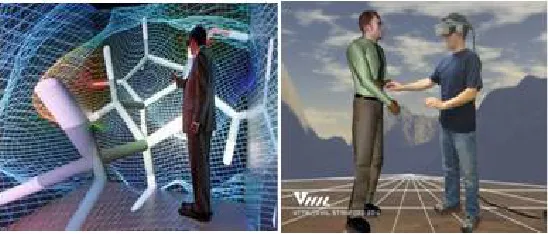
Virtual Assistant (VA) is a term that applies to computer-simulated environments that can simulate physical presence in places in the real world, as well as in imaginary worlds. In other word, virtual assistant is a simulation in which computer graphics is used to create a realistic looking world. Moreover the synthesized world is dynamic and responds to user inputs such as gestures and verbal commands. Virtual Assistant is a real-time and interactive technology. It means that the computer is able to detect user inputs and modify the virtual world instantaneously. Interactivity and its captivating power contribute to the feeling of being the part of the action on the environment that the user experience. All human sensorial channels can be used to have a high level interaction. Most current virtual assistant environments are primarily visual experiences, displayed either on a computer screen, but some simulations include additional sensory information, such as sound through speakers or headphones. Some advanced simulators, use haptic systems which include tactile information, generally known as force feedback. So, we can summarize the above ideas of Virtual Assistant in one definition Virtual Assistant is a high-end user interface that involves real time simulation and interaction through multiple sensorial channels like visual, auditory or tactile. Samples of Virtual Assistant interaction are illustrated in the Figure below,
Virtual Assistant technology has been a promising technology applicable in various domains of application such as training simulators, medical and health care, rehabilitation , education, engineering , scientific visualization , and entertainment industry.
II. VIRTUAL ASSISTANT TYPES
We can categorize Virtual Assistant systems into three groups depending on the degree of immersion and interactivity. These three groups are immersive systems, non-immersive systems and hybrid VR systems.
1. Immersive systems replace our view of the real world with the computer-generated images that interact to the position and orientation of the user’s head.
2. A non-immersive system on the other hand, leaves the user visually aware of the real world but able to observe the virtual world through some display device such as graphics workstation.
3. A hybrid VR system permits the user to view the real world with virtual images superimposed over this view. Such systems are also known as “Augmented Assistant” systems.
A practical example is found in the HMDs used by fighter pilot, which allow the pilot to view their outside world simultaneously with overlaid synthetic graphics.
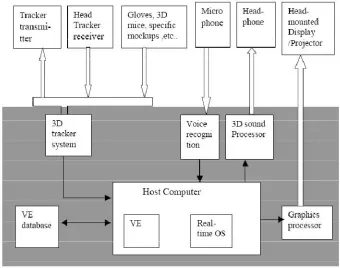
A generic immersive VR system consists of three system elements interacting with each other to make the whole functioning system. These three elements are the Virtual Environment, the computer environment and VR Interfaces. a. VE covers ideas such as model building, introducing dynamic features and physical constraints.
b. The computer environment includes the processor configuration, the I/O channels the VE database and the real-time operating system.
III. VIRTUAL ENVIRONMENT
Virtual Environment as its name implies is a virtual representation of an existing or non existing physical environment or an abstract information which offers end users real time interactivity and make them feel as if they are part of it. Due to the interactive and behaviors that occur in real, immersive nature of Virtual Environment have resemblance with behaviors that occur in real environments.
The VE can take many forms; for example it could be realistic representation of some physical environment such as the interior of a building, a kitchen or even an object such as a car. It could be that the VE does not have any physical basis at all. For instance, it might be a 3D database of a geographical, hierarchical network describing a multinational company or a multidimensional data set associated with stock transactions. Whatever the nature of the underlying data, a geometric model is required to represent atomic entities and their relationships with one another. Based on this geometric model a geometric database must be built to represent the environment and stored such that it can be retrieved and rendered in real time when required. The database storing VE includes 3D geometry, color and texture, dynamic characteristics, physical constraints and acoustic attributes. HMD, BOOM, CAVE are common virtual environments now and virtual globe is an upcoming technology in virtual environments.
HMD:
Head mounted device was the first device to create, and provide its wearer with unseen world of virtual assistant. In 1965, Evans and Sutherland first introduced head mounted display. HMD device consist of two miniature display screens and an optical system. These two components channel the images from the screens to the eyes, presenting a stereoscopic imaging.
BOOM:
The Binocular Omni-Orientation Monitor (BOOM) from fake space is a high-resolution stereoscopic viewing device. Screens and optical system are housed in a box that is attached to a multi-link arm. The user looks into the box through two holes, sees the virtual world, and can guide the box to any position within the operational volume of the device. Head tracking is accomplished via sensors in the links of the arm that holds the box.
CAVE :
The Cave Automatic Virtual Environment (CAVE) is an immersive virtual assistant facility designed for theexploration of and interaction with spatially engaging environments. Basically, the CAVE’s comprises of four projection surfaces on which images are projected with uniquely immersive design.
Virtual Globe:
Virtual globe is a 3D software model or representation of the Earth or another world.
IV. VIRTUAL ASSISTANT INTERFACES
One of the key features of Virtual Assistant is interactivity. So HCI (Human-Computer Interaction) is one of domination factors in VR researches. In order to allow human-computer interaction it is necessary to use special tools designed both to allow input to the computer and to provide feedback to the users. Today’s VR interfaces are varied in functionality and purpose as they address several human sensorial channels. To generate the VE’s images according to the movements of the user’s body, it is fundamental to rapidly acquire data about the different body positions in the 3D space, and transmit them to the computer in order to elaborate the environment’s modifications to be issued in response to the user’s actions. This can be done by dedicated devices named 3D trackers. The technologies used predominantly in 3D tracking are four: mechanically based, optically based, magnetically based and acoustically based.
1. Mechanical tracking makes use of a mechanical armature with one side connected to the top of a helmet and the
other end connected to an encoding device on the ceiling.
2. Optical tracking can be implemented by sensor or by camera. Sensor-based tracking makes use of small markers -
for example flashing infrared LED’s- on the body.
3. Magnetic tracking uses a source element radiating a magnetic field and a small sensor that reports its position and orientation with respect to the source.
V. VIRTUAL ASSISTANT APPLICATIONS
1. The virtual domain offers reliability, speed, ease of access, compactness and security, and is easily transmitted to other virtual domains for example computers located in distant parts of the world.
2. Due to these facts, VR technology has been a promising technology applicable in various domains of application. These most popular domains of application are training simulators, medical and health care, education, defense, engineering, ergonomics and human factors research, database and scientific visualization, and entertainment industry.
3. Training simulators are used for planes, submarines, power plants, surgery, endoscopes and air traffic control. Such simulation uses a replica of the real operational environment and real time computer to model its dynamics. 4. Training through simulation provides significant benefits over other methods. Hazardous environment, such as a
nuclear power station or an aircraft landing in a fog can be accurately simulated without any danger to the trainee. 5. Diagnosis using virtual endoscopy is one of the areas that can achieve clinical efficiency in the earliest time frame. 6. it allows healthcare professionals to learn new skills as well as refreshing existing ones in a safe environment. Plus
it allows this without causing any danger to the patients and can record improvement stages of the patient.
7. Education is another area which has adopted virtual assistant for teaching and learning situations. Virtual Environments can be used for learning of the kind expected to occur in schools, colleges and universities.
VI. VIRTUAL RELITY CHALLENGES
Virtual assistant can lead to state of the art technologies like second life. In fact, virtual assistant program Second Life poses new challenges to its more than millions of users that include economic interactions, methods of communication and documentation. In other words, Second Life is a MUVE, or Multi-user Virtual Environment.
TECHNICAL CHALLENGES :
Due to the proprietary communications protocols, it is not possible to use a network proxy/caching service to reduce network load. Cost is another issue.
CULTURAL CHALLENGES :
Liability issues are still at question in virtual worlds. In Second Life private land can be pur-chased. Private land can be restricted to only authorized users.
VII. CONCLUSION
1. Nowadays, VR technology has been applied in various domains such as training simulators, medical and health care, education, scientific visualization, and entertainment industry.
2. Virtual assistant can lead to state of the art technologies like Second Life, too. Virtual Assistant (VR) is a term that applies to computer-simulated environments that can simulate physical presence in places in the real world, as well as in imaginary worlds.
3. Like many advantageous technologies, beside opportunities of Virtual Assistant and Second Life, unavoidable challenges appear, too.
4. In this paper, Virtual assistant types and structural elements of a virtual assistant system are described. Two main of these elements: Virtual Environment and Virtual Assistant Interfaces are explained further.
5. Then applications of virtual assistant that providing us opportunities in various domains are described and at last, challenges of applying virtual assistant technology are presented.
REFERENCES
1. https://www.bbvaresearch.com/wp-content/uploads/ 2. https://www.chatbots.org/papers/
3. http://www.ijtra.com/view/artificially-intelligent-college-oriented-virtual-assistant.pdf 4. http://www.engpaper.com/artificial-intelligence-research-papers-2012.htm
5. https://papers.ssrn.com/sol3/