Effects of end group functionalization and level alignment on electron
transport in molecular devices
Gunn Kima兲 and Shuchun Wang
Center for High Performance Simulation and Department of Physics, North Carolina State University, Raleigh, North Carolina 27695-7518, USA
Wenchang Lu, Marco Buongiorno Nardelli, and J. Bernholcb兲
Center for High Performance Simulation and Department of Physics, North Carolina State University, Raleigh, North Carolina 27695-7518, USA and CSMD, Oak Ridge National Laboratory, Oak Ridge, Tennessee 37881-6359, USA
共Received 1 October 2007; accepted 8 November 2007; published online 11 January 2008兲
The effect of metal-molecule coupling on electron transport is examined in the prototypical case of alkane chains sandwiched between gold contacts and bridged by either amine or thiol groups. The results show that end group functionalization plays a crucial role in controlling electron transport, and that the symmetries and spatial extent of orbitals near the Fermi level control the conductivity rather than the strength of the bonding. For amine/Au and thiol/Au junctions, a crossover in conductivity with increasing bias is predicted. ©2008 American Institute of Physics.
关DOI:10.1063/1.2822180兴
I. INTRODUCTION
One of the main goals of nanotechnology is the minia-turization of electronic devices through exploitation of unique properties of matter at the nanoscale. This technologi-cal quest should lead to the development of novel applica-tions and devices, where nanostructures, molecules, or quan-tum dots are the active elements of the device. At present, one of the most active areas of study is the development of molecular electronic devices. Advancements in such devices based on single organic molecules would enable new com-puter architectures and provide fresh insight into the nature of electronic coupling between inorganic solids and organic molecules.1,2 Although this field is relatively new, a large variety of techniques for measuring electron transport prop-erties of single organic molecules have been developed. These include scanning tunneling microscopy,3,4mechanical break junctions,5 and asymmetric metal/molecule/ nanoparticle/molecule/metal bridges.6,7 However, despite great efforts dedicated to the investigations of these systems, comprehensive conceptual understanding of electron trans-port in molecular systems is lacking, which impedes devel-opment of molecular devices and the technologies that would be based on them.
The primary aim of this work is to examine metal/ molecule coupling by directly comparing the conductance of long hydrocarbon 共alkane兲 chains sandwiched between two gold contacts. Recent experiments revealed dramatic differ-ences in electronic coupling at an alkane/gold interface de-pending on the end group: thiol 共–SH兲 versus amine
共–NH2兲.7 In this letter, we examine the electron transport through these junctions through first-principles methods.
Analysis of the theoretical results shows that conductance is governed by the energies, spatial extent, and symmetries of the orbitals near the Fermi level rather than by the strength of the bonding. For the amine/Au and thiol/Au junctions, we find that in the low bias regime the current through the former is larger than through the latter, in agreement with recent experimental results. However, at biases higher than
⬃1 V, we predict that this ordering is reversed and a larger current flows through molecules with a thiol/Au contact. The reversal is explained through detailed analysis of individual orbitals and the shifts of their levels with bias. These shifts could be further tuned by gating or additional ligands, which could serve as a further avenue for adjusting the device per-formance.
II. COMPUTATIONAL DETAILS
Our calculations of the electronic structure and quantum transport are carried out using density functional theory, with generalized gradient approximation8 for evaluating the exchange-correlation energy. To obtain optimized geometries and electronic levels of our model structures, we employ the OPENMX code9–11 in a cluster geometry. The core electrons are described by Troullier-Martins-type pseudopotentials12 with a partial core correction13in a separable form with mul-tiple projectors.14 The atomic coordinates are relaxed until the Hellmann-Feynman forces are reduced to less than 0.03 eV/Å.
After geometry optimization, quantum transport calcula-tions are performed using a non-equilibrium Green’s func-tion method15,16 within a real-space multigrid-based approach.17,18Ultrasoft pseudopotentials are employed to de-scribe the core electrons.19 The various Green’s functions and self-energies are computed in a basis of localized orbit-als centered on atoms with a radius of 4.5 Å. The orbitorbit-als are variationally optimized for each system.20 Therefore, very
a兲Present address: BK21 Physics Research Division and Department of
Physics Sungkyunkwan University, Suwon 440-746, Korea.
b兲Electronic mail: [email protected].
few orbitals are needed for full density functional theory ac-curacy. We use four orbitals for hydrogen, six for carbon, eight for oxygen and nitrogen, and eleven for gold. The Har-tree potential is obtained by solving the Poisson equation with fixed boundary conditions to match the semi-infinite gold leads on the left and right, respectively. To ensure that the bias-induced forces on the molecule are small, we con-sider only biases smaller than 1 eV.
The transmittance共transmission probability兲spectra un-der the external applied biasVare calculated using the well-known formula,21
T共E,V兲=Tr关⌫L共E,V兲GC+共E,V兲⌫R共E,V兲GC−共E,V兲兴, 共1兲
whereGC±are the advanced and retarded Green’s functions of the conductor, while ⌫L,R are the coupling functions of the conductor to the left and right leads. The current through the molecule is calculated from the Landauer-Büttiker formula22,23
I=
冕
−⬁ ⬁ 2e2
h T共E,V兲关nFD共E−R兲−nFD共E−L兲兴dE, 共2兲
whereR共L兲 is the chemical potential of the right共left兲lead, V=共R−L兲/eandnFDis the Fermi-Dirac distribution.
In our simulations, 1 molecule per 共4⫻4兲 unit cell is adsorbed on a Au 共111兲 surface and its structure is fully optimized. In analyzing the electronic structure and the mo-lecular orbitals, the leads are represented by six bulklike lay-ers of Au along the关111兴direction. In transport calculations, the leads are semi-infinite and the scattering part includes the molecule and eight layers of Au on each side. Under bias, the charge density and potentials in the scattering part are com-puted self-consistently with open boundary conditions in the current direction and periodic boundary conditions in the other two directions. The charge density is allowed to change in the central region, which includes the molecules and two layers of Au on each side. It matches smoothly the bulk charge densities of the semi-infinite leads. While the calcu-lations are carried out atT= 0, the thermal broadening of the Fermi-Dirac function at the experimental共room兲temperature is much smaller than level broadening induced by chemical coupling to the leads, for example.
III. RESULTS AND DISCUSSION
The optimized geometries of 1-pentanethiol 共PT兲
关CH3–共CH2兲4– SH兴 and 1-pentylamine 共PA兲 关CH3–共CH2兲4– NH2兴 on Au 共111兲 surfaces are shown in
Figs.1共a兲and1共b兲. For the PA molecule in Fig.1共a兲, we find that the on-top adsorption site24,25is the most favorable, with Au–N distance of 2.35 Å. Considering the covalent bond radii of nitrogen 共⬃0.75 Å兲 and gold共⬃1.44 Å兲, the value of 2.35 Å is quite long. Furthermore, the uppermost Au layer is distorted due to the adsorption of the amino group. All the other sites, such as bridge, fcc-, and hcp-hollow result in a very weak or almost no binding.25 On the other hand, it is well known that the alkanethiol molecule prefers a fcc-hollow adsorption site.26–29 The optimized Au–S distance is 2.52 Å and displays a covalent bond character,29 consistent with the covalent bond radius of sulfur, ⬃1.02 Å. The
ad-sorption energy 关E共molecule兲+E共surface兲−E共molecule + surface兲兴of the thiol group on gold is 2.3 eV, which is in agreement with the results of other groups.30,31For the amino group on Au surface, we find an adsorption energy of 0.61 eV, which is a little higher than the adsorption energy of ammonia on Au.25The relatively small adsorption energy and the distortion of the Au surface may explain why self-assembled monolayers of PA on gold are less stable than those of PT.7According to our Mulliken population analysis, PT transfers a larger fraction of an electron 共0.65e兲 to the gold surface than PA 共0.45e兲. The structures of octanedi-amine 共ODA兲 关C8H16共NH2兲2兴 and octanedithiol 共ODT兲 关C8H16共SH兲2兴on Au共111兲surfaces are created, removing the
methyl 共–CH3兲 terminal groups and using the same attach-ment geometries on the left as on the right关see Figs.1共c兲and
1共d兲兴.
The PT and PA do not bond with the right lead and the distance between the molecule and the gold surface is set to 3.9 Å, which is the distance for physisorption of CH4on Au
surface. This distance could be even larger in experiment, depending on its conditions. Our previous calculations have shown that the shape of I-V curve does not change much, while the amplitude of the current decreases exponentially with increasing distance.29
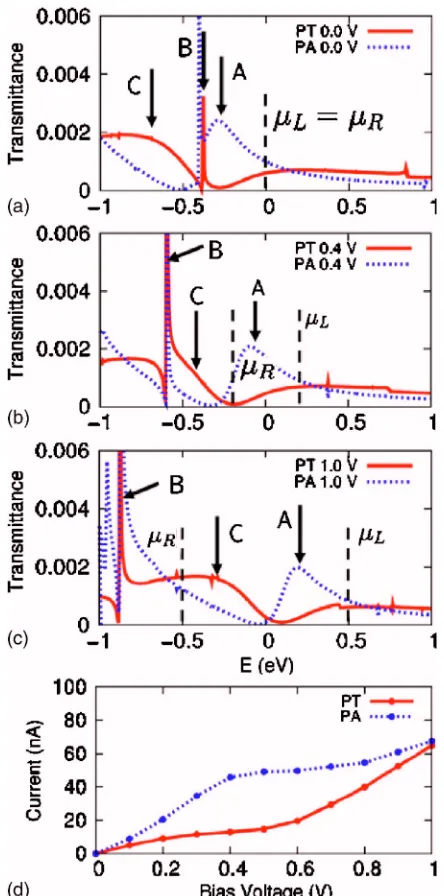
Self-consistent calculations for biases up to 1.0 V are performed for all four molecules sandwiched between the two gold leads. First, we discuss the cases of PT and PA. Figures 2共a兲–2共c兲 show the transmittance spectra as a func-tion of the incident electron energy under different biases, while theI-Vcurves are displayed in Fig.2共d兲. At zero bias, peak A at −0.3 eV is a signature of hybridized states between the molecular orbitals of PA and the left Au lead. Peak B at −0.4 eV, which occurs in both PT and PA adsorption, stems from a surface state of the right Au lead. The appearance of these surface states has been previously documented in the literature.32 Peak C at −0.7 eV originates from hybridized states between the molecular orbitals of PT and the left lead. In order to understand how the molecular orbitals correlate with the appearance of individual peaks in the transmittance and hence influence the current, we plot the highest occupied molecular orbital共HOMO兲states in Fig.3. As shown in Figs.
3共a兲and3共b兲, the HOMOs of both PA and PT are edge states FIG. 1. 共Color online兲Atomic geometries for共a兲1-pentylamine共PA兲and
localized on the amine and thiol groups, respectively, and located at approximately 0.3 eV below the Fermi energy. The HOMO of PA derives from the lone pair of the nitrogen atom and is parallel to the axis of the alkane chain along which the current flows. This state results in the transmittance peak A. The HOMO of PT 关Fig. 3共b兲兴 is strongly localized at the edge, with a well-definedp-orbital character perpendicular to the current direction. Therefore, this state does not contribute to the conductance. In fact, the HOMO-1 derived state关Fig.
3共c兲兴, located at 0.7 eV below the Fermi energy, is the trans-mitting state in the case of PT. It gives rise to the very broad peak C in the transmittance. Since broadening of the HOMO states is an indication of the strength of interaction between the molecule and the Au lead, we expect only a small
broad-ening for the amine end group, which is weakly bonded to the gold surface. In contrast, the thiol end group interacts with the gold surface via a strong chemical bond.33 Hence, substantial level broadening is anticipated. These expecta-tions are consistent with the broadening observed in the transmittance spectra.
Figure4shows a schematic diagram of the alignment of the molecular orbitals that contribute to transmission prob-abilities of PA and PT relative to the chemical potentials of the two leads. Using the same notation as in Fig.6, state A denotes the HOMO of PA, B is the surface state of the right lead and C is the HOMO-1 of the PT. The HOMO of PT is not shown in the figure because it does not contribute to the current. When bias is applied, the electrostatic potential drops mainly in the vacuum region and in the carbon chain. Since the surface state B is localized at the right lead, it is expected to be pinned by the chemical potential of this lead
共R兲. On the other hand, peaks A and C, which are due to edge states at the end group共either amine for PA or thiol for PT兲, are expected to be pinned by the chemical potential of the left lead 共L兲. From Figs. 2共b兲 and2共c兲, we can clearly see this effect. Peaks A and C shift up and peak B shifts down in energy with the increase of bias.
From 0.0 to 0.4 V, tunneling through the HOMO of the PA共peak A兲results in a nearly linear increase in the current
关the blue line in Fig.5共d兲兴. From 0.4 V on, the whole peak A falls into the bias window. Therefore, a plateau in the I-V curve occurs. When the bias is larger than 0.8 eV, another FIG. 2.共Color online兲Transmittance spectra for PA共blue lines兲and PT共red
lines兲as functions of the energyEunder biases of共a兲0.0 V,共b兲0.4 V, and
共c兲1.0 V. The zero of energy in taken in the middle of the bias window, betweenLandR.共d兲Current-voltage共I-V兲characteristics for PA共blue line兲and PT共red line兲on Au共111兲surfaces, when probed by the model STM tip. See text.
FIG. 3.共Color online兲Wavefunctions of occupied orbitals of bridging mol-ecules between two Au共111兲surfaces at the⌫kpoint:共a兲HOMO of PA,共b兲 HOMO of PT,共c兲HOMO-1 of PT,共d兲HOMO of ODA,共e兲HOMO of ODT, and共f兲HOMO-1 of ODT. The values for the red and blue isodensity sur-faces are ±0.005e/a03. See text.
state begins to contribute, leading to a slight increase in the current. In the case of PT, the current is very small for biases lesser than 0.6 V. This is because the HOMO of PT is very localized and does not contribute much to the current, while the scattering state HOMO-1 is still far from the bias win-dow. When the bias is larger than 0.6 V, tunneling through HOMO-1 results in a linear increase in current.
Next, we turn to transport properties of ODA and ODT sandwiched between two Au leads. Both sides of the mol-ecules are connected to the Au surface with either amine
共ODA兲 or thiol 共ODT兲 end groups, as shown in Figs. 5共c兲
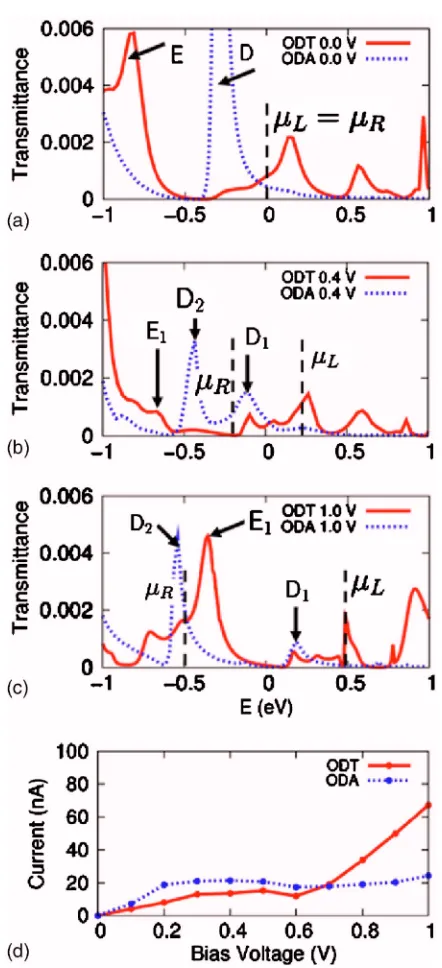
and 5共d兲. Figure 5 shows the transmittance and I-V curves for ODA共blue lines兲and ODT共red lines兲. Obviously, there
is no surface-state-related peak for either ODT or ODA, since these molecules bond to both surfaces. In analogy to PA and PT, peak D in Fig.5is associated with the HOMO of ODA 关Fig. 3共d兲兴 and peak E is related to the HOMO-1 of ODT 关Fig. 3共f兲兴. The HOMO of ODT 共Fig. 3共e兲兲 is very localized and practically does not contribute to the current. At zero bias, both systems have inversion symmetry and the HOMOs are nearly doubly degenerate. Under finite bias, the inversion symmetry is broken and the HOMOs are split into two states. Correspondingly, peak D splits into D1 and D2
when bias is applied. Peak D1is pinned byLand peak D2is
pinned byR. Similarly, peak E also splits into two共E1and
E2兲, but only E1 is visible in Fig. 5, since E2 is below
−1.0 eV. Depending on the bias voltage, the height of E1
varies dramatically. For example, large suppression of the conductance occurs at the bias of 0.4 V, as seen in Fig.5共b兲. The same mechanisms as for PT and PA can be used to explain the differentI-Vcharacteristics of ODA and ODT. At small bias, tunneling through D1of ODA results in a larger
current than in the ODT. At large biases, the HOMO-1 of ODT contributes strongly to the current, which results in ODT transmitting a larger current than ODA at biases larger than 0.7 V. Figure 6 shows schematically the alignment of the molecular orbitals that contribute to the transmission probabilities of ODA and ODT at different voltages. The symbols used are the same as in Fig. 4.
In general, we find that electron tunneling through a mo-lecular junction is strongly affected by coupling between the discrete energy levels in the molecule and the continuum states of the leads. Coupling with the continuum broadens the molecular levels, which become resonances. The shapes and symmetries of the transmitting wave functions result in different broadening of the various conductance peaks. In the adsorption of an amine on gold, which results in hybridiza-tion of the nitrogen lone pair with the gold surface, a hybrid-ized state is directed along the bond axis, leading to a narrow transmittance, whereas more localized and covalent bonding at the junction, as in thiol/Au, results in a much broader transmittance. Furthermore, when the molecular orbitals are more delocalized, they overlap better with the lead states, ensuing in higher conductance. As the bias increases, the HOMO shifts into the bias window and thus the current in-creases. In the amine- and thiol-bridged alkanes, the current at low biases flows mainly through the HOMO. Until the HOMO-1 enters the bias window, the I-V curve has a pla-FIG. 5.共Color online兲Transmittance spectra for ODA共blue lines兲and ODT
共red lines兲as functions of the energyEat biases of共a兲0.0 V,共b兲0.4 V, and
共c兲1.0 V. The zero of energy is taken in the middle of the bias window betweenLandR.共d兲Current-voltage共I-V兲characteristics of ODA共blue line兲and ODT共red line兲bridging Au共111兲surfaces.
teau. Among our model systems, the ODA has the largest energy spacing between the HOMO and HOMO-1 levels, and thus the longest plateau in the I-V curve. While our results for current flow through PT and PA reproduce the low-bias experimental trends, they predict that transmission through PT will eventually become larger for voltages greater than 1 eV in our configuration. For fully bridged leads, the current through ODT becomes greater than through ODA at about 0.7 eV in our geometry.
IV. CONCLUSION
In summary, the electronic structure and transport prop-erties of long alkane chains sandwiched between gold con-tacts was examined theoretically, focusing on metal/molecule coupling and its effect on the electronic transport. We found that end group functionalization plays a crucial role in con-trolling the electronic transport. At small biases 共⬍0.6 V兲, the amine end group results in a larger current than the thiol end group, although the former is only weakly bonded to the surface, while thiols are well known to chemisorb strongly at gold surfaces. It follows that the I-V characteristics are mainly determined by the properties 共symmetry and decay length兲of the molecular orbitals near the Fermi level, and by the number of orbitals falling within the bias window and thus contributing to the current rather than by the strength of the bond. Our results are in good agreement with the avail-able experimental data for similar systems.7
ACKNOWLEDGMENTS
We would like to thank Professor G. N. Parsons for shar-ing his data prior to publication and for helpful discussions. We gratefully acknowledge support by DOE and ONR, and grants of supercomputer time provided by the DOD Chal-lenge Program and the DOE INCITE Program.
1Y. Selzer, A. Salomon, and D. J. Cahen, J. Phys. Chem. B 106, 10432 共2002兲.
2A. Nitzan and M. A. Ratner, Science 300, 1384共2003兲.
3X. D. Cui, X. Zarate, J. Tomfohr, O. F. Sankey, A. Primak, A. L. Moore,
T. A. Moore, D. Gust, G. Harris, and S. M. Lindsay, Nanotechnology13, 5共2002兲.
4C. Joachim, J. K. Gimzewski, R. R. Schlittler, and C. Chavy, Phys. Rev.
Lett. 74, 2102共1995兲.
5C. Kergueris, J. P. Bourgoin, S. Palacin, D. Esteve, C. Urbina, M.
Ma-goga, and C. Joachim, Phys. Rev. B 59, 12505共1999兲.
6I. Amlani, A. M. Rawlett, L. A. Nagahara, and R. K. Tsui, Appl. Phys.
Lett. 80, 2761共2002兲.
7C. Chu, J.-S. Na, and G. N. Parsons, J. Am. Chem. Soc. 129, 2287 共2007兲.
8J. P. Perdew, K. Burke, and M. Ernzerhof, Phys. Rev. Lett. 77, 3865 共1996兲.
9T. Ozaki, Phys. Rev. B 67, 155108共2003兲.
10T. Ozaki and H. Kino, Phys. Rev. B 69, 195113共2004兲.
11The density functional theory code, OpenMX, the basis orbitals, and the
pseudopotentials used in this study are available on the web site http://www.openmx-square.org under the conditions of the GNU General Public License.
12N. Troullier and J. L. Martins, Phys. Rev. B 43, 1993共1991兲. 13S. G. Louie, S. Froyen, and M. L. Cohen, Phys. Rev. B 26, 1738共1982兲. 14P. E. Blochl, Phys. Rev. B 41, 5414共1990兲.
15B. Larade, J. Taylor, H. Mehrez, and H. Guo, Phys. Rev. B 64, 075420 共2001兲.
16M. Brandbyge, J.-L. Mozos, P. Ordejón, J. Taylor, K. Stokbro, Phys. Rev.
B 65, 165401共2002兲.
17M. Buongiorno Nardelli, J.-L. Fattebert, and J. Bernholc, Phys. Rev. B
64, 245423共2001兲.
18W. Lu, V. Meunier, and J. Bernholc, Phys. Rev. Lett. 95, 206805共2005兲. 19D. Vanderbilt, Phys. Rev. B 41, 7892共1990兲.
20J.-L. Fattebert and J. Bernholc, Phys. Rev. B 62, 1713共2000兲. 21S. Datta,Electronic Transport in Mesoscopic Systems共Cambridge
Uni-versity Press, Cambridge, 1995兲.
22R. Landauer, Philos. Mag. 21, 863共1970兲. 23M. Büttiker, Phys. Rev. Lett. 57, 1761共1986兲.
24L. Venkataraman, J. E. Klare, I. W. Tam, C. Nuckolls, M. S. Hybertsen,
and M. L. Steigerwald, Nano Lett. 6, 458共2006兲.
25A. Bilić, J. R. Reimers, N. S. Hush, and J. Hafner, J. Chem. Phys. 116,
8981共2002兲.
26F. T. Arce, M. E. Vela, R. C. Salvarenzza, and A. J. Aevia, Langmuir14,
7203共1998兲.
27Y. Yourdshahyan, H. K. Zhang, and A. M. Rappe, Phys. Rev. B 63,
081405共2001兲.
28H. Gronbeck, A. Curioni, and W. Andreoni, J. Am. Chem. Soc. 122,
3839共2000兲.
29S. Wang, W. Lu, Q. Zhao, and J. Bernholc, Phys. Rev. B 74, 195430 共2006兲.
30C. Majumder, H. Mizuseki, and Y. Kawazoe, J. Chem. Phys. 118, 9809 共2003兲.
31Y. Yourdshahyan and A. M. Rappe, J. Chem. Phys. 117, 825共2002兲. 32S. LaShell, B. A. McDougall, and E. Jensen, Phys. Rev. Lett. 77, 3419
共1996兲.
33W. Tian, S. Datta, S. Hong, R. Reifenberger, J. T. Henderson, and C. P.