A Collaborative Rating Analysis from
Sentiment Mining for Mobile Apps
Dr. R.PRIYA1, SNEHA. R 2
Associate Professor & Head, Department of Computer Science, Sree Narayana Guru College, Coimbatore,
Tamil Nadu, India 1
M.Phil Scholar, Department of Computer Science, Sree Narayana Guru College, Coimbatore, Tamil Nadu, India 2
ABSTRACT: Due to the huge development of internet and social network, the data sources are widely increased. Number of reviews and feedbacks for a particular product or service has been shared by the users via social networks. Finding the best product or service from learning the reviews is more tedious to the users. Data mining is the effective way to handle such huge data reviews and allows the user to get the best product according to the reviews. There are several solutions in the existing system performed opinion and sentiment mining from the social data’s, which poses huge set of drawbacks and complications. Finding the product or service rating from the review analysis involved with textual analysis. This paper developed a new sentiment based rating predication approach for mobile applications from huge number of reviews. Predicting, ranking and rating the mobile apps and its services with the considerations of semantic and hyponym features. This gives a semantic expression to improve the classification accuracy and the proposed technique was investigated on four classifiers. There was a uniform improvement in the classification accuracy for all the classifiers tested. The output of the application is experimented and tested with the mobile app review dataset crawled form Google play store. The use of Hybrid sentiment analysis methods with combining aspect, sentence and document levels were performed in the proposed system.
KEYWORDS: Opinion Mining, Sentiment Mining, Rating Prediction, Review Analysis, Review classification.
I. INTRODUCTION
II. PROBLEM DEFINITION
There is large amount of opinion data on Internet. The data could help other users in making judgment about products or movies after analyzing public opinions. Current search engines selects relevant documents based on keyword matching. Keyword matching is not sufficient for finding subjective (opinion) information. Various applications are developed in different domains like movie domain, products domain, twitter etc in past. The existing Opinion Mining systems [3][4][5] perform the subjectivity detection of reviews at different levels: Document level, Sentence Level and Feature level. All have respective pros and cons. For instance, in movie domain: The heroes are fine and the heroines are good as well, the story is nice. The heroes have best costume design. But, the movie can‘t hold up. There are various positive sentiment words present in the sentence; still the overall sentiment polarity is negative due to the importance of the last sentence. System performing Opinion Mining at document level, sentence and feature level treats all sentences as equal hence last sentence (having highest priority) is treated in the same way as other sentences. The analysis performed at document level, sentence level, or feature level does not yield good results in such cases. There is a need to analyze the review at inter sentential and intra sentential level for proper Opinion Mining of the review [6].
The scope of the research is limited to mining opinion of reviewers from mobile app domain reviews. This performs feature based sentiment analysis of the reviews. This assumes that features of mobile apps are already compiled. Task of extracting features is not a concern here. The reviews are posted by well known critics. So the task of spam detection is not an issue in this work. Based on literature survey, this identify that there is a need to analyze the review at feature level through intra sentential and intra sentential analysis for proper Opinion Mining of the review. So in nutshell, this concludes that this focus on mining of opinions from sentences having mixed and comparative opinions.
III. PROPOSED SYSTEM
A vast range of tools as well as methods are utilized for tackling the problems for achieving SA. The several methods utilized for achieving sentiment classification and they are: 1) classifying with regard to term frequency, n-grams, negation or POS, 2) identifying semantic orientation of words utilizing lexicon, statistical methods as well as training documents, 3) identifying semantic orientation of sentences as well as phrases, 4) identifying semantic orientation of documents, 5) object features extraction, 6) comparative sentences identification. Machine learning applicable to SA is a part of supervised classification. Generally, two sets of documents, training as well as test sets are needed in machine learning based classification. Training sets are utilized by classifiers for learning document differentiating features; it is hence known as supervised learning. Test sets validate classifier performance. Semantic orientation method for SA is unsupervised learning because it requires no earlier training for mining data. It assesses how far a word is either positive or negative. Sentiment classification is regarded as a two-class, positive as well as negative, classification issue. Training or testing data comprises reviews. As online review includes rating score by reviewers, for instance, stars between one and five, these ratings define the positive as well as negative classes. Research typically does not utilize a neutral class which ensures easier classification. Sentiment classification is a text classification issue. Traditional text classification sorts various topic documents with the topic -related words functioning as keywords (for instance science, politics and sports). Sentiment classification is not concerned with the topic rather than sentiments of the words denoting positive or negative opinions. Hence, terms such as great, excellent, amazing, horrible, bad, worst and so on are important in classification of polarities. Classification carried out has its basis in fixed syntactic patterns likely to convey opinions.
Hybrid Sentiment Analysis (HSA): HSA is a standard method utilized in statistical pattern recognition as well as signal processing for data reduction as well as features extraction. Because patterns frequently comprise redundant information, mapping them to features vector may get rid of the redundancy while preserving almost all intrinsic informative content of the patterns. The extracted attributes have a huge role in differentiating input patterns. HSA operates in an unsupervised setting with no usage of class labels of training input for deriving informative linear projections. The linear pre-processing from HSA can considerably decrease the quantity of computations either through explicit reduction of dimensionality of inputs or through simple reordering of input coordinates with regard to variance. HSA is utilized for two aims:
2. Identification of hidden patterns in the data and classification as per how much of the information, stored in the data, they account for.
HSA is mathematically expressed as an orthogonal linear transformation modifying data to a novel coordinate system such that any data projection’s hugest variance comes to lie on first coordinate, second greatest variance on second coordinate etc. If XT with zero empirical mean, wherein every n row denotes varying repetitions of an experiment, every m column specifies a particular datum. Singular value decomposition of X is X= WΣVT, where
m×m matrix W is matrix of eigenvectors of covariance matrix XXT , the matrix Σ is m×n rectangular diagonal matrix with non- negative real numbers on diagonal and n × n matrix V is matrix of eigenvectors of XT X. Extracted features are selected using HSA and the suggested decision forest based features selection. HSA uses a linear transformation to form a simplified data set retaining original data set’s characteristics. If it is assumed that original matrix comprises d dimensions and n observations and is required to reduce dimensionality into a k dimensional subspace then its transformation is expressed as.
Y = ETX 1.1
Here Ed×k is projection matrix with k Eigenvectors equivalent to k greatest Eigen values and wherein Xd×n is mean centered data matrix. HSA’s objective is to find a linear transform for every class using that class’ training patterns in feature space ensuring class -dependent based vectors. The first basis vector is in the given data direction of maximum variance. The other basis vectors are mutually orthogonal and make maximum the remaining variances subject to orthogonal condition. The principal axes are orthonormal axes onto which remaining variances are maximum under projection. These orthonormal axes are given by dominant eigenvectors of the covariance matrix. In the classifier, all classes are characterized by class-dependent basis vectors and number of basis vectors used to characterize ought to be less than the dimensionality d of features space.
HSA’s disadvantages are its global linearity assumption as well as a missing underlying statistical model which ensures soft decisions about membership of specific objects using probabilities. Using HSA model mixtures involves some kind of vector quantization in advance to get clusters to calculate local HSA features. As clustering is independent from HSA, the resulting representation regarding reconstruction error is not optimal. With factor analyzer’s mixtures application a combined clusters optimization and local HSA like dimensionality reduction is available. Dimensionality Reduction (DR) are algorithms and techniques that create new attributes as combinations of original attributes to reduce data set dimensionality. A very important DR technique is HSA which produces new attributes as original variables linear combinations. In contrast, factor analysis aims to express original attributes as linear combinations of limited hidden or latent attributes. Factor analysis searches for underlying (hidden or latent) attributes which summarize a highly correlated attributes group.
Proposed Feature expansion using hyponymy
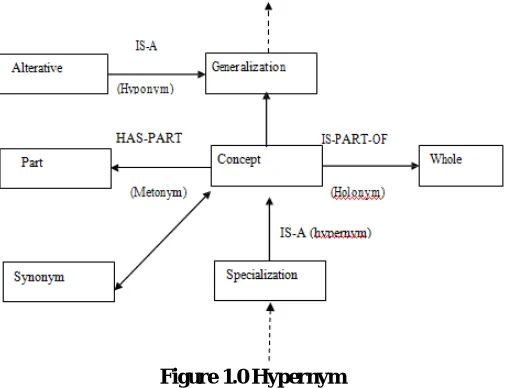
A hyponym is a word that describes things specifically. Proper nouns are examples. Niagara fall is a hyponym for a waterfall’s concept. Ford is a hyponym for a car concept. Hypernyms refer to broad categories or general concepts. Car or air planes are hypernyms for precise terms like Toyota Camry or Boeing 747. Hypernym or Hyponymy is a partial order relation between generalization and concepts specialization. Hypernym is denoted by IS-A. For example, IS-A ("elevator ", "ship equipment "), means an elevator is a part of ship’s equipment. The algorithm’s main lines to identify pairs of hyponym(s) -hyponym have these steps:
1. Deciding on a lexical-semantic relation of interest;
2. Deciding a list of word pairs from WordNet where this relationship holds;
3. Extracts sentences from large corpus where these terms occur and record lexical/syntactic context;
4. Finding communalities among contexts and hypothesizing that common ones produce patterns indicating the relationship of interest.
dependency path and has the total times that that path was shortest path connecting that noun pair in some dependency tree in a corpus. Task is then defined and a noun pair’s binary classification as a hypernym pair based on its feature vector of dependency paths is discussed. Automatic hyponymy relation acquisition from a term-explanation pair needs to find a head word corresponding to hypernym or hyponyms of legal terms from an explanation sentence. So, a syntactic parser is used to extract legal terms.
Figure 1.0 Hypernym
The fundamental procedure of weak semantic mapping begins with extraction of graph structure of thesaurus wherein graph nodes are in the simplest case words as well as graph edges are specified by semantic relation of interest. Generally, not every word in the thesaurus will be linked and the current study solely takes into consideration the biggest connected graph known as the “core”. Every word in the core is allotted on the metric space utilizing a statistical optimization process on the basis of energy minimization. The details of the energy functional as well as of the space rely on the characteristics of the semantic relationship: synonymy as well as antonyms are symmetric and produce multidimensional space with four independent coordinates relating to valence, arousal, freedom, as well as richness. Hypernymy or hyponymy are anti-symmetric and produce uni-dimensional space wherein single coordinate assesses ontological generality of words. A novel element suggested here is the usage of word senses present in WordNet in contrast to words, as graph nodes. Word senses are unique meaning linked to words or idioms, all defined by maximum collection of words which share same joint sense. Hence, there is typically a many-to-many relation between words as well as senses. Senses might also define individual parts of speech, wherein one word might relate to noun, adjective as well as verb. WordNet offers semantic relations amongst senses and words and attributes single word tag to every sense that permits direct comparison of maps acquired with words as well as senses. WordNet is a hierarchically organized lexical system motivated by theory of psycholinguistics that was developed at Princeton University in the 1990s. As a conventional online dictionary, Word Net lists alphabetically concepts important to a particular subject along with explanation. The major advantage of Word Net is linking the words based on semantic relations between their meanings. The most frequently encoded semantic relation among synsets is the super-subordinate relation i.e. hypernym- hyponym. This relation links more general synsets to the specific ones. Hypernym represents is-a relationship among the words.
IV. IMPLEMENTATION AND RESULTS
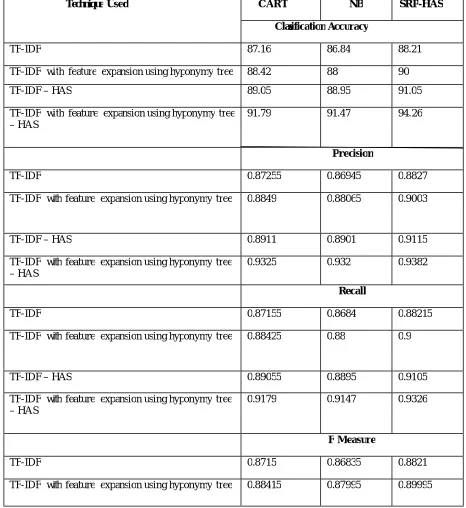
Table 1.1Consolidated output for MOBILE APP Dataset
Technique Used CART NB SRP-HAS
Classification Accuracy
TF- IDF 87.16 86.84 88.21
TF- IDF with feature expansion using hyponymy tree 88.42 88 90
TF- IDF – HAS 89.05 88.95 91.05
TF- IDF with feature expansion using hyponymy tree – HAS
91.79 91.47 94.26
Precision
TF- IDF 0.87255 0.86945 0.8827
TF- IDF with feature expansion using hyponymy tree 0.8849 0.88065 0.9003
TF- IDF – HAS 0.8911 0.8901 0.9115
TF- IDF with feature expansion using hyponymy tree – HAS
0.9325 0.932 0.9382
Recall
TF- IDF 0.87155 0.8684 0.88215
TF- IDF with feature expansion using hyponymy tree 0.88425 0.88 0.9
TF- IDF – HAS 0.89055 0.8895 0.9105
TF- IDF with feature expansion using hyponymy tree – HAS
0.9179 0.9147 0.9326
F Measure
TF- IDF 0.8715 0.86835 0.8821
From the figure 3.0, it can be observed that the SRP- HSA method increased Precision for Positive sentiment by 1.68%, 2.34%, 1.73% & 2.50% by CART and 2.11%, 2.81%, 1.93% & 4.11% by NB when compared with TF- IDF, TF- IDF with feature expansion using hyponym y tree, TF- IDF - HSA and TF- IDF with feature expansion using hyponymy tree - HSA methods.
From the figure 5.0, it can be observed that the SRP-HSA method increased average precision by 1.15%, 1.72%, 2.26% & 0.60% by CART and 1.51%, 2.20%, 2.37% & 0.66% by NB when compared with TF- IDF, TF- IDF with feature expansion using hyponymy tree, TF-IDF - HSA and TF- IDF with feature expansion using hyponymy tree- HSA methods.
V. CONCLUSION
Sentiment Analysis has a huge part to play within text mining applications in the domains of customer relationships management, customer attitude detection, brand/ product positioning as well as market research. The subsequent focus on the applications has given rise to a fresh set of organizations as well as products which are focused on online reputation management, market perception as well as online content monitoring. Subjectivity as well as Opinion Mining devotes itself to the automated detection of private states like opinions, sentiments, beliefs, perceptions and so on in natural language. Subjectivity classification sorts data as subjective or objective, whereas sentiments classification includes another level of granularity by sorting subjective data even further as positive, negative or neutral. This work proposed semantic expression to improve the classification accuracy and the proposed technique was investigated on four classifiers. There was a uniform improvement in the classification accuracy for all the classifiers tested. Similarly the proposed technique showed improved classification accuracy compared to Principal Component Analysis. Limitations of a work can lead to an invention of the other. Though certain efforts have been made to reach the goals, but the following objectives are retained for future work: The proposal fined that some incomplete meaningless sentences or clauses are present in some groups. This is the future work to identify important complete groups for opinion mining. In the research work, feature extraction of apps can be automated. Hence future task will be automatic inclusion of new features and apps from reviews. Even different aspects of mobile app has different sub features hence segmentation based on sub feature is required for the opinion mining. This is the future work. As all dictionaries have their respective pros and cons. This will make combined use of dictionaries for increasing accuracy of the system. This will address the issue of spam detection in mobile app reviews. This will assign degree to positivity and negativity scores. A major disadvantage of semantic feature expansion is the increase in the feature space which increases the computational complexity. The next chapter deals with feature selection techniques to reduce the computational complexity.
REFERENCES
[1]. Pang, Bo, and Lillian Lee. "Opinion mining and sentiment analysis." Foundations and Trends® in Information Retrieval 2.1–2 (2008): 1-135. [2]. Sánchez, David, Montserrat Batet, and David Isern. "Ontology-based information content computation." Knowledge-Based Systems 24.2
(2011): 297-303.
[3]. Hu, Minqing, and Bing Liu. "Mining and summarizing customer reviews." Proceedings of the tenth ACM SIGKDD international conference on Knowledge discovery and data mining. ACM, 2004.
[4]. Vinodhini, G., and R. M. Chandrasekaran. "Sentiment analysis and opinion mining: a survey." International Journal 2.6 (2012): 282-292. [5]. Varghese, Raisa, and M. Jayasree. "A survey on sentiment analysis and opinion mining." International Journal of Research in Engineering and
Technology 2.11 (2013): 312-317.