ABSTRACT
REGAN, ERIN MATILDA. Developing Water Quality and Storage Standards for Cut Rosa Stems and Postharvest Handling Protocols for Specialty Cut Flowers. (Under the direction of Dr. John M. Dole.)
Cut Rosa ‘Freedom’, ‘Charlotte’, and ‘Classy’ stems were subjected to solutions of various pH and electrical conductivity levels created by adding NaCl, Na2SO4, or CaCl2 to a
base solution: Floralife Professional; distilled water; or solutions of HCl, H2SO4, NaCl,
Na2SO4, or NaOH. The solution that produced the longest vase life had a low pH, 3.5 to 4.0,
and an EC of 1.0 dSžm 1 . The average vase life of stems placed in a 1.0 dSžm 1 vase solution was 13.9 d.
2.9 d, at 30ºC for 36 h. ‘Classy’ stems had the longest vase life, 9.3 d, at 1ºC for 24 h, and shortest, 5.8 d, at 30ºC for 48 h.
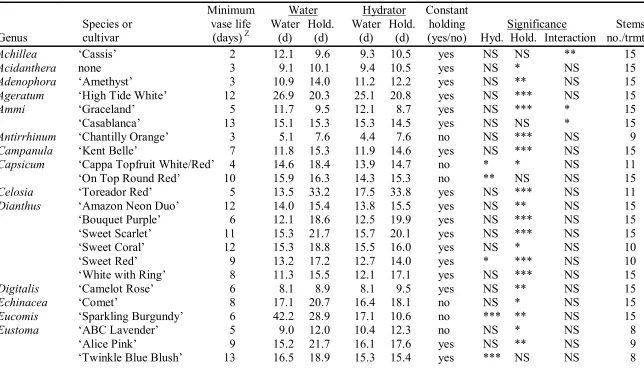
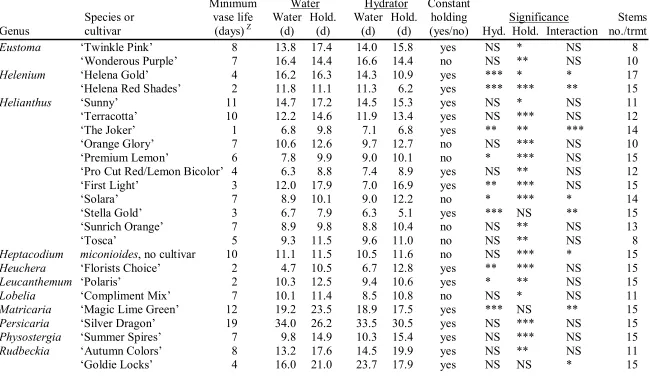
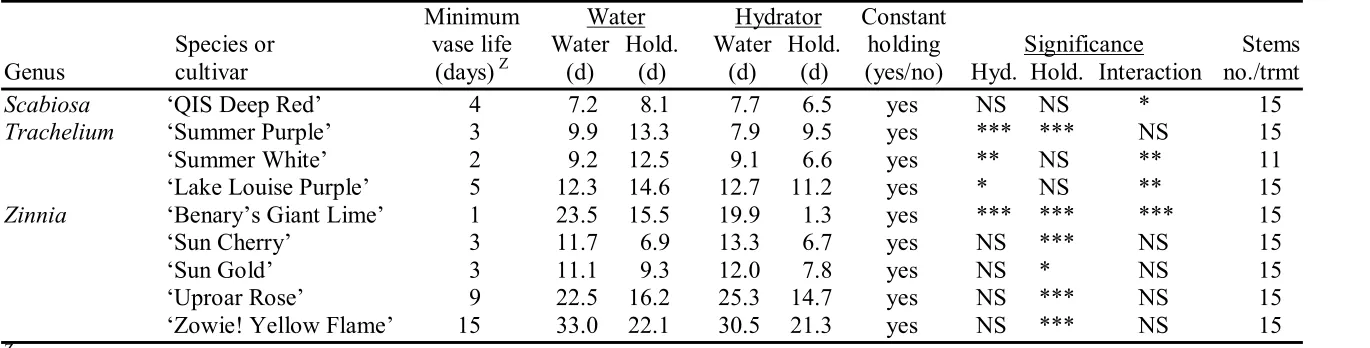
In the Association of Specialty Cut Flower Growers National Cut Flower Trial Program, stems of promising cultivars were pretreated with either a commercial hydrating solution or DI water and placed in either a commercial holding solution or DI water. Over six years, the vase lives of 88 cultivars representing 38 cut flower genera were tested. While there was cultivar variation within each genus, patterns of postharvest responses emerged. The largest category, with 35 cultivars in the following genera, responded positively to a holding preservative: Acidanthera, Adenophora, Antirrhinum, Campanula, Capsicum, Celosia, Dianthus, Digitalis, Echinacea, Eustoma, Helianthus, Heptacodium, Heuchera, Leucanthemum, Lobelia,Physostegia, Rudbeckia, and Trachelium.
Developing Water Quality and Storage Standards for Cut Rosa Stems and Postharvest Handling Protocols for Specialty Cut Flowers
by
Erin Matilda Regan
A thesis submitted to the Graduate Faculty of North Carolina State University
in partial fulfillment of the requirements for the Degree of
Master of Science
Horticultural Science Raleigh, North Carolina
2008 APPROVED BY:
_______________________________ ________________________________
Dr. Sylvia M. Blankenship Dr. John M. Dole
Chair of Advisory Committee
ii BIOGRAPHY
ACKNOWLEDGEMENTS
iv TABLE OF CONTENTS
LIST OF FIGURES... vii
LIST OF TABLES ... viii
CHAPTER 1. LITERATURE REVIEW... 1
Rosa Water Quality... 1
Soluble salts (EC)... 2
pH ... 2
Elements... 2
Standardized vase solution... 3
Rosa Time Temperature Studies... 3
New Cuts Preliminary Studies... 6
New Cuts ... 6
Ethylene sensitivity ... 7
Cold storage duration... 7
Pretreatments... 8
Vase solutions and substrates... 8
Commercial preservatives... 8
Literature Cited ... 10
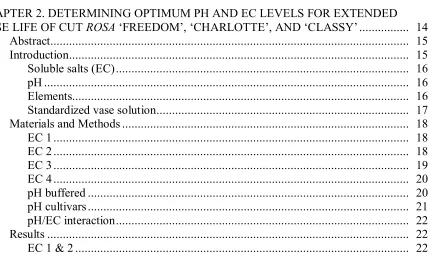
CHAPTER 2. DETERMINING OPTIMUM PH AND EC LEVELS FOR EXTENDED VASE LIFE OF CUT ROSA ‘FREEDOM’, ‘CHARLOTTE’, AND ‘CLASSY’ ... 14
Abstract... 15
Introduction... 15
Soluble salts (EC)... 16
pH ... 16
Elements... 16
Standardized vase solution... 17
Materials and Methods ... 18
EC 1 ... 18
EC 2 ... 18
EC 3 ... 19
EC 4 ... 20
pH buffered ... 20
pH cultivars ... 21
pH/EC interaction... 22
Results ... 22
EC 3 ... 23
EC 4 ... 24
pH buffered ... 25
pH cultivars ... 25
pH/EC interaction... 27
Discussion... 27
Conclusion ... 32
Literature Cited ... 34
CHAPTER 3. DETERMINING STORAGE TEMPERATURE EFFECTS OF CUT ROSA ‘FREEDOM’, ‘CHARLOTTE’, AND ‘CLASSY’... 54
Abstract... 55
Introduction... 56
Materials and Methods ... 58
Timetemperature preliminary study... 58
Fluctuating temperatures... 59
Constant storage temperature... 60
Results ... 61
Timetemperature preliminary study... 61
Fluctuating temperatures... 61
Constant storage temperature... 62
Discussion... 63
Conclusion ... 65
Literature Cited ... 66
CHAPTER 4. EVALUATING POSTHARVEST ATTRIBUTES OF NEW CUT FLOWERS ... 74
Abstract... 75
Introduction... 76
Materials and Methods ... 77
Results and Discussion ... 78
General trends and recommendations by genus... 86
Conclusion ... 91
Literature Cited ... 92
vi
Pretreatments...104
Vase solutions and substrates...104
Commercial preservatives...104
Materials and Methods ...105
Cut stem production ...105
Ethylene sensitivity ...106
Cold storage duration...106
Pretreatments and storage ...107
Sucrose pulses ...107
Vase solutions and substrates...107
Commercial preservatives...108
Control solutions ...108
Results ...108
Ethylene sensitivity ...108
Cold storage duration...108
Pretreatments and storage ...109
Sucrose pulses ...109
Vase solutions and substrates...109
Commercial preservatives...109
Control solutions ...109
Discussion...110
Conclusion ...112
LIST OF FIGURES
DETERMINING OPTIMUM PH AND EC LEVELS FOR EXTENDED VASE LIFE OF CUT ROSA‘FREEDOM’, ‘CHARLOTTE’, AND ‘CLASSY’
Figure 1. Effect of vase solution, EC, and floral preservative on postharvest
characteristics ofRosa ‘Freedom’. EC 2……. ... 36 Figure 2. Effect of vase solution, EC, and chemical on postharvest characteristics of
Rosa ‘Freedom’. EC 3... 39 Figure 3. Effect of EC on postharvest characteristics ofRosa ‘Freedom’, ‘Classy’,
and ‘Charlotte’. EC 4... 41 Figure 4. Effect of vase solution and pH on postharvest characteristics ofRosa
‘Freedom’. pH buffered... 46 Figure 5. Effect of vase solution and pH on postharvest characteristics ofRosa
‘Freedom’, ‘Charlotte’, and ‘Classy’. pH cultivars... 48 Figure 6. Effect of vase solution, pH, EC, and chemical on postharvest characteristics
of Rosa ‘Freedom’. pH/EC interaction... 51
DETERMINING STORAGE TEMPERATURE EFFECTS OF CUT ROSA ‘FREEDOM’, ‘CHARLOTTE’, AND ‘CLASSY’
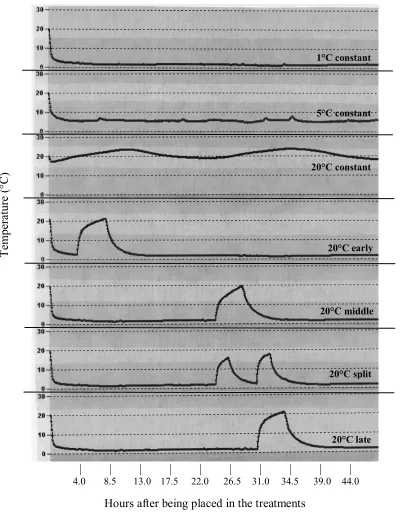
Figure 1. Box temperature of ‘Freedom’ rose stems stored at various temperature
regimes for 48 h as recorded by TL20 data loggers... 68 Figure 2. Effect of fluctuating temperatures on postharvest characteristics ofRosa
‘Freedom’. Timetemperature fluctuating... 69 Figure 3. Effect of storage regiment on postharvest characteristics ofRosa
viii LIST OF TABLES
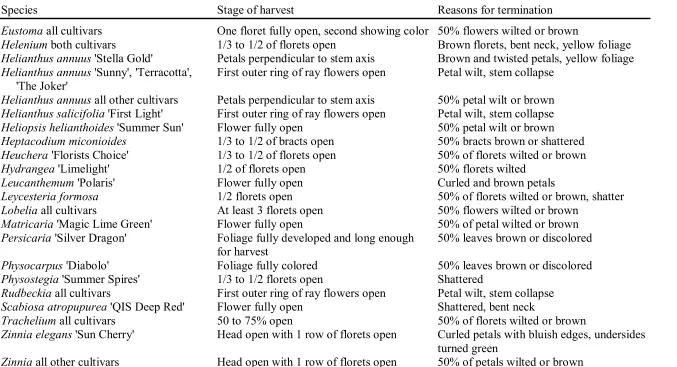
EVALUATING POSTHARVEST ATTRIBUTES OF NEW CUT FLOWERS Table 1. The stage at which each of the species was harvested and criteria by which
the vase life of each species was terminated... 93 Table 2. Effects of hydrator (hyd.) and holding (hold.) solutions on six years of new
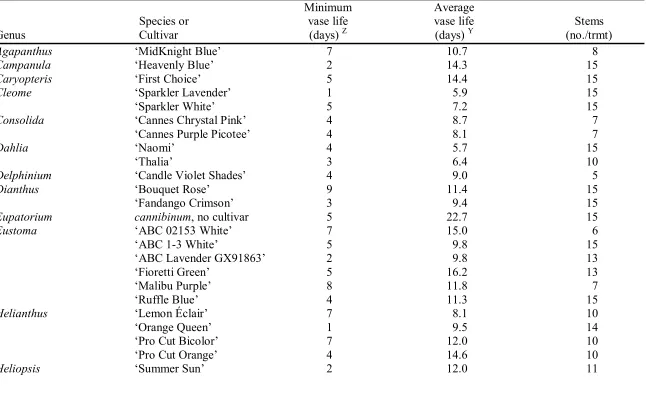
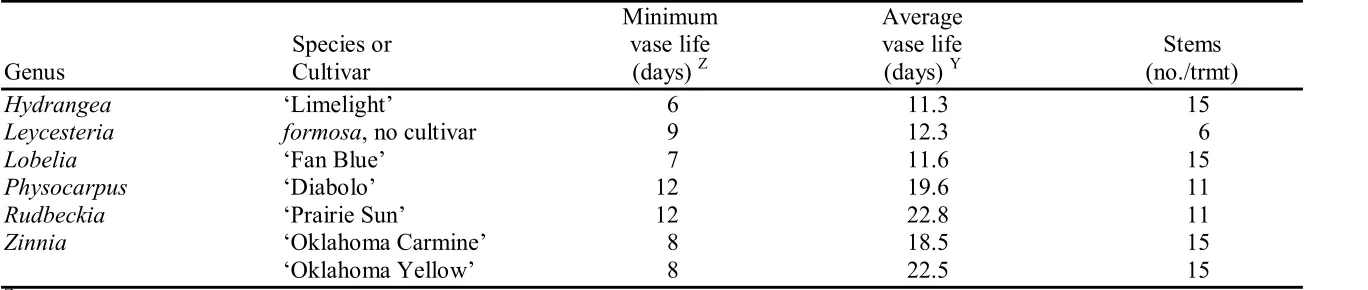
cut flower trials. ... 95 Table 3. Cultivars on which neither hydrator nor holding solutions had an effect... 98 Table 4. Number of genera and cultivars whose response to floral preservatives fits
the indicated categories. Cultivars can fit more than one category...100
POSTHARVEST HANDLING PROCEDURES OFMATTHIOLA INCANA ‘VIVAS BLUE’ Table 1. Effect of ethylene blockers on postharvest characteristics ofMatthiola incana
‘Vivas Blue’.. ...116 Table 2. Effect of ethylene blockers on postharvest characteristics ofMatthiola incana
‘Vivas Blue’.. ...117 Table 3. Effect of cold storage and duration on postharvest characteristics ofMatthiola incana ‘Vivas Blue’...118 Table 4. Effect of cold storage and duration on postharvest characteristics ofMatthiola incana ‘Vivas Blue’...119 Table 5. Effect of pretreatments and storage on postharvest characteristics ofMatthiola incana ‘Vivas Blue’...120 Table 6. Effect of pretreatments and storage on postharvest characteristics ofMatthiola incana ‘Vivas Blue’...121 Table 7. Effect of sucrose pulses on postharvest characteristics ofMatthiola incana
Table 8. Effect of sucrose pulses on postharvest characteristics ofMatthiola incana
‘Vivas Blue’ ...123 Table 9. Effect of vase solutions and substrates on postharvest characteristics of
Matthiola incana‘Vivas Blue’ ... 124 Table 10. Effect of vase solutions and substrates on postharvest characteristics of
Matthiola incana‘Vivas Blue’ ...125 Table 11. Effect of vase solutions on postharvest characteristics ofMatthiola incana
1 LITERATURE REVIEW
The cut flower industry is strong, but postharvest handling continues to be a concern. The work presented in this thesis supports the cut flower industry through extending the vase life of cut Rosa and establishing optimum postharvest handling procedures for new cut flowers. Specifically, examined are water quality issues as well as storage duration and temperature for cut Rosa, the use of hydrators and holding solutions for new specialty cut flowers, and postharvest handling procedures forMatthiola incana‘Vivas Blue’.
Rosa Water Quality
“drawing distilled water through stem segments progressively decreased the rate of conductance and that this phenomenon can be eliminated by using tap water or a dilute osmoticum.” Van Meeteren et al. (2001) continued to question “the predictive value of experiments using deionized water” and speculated that positive effects could be overestimated. Furthermore, floral preservatives and other additives had variable effects on vase life dependent on the water qualities. In decarbonized water, the concentration of Chrysal Professional could be reduced from the commercially recommended 10.0 gžL 1 down to 2.5 to 5.0 gžL 1 when compared to Chrysal Professional in tap water and still obtain the same cut flower longevity (Brecheisen et al., 1995).
Soluble salts (EC). Longevity can be increased with the use of KCl, KNO3, K2SO4,
Ca(NO3)2, and NH4NO2 (Halevy and Mayak, 2001). However, Neumaier et al. (1999) found
that NaCl decreased vase life at concentrations greater than 20 mM NaCl in tap water.
pH. Water with a low pH is taken up more easily by cut flowers than water with a higher pH. A pH of approximately 3.5 is considered most beneficial because it deters the growth of harmful microbes (Gast, 2000; Reid and Kofranek, 1980). Reduced microbe contamination leads to reduced stem plugging and increased vase life.
3 anthocyanins, and improves water uptake (Halevy and Mayak, 1981). For these reasons Al2(SO4)3 is commonly found in floral preservatives (Halevy and Mayak, 1981). Other
elements such as copper, nickel, and zinc are useful germicides (van Meeteren, 2001; Halevy and Mayak, 1981). In contrast, a low level of potassium increased the frequency of bent neck in roses, while fluoride concentrations higher than 5 ppm were detrimental to roses (Halevy and Mayak, 1981).
Standardized vase solution. With all the information on specific elements, little has been concisely stated about a beneficial combination of ions. Van Meeteren (2001) suggested a solution of CuSO4 (0.005 mM) + CaCl2 (0.7 mM) + NaHCO3 (1.5 mM) as a
standardized laboratory “tap water”. The optimum pH, electrical conductivity (EC), and nutrient combination need to be established for cut flowers, especially Rosa, allowing for development of a standardized laboratory “tap water”.
The objectives of this study were to characterize the effects of water EC, pH, and elemental composition on Rosa vase life to develop a standardized water. This water would simulate water quality used commercially and in the consumer’s home, allowing experimental results to better reflect real world conditions.
Rosa Time Temperature Studies
produced in locations that necessitate the use of air transportation to reach customers. Mwangi and Bhattacharjee (2003) inform us that “when transported by air, cut flowers…are usually subject to fluctuating ambient temperatures”. In a diagram depicting the cold chain for the international shipment of unrooted cuttings, Faust et al. (2006) illustrates the wide temperature range that can occur (45 to 90ºF) as well as temperature peaks (60ºF, 22 to 23 h after harvest). Each step of the chain is an opportunity for poor temperature management to occur. Halevy and Mayak (1981) warned that temperature variations should be kept to a minimum. Even short exposures to high temperatures can significantly reduce the longevity of cuts (Reid and Kofranek, 1980). At high temperatures, buds open unacceptably fast or fail to open enough (Nell and Leonard, 2005; Hu et al., 1994; Halevy and Mayak, 1981). Nell and Leonard (2005) state that, although cultivar dependent, inadequate flower opening occurred when storage temperatures were 10ºC compared to 2 and 6ºC. One exception was ‘Charlotte’, which experienced the greatest flower opening at 10ºC (Nell and Leonard, 2005). Cut flowers respired up to 25 times faster at higher temperatures (20ºC) than at recommended (0.5ºC) storage and transport temperatures (Reid and Kofranek, 1980). Proper handling recommendations include storing roses at 0.5ºC for no longer than 2 weeks (dry storage) (Hardenburg et al., 1986).
5 environment. Thus, the flowers may appear to be high quality, but have a short vase life due to improper shipping and handling.
Time temperature indicators are “small measuring devices that show a time temperature dependent, easily, accurately and precisely measurable irreversible change that mimics the change of a target attribute undergoing the same time variable temperature exposure” (Guiavarc’h et al., 2004). The devices record the temperature history over a set amount of time (Singh and Wells, 1986). An irreversible change in the device occurs when it is exposed to a period of temperatures above a given limit. The change is based on mechanical, chemical, enzymatic, or microbiological systems and can be seen as a mechanical deformation, color development, or color change (T. Labuza, personal communication). By using timetemperature indicators, customers would be able to review the transportation conditions and determine if problems, especially high temperatures, occurred during shipping.
New Cuts Preliminary Testing
Each year a wide variety of new cultivars and species are evaluated in the National Cut Flower Trial Programs, administered by North Carolina State University and the Association of Specialty Cut Flower Growers (ASCFG). These new cultivars are tested at approximately 50 locations in the United States and Canada, providing valuable production and marketing information. However, postharvest life, a key component of a successful cut flower cultivar, is not included in the trial program. In response, a two stage postharvest evaluation program has been developed to screen large numbers of taxa.
In stage one, stems of promising cultivars from the National Trial Program are pretreated with either a commercial hydrating solution or DI water and placed in either a commercial holding solution or DI water. To date, the vase life of 88 cultivars representing 38 cut flower genera have been tested. The objective of this multiyear study is to identify patterns of postharvest responses among the different genera.
New Cuts
If a specific cultivar appears particularly promising, but there has not been a great deal of research conducted with the cultivar or genus, the cultivar undergoes studies (Stage 2) to provide growers, wholesalers, and retailers with the information required to handle large amounts of the new product.
7 Matthiola ‘Asanami’ (Yamonouchi and XinZhen, 2000), ‘Rubin’ (Nowak and Rudnicki, 1975), and ‘Chohong’ (Song et al., 1996). Studies with cut Rosa L. have shown that cultivars may vary in vase life and optimum postharvest handling procedures (Nell and Leonard, 2005).
Ethylene sensitivity. When exposed to ethylene at rates as low as 100 parts per billion, cut stems of sensitive species abscise buds, leaves, and flowers; abort buds; rapidly senesce; experience epinasty; and have a decreased vase life (Dole et al., 2005). Silver thiosulfate (STS) and 1methylcyclopropene (1MCP) are two common antiethylene agents that are effective in increasing the vase life of Matthiola. Some studies showed that STS resulted in longer vase life than 1MCP (Dole and Wilkins, 2005; Dole et al., 2005; Celikel and Reid, 2002); yet others stated the results are comparable (Serek et al., 1995). Work is needed to determine which product is more effective in increasing vase life and to determine the optimum application rates.
Pretreatments. Pretreatments are shortterm treatments (generally 24 h or less) implemented shortly after harvest to increase the longevity of cut stems (Nowak and Rudnicki, 1990). Examples of pretreatments include placing the stems in hot water (100ºF) or a 5 to 20% sucrose solution, or exposing the stems to an antiethylene compound (Dole and Wilkins, 2005). Sucrose in the pulsing solution may increase the rate and number of buds opening, improve petal coloration, and extend vase life (Sacalis, 1993; Nowak and Rudnicki, 1990; Halevy and Mayak, 1979). Concentrations of 5 to 20% sucrose are typically used (Dole and Wilkins, 2005) for a duration of a few hours to 2 d.
Vase solutions and substrates. A variety of vase solution and substrate options exist for cut stems. Floral preservatives are typically used by consumers to extend cut flower vase life. The floral foam substrate typically used in the floral arrangement may decrease vase life when compared to stems placed in solution (Neumaier et al., 1999).
Commercial preservatives. The use of preservatives considerably increases the vase life of cut Matthiola (Celikel and Reid, 2002). Typically, hydrators contain an acidifier and/or an antimicrobial agent and are used to increase water uptake (Dole and Wilkins, 2005). Holding solutions contain similar compounds to hydrators, but also include sucrose to provide carbohydrates and encourage flower opening. Hydration solutions do not contain sucrose as flower opening is not beneficial or needed in some species, such as cut Rosa, and sucrose may decrease water uptake.
Literature Cited
Amin, E. and M.E. Hashem. 1984. Handling of rose cut flowers for export from Egypt, with reference to temperature, pulsing and preservatives. Ann. Agr. Sci. 29 (2): 903915. Armitage, A.M. and J. M. Laushman. 2003. Specialty cut flowers. 2 nd ed. Timber Press,
Portland, Ore.
Brecheisen, S., H.P. Haas, and R. Rober. 1995. Influence of water quality and chemical compounds on vase life of cut roses. Acta Hort. 405: 392400.
Celikel, F. G. and M. S. Reid. 2002. Postharvest handling of stock (Matthiola incana). HortScience 37: 144147.
Dole, J.M., W.C. Fonteno, and S.M. Blankenship. 2005. Comparison of silver thiosulfate with 1methycyclopropene on 19 cut flower taxa. Acta Hort. 682: 949953.
Dole, J.M. and H. F. Wilkins. 2005. Floriculture: principles and species. 2 nd ed. Prentice Hall, Upper Saddle River, N.J.
Faust, J.E., A.L. Enfield, S.M. Blankenship, and J.M. Dole. 2006. Postharvest, p. 145152. In: J.M. Dole and J.L. Gibson. Cutting propagation: a guide to propagating and producing floriculture crops. Ball Publishing, Batavia, Ill.
Gast, K.L.B. 2000. Water quality: why it is so important for florists. Ext. Publ. MF2436. Kansas State Univ.
11 Guiavarc’h, Y.P., A.M. van Loey, M.E. Hendrickx. 2005. Extended study on the influence of
z value(s) of single and multicomponent timetemperature integrators on the accuracy of quantitative thermal process assessment. J. Food Protection 68 (2): 384395. Halvey, A. H. and S. Mayak. 1979. Senescence and postharvest physiology of cut flowers,
Part I. pp.204236. In: J. Jancik (ed.). Hort. Rev., Vol. 1. AVI Publishing Company, Westport, Conn.
Halvey, A. H. and S. Mayak. 1981. Senescence and postharvest physiology of cut flowers, Part 2. pp.204236. In: J. Jancik (ed.). Hort. Rev., Vol. 1. AVI Publishing Company, Westport, Conn.
Hardenburg, R.E., A.E. Watada, C.Y. Wang. 1986. The commercial storage of fruits,
vegetables, and florist and nursery stocks. U.S. Dept. Agr., Agr. Hdbk. No. 66 (revised), pp. 7591.
Hu, Y., M. Doi, and H. Imanishi. 1994. Improving the longevity of cut roses by cool and wet transport. J. Jpn. Soc. Hort. Sci. 67 (5): 681684.
Kamataka. 2003. Chemically fortified solutions to enhance the longevity of cut rose cv. Arjun. J. Agr. Sci. 16 (2): 324326.
Mwangi, M. and S.K. Bhattacharjee. 2003. Influence of pulsing and dry cool storage on postharvest life and quality of ‘Noblesse’ cut roses. J. Ornamental. Hort. 6 (2): 126 129.
Nell, T. A. and R. T. Leonard. 2005. The effect of storage temperatures on Colombian grown rose varieties. Acta Hort. 669: 337342.
Neumaier, D., H.P. Haas, and R. Roeber. 1999. Longevity of cut flowers as influenced by water quality and floral foam. Acta Hort. 482: 7781.
Nowak, J. and R.M. Rudnicki. 1975. The effect of "Proflovit72" on the extension of vase life of cut flowers. Prace Instytutu Sadownictwa w Skierniewicach, B 1:173179. Nowak, J. and R.M. Rudnicki. 1990. Postharvest handling and storage of cut flowers, florist
greens, and potted plants. Timber Press, Portland, Ore.
Palanikumar, S. and S.K. Bhattacharjee. 2001. Effect of wet storage on postharvest life and flower quality of cut roses. J. Ornamental. Hort. 4(2): 8790.
Pompodakis, N.E., L.A. Terry, D.C. Joyce, D.E. Lydakis, and M.D. Papadimitriou. 2005. Effect of seasonal variation and storage temperature on leaf chlorophyll fluorescence and vase life of cut roses. Postharvest Biol. Technol. 36: 18.
Reid, M.S. and A.M. Kofranek. 1980. Postharvest physiology of cut flowers. Chronica Hort. 20 (2): 2527.
Sacalis, J.N. 1993. Cut flowers: prolonging freshness. 2 nd ed. Ball Publishing, Batavia, Ill. Serek, M., E.C. Sisler, and M.S. Reid. 1995. Effects of 1MCP on the vase life and ethylene
13 Singh, R.P. and J.H. Wells. 1986. Keeping track of time and temperature. Meat Processing
25 (5): 4142,4647.
Song, C.Y., C.S. Bang, K.Y. Huh, and J.S. Song. 1996. Effects of preservatives and cold storage on vase life and quality of cut hybrid stock (Matthiola incana). J. Agri. Sci. 38: 598603.
Teklic, T., N. Parakzikovic, V. Vukadinovic. 2003. The influence of temperature on flower opening, vase life, and transpiration of cut roses and carnations. Acta Hort. 624: 405 411.
Van Meeteren, U., A. van Gelder, W. van Imperen, and C. Slootweg. 2001. Should we
reconsider the use of deionized water as control vase solutions? Acta Hort. 543: 257 264.
Determining Optimum pH and EC Levels for Extended Vase Life of Cut Rosa ‘Freedom’, ‘Charlotte’, and ‘Classy’
Erin M. Regan 1 and John M. Dole
Department of Horticultural Science, North Carolina State University, Raleigh, NC 27614
Received for publication _____. Accepted for publication ______. We gratefully acknowledge funding and plant material from Dole Fresh Flowers and support from the floriculture research technicians, Ingram McCall and Diane Mays, as well as graduate students Emma Locke, Erin Possiel, and J.B. Clark IV.
1
Abstract
Cut ‘Freedom’, ‘Charlotte’, and ‘Classy’ roses were subjected to solutions of various pH and EC levels created by adding NaCl, Na2SO4, or CaCl2 to a base solution: Floralife
Professional; distilled water; or solutions of HCl, H2SO4, NaCl, Na2SO4, or NaOH. The
solution that produced the longest vase life had a low pH, 3.5 to 4.0, and an EC of 1.0 dSžm
1
. The salt that resulted in the longest vase life was Na2SO4, but all tested salts provided
acceptable results. The average vase life of cut Rosa stems placed in a 1.0 dSžm 1 vase solution was 13.9 d and the minimum, 5 d, was recorded for a ‘Freedom’ rose in either distilled water or a H2SO4 solution. ‘Freedom’ stems were more prone to rot and loss of
pigment, but less affected by high EC. While stems of ‘Charlotte’ and ‘Classy’ experienced a maximum of only 7% rot and loss of pigment, ‘Freedom’ reached 87% rot and 80% loss of pigment. At 4.0 dSžm 1 , the vase life of ‘Classy’ dropped 1.8 d from 2.0 dSžm 1 whereas ‘Freedom’ and ‘Charlotte’ only declined by 1.0 and 0.5 d, respectively.
Introduction
deionized or distilled water would be used as the experimental control to obtain more consistent results (van Meeteren et al., 2001). However, the use of purified waters in a lab setting is problematic because it does not reflect physiological conditions in the plant or standard commercial practices in the industry. Van Meeteren (2001) stated that “drawing distilled water through stem segments progressively decreased the rate of conductance and that this phenomenon can be eliminated by using tap water or a dilute osmoticum.” Van Meeteren continued to question “the predictive value of experiments using deionized water” and speculated that positive effects could be overestimated (van Meeteren, 2001). Furthermore, floral preservatives and other additives had variable effects on vase life dependent on the water qualities. In decarbonized water, the concentration of Chrysal Professional could be reduced from the commercially recommended 10.0 gžL 1
down to 2.5 to 5.0 gžL 1 when compared to Chrysal Professional in tap water and still obtain the same cut flower longevity (Brecheisen et al., 1995).
Soluble salts (EC). Longevity can be increased with the use of KCl, KNO3, K2SO4,
Ca(NO3)2, and NH4NO2 (Halevy and Mayak, 2001). However, Neumaier et al. (1999) found
that NaCl decreased vase life at concentrations greater than 20 mM NaCl in tap water.
pH. Water with a low pH is taken up more easily by cut flowers than water with a higher pH. A pH of approximately 3.5 is considered most beneficial because it deters the growth of harmful microbes (Gast, 2000; Reid and Kofranek, 1980). Reduced microbe contamination leads to reduced stem plugging and increased vase life (Gast, 2000).
show the presence of aluminum, particularly aluminum sulfate, significantly increased cut flower longevity (Kamataka, 2003; Amin, 1984; Halevy and Mayak, 1981). Aluminum reduces transpiration by inducing stomatal closure, reduces bent neck and wilting, stabilizes anthocyanins, and improves water uptake (Halevy and Mayak, 1981). For these reasons Al2(SO4)3 is commonly found in floral preservatives (Halevy and Mayak, 1981). Other
elements such as copper, nickel, and zinc are useful germicides (van Meeteren, 2001; Halevy and Mayak, 1981). In contrast, a low level of potassium increased the frequency of bent neck in roses, while fluoride concentrations higher than 5 ppm were detrimental to roses (Halevy and Mayak, 1981).
Standardized vase solution. With all the information on specific elements, little has been concisely stated about a beneficial combination of ions. Van Meeteren (2001) suggested a solution of CuSO4 (0.005 mM) + CaCl2 (0.7 mM) + NaHCO3 (1.5 mM) as a
standardized laboratory “tap water”. The optimum pH, electrical conductivity (EC), and nutrient combination need to be established for cut flowers, especially Rosa, allowing for development of a standardized laboratory “tap water”.
Materials and Methods
EC 1. Cut stems of Rosa ‘Freedom’ were received from Dole Fresh Flowers (Colombia, South America) and held overnight in a 2ºC cooler. In the morning, roses were unpacked and sorted into ten groups of fifteen stems, according to stem caliper. Stems were cut to 45 cm, labeled, and placed in the treatments. NaCl was added to distilled water at 0.297, 0.590, 1.181, or 2.360 gžL 1
to create solutions with a final EC of 0.5, 1.0, 2.0, or 4.0 dSžm 1 , respectively, or to distilled water plus 10 mL∙L 1 Floralife Professional (pH 3.7, EC 0.40 dSžm 1 ; Floralife, Walterboro, SC) at 0.101, 0.400, 1.001, or 2.0 gžL 1 to create solutions with a final EC of 0.5, 1.0, 2.0, or 4.0 dSžm 1 , respectively. Distilled water or distilled water plus Floralife Professional at 10 mL∙L 1 controls were included. A replication consisted of three stems per vase and each treatment was replicated five times. Vases were arranged in a completely randomized design and placed in a postharvest environment at 68+4 o F under approximately 200 ftc light for 12 h/d. One stem in each vase was weighed for the initial wet weight. Data collected included vase life, termination wet and dry weight for each stem, water uptake, reasons for termination, degree of openness (tight= 1, medium= 2, open= 3, very open= 4), and final solution pH and EC. Reasons for termination, including petal wilt, crisping, bluing, browning, or pigment loss; bent neck, or stem rot, were recorded as either present or not present. Data were analyzed using analysis of variance (SAS Institute, Cary, NC) and means were separated using Tukey’s multiplecomparison procedure at P≤0.05.
were cut to 45 cm, labeled, and placed in the treatments. NaCl was added to distilled water at 0.145, 0.294, 0.441, 0.590, 1.181, 1.476, 1.774, 2.070, or 2.455 gžL 1 to create solutions with a final EC of 0.25, 0.5, 0.75, 1.0, 2.0, 2.5, 3.0, 3.5, or 4.0 dSžm 1 , respectively, or to distilled water plus 10 mL∙L 1 Floralife Professional at 0.100, 0.402, 1.067, or 2.535 gžL 1 to create solutions with a final EC of 0.5, 1.0, 2.0, or 4.0 dSžm 1 , respectively. Distilled water or tap water controls were included. Tap water had a pH of 6.82 and EC of 0.27 dSžm 1
. Element levels significant for this research included: Ca at 7.66 ppm, Cl at 16.0 ppm, Na at 41.8 ppm, and S at 22.8 ppm. A replication consisted of three stems per vase and each treatment was replicated five times. Vases were arranged in a completely randomized design and placed in a postharvest environment at 68+4 o F under approximately 200 ftc light for 12 h/d. One stem in each vase was weighed for its initial wet weight. Data collected and analyzed were the same as in experiment EC 1.
EC 3. Cut stems of Rosa ‘Freedom’ were received from Dole Fresh Flowers (Colombia, South America) and held overnight in a 2ºC cooler. Roses were unpacked and sorted into fourteen groups of fifteen stems, according to stem caliper. Stems were cut to 45 cm, labeled, and placed in the treatments. NaCl was added to distilled water at 0.253, 0.534, 1.067, or 2.201 gžL 1 to create solutions with a final EC of 0.5, 1.0, 2.0, or 4.0 dSžm 1 , respectively. Na2SO4 was added to distilled water at 0.293, 0.663, 1.328, or 2.884 gžL 1 to
create solutions with a final EC of 0.5, 1.0, 2.0, or 4.0 dSžm 1 , respectively. CaCl2 was added
to distilled water at 0.295, 0.581, 1.184, or 2.668 gžL 1 to create solutions with a final EC of 0.5, 1.0, 2.0, or 4.0 dSžm 1
Vases were arranged in a completely randomized design and placed in a postharvest environment at 68+4 o F under approximately 200 ftc light for 12 h/d. One stem in each vase was weighed for its initial wet weight. Data collected and analyzed were the same as in experiment EC 1.
EC 4. Cut stems of Rosa ‘Freedom’, ‘Classy’, and ‘Charlotte’ were received from Dole Fresh Flowers (Colombia, South America) and held overnight in a 2ºC cooler. In the morning, roses were unpacked and sorted into six groups of fifteen stems per cultivar, according to stem caliper. Stems were cut to 45 cm, labeled, and placed in the treatments. NaCl was added to distilled water plus 10 mL∙L 1 Floralife Professional at 0.297, 0.590, 1.181, or 2.360 gžL 1 to create solutions with a final EC of 0.97, 1.57, 2.70, or 4.75 dSžm 1 , respectively. Tap water or distilled water plus Floralife Professional at 10 mL∙L 1 controls were included. A replication consisted of three stems per vase and each treatment was replicated five times. Vases were arranged in a completely randomized design and placed in a postharvest environment at 68+4 o F under approximately 200 ftc light for 12 h/d. One stem in each vase was weighed for its initial wet weight. Data collected and analyzed were the same as in experiment EC 1.
pH buffered. Cut stems of Rosa ‘Freedom’ were received from Dole Fresh Flowers (Colombia, South America) and held overnight in a 2ºC cooler. Stems were unpacked and sorted into seven groups of fifteen stems, according to stem caliper. Stems were cut to 45 cm, labeled, and placed in distilled water amended with a citrateboratephosphate buffer plus 1) HCl (0.83 mL∙L 1 of 12.1 N HCl), 2) H2SO4 (8.3 mL∙L 1 of 1 N H2SO4), 3) NaCl (0.33
amendments). The citrateboratephosphate buffer was made from 0.367 g sodium phosphate, 0.377 g sodium citrate 2hydrate, and 0.487 g sodium borate 10hydrate in 1 L distilled water. The two acidic treatments, HCl and H2SO4, resulted in a target pH of 3.2; the
basic treatment, NaOH, to a target pH of 8.2; and the neutral treatments, NaCl and Na2SO4,
to a target pH of 6.5. Distilled or tap water controls were included. A replication consisted of three stems in a vase and each treatment had five replications. Vases were arranged in a completely randomized design and placed in a postharvest environment at 68+4 o F under approximately 200 ftc light for 12 h/d. One stem in each vase was weighted for its initial wet weight. Data collected and analyzed were the same as in experiment EC 1.
pH cultivars. Cut stems of Rosa ‘Freedom’, ‘Classy’, and ‘Charlotte’ were received from Dole Fresh Flowers (Colombia, South America) and held overnight in a 2ºC cooler. In the morning, the roses were unpacked and sorted into seven groups of fifteen stems per cultivar, according to stem caliper. Stems were cut to 45 cm, labeled, and placed in distilled water amended with a citrateboratephosphate buffer plus 1) HCl, 2) H2SO4, 3) NaCl, 4)
Na2SO4, or 5) NaOH as indicated in the previous experiment. The two acidic treatments, HCl
and H2SO4, resulted in a target pH of 3.2; the basic treatment, NaOH to a target pH of 8.5;
and the neutral treatments, NaCl and Na2SO4, to a target pH of 6.6. Both a distilled or tap
pH/EC interaction. Cut stems of Rosa ‘Freedom’ were received from Dole Fresh Flowers (Colombia, South America) and held overnight in a 2ºC cooler. In the morning, roses were unpacked and sorted into twelve groups of fifteen stems, according to stem caliper. Stems were cut to 45 cm, labeled, and placed in the treatments. HCl solutions were created by making the HCl solution described in the pH studies above then adding NaCl at 0, 0.34, 0.957, or 1.500 gžL 1 to produce solutions with an EC of 1.3, 2.0, 3.0, or 4.0 dSžm 1
, respectively. H2SO4 solutions were created by making the H2SO4 solution described above in
the pH studies then adding NaCl at 0, 0.367, 0.943, or 1.520 gžL 1 to produce solutions with an EC of 1.3, 2.0, 3.0, or 4.0 dSžm 1 , respectively. Distilled water solutions were created by adding NaCl at 0.633, 1.053, 1.617, or 2.033 gžL 1 to produce solutions with an EC of 1.3, 2.0, 3.0, or 4.0 dSžm 1
, respectively. The two acidic treatments, HCl and H2SO4, resulted in a
target pH of 3.3, while the distilled water had an initial pH of 5.4. A replication consisted of three stems in a vase and each treatment had five replications. Vases were arranged in a completely randomized design and placed in a postharvest environment at 68+4 o F under approximately 200 ftc light for 12 h/d. One stem in each vase was weighted for its initial wet weight. Data collected and analyzed were the same as in experiment EC 1.
Results
EC 1 & 2. Results from the expanded EC range were similar to the EC 1 study. The longest vase life, 15.7 d, was obtained with a vase solution containing a floral preservative and having an initial EC of 1.0 dSžm 1
without a preservative, 7.8 to 12.9 d. Vase life curvalinearly increased up to a maximum of 12.9 d in water initially at 0.5 dSžm 1 and up to 15.7 d in preservative initially at 1.0 dSžm 1 and decreased with increasing EC. Water uptake decreased with increasing EC and was greater when a preservative was used; peaking at 93.0 mL at 0.5 dSžm 1 in water only and at 103.0 mL in water with preservative at 1.0 dSžm 1 . Neither preservative nor EC had a significant effect on initial or termination wet weights or weight change, which averaged 29.4, 23.5, or 5.9 g, respectively. Termination dry weight increased with increasing EC, reaching 7.0 g at 4.0 dSžm 1 .
The occurrence of bent neck reached 100% at an initial solution EC of 3.0 dSžm 1 , but was only 33% at 1.0 dSžm 1 (Figure 1). A floral preservative decreased bent neck to nearly 0%. Crispy edge increased quadratically with increasing EC and was greater when a floral preservative was used. Pigment loss and flower opening were greatest in solutions containing a preservative. Bluing decreased to 20% in water initially at 3.5 dSžm 1 , but was consistently 100% with a floral preservative. The incidence of rot decreased with increasing EC, reaching a minimum of 0% with water initially at 3.0 and 3.5 dSžm 1 and 13% with a preservative at 4.0 dSžm 1
. Petal browning was not affected by treatment and averaged 31%. EC 3. The longest vase life, 15.5 d, was obtained with an initial EC of 1.0 dSžm 1
from Na2SO4 (Figure 2). Vase solutions created with CaCl2 and NaCl initially at 1.0 dSžm 1
also produced long vase lives. Vase life curvalinearly increased up to a maximum of 15.5, 14.8, and 14.7 d in water with Na2SO4, NaCl, and CaCl2 at 1.0 dSžm 1 , respectively, and
life. Neither salt composition nor EC had a significant effect on initial or termination wet and dry weights or weight change, which averaged 31.3, 23.8, 5.3, or 7.5 g, respectively.
Petal wilt, crispy edge, brown petal, and rot did not differ significantly between the various salt types or EC levels and averaged 95, 71, 21, or 29% (Figure 2). Loss of pigment was quadratically related to EC and peaked at 60% in a solution of CaCl2 initially at 4.0
dSžm 1
. However, NaCl and Na2SO4 produced a maximum pigment loss of 33 or 25%,
respectively. Rot was most prevalent, 87%, for stems placed in a CaCl2 vase solution
initially at 4.0 dSžm 1 . Stems placed in solutions containing either NaCl or Na2SO4 had the
most bent neck at the high and low EC rates, 93% at 4.0 dSžm 1 and 57% at 0.5 dSžm 1 , respectively. However, stems placed in solutions containing CaCl2 had decreased rates of
bent neck as the EC increased, with a minimum of 7%.
EC 4. The longest vase lives, 16.7 and 15.1 d, were obtained with ‘Freedom’ and ‘Charlotte’ stems in an initial vase solution EC of 1.0 dSžm 1 (Figure 3). However, the longest vase life for ‘Classy’, 16.6 d, was obtained with an initial vase solution EC of 0.5 dSžm 1 . Vase life increased curvalinearly with increasing EC for ‘Freedom’, ‘Charlotte’, and ‘Classy’ up to the maximum indicated above, then decreased with increasing EC. Water uptake peaked at 172, 153, and 156 mL when stems were placed in 0.5, 0.5, and 0 and 2.0 dSžm 1 EC water for ‘Freedom’, ‘Charlotte’, and ‘Classy’, respectively. Initial or termination wet and dry weights or weight change were not affected by treatment and averaged 25.9, 20.0, 4.6, or 5.9 g, respectively.
of flower opening, 1.80, 1.40, and 1.47 for ‘Freedom’, ‘Charlotte’, and ‘Classy’, respectively. ‘Classy’ experienced only 53% crispy edge and ‘Charlotte’ only 67% when placed in tap water, while 93% of ‘Freedom’ stems in tap water were damaged. Similarly, only 47, 73, or 87% of ‘Classy’, ‘Charlotte’, or ‘Freedom’ stems exhibited bluing in tap water. ‘Charlotte’ experienced significantly less brown petal than the other cultivars, with a minimum of 0% with tap water at solution initially at 1.0 dSžm 1
. ‘Freedom’ had significantly more rot and pigment loss than the other cultivars, peaking at 87% at 4.0 dSžm 1 and 80% at 0 dSžm 1 . Petal wilt was unaffected by treatment and averaged 92%.
pH buffered. The low pH solutions, HCl and H2SO4, produced the longest vase lives,
at 11.2 and 10.5 d, respectively (Figure 4). Initial or termination wet and dry weights and weight change were not affected by pH or chemical and averaged 29.8, 24.2, 5.5, or 5.5 g, respectively. Water uptake was proportional to vase life, reaching a maximum of 143 mL with the HCl solution.
Solutions containing H2SO4, Na2SO4, and NaOH experienced 100% bent neck
(Figure 4). Chemical solutions were as low as 0% for both bluing and loss of pigment. The degree of openness and prevalence of rot, crispy edge, bluing, and brown petal increased with increasing vase life, ranging from 1.20 to 2.40, 0 to 100%, 13 to 100%, 0 to 100%, and 0 to 53%, respectively. Petal wilt was unaffected by treatment and averaged 87%.
pH cultivars. The longest vase lives for ‘Freedom’, ‘Charlotte’, and ‘Classy’ were all obtained with distilled and tap water, 11.2 and 10.9, 10.5 and 10.7, and 9.9 and 9.7 d, respectively (Figure 5). Of the chemical solutions, H2SO4 resulted in the longest vase life for
curvalinearly increased up to a maximum of 11.2, 10.7, and 9.9 d at a pH of 4.0, 6.6, and 4.0, for ‘Freedom’, ‘Charlotte’, and ‘Classy, respectively, and decreased with increasing pH. Water uptake followed the same trend as vase life, peaking at 158 mL for ‘Freedom’ at an initial pH of 3.5. Water uptake was significantly less at an intial pH of 8.5 for ‘Freedom’ and ‘Charlotte’ (121.0 and 70.0 mL, respectively) but not ‘Classy’ (67.0 mL). The pH did not have a significant effect on initial or termination wet or dry weights, or weight change for any of the cultivars and averaged 27.5, 21.2, 4.9, or 6.2 g, respectively.
Bluing occurred most frequently with either distilled or tap water for all cultivars (Figure 5). ‘Freedom’, ‘Charlotte’, and ‘Classy’ experienced 80 to 93%, 67 to 87%, and 33 to 40% bluing, respectively with water compared to lows of 7, 0, and 0%, respectively with chemical solutions. All cultivars, in all treatments had a high occurrence of bent neck, ranging from 73 to 100%, with the exception of ‘Charlotte’ in a NaOH solution at 27%. ‘Classy’ stems had a higher prevalence of brown petal, reaching 73%, than the other two cultivars which only had a maximum of 20%. Petal wilt and loss of pigment were unaffected by treatment and averaged 99 and 2%, respectively. ‘Freedom’ stems experienced significantly more rot than the other cultivars, up to 47%, compared to a maximum of only 13% in the other two cultivars. However, cut ‘Freedom’ stems in vase solutions containing sodium only had 13% rot. ‘Classy’ flowers opened the most of all cultivars, reaching a rating of 2.53 out of 4.00 in a NaOH vase solution. ‘Freedom’ flowers opened the most when placed in a H2SO4 solution, 1.87 rating. ‘Charlotte’ flowers opened poorly in all treatments,
pH/EC interaction. The longest vase life, 14.6 d, was obtained with distilled water at an intial EC of 1.0 dSžm 1 and decreased linearly as EC increased (Figure 6). When vase life was plotted against EC, distilled water had a slope of 1.71. HCl and H2SO4 had slopes of
0.84 and 0.21, respectively (data not presented). The flatter slope of the acidic solutions indicates that the vase life of stems placed in a low pH solution did not decrease as EC increased as drastically as stems placed in water of a higher pH. Water uptake was proportional to vase life and peaked at 185 mL of distilled water with an initial EC of 1.0 dSžm 1 . Neither pH nor EC had a significant effect on initial or termination wet and dry weights, or weight change and averaged 25.8, 18.6, 4.5, or 7.1 g, respectively.
Stems placed in distilled water had significantly less bent neck, ranging from 20 to 67%, at all levels of EC, when compared to chemical solutions, ranging from 80 to 100% (Figure 6). At an intial EC of 1.0 and 2.0 dSžm 1 , stems in distilled water experienced more loss of pigment when compared with HCl and H2SO4, 33 and 13% versus 0% and 0 to 7%,
respectively. ‘Freedom’ stems experienced significantly more rot than the other cultivars, a maximum of 47% compared to nearly 0% for ‘Classy’ and ‘Charlotte’. Bluing, brown petal, and stage of openness all decreased linearly with increasing EC. Petal wilt and crispy edge were unaffected by treatment and averaged 96 and 55%, respectively.
Discussion
An intial EC of 1.0 dSžm 1 consistently resulted in the longest vase life. Regardless of starting solution, salt added, or cultivar, stems placed in 1.0 dSžm 1
1 vase solutions. All stems placed in 1.0 dSžm 1
vase solutions had adequate opening; all but two treatments opened more than “medium”, which was a rating of 2 (Figure 3).
In the experiments where tap water (0.26 dSžm 1 ) was used as a control, it produced results most similar to the 0 dSžm 1 distilled water than to a 0.5 dSžm 1 solution of NaCl, CaCl2, or Na2SO4 (Figures 1, 2, and 3). The concentrations of Ca, Cl, and Na in the tap water
were closer to 0 than to the 0.5 dSžm 1
counterparts. In tap water, the concentrations were as follows: 7.66 ppm Ca, 16.0 ppm Cl, and 41.8 ppm Na. In a 0.5 dSžm 1 solution the element concentrations were as follows: 107 ppm Ca, 181 ppm Cl, and 117 ppm Na. The lower concentrations of elements in the tap water may explain the similarity in response between the tap and distilled waters. The tap water has many other elements, such as B, Cu, Fe, K, Mg, Mn, P, and Zn, that may negatively affect vase life and were not included in the laboratory amended water. From this, we can deduce that there may be an elemental effect in addition to an EC effect. This elemental effect should be further investigated.
As stated earlier, the components that comprise tap water and the EC vary across the United States. The Environmental Protection Agency (EPA) has only “nonenforceable guidelines” for electrical conductivity as it affects cosmetics, not water safety (EPA, 2008). This means that the EC can fluctuate widely across the country without consequences for the facilities providing the water. The EPA’s guidelines specify a maximum of 500 mgžL (0.71 dSžm 1 ) total dissolved solids. However, many water sources have higher levels: College Station, Texas at 0.75 dSžm 1 ; San Diego, California at 0.82 dSžm 1 ; and Madison, Wisconsin up to 0.93 dSžm 1
control treatment. The studies presented here determined an optimum EC of 1.0 dSžm 1
, yet none of the cities surveyed had tap water with an EC that high. A standard formula based on distilled or deionized water would be more consistent and useful.
Determining the optimum pH is more difficult than EC. Commercial recommendations state that a pH of 3.5 is best (Gast, 2000; Reid and Kofranek, 1980), but the studies presented here show an optimum range from 3.5 to 5.4 (Figures 4 and 5). In the pH/EC interaction experiment, an intial pH of 5.4 was optimum, but in the pH buffered experiment, which used the same cultivar, 5.4 resulted in the shortest vase life (Figures 4 and 6). The general trend, however, is a lower pH provides a longer vase life. In particular, high pH levels reduced vase life to 3.6 d for ‘Charlotte’ roses placed in a NaOH solution of 8.5 (Figure 5). The variability of optimum pH may be due, in part, to the buffer solution used. The boron present in the buffer solution may be negatively affecting the vase life of roses placed in the buffered vase solutions. The distilled water control would then result in a superficially longer vase life when compared to the buffered vase solutions. Evidence for this theory is discussed later.
10 ppm boron during growth (Ishida et al., 1988). The vase life of cut flowers from those plants was then assessed. Flowers from plants given 0.2 ppm boron had a vase life of 37 d, while flowers from plants given 10 ppm boron resulted in a vase life of only 20 d. Although Ishida et al. (1988) studied the affect of preplant B, they demonstrate the negative effect boron can have on vase life. The rate of boron in the buffer solutions used in the studies presented here was 55 ppm, much greater than that of the Japanese study, although we do not know how much was actually in the rose tissue. Further studies should be conducted to better understand the effect of the various elements.
Water uptake was correlated to vase life which was correlated to EC. As EC increased, vase life and water uptake both increased up to a maximum of 1.0 dSžm 1 , then decreased. For example, in EC experiment three, solutions containing Na2SO4 with 0.5, 1.0,
2.0, and 4.0 dSžm 1 result in vase lives of 14.2, 15.5, 12.9, and 10.9 d, respectively, and water uptake at 191, 214, 158, and 141 mL, respectively (Figure 2). Van Meeteren (2001) stated that “drawing distilled water through stem segments progressively decreased the rate of conductance and that this phenomenon can be eliminated by using tap water or a dilute osmoticum.” It appears that 1.0 dSžm 1
is the optimum “dilute osmoticum” and that higher levels of soluble salts were damaging.
As stated previously, tap water is quite variable, not only across the country, but even from day to day in the same location (EPA, 2008; Halevy and Mayak, 1979). In the second EC experiment, tap water produced results similar to that of a 2.0 dSžm 1 NaCl solution, while in the third, tap water produced results more similar to the 4.0 dSžm 1
laboratory testing solution. Interestingly, stems placed in tap water had an increased occurrence of bent neck. In the third EC study, 100% of the stems in tap water experienced bent neck, while stems in the other treatments experienced a maximum of 57% bent neck (with the single exception of 93% bent neck for stems in a 4.0 dSžm 1 NaCl solution) (Figure 2). In addition, in the fourth EC study stems in tap water experienced 53 to 73% bent neck compared with a maximum of 20% bent neck in all other treatments (Figure 3). This may be due to the vase life of stems placed in tap water. Stems with a shorter vase life typically are terminated because of bent neck, while stems with a longer vase life are typically terminated for reasons associated with aging. Tap water consistently has a lower vase life than other treatments, therefore appearing to be more prone to bent neck. Also, it may appear that tap water causes bent neck when compared to a floral preservative because floral preservatives typically contain aluminum sulfate, which decreases the occurrence of bent neck. Tap water may not, in fact, cause bent neck, but simply not prevent it from occurring.
(Dole and Wilkins, 2005; Kuiper et al., 1995; Reid and Kofranek, 1980). Unfortunately, stems placed in water with a preservative also experience more crispy petals, bluing, brown petals, rot, and loss of pigment. However, the increase in these maladies was likely due to the extended vase life allowing them to develop on the older flowers.
Reasons for termination varied with the length of the vase life. Stems terminated quickly typically exhibited bent neck, which appeared within the first week in the vase. Stems with longer vase lives had more time to mature and senesce, which exhibited petal crisping, bluing, or browning; pigment loss; or stem rot. Petal wilt appeared to occur regardless of vase life.
‘Freedom’ stems were more prone to rot and loss of pigment, but less affected by high EC. While stems of ‘Charlotte’ and ‘Classy’ experienced up to 7% rot and loss of pigment, ‘Freedom’ reached 87 and 80%, respectively (Figure 4). ‘Classy’ was more affected by high EC than ‘Freedom’ or ‘Charlotte’. At 4.0 dSžm 1 , the vase life of ‘Classy’ dropped 1.8 d from 2.0 dSžm 1 whereas ‘Freedom’ and ‘Charlotte’ only declined by 1.0 and 0.5 d, respectively. Petal wilt, crispy edge, and bluing were common reasons for termination for all cultivars. Bent neck did not occur when a preservative was used, but reached 100% when the solution was created with H2SO4 and HCl. There was low occurrence of petal
browning in all treatments.
Conclusion
Na2SO4, but all tested salts, NaCl, Na2SO4, and CaCl2, provided similar results. Although
Literature Cited
Amin, E. and M.E. Hashem. 1984. Handling of rose cut flowers for export from Egypt, with reference to temperature, pulsing and preservatives. Ann. Agr. Sci. 29 (2): 903915. Brecheisen, S., H.P. Haas, and R. Rober. 1995. Influence of water quality and chemical
compounds on vase life of cut roses. Acta Hort. 405: 392400.
Dole, J.M. and H. F. Wilkins. 2005. Floriculture: principles and species. 2 nd ed. Prentice Hall, Upper Saddle River, N.J.
Gast, K.L.B. 2000. Water quality: why it is so important for florists. Ext. Publ. MF2436. Kansas State Univ.
Halvey, A. H. and S. Mayak. 1979. Senescence and postharvest physiology of cut flowers, Part 1. pp.204236. In: J. Jancik (ed.). Hort. Rev., Vol. 1. AVI Publishing Company, Westport, Conn.
Halvey, A. H. and S. Mayak. 1981. Senescence and postharvest physiology of cut flowers, Part 2. pp.204236. In: J. Jancik (ed.). Hort. Rev., Vol. 1. AVI Publishing Company, Westport, Conn.
Ishida, A., A. Nukaya, H. Shigeoka, and Y. Tagata. 1988. Some factors affecting leaf
marginal burn and vase life deterioration in chrysanthemums induced with excess boron. J. Jpn. Soc. Hort. Sci. 57 (3): 487493.
Kamataka. 2003. Chemically fortified solutions to enhance the longevity of cut rose cv. Arjun. J. Agr. Sci. 16 (2): 324326.
Neumaier, D., H.P. Haas, and R. Roeber. 1999. Longevity of cut flowers as influenced by water quality and floral foam. Acta Hort. 482: 7781.
Reid, M.S. and A.M. Kofranek. 1980. Postharvest physiology of cut flowers. Chronica Hort. 20 (2): 2527.
United States Environmental Protection Agency. 2008a. Drinking water contaminants. 30 May 2008. < http://www.epa.gov/safewater/contaminants/index.html#primary>. United States Environmental Protection Agency. 2008b. Water quality assessment and
total maximum daily loads information. 30 May 2008. <http://www.epa.gov/waters/ir/>.
Van Meeteren, U., A. van Gelder, W. van Imperen, and C. Slootweg. 2001. Should we
Figure 2. Effect of vase solution, EC, and chemical on postharvest characteristics of Rosa ‘Freedom’. Stems were placed in jars containing either distilled water alone or with a chemical and variable EC levels from 0.5, 1.0, 2.0, or 4.0 dSžm 1 . Means are an average of 15 stems. Relationships between parameters were fitted to appropriate nonlinear regression models using Microsoft Excel (Microsoft Co., Redmond, WA). The yellow line represents results obtained with distilled water control. Regression of each factor or vase solution EC resulted in the following equations: vase life, CaCl2 y = 0.2075x 2 + 0.7035x + 13.983, R 2 =
0.8193, NaCl y = 0.6978x 2 + 2.0661x + 13.083, R 2 = 0.9924, Na2SO4 y = 0.1118x 2 –
0.6387x + 15.167, R 2 = 0.8391; water uptake, CaCl2 y = 3.4516x 2 – 45.113x + 245.5, R 2 =
0.7282, NaCl y = 2.6129x 2 – 31.003x + 218.5, R 2 = 0.9899, Na2SO4 y = 2.3118x 2 – 28.861x
+ 217.83, R 2 = 0.7464; final pH, CaCl2 y = 0.1172x 2 + 0.621x + 4.8833, R 2 = 0.8633, NaCl
y = 0.0022x 2 + 0.0639x + 5.3667, R 2 = 0.3099, Na2SO4 y = 0.1022x 2 – 0.0539x + 5.3833, R 2
= 0.09988; final EC, CaCl2 y = 0.0537x 2 + 1.1364x + 0.1517, R 2 = 0.9996, NaCl y =
0.0689x 2 + 1.5571x + 0.0883, R 2 = 0.9998, Na2SO4 y = 0.0017x 2 + 1.2751x + 0.0633, R 2 =
0.9996; bent neck, CaCl2 y = 0.0774x 2 – 0.4594x + 0.67, R 2 = 0.9953, NaCl y = 0.1602x 2 –
0.5344x + 0.5033, R 2 = 0.9996, Na2SO4 y = 0.1317x 2 – 0.5661x + 0.7017, R 2 = 6366; flower
openness, CaCl2 y = 0.0718x 2 + 0.5333x + 1.7407, R 2 = 0.9997, NaCl y = 0.2099x 2 +
0.7058x + 1.8767, R 2 = 0.9489, Na2SO4 y = 0.0247x 2 – 0.2465x + 2.3133, R 2 = 0.8937; petal
bluing, CaCl2 y = 0.0248x 2 + 0.1077x + 0.895, R 2 = 0.8419, NaCl y = 0.0492x 2 + 0.0786x
+ 0.9467, R 2 = 0.9812, Na2SO4 y = 0.071x 2 + 0.2237x + 0.84, R 2 = 0.9992; loss of pigment,
CaCl2 y = 0.0749x 2 + 0.4959x + 0.1817, R 2 = 0.9875, NaCl y = 0.081x 2 + 0.3387x – 0.055,