PATTERN OF WAYFINDING AND SPATIAL COGNITION FOR EFFECTIVE SPATIAL PLANNING OF THEME PARK
MEGA SURIA BINTI HASHIM
A thesis submitted in fulfilment of the requirements for the award of the degree of
Master of Architecture
Faculty of Built Environment Universiti Teknologi Malaysia
ACKNOWLEDGEMENT
Bismillahirrahmanirrahim
In the name of Allah, the Most Gracious, the Most Merciful.
My utmost thanks to Allah Almighty for the help, guidance and blessings showered on me to complete this Master’s thesis. Alhamdulillah.
My profound gratitude goes first to my one and only supervisor, Associates Professor Dr. Ismail bin Said for his patience, guidance, and encouragement, and his philosophical words of advice. He was so patiently guided my research, reading, and writing and always gently reminded me to finish my work step-by-step. He was highly responsible supervisor who always gave priority to the student’s research work and gave me constructive comments and ideas. On a personal level, I really admired of his style of thinking and respect him as a person with full of knowledge and forceful in his pursuit of a good thesis. May you be blessed with good health, happiness and success. In Shaa Allah.
Secondly, my appreciation goes to all the lecturers that I have known either from Malaysia or from overseas for their good advice and encouragement during the process of completing this thesis, not to forget to all my lovely friends out there: thank you for the friendships and encouragement that have enabled me to reach the rainbow after the heavy storm. My gratitude also goes to the Greenovation Research Group members for helping me directly or indirectly and the chats, jokes, and motivational words that helped to release my stress.
My sincere thanks goes to the manager of Tune Hotel in Johor Bahru, Mr. John Alex, of introducing me to his travel agency, Odyssey Travel Tours Agency, and for helping me in collecting the data from his agency. This thesis could not have been completed without the active and responsible tour guide, Mr. Suffian, who helped in distributing copies of the questionnaires.
completion of this study would not have been possible. I wish also to remember my beloved late father, Haji Hashim bin Haji Abu Bakar who always encouraged me in this accomplishment. This is for you Ayah! My greatest pleasure would have been to share my success with him had he still been alive.
This appreciation is also extended to my mother, Bonda Asnah bte Bidin, my mother-in-law, Bonda Na’esah bte Abd Rahim, my two sisters, Dr. Dang MerduWati bte Hashim and Dewi Ratna Lela bte Hashim, and my brother-in-law, nephews, and nieces who have given me their prayers, encouragement and unfailing support for me to go throughout this journey. I love you all.
Finally, and most importantly, I would like to extend my gratitude and affection to the second half of my life, my dearest and lovely husband, Ayob Ismail for his unconditional support and love. Thank you for providing me with the support, for your patience with my grumpiness, and for sharing the housework during the most difficult time of thesis writing. You have given me lots of love and inspiration. You are my best and worst critic regarding any of my research discussions.
ABSTRACT
ABSTRAK
TABLE OF CONTENTS
CHAPTER TITLE PAGE
DECLARATION ii
DEDICATION iii
ACKNOWLEDGEMENT iv
ABSTRACT vi
ABSTRAK vii
TABLE OF CONTENTS viii
LIST OF TABLES xiii
LIST OF FIGURES xv
LIST OF ABBREVIATIONS xviii
LIST OF APPENDICES xix
1 INTRODUCTION 1
1.1 Introduction 1
1.2 Research Background 3
1.3 Research Problem 3
1.4 Research Gap 5
1.5 Research Aim and Objectives 6
1.6 Scope of the Study 6
1.8.2 Chapter 2 - Literature Review 8 1.8.3 Chapter 3 - Research Methodology 8 1.8.4 Chapter 4 - Analysis, Results and Discussion 8 1.8.5 Chapter 5 - Conclusion and
Recommendations 9
1.9 Summary 10
2 LITERATURE REVIEW 11
2.1 Introduction 11
2.2 Definition of Theme Park 11
2.3 Types of Theme Park 12
2.4 Theme Park Layouts 15
2.4.1 Thoroughfare (Grid Pattern) 15
2.4.2 The Axis 17
2.4.3 The Loop 20
2.5 Advantages and Disadvantages of the Three Layouts 22
2.6 Wayfinding 24
2.6.1 Spatial Cognition 25
2.6.2 Landmark 26
2.6.3 Route 27
2.6.4 Cognitive Mapping 27
2.6.5 Visual Attraction 29
2.6.6 Physical Environmental Behaviour 30
2.6.6.1 Space Factor 31
2.6.6.2 Spatial Layout 31
2.6.6.3 Colour 34
2.6.6.4 Quality of Experience 35
2.7 Summary 35
3 RESEARCH METHODOLOGY 37
3.2 Types of Research: Post Evaluation Occupancy (POE) USS
37
3.3 Research Aim, Objectives and Questions 38
3.4 Research Background 39
3.5 Profile of Universal Studios Singapore Zones 41 3.5.1 Zone 1 - Hollywood: Monster Rock and
Lake Hollywood Spectacular
41
3.5.2 Zone 2 - New York, Sesame Street, Spaghetti Space Chase, Light! Camera! Action! - hosted by Steven Spielberg
41
3.5.3 Zone 3 - Ancient Egypt: Revenge of the Mummy and Treasure Hunters
42
3.5.4 Zone 4 - Sci-Fi City: Transformer 3D, Accelerators and Battlestar Galactica
42
3.5.5 Zone 5 - The Lost World: Water World. Jurassic Park Rapids, Canopy Flyer and Dino-Soarin
42
3.5.6 Zone 6 - Far Far Away: Shrek 4-D, Magic Portion Spin, Enchanted Airways and Donkey Life
43
3.5.7 Zone 7 - Madagascar: King Julien’s Beach Party-Go-Around and Madagascar: The Crate Adventure
43
3.5.8 Overview of the Existing Layout at USS 45
3.6 Research Methods 45
3.6.1 Pilot Study 46
3.6.2 Survey Questionnaire 46
3.6.3 Direct Observation 47
3.6.4 Rasch Model Analysis 49
3.7 Reliability and Validity of Research 50
3.7.1 Parameters of the Study 52
4 ANALYSIS, RESULTS AND DISCUSSION 55
4.1 Introduction 55
4.2 Descriptive Analysis on Demographic Factors 56
4.2.1 Age 56
4.2.2 Type of Groups 56
4.2.3 Frequency of Visit 57
4.2.4 Duration of Visit 58
4.2.5 Queuing Time 59
4.2.6 General Media Publicity 60
4.3 Discussion 61
4.4 Objective 1: To examine how visitors’ ability movement around a theme park is affected by the physical elements
62
4.4.1 Space Factor 63
4.4.2 Spatial Layout 67
4.4.3 Colour 72
4.4.4 Quality of Experience 76
4.5 Discussion 80
4.6 Objective 2: To define the relationship between park legibility and visitors’ spatial cognition on outdoor environments that affect visitors’ wayfinding in theme park
85
4.6.1 Interactions between the Visitor and the Setting
85
4.6.1.1 1000- 1200 hours 86
4.6.1.2 1200 - 1800 hours 88
4.6.1.3 1800 - 1900 hours 94
5 CONCLUSION AND RECOMMENDATIONS 111
5.1 Introduction 111
5.2 Conclusion 111
5.3 Implications of the Research 116 5.4 Suggestions for Future Research 116
REFERENCES 117
LIST OF TABLES
TABLE NO. TITLE PAGE
2.1 Typical types of theme parks 13
2.2 Comparison between the three layouts 23
2.3 Review of contribution to wayfinding research 36 3.1 Structural formation of the research objectives to
research questions
39
3.2 Summary statistic overall analysis 51
3.3 The parameter of the study related to wayfinding 53
4.1 Analysis of visitors’ age 56
4.2 Analysis of types of group for visitors 57
4.3 Analysis of visitors’ visit 58
4.4 Analysis of duration of visit 58
4.5 Analysis of queuing time 59
4.6 Analysis on general media publicity 60
4.7 Summary of statistics on 229 persons of respondents and 15 measured items on Space Factor
64
4.8 Person Item Distribution Map (PIDM) on Space Factor 66 4.9 Summary of statistics on 229 persons of respondents
and nine measured items on Spatial Layout
68
4.10 Person Item Distribution Map on Spatial Layout 70 4.11 Summary of statistics on 229 persons of respondents
and five measured items on Colour
73
4.12 Person Distribution Map on Colour 75
and five measured item on Quality of Experience
4.14 Person Distribution Map on Quality of Experience 79 4.15 Results on queuing schedule and number of repeat
rides (through observation)
LIST OF FIGURES
FIGURE NO. TITLE PAGE
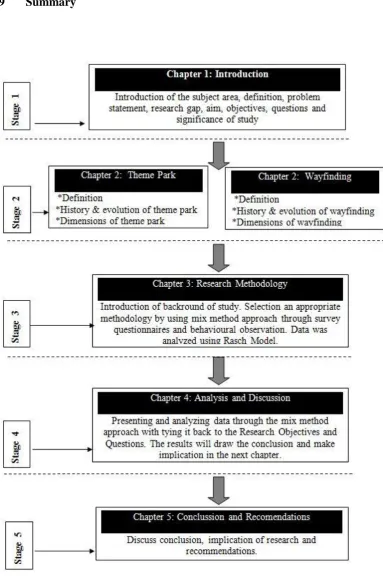
1.1 Flow chart showing structure of the thesis 10
2.1 Images of type of theme parks 14
2.2 The thoroughfare design layout 16
2.3 Plan layout of thoroughfare: Photo 1- (left: Sesame Place Bucks) and Photo 2 (right: Six Flag La Roude, Canada)
16
2.4 Plan layout of thoroughfare: Disney’s Hollywood Studios (2014)
17
2.5 The axis design layout 18
2.6 Plan layout of the axis:The three maps (left to right and bottom), Movie World Australia, Universal Studio Japan and Flamingo Land, UK
19
2.7 The layout for the loop 21
2.8 Plan layout for the loop:Two theme parks (right to left)
Universal Studios Singapore and Universal Studio Florida US 21
2.9 Plan layout for the loop: Epcot, (Experimental Prototype Community of Tomorrow), USA
22
2.10 Influences - social network and sharing knowledge 32
2.11 Influences - movement patterns and attractors 33
3.1 Ariel view of Universal Studio Singapore 41
3.2 Zones location map of Universal Studios Singapore 44 3.3 Layout at Universal Studios Singapore as walking nodes 45
4.1 Influences - perception and atmosphere 63
4.3 Schematic diagram of the usage on space factor 71
4.4 Maze of the Transformer Ride 82
4.5 Proposed relations between wayfinding parameters and wayfinding demographic factors
84
4.6 The street of Walk of Fame 87
4.7 The New York and the Sci-Fi City walkway 90
4.8 Swamped by a group of visitors gathering at the canopy on a rainy day
91
4.9 Two major roller coaster attractions 92
4.10 Kids’ attraction zone 93
4.11 Visitors taking boat ride 93
4.12 Entertainments before the visitors leave USS 94
4.13 Night-time entertainment at USS 95
4.14 Map indicating the routes taken by Group 1 and Group 2 96 4.15 Maps to be picked up by visitor and opening hour signage 99 4.16 Various of visitors - groups, families, individual and couples 100 4.17 Streets and performances and taking photos with the mascot 100 4.18 The routes starting from the main entrance and ending at the
same entrance
101
4.19 Point Pause Location for Group 1 and Group 2 103
4.20 Area of clusters of visitors that formed of crowd control 104
4.21 Crowd clusters at the adventurous zones 105
4.22 Scene from the ‘live’ water show with daring stunts and real explosions at the Water World
106
4.23 Photos with the street characters 107
4.24 The interconnectedness of the route for zones Hollywood , New York and Sci-Fi City
4.26 The interconnectedness of the route for zones man made lake and Madagascar
110
5.1 Wayfinding relation between elements of surroundings and perception
LIST OF ABBREVIATIONS
USS - Universal Studios Singapore
LIST OF APPENDICES
APPENDIX TITLE PAGE
CHAPTER 1
INTRODUCTION
1.1 Introduction
Places of attractions are crucial to boosting the tourism industry. They are the
However, getting lost or confused is common for first time visitors. Reorientation will depend on the wayfinding strategy they use and will require them to take time to orientate themselves and locate the correct path. Once they are familiar with the
surroundings and can find their way to the exact location, the overall experience will
be much more enjoyable and memorable. Thus, they depend on external information,
known as knowledge of the world (Raubal, 2001). As Kober (2007) mentioned,
wayfinding requires the processing of information in advance. The basic elements of navigation tools are the position of signs, and the use of brochures, maps, and other wayfinding aids which motivate visitors to reach their destinations as quickly as possible. Most wayfinding research has focused on the creation and development of theme parks and how visitors, especially if they are first time visitors, become disoriented and feel confused. In this case, a planning and route strategy is needed. However, less research has been conducted to determine the ability and efficiency of the navigation tools that influence visitors’ wayfinding performance especially in theme parks, and so it is this element that will be discussed in this research.
1.2 Research Background
The theme park USS is located in Sentosa Island. It is significantly smaller than other Universal Studios in other countries. The detailed discussion of the background of USS will be given in Chapter Three. The main focus of the discussion here is that USS, like many other theme parks, focuses on how visitors utilize their main attractions, such as The Lost World, Ancient Egypt, and Sci-Fi City, and how they locate their favourite zones. However, there are also other attractions for different age groups, such as the Far Far Away, Madagascar, New York, and Hollywood zones, and the crowd’s occupancy of each zones has a significant impact on visitors’ wayfinding movements. Indeed, visitors’ wayfinding performance depends on the environment as this can have a significant influence on their behaviour. Therefore, different types of visitors will act very differently when they engage with the activities on each play zone.
1.3 Research Problem
In today’s context and strong economic environment, increasing numbers of
tourists are able and willing to spend their money on building up quality time and
participating in leisure activities with the family (Pearce, 1988). Thus, theme parks
are experiencing an increasing number of visitors, and especially during weekends
and on public holidays, are packed with many types of visitors. Usually, visitors will
wait for a long weekend when they have more time, or if they receive an extra wage
bonus, they will spend the money by visiting a theme park. To encourage visitors to
spend their money, a theme park should maintain the quality of the attractions
regularly and update with new attractions.
Usually, visitors to theme parks orientate themselves by using maps to show them the right direction; this is known as ‘survey knowledge’. As Wickens and Hollands (2000) stated, there are three kinds of knowledge that can be used during
1975). Landmark knowledge is related to a particular location that sets a reference
point which is easy to identify. As well as confirming the location of the destination,
it can also be useful in connecting the routes. As Cornell et al. (1992) commented,
route knowledge is the process of creating a sensory path linked to the landmark.
Therefore, visitors spend time and effort in figuring out spatial information to add as
survey knowledge and environmental information about their surroundings
(Montello, 1998). They derive such information from the prominent landmarks;
these can be architectural elements, such as buildings, sculptures, and signages. All
the survey knowledge will be utilized in route planning (Belingard and Peruch, 2000). However, not all visitors are familiar with the outdoor environments, or sometimes, they do not want spend time looking at the details of the environment.
Thus, moving around in USS has to be made more practical by assigning a pattern of
movement and taking into account the characteristics of individual behaviour.
Visitors’ preference for different play zones is shown by their movements and
defines the sequence of paths they take, moving from a major path to minor paths.
USS offers many kinds of information that visitors can use as part of their route
strategies. Indeed, visitors will use different kinds of strategies depending on their
experiences during the wayfinding. This is related to visitors’ emotions and their
ability to determine their destinations (VanderKlipp, 2006). The theme park
experience is intangible, and the outcomes can be seen after the visitors have experienced or participated in the activities.
will find the wayfinding experience more difficult. This situation not only costs time and money but can affect their psychological experience of the theme park.
Within the general problem, this research focuses on two specific elements:
i. USS needs a more rigorous analysis for understanding the visitor behaviour.
ii. USS needs to improve in tracking the changes in the physical surroundings.
1.4 Research Gap
Several studies have shown that different kinds of strategies are used depending on visitors’ experiences with their surroundings. These are related to the individual strategies visitors use when finding on their own way. Most of the research describes visitors revisiting attractions once, supported by survey strategies, they are familiar with the surrounding environment. Prestopnik et al. (2000) claimed that people having a sense of which direction they need to take may lead to better wayfinding. However, when an individual has little experience of an environment and becomes lost or disoriented, he or she cannot rely on survey strategies. Thus, seeking information from another media may be the best strategy to find their way leading to them developing a wayfinding movement pattern in the theme park, and this information can relate to emotional variables. However, when visitors’ anxiety
levels increase, navigation errors will affect their wayfinding abilities (Lawton and
Kallai, 2002). Consequently, this research has been undertaken to explore first, how
The aim of this research is to study visitors’ pattern of wayfinding behaviour and perception regarding the surrounding environments as a strategic approach to improve the wayfinding experience in theme parks. To achieve this aim, the following research objectives and research questions were formulated:
Objective 1:
To examine how visitors’ ability movement around a theme park is affected by the physical elements.
Question 1:
How does the physical elements contribute to make wayfinding easy in USS?
Objective 2:
To define the relationship between park legibility and visitors’ spatial cognition on outdoor environments that affect visitors’ wayfinding in theme park.
Question 2:
How does the cognitive process influence decision making on the spatial settings and affect the wayfinding experience in theme park?
1.6 Scope of the Study
This research also examines how visitors interact with their physical surroundings via the activities and their responses to wayfinding situations. When visitors have very diverse ideas regarding how they want to spend their time, they need to find their way around the park easily and quickly. Thus, it is important to see how the effective design can assist the visitor in navigating their way around the theme park.
1.7 Significance of Study
USS is a significant theme park because it offers physical excitement for both
children and adults. By understanding visitors’ wayfinding abilities and defining
their level of anxiety, this research will shape route system performance and show
how to balance the number of visitors by having consistent and quality facilities and
services throughout the play zones. Therefore, this research is necessary for the future planning and/or upgrading of theme parks. Thus, the management should focus on visitor satisfaction and find a way to keep the visitors in USS longer and thus increase daily revenues.
1.8 Structure of the Thesis
The thesis consists of five chapters. The following sections give information
about each chapter.
1.8.1 Chapter 1 - Introduction
This chapter outlines the background and the main focus of this research. It
provides an overview of the thesis and describes the background of the research. The
second section briefly outlines the problem statement. The third section discusses the
research objectives and the research questions regarding visitors’ perception of USS.
1.8.2 Chapter 2 - Literature Review
This chapter reviews the relevant literature and theories underpinning the
fundamental concepts of the research gap. The literature review consists of two
parts. The first part introduces the definition of the theme park and the process of the
development of attractions until the present. The second part discusses wayfinding in
the context of the history of theme parks and the behaviour and the level of
familiarity that affect human cognition and perception.
1.8.3 Chapter 3 - Research Methodology
Chapter 3 explains the methodology and describes the research design
according to the mixed methods approach of using photographs, behavioural
observation, and a survey questionnaire. The segmentation of the zones in USS with
respect to visitors’ movements is also described. This research examines the
effectiveness of the previous design theory on how wayfinding in the theme park can
be controlled by visitors through the character of different locations and based on
theirexperience.
1.8.4 Chapter 4 - Analysis, Results and Discussion
This chapter provides the analysis and discussions of the findings using
Rasch Model software. The result from the analysis provides several interesting
1.8.5 Chapter 5 - Conclusion and Recomendations
The last chapter of this research includes the conclusion and offers recommendations
for future enhancements of wayfinding in theme parks. This research is conducted
REFERENCES
Allen, G. L. (1999). Cognitive Abilities in the Service of Wayfinding: A Functional Approach. The Professional Geographer, 5(4), 555-561.
Allen, G. L. (2000). Principles and Practises for Commnicating Route Knowledge.
Applied Cognitive Psychology, 14(4), 333-359.
Appleyard, D. (1969). Why Buildings are Known. Environment and Behavior, 1, 131-156.
Arthur, P . and Passini, R. (1992). Wayfinding: People, Signs and Architecture. Toronto: McGraw-Jill.
Babin, B. J., Hardesty, D. M. and Suter, T. A. (1988). Color and Shopping Intensions, The Interveving, Effects of Price Fairness and Perceived Affect.
Journal Business Research, 56, 541-551.
Baskaya, A., Wilson, C. and Özcan, Y. Z. (2004). Wayfinding in Unfamiliar Environment: Different Spatial Settings of Two Polyclinics. Environment and
Behavior, 36(6), 839-867.
Beck, S. G. (1996). Wayfinding in Libraries. Library Hi Tech, 14(1), 27-36. doi:http;//dx.doi.org/10.1108/eb047977.
Belingard, L. and Peruch, P. (2000). Mental Representation and the Spatial Structure of Virtual Environments. Environment and Behavior, 32(3), 427-442.
Bell, S. (2002). Spatial Cognition and Scale: A Child’s Perspective. Environmental
Psychology, 22(1-2), 9-27.
Bellizzi, J. A., Crowley, A. E. and Hasty, R. (1983). The Effects of Color in Store Design. Journal of Retailing, 59, 21-45.
Bond, T. G and Fox, C. M. (2007). Applying the Rasch Model: Fundamental
Measurement in the Human Sciences (2 ed.). London: Lawrence Erlbaum.
Bond, T. G. and Fox, C. M. (2007). Applying the Rasch Model: Fundamental
Measurement in the Human Sciences. Mahwah, NJ: Lawrence Erlbaum
Buchanan, D. A. (2001). The Role of Photography in Organization Research: A Reengineering Case Illustration. Journal of Management Inquiry, 10(2), 151-164.
Burns, R. (2000). Introduction of Resarch Method. London: Sage Publications. Carpman, J. and Grant, M. (2006). Directional Sense. Evans & Co.
Chebat, J. C., Gélinas-Chebat, C. and Therrien, K. (2005). Lost in a Mall, The Effects of Gender, Familiarity with the Shopping Mall and the Shopping Values on Shoppers’ Wayfinding Processes. Journal of Business Research, 58(11), 1590-1598. doi:10.1016/j.jbusres.2004.02.006.
Chown, E. Kaplan, S. and Kortenkamp, D. (1995). Prototypes, Location and Associates Networks (PLAN): Towards a Unified Theory of Cognitive Mapping. Cognitive Science, 19, 1-51.
Cornell, E. H., Heth, C. D. and Rowat, W. L. (1992). Wayfinding by Children and Adults: Response to Instructions to Use Look-Back and Retrace Strategies.
Environmental Psychology, 28(2), 328-336.
Creswell, J. (2010). Research Design, Qualitative, Quantitative and Mixed Method
Approach (2nd ed.). Sage Pub.
Cubukcu, E. (2003). Investigating Wayfinding using Virtual Environments. PhD thesis, Ohio State University.
Demirbas, G. U. D. (2001). Spatial Familiarity as A Dimension of Wayfinding. PhD thesis, Bilkent University.
Dennis, M. and Pazzaglia, F. (1999). Spatial Discourse and Navigation: An Analysis of Route Directions in the City of Venice. Applied Cognitive Psychology, 13, 145-174.
Dijikstra, K. and Pieterse, M. E. and Pruyn, A. T. H. (2008). Individual Differences In Reaction Towards Color in Simulated Healthcare Environments: The Role of Stimulous Screening Ability. Environmental Psychology, 28(3), 268-277.
Disney’s Hollywood Studio. (n.d.). Retrieved from
http://disneyworld.disney.go.com/parks/hollywood-studios/.
Downs R. M. and Stea, D. (2006). Image and Environment. News Brunswick, NJ: Adline Transactions.
Dursun, P. (2009). Architects are Talking about Space, In Proceedings of 7th International Space Syntax Symposium, School of Architecture and the Built
Environment, KTH, Stockholm (pp. 8-11).
Eindhoven, D. T. U. and Rem, M. (2000). Temporal Aspects of Theme Park Choice
Behavior. Eindhoven University of Technology.
Epcot (Experimental Prototype Community of Tomorrow). (n.d.). Retrieved from http://disneyworld.disney.go.com/parks/epcot/.
Fewings, R. (2001). Wayfinding and Airport Terminal Design. Journal of
Navigation, 54(2), 177-184.
Frankenstein, J., Brüssow, S., Ruzzoli, F. and Hölscher, C. (2012). The Language of Landmarks: The Role of Background Knowledge in Indoor Wayfinding.
Cognitive Processing, 13(1), 165-170. doi:10.1007/s10339-012-0482-8.
Raluca, D. C. and Gina, S. (2008). Theme Park - The Main Concept of Tourism Industry Development. Annals of the University of Oradea, Economic Science
Series,17(2), 641-646.
Golledge, R. (1999). Human Wayfinding and Cognitive Maps. In Wayfinding
Behavior: Cognitive Mapping and other Spatial Process (pp. 5-45). Baltimore:
Johns Hopkins University Press.
Hashim, M. S. and Said, I. (2013). Effectiveness of Wayfinding Towards Spatial Space and Human Behavior in Theme Park. In Preceedia Social and
Behavioral Sciences (pp. 282-295). Elsevier Ltd.
Helvacıog˘lu, E. and Olguntürk, N. (2011). Colour Contribution to Children’s Wayfinding in School Environments. Optics & Laser Technology, 43(2), 410-419. doi:10.1016/j.optlastec.2009.06.012.
Helvacıoğlu, E. (2010). Colour and Wayfinding, 464–468.
Hendricks, B. E. (2001). Designing for Play. England: Ashgate Publishing Ltd. Hidayetoglu, M. L., Yildirim, K. and Akalin, A. (2012). The Effects of Color and
Light on Indoor Wayfinding and the Evaluation of the Perceived Environment.
Journal of Environmental Psychology, 32(1), 50-58.
doi:10.1016/j.jenvp.2011.09.001.
Hong, I. (2007). Communal Ontology for Navigation Support in Urban Region:
Getting Directions from Familiar Landmarks. The State University of New
York, Buffalo.
Hoyle, R. H., Harris, M. J., and Judd, C. (2002). Research Methods in Social
Relation. Belmont, CA: Wadsworth.
Hund, A. M. and Padgitt, A. (2010). Direction Giving and Following in the Service of Wayfinding in a Complex Indoor Environment. Environmental Psychology, 30, 553-564.
Johns, N. and Gyimothy, S. (2002). Market Segmentation and The Prediction of Tourist Behavior: The Case of Bornholm, Denmark. Journal of Travel
Research, 40(3), 316-327.
Karin, F. (2008). Forming Spaces with Color and Light: Trends in Architectural Practise and Sweedish Colour Research. Retrieved from http://www.colour-journal.org/2008/2/2/.
Kato, Y. and Takeuchi, Y. (2003). Individual Differencies in Wayfinding Strategies.
Environment Psychology, 23(2), 171-188.
Kendall, R. and Carterette, E. (1990). The Communication of Musical Expression.
Music Perception, 8, 129-164.
Kerstin, S. (2007). How Spatial Layout and Architecture Influence Everyday Work of Theoritical Physicists-The Example of the MPIPKS. Retrieved from http://www.mpipks-dresden.mpg.de/.
Kitchin, R. (1994). Cognitive Maps: What are They and Why Study Them?
Environment Psychology, 14(1), 1-19.
Kober, J. (2007). Wayfinding at Disney. Mouse Planet.
Kurtuncu, B., Koknar, S., Dursun, P. (n.d.). Decoding Spatial Knowledge and Spatial Experience Title. In Proceedings of Design Train Progress.
Lawson, B. (2005). The Language of Space. Oxford, UK: Architectural Press.
Lawton, C. A. and Kallai, J. (2002). Gender Differences in Wayfinding Strategies and Anxiety about Wayfinding: Across-cultural Comparison, Sex Roles, 47, 389-401.
Li, R. and Klippel, A. (2012). Wayfinding in Libraries: Can Problems Be Predicted?
Journal of Map & Geography Libraries, 8(1), 21-38.
Lim, P. (2010). Growing Asian Middle Class Fuels Theme Park Boom. Retrieved from http://www.google.com/hostednews/afp/article.
Linacre, J. (2009). Winsteps Computer Program Version 3:48. Chicago. Retrieved from www.winsteps.com.
Linacre, J. M. (2008). Development and Validation of Instrument, Rasch Measurement Transaction.
Long, R and Hill, E. (1997). Establishing and Maintaining Orientation for Mobility (2nd ed). New York: American Foundation for the Blind.
Lynch, K. (1960). The Image of the City. Cambridge, MA: MIT Press.
Margaret J. K. (2004). Disneyland and Waltz Disney World: Traditional Values in Futuristic Form. The Journal Popular Culture, 15(1), 116-140.
Mary, C. R. (2004). Concept Mapping as an Intructional Strategy for Adults. Mcguire, M. (1978). Getting A Sense of the Theme, 1-27.
Middleton, V. T. (1988). Marketing in Travel and Tourism. Oxford: Heinemann Professional Publishing Ltd.
Milman, A. (2007). Theme Park Tourism And Management Strategy. University of Central Florida.
Mitrasinovic, M. (2006). Total Landscape, Theme Parks, Public Space. Ashgate Publishing Ltd.
Montello, D. R. (1998). A New Framework for Understanding the Acquisition of Spatial Knowledge in Large-scale Environment. In Spatial and Temporal
Reasoning in Geographic Information Systems (pp. 143–154). New York:
Oxford University Press.
Montello, D. R. (2005). Navigation (pp. 257–294). Cambridge: Cambridge University Press.
Montello, D. R., Frank, A.U. and Campari, I. (1993). Scale and Multiple Psychologies of Space. Spatial Information Theory: A Theoritical Basis for GIS (pp. 312–321). Berlin: Springer-Verlag.
Nicholas, F., Canete, I. J. and Tuladhat, S. (1992). Designing for Pedestrians: A CAD Network Analysis Approach. In Kalay, Y. E. (Ed), Evaluating and
Predicting Design Performance, 379–398.
Park Layout. (n.d.). Retrieved from
Patel, K., Chen, M. Y., Smith, I. and Landay, J. (2006). Personalizing Routes in UIST’06. In Proceedings of the 19th Annual ACM Swmposium on Uer Interface
Software and Technology (pp. 187-190). ACM Press.
Pearce, J. (2007). Do Animals use Cognitive Maps. Retrieved from www.thepsychologist.org.uk/.../thepsychologist%5C0907pear.pdf.
Pearce, P. (1988). The Ulysses Factor: Evaluating Visitors in Tourist Settings.
Springer-Verlag New York.
Peponis, J., Zimring, C. and Cho, Y. K. (1990). Finding the Building in Wayfinding.
Environment and Behavior, 22, 555-590.
Pikkemaat, B. and Schuckert, M. (2007). Success Factors of Theme Parks - An Exploratory Study, 55, 197-208.
Podilchak, W. (1991). The Tourist Experience.
Prestopnik, J. L. and Roskos-Ewoldsen, B. (2000). The Relations among Wayfinding Strategy Use, Sense of Direction, Sex, Familiarity and Wayfinding Ability.
Environment Psychology, 20(2), 177-191.
Rasch, D. (1960). Probabilistic Model for Some Intelligence and Attainment Tests. MESA Press.
Raubal, M. (2001). Agent-based Simulation of Human Wayfinding: A Perceptual
Model for Unfamiliar Buildings. PhD thesis, Faculty of Sciences and
Informatics Vienna University of Technology.
Read, M. (2003a). Use of Color in Child Care Environments: Application of Color For Wayfinding and Space Definition in Alabama Child Care Environments.
Early Childhood Journal, 30(4), 233-239.
Read, M. (2003b). Use of Color in Child Care Environments: Applicattion of Colour for Wayfinding and Space Definition in Alabama Child Care Environments.
Early Childhood Education Journal, 4, 233-239.
Richardson, J. T. (2004). Methodological Issues in Questionnaire-based Research on Sudent Learning in Higher Education. Educational Physchology Review, 16(4), 347-358.
Rovine, M. J. and Weisman, G. D. (1989). Sketch-Map Variables as Predictors of Way-finding Performance. Environment Psychology, 9(3), 217-232.
Schmid, F., Richter, K. F. and Peters, D. (2010). Route Aware Maps: Multigranular Wayfinding Assistance. Spatial Cognition & Computation, 10(2-3), 184-206. doi:10.1080/13875861003592748.
Shah, P. M. A. (2005). The Cambridge Handbook of Visuouspatial Thinking. Cambridge: Cambridge University Press, New York.
Siegel, A. W and White, S. (1975). The Development of Spatial Representations of
Large-scale Environments. Advances in Child Development and Behavior (10th
ed.), 9-55.
Simmel, G. (2009). Sociology: Inquiries into the Construction of Social Forms. Leiden and Boston: Brill.
Sorrows, M. E. and Hirtle, S. (1990). The Nature Landmarks for Real and Electronic
Spaces-Spatial Information Theory (pp. 37-50). Berlin: Springer.
Swarbrooke, J. (1995). The Development and Management of Visitor Attractions. Butterwort-Heinemann, Oxford.
Tang, L. (2011). In Search of an Architectural Legibility: Human Movement
Behavior and Wayfinding for Pattern Design.
Titus, P. A. and Everett, P. (1996). Consumer Wayfinding Task, Stratregies and Errors: An Exploratory Field Study. Physchology Mark, 13(265-90).
Tolman, E. (1948). Cognitive Maps in Rats and Men. Psychological Review, 55, 189-208.
Tuan, Y. (1977). Literature Experience and Environment Knowing. In G. T and R. G. Golledge (Eds.), Environmental Knowing: Theories, Research and Methods (pp. 260–272). Dowsden, Hutchinson and Rose, Inc., Stroudsburg, Pennsylavania.
USS Essays: Tourism Case Study of Universal Studio Tourism Essay (2013).
Retrieved September 23, 2014, from
http;//www.ukessays.com/essays/tourism/tourism-case-study-of-universal-studios-tourism-essay.php.
VanderKlipp, M. (2006). Develop a Successful Wayfinding System. Buildings, 100(4), 28.
Village, J., Salustri, F. A. and Neumann, W. P. (2013). International Journal of Industrial Ergonomics Cognitive Mapping : Revealing the Links between Human Factors and Strategic Goals in Organizations. International Journal of
Industrial Ergonomics, 43(4), 304-313. doi:10.1016/j.ergon.2013.05.001.
36-42.
Weisman, J. (1981a). Chapter Two : Wayfinding in the Real and Virtual World, 1-27.
Weisman, J. (1981b). Evaluating Architectural Legibility. Wayfinding in the Built Environment. Environment and Behavior, 13(2), 189-204.
Wickens, C. D. and Hollands, J. (2000). Engineering Psychology and Human
Performance. (3rd ed.). New Jersey: Prentice Hall.
Wionczek, M. (2002). Wayfinding in New York City: An Intergrated Approach to
Spatial Cognition. Faculty of Psychology, The City Universioty of New York.
Wright, B. and Masters, G. (1982). Rating Scale Analysis. Chicago: MESA Press. Xia, J., Arrowsmith, C., Jackson, M. and Cartwright, W. (2008). The Wayfinding
Process Relationships between Decision-Making and Landmark Utility.
Tourism Management, 29(3), 445-457.
Yildirim, K. and Akalin, B. (2007). Perceived Crowding in a Cafe- Restaurant with Different Seating Densities. Building and Environment, 42, 3410-3417.
Yin, R. (1984). Case Study Research: Design and Methods. Beverly Hills, CA: Sage. Yumin, L. (1995). A Study of Theme Park Circulation and Concepts. The Ohio State
University.
Zimring, C. (2002). Post Occupancy Evaluations: Issue and Implementation. In
Handbook of Environmental Psychology (pp. 306-319). NY: John Wiley and
Sons.
Website Sources:
http://www.themeparkbrochures.net/mainmaps