Development
of Rule.Based
Advisory System
from Modified Hazard and Operability
Study
on Fatty Acid Fractionation
Column
M.Y.MYunusr
M.W.Ar
M.Z, Kamsah3
\23 Pracess Safety and Control Group, Depa'tnent ofchenical Engineei g,
Facult), of Chemical and Natural Resources Engineering, Univetsiti Teknologi Mdlaysil' 81310, Sladai Jahor, Malaj,sia
Tel: +607-5533333 r 35602, Fax.: +607-5581463, E-mail: [email protected]. 1)
Abstract
A nodifed Hazard a d Opetabilir:,' Stltdy (HAZOP) algotithm has b eal p roposed in oftler t o dewlop p roc?,ss
deyiation relatiotships beh./een two study nodes ih IUZOP
stu4). Iti oftler to apply the modified HAZ)P lhtdy, a
nle-based atuisoty systEm, Nhich consists of
k owledge-based and infelence engine ha", bee dercloped.
The nain objective of buildi g the tule-based edvisory syitan is to facilitate the dfhia -naki 8 prccess and also to co duct the.Iatabase rurwgenent efrciettly. Microsofr
AccessrM and Ilisual Basictu have been wed to dewlop the
knowledge-based snd the i fercnce etgi e respecttuely. The
base case in thh study is afatty acidfractiondtkn column oJ
all oleo chemical plant. As a result of the nodifed HAZOP
studt applicano , a new docunentation system of HAZOP st dt is prcduced tu the advilory system developed. In
comparing with the c om'enrional HAZOP s tudy, the main
imprclenent made by the modifed HAZOP study is that it
contai s lhe nain and side causes/conseErcnces database
category, which arc rclated to the anallzed guideword and the identified prccess de|iation relationship.
Ke'.words:
Hazard Identficatio4 HAZOP, Advisory System, Expert
System, Rule-based System
..- Introduction
ln the assessment of nsks, and the ptaDning of m€asures to
rcduce or sontlol risks, lEzard identification is a! irryortant €l€ment. Among the methgds lsed to identify hazards are Preliminary Hazard Analysis fPHA). Coocepr Hazard Analysis (-HA). Checklisr and Hazard and Operabitiry Study (HAZOP). However, HAZOP is the most widely applied method for the identification of hazarils itr the
Focess jnd say [1,2]
HAZOP is defined as a systematic apFoach to identify
potential hazards and operational probl€ms [3]. HAZOP has
ploven to be one ofthe mosx powertul and usetul aia\tical
rools aDd rapidly beconing a srandard lechnjque.
However, the existing safery procedure of HAZOP caxri€s some problems aad deficiencies, as it does not cover all rrpes of haards and lisk facton. The major problem with HAZOP relates to the level of detail in the study, especialy to carry out bazard alalysb in a complex prccess and to develop the linkag€ pmpagation of the fault or hazald
identified to each of unit plant.
Besides, nowadays, new denlands axe constantly clBllenging
ihe Focess chemical industy and oD€ of the rnail cha eqing demands in safety analysis is to handle the
accumulated amomt of data and knowledge in such a way
that it is available at the righx place a.nd time. Hence, there is
a need in plant safety to traNfer the experts' knowledge into
an inteligent syst€m of computer-aided program particularly
for rcducing tle time, effofi and costs involved in the safety analysis donrain [1].
Problem Background
In the curent algoritlm of the HAZOP study, relationships of process deviations information between two or mor€ stseans have not been consider€d in detail. The lack of linkages of the infomation betlveen study nod€s identified
rDay lead to atr incon4lete database analysis of the study.
Hence, a modified algodtlm should be d€veloped to link of
and also for excbange ofinformation betweer study nodes in
order to set up a conrFehensive HAZOP shdy database.
With the modified HAZOP algo.itbr! an advisory system is
needed in which the expert syst€m apFoach will be used as a
basis for developing the structure. The advisory system is
expected to demonstate how the modified algodtbm could
rnanage the howledge used in the study, as to make it available at the right place, where it is needed. In this
res€arch, the causes and consequences ofa process deviation
wil be used in other mode of process deviatiotrs (i.€ guidewods). The expert s)€tem is used to bandle facts, mles
and showing the desned output (causes and consequflces of
process deviations) that are related to the input data (guidewords) specifi ed.
Approach and Methods
The following discussiotr is divided inxo two maia sections.
Fnsdy, the modified algorithm pmposed will be discussed in
general and then followed b y the detail discussiotr on th€ nain ftanework ofthe advisory system. The base case for the study is a fatty acid fractronahon colunm of an
oleo-chemical plant.
The Modified HAZOP Algorithm
The modjfied algodthm for the HAZOP study proposed
cenerally, tle algorithm consists of thr€e mah p}ases. The tust pllase involves the conventional HAZOP study procedure. Th€ objective of this phase is to identify all
possible causes and consequeDces for every process
deviation specified.
In the second plase, the objective is to create a process deviation relationship between the two study nodes, and it involves two procedues. Fnst, is to select another study node to b€ anal)zed together $rith ihe previous study node. Second, is to anallze both study nodes in order to obiaiD a rciationship b€tween then
Finalln m the last phase, the objective is xo comect all the
causes or co$equences of study node B to be put together as
causes or consequ€nces for study nod€ A based on the
process deviation rclatioiship identilied. This infomation
will be classifr€d as 'Side Causes' or'Sid€ Coffequences'.
If everything completes, the plocedure reh]ms to the fust phase.
D€velopment of Advisory System
The expert system approach is used as a basic structure for
lhe developrnent ofthe advisory system i]l this research. The
experx system approach is used to conduct decision- making
process aIId also to organize krcwledge sysxe aiically to be
available at the right p lace, where it is r equired. The two
coinponeDts us€d in the development of advisory system are
the knowledge-based and the inference engine.
Dewlopne t of Kttottkdge-Based
The development of l owledge based is carried out for
storing aI th€ calses and coDsequences ofprocess deviation
that are obtained jiom the conventional HAZOP study. Firstly, the conventioMl HAZOP study is caded out. The
process is divided into 4 study mdes, which are Study Node
1 (Feed Stream), Sfirdy Node 2 (Bottom Str€am), Study Node
3 (Vent Stream) aM StudyNode 4 (Distiflate Stream). Wl€n
the study is conplete4 all the infomation (causes and consequences) is stored in a database system using
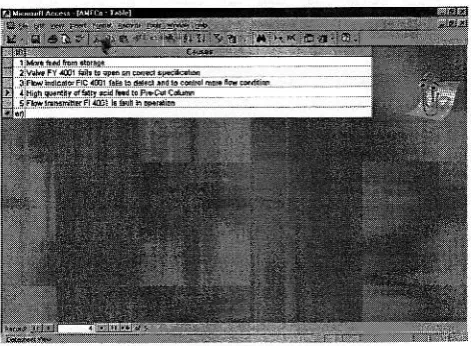
l.licroioft Accessru. gxamples of causes and consequences
fiom a process d€viation for orc study node have been shown in Figure I and Figue 2 respectively.
Figwe 2 - Cnnsequence.s ofMore Flow for Study Node l
Develop nent of Rule-B ased
The production ofn e-based method is used to r€Fesent the
behavior of process deviation rclationships between two
sxudy nodes specified. Tho 'process d€viation rclationships'
is a term to show how one process deviation fiom orc study
nod€ couid affect or could be afected by other sndy nodes, as aD example, 'if fe€d is more flow then ouQut is more flow'. The plant sirnulation data is used as the infomation sowce in order io Fedict the pocess deviation Flationships. There are two types ofrules that have be€n developed:
(i) Rule I: to identify a kind of process deviatlon
relanorship accorditrg to the guidewords specifi€d.
(it Rule II: to comect the Focess deviation
relationship with tho causes atld consequences of
HAZOP study tllat r€lated.
Two categories ofrules wil be pmduced in Rule I, which are
True Rules Cat€gory aDd False Rules Category. Th€ 'True Rules Category' provides rules, which idedi& the t)"e of Focess d€viation relationship tllat relates to the specifled study nodes. If the specified condition of study node A
produces changes h study node B, the! a pmcess deviation
relationship is obtained. As an €xample, this relaiionship will be stuctured asl
"IF Sheam A is More Floi,, THEN, Sheam B is Morc Flow'
Meanwhile, the 'False Rules Category' contaiis mles ihat
will never ideffiry such relationships, as showa b€low:
"II Stream A is More Pressu.e, THEN, Stream B No Deviation"
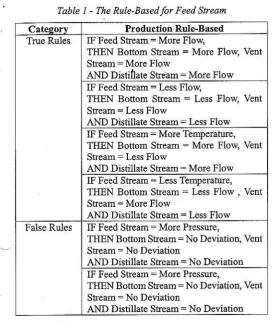
Table 1 shows the rules developed for feed strean
Table 1 - The Ruk-Ba'ed for Feed Strean
Catecory Production Rule-Based
II Feed Stream = More Flow,
THEN Bottom Stream = More Flow, Vent Sfeam = Mor€ Flow
AND Distitate Stream = More Flow
II Feed Stream = Less Flow,
THEN Boitom Steam = Less llow, Vent
Steam = Less Flow
AND Distilare $ream = L€ss Flow IF Feed Steam = Morc Temperahfe, THEN Bottom Strean = More Flow, Vent Streaa = Less Flow
AND Distillate Sherm: More Flow
lF Feed Stream = Less Tempennre,
THEN Bottom Stseam = Less Flow , Vetrt
Stream = More Flow
AND Distillat€ Stream = Less Flow
False Rules IF Feed Sheam = More Pressure,
THEN Bottom Stseam = No Deviation, Vent
Stream = No Deviation
AND Distillate Sir€am = No Deviation
IF Feed Stream = More Pressue,
THEN Bottom Sheam = No Deviation, Vent
Stream = No Deviation
AND Distilate Stream = No Deviation
The next Focedme is to deielop Rule II, which refers to the
rcsults found in Rule L Rule II bas also been categorized into
'True Rules Category' alrd 'False Rul€s Category' as Rule I:
The structue of the True Rules Category isbasedonthe
following exarplel
" II' Feed Stream = Less Flow AND V€nt Stream : L ess Flow AND Bottom Strealn = l-ess Flow AND Distillate
Strean Less Flow, THEN Less Flow Causes and
Consequences of Feed Stream = ManL ANrD Less Flow
Consequences of Vent Stream = Side, AND Less Flow
Consequences ofBottom Stseam = Side".
Meanwhile, an example ofFalse Rules Category is showr as
"II Feed Siream = Less Prcssure AND Vent Stleam = No
Deviation AND Bottom Sheam = No Deviation AND Distillate Stream = No Deyiatior THEN L€ss Prcssue
Causes and Consesuences ofFeed Steam = Main".
The statement of 'Maitr Causes a&d Main Consequerccs 6 a
telm to show that the facts are obtained direcdy frcm the result of study node being anabzed. On the otlEr hand, the
statement of'Side Causes and Sid€ Consequences' is a tem
to show that the facts are'obtained from other souces of study node being anabzed.
Developnent of Infercdce Engi e
The development ofthe infer€nc€ eDgine is very essential as
it applies rules that integaie the process deviation rclationship ftom l€rowledge acquisition Focess $.iih the
causes and consequenc€s of HAZOP study contained itr
knowledge-based as the final result.
The analysis of the advisory system stans with the identification of Focess deviation relationship and ends up
with searchiq for causes and corsequences of HAZOP
l h t n w r t i r
' r a . ' l a r ' . 1 r ^ i i
The rules thai were developed fiom the lmowledge
acquisition process will be directly stored in the source code
piograrDming in oder to get the result. The rul€s are structured usirg the 'Select Case Slatement' aDd also 'lf...Then Statement' functionl. Selecl case statement is used to execule one of seveml goups of statement,
dQending on the value of an expression. Meanwhile, the
'If...Then Statement' is used when a corryadson has to be
In s todry Rul€ I, the'case' or' if ' c ondition will b e the guideword, meanwhile t he ' siatement' will b e t he p rocess deviation identi6e4 as shown in the following exarnple:
Case "Feed"
If cbocuidePri.Text = "Irss Flow" Then
picAna2.Prinl venr (DeviaEionRale Very Higl)
-Bottom (Deviation Rate = High) = Distillate (D€viation Rate : Very Inw) = Less Flow"
picAna2.Pimt "Please Fess Enter III for HAZOP
Database"
Elself cbocuidePd.Text = "More Pressule" Th@ picAna2.P nt "Vent = Bottom = Dbtillate = No Deviation"
picAia2.Pdnt "Please press Etrter III for HAZOP Database"
Else
picAia2.Print "Fault Data lnputl " End ff
On the other hand, for the II, the 'case' or 'if cotrdition will be the process deviation idetrtified, meanwhile the 'statemenf will be the searchiq proc€dwe to get the causes
and consequences of HAZOP study, as showl in the
folowing €xanple:
Case "Feed"
ffcuide = "I-ess Flow" Then
adodcAlfca.Visible = Tnl€
txtAuca.Visible = Tlue
adodcAlfco.Visible = True
tltAlfco.Visible = True cndNext"{.visible = True
adodcsideDlfco.Visible : Tnle
txtsideDlfco.Visible = True Elselfcuide = "Less Pressure" Th€n
adodcAlpca.Visible = True
NrtAlpca.Visible = True
adodcAlpco.Visible = True
txtAlpco.Visible = Trug' EndIf
All of these flnes are using Activex Data Object (ADo)
ftmcrion thar exposed Lhe_Microsoff Jel dal-abrs." eDgine
(tlsed by NtcrosoR Access'-) (o v;ual Basic p'oREnrnrer
aDd aUoor'ed developers lo assess Microsoff Access"'' rables
for Rule II io get th€ causes and consequences of HAZOP study Gearching Focedure).
Results
Ali the rDain outputs of tbe advisory system Fogram are pesented and divided into two sections; feed stream results and vent stream results.
Feed Steltn Resuks
The following dircussion is based on the feed steam analysis rcsult. The rrail objective of the tust plns€ in the
advisory system procedue is to define the tlpe ofstudy trode
or streaq which requied to be ana.llzed. Figure 3 shows ihe
prograrn interfac€ developed for advisory system to start an
analysis.
Figure 3 - I ital User Intefrce ofAdritoty Systen
If th€ feed steam ias been selected for the primary str€aq
and the "Enter I" cornmand buttor las been clicked, then the
pmgam will show 'No Secondary Stream' statemeng as showr in Figue 4.
Fisure 4 - Result ofAnalys^ Ifor Feed Strcam
Figue 4 shows the ftst rcsuli after ihe feed stream las been
selected as the pdnary streanl After a guideword is selected,
and the "Enter tr" command button has been clicked, the progmm continues to find itrImediate prccess deviation relationslup as shown irl Figure 5.
Figure 5: Result ofAnalysis II Jot Feed Stean (Less Flow)
From Figur€ 5, if the less flow (True Rules Catesory) 's sel€cted for feed stean! each output streams win be
identified as ih€ consequences, which Foduce the less flow
deviation as well Corsequendy, a[ the output steams showa h the justifier area, will be colored in y€llow. Then, the user will be asked to click the "Enter I]I" cornnand
button to perfom the rnain causes and coDsequences as well
as the siale consequences ofHAZOP study related to proc€ss
deviation relationship as shom in Figue
6-Figurc6-ResultofA alysi.s IIIfat Feed Stredn (Lets FIow
I
In this case, the main causes and consequences provided ln
Figure 6 are related to th€ less flow deviatiol offeed stleanr,
which is the main guideword selected to be anabzed. On the
other hand, there arc two databases of side consequenc€s
Fovid€d; consequences of less flow in bottom stseam
analvsis I {or vent stream is sho1,Ilin Fisue 9
Fiswe 7 - Result ofAnarysis IIIfar FeedSteamOess Ftovr
n)
From Figue 7, the side consequences is th€ coirsequences of
less flow in vent. This result is an exanple of the nair output stroctue for 'Tnre Rules Cat€gory', and it is based on the result of analysis I], where less flow deviation in feed
steam identfied has produced high deviation rat€ h bottom
and veni stteam (output streans).
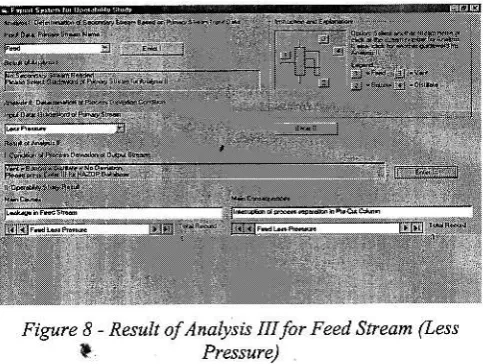
Besides, user rnay also select another guidewod for the same stream in order to perfoml anoiher mode ol alalyses. For example, Figure 8 shows ihe corryl€te less presstrle rc$it for feed
stearn-Figurc 8 - Result of Analysis III for Feed Steam (Less
I PressuA
Figure 8 shows an exarryle of the cotrplete adl'lsory system's rcsult struchre for 'False Rules Category' (e.9. iess pressue). The n es of 'False rules Category' wil identiry no process deviation rclationship beiwe€n feed ard bottom. As a result, there will be only the Inain calses and consequences rclated to the less plessule guideword provided in Figue 8. There will be no side consequences produced as all the output streafis condrtlons are defined as 'No Deviation".
Vent Strcah Results
The same basic procedues as in the feed stueam analysis are
applied to lhe output steams. For example, the resolt of
Figurc9 - Res lt of Analysx I fot rent Stueam
Frcm Figwe 9, ihe bottom stream is identified as secondary str€am for the verlt steam analysis. There are also two input boxes shonn in the user inteface, particularly for the selection of a guideword for botl pdmary and secontlary stream specified. As an example, the less flow deviation is select€d as the guideword for both priIDary and s€condary steam and the result is showr in Fisue 10.
Figure l0 - Result of Aaalysis II for vent Stueam (Less
Flow-Less Flow)
From Figue 10, the result shows 'Teed Sheam = Less FIow (Deviation rate of less flow at V€nt Stream = Very Hig!)", mea ng that the less flow condition of feed stream ias b€en
identified as a cause to Foduce the less flow deviation in the
Fisure I t - Resuh of Analtsis I for rent Steam (Less
Flow-Less FIow)
From Figur€ 11, the main causes and consequences are
related to the less flow, which has been selected as
guideword for the vent stream before, while, the side causes
k obtained ftom lhe less flow causes offeed str€am database
These daxabases are given as the result of less flow in feed
str€am is identifi€d to produce the less flow deviation at vent str€am. which is show! in the anal)sis II before ln general, this is the main aoalysis stluctule of the 'Tru€ Rules
Category' t hat d eveloped for a ll th€ o utput streams i n the
advisory system. However, the analysis stucture of the
'False Rules Category'(e.g.1€ss flowless t enperatue) is
dilTerent as showl in Figure 12.
Fisure 12 - Result ofA dbJsh llfor Vent Stean (Le:s
t Flow-Less Te peruture)
From Figure | 2. rhe program s ill.how ooly the najn cau5es
and consequences of less flow for vent str€am as the final
result. There ar€ no side causes databases give4 as th€
progam las identified no deviation in the analysis II rcsult.
Discussion
From a1l the resulLs obtained, it has been found that the
modifred HAZOP has htroduced a new databas€ structure,
in which the causes and consequ€nces fiom convennonal
HAZOP study have been categorized into 'main' and 'side'
causes or consequences rcspectively. The 'main' caus€s and
consequences are related to the main anabzed gddeword
meanwhile, the 'side' caues or consequerc€s are conelated
to the process deyiation fiom other study rcdes, which produce a proc€ss deviation rclationship with the arMllzed guideword.
Conpuison of Modified L4ZOP teith Co |ennonal IIAZOP Structute fot Feed Strean
In g€nenl, for €ach guideword specified in th€ coNentional
HAZOP study, tLe causes and consequ€nces are deie.mined
usi]1g the bminstorming appmach. If a[ have beeD identified,
ihen anotber guideword or study node wil be examined in
sequence, however, the relationships among them are not
specifically beiag anallzed. As a result, each guideword
analyzed produces only one list ofcauses or consequences.
On the other lEnd, after the modified HAZOP ,lgoftbm has been applie4 the stmcture produced is different. Th€ result shows that less flow deviation of feed and vent is co.mect€d with each other to Foduce a process d€viation relationship. Particularly, less flow deviation fiom feed stream is identified to produce less flow deviation in vent strearl As a result, the rnain cairses of less flow in feed steam is
coniected xo the mail consequences of less flow m vent
stream, in which lhe maill consequences ofless flow in vent
steam is identifi€d as 'side' consequences. This result is
shown in the Figure 7 earlier. ,
In conclusion, fiom the study, the main irnpmvements made
by th€ modifred HAZOP are:
l. Two of study nodes in the conventional IIAZOP
study have been connected together, whereby both
of them art being separated in the conv€ntional
HAZOP study before.
2. Both ofthe study nod€s are comected tbrough the guidewor4 whereby the Focess deviation rclationships can then to be obtain€d.
Consequently, a new documeniation structue as well as conlpiehensive HAZOP database is produced, where the
databases of carses and consequences ftom other study
nodes can be used for the study node xnder consideration.
Conclusion
In sumflary it can b€ concluded that, the advisory system
developed has been ploven to demonstsat€ as well as to
support the rnodified HAZOP algorithm Fopos€d. The advisory system Fovides an interactive-user ftiendly interfac€ and a sirple analysislfor th€ rser to understa as well as to presert the modifi€d HAZOP study.
Acktrowledgemerts/
References
lrl Vaidhlalathaa R. and Venkatasubmnaniarn, V. (1995).
Digaph Based Models for Automated IIAZOP Amlysis.
Reliability Engineering & System Safety. 501 3349.
[2] Yutiyasu, S.; Zong, X.Y.; Jing, W.S.; Kazuhiko, S. atrd HayatosLi, S. 1995. Codputer-aided Operability S tudy
for Balch Plants. In Loss Prewntia and Safety
Promotian in The Proce:s Indtsties (vol. II).
Netherlandsi Els€vier Science B. V.
[3] Shafagi, A. atrd GibsoD, S. A. 1984. Hazafd and Operability Study I A Flexible Tecbnique for ?mcess Systen Saf€ty and Reliability At]alysis. In Chenical
tuocess Haza Reviet,. WashingtoD, D. C.: American
Chenical Soci€ty.