ISSN(Online): 2320-9801
ISSN (Print) : 2320-9798
International Journal of Innovative Research in Computer
and Communication Engineering
(A High Impact Factor, Monthly, Peer Reviewed Journal)
Website: www.ijircce.com
Vol. 6, Issue 3, March 2018
Realizing of a PBR System for Heterogeneous
Virtual Reality Systems
M.S. Alkassab 1, H.M.Mohammed 1, H.R. Mohammed1, H.Abdulaziz 1, Ahmed S. Jagmagji 1
Assistant Lecturer, Department of Computer Engineering, Engineering College, University of Mosul, Mosul, Iraq1
ABSTRACT: In many modern computational systems, whether they are personal, large scale computer systems or systems of any kind which are called heterogeneous, the use of a heterogeneous system (GPU+CPU) gives huge advantages in designing of virtual reality systems. However, it complicates the process of designing software projects. Using High-Performance Computing (HPC) to build real time applications should increase the effectively of rendering and photorealistic of the scene. HPC, which refers to the practice of combining computing power in such a way in order to provide much higher performance than it would be possible to get out of a conventional desktop or workstation to solve big problems. The point that we want to discuss in this paper is the real time rendering. We can spend multiple days in the rendering process waiting for artifact scene, but what about Games and training simulators which need real-time processing for each frame? Physics is very rich in mathematics, that modules light interaction with surfaces and materials. As we aim to perfection in the creation of scene to give illusion that seems like a real scene, we faced a lot of obstacles. The first obstacle is the complicity of programming which can be solved either by using the spirit of object oriented programming OOP, which guides the built-in libraries and functions which accumulate the effort made by each researcher. The second obstacle is the manipulations time cost that can be reduced by designing better data structure algorithms, mathematical models (easier to implement), faster processor and bigger memory (faster to access). Finally, we can use a combination of the previous suggested solutions by using High Performance Computers.
KEYWORDS: Virtual reality systems; Visualization; Heterogeneous computer systems; Virtual environment.
I. INTRODUCTION
The implementation of virtual reality systems requires the developers to use the simplest and fastest algorithms for describing objects and processes, as well as methods for their visualization. At the same time, the hardware of computer systems is constantly evolving, CPUs and GPUs are becoming faster and faster, which allows programmers to implement increasingly complex and physically correct models of describing the behaviour of objects in the real world and their visualization. At present, the power of many computer systems allows implementing Physically Based Rendering (PBR) models for use in virtual reality systems [1].
Realization of realistic visualization always implies the use of some basic physical models to describe processes or phenomena of the real world. The term "Physically Based" indicates the use of only physically correct models or approximations that are widely known and approved in many areas of science and technology. The use of such methods is becoming increasingly popular when creating virtual reality systems. At the same time, physically correct models describing many phenomena are difficult to implement in real-time systems, therefore, in order to maintain some accuracy and practicality, heterogeneous models are created that combine different methods.
II. LITERATUREREVIEW
From movies to video games, computer-rendered images are pervasive today. Physically Based Rendering introduces the concepts and theories of a photorealistic rendering with the source code for a sophisticated renderer [1].
ISSN(Online): 2320-9801
ISSN (Print) : 2320-9798
International Journal of Innovative Research in Computer
and Communication Engineering
(A High Impact Factor, Monthly, Peer Reviewed Journal)
Website: www.ijircce.com
Vol. 6, Issue 3, March 2018
High dynamic range imaging produces images with a much greater range of light and color than conventional imaging. The effect is stunning, as great as the difference between black-and-white and col or television. High Dynamic Range Imaging is the first book that describes this exciting new field which transforms the media and entertainment industries. Written by the foremost researchers in HDRI, it will explain and define this new technology for anyone who works with images, whether it is for computer graphics, film, video, photography, or lighting design [4].
III. PROPOSEDWORKANDRESULTS
The tasks described in this paper are solved using heterogeneous computer systems, heterogeneous configurations and capacities, which allows us to fully evaluate the effectiveness of the proposed solutions. To create photorealistic images, it is important to realize the indirect lighting, despite of its manipulation is so expensive from a computational point of view and depends very much on complexity of the scene. While its calculation in off-line mode and the storage in the form of textures is unacceptable for most virtual reality systems. Such applications as renderers and simulators require real time processing of information or interactive approaches for counting indirect lighting in a three-dimensional scene.
For applications in various fields of science and technology, the main goal is the need for representation and processing information about objects in a three-dimensional scene under illumination, as objects with the most properties materials of the real world. At the moment, a virtual reality system is implemented, realizing PBR and representing marine simulator that uses a hybrid method of representing the hydrodynamic model [3]. As studies have shown, the proposed method can be applied in real-time systems through the use of heterogeneous medium. This method allows taking into account that waves of different frequencies have different propagation velocities and can have different nature of occurrence, therefore the problem of representation and visualization of the sea can be divided by processes and performs calculations in parallel. Within the framework of the proposed method, surface waves can be presented as a sum of 3 components, providing processing of various information:
Where X is the horizontal position of the point (x,z), whose height we estimate;Ext(Flow) - height of the iso-surface at the point X, constructed as a result of fluid simulation by the SPH method. The termh~(k , t) is a complex number,
representing both the amplitude and phase of the wave at time t, while is the number of harmonics selected from the spectrum describing the wind wave, in addition M - the number of octaves of noise used to simulate the ripples, and α
is a parameter of the stability, determining the weight coefficient with which the i-th octave of noise affects the this result. Finally, parametersA B C are some scaling factors that take in account the degree of contribution to the result of visualization, respectively, of the SPH method of describing the medium, the statistical method for describing the wind, the disturbance of the surface of the medium and the noise function simulating high-frequency waves, such as ripples. For realization of reflections under illumination, the IBL model [4, 5] is realized. Map-based lighting environment, this in turn is part of the PBR model used.
The productivity of the developed software package depends on two main factors:
1- The effectiveness of implemented algorithms.
2- The time spent on planning tasks in a heterogeneous environment.
ISSN(Online): 2320-9801
ISSN (Print) : 2320-9798
International Journal of Innovative Research in Computer
and Communication Engineering
(A High Impact Factor, Monthly, Peer Reviewed Journal)
Website: www.ijircce.com
Vol. 6, Issue 3, March 2018
CPU 3.3GHz Intel Core i5-3550 - four core processor with 8 gigabytes RAM, system bus ~ 22 GB / s, and AMD HD7850 2Gb VRAM (1,76 TFLOPS).
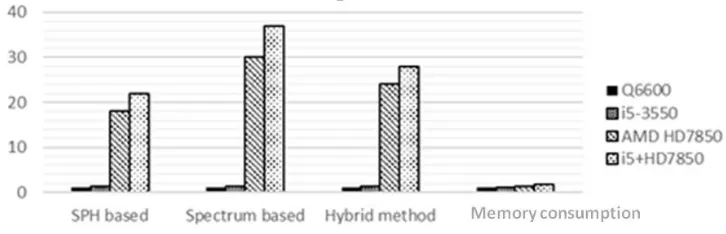
By testing, the systems are similar, but they differ in the performance of individual components, which makes it possible to evaluate the efficiency of both the scaling of the application and the use of individual computing devices in the system. Three algorithms for constructing and visualizing the sea surface were compared in single-precision calculations with a standard four-threaded application on an Intel Core 2 Quad Q6600 CPU, as shown in Figure 1. Higher memory overhead in a heterogeneous environment (Intel Core i5 processor and HD7850 graphics card) was caused a large number of available computational units and the need to duplicate more information, but it is justified and allows obtaining a significant increase in productivity due to saving time for the work of synchronization tools. Thus, the proposed approach scales well, is effective in a heterogeneous environment, allows the use of the GPU as an additional performer to significantly increase the performance compared to a system using many executors based on the CPU. This occurs even in cases where data is transferred between the system memory and the GPU memory each time the visualization function is called.
Figure 1: Testing the scalability of the developed method.
Table 1 shows the number of frames per second performed by the visualization of the liquid (ocean surface) with a geometric grid of 256x256 vertex dimensions and a set of 100,000 particles for the SPH method. The experiment was carried out for a second. More powerful test system, where the developed Hybrid method (Hb) for describing and visualizing the liquid medium is executed. For comparison, the widely known FFT method [6] and SPH [3] using 1 million particles are given.
Table 1: Comparative analysis of the effectiveness of the proposed approach.
ISSN(Online): 2320-9801
ISSN (Print) : 2320-9798
International Journal of Innovative Research in Computer
and Communication Engineering
(A High Impact Factor, Monthly, Peer Reviewed Journal)
Website: www.ijircce.com
Vol. 6, Issue 3, March 2018
costs that do not allow the maximum use of all available resources. The increase in costs is due to the inability to reorder the tasks with the GPU, with the cost of data transfer via the PCI-E bus, as well as the features of access to the memory of the GPU. Sharing CPU and GPU computing devices allows you to minimize these costs a little and better distribute the load. But as the experiment showed, the use of heterogeneous computing system with GPU and CPU executors, just cannot ideally scale. A relatively small increase in speed performing compared to using only the GPU as an artist. The reason for this lies in the impossibility, in some cases, of splitting the associated data into separate clusters, which causes an increase in the volumes of data transmitted through the PCI-E bus and, accordingly, increases the increase in the time required for planning and preparing data.
Figure 2 shows the result of checking the costs that arise when parallelizing the computations in a system with one to eight CPU executors (threads) and two GPU executors involved. The scaling efficiency of the Tessend form spectral method (FFT), the developed hybrid method and the SPH approach with a particle number of 1.5 times greater than the hybrid method was tested. It is revealed that the average time spent on planning the task is not significant, the developed software package for parallel execution of the problem of describing the dynamics and visualization of the surface of the liquid medium allows us to impose only small costs for the planning and allocation of resources.
Figure2: number of performers.
The increasing in costs when using the GPU as the ninth and tenth executors is due to the costs of data transfer via the bus to the local GPU memory, besides the SPH method does not scale very well in a heterogeneous environment when it is required to move large volumes of interrelated information into the memory of various computing nodes.
IV. CONCLUSION
ISSN(Online): 2320-9801
ISSN (Print) : 2320-9798
International Journal of Innovative Research in Computer
and Communication Engineering
(A High Impact Factor, Monthly, Peer Reviewed Journal)
Website: www.ijircce.com
Vol. 6, Issue 3, March 2018
REFERENCES
1. Matt Pharr, Greg Humphreys, Physically Based Rendering From Theory to Implementation, Morgan Kaufmann, 2010.
2. Miguel Sainz, Cyril Crassin, Fabrice Neyret, Simon Green, Interactive Indirect Illumination Using Voxel Cone Tracing, Proc. of Pacific Graphics, 2011.
3. Torgonin E. U., The processing of information in an heterogeneous range of pre-visualization is possible with a number of computer simulators, Materials III of the International Scientific and Technical Conference, High-performance computations (HPC-UA'13), Kiev, 402–407, 2013.
4. Greg Ward, Paul E. Debevec, E. Reinhard, Sumanta Pattanaink, High Dynamic Range Imaging acquisition display and Image-Based Lighting, Elsevier, 2006.
5. Paul E. Debevec, Rendering with natural light, In SIGGRAPH ’98, ACM SIGGRAPH 98 Electronic art and animation catalog, New York, NY, USA, ACM, 166, 1998.