An Implementation of Securing the Sensitive
Data at Application Level using P
M
Q
N
-RSA in
Big Data
Naveen Kumar R#1, Prof Padmavathamma Mokkala*2
Research Scholar, Department of Computer Science, S.V.University, Tirupathi, India#1
BOS, Department of Computer Science, S.V.University, Tirupathi, India*2
ABSTRACT: An era has come where Organizations and individuals are more connected to digitally than ever before.
As a significance, data is accessible to more people than ever before. While digitization accelerates information sharing of sensitive, it exacerbates the threat of sensitive data falling into the un-authorized / wrong hands. To combat this sensitive data threat, enterprises turn to cryptosystem. In the cryptosystem encryption is the process of encoding sensitive data so that only authorized or privileged parties can decrypt and read the sensitive data applying this methodology in application level we provide complete security on the sensitive data.
KEYWORDS: Big Data; Sensitive Data; Application Level; RSA; PMQN-RSA; cryptosystem; authorization; Privilege
users
I. INTRODUCTION
In the modern distributed era has come where organizations and individuals are more connected to digitally than ever before. In the Digital world the government\Companies collecting the massive data of their resource\people. For marketing and research, many of the businesses uses this big data, but may not have the fundamental assets particularly from a security perspective. If a security breach occurs to big data, it would result in even more serious legal repercussions and reputational damage than at present.
In this new era, many companies are using the technology to store and analyze petabytes of data about their data, business of their customers\people. As a result, information classification becomes even more critical. In Government\organizations classification of sensitive data and encrypting the sensitive data is very essential. Not only security but also data privacy challenges existing industries and federal organizations. With the increase in the use of big data in business, many companies are wrestling with privacy issues on the sensitive data. Data privacy [1][2] is a liability, thus Government\companies must be on privacy defensive on sensitive data. But unlike security, privacy on sensitive data should be considered as an asset. There should be a balance between data privacy and national security on sensitive data.
II. RELATED WORK
Data sources for information fed into a Big Data implementation inevitably contain either sensitive, protected information or key intellectual property. This information is distributed throughout the Big Data implementation. That entire sensitive data should be protected.
often try to lift health information, credit card numbers, and other vital information in order to sell it on the black market. No company wants its data to be compromised or its systems to be breached. However, most traditional IT security practices aren’t strong enough to resist the new types of malware, phishing schemes, netbots, and SQL injection attacks unleashed by cybercriminal organizations for sensitive data.
Security[7][8][9] Issues with Hadoop Many of today’s big data projects incorporate Apache Hadoop, an open-source framework for storing and processing big data in a distributed fashion. Business analysts load data into Hadoop to detect patterns and extract insights from structured, semi-structured, and unstructured data. Unfortunately, not all organizations have strong data security in place for these activities. There may be personally identifiable information and intellectual property loaded into these data sets. Initially developed as a way to distribute big data processing jobs among many clustered servers, the Hadoop architecture wasn’t built with security in mind. Namely, it lacks access controls on the data, including password controls, file and database authorization, and auditing. As such, it doesn’t comply with important industry standards such as the Health Insurance Portability and Accountability Act (HIPAA) and the Payment Card Industry Data Security Standard (PCI DSS). Sometimes supplementary group of users can access sensitive data. So we need to provide the privileges user can access sensitive data.
For many organizations big data has evolved into an enterprise data platform. That poses new security challenges as data that was once siloed is brought together in a vast data lake and made accessible to a variety of users across the organization. Among these challenges are:
• Ensuring that authorized users can only access the sensitive data that they are entitled to access. • Ensuring the protection of data—both at rest and in transit—through enterprise-grade encryption.
III.PROPOSED ALGORITHM
In our approach our secure model will provide government\organizations can restrict the sensitive data access and data theft which leads potential threat of the government\organization. To overcome this issue we are proposing the privilege access control on sensitive data of the user’s in application level. Sensitive data can be encrypted in application level will give more secure than other type of encryption such as File level Encryption and Full-Disk encryption. Below table will shows the advantages of application level encryption.
RISK Full Disk
Encryption
File Level Encryption
Application Encryption- Privileged Users
Data unrecoverable when drive stolen or lost from data center
Yes Yes Yes
Data made inaccessible to root and system admins
No Yes Yes
Data made inaccessible to admins
No Yes Yes
Create access logs for threat analytics
No No Yes
Unstructured data , config files, logs protected from theft
Yes Yes Yes
Table 1: Different level of Encryption along with Risk
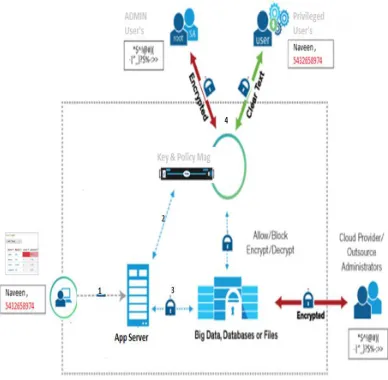
Fig 1: Proposed to cryptosystem along with AppServer , Key & Policy Management
Key Management & Policy Management:-
In this Key Management phase privileged user’s will get the users key, using this key user can encrypt and decrypt the sensitive data. To generating the Key Generation we can use the public key cryptosystem like PMQN-RSA[3][4][5][6] etc., Policy management will classify the sensitive data from the file so sensitive data can’t be tampered or hacked from other users such as Admin, Cloud Provider & Outsource Administrators of Cloud.
Sensitive and Non-Sensitive Data is moving to Big Data Cluster’s we are following below steps
Key Generation: - Privileged user’s creating the keys using the PMQN-RSA[3][4][5][6]which is elaborated in the below
IV.PSEUDOCODE
PMQN-RSA algorithm:
We use the PMQN RSA algorithm as a basis to provide data-centric security for shared data:
Step 1 :Randomly chosen distinct primes P, Q
Step 2 :Randomly chose the two natural numbers M,N Step 3 :Calculate n = P * Q
Step 4 :Calculate Ø(n) = (PM-1 -1)* (QN-1 -1)
Step 5 :Select e such that e is relatively prime to Ø (n) and less than Ø (n). Step 6 :Calculate d such that d is e congruent modulo 1 (modØ (n)) and d<Ø (n). Step 7: Public key = {e, n}
Step 8 :Private key = {d, n}
Step 9 :Cipher message c = ( msge)mod n
V. WORKFLOW
Step 1:- User’s data having sensitive and non-sensitive data transferring to the App Server’s
Step 2:- Data is moving\transferring to the Big Data cluster’s through App Server, while transferring the data through App Server we need encrypt the sensitive data using the Key & Policy Management. Key Management will generate keys and distributing to the group or user’s using the private using PMQN-RSA algorithm as shown above.
Step 3:- Privileged user’s Key and Policy classification (HIPAA\ PCI DSS) sensitive data is encrypting and storing in the Big Data clusters
Step 4:- while accessing sensitive data, primarily the system will check user’s Key and their policy in Key Management and Policy Management after successful authentication privileged users can decrypt the sensitive data. If non-privileged user’s (Admin’s, Root user’s, Cloud Provider / Outsource Administrators) trying to access the sensitive data they will receive the encrypted data.
VI.PSEUDO CODE
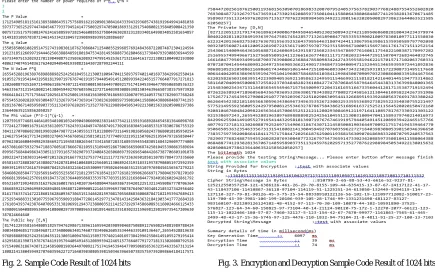
The simulation studies involve the case study of cryptosystem along with test results, the cryptosystem is deployed using the java language and run with sample of 100 test cases with 1024 bits
Fig. 2. Sample Code Result of 1024 bits Fig. 3. Encryption and Decryption Sample Code Result of 1024 bits
VII. CONCLUSION
we obtained it is proved that PMQN-RSA gives more protection only authorized user can retrieve the encrypted data and decrypt it.
REFERENCES
1. Cong Wang, Qian Wang, and Kui Ren and Wenjing Lou (2011) “Ensuring Data Storage Security in Cloud Computing”- IEEE
Transaction on Parallel and Distributed Systems, Vol. 22, No. 5
2. Kenneth Cukier, Data, Data Everywhere, Economist, Feb. 27, 2010, at 3-5, available at http://www.economist.com/node/15557443. 3. NavaneetOjha and SahadeoPadhye “Cryptanalysis of Multi Prime RSA with Secret Key Greater than Public Key” International Journal of
Network Security, Vol.16, No.1, PP.53-57, Jan. 2014
4. Saveetha&S.Arumugam “Study on improvement in RSA algorithm and its implementation” International Journal of Computer & Communication Technology ISSN (PRINT): 0975 - 7449, Volume-3, Issue-6, 7, 8, 2012.
5. Suganya .N , “Implementing Multiprime RSA Algorithm to Enhance the Data Security in Cloud Computing”, International Journal of Innovative Research in Science, Engineering and Technology, ISSN(Online): 2319 - 8753
6. R. Rivest, A. Shamir and L. Adleman, “A Method for Obtaining Digital Signature and Public Key Cryptosystems”, Communications of the ACM, Vol. 21, No. 2, pp. 120-126 (1978).
7. Wang Jun-jie&MuSen (2011) “Security Issues and Countermeasures in Cloud Computing” IEEE Conference on Grey Systems and Intelligent Services (GSIS).
8. Wentao Liu (2012) ”Research on Cloud Computing Security Problem and strategy” 2nd International Conference on Consumer Electronics, Communications and Networks (CECNet)
9. YashpalKadam, “Security Issues in Cloud Computing A Transparent View”, International Journal of Computer Science Emerging Technology, Vol-2 No 5 October, 2011 , 316-322.
BIOGRAPHY
Naveen Kumar R isa Research Scholar in the Computer Science Department, SVUCM&CS, SVUniversity Campus,
Thirupathi, He received Master of Computer Application (MCA) degree in 2008 from SVUniversiry, Tirupati, AP, India. His research interests are Big Data, Cryptosystems and Computer Networks etc.
Prof. M. Padmavathammais