ISSN(Online): 2320-9801
ISSN (Print): 2320-9798
I
nternational
J
ournal of
I
nnovative
R
esearch in
C
omputer
and
C
ommunication
E
ngineering
(An ISO 3297: 2007 Certified Organization)
Vol. 4, Issue 9, September 2016
Security Issues for Cloud Supported IoT
Nikita D. Shingarwade, Sushama C.Suryawanshi, Shashank P. Wankhade
Department of Computer Engineering, Savitribai Phule Pune Univesity, MH, India
ABSTRACT: The internet of things is becoming an attractive system paradigm to realize interconnections through physical, cyber and social spaces. During the interactions among the internet of things, security issues become noteworthy, and it is significant to establish enhanced solutions for security protections. The IoT vision of open data sharing is achieved by using cloud computing concepts. As IoT is built on the basis of the Internet, security problems of internet will also show up in IoT and IoT contain three layers i.e. perception, transportation and application layers. The security issues, technology and solution related to the application layer are discussed in this Paper. The main focus of this Paper on Data Security Protection technique
for application layer and comparison for various techniques.
KEYWORDS: Internet of things, security, privacy, cloud computing
I. INTRODUCTION
Nowadays there is rapid development of Internet of Things there is a variety of IoT applications, which uses in our daily life. They cover from traditional equipment to general household equipment, which help make human beings life better. Meanwhile, numbers of challenges are in the way of the IoT.[1] In terms Of scalability, IoT applications that require large number of devices are often difficult to implement because of the restrictions on time, memory and processing and energy constraints. Hackers, malicious software and viruses in the communication process might disturb data and information integrity. Access cards, bus cards and some other small applications also belong to IoT. Application of IoT can bring convenience to people, but if it cannot ensure the security of personal privacy, private information may be leaked at any time.[1][2] The internet of things based on the ever wider connectivity of sensors or actuators based systems, more general data sharing would become possible within the specific applications for which those sensor or actuating systems were developed. Computers would become autonomous, able to collect data and take decisions based on them, without human intervention.Sensors /actuators based system have been developedindependently of the IoT vision of open data sharing. The cloud is an obvious technology for achieving this open sharing. Cloud computing has evolved to manage, process and store big data.[1][3] IoT not only has the same security issues as sensor networks, mobile communications network and the internet,but also has it specialties such as privacy issues, different authentication an daces control network configuration issues, information storage and management and so on. Data and privacy protection is one of the application challenges of IoT. In IoT there are three layers in IoT: perception layer, transportation layer and application layer. Each layer included various security aspects. In mainly application layer having issues of invalid and in secure data and solutions for removing it is data security protection. There are various methods for data security protection.[2][4]
The main objective of these Papers is:
1. Architecture of IoT containing three layers and various techniques for removing issues related to security. 2. Cloud supported security is achieving open sharing of IoT.
3. Comparisons of various methods of data security protection in application layer of IoT.
A. SECURITY ARCHITECTURE AND SECURITY ISSUES ANALYSIS IN IOT
ISSN(Online): 2320-9801
ISSN (Print): 2320-9798
I
nternational
J
ournal of
I
nnovative
R
esearch in
C
omputer
and
C
ommunication
E
ngineering
(An ISO 3297: 2007 Certified Organization)
Vol. 4, Issue 9, September 2016
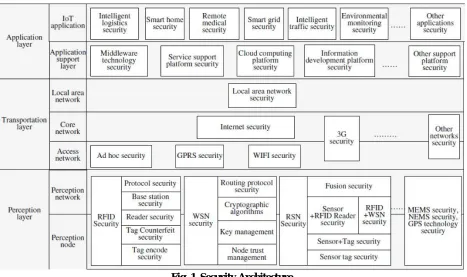
application challenges of IoT.[1] In IoT, RFID systems, WSNs sensors perceive for the end of the information technology, which protect the integrity and confidentiality of information by the password encryption technology. There are many ways to encrypt data and information, such as random hash lock protocol, hash chain protocol, extract key from an infinite channel, encrypted identifier and so on. Identity authentication and access control can determine the communication between both the sides and confirms each other true identity, prevent disguised attacks to ensure the authenticity, validity of the information and so on. There are two major security issues in the transmission process. one risk of the IoT security is from itself, and the other comes from the related technology of construction and implementation of the network functions. IoT itself is the integration of the multiple heterogeneous network, it should deal with compatibility issues between different networks which is prone to security issues. Security issues such as DOS/DDOS attacks, forgery/middle attack, heterogeneous network attacks, application risk of ipv6, WLAN application conflicts also affect the transport security of IoT.[1] IoT divide into three layers: perception layer, transportation layer and application layer. Perception layer includes RFID security, WSNs security, RSN security and any others. Transportation layer includes access network security, core network security and local network security.
Fig. 1. Security Architecture
Application layer includes support layer and specific IoT applications.
B. CLOUD SUPPORTED IoT
ISSN(Online): 2320-9801
ISSN (Print): 2320-9798
I
nternational
J
ournal of
I
nnovative
R
esearch in
C
omputer
and
C
ommunication
E
ngineering
(An ISO 3297: 2007 Certified Organization)
Vol. 4, Issue 9, September 2016
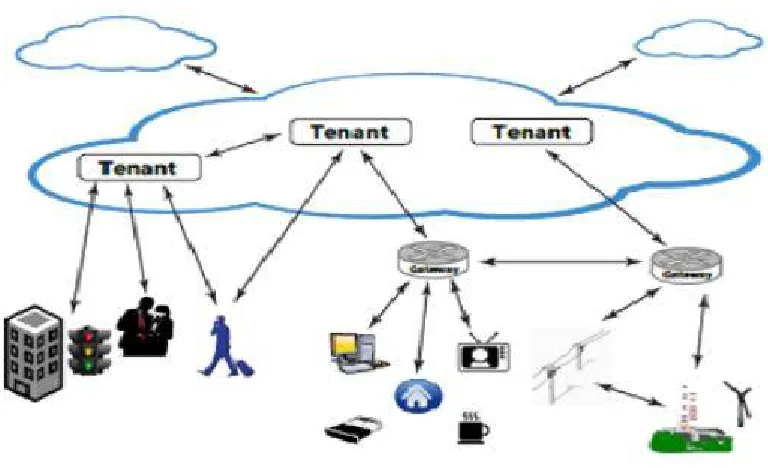
independently shareable and widely available. The cloud is an ideal component in IoT architecture. Firstly, because cloud services can operate across a range of systems, services and devices, it provides the natural point for a) data aggregation and analysis, and b) the management control and coordination of the range of systems and services c) cloud services offer benefits in terms of resource management, as a clouds are always on, can scale to meet demand, and allow the offloading from constrained hardware of data and management specifies. The support for connectivity and open sharing via
cloud services allow. IoT applications are linked to physical world and can directly influence and change it. A cloud system is private and public. Public clouds are the most common, where the cloud provider shares resources between tenants. In a private cloud model, the tenant is offered a dedicated set of resources. This is analogues to in house management, giving the tenant greater control and an increase d sense of security. Hybrid cloud might be processed in private cloud, others on the public cloud. Data and processing may be transferred between two, when and where appropriate.iot subsystems in order to represent aclosed and self contained network of thing. The thing is an entity, physical or virtual, capable of interactionand interacting with cloud services.[2] A subsystem is also.
Fig. 2. Interaction with an Iot cloud
ISSN(Online): 2320-9801
ISSN (Print): 2320-9798
I
nternational
J
ournal of
I
nnovative
R
esearch in
C
omputer
and
C
ommunication
E
ngineering
(An ISO 3297: 2007 Certified Organization)
Vol. 4, Issue 9, September 2016
II. EXISTING SYSTEMS
A. AGGREGATED PROOF-BASED HIERARCHICAL AUTHENTICATION SCHEME FOR IOT
The internet of things is becoming an attractive system paradigm to realize interconnections through the physical cyber, and social spaces. During the interactions among the ubiquitous things, security issues become noteworthy, and it is significant to establish enhanced solutions for security protection.[4] U2IoT architecture mankind neural system and social organization framework are introduced to establish the single-application and multi-application IOT frameworks. System security mainly considers a whole IoT system to identify the unique security and privacy challenges, to design systemic security frameworks, and to provide security mainly focuses on wireless communication networks to design key distribution algorithms, authentication protocols, advanced signature algorithms access control mechanisms and secure routing protocols. Application security serves for IoTapplications and resolves practical problems with particular scenario requirements.
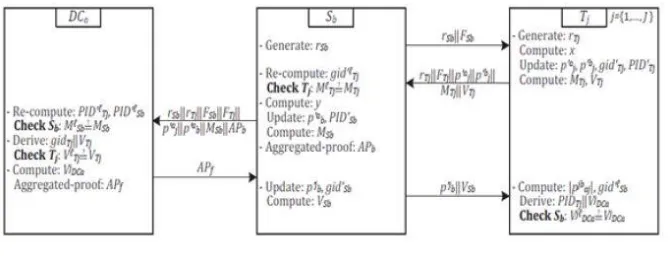
The Authentication protocol in the unit IoT:
Towards the homomorphism function. According to FermatsLittle theorem: if q is a prime number, and x is not a multiple of q, thus x q-1=1modq. In the trust model, nDC is an only entity trusted by all the other entities (i.e., Tj, Sb, DCa, iDC). In the unit IoT, DCa is trusted by Tj, Sb and is under iDCs default jurisdiction. In the ubiquitous IoT, iDC and nDC have relatively independent jurisdictions on DCa.
In the U2IoT architecture the unit IoT refers to a
\
Fig. 3. The Authentication protocol in unit IoT
Fig. 4. The Authentication protocol in ubiquitous IoT
ISSN(Online): 2320-9801
ISSN (Print): 2320-9798
I
nternational
J
ournal of
I
nnovative
R
esearch in
C
omputer
and
C
ommunication
E
ngineering
(An ISO 3297: 2007 Certified Organization)
Vol. 4, Issue 9, September 2016
corresponding unit IoTs in diverse industries. Meanwhile, the industrial IoTs are under the jurisdiction of a national IoT to realize interconnections. In the system model there are heterogeneous sensors (S) and targets (T), which are various according to different scenarios. Multiple unit data centers are under a particular industrial IoT jurisdiction, and industrial data centers have relatively independent authorities on a certain DC. Meanwhile, the trusted national data center (nDC) is introduced to manage multiple iDCs. The APHA is designed based on two main cryptographic primitives: a homomorphism function F (.), and Chebyshev polynomials T*(.).
1. The authentication protocol in the ubiquitous IoT:
An interaction among DCa, iDC, nDC in which DCais under iDCs jurisdiction, and DCa, iDC are within nDCs management range. Dca and iDC have establishedmutual authentication, and nDC has authenticatedDCa, iDC as legal entities. There into, iDCand nDC have different access authorities on DCasgroup identifier and pseudonym to achieve hierarchical access control.
2. Security properties:
a. Data confidentiality and data integrity Theonewayvalues apply pseudo-random numbers,which can ensure that attackers cannot derivethe private values for data corruption.
b. Hierarchical access control Two-layered interactions of Tj, Sb, DCa and DCa, iDC, nDC are performed in relatively independent modes,during which DCa acts as a media to
connectthe unit IoT and ubiquitous IoT. Accordingto the practical application requirements, Tj,Sb, DCa, iDC, nDC are assigned the differentaccess authorities in the U2IoT.
Forward UnlinkabilityThe pseudo-randomnumbers are generated as session-sensitiveoperators to provide session freshness andrandomization. Additionally, the identityrelated values are dynamically updated duringeach session.
c. Mutual Authentication: In the unit IoT, themutual authentication is established between Tj and Sb and authentication operators areapplied to check the identity correctness andconsistency.
B. PRIVACY-AWARE DISTRIBUTED BAYESIAN DETECTION
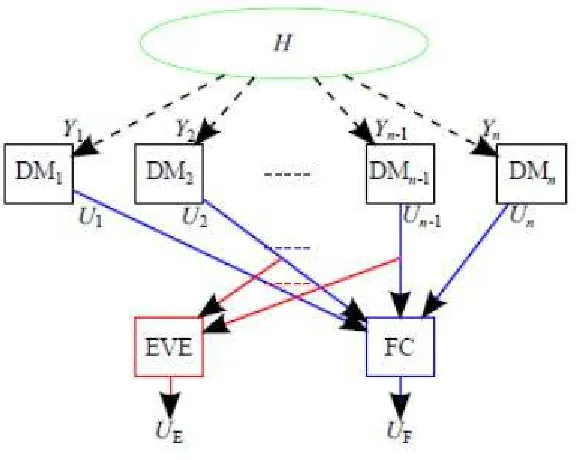
The eavesdropping problem in the remotely distributedsensing on privacy-sensible hypothesis fromthe Bayesian detection perspective.[8] We consider aparallel distributed detection network where remotedecision makers independently make local decision sdefined on finite domains and forward them to thefusion center which makes the final decision.An eavesdropper is assumed to intercept a specificset of local decisions to make also a guess onthe hypothesis. Propose a novel Bayesian detectionoperationalprivacy metric given by the minimal achievable Bayesian risk of the eavesdropper. Further,we introduce two privacy-aware distributed Bayesiandetection formulations, namely the privacy-concerneddistributed Bayesian detection problem where the detectionperformance is optimized under a privacy guarantee constraint and a weighted sum objective of thedetection performance and privacy risk is minimizedrespectively. For a optimal decision strategy of employinga deterministic likelihood test or a randomizedstrategy thereof is identified[8].
C. DISTRIBUTED DETECTION SUSCEPTIBLE TO AN EAVESDROPPER:
ISSN(Online): 2320-9801
ISSN (Print): 2320-9798
I
nternational
J
ournal of
I
nnovative
R
esearch in
C
omputer
and
C
ommunication
E
ngineering
(An ISO 3297: 2007 Certified Organization)
Vol. 4, Issue 9, September 2016
Fig. 5. Model of parallel distributed detection network
D. PRIVACY-AWARE DISTRIBUTED BAYESIAN DETECTIONPROBLEMS:
ISSN(Online): 2320-9801
ISSN (Print): 2320-9798
I
nternational
J
ournal of
I
nnovative
R
esearch in
C
omputer
and
C
ommunication
E
ngineering
(An ISO 3297: 2007 Certified Organization)
Vol. 4, Issue 9, September 2016
Fig. 6. JSON Sensor Signatures
digital signature, over the message and then send messageand signature over an unsecured communicationchannel. In the Internet-of-Things, sensory informationis gathered by constrained devices and the datais then forwarded to other things or to servers. Currently a cryptographically verifiable proof of integrityand origin is hardly ever seamlessly preserved fromthe sensor-based IoT-world to the world of flexibleinterchangeable services and their applications. Goalis to protect integrity of information in an end-to-endfashion in the IoT data processing chain: starting theearliest, generally already on the device , and extendit seamlessly all the way up to the applications.[6]
E. CRYPTOGRAPHIC PRIMITIVES FOR DIGITAL SIGNATURES ONCONSTRAINED DEVICES:
There are several different approaches to allow cryptoon constrained devices: On the one hand lightweight cryptosuitable for severely resource constrained devicesand on the other hand solutions based ontraditional cryptographic primitives. The need forlightweight cryptography and special schemes. Solutionslike the ultra-lightweight Hummingbird allowbringing crypto to nearly any device in the IoT (8-bitmicrocontroller ATmega128L). These and the ongoing
ISSN(Online): 2320-9801
ISSN (Print): 2320-9798
I
nternational
J
ournal of
I
nnovative
R
esearch in
C
omputer
and
C
ommunication
E
ngineering
(An ISO 3297: 2007 Certified Organization)
Vol. 4, Issue 9, September 2016
F. MESSAGE-LEVEL INTEGRITY:
Cryptographically digital signatures protect a stringof bits. When facilitated for message-level integrityprocedureon how the messages content is supplied to thecryptographic algorithm. At this point the mechanismsmust be tailored to fit the structure of the data theyprotect.
G. JSON WEB SIGNATURES (JWS):
JavaScript Object Notation (JSON) has become verypopular to represent data in the IoT domain2. It isstandardized, simple, offers structure, and can be self explainingto humans if semantically names are used.JSON formatted temperature value of 23.4 with somemeta-data. One candidate to sign JSON is the so-calledJSON Web Signature (JWS) that is currently discussedin IETFs JOSE working group as an draft.
H. JSON CLEAR TEXT SIGNATURE (JCS):
JCS does not list the accessibility of the content astheir main design goal. Important to note is that JCShas a potential dependency on canonicalization.
III. SURVEY CONCLUSION
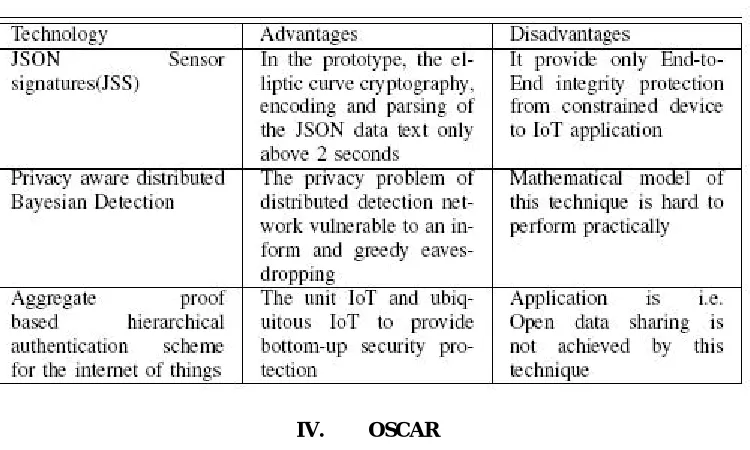
In literature survey we studied all existing techniquefor data privacy protection in application layer of anIoT. The technique like JSON provided only end toend protection not for overall system. Another is privacyaware distributed Bayesian technique containinglarge number of calculation. These all technique notprovided privacy and security over application of the IoT i.e. open data sharing of the data. These open datasharing is achieved by the using cloud technology andOSCAR uses cloud.[6][8][4]
TABLE I. COMPARISON OF DATA PRIVACY PROTECTION TECHNIQUE
IV. OSCAR
ISSN(Online): 2320-9801
ISSN (Print): 2320-9798
I
nternational
J
ournal of
I
nnovative
R
esearch in
C
omputer
and
C
ommunication
E
ngineering
(An ISO 3297: 2007 Certified Organization)
Vol. 4, Issue 9, September 2016
of extra frames that need to be transmittedor received for pure security purposes. This goal byleveraging the benefits of public key cryptography,sparse traffic patterns within local constrained networks,
and messages of limited size, trade the radiousage for a higher computation model[7].
A. INTERNET TRUST MODEL AND THE IOT REQUIREMENTS
The host oriented paradigm has a direct consequenceon trust-its transitivity; once a logical connectionbetween the hosts is closed, the trust in the informationis gone. The information is implicitly dependent onthe trust of the communicating entries during theconnection time.DNS is purposely secured with theapplication level extension DNSSEC and not with aconnection-oriented protocol, such as DTLS. Electronicmail, passing multiple application level gatewaysand without clear connection between end pointsis secured with S/MIME or PGP. Application traffic isasynchronous. Servers notify their clients of physicalstate changes as they happen. Clients send commandsto actuating devices asynchronously as the changesin the environment are observed. DNS traffic is agood parallel as it is triggered by asynchronous humanactions. Caching is must. Severe energy constraintslead to servers being asleep more than 99 percentageof the time.As an already supported and intuitive mechanism,caching at untrusted intermediaries is a way to keepapplications running independently. A similar problemis faced with electronic mails, as they are stored atuntrusted servers until delivery. Group communicationis frequent. Commonly, clients instruct a subset of alldevices to perform an action, for example to turn offall lights on the nth floor or to update the firmware.Achieve these, IPv6 multicast and UDP are exploitedbearing no connection state between and points. Webapplications are built around a single logical server andmultiple clients. Access control is often done withinthe server side applications, once the client has beenauthenticated.[7] IoT reverses this paradigm by havingmany devices serving as servers and possibly manyclients, taking part in the same application. Servers aresignificantly resource constrained which results in theminimization of the server side functionality. Accesscontrol become a distributed problem, especially whentaking into account the recent efforts of decouplingthe sensor network infrastructure from applications.Further-more, applications have emerged that use localdatabases to store parts of collected data. Differentsorts of connection time tweaking and keep-alive messagescloud squeeze in connection-oriented securityprotocols and work around the asynchronous trafficrequirements to support caching, need to trust theIntermediate nodes or proxies to store the data. Tosupport group communication, need to open separatesecure connections among group members and addadditional protocols on top of them, which effectivelyprovides redundant security services necessary for theuse cases.
B. PRODUCER-CONSUMER MODEL
ISSN(Online): 2320-9801
ISSN (Print): 2320-9798
I
nternational
J
ournal of
I
nnovative
R
esearch in
C
omputer
and
C
ommunication
E
ngineering
(An ISO 3297: 2007 Certified Organization)
Vol. 4, Issue 9, September 2016
share with them appropriateaccess secrets and necessary certificates an accesssecrets as an access token from which symmetricencryption keys are derived. Consumers can fetch theprotected content either from intermediate proxies or directly from producers.
V. SECURITY CONSIDERATION
A. DENIAL OF SERVICE
OSCAR takes s non-traditional approach to fight Denialof Service. It builds upon the assumption that
Fig. 7. Producer-Consumer Model For IoT
typical IoT resource representations are small in sizeand directly responds to requests with access protectedresource representations. Moreover, it does not keepany state between communicating entities, which findparticularly important to fight memory exhaustionattacks. Since server-side digital signing operations aredone offline, the intensity of incoming traffic is notcorrelated with asymmetric cryptographic overhead.
Confidentiality:
As content encryption keys are derived from accesssecrets, OSCAR provides confidentiality withinthe resource access right group. Actual securityproperties are dependent on the encryption algorithmused. Note that an adversary able to compromise theAuthorization Servers may only obtain eavesdroppingcapabilities E2E integrity and authenticity propertiesare preserved. If the mutual trust among clientsin terms of confidentiality is not desired, OSCAR
puts the burden on the key management schemerunning on Authorization Servers. One such examplewould be the use of a recently proposed batch-basedgroup key management protocol, where clients wouldbe given cryptographic material corresponding todescendants in the binary tree of the actual accesssecret on a server. However, this would requireadditional signaling of the supported access secret inthe GET request.
Replay Protection:
ISSN(Online): 2320-9801
ISSN (Print): 2320-9798
I
nternational
J
ournal of
I
nnovative
R
esearch in
C
omputer
and
C
ommunication
E
ngineering
(An ISO 3297: 2007 Certified Organization)
Vol. 4, Issue 9, September 2016
notprovide robust protection in security terms. Therefore,successful coupling of OSCAR with CoAP would require additional clarifications and specification tothe duplicate detection mechanism. Another concernwith respect to the replay attack is a maliciousadversary within the resource access tight group incase of asynchronous traffic. Such an adversary is ableto asynchronously inject old resource representationsmaking other members of the group believe they arefresh. Protection against such adversary would requirethe use of a key management scheme that wouldprovide different access secret cryptographic materialon the constrained server and individual clients.
B. SECURING THE IOT
Scalability:
Scalability as a function of the ratio between thetotal number of clients and a maximum number ofopen DTLS sessions at a constrained server (due tomemory limitations, constrained servers have a limitednumber of DTLS session slots). We have followedthe guideline on practical issues with DTLS andextended the Tiny DTLS implementation with theLeast Recently Used (LRU) session closure algorithm.The server immediately releases memory and sends a closing alert to the LRU session as soon as a new clienthas demonstrated good intentions by retransmitting thestateless cookie in the ClientHello message (recall theDTLS handshake). Therefore, the handshake with thenew client proceeds immediately. Clients keep their sessions open as long as possible, i.e. until they receivethe closing alert from the server. The maximum numberof DTLS session slots is dependent on platformmemory capabilities and actual application memoryrequirements.
End-to-End Security at the Network Layer:
Ever since the efforts on integrating Wireless SensorNetworks with the Internet have begun, the so-calledblanket coverage at the network layer has been considereda potential solution to provide end-to-end securityservices. The literature widely discussed the feasibilityof porting the IPsec protocol suite to smart objects.The authors mostly evaluated the processing overhead
and energy requirements of different cryptographicsuites used by IPsec, but also the memory footprintsand system response time. Even though it was initiallyconsidered too heavy for constrained environments,these results led to the common conclusion that alightweight version of IPsec is a feasible option.In the Internet, IPsec mostly secures Virtual PrivateNetworks (VPN).
End-to-End Security at the Transport Layer:
Impracticality of IPSec has been overcome in theInternet by introducing the security services just belowthe application layer, in the form of TLS/SSL. Thewide and successful use of this model in the Web hasalso suggested its use in IoT. The authors evaluatedthe HTTPS stack that leverages assembly optimizedimplementation of ECC as a public key algorithm.SNAIL complemented this work by introducing SSLon all IP architecture, leveraging the 6LoWPAN adaptationefforts done in the meantime. Together withthe introduction of IP to the embedded world camethe dilemma whether TCP is suited or not, due to itsconnection establishment overhead, poor performancein case of lossy networks and short term connections.
Object Security Approaches:
Although the concept of object security, i.e. placingsecurity within the application payload, has been discussedas an option the related work in the literatureleverages its benefits to provide fine grained accesscontrol with an assertion based authorization framework.The problems of E2E security and authorizationfor IoT and use the capability-based access controlsolely as a means to provide communication confidentiality.
Standardization Efforts:
ISSN(Online): 2320-9801
ISSN (Print): 2320-9798
I
nternational
J
ournal of
I
nnovative
R
esearch in
C
omputer
and
C
ommunication
E
ngineering
(An ISO 3297: 2007 Certified Organization)
Vol. 4, Issue 9, September 2016
by ACE, however, seem to be contradictorywith the initial choice of DTLS as a security protocol,particularly when it comes to proxies and caching.OSCAR bridges this gap and jointly.
VI. CONCLUSION
The security architecture and security issues of IoT, andhave divided IoT into three layers: perception layer, transportationlayer and application layer. The features and securityissues of each layer, and introduced the corresponding typicalsolutions for these issues. Problem of E2E security in IoT.It is based on the concept of object security that introducessecurity within the application payload. Consider separateconfidentiality and authenticity trust domains. Confidentialityis used as a means to provide capability based access controland a protection against eavesdropping during the communication.The security issues, technology solution related tothe application layer are discussed in this Paper. The mainfocus of this Paper on Data Security Protection technique forapplication layer and comparison for various techniques of Data security protection.
VII. ACKNOWLEDGMENT
It gives us great pleasure on bringing out seminar entitledSecurity Issues For Cloud Supported Internet of Things. Wewould like to thank all who directly or indirectly helped usduring our work.The authors are grateful to the anonymousreviewers for their valuable comments, which helped us toimprove the quality and presentation of this paper.
REFERENCES
[1] Qi Jing, Athanasios V, Vasilakos, Jiafu Wan, Jingwei Lu, DechaoQiu ,Security of the internet of thing : perspectives and challenges, Issue
17thJune 2014 DOI 10.1007/s11276-014-0761-7.
[2] Jatinder Singh, Thomas Pasquier, Jean Bacon, HajoonKo and David Eyers,Twenty security considerations for cloud-supported internet of things,IEEE journal issue on April 2015 DOI 10.1109/JIOT.2015.2460333.
[3] Sandip Ray and ArijitRaychowdhaury,The changing computingparadigm with internet of things: A tutorial introduction, IEEE journalissue on 2015 DOI 10.1109/MDAT.2016.2526612.
[4] HaunshengNing, Hong liu,LaurenceT.Yang , Aggregated proof basedHierarchical Authentication Scheme for Internet Of Things, issue onMarch 2015 DOI 10.1109/TPDS.2014.2311791.
[5] WeizheZhang ,BeoshengQu, Security architecture of the internet ofthings oriented to perceptual layer, IEEE journal issue on 2013.
[6] Henrich C. Pohls, JSON Sensor Architecture:End-to-End integrityProtection from Constrained Device to IoT Application, 2005 DOI10.1109/IMIS.2015.48.
[7] Mali saVucinic, Bernard Tourancheau, Franck Rousseau, AndrzejDuda,Laurent Damon, Roberto Guizzetti, OSCAR: Object Security Architecturefor the Internet of Things.
[8] Zuxing Li, Student Member, IEEE, and Tobias J. Oechtering,Privacy-Aware Distributed Bayesian Detection, IEEE, 2015, DOI10.1109/JSTSP.2015.2429123.
[9] S. Raza, D. Trabalza, and T. Voigt, 6LoWPAN Compressed DTLS forCoAP,in Distributed Computing in Sensor Systems (DCOSS), 2012 IEEE8th International Conference on. IEEE, 2012, pp. 287289.