ISSN(Online): 2320-9801
ISSN (Print): 2320-9798
I
nternational
J
ournal of
I
nnovative
R
esearch in
C
omputer
and
C
ommunication
E
ngineering
(An ISO 3297: 2007 Certified Organization)
Vol. 4, Issue 8, August 2016
A Survey on Night Vision Techniques and
Their Applications
Soundarya. P1, Dr.Indumathy. R2
M.Sc Student, Department of Computer Technology, Sri Krishna Arts and Science College, Coimbatore, Tamil Nadu,
India1
Asst. Professor, Department of Computer Technology, Sri Krishna Arts and Science College, Coimbatore, Tamil Nadu,
India2
ABSTRACT: Night vision technique is used under low light environment, which works based on three methods. Image intensifier, active illumination and thermal imaging. Image intensifier has high resolution but it requires some light source. Active illumination method used at short distance range and known as active system, whereas thermal imaging method used for long distance range and known as passive system. Active system used with Near Infrared camera [NIR] and passive system used with Far Infrared camera [FIR]. Both active and passive methods are highly useful for pedestrian detection during night time. Active illumination system has wider angle and compared to other night vision technique it is low cost and gives clear image. Thermal imaging works by observing temperature produced by objects. The warmer object appears white and cool object appears in black colour,but the resultant image produced by thermal image is not clear due to its weak signal. To overcome this, double spectral and image fusion algorithm is used. Thermal imaging has image sensor used to detect the range of the wavelength. Sensor can generate new image up to 60 times per second.In active illumination method, to detect pedestrian edge detection algorithm is used. It also has gated camera to filter the unwanted rays and allow only required rays. Active illumination method is used in agricultural vehicle,Mercedes-Benz. Thermal imaging method isused in BMW cars.
KEYWORDS: Image intensifier, Active illumination, Thermal imaging, Edge detection, Double spectral.
I. INTRODUCTION
Compared to animals, human beings have low eye sight during night. Only with the help of light humans are able to see at night time. When there is no light they could not see. In such situation, these night vision techniques are used. Using this technique, the soldiers able to find out or locate their enemies during night time. It also used by wildlife observer to capture the wild animals like rarely seen creatures. Elusive creature may be more active during night time[1]. Later it has been used for surveillance,security,pedestrian detection. Many accidents are taken place during night time due to low light and bad weather condition. To overcome this problem many automobile companies use these night vision techniques.The image intensifier is one of the oldest electro-optical surveillance technologies [2]. It receives less attention from international scientific community due to two reasons. The first reason is, it was developed by big manufactures and not by scientific institutes. The second reason is the competition between the thermal imaging and active illumination. The resultant image given by image intensifier appears green due to the use of green phosphorus.
ISSN(Online): 2320-9801
ISSN (Print): 2320-9798
I
nternational
J
ournal of
I
nnovative
R
esearch in
C
omputer
and
C
ommunication
E
ngineering
(An ISO 3297: 2007 Certified Organization)
Vol. 4, Issue 8, August 2016
II. OVERVIEW OF NIGHT VISION TECHNIQUE
Night vision has its ability to see in low light condition. It has used in both biological and technological field. It has two common types of approaches. The first approach is spectral range and the secondis intensity range. By using spectral range radiation which is invisible to human can be sense. Human vision has immovable portion of the electromagnetic spectrum called visible light. Enhanced spectral range allows the viewer to take advantage of non-visible electromagneticradiation. The second approach is the intensity range which has the ability to see with very small quantity of light. To achieve the enhanced intensity range, image intensifier technique is used. In biological terms humans have poor night vision due to lack of tapetum lucidum. The retina of human eyes has cones and rods. The cones are used for seeing colour lights and rods for detecting movement and dim light. Humans have 20 times more rods than cones, but due to lack of tapetum we cannot able to see in dark. This problem can be solved by night vision technique.
III. MAJOR METHODS USED IN NIGHT VISION TECHNIQUE
Night vision technologies can be broadly divided into three main categories: i. Image intensifier.
ii. Active illumination. iii. Thermal imaging.
A. Image intensifier
Image intensifier is an oldest electro-optical, vacuum tube based device[2]. By using this method, humans can view things in dark. It converts the invisible light from an image to visible light. It consists of photo cathode. When light strikes the cathode, electrons will be emitted. The emitted electrons will be passed through vacuum tube and then it strikes the micro channel plate[1]. From that, the illuminated image will be produced. The resultant image appeared in green colour due to the use of green phosphorus. This is used because human eye can differentiate the shades of green than any other colour. The working model is shown in Fig.1.
Fig 1: Image intensifier Advantages
Low power and cost Low light level sensitivity High resolution
ISSN(Online): 2320-9801
ISSN (Print): 2320-9798
I
nternational
J
ournal of
I
nnovative
R
esearch in
C
omputer
and
C
ommunication
E
ngineering
(An ISO 3297: 2007 Certified Organization)
Vol. 4, Issue 8, August 2016
Cause damage when absorbing bright sources under low light condition
B. Active illumination
Active illumination method is used when there is no sufficient visible light. It produce gray-scale image. It works based on Near Infrared[NIR]. In this method,the photons emitted by the surrounding light are converted into electrons. The emitted electrons are amplified by chemical and electrical process[1]. Then it is converted into visible light. Thus using these method humans can see the image in dark. In active illumination the shadows will be eliminatedand only the required area will be visible. In active system edge detection algorithm is applied in some applications[5].
Advantages
Lowest cost compared to other night vision technologies. Eliminate shadows
Can see through night time fog,mist,rain. Disadvantages
Cover short distance.
C. Thermal imaging
Thermal imaging method does not require light. It has the infrared detector element that will scan and create the temperature pattern. Such pattern is called thermo gram and that is converted into electrical signals. The electrical signals are sent to a signal processing unit. That unit has a circuit board with chip which converts the signal into required visible image[1]. Thermal image detects the temperature difference between the background and the foreground objects. Thus the warmer object appears white and cool objects appear in black colour. In Passivesystem adaboost algorithm is used in some applications[6]. Thermal imaging device has two types. They are un-cooled and cryogenically cooled.
a. Uncooled
In thermal imaging device the most commonly used method is un-cooled. It is used to operate at room temperature. When using un-cooled detector, the heat detected by this will cause changes to the electrical properties of that material. Those changes are compared to the baseline and thermal imaging is created.
Advantages
Inexpensive when compared to other thermal imaging. Not affected by bright light source.
Easily detect people and vehicles. Disadvantages
Less sensitive than cooled detector Cannot be used for multispectral.
b. Cryogenically cooled
Cryogenically cooled device are more susceptible to damage from rough use, so they are housed in a vacuum-sealed case. It cools the material to below 32F(zero c). By cooling them it increases their sensitivity.
Advantages
Able to perform multispectral infrared imaging. The highest possible thermal sensitivity.
Able to detect people and vehicles at great distance.
Disadvantages
ISSN(Online): 2320-9801
ISSN (Print): 2320-9798
I
nternational
J
ournal of
I
nnovative
R
esearch in
C
omputer
and
C
ommunication
E
ngineering
(An ISO 3297: 2007 Certified Organization)
Vol. 4, Issue 8, August 2016
IV. APPLICATION OF NIGHT VISION TECHNOLOGY
The night vision technology is mainly developed for military use to locate enemies at night. Later it is used in many fields such as
i. Wildlife observation ii. Automobiles
A. Wildlife observation
Many rarely seen animals including most large mammals are more active at night. To capture the elusive creature animals,night vision technique is used.Fig.2 shows the example of night vision technique used in wildlife observation.
Fig 2: Observed wild animals using night vision technique
B. Automobiles
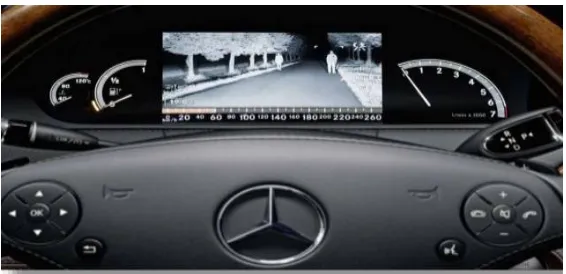
Night vision techniques are used in automobiles to reduce the accidents occurred during night time. Both active and passive methods are used in automobiles.
a. Active method used in vehicle
Active method is used in most of the vehicles such as Mercedes-Benz,agriculture vehicle to prevent from pedestrian accidents[7]. It has segmentation method,based on this method edge detection is applied to identify the edges of pedestrians[5,8]. The active illumination works by capturing input videos using NIR cameras. From that video extract the frames and then segment the digital image into multiple segments. The segmentation has edge detection,detection of blob and merging of blob. Edge detection algorithm is used to reduce the quantity of image and get only important information. It involves smoothing, enhancement and detection. Smoothing is used to reduce the noise and enhancement is used to highlight the pixels. Detecting the blob by using vertical and horizontal diagonals. Merge the detected blob which has the same information. After merging the blob the false positive will be detected.False positive is an error and it will be discard. Then the required pedestrian image will be displayed.
b. Passive method used in cars
ISSN(Online): 2320-9801
ISSN (Print): 2320-9798
I
nternational
J
ournal of
I
nnovative
R
esearch in
C
omputer
and
C
ommunication
E
ngineering
(An ISO 3297: 2007 Certified Organization)
Vol. 4, Issue 8, August 2016
a powerful machine learning algorithm.At each stage of cascade classifier is trained by adaboost algorithm.Cascade classifier is used to classify the pedestrian and non-pedestrian.Finally the required pedestrian image will be displayed. Fig.3 shows an example of night vision technique used in automobiles.
Fig 3: Night vision technique used in automobiles
V. CONCLUSION
In this paper, the various methods and applications of night vision technology has been explained. The working of the methods,both advantages and disadvantages of three methods has been explained. The importance and working of night vision technique in automobiles has been mentioned. Image fusion and edge detection algorithm has been used in night vision techniques to display the clear image.
REFERENCES
1 Rupesh P.Raghatate, Swapnil S.Rajurkar, Manisha P.Waghmare, Pooja V. Ambatkar, “Night Vision Techniques and Their Applications”, International Journal of Modern Engineering Research (IJMER) Vol.3, Issue.2, March-April. 2013.
2 K. CHRZANOWSKI, “Review of night vision technology”, Opto−Electron. Rev., 21, no. 2, 2013.
3 Ankit Dilip Yawale, V. B. Raskar, “Review of Pedestrian Detection by Video Processing in Automotive Night Vision System”, International Journal of Science and Research (IJSR)Volume 5 Issue 4, April 2016.
4 Erwan Bernard, Nicolas Riviere, Mathieu Renaudat, Pierrick Guiset, Michel Pealat,Emmanuel Zenou, “Experiments and models of active and thermal imaging under badWeather conditions”, Proc. of SPIE Vol. 8897 889703-1© 2013.
5 Lakshmi J, Rashmi C R, Roopa S, “Pedestrian Detection System for Night VisionApplication to Avoid Pedestrian Vehicle Related Accidents”, International Journal of Engineering Research & Technology (IJERT), Vol. 4 Issue 07, July-2015.
6 Hao Sun, Cheng Wang, Boliang Wang, “Night vision pedestrian detection using a forwardlookinginfrared camera”, 978-1-4244-9404-0/11/$26.00 ©2011 IEEE.
7 Haijun Yue, Haisheng Xin, “Active Infrared Night Vision System of AgriculturalVehicles”, TELKOMNIKA Indonesian Journal of Electrical EngineeringVol. 14, No. 2, May 2015.
8 Rafael Mosberger and Henrik Andreasson, “An Inexpensive Monocular Vision System for Tracking Humans in Industrial Environments”, 2013 IEEE International Conference on Robotics and Automation (ICRA)Karlsruhe, Germany, May 6-10, 2013.
9 Aniket S. Ahire, “Night Vision System in BMW”, International Review of Applied Engineering Research. ISSN 2248-9967 Volume 4, Number 1 (2014).
10 Qin Yi, “A Research about the Design and Application of Double Spectrum Car Night Vision System”, Journal of Remote Sensing Technology, Vol. 2 Iss. 3 Aug. 2014.
BIOGRAPHY
Soundarya.P is an MSc Student in Department of Computer technology, Sri Krishna Arts and Science College, Coimbatore, TamilNadu, India.