Extracting Comparative Sentences from
Twitter Using POS tagging
Ashwini D. Pawar 1, Sachin N. Deshmukh2
M. Tech Student, Dept. of Computer Science and Information Technology, Dr. B. A. M. University Aurangabad,
Maharashtra, India1
Professor, Dept. of Computer Science and Information Technology, Dr B. A. M. University, Aurangabad, Maharashtra,
India2
ABSTRACT: The importance of Text Mining applications has increased in recent years because of the large number of
web-based applications which lead to the creation of such data. Now a days, newer aspects of Text Mining can be apply on emerging platforms such as Social Networks. Opinion Mining and Sentiment Analysis are one of the applications of Text Mining. Opinion Mining refers to the extraction of lines and phases from the social networks that contain some opinion. Sentiment analysis identifies the polarity of opinion being extracted. Daily huge amount of data is generated by these Social networks such as Twitter. Users not only use these social networks but also give their valuable feedback, thus generating additional information. Due large amount of user’s opinion, views, feedback and suggestion
available through social networks in terms of comparative thoughts represent a way of users express their preferences
about two or more entities, it’s very much essential to explore, analyze and organize their views for better decision making.
KEYWORDS: Text Mining, opinion mining, comparative sentences.
I. INTRODUCTION
If we want to take a decision, we first prefer to seek others opinion, we evaluate opinions and take decision. Same thing is applied to organizations when they introduce new product or on the way to introduce it; organizations take opinions of its customers in the form of reviews of product on official websites of organization, social media sites such as Facebook, Twitter, Blogs or online shopping sites. Customer also wants to know opinions of existing users before they use service or purchase a product. These reviews help organizations and its Customers to evaluate the response or love among people about product or service.
II. RELATED WORK
III. PROBLEM DEFINITION
In this section, we state the difficulty that we aim to solve. We first give a linguistic view of comparatives (also called
comparative constructions) and discover some restrictions. We then enhance them by including implicit comparatives,
and state the difficulty that we deal with in this paper. Since we need Part-Of-Speech (POS) tags throughout this section and the paper, let us first acquaint ourselves with some tags and their POS categories. We used Brill's Tagger to tag sentences. It follows the Penn Tree Bank POS Tagging Scheme. The POS tags and their categories that are important to this work are: NN: Noun, NNP: Proper Noun, VBZ: Verb, present tense, 3rd person singular, JJ: Adjective,
RB: Adverb, JJR: adjective, comparative, JJS: adjective, superlative, RBR: Adverb, comparative, RBS: Adverb, superlative.
IV.SENTIMENT ANALYSIS IN TWITTER
Sentiment analysis is a type of natural language processing for analyzing the mood of the public about a specific product or subject. Opinion Mining and Sentiment Analysis are the branches of Text Mining which refer to the process of extracting nontrivial patterns and interesting information from unstructured script documents. We can say that they are the expansion to data mining and knowledge discovery. Opinion Mining and Sentiment Analysis concentrate on polarity identification and emotion recognition correspondingly. Opinion Mining has higher attractive potential than data mining, as it is the most natural type of storing the information in text format. It is much complex task than data mining because it needs to manage unstructured and fuzzy information.
A. Comparative sentences
An object is an entity that can be a person, a product, an action, etc, under comparison in a comparative sentence. Each
object has a set of features, which are used to compare objects. A comparison can be among two or more objects, groups of objects, one object and the rest of the objects. It can also be between an object and its previous or future versions.
Types of comparatives: We group comparatives into four types. The first three of which are gradable comparatives and the fourth one is non-gradable comparative. The gradable types are defined based on the relationships of greater or
less than, equal to, and greater or less than all others.
1) Non-Equal Gradable: Relations of the type greater or less than that express an ordering of some objects with regard
to certain features. This type includes user preferences, and also those comparatives that do not use JJR and RBR
words.Ex: “optics of camera A is better than that of camera B”
2) Equative: Relations of the type equal to that state two objects as equal with respect to some features.Ex: “camera A
and camera B both come in 7MP”
3) Superlative: Relations of the type greater or less than all others that rank one object over all others.Ex: “camera A is
the cheapest camera available in market”.
V. EXPERIMENTAL WORK
A. Data Description
Twitter is complicated than doing it for large reviews. This is because the tweets are very short and mostly contain slangs, emoticons, hash tags and other twitter language.
There is no large public available data set of Twitter tweets with sentiment, so we use Twitter API to collect data. The Twitter API has a parameter that specifies in which language you want to retrieve tweets and we set this parameter to English. We acquire tweets of iPhone mobile then we performed preprocessing on tweets
B.Preprocessing
In the tweets, people use acronyms; make the spelling mistake, use emoticons and the other characteristics that express the social meaning. Particularly the other characteristics includes the used of “@” and “#” symbols in tweets, where “@” symbol is act as the target and used to refer the other users on microblog while “#” symbol represents the content of the tweet.
We pre-process the tweets as follows.
All the words are transformed into lower case.Removes the numbers from the tweets.Removes the URL from the tweets.Removes the Punctuation from the tweets.Stop Word Dictionary: Stop word dictionary recognizes a stop words in the tweets.Removes Whitespaces from the tweets.
C.Part-of-Speech (POS) Tagging
We now give an introduction to part-of-speech (POS)tagging as it is useful to our subsequent discussion and alsothe proposed techniques. In grammar, part-of-speech of aword is a linguistic category defined by its syntactic ormorphological behavior. Common POS categories are: Noun, verb, adjective, adverb, pronoun, preposition,conjunction and interjection. Then there are manycategories which arise from different forms of thesecategorieseach word is then replaced with its POS tag. We do not usethe actual words. For each keyword, we combine the actual keyword and the POS tag to form a single item. The reasonfor this is that some keywords have multiple POS tagsdepending upon their uses. Their specific usages can beimportant in deciding whether a sentence is a comparativesentence or not. For example, the keyword “more” can be acomparative adjective (more/JJR) or a comparative adverb(more/RBR) in a sentence.
D. Comparative Sentences Mining Techniques
1.N-grams Classification
The technique of document representation through term vector is the most commonin the sentiment analysis field and can be used as our baseline. In thisapproach, each sentence in the corpus is a document, terms are the most relevantwords and we use TF-IDF matrix to represent them. Such matrix is,therefore, submitted to a classifier that builds a model able to discover whethera given sentence is comparative or not.
2. Sequential Patterns Classification
VI. RESULT
We collected data from Twitter to represent differenttypes of text. Our data consist ofConsumer reviews on iphone
mobile. Table 1 and Table 2 shows Training data and testing data respectively, which we labeled automatically using
POS tagging.
Table1: Training Data
Data sets Comp Non-Comp Total
Tweets 700 550 1250
Table 2: Testing Data
Data sets Comp Non-Comp Total
Tweets 250 50 300
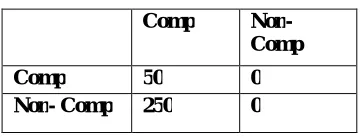
From the different machine learning algorithms; we used Naive-bayes Classifier to determine the sentiment of the tweets on Testing Data. Table 3 shows the result of Testing Data using Naive-Bayes Classifier.
Table 3: Result of Naive-Bayes classifiers
Comp Non-
Comp
Comp 50 0
Non- Comp 250 0
We obtain 0.83 Accuracy after Naïve bayes Classifier.
VII. CONCLUSION AND FUTURE WORK
In our research, we have presented a method that automatically collects tweets from twitter using Twitter API. Then on these collected tweets, we perform preprocessing for our desired results and after that we performed POS tagging by using Tree-Tagger. We can use some of tweets to train a sentiment classifier. Our classifier is able to determine comparative, and non-comparative from tweets. The classifier is based on Naive Bayes classifier that uses Unigram and POS tags as features. We can observe a poor performance for n-grams approachvarying classifiers algorithms does not impact on results that reach a maximum accuracy of 68.6% for RBF neural network. The neural network RBF-CSR reached the best accuracy of 81.13%. But by using Naïve bayes classifier and POS tags, our system got 83% accuracy.
This work primarily used POS tags. Infuture work, we also plan to explore other languagefeatures (e.g., named entities, dependency relationships ofdifferent conceptions, etc) to improve the accuracy.
3) Ceron, A., Curini, L., Iacus, and S.M.: Using sentiment analysis to monitor electoral campaigns: Technique matters-evidence from the United States and Italy. Soc. Sci. Comput. Rev. 33(1), 3–20 (2015)
4) Fournier-Viger, P.,Wu, C.W., Tseng, V.: Mining maximal sequential patterns without
Candidate maintenance. In: Advanced Data Mining and Applications, vol. 8346,pp. 169–180 (2013) 5) Jindal, N., Liu, B.: Distinguishing comparative sentences in text documents. In: Proceedings
of the 29th Annual International ACM SIGIR Conference on Researchand Development in Information Retrieval. pp. 244–251. SIGIR ’06 (2006)
6) Liu, B.: Sentiment Analysis and Opinion Mining. Morgan Claypool Pub. (2012)
7) McAuley, J., Leskovec, J.: Hidden factors and hidden topics: Understanding rating dimensions with review text. In: Proceedings of the 7th ACM Conference on Recommender Systems. pp. 165–172. RecSys ’13 (2013)
8) Pang, B., Lee, L.: Opinion mining and sentiment analysis. Foundations and Trendsin Information Retrieval 2, 1–135 (2008)
9) Pei, J., Han, J., Mortazavi-Asl, B., Wang, J., Pinto, H., Chen, Q., Dayal, U., Hsu,M.C.: Mining sequential patterns by pattern-growth: The PrefixSpanapproach.IEEE Trans. on Knowl.And Data Eng. 16(11), 1424–1440 (Nov 2004)
10) Sharma, A., Dey, S.: An artificial neural network based approach for sentiment analysis ofopinionated text. In: Proc. of the 2012 ACM Research in Applied Computation Symposium. pp. 37–42 (2012)
BIOGRAPHY
Ashwini Deeliprao Pawar M.Tech Student Received B.E in Computer Science and Engineering from Godavari
College of Engineering Jalgaon, North Maharashtra University (NMU), Jalgaon in 2012. Currently pursuing M.Tech in Computer Science and Engineering from Department of Computer Science and IT, Dr. Babasaheb Ambedkar Marathwada University, Aurangabad, India.
Dr. Sachin N. Deshmukh Professor completed his Ph.D. and M.E in Computer Science and Engineering. He is