Bimodal Biometric Recognition Using PCA
Aniket Ugale
1, Atul Ingole
2M. E Student, Dept. of E & TC, SAE, Pune, India1 Asst. Professor,Dept. of E & TC, SAE, Pune, India2
ABSTRACT: Biometric person identification is very effective method for automatic recognition. Multimodal biometric system gives better recognition results compared to Unimodal approach. In this paper two modalities are considered namely face and fingerprint. Both modalities are taken from standard database. Feature extraction of both face and fingerprint is done by principal component analysis. As it converts set of correlated variables into a set of uncorrelated ones it gives distinguishable features. Feature vectors of both modalities are fused by direct fusion method. A single vector is formed which shows single person identity. These vectors are then stored to form database. Euclidean distance classifier is used to recognize a person. Classifier uses this database to distinguish person and gives recognition result as "match found" or "match not found".
KEYWORDS: Bimodal; Principal Component Analysis; Fusion; Euclidean; Match
I. INTRODUCTION
In recent years, identification become very important aspect because people are required to be claimed individual so that the right person can access ATMs, buildings, files etc. Traditionally authentication is done with the help of password, PIN(Personal Identification Number), ID card etc. These methods are not secured because ID card may be lost, password may be forgotten.
Biometrics based identification system where automatic recognition of a person is done. It uses behavioural or physiological characteristics of a person. It includes face, fingerprint, iris, hand geometry, palm prints, signature etc. These characteristics never be forgotten, stolen. Hence they are better than traditional approaches also multimodal biometrics integrate information of different characteristics. This information is efficient to distinguish. Hence results obtained using multimodal approach are far better than Unimodal approach.
In this paper, bimodal approach is considered where face and fingerprint modalities are considered. Both these modalities are widely used in the field of biometrics as they give efficient features. Features of both are calculated by Principal Component Analysis. Direct fusion is done where features of both the modalities are concatenated to form a single vector. Database of such vectors are formed and used in recognition stage. For recognition purpose, Euclidean distance method is used. The vectors having less Euclidean distance is regarded as identified.
II. RELATED WORK
fingerprint biometric characteristics of users for verification. ROI extraction is done in preprocessing and then Gabor and magnitude feature extraction is done. Feature level fusion is used to get a feature vector for further processing. Dimensionality reduction is done using linear discriminant analysis and linear projection. Classification is done with the help of K nearest neighbor where training, testing and analysis is done. Experimental results proved fusion algorithm gives satisfactory results in bimodal approach. In [5] authors training database contains face and palmprint. Integration of face and palmprint increases robustness of the system. Feature extraction is done using canonical form based PCA approach. Final decision is made by fusion at matching score level architecture.
III.PROPOSEDMETHODOLOGY
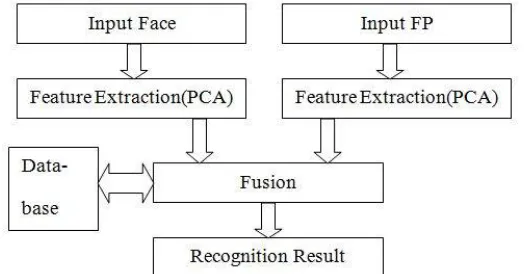
Block diagram of biometric recognition system is as shown in fig 1. The flow is indicated by arrow. The detailed information is:-
Fig 1.Block Diagram of Recognition System
A. Input Image:
Face images are taken from ORL(develop at the Olivetti Research Laboratory, UK AT & T Laboratories Cambridge) . FP(Fingerprint) images are taken from FVC database. Both modalities are resized to 200*180 so that they are processed easily further. Sample input images are shown in figure 2a and 2b.
Fig 2a. Sample Face Image Fig 2b. Sample Fingerprint Image
B. Feature Extraction:
Principal Component Analysis is used for feature extraction. It is an orthogonal transformation. It converts set of correlated data into a set of uncorrelated ones. Procedure of PCA is:-
Step 1: Align in Columns:-
Each 2D image is converted to 1D. This is done on both database. Let there is set of N images T1,T2,T3 upto TN. T
Mean of all images is calculated say(M). Then it is subtracted from each image that forms matrix of centered image vectors. This process is called as 'Normalization'. It helps in giving more efficient data for recognition.
M=T1+T2+T3+...+TN /N eq. (1)
S=T-M eq. (2) Step 3: Calculation of Covariance Matrix
In this system, Covariance matrix is calculated as:-
C=ATA eq. (3) Earlier, covariance matrix is calculated as:
C=AAT eq. (4)
The size of the matrix computed by eq. 4 is very large comparing to number of images. This will large number of eigen vectors. Large number of eigen vectors contribute to large data space. This leads to lot of complexity of data. This will not differentiate the images hence eq. 3 is applied where dimensions can be reduced. Which can give low dimensional space and will give efficient recognition results. This phenomenon is called as Dimensionality Reduction. Step 4: Feature Vector Formation:
With the help of M, eigentemplate (eigenface for face and eigenfp for fingerprint) and matrix of centered image vectors facetemplate(Feature vector of face) and fptemplate(Feature vector of fingerprint) are formed.
C. Fusion:
Fusion is done by concatenating features generated by face and fingerprint modalities. At facetemplate and fptemplate are loaded. They are reshaped to form a single vector. Concatenation is done by cascading fptemplate and facetemplate. In this way all templates are formed and all are stored in database then these templates are used for the comparison purpose in the recognition stage.
D. Classifier:
Euclidean distance classifier is used for the recognition result. Database contains all the feature vector templates of different combinations of face and fingerprint modalities. When test images are fed to the system then their feature vector template is formed. That template is compared with the templates stored in the database. The template which gives minimum distance recognized as recognition index
IV.EXPERIMENTALANALYSIS
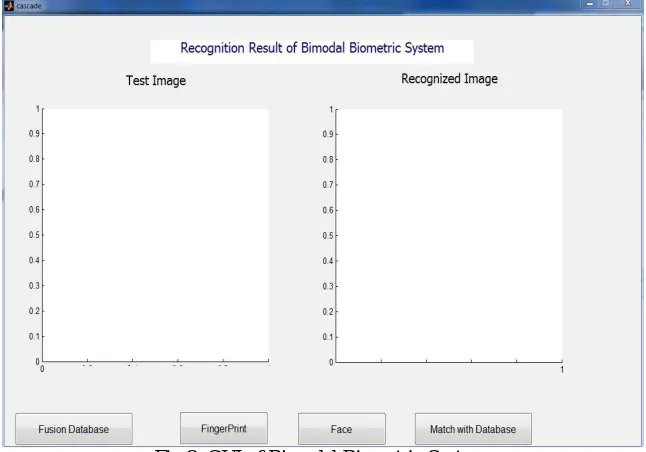
GUI of the bimodal biometric system is shown in figure 3. It mainly consists of four parts:- A. Face:
This button contains two important features. ‘Face database’ is first feature. Here M, S and eigentemplates (eigenfaces for face modality) for face are calculated with the help of PCA standard procedure which is explained earlier. And all this information is stored in a separate say(faceinfo.mat) file. ‘Select face’ is second important feature. Here the face image of the person who is to be identified is taken. M and Eigenfaces are extracted from 'faceinfo.mat' and its feature vector is calculated by PCA procedure and stored in say (face.mat).
B. Fingerprint:
important feature. Here the fingerprint image of the person who is to be identified is taken. M and Eigenfp are extracted from 'fpinfo.mat' and its feature vector is calculated by PCA procedure and stored in say (fp.mat).
Fig 3. GUI of Bimodal Biometric System
C. Fusion Database:
Here the all the face and fingerprint images are read and record by record 'facetemplate' and 'fptemplate' are concatenated by direct fusion. They are then used in next step for recognition purpose. One of the feature vector template is shown in the table below. these values are formed with the help of eigen template of respective modality and normalization matrix(A). These values are of high exponential range hence significant values are shown in table. first row indicates 'facetemplate' and second row indicates 'fptemplate'. Values are different for different combination.
0.0061 0.0012 0.0016 0.0028 -0.0015 0.0011 -0.0011 0.0017 5.2881 0.0136 1.4161 -0.0003 0.0014 0.0005 -0.0021 0.0012 -0.0037 2.9313
Table. Feature Vector Template
D. Match with Database:
test image feature vectors which are stored in 'face.mat' and 'fp.mat' are extracted. They are concatenated to form a feature vector. This feature vector is compared with feature vector templates in Fusion Database by euclidean distance method and recognition procedure is done with it.
V. RECOGNITIONRESULTS
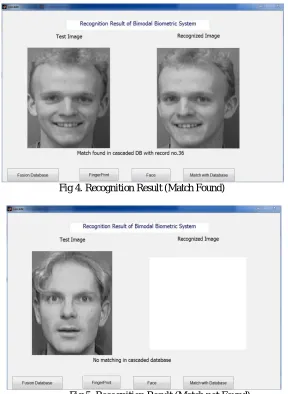
In match found case, the euclidean distance algorithm is used. This euclidean distance will scan all of the template vectors which are present in cascaded database. The scan which is having less distance is find out and it is displayed as a recognition result. The set point is set for minimum distance algorithm. The distance of matched index is not greater than the set point. Here face and fingerprint images are selected first as test images. All procedure of PCA is applied on them and euclidean distance found to be less than set point hence result displayed as “Match found in database with record number” as shown in figure 4.
than set point. Here face and fingerprint images are selected first as test images. All procedure of PCA is applied on them and euclidean distance found to be more than set point hence result displayed as “Match found in database with record number” as shown in figure 5.
.
Fig 4. Recognition Result (Match Found)
Fig 5. Recognition Result (Match not Found)
VI.CONCLUSION
The proposed bimodal approach avoids drawbacks of traditional methods. It gives better recognition results than unimodal approach and also avoids dependency on single modality. Due to properties like normalization and dimensionality reduction of principal component analysis more distinguishable data is obtained hence efficient feature vectors are formed and results obtained are much more accurate.
REFERENCES
2. Piyush G. Kale, Khandelwal C.S, ' IRIS Finger Print Recognition Using PCA for Multi Modal Biometric System', International Conference on Global Trends in Engineering, Technology and Management , ISSN 2231-5381, pp. 78-81, 2016.
3. Arun Ross and Rohin Govindarajan, 'Feature Level Fusion Using Hand and Face Biometrics', SPIE Conference on Biometric Technology for Human Identification II, Vol. 5779, pp. 196-204, (Orlando, USA), March 2005.
4. Manjunathswamy B E, Dr Thriveni J land, Dr Venugopal K R, 'Bimodal Biometric Verification Mechanism using Fingerprint and Face Images(BBVMFF)', 2015 IEEE 10th International Conference on Industrial and Information Systems, Sri Lanka, pp. 372-377, ICIIS 2015. 5. Nageshkumar.M, Mahesh.PK and M.N. Shanmukha Swamy, 'An Efficient Secure Multimodal Biometric Fusion Using Palmprint and Face
Image', IJCSI International Journal of Computer Science Issues, Vol. 2, pp. 49-53, 2009.
6. Ross and A. Jain, 'Information fusion in biometrics', Pattern Recognition Letters', vol. 24, pp. 2115-2125, 2003.
7. Mitul D Dhameliya, Jitendra P Chaudhari, 'A Multimodal Biometric Recognition System based on Fusion of Palmprint and Fingerprint' , International Journal of Engineering Trends and Technology (IJETT) - Volume4 Issue5, ISSN 2231-5381, pp. 1908-1911, May 2013.