Grading and Quality Testing of Rice Granules
Using Neural Network
Bushra.N.Shaikh, Vijay.S.Kolkure
M.Tech Student, Department of Electronics Engineering,Bharat Ratna Indira Gandhi College of Engineering Kegaon,
Solapur,India.
Assistant Professor, Department of Electronics Engineering,Bharat Ratna Indira Gandhi College of Engineering
Kegaon, Solapur, India
ABSTRACT : In the present grain-handling system, grain type and quality are identified manually by visual inspection which is tedious, time consuming and not accurate. There is need for the growth of fast, accurate and objective system for quality determination of food grains. An automatic evaluation method for the determination of the quality of rice granules and grain type identification is introduced using Probabilistic Neural Network.. A model of quality testing and identification is built which is based on geometric features and color features with technology of computer image processing and neural network. These features are presented to the neural network for training purposes. The trained network is then used to identify the unknown grain types and its quality. The grading of rice sample is done according to the size of the grain kernel and presence of impurities. This method gives good results in evaluation of rice quality.
KEYWORDS-Rice quality, Grain Type Identification, Color Features, Geometric Features, PNN
I.INTRODUCTION
The demand for quality of food products we consume is increasing day by day. As the literacy rate is increasing in India so is the need for quality of food products is increasing. India is the second largest producer of rice grains first being China. As the production of rice is increasing so is the demand for its quality. This demand for quality of food grains is increasing because some of the traders cheat the shopkeepers by selling poor quality food grains which contains the particles like stones, sand, leaf, broken and damaged seeds etc. This kind of low quality of rice is sold without being noticed even and moreover there is no special scheme to find such poor quality grains. Therefore it is been a problem for both consumers and sellers.
Now a days grain type and quality are identified manually by visual inspection which is tedious, time consuming and not accurate. Another one is the chemical methods for the identification of rice grain seed varieties and quality. The chemical method used also destructs the sample used and is also very time consuming method.
These can be avoided by using a machine vision or the digital image processing system. These method is a non destructive, very fast and cheap compared to the chemical method and also an attempt to overcomes the drawbacks of manual process.
II.RELATED WORK
L.A.I.Pabamalie, H.L.Premaratne [2] focused on providing a better approach for identification of rice quality by using neural network and image processing concepts. Today a great deal of effort is focused on the development of neural networks for applications such as pattern recognition and classification. Neural Networks, with their remarkable ability to derive meaning from complicated or imprecise data can be used to extract patterns and detect that are too complex to be noticed by either humans or other computer techniques. This research has been done to identify the relevant quality category for a given rice sample and it was based on texture and color feature extraction are used to measure the quality of a rice sample.
Harish S Gujjar, Dr. M. Siddappa[3] used an Image Warping and Image analysis approach. The method has been employed to normalize food grain images and hence eliminating the effects of orientation using image warping technique with proper scaling. The approach has been tested on sufficient number of basmati rice grain images of rice based on intensity, position and orientation. A digital image analysis algorithm based on color, morphological and textural features was developed to identify the six varieties of basmati rice seeds which are widely planted in India. A back propagation neural network-based classifier was developed to identify the unknown grain types. The color and textural features were presented to the neural network for training purposes. The trained network was then used to identify the unknown grain types.
S. F. Lilhare Research Scholar ,Dr N G Bawane [4] provides an approach the classification method of various paddy varieties as per the rice processing requirement is presented. In first phase four morphological features of the individual as well as group's average features of paddy were extracted using image processing. In the second stage a feed forward neural network was applied to classify the extracted data. These data were classified into large, medium and small samples. Another sets of samples were tested using NN and it is found that all these samples are classified properly.
Sanjivani Shantaiya,, Mrs.Uzma Ansari [5] provides an algorithm to identify varieties of rice seed based on morphological features and color features. Morphological features and color features of each image acquired with a color machine vision system were extracted. A neural network technique was used to classify the rice seed.
III.PROPOSED METHODOLOGY
An architecture of proposed rice grain identification system is shown in Fig 1
A. Description of the Proposed Algorithm:
This project is design to identify and analyze the quality of a food grain using its color and appearance features, which classifies the type of grain and its quality and grade for rice.The work process system consist of following steps.
Step 1:mages Acquisition :
Food grain images acquisition is considered as the most critical step of the grain recognition system, as it determines the final grain image quality, which has drastic effects on overall system performance. The first step in using a machine vision system is to acquire a digital image. This can be achieved by either using a sensor and a digitizer or a digital camera. Proper illumination plays a very important role in order to obtain a good image. This can lead to distortion of object features in the image. Determination of an ideal illumination source is not easy and depends on the nature of the task. The images of different food grains were captured by using a digitized camera. The camera used here has a resolution of 16MP. A fixed distance was to be maintained between the camera and the grain samples, by using a stand which provides vertical movement. The images are captured under natural light avoiding the direct sunlight for proper illumination. We maintain a uniform background which is black in color. The grains are spread on a black sheet randomly. Although we place them randomly, we must make sure that they are not in contact with other, i.e. non touching fashion. Images for all set of variety of food grains i.e for Rice,wheat & corn are captured. Then the captured images were stored in JPEG format automatically.
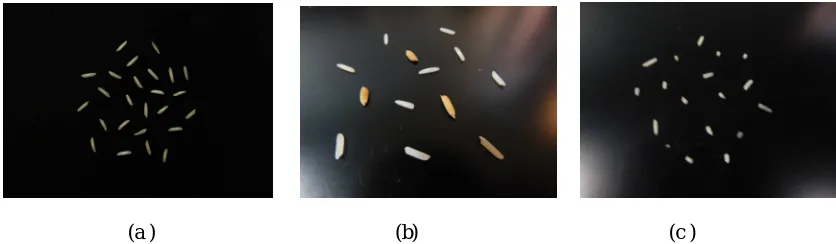
Fig2.1 . Different kinds of grains considered for classification
Fig 2.2Two quality of Rice Grains namely Basmati and Boiled Rice.
(a ) (b) (c )
Step 1:ImagePre-processing:
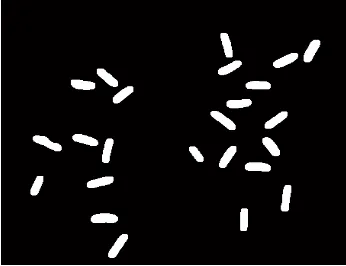
Captured image is then resized and enhanced. The images acquired with a color Digital Camera is resized to a resolution of 640 by 480 saved as JPEG image. Further to remove noise the image is converted to black and white image. The patches with size less than 70 pixels are assumed to be noise and are ignored. The other patches are the region of interest. Image processing modifies pictures to improve them (enhancement, restoration), extract information by analysis, recognition, and change their structure.
Fig 3. Black and White Image
Image enhancement improves the quality and clarity of images for human viewing. Removing blurring and noise, increasing contrast, and revealing details are examples of enhancement operations.
Step 3:Image Segmentation :
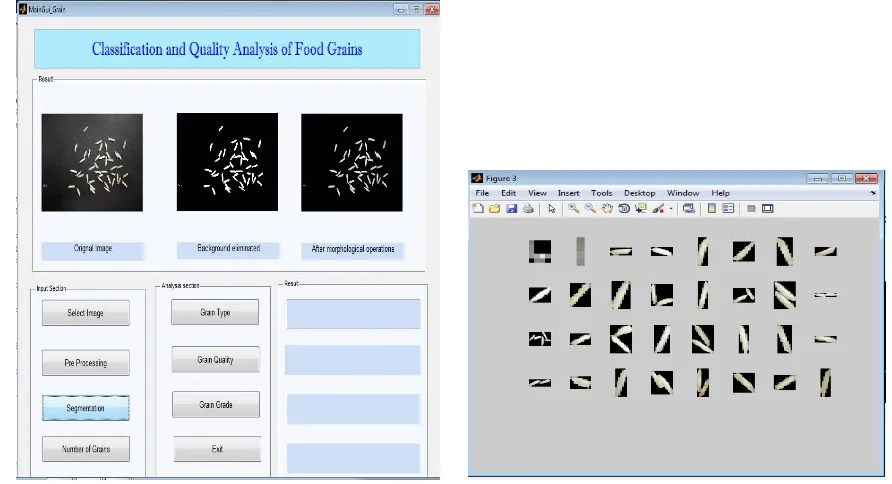
Segmentation is the process of partitioning a digital image into multiple segments (sets of pixels, also known as super pixels). The goal of segmentation is to simplify and/or change the representation of an image into something that is more meaningful and easier to analyze. Image segmentation is typically used to locate objects and boundaries.After image enhancement, the image has been segmented. Image segmentation i.e. subdividing an image into different parts or objects is the first step in image analysis. The image is usually subdivided until the objects of interest are isolated from their background.. Segmentation accuracy determines the eventual success or failure of computerized analysis procedures. Segmentation basically includes edge detection[1]. Thresholding is also one of the fundamental approaches of segmentation. Another approach is for region oriented segmentation as Watershed segmentation . Image segmentation is the process of assigning a label to every pixel in an image such that pixels with the same label share certain visual characteristics.
Step 4:Feature Extraction:
Algorithms were developed in Windows environment using MATLAB programming language to extract morphological features of individual rice seeds. The following morphological features were extracted from images of individual rice seeds.
Color Feature Extractions
From the red (R), green (G), and blue (B) color bands of an image, hue (H), saturation (S), and intensity (I) were calculated using the following equations[1]. Color features play a vital role in the classification process. We have extracted three color features from the captured image, i.e. the mean values of the RGB colors. The mean values of red, green and blue colors are extracted from the image.
Geometrical Features Extractions:
The following morphological features gives the basic information regarding the size and shape of the grains. The features were extracted from images of rice seeds:
Area: This refers to the amount of pixels in the region.The algorithm calculated the number of pixels inside, and including the seed boundary (mm2/pixel).
Major axis length: It was the distance between the end points of the longest line that could be drawn through the seed. The major axis endpoints were found by computing the pixel distance between every combination of border pixels in the seed boundary.
Minor axis length: It was the distance between the end points of the longest line that could be drawn through the seed while maintaining perpendicularity with the major axis.
Geometrical and color features are extracted from the images and are stored in the knowledgebase.
Step 5:Training and Testing Phase:
The two phases that are in use for classification algorithms are training and testing. In the training phase, properties of the image features are separated and, based on these, a exclusive explanation of each classification category. In the testing phase, image features are classified by using the feature space partitions.Testing is the final step of the grain recognition system. In case of testing phase an image from the testing set (different from the training set) is selected and its features are extracted as training images. Then those features are matched with the feature from the database created for training image. It will compute the shortest distance between the trained images stored in the database and the image that was chosen for testing. This process is repeated for all the testing images in order to know the accuracy of the system.The Probabilistic neural network is trained with different types of rice grains with more number of samples. A probabilistic neural network (PNN) is predominantly a classifier that maps any input pattern to a number of classifications.The input layer contains N nodes ,one for each of the N input for each class that is recognized by the PNN as follows features of a feature vector. The hidden layer contains a node for each training vector. The hidden nodes are collected into groups one group for each of the K classes. The output layer has a node
where X= unknown (input)
IV.RESULTS
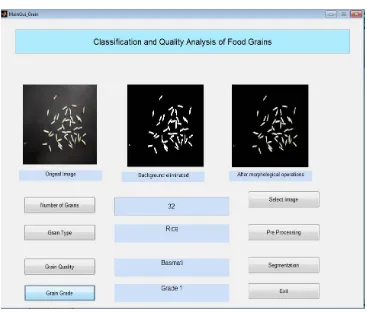
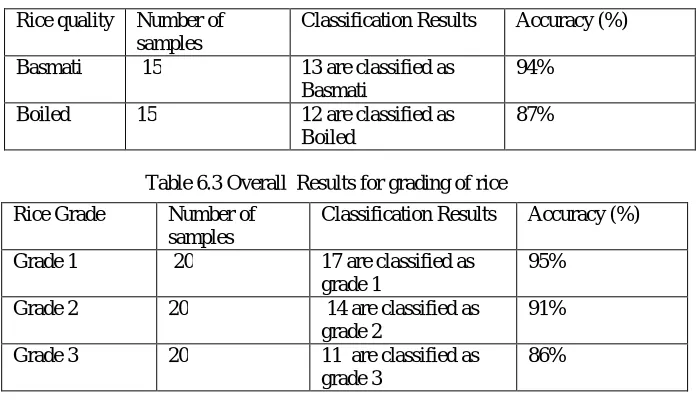
Once the classifier is trained for a set of images, we consider a test sample for testing. At the first stage the grain is classified with respect to its type such as corn, wheat ,rice by using color features. If the grain type is classified as rice, we go for quality analysis wherein the quality and grade of the rice is given.Grading of rice kernels is depend on size and presence of impurities. Grade1: premium, with no impurities and whole kernels Grade2: presence of impurities Grade3: Poor quality, large number of broken kernels.
Fig 5.1 Snapshot of Testing GUI
Fig 5.3 Final output
Performance Analysis :
The performance of Classification of food grains and the quality analysis of rice is evaluated using different images of grains. For evaluation we mainly consider 20 images of each grain type. We use 10 images of each type for training and 10 remaining images for testing.
Testing results of grain type identification :
Here 10 images of each of the type of grain are tested to evaluate the performance of the system. It is found that accuracy of identifying of grain type is 100%. PNN Classifier is used to classify testing samples, and the overall grain classification is shown in the table below.
Table 6.1 Test Result for Grain Type Classification
Grain Type No of Images tested
No of images predicted correctly
Accuracy
Rice 20 20 100%
Corn 20 20 100%
Table 6.2 Testing Results for Quality analysis and grading of rice
Table 6.3 Overall Results for grading of rice
V. CONCLUSION AND FUTURE WORK
This project is designed to provide a better approach for identification of different types of grains and rice quality based on color and geometrical features using Probabilistic neural network and image processing concepts. Different food grains like wheat, corn and rice are considered in the study. More than 120 images were used to test the system and it was found that accuracy of identifying grain is 100%.Where as the accuracy of identifying quality of grains and its grade is 92% and 91% accurate for each grain type. Even though the problem being worked upon is not completely new, the earlier approaches employed very large number of color, textural and morphological features which made the algorithm extremely slow because of the intensive computation.An efficient method is proposed for classification of food grains which require limited features and thus overcoming the disadvantages like tediousness and time consumption. These work can be further enhanced by focusing on different sampling methods, sample sizes, sample pre-processing techniques, different features and different neural network models to match the requirements of the rice industry.
REFERENCES
[1] Nandini Sidnal, Uttam V. Patil and Pankaja Patil “Grading and Quality Testing of Food Grains Using NeuralNetwork”, IJRET,Volume: 02 ,Nov -2013.
[2] L.A.I.Pabamalie,H.L.Premaratne,“A Grain Quality Classification System,” University of Colombo School of Computing, Sri Lanka, 2010 IEEE [3] Harish S Gujjar, Dr. M. Siddappa, "A Method for Identification of Basmati Rice grain of India and Its Quality Using Pattern Classification",
IJERA,Vol. 3,January -February 2013.
[4] S. F. Lilhare Research Scholar ,Dr N G Bawane ,"Classification Of Paddy varities Using Image Processing"National Conference on Innovative Paradigms in Engineering & Technology (NCIPET- 2012) .
[5] Sanjivani Shantaiya, Mrs.Uzma Ansari,"Identification Of Food Grains And Its Quality Using Pattern Classification",Special Issue of IJCCT ,Vol. 2 ,2010.
[6] Megha R. Siddagangappa1, Asso.Prof. A. H. Kulkarni," Classification and Quality Analysis of Food Grains "OSR-JCE Volume 16, Issue 4, Ver. III ,Jul – Aug. 2014
Rice quality Number of samples
Classification Results Accuracy (%)
Basmati 15 13 are classified as
Basmati
94%
Boiled 15 12 are classified as
Boiled
87%
Rice Grade Number of
samples
Classification Results Accuracy (%)
Grade 1 20 17 are classified as
grade 1
95%
Grade 2 20 14 are classified as
grade 2
91%
Grade 3 20 11 are classified as
grade 3