SUMMARY JUDGMENT IN CONSTRUCTION CONTRACT
ZULKFLI BIN SAPECIAY
A project report submitted in partial fulfillment of the
requirements for the award of the degree of
Master of Science (Construction Contract Management)
Faculty of Built Environment
Universiti Teknologi Malaysia
iii
DEDICATION
For
My parents,
Sapeciay Hussin and Salasiah Ahmad
With love and respect
For
My family,
Norhafizah Abd Razak & Amirah Hazirah Zulkfli
ACKNOWLEDGEMENTS
First of all, I would like to express my highest gratitude to my supervisor,
Encik Jamaludin Yaakob for his guidance, advice and support in order to complete
this master project.
Next, thanks also go to all the lecturers for the course of Master of Science
(Construction Contract Management), for their patient and kind advice during the
process of completing the master project.
Not forgetting my dearest parents, wife, daughter and all family members, a
token of appreciation goes to them for giving full support. Lastly, I would like to
thank my classmates for giving me morale support and supplying me with the
V
ABSTRACT
The construction contract has built-in potential for conflicts and disputes to arise
between the contracting parties. Disputes if not promptly resolved, will lead to losses
and it is necessary for the parties to use the best method of dispute resolution to resolve
their disputes. Litigation is one of the methods but the process takes substantial period to
come to determination. Therefore, most disputes in construction contract are resolved by
arbitration or mediation. In litigation process, there is a procedure that allows a litigatant
to obtain quick judgment without going to trial. It is known as summary judgment
procedure. However, it is available only in limited circumstances. Furthermore, it
appears that it is not frequently used in construction contract cases. Therefore, this
master project intends to identify the circumstances, limited as it may, that allow
summary judgment to be available to the parties in a building contract. This research
was carried out mainly through analysis o f cases reported in law journals, such as
Malayan Law Journal, Building Law Report, etc. The result showed there were four
circumstances where the summary judgment has been made available to the parties in a
building contract in Malaysian construction cases. All these four circumstances were
related to claims for progress payments that the employers (or the main contractors)
refused or failed to pay to the main contractor (or the subcontractor as the case may
be).In conclusion, it can be said that this summary judgment procedure is only suitable
ABSTRAK
Risiko dan potensi kepada konflik dan pertikaian di kalangan pihak berkontrak
sememangnya wujud sejak mula kontrak pembinaan itu dimetrai. Sekiranya pertikaian
ini tidak dapat diselesaikan secepat mungkin, ia akan mengakibatkan kerugian. Oleh itu,
pihak yg berkontrak perlu mencari kaedah terbaik untuk menyelesaikan pertikaian antara
mereka. Pendakwaan di mahkamah merupakan salah satu cara tetapi ianya mengambil
masa yang lama kepada penyelesaian. Oleh itu, kebanyakan pertikaian di dalam kontrak
binaan diselesaikan dalam kaedah timbangtara atau perantaraan. Di dalam proses
pendakwaan, terdapat kaedah yang membenarkan pendakwa boleh mencapai keputusan
penghakiman lebih cepat tanpa menunggu perbicaraan. Ia dipanggil penghakiman terus
(summary judgment) tetapi ianya hanya dibenarkan kepada keadaan yg terhad. Ia juga
jarang didapati didalam kes-kes perbicaraan kontrak pembinaan. Oleh itu, penyelidikan
ini bertujuan untuk mengenalpasti keadaan yang terhad ini di mana penghakiman terus
boleh dikeluarkan untuk pihak di dalam kontrak pembinaan. Projek ini dijalankan
melalui analisis kes-kes di dalam laporan undang-undang seperti Malayan Larw Journal,
Building Law Report, dan sebagainya. Hasil kajian mendapati bahawa terdapat empat
keadaan di mana penghakiman terus boleh dikeluarkan untuk pihak kepada sesuatu
kontrak pembinaan di dalam kes-kes pembinaan di Malaysia. Kesemua keadaan-
keadaaan ini berkaitan kepada tuntutan pembavaran kemajuan keija dimana pihak
majikan (atau kontraktor utama) enggan atau gagal membuat pembavaran kepada
kontraktor (atau sub-kontraktor). Kesimpulannya, kaedah penghakiman terus sesuai
TABLE OF CONTENTS
CHAPTER TITLE PAGE
1 INTRODUCTION 1
1.1 Background of Topic 1
1.2 Problem Statement 4
1.3 Objective of Research 6
1.4 Scope of Research 6
1.5 Importance of Research 6
1.6 Research Process and Methods of Approach 7
2 DISPUTE RESOLUTION IN CONSTRUCTION
CONTRACTS n
2.1 Introduction lj
2.2 Dispute Resolution in Construction Industry p
CHAPTER TITLE PAGE
2.4 Implication of Arbitration Clause 15
2.5 Situation that Permit the Party to Refer the Dispute
Direct to Court 20
2.6 Conclusion ~,A
3 SUM M ARY JUDG M ENT IN CONSTRUCTION
CONTRACT
3.1 Introduction 25
3.2 Summary Judgment 26
3.3 The Importance o f Summary Judgment 26
3.4 Scope of Summary Judgment 27
3.5 Application For Summary Judgment 33
3.6 Parties Who May Apply 38
3.7 Counterclaim and Set-Off 41
3.8 Possible Order 47
3.9 Summary Judgement and Arbitration Agreement 52
CHAPTER TITLE PAGE
4 CIRCUM STANCES TH A T ALLOW PARTIES IN
BUILDING CONTRACT TO OBTAIN SUM M ARY
JUDGM ENT 55
4 .1 Introduction 55
4.2 Circumstances that the Summary Judgment will be
Available to Parties in a Building Contract 56
4.3 Conclusion 78
5 CONCLUSION 79
5.1 Introduction 79
5.2 Summary of Research Findings 79
5.3 Problem Encountered During Research 80
5.4 Future Research 81
5.5 Conclusion 81
REFERENCES
X
LIST OF CASES
CASE PAGE
Alliance (Malaya) Engineering Co Sdn Bhd v San Development Sdn Bhd
[1974] 2 MLJ 94 39,45
Anglo-ltalian Bank v Well [1878] 38 LT 197 49
British and Commonwealth Holdings Pic v Quadrex Holdings Inc [1989]
3 All ER 492 28
Chai Cheon Kam v Hua Joo Development Co Sdn Bhd [1989] 2 MLJ 34
CGIR v Weng Lok Mining Co Ltd [1969] 2 MLJ 98 37
Crown Alliance Marketing (PTE) Ltd v ABV Builders Sdn Bhd [2001] 68
2 MLJ 16 75
Dawnays Ltd v FG Minter Ltd & Anors [1971] 2 All ER 1389; [1971]
Ellis Mechanical Services Ltd v Wates Construction Ltd Lord 53,60
Denning[1976] 2 Build LR 57
Fabrique Ebel Societe Anonyme v Syarikat Pemiagaan Tukang Jam City 49
Port & O rs [1988] 1 MLJ 188
Gilbert-Ash (Northern) Ltd v Modem Engineering (Bristol) Ltd [1974] 59
AC 689; [1973] 2 All ER 195; [1973] 3WLR 421
Gold Ores Reduction Co v Parr [1892] 2 QB 14 34
Hanak v Green [1958] 2 All ER 141 44
Jacobs v Booth’s Distillery Co [1901] 85 LT 262 (HL) 27
Jallcon (M) Sdn Bhd v Nikken Metal (M) Sdn Bhd (No.2) [2001 ] 40,64
5 MLJ 716
Jetera Sdn Bhd v Maj u Holdings Sdn Bhd [2001 ] 5 MLJ 716 66
John Sisk & Sons v Lavvter Products BV[1976] 1124 59
K&N Kenganga Sdn Bhd v Latchumi Dass s/o Sherwaram [1986] 37
2 CLJ 136
Krishnamurthy s/o Nagaratnam & Anor v The Malaysian Finance 36
Corporation Bhd [1986] 1 CLJ 541
KM Quarry Sdn Bhd v Ho Hup Construction Co Bhd [2006] 7 MLJ 203 69,72
Loh Chow Sang & Anors v Meru Valley Resort Bhd [2002] 2 MLJ 666 39
Mahkota Technologies Sdn Bhd v Panflex Sdn Bhd [2003] MLJ 110 72
Mahkota Technologies Sdn Bhd (formerly known as the General Electric
Co (M) Sdn Bhd) v BS Civil Engineering Sdn Bhd [2000] 6 MLJ 505 38,60
McLardy v Slateum [1984] 2 M U 300 37
National Company for Foreign Trade v Kayu Raya Sdn Bhd [1984]
2 MLJ 300 33,36
Official Administrator v China Insurance Co Ltd [1955] MLJ 138 32
Oriental Wealth (M) Sdn Bhd v Nakano (M) Sdn Bhd [2001 ] 3 MLJ 18
Pembenaan Leow Tuck Chui & Sons Sdn Bhd v Dr Leela's Medical
Centre Sdn Bhd [1974] 2 MLJ 94 40,56,61
Permodalan Plantations Sdn Bhd v Rachuta Sdn Bhd [1985] 1 MLJ 157 42,44
Ronald Quay Sdn Bhd v Maheswary Sdn Bhd [1987] 1 MLJ 322 43
Sarawak Government v KCS Sawmill Sdn Bhd [1990] 1 CLJ 1224 31
Shanghai Hall Ltd v Town House Ltd [1967] 1 MLJ 223 47
Societe de Etains de Bayas Tudjuh v WTio Heng Mining Kongsi [1978]
2 MLJ 267 56 51
Tan Kok Cheng & Sons Co Realty Sdn Bhd v Lim Ah Pat (T/A Juta Bena)
[1995] 3 MLJ 273 17
Tan Tik Sing v Gomez Development Co Sdn Bhd [ 1979] 2 MIJ 78 35
1
CHAPTER 1
INTRODUCTION
1. 1 Background of T opic
Conflicts and disputes have always arisen between contracting parties in
construction industry. The disputes between employers, main contractors and nominated
sub-contractors are resolved either by court proceedings, arbitration proceedings and
some alternative dispute resolution methods. Normally, disputes in construction contract
are referred to arbitration. However, some dispute disputes are tried in the courts by
litigation for determination1.
1 John Uff (1991). Construction Law. Law and Practice Relating to the Construction Industry.5th Edition.
2
There are some perceptions about arbitration, where in construction industry,
contrary to popular believed the arbitration in building contract matter is generally
slower, more expensive and less certain than litigation.2 Furthermore, in comparing
main features of dispute resolution process in construction dispute, Noushad Ali
Naseem (2006) stated that there are similar features between litigation and arbitration
process in term of basic resolution, duration and cost.3
Normally, litigation is the final stage in the dispute resolutions. It comes about
when other dispute resolution or alternative dispute resolution (ADR) have failed to
work or when the arbitration clause are not incorporated in the contract, or when the
nature of the conflict, characteristic of the dispute, or the relationship between the
parties does not allow for intermediate step. 4
When the parties refer the dispute to the court, it has always been the case that
building contract litigation tends to take a substantial period of time to come to trial. It is
not uncommon for a case to take a year or more before a pleadings are complete and
even waiting for trial date, in substantial case, the delay as much as three years. 5
In view of the time taken to resolve the dispute, in an appropriate case, the
plaintiff may apply to the court for judgment on his claim or the defendant for judgment
on his counter claim on the ground that there is no sufficient defence. In Malaysia Under
2 Robert Fenwick Elliott (1985). Building Contract Litigation. 2nd Edition. Longman Professional. 3 Noushad Ali Naseem Ameer Ali (2006). A Construction Industry Payment and Adjudication Act:
Reducing Payment-Default and Increasing Dispute Resolution Efficiency In Construction. Master Builders.
4 Feniosky Pena-Mora, Carlos E. Sosa, D. Sean.McCone (2003). Introduction to Dispute Resolution. " 1st Edition. Peason Education
3
order 14, Rules of The High Court 19 806, the plaintiff may apply for summary judgment
on the claim or some particular part of the claim, on the ground there is no defence to it.
If the defendant fails to satisfy the court that there is an issue, which ought to be tried,
the plaintiff will be entitled to immediate judgment on the claim or part of it, as the case
may be.
Frequently, the only dispute on an application for summary judgment under
Order 14 is whether the defendant can establish a credible counterclaim, which he is
entitled to set-off against the sum otherwise due. Order 14 entitles the court to give
summary judgment on a point of law that does not merit a full hearing7.
Summary Judgment is defined in the Dictionary of Law as: “Procedure where the court decides a claim or particular issue against claimant or defendant without
trial” 8. It means that a plaintiff may at an early stage of proceedings try to obtain
judgment on his claim or part of his claim without going to trial. It will save in term of
time and cost for trial and hearing process9.
In Malaysia, there are four standard forms of construction contract being use
such as PWD 203A, PAM 98, CIDB 2000 and IEM 1989 Forms. Each standard form
usually indicate the type of dispute resolution to be use in the event that any disputes or
differences arise between the employer, or the architect on his behalf, and the
contractor, either during the progress or after completion or abandonment of the Works.
6 Ravindran Nekoo (2004). Practical Guide to Civil Procedure in Malaysia. International Law Book Services.
7 John Uff (1991). Construction Law. Law and Practice Relating to the Construction Industry.5th Edition.
Sweet & Maxwell
8 L.B Curzon (2004). Dictionary o f Law. 2nd Edition. International Law Book Services.
4
PAM 98 and CIDB 2000 standard forms allow the employer and contractor to
choose either arbitration10 or mediation11 to resolve any disputes that arise between
them. However, in PWD 203A and IEM standard form stated only arbitration12 process
are covers any dispute or difference touching on the construction of the contract.
Legally, right to litigation is precluded if there is an arbitration clause in the
contract. As provided in section 6 Arbitration Act 2006, it may be use to challenge an
arbitrator’s award although only on very limited grounds.13 However, in limited
circumstances, the court may allow a party to an arbitration agreement to refer a dispute
direct to court. For example, the dispute matters beyond limitation of arbitrator
jurisdiction or there is no dispute among the parties.
Through this litigation procedure, the plaintiff or defendant may apply to the
court for judgement for his claim or counterclaim on the ground that there is no
sufficient defence.
1.2 Problem Statement
As discussed above, there are various forms of dispute resolution to resolve a
claim or dispute. Most disputes in construction contract are resolved by arbitration and
10 Clause 34, The PAM Standard Form of Building Contract 1998 & Clause 46 CIDB Standard Form o f Contract fo r Building Works (2000)
11 Clause 35, The PAM Standard Form of Building Contract 1998 & & Clause 47 CIDB Standard Form o f Contract fo r Building Works (2000)
12 Clause 54, Standard Form o f Contract (P. W.D. Form 203A (Rev.10/83) & Clause 55, I.E.M. Condition o f Contract For Mainly o f Civil Engineering Construction (1989)
5
mediation. There are few cases are resolved by litigation because it is believe that
arbitration and mediation methods are generally faster and less expensive than a court
action.14 As a result, litigation is used only as a last option in settling the disputes.
After done some literature review, it is found that under litigation, the parties can
settling the dispute especially in non-payment issue by the application for summary
judgment. However, most parties in Malaysian construction industry do not
acknowledge the function of this procedure and not even know it can use to resolve the
disputes.
In view that only a few construction cases related to application for summary
judgment, it shows that summary judgment only allowed in limited circumstances. The
question is what are those circumstances? Hence, it is important and necessary for us to
understand the circumstances, which are limited, and the procedures that will be
available to the parties to a building contract.
With the knowledge, parties in the building contract would have an idea on how
could succeed in the application for summary judgment and when they can apply and
how to apply for summary judgement. Thus, the above-mentioned question forms the
basis for this project paper, which intends to identify the closest answers of it.
14 Stuart H Bartholomew (2001). Construction Contracting, Business and Legal Principles. 2nd Edition.
6
1.3 Obj ective of Research
From the problem statement, the following is the objective of the study:
-1. To identify the circumstances those allow a party in a litigation to obtain
summary judgment in construction contract litigation cases.
1.4 Scope of Research
The following are the scopes for this study:
-1. The circumstances discussed are those arising there under, in connection
therewith and related to the building contract.
2. Only cases related to building contract will be discuss in the study.
1.5 Importance of Research
The importance of this study is to give an insight of the litigation-dispute
resolution process, i.e. summary judgment, available in construction contract especially
set-off and counter claim. After this study, the disputes parties will know when the
summary judgment will be available to them and the outline of the summary judgment
application under civil procedure in Malaysia can be referred. Both the successful and
unsuccessful applications for summary judgment will be discussed based on relevant
7
1.6 Research Process and Methods of Approach
Research process and method of approach will be used as guidelines so that the
research could be done in a systematic way to achieve the research objective. The
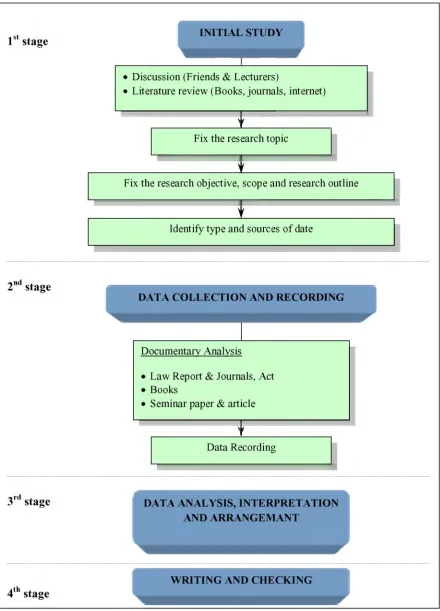
research process generally consists of 4 stages, i.e. 1st stage: initial study and fixing
research topic, objective, scope and outline, 2nd stage: data collection and recording, 3rd
stage: data analysis and interpretation and 4th stage: writing and checking.
1.6.1 1st Stage
The first stage of research involves initial study, which is discussion with
friends, and lecturers regarding the research topic and initial literature review to
get an idea of the research topic. The objective and scope of the research will be
determined after the initial study and the outline will be prepared in order to
identify the type and sources of data related to the research.
1.6.2 2nd Stage
The 2nd stage of research process is data collection which is consists of primary
data and secondary data. Data will be collected mainly through documentary
8
1.6.2.1 Primary Data
Primary data will be collected from Malayan Law Journal, Singapore Law
Report, Building Law Report, Construction Law Report and other law journals
through the LexisNexis law database and Current Law Journal online database.
The cases relating to the research topic will be collected and only important
cases will be used for the analysis at the final stage.
1.6.2.2 Secondary Data
Secondary data is data obtained from research done by third parties other than
the writer. Sources of secondary data consist of books, act, articles and seminar
papers. These sources are important to complete the literature review chapter.
(i) Books
Books are the main secondary data sources. Books relating to summary
judgement and building contract litigation will be referred for this research.
(ii) Seminar Papers and Articles
Seminar papers and articles will be used to support the theories stated in the
relevant books.
9
Act is an important source to support the literature review chapter and analysis
done. Act used is mainly the Rules of the High Court 1980 (RHC) and
Subordinate Court Rules 1980 (SCR).
1.6.3 3rd Stage
3rd stage of research involves data analysis, interpretation and data arrangement.
This process is to process and convert the data collected to information that is
useful for the research. Arrangement of data tends to streamline the process of
writing of the paper.
1.6.4 4th Stage
10
REFERENCE
Ravindran Nekoo (2002). Practical Guide to C ivil Procedure in Malaysia. Malaysia; International Law Book Services
Puan Sri Grace Chang (1986). Practical Guide to Civil Procedure in Malaysia and Singapore. Singapore: Malayan Law Journal Pte. Ltd
Naseer Hamid & S.S. Ravichandran (1993). Summary Judgment. Malaysia: Central Law Book Corporation
Neil F. Jones (1991). Set-Off in Construction Industry. 2nd Edition. London : Blackwell Science
Sundra Rajoo (2003). Law, Practice and Procedure o f Arbitration. Malaysia: LexisNexis
John UfT (1991). Construction Law: Law and Practice Relating to the Construction Industry. 5,h Edition. London: Sweet & Maxwell
Lim Chong Fong (2004). The Malaysian PWD Form o f Construction Contract (PWD 203AForm). ” Is'Edition. Malaysia: Sweet & Maxwell.
Murdoch, J. and Hughes, W. (2000). Construction Contracts: Law’ and Management. 3rd Edition. London: Spon Press
BIBLIOGRAPHY
Shamsiah Begum Syed Ismail, Order 14 and I t ’s Alternatives. [1992], 1 MLJ 1; [1992] 1 MLJA 50
Robert Fenwick Elliott (1985). Building Contract Litigation. 2nd Edition. London: Longman Professional
Vinayak Pradhan Advocate and Solicitor, High Court of Malaya Unpaid Interim Payment Certificate. [1997]. 2 MLJ xv;[1997] 2 MLJA 15
Stuart H Bartholomew (2001). Construction Contracting, Business and Legal Principles. 2nd Edition. New Jersey: Prentice Hall.
R Baden Hellard (1988). Managing Construction Conflict: London: British Library Cataloguing
Gopal Sreenevasan. Nahendran Navaratnam (2005). Malaysian Litigation Practice Guide. Malaysia: Sweet & Maxwell Asia
Salleh Buang (1992). “IJndang-undang Kontrak Di Malaysia.” Kuala Lumpur, Malaysia:
Central Law Book.
Smith, J. (1996). “Smith and Thomas a Casebook on Contract.” 10th Edition. London:
Sweet & Maxwell.
Robert F. Cushment (1986). Construction Litigation: Representing the Contractor. New York: John Wiley & Sons Inc. Wiley Law Publication