University of Windsor University of Windsor
Scholarship at UWindsor
Scholarship at UWindsor
Electronic Theses and Dissertations Theses, Dissertations, and Major Papers
2010
Delta bloom filter compression using stochastic learning-based
Delta bloom filter compression using stochastic learning-based
weak estimation
weak estimation
Priyanka Trivedi University of Windsor
Follow this and additional works at: https://scholar.uwindsor.ca/etd
Recommended Citation Recommended Citation
Trivedi, Priyanka, "Delta bloom filter compression using stochastic learning-based weak estimation" (2010). Electronic Theses and Dissertations. 7954.
https://scholar.uwindsor.ca/etd/7954
NOTE TO USERS
This reproduction is the best copy available.
Delta Bloom Filter Compression
Using Stochastic Learning-Based Weak
Estimation
By Priyanka Trivedi
A Thesis
Submitted to the Faculty of Graduate Studies
Through Computer Science
In Partial Fulfillment of the Requirements for
The Degree of Master of Science at the
University of Windsor
Windsor, Ontario, Canada
2010
1*1
Library and Archives CanadaPublished Heritage Branch
395 Wellington Street Ottawa ON K1A 0N4 Canada
Bibliotheque et Archives Canada
Direction du
Patrimoine de I'edition
395, rue Wellington Ottawa ON K1A 0N4 Canada
Your file Votre reference ISBN: 978-0-494-57595-6 Our file Notre reference ISBN: 978-0-494-57595-6
NOTICE: AVIS:
The author has granted a
non-exclusive license allowing Library and Archives Canada to reproduce, publish, archive, preserve, conserve, communicate to the public by
telecommunication or on the Internet, loan, distribute and sell theses
worldwide, for commercial or non-commercial purposes, in microform, paper, electronic and/or any other formats.
L'auteur a accorde une licence non exclusive permettant a la Bibliotheque et Archives Canada de reproduire, publier, archiver, sauvegarder, conserver, transmettre au public par telecommunication ou par I'lnternet, preter, distribuer et vendre des theses partout dans le monde, a des fins commerciales ou autres, sur support microforme, papier, electronique et/ou autres formats.
The author retains copyright ownership and moral rights in this thesis. Neither the thesis nor substantial extracts from it may be printed or otherwise reproduced without the author's permission.
L'auteur conserve la propriete du droit d'auteur et des droits moraux qui protege cette these. Ni la these ni des extraits substantiels de celle-ci ne doivent etre imprimes ou autrement
reproduits sans son autorisation.
In compliance with the Canadian Privacy Act some supporting forms may have been removed from this thesis.
Conformement a la loi canadienne sur la protection de la vie privee, quelques formulaires secondaires ont ete enleves de cette these.
While these forms may be included in the document page count, their removal does not represent any loss of content from the thesis.
Bien que ces formulaires aient inclus dans la pagination, il n'y aura aucun contenu manquant.
1+1
AUTHOR'S DECLARATION OF ORIGINALITY
I hereby certify that I am the sole author of this thesis and that no part of this thesis has been
published or submitted for publication.
I certify that, to the best of my knowledge, my thesis does not infringe upon anyone's copyright
nor violate any proprietary rights and that any ideas, techniques, quotations, or any other material
from the work of other people included in my thesis, published or otherwise, are fully
acknowledged in accordance with the standard referencing practices. Furthermore, to the extent
that I have included copyrighted material that surpasses the bounds of fair dealing within the
meaning of the Canada Copyright Act, I certify that I have obtained a written permission from the
copyright owner(s) to include such material(s) in my thesis and have included copies of such
copyright clearances to my appendix.
I declare that this is a true copy of my thesis, including any final revisions, as approved by my
thesis committee and the Graduate Studies office, and that this thesis has not been submitted for a
ABSTRACT
Substantial research has been done, and sill continues, for reducing the bandwidth requirement
and for reliable access to the data, stored and transmitted, in a space efficient manner. Bloom
filters and their variants have achieved wide spread acceptability in various fields due to tiieir
ability to satisfy these requirements.
As this need has increased, especially, for the applications which require heavy use of the
transmission bandwidth, distributed computing environment for the databases or the proxy
servers, and even the applications which are sensitive to the access to the information with
frequent modifications, this thesis proposes a solution in the form of compressed delta Bloom
filter.
This thesis proposes delta Bloom filter compression, using stochastic learning-based weak
estimation and prediction with partial matching to achieve the goal of lossless compression with
high compression gain for reducing the large data transferred frequently.
Keywords: Bloom filter, Compression, Stochastic learning-based weak estimation, Delta Bloom
DEDICATION
This thesis is dedicated to
ACKNOWLEDGEMENTS
This thesis is a result of the research conducted at the University of Windsor. In the
process, some people who contributed in varied ways to the research and the creation of
the thesis deserve special mention.
I would like to convey my sincere gratitude to my supervisors Dr. Xiaobu Yuan and Dr.
Luis Rueda, for their excellent supervision, advice and guidance through out this research
work. Without their help and guidance the work presented here would not have been
possible. Their confidence in my abilities has been unwavering, and has helped to make
this thesis a solid work. Above all and the most needed, they provided me unflinching
encouragement and support in various ways. I hope to keep up our collaboration in the
future.
I would like to thank my internal reader, Dr. Alioune Ngom and my external reader, Dr.
S. Ejaz Ahmed for their participation as my thesis committee members and for taking out
their precious time to review this thesis and to give their comments and suggestions for
the thesis work. I would also take the opportunity to thank Dr. Akshai Kumar Aggarwal
for being the Chair of Defense.
I gratefully acknowledge Dr. James Frank for his advice and contribution in bringing the
thesis to this level and Dr. Maria Blass for her support at the time when I needed it the
most. I would like to thank my family for their constant support in every possible way.
TABLE OF CONTENTS
AUTHOR'S DECLARATION OF ORIGINALITY iii
ABSTRACT iv
DEDICATION v
ACKNOWLEDGEMENTS vi
TABLE OF CONTENTS vii
LIST OF TABLES ix
LIST OF FIGURES x
1. INTRODUCTION 1
1.1 Motivation 3 1.2 Thesis Contribution 5
1.3 Thesis Summary 6
2. BLOOM FILTERS 8
2.1 Probabilistic Data Structure 8
2.2 Bloom Filters 8 2.2.1. False Positive Rate 10
2.3 Bloom Filter Applications 11 2.4.1. Networking 11
2.4.2. Web 18 2.4 Delta Bloom Filter 22
3. DATA COMPRESSION 23
3.1 Lossless Compression 24 3.2 Encoding Methods 25
3.2.1 Huffman Coding 26 3.2.2 Shannon and Fano Coding 26
3.3 Adaptive Methods 28 3.4 Higher-Order Models 28
3.4.1 Models 29
3.4.1.1 Probability Models 29 3.4.1.2 Markov Models 30 3.4.2 Prediction with Partial Matching (PPM) 31
3.4.3 Burrows Wheeler Transformation or Block Sorting (BWT) 31
3.4.4 Stochastic Learning-Based Weak Estimation (SLWE) 32
4. PROBLEM SPECIFICATION AND SOLUTION 34
4.1 Delta Bloom Filter 34
4.2 Adaptive Unigram Method 38
4.3 Partial Prediction Model (kth order) 38
4.4 Stochastic Learning-Based Weak Estimation Based Compression 40
4.4.1 Notes on the Implementation 43 4.5 Benefits of Delta Bloom Filter Compression 45
5. IMPLIMENTATION AND EXPERIMENTS 47
5.1 Implementation Consideration 47
5.2 Experimental Setup 48 5.3 Experiment Results and Observations 49
5.3.1 Results of the SLWE based Compression 50 5.3.1.1 Size of the Delta Bloom filter 50
5.3.1.2 Number of Hash Functions Used 54 5.3.1.3 % Change between Bloom filters 55
5.3.1.4 User based .parameter Lambda 57 5.3.2 Result Comparison between SLWE and PPM based Compression 58
5.3.2.1 Size of the Delta Bloom filter 59
5.3.2.2 Number of Hash Functions Used 60 5.3.2.3 % Change between Bloom filters 62
5.4 Analysis and Discussion 64
6. CONCLUSION AND FUTURE WORK 66
6.1 Conclusion 66 6.2 Future Work 67
LIST OF THE TABLES
Table 2-1: Summary of the Research on the use of
Bloom filters for Network Applications 17
Table 2-2: Summary of the Research on the use of
Bloom filters for Web Applications 21
Table 5-1: Effect of the size of Bloom filter
(4Mb < m< 10Mb) on the SLWE-based compression 51
Table 5-2: Effect of the size of Bloom filter
(5Mb < m< 40Mb) on the SLWE-based compression 52
Table 5-3: Effect of the Number of Hash Functions, k,
on the SLWE-based compression 54
Table 5-4: Effect of percentage of change between two Bloom filters, c,
and X on SLWE-based Delta Bloom filter Compression for m = 140Kb 56
Table 5-5: Effect of A, on SLWE-based Delta Bloom filter compression 57
Table 5-6: Effect of the size of Bloom filter, m, on Compression gain
with respect to different compression models 59
Table 5-7: Effect of the number of Hash Functions, k, used to
construct Bloom filter on different compression models 61
Table 5-8: Effect of percentage of change between two Bloom filters, c,
LIST OF THE FIGURES
Figure 2-1: Standard Bloom filter 9
Figure 2-2: Applications in Networking 12
Figure2-3: Web Applications 18
Figure 2-4: Delta Bloom filter 22
Figure 3-1: Compression and Decompression 25
Figure 3-2: A two- state Markov model 30
Figure 3-3: A basic Burrows - Wheeler Compression scheme 32
Figure 4-1: Summary Cache Representation 35
Figure 4-2: Delta Bloom Filter 36
Figure4-3: Bloom filter with4 hash functions 37
Figure 4-4: Delta Bloom filter compression using PPM 38
Figure 4-5: Delta Bloom filter compression using SLWE 41
Figure 5-1: Effect of the size of Bloom filter on the
SLWE-based compression 51 Figure 5-2: Effect of the size of Bloom filter on the
SLWE-based compression 53 Figure 5-3: Effect of the Number of Hash Functions on
the SLWE-based compression 55 Figure 5-4: Effect of percentage of change between two Bloom filters, c,
and X. on SLWE-based Delta Bloom filter compression for m = 140Kb 57 Figure 5-5: Effect of varying A. on SLWE-based Delta Bloom filter
compression for m=140Kb 58 Figure 5-6: Effect of the size of Bloom filter, m, on Compression
gain with respect to the different compression models 60 Figure 5-7: Effect of the number of Hash Functions used to construct
Bloom filter on the different compression models 62 Figure 5-8: Effect of percentage of change between two Bloom filters, c, on different
Chapter 1
INTRODUCTION
Computers and the technology related with computers have evolved over time. In
seventies, memory requirements were a major issue. The reason for it was that the
memory available at that time was small and expensive. Therefore, for commercial and
research purposes it was essential to utilize memory resources as efficiently as possible.
In recent years, the scenario has evolved, though the core issues remain the same. The
data to be dealt with has increased exponentially. Although, memory capacities have
increased since the last decades, with the present data requirements, there is a substantial
need to handle the data sets as concisely as possible. On the network side, also, there is a
limitation on the bandwidth and the communication times and costs, since the data
residing at any one node itself are significantly large. Here, also, there is a need for a
concise data representation. Membership query is the most common query type and
extensively used. It would reduce the relative costs sufficiently, even if there was just a
way to know in advance and succinctly about the membership of an element, i.e. whether
the element exist in the set or not.
Bloom filters have the capacity to fulfill all these requirements (broadly speaking, three
aspects of Information Economy), though, with a small limitation. Therefore, there was a
boom in the research work related to Bloom filters and their active participation in the
recent applications. In fact, its use has been picked up for the web applications which are
in demand in the industry.
Bloom filters are now widely used in peer-to-peer network systems [YS2006] and the
research on them is still active in this field. The applications are for string matching,
confidentiality maintenance, or the security [LPKS2005]. Bloom filters are also used for
wireless podcasting and the association rules in data mining [0LW2OO7]. Bloom filters
information. md5bloom [RCBG2006], a Bloom filter manipulation tool that can be
incorporated into forensics, has been introduced. Recently Microsoft produced a Bloom
filter forwarding architecture called BUFFALO which uses a small SRAM to store one
Bloom filter of the addresses associated with each outgoing link. BUFFALO significantly
reduces memory cost, increases the scalability of the data plane, and improves packet
-forwarding performance [MS2009]. A data popularity conscious Bloom filter has been
introduced recently [ZLSS2008]. It considers object popularity in sets and membership
queries and minimizes false-positive probability of BF by adapting the number of hash
functions used for each data object to its popularity in sets and membership queries. An
aging BF with two BF for the dynamic set is introduced to remove stale data in the BF to
make space for the new data. This scheme utilizes memory space more efficiently than
double buffering, the current state of the art [Yoon2010].
As technology is evolving further, now, there is a need for improving the efficiency and
representation of compressed Bloom filters. The applications involving heavy use of the
bandwidth, distributed computing environment for databases or proxy servers, and even
applications that are sensitive to the access to the data with frequent modifications, all
will benefit from the use of compressed Bloom filters. Depending on the benefits that
compressed Bloom filters offer, they will prove of vital use in application areas such as
databases, web caching, P2P applications and network applications.
Moving ahead of this, applications, for example in web proxies, that broadcasts its cache
content or the updates to the other proxies at frequent intervals, will benefit more from
the compressed delta Boom filter, which represents the updates to the Bloom filter in the
compressed form. In this way less data has to be transmitted.
In this thesis, delta Boom filter compression is proposed using Stochastic learning-based
weak estimation (SLWE) [OR2005] and using prediction with partial matching (PPM).
For delta Bloom filter compression, a lossless compression technique is needed to reduce
the amount of data without any loss of data. Using SLWE, probabilities of the source
statistics of the source but also considers the variability of the source statistics. PPM is a
higher-order source modeling technique that makes use of the past history of the data
being encoded to give more efficient compression.
The proposed methods will provide substantial compression gain to applications relying
on heavy use of the bandwidth and distributed computing environment relying on
frequent updates of the underlying data.
1.1. Motivation
Bloom filters have a widespread use in databases, web caching, P2P applications and
network applications both for data storage and as a message. There is a present need for
an efficient and compact transfer of Bloom filter updates. This thesis addresses this need
and proposes delta Bloom filter compression using SLWE and PPM based methods.
Why Bloom Filters?
A Bloom filter is a probabilistic data structure which is used to test whether an element is
a member of a set, i.e. membership testing. Given a set S = {*/, } on a
universe U, if there is a need to answer queries of the form: Is y e SI, a Bloom filter is a
good choice. Bloom filters provide an answer in a constant time depending on the time to
hash. It requires a small amount of space compared to the original data.
Why Delta Bloom filters?
A Bloom filter is not just a data structure; it can also be used as a message which needs to
be broadcasted. In applications, for example, which require web cache sharing, the
proxies periodically broadcast updates of their cache contents. It has been proved that
Bloom filter-based caches are more efficient than the exact dictionary or the server list
approaches [FCAB2000]. In this scenario, where broadcasting of the updates is required,
which is frequently updated, can gain from the use of the delta Boom filter. Furthermore,
this delta Boom filter can be compressed to increase the compression gain for these
applications and this is the main aim that we endeavor in this thesis.
Why Compression?
In a situation in which the Bloom filter is not just a data structure but also a message and
this message needs to be transmitted from one location to another, it will be beneficial to
compress it. Where there is a need for the access to this data which is frequently updated
and transmitted, compressed delta Boom filter can prove beneficial. Compression will
reduce the amount of the data being transmitted.
Why Lossless Compression?
Lossless compression is a process in which the data recovered after decompression is
exactly same as the original data. Bloom filters represent the set in the form of a bit
vector. Each element is hashed k times hi,...hk with the range {l,....m}, i.e. A,-: X —*
{l....m}, 1 < i < k . To store an element Xe S, the bits hj(X) are set to 1 for 1 < / < k . If any of these bits are incorrectly represented due to the loss of data during
compression, the element which is a member of the set might be incorrectly represented
as not a member. This defies the basic property of the Bloom filter which states that the
false negative rate is not a characteristic of a Bloom filter [Mitz2002]. Therefore, lossless
data compression is the only choice for Bloom filter Compression.
Why SLWE based Compression?
Stochastic Learning-based Weak Estimation (SLWE) is a fairly new technique introduced
in [OR2006]. To the best of our knowledge, it has not been used to compress Bloom
filters. Using this technique we can adaptively update the probabilities of the source
symbols while being encoded. This technique not only uses higher-order statistical
this technique, the data is encoded through single pass unlike the static coding algorithms
which require two passes, one pass to learn the probabilities and the second to encode the
data. As opposed to higher models, SLWE based compression has linear space
complexity. Also, in our experiments it was found out that SLWE achieves a better
compression gain than benchmark arithmetic coding and the higher-order Prediction with
partial matching compression method. Our proposed delta Boom filter compression
method using SLWE also works better in terms of scalability and adaptability in
comparison to the above mentioned methods. This thesis also proposes delta BF
compression using PPM model with arithmetic coding.
1.2. Thesis Contribution
This thesis proposes delta Boom filter compression. With respect to this goal, the thesis
contribution is twofold. Firstly, the use of higher-order model with arithmetic coding, in
terms of prediction with partial matching, for achieving delta Bloom filter compression.
Secondly, the use of SLWE an advanced estimation technique with arithmetic coding that
uses higher-order statistical model and, also, takes into account the variability of the
source statistics, for compressing the delta Bloom filter.
The compression gain achieved by the proposed methods is compared with the
benchmark arithmetic coding with adaptive unigram model with a conclusion that the
proposed methods are more efficient. Also, the results are compared between the
proposed delta Bloom filter compression using higher-order prediction with partial
matching and arithmetic coding, and found that the second proposed method for delta
Boom filter compression using SLWE is better in terms of compression gain.
The proposed methods are tested for the efficiency in terms of the compression gain,
scalability in terms of the dependence on the size of the Bloom filter and the adaptability
in terms of the number of the hash functions used, delta change in the Bloom filter
1.3. Thesis Summary
The thesis is organized as follows:
Chapter 2: Bloom filter: In this chapter, Bloom filter principles are explained with its
characteristics and limitations. We highlight why Bloom filters are widely accepted for
the applications. Few uses of Bloom filters for networking and web applications are also
discussed. This cements the fact that, although Bloom filters were introduced in 1970's
[Blooml970], they have an active participation in the computer field. In this chapter, the
principles of the delta Boom filters are also explained.
Chapter 3: Data Compression: This chapter discusses data compression in the past and
in the present scenarios and how it is the behind-the-scene enabler for the common
aspects of our life. This chapter presents different data compression techniques including
lossless compression. Then, the encoding methods and the higher-order models for
coding are discussed. This chapter explains Huffman and arithmetic coding techniques,
as well as higher-order models, including Prediction with partial matching,
Burrows-Wheeler transformation and most importantly, the Stochastic learning- based weak
estimation method which is the backbone of the thesis, are also presented here.
Chapter 4: Problem Specification and Solution: This chapter presents the delta Boom
filter in detail including the real world applications and importance of the proposed
compressed delta Boom filter and how it can play an active role in enhancing the
efficiency of the present model. First, the implementation of the proposed method for
delta Boom filter compression using a higher-order model in terms of prediction with
partial matching coupled with arithmetic coding is presented. Then, the implementation
details of the second proposed method for delta BF compression by using the Stochastic
Chapter 5: Implementation and Experiments: This chapter presents the issues faced
during the implementation and the experimental setup. Then the results of the proposed
delta Boom filter compression using the Stochastic learning-based weak estimation
method are presented. The proposed method is tested for efficiency in terms of
compression gain, scalability in terms of the dependence on the size of the Bloom filter
and adaptability in terms of the number of the hash functions used, delta change in the
Bloom filter content and its dependence on the parameter X.
Then the efficiency and dependence of the proposed methods are compared to the
benchmark and among each other on the factors mentioned above. With the encouraging
results of the comparison, it can be stated that the second proposed method that utilizes
SLWE is better than the benchmark arithmetic coding with adaptive unigram model and
the higher-order model that utilizes prediction with partial matching.
Chapter 6: Conclusion and Future Work: This chapter concludes the thesis by
Chapter 2
BLOOM FILTERS
This chapter presents Bloom filters. First, the concept of probabilistic data structure is
presented and then the Bloom filter, a type of probabilistic data structure is introduced
with its characteristics. Then, Bloom filter applications are discussed. At the end, the
principle of the delta Boom filter is presented.
2.1. Probabilistic Data Structure
A probabilistic data structure (PDS) is a data structure that supports algorithms which
inherently use a certain amount of randomness for their operations. Without a measure of
randomness, the data these data structures encode would use a prohibitive amount of
memory and/or the algorithms they support would be very slow. As a trade off for their
space, speed, and computational efficiency, many PDSs allow for a small margin of error
returns for instance Bloom filters.
2.2. Standard Bloom Filter
The Bloom filter was first introduced by Burton H. Bloom in 1970 [BLOOM 1970]. It is a
probabilistic data structure that is used basically to test whether an element is a member
of a set, i.e. membership testing. Here, false positives are possible, but false negatives are
not. Elements can be inserted into the set, but not removed/deleted. There are Bloom
filter variants that have achieved this (counting Bloom filter). The application areas
which require error free performance are not meant to use Bloom filters.
A Bloom filter represents an n-element set S = {Xj, X2, , X„} by using a bit vector
V= Vi, V 2,-— Vm of length m. All the bits are initially set to zero as in Figure 2-1 (a). The filter uses k independent hash functions hi,...hk with the range {l,..../w}, i.e. hi: X —>
As in Figure 2-1 (b), to store an element Q e S, the bits A,-(Q) are set to 1 for 1 < / < k. It
is to be noted that although a location can be set to one multiple times, it is only the first
change that has an effect. With respect to Figure 2-1 (c), if we want to check whether the
element Q is in the set S, we simply check if all ht{Q) are set to 1 or not. If any is set to 0, then Q is not a member of S.
0 0 0 0 0 0 0 0 0 0
Figure 2-1: Standard Bloom filter
(a): all the bits are initially set to zero.
(b): each element is hashed k times and corresponding bits are set to one.
(c): While membership testing, Qi and Q3 cannot be members of the groups as they
2.2.1. False Positive Rate / False Drop Rate
If all hi (Q) are set to 1, we should not infer from it that the element Q is definitely in S.
There is a reason behind this. It is also possible that by coincidence hi(Q),...Jtk (Q) are
all set to 1. In the above example in Figure 2-1(c), hiiQi), h2(Qi) and /JJ(£?2) all bits are
set to 1, yet there is a probability that Qz is not the element of the set. This is known as
the false-positive/drop. The probability of this happening is termed as the false-positive
rate. Here, it is to be noted that the Bloom filter does not have a false-negative but may
have false-positive. This means that if an element does not exist in the set, the answer
could be that it does exist. On the other hand, if the element does exist in the set, it is
never possible that it is reported not to exist. In Figure 2-l(c), Q\ and Qi cannot be in the
set as there is a 0 value corresponding to them.
When all the elements are hashed into the Bloom filter, the probability that a specific bit
is still 0 is:
(1-1/#»)*" *£*"""
Suppose that p = e "kn/m. Then, the probability of a false positive, on the assumption that
the hash functions are purely random, is:
f ^ - e ^ y = ( l - / t f , where P = e ^
The false-positive rate depends on the total length of the filter and the number of
elements that it contains. In other words, it means that the smaller the size of the Bloom
filter and larger the number of elements it contains, the greater the false positive rate is. It
is to be noted that if the probability, i.e. the false positive rate, is small enough, the false
positive is accepted for many applications. This depends on the advantages of using the
The overhead borne due to the addition of every hash function remains constant, whereas,
after a given threshold value the compounded benefit of adding this new hash function
starts decreasing. The probability of false positives can be reduced by the allocation of a
larger amount of memory [Mitz2002].
2.3. Bloom Filter Applications
Bloom filters have a wide spread use for the applications that require data for
membership testing or similarity detection. These applications can rely heavily on the
bandwidth. In this section, the Bloom filter use for network and web based applications is
presented. It is relevant to discuss these applications as these are the fields which can also
benefit in the future from the compressed delta Boom filters.
2.3.1. Using Bloom filters for Network Applications
Bloom filters upon their introduction, were not considered for their use in network
applications. As the data residing at any one node itself grew exponentially, it was
realized that there is a limitation on the bandwidth, communication time and cost. The
need for a concise data structure like the Bloom filter was felt and, consequently, they
were implemented into various areas within networking as listed in Figure 2-2. The
Applications In Networking
^
f Netww* N Authentication 1 /^^Attack Security1
x
—
7~^
Worm
^ • ^
Spam
Figure 2-2: Applications in Networking
2.3.1.1. Broadcast Authentication
As broadcast authentication is the most basic approach to defend against attackers in the
wireless environments, it is a critical security primitive for sensor networks. The central
server relies on it to issue legitimate commands or queries to all or partial motes in the
network. //TESLA is a light-weight and self-healing protocol for sensor motes. Chen et al
[CLL2008] have proposed an efficient and flexible broadcast authentication protocol
combing //TESLA and compressed Bloom filter techniques. This technique also supports
multiuser authentication.
To bundle W independent //TESLA instances, Curtain takes the last N keys as entries to
be hashed into the Bloom filter of m bits. The Bloom filter bitmap replaces the
last-generated key in standard //TESLA or the root key in tree-based //TESLA as the
commitment. Pre-loaded by the sender to each receiver, the bitmap provides the
computational security during the usage of W //TESLA instances. For the receiver to
activate the next instance, it just checks that the last-generated N keys are all successfully
hashed into the Bloom bitmap. Before the end of the W instances, the sender broadcasts
the compressed bitmap of the next W instance with an ECC signature to enter the next
The hash functions used are based on SHA1 and a variant of first-order difference
compression is used to compress the bitmap [CLL2008]
2.3.1.2. Network Routing
Longest Prefix Matching (LPM) techniques are important for networking due to their
fundamental role in the performance of the Internet routers. Internet routers are required
to search variable-length address prefixes for the Classless inter-domain routing (CIDR)
in order to find the longest matching prefix of the IP destination address and retrieve the
corresponding forwarding information for each packet traversing the router. This is often
the performance reducer for the high-performance internet routers.
A probable solution given by Dharmapurikar et al [DKT2003] is sorting the forwarding
table entries by prefix length, associating a Bloom filter with each unique prefix length,
and "programming" each Bloom filter with prefixes of its associated length. A search
begins by performing parallel membership queries to the Bloom filters by using the
appropriate segments of the input IP address. The result of this step is a vector of
matching prefix lengths, some of which may be false matches. Hash tables corresponding
to each prefix length are probed in order of longest to shortest match in the vector,
terminating when a match is found or all of the lengths represented in the vector are
searched. The best part is that the approach is feasible for the newer version Internet
Protocol Version 6 (IPv6) which uses four times larger destination address of 128 bits.
2.3.1.3. Wireless Networks
A wireless object network is a network that connects objects to each other wirelessly.
Due to hardware advances it will be possible to embed small devices into everyday
objects such as toasters and coffee mugs, and hence forming a network. Wang et al.
presented a search engine for such a network called Snoogle. Snoogle uses information
reduce communication overhead. Snoogle also considers security and privacy protections
for sensitive data [WTL2008].
2.3.1.4. Authentication
There are two major components for entity authentication for pervasive computing
environments: the Master key and the multiple access tokens. Master keys are
convenient, whereas multiple access tokens improve usability and do not have the
revocation problems. The question is how to combine both the advantages of traditional
master keys and multiple access tokens while avoiding their disadvantages. Zhu et al.
[FML2006] present the Master Key method, which is an approach for digital access
tokens to have the advantages of master keys and multiple access tokens.
The Master Key is invoked when the owner pushes a lock (target resource) or unlock
button. At that time, the Master Key discovers the right key (digital access token) for a
lock and authenticates with the lock. Now, the master key has to deal with privacy,
security and scalability- efficiency problems. The Bloom filter approach is useful here.
The Master key can utilize Bloom filter's time and space advantages as well as false
positive cases. The Bloom filter approach also helps in maintaining the security as
cryptographic hash functions, such as MD5 and SHA, are used.
Code words in the master key approach have two formats: the hash format and the Bloom
filter format. The hash format is used when the key and lock has a one-to-one relation, for
example, after the Master Key has discovered the target lock. The Bloom filter format is
used when keys and locks have one-to-many relationships. For instance, the Master Key
queries a set of potential locks, or a lock needs to identify a particular key owner from
many key owners.
However, here, the Master Key does not support multiple groups of key owners. There
are Bloom filter variants which support multisets. These could be investigated for the
2.3.1.3. Network Security
2.3.1.3.1. Worm Attack
It is a fact now that the manual defense techniques are not useful against the worm
epidemic. Due to the high infection speed of worms, worm identification and
containment methods are deployed into the network (instead of end-hosts) for fast and
coordinated response with a high coverage. Signature-based filtering has a higher chance
of containing epidemics and precision compared to blacklisting methods.
The fundamental operation of signature-based filtering is deep packet inspection (DPI),
the string matching of packet payloads against characteristic worm content, known as
signatures [AC2005]. Artan et al presented a space-efficient method to follow and detect
signatures that are fragmented over multiple packets, to solve the multi-packet signature
detection problem. To solve this problem, they introduced a new data structure, called
prefix Bloom filters (PBFs) and Chain heuristic (CH).
PBFs help recognize prefixes of signatures so that signatures over multiple packets can
be detected. These are Bloom filters programmed with the prefixes of the signatures. P, is
taken as the set of /-length prefixes of all signatures with lengths longer than i and 5, is
the set of signatures with lengths i. Then, PBFi is a Bloom filter that is programmed with
the elements of the set Pt and SBFt is a Bloom filter programmed with the elements of
set,.
The major advantage of the Prefix Bloom filter is that, even if a string contains only a
prefix of the signature, this prefix can be detected due to the use of the PBF. Also, to
make sure that the prefixes are detected just like the signatures, the Bloom filter is used to
store these signature prefixes. However, this increases the load on memory requirements.
Therefore, another concept called Chain heuristic is introduced to reduce this increased
prefix Bloom filters as well as the SBFs, without the requirement of any additional
memory.
2.3.1.3.2. Spam Filters
Spamming is the abuse of electronic messaging systems to indiscriminately send
unsolicited bulk messages. The filters are used as a safeguard against the spam by
classifying email as spam or ham (non-spam) by a statistical analysis of the message's
header and content (body). Statistical-based Bayesian filters are widely used in the tools
for blocking spam.
However, they have a problem of being bounded by the memory access rate. Kang. et al.
[KZ2006] have used Bloom filters for speeding up spam filters while keeping high
classification accuracy. First, the method used approximates of the dictionary lookup
with hash-based Bloom filter lookup, which trades off memory accesses with increase in
computations. Second, the method uses lossy encoding.
The approach takes Bloom filters one step ahead and uses a Bloom filter to serve for
value queries while preserving the Bloom filter's desired operating characteristics. For a
given token in the member set, the extension returns a value that corresponds to a given
Table 2-1: Summary of the Research on the use of Bloom filters for Network Applications.
Authors)
Wang, H., Tan,
C.C., Li,Q
Chen, Y., Lin, I., Lei,
C , and Liao, Y.
Dharmapurikar, S.,
Krishnamurthy, P., and
Taylor, D. E.
Feng, Z., Matt W. M.,
and Lionel M. N.
Artan, N. S., and Chao,
H.J.
Kang, L., and Zhenyu
Z.
Conference/Journal and Year
IEEE INFOCOM 2008
Lecture Notes in Computer
Science, 2008
ACM Conference on
Applications, Technologies,
Architectures and Protocols
For Computer
Communications, 2003.
IEEE International Conference
on Pervasive Computing and
Communications, 2006.
IEEE, Global
Telecommunications
Conference, 2005.
ACM Joint international
conference on Measurement
and modeling of computer
systems, 2006.
Tide of the Paper
Snoogle: A Search Engine for the Physical World
Broadcast
Authentication in
Sensor Networks Using
Compressed Bloom
filters
Longest prefix
matching using bloom
filters
The Master Key: A
Private Authentication
Approach for Pervasive
Computing
Environments
Multi-packet signature
detection using prefix
bloom filters
Fast statistical spam
filter by approximate
classifications
Main Contribution
The authors propose a search engine, Snoogle, for wireless object networks. It uses a BF to reduce communication overhead.
The authors propose an
efficient and flexible broadcast
authentication protocol
combing/<TESLA and
compressed Bloom filter
techniques. It also supports
multiuser authentication.
The authors introduce the use
of bloom filters for the longest
prefix matching for Internet
Protocol (IP) routing lookups.
The authors introduce a new
entity authentication approach,
combining both the advantages
of the traditional master keys
and multiple access tokens
(using BF), for pervasive
computing environments.
The authors introduce Prefix
BF to detect the signatures, of
the worms and malicious items,
that are fragmented over the
network packets and thus to
prevent the epidemic.
The authors introduce use of
Bloom filters to deal with the
problem of memory access of
Bayesian filters (spam filter),
by approximating
2.3.2. Using Bloom filters for Web Applications
Bloom filters can be used at the different levels of the web search/ refinement. Since this
is a relatively new application area, further research is required to get the maximum
benefit from the use of Bloom filters. This research area can be further divided depending
on the context of the use of Bloom filters: membership testing or the less explored area
similarity detection. Bloom filters cannot be used for exact matching due to their false
positive property. However, Bloom filters can be efficiently used for similarity detection.
Web Application!
s
<^~~ Membership Query ^ ~ ^ >
• ^
Prospective Search\
Unk-Based Ranking
N^
(^[^JSImitarlty Detection""^)
• Si
Template Removal DupHcata DocumentRemoval
Figure 2-3: Web Applications
2.3.2.1._Membership Test Based
First is the prospective search. Most of the searches are retro in nature. There is another
search - the prospective search by Irmak et al [IMSGI2006]. This can be used for news
alerts, job hunting, etc. This is a keyword oriented search. The Bloom filter is used along
with a hash table. During the matching phase, when the hash entries are created, the
corresponding bits in the Bloom filter are also set. The overhead for this is quite low.
During the testing phase, first a lookup is done into the Bloom filter to see if there might
be a hash entry for the current QID (integer query ID). If the answer is negative, the
table. Here, not much can be done with the Bloom filter variants. A standard Bloom filter
is sufficient.
One of the basic problems in Information Retrieval on web applications is the ranking
problem: how to arrange the documents that satisfy a query into an order such that the
documents most relevant to the query rank first. A solution is provided by Link-based
ranking algorithms which, again, can be grouped into two classes: query-independent
(in-link count or Google's famous PageRank) and query-dependent (HITS and SALSA).
What can be done further is to lower the query-time cost of HITS-like ranking
algorithms, i.e. algorithms that perform computations on the distance-one neighborhood
graph of the results to a query [GNPmc]. The basic idea is to compute a summary of the
neighborhood of each page on the web (an operation that is query-independent and thus
can be done off-line, may be at index construction time), and to use these summaries at
the time of the query for the approximation of the neighborhood graph of the resulting set
and hence, to compute scores using this approximate graph.
Here, Bloom filters are used to store the ancestors, descendents in the neighborhood
graph to facilitate the membership testing of the elements. Since, here, consistent
sampling is done instead of the random one the properties relevant to the ranking
algorithms are preserved in spite of using approximation of the neighborhood graph.
2.3.2.2. Similarity Detection Based
In web search, content relevance and link analysis comes next. Earlier, not much
attention was paid towards this area. But then researchers got interested in web search
refinement as it became the need of the time and of the industry.
Web search engines have now become a necessity as they offer a lot of convenience to
the users. Therefore, their performance is always under the scrutiny and day after day
better performance is expected. A necessary but also a hindrance in their efficiency is a
performance. There are other template removal methods but their main bottleneck is
speed and scalability. Therefore, Chen et al [CYL2006] have used Bloom filters to
overcome this problem. In the first phase, web segmentation is done. Then the blocks are
clustered based on their layout style information. During the second phase, the word
offset distribution in the block is used to measure the similarity between the contents.
Here, Bloom filters are used. The evaluation is fast here as matching is only a bit wise
AND operation.
Next is the improving of the search experience by removing or grouping all near
duplicate documents in the results presented to the user by Jain N. et al [JDT2005].
There are three stages required here:
1: In the first stage content defined chunking is done to extract the document features.
2: In the second stage, these features are used as the set elements for the Bloom filter.
3: Finally, these Bloom filters are compared to detect the near-similar documents
(a threshold value is already defined).
Compared to other approaches like shingling, the Bloom filter approach is faster as only
bitwise ANDing is required. The second advantage is the compact size of the Bloom
filter. Due to this compact size, it can be easily attached to the document tag. Although, it
would have been more beneficial if a compressed Bloom filter was used; lesser data
Table 2-2: Summary of the Research on the use of Bloom filters for Web Applications
Authors)
Irmak, U.,
Mihaylov, S.,
Suel, T., Ganguly,
S., and Izmailov,
R.
Gollapudi, S.,
Najork, M., and
Panigrahy, R.
Chen, L., Ye, S.,
and Li, X.
Jain, N., Dahlin,
M. and Tewari, R.
Conference/Journal and Year
International conference
on World Wide Web,
ACM, 2006.
research.microsoft.com, 2007.
ACM symposium on
Applied computing, 2006.
International Workshop
on the Web and
Databases, 2005.
Title of the Paper Efficient Query Subscription Processing for Prospective Search Engines Using Bloom
Filters to Speed
Up HITS-like
Ranking
Algorithms
Template
detection for large
scale search
engines
Using Bloom
Filters to Refine
Web Search
Results
Main Contribution
The authors introduce the
Prospective search engine utilizing
the bloom filters for effective
membership testing.
The authors attempts the major
problem of information retrieval
and introduces a new technique,
utilizing bloom filter, for reducing
the query-time cost of query
dependent link-based ranking
algorithms
The authors introduce a two-stage
template detection method
approach which combines the
template detection and removal to
the index building process of a
search engine. The paper
introduces a bloom filter based
technique for finding similar
sequences
The authors introduce the solution
to the web search efficiency
problem by refining the web
search results by using bloom
2.4. Delta Bloom filter
In a scenario where an update to the Bloom filter has to be sent, these updates can either
be new Bloom filters or representations of the changes between the updated filter and the
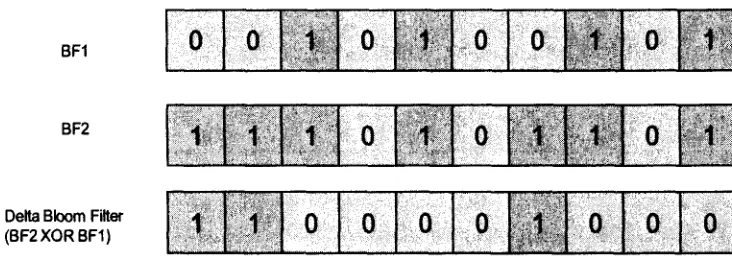
original filter. Suppose there are two Bloom filters, BF1 and BF2. If an update has to be
sent, another Bloom filter can be generated, which represents the update, by performing
Exclusive-OR between the two Bloom filters as represented in Figure 2-4. The newly
generated Bloom filter representing the update or delta is known as the delta Boom filter.
Delta Bloom filters are discussed in detail in the Section 4.1.
BF1
BF2
Delta Bloom Filter (BF2XORBF1)
0
0
, r
0
1
0
0
0
1
t
i
'V'
0
1
0
If .
?'&
0
1
1
1
0
0
0
0
# ;
0
0
0
Figure 2-4: Delta Boom filter
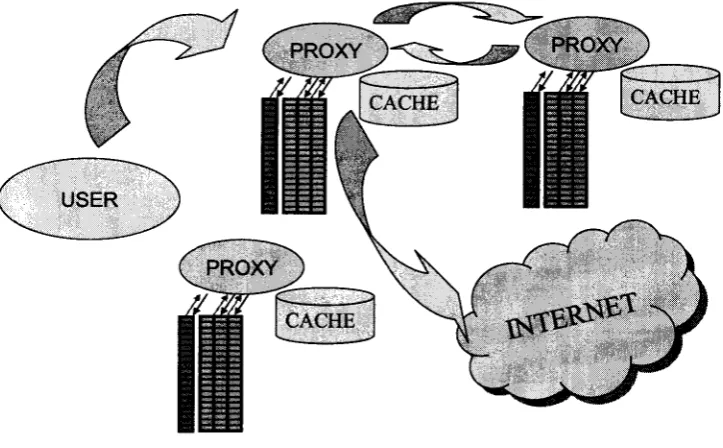
One of the practical applications for the delta Bloom filter is sharing of caches between
web proxies. Sharing of caches between web proxies is an important technique for
reducing web traffic and relieving network bottlenecks. Each proxy maintains a Bloom
filter representing its local cache. It also holds the Bloom filters representing caches of
the other proxies. The proxies periodically broadcast updates to their cache contents
Chapter 3
DATA COMPRESSION
In the last two decades, there has been a vast improvement in the way communication
takes place. Ever growing Internet, mobile and video communications have become an
integral part of our lives. All these require large amounts of data to be processed, stored
and transmitted. Another aspect that is common to all these, as a major enabler, is data
compression. It would not be an exaggeration to say that if data compression was not
there, then we would not be enjoying today's facilities for communication and
entertainment. It would not even be practical to load images on the websites. Little do we
realize that even for a long distance phone call, it is the data compression in the
back-ground present as one of the enabler s.
There is an example of data compression from mid-19th century in the form of Morse
code introduced by Samuel Morse. Morse had observed that a telegram, represented with
dots and dashes, has some letters having more frequency than others. Based on this
observation he assigned shorter codes to the letters occurring more frequently (for
example,'.' for e). This reduced the average time to send the message.
Data compression can range from simple removal of extra space characters to the most
complex and sophisticated currently available statistical models. For example, a simple
removal of all extra space characters, insertion of a single repeat character to indicate a
string of repeated characters, and the substitution of the smaller bit strings for the
frequently occurring characters, can reduce the original size of a text file up to 50 %
[SK2000].
Data compression can be defined as the process of encoding using fewer bits than
un-encoded data through the use of encoding or compression techniques. In general terms,
data compression is a science of representing data in a compact form. The selection of the
compression tools for a particular application depends on the characteristics of the data
and regularities in the data; relative importance of CPU usage, memory usage, channel
demands and storage requirements, along with other factors [Mertlbm].
This chapter presents different categories of the data compression techniques as well as
various encoding methods and models.
3.1. Lossless Data Compression
Data compression techniques can be classified as of two types: Lossy and Lossless.
Lossy compression involves techniques in which compressing the data and then
decompressing it, retrieves data that is not exactly the same as the original, but is close
enough to be useful for the application. For an example, if there is a need to compress an
image representing scenery, some loss of data would not matter much. Here, limitations
of human perception can be taken advantage of.
Lossless compression is a technique that reduces the size of a file without losing any
data at all. That means that when a file is compressed, it will take up less space, but when
decompressed, it will still have the exact same data. For instance, images representing
medical data cannot afford to lose data between generation, storage, transmission and
reconstruction.
For lossless data compression, X, in Figure 3-1, is exactly same as Y whereas for lossy
compression schemes, X is slightly different from Y but in the allowable range. Cx
txJpUuTS
Ffrggvfvnjkn Nbnlkmdcadf Cdsfmlklemn Hbhefrekm,.
X Y
Figure 3-1: Compression and Decompression
3.2. Encoding Methods
By taking advantage of redundancy or patterns in the data, it is possible to abbreviate the
data so as to take up less space yet maintain the ability to reconstruct a full version of the
original data when required. In the encoding process, a code word, where a code alphabet
A = {ai, ..., a„}, is associated to represent each source alphabet word, where a source
alphabet S={si sm}, so as to minimize the size of the encoded data.
For lossless compression, we need uniquely decodable codes, that is, any given sequence
code words can be decoded in one and only one way. A code is uniquely decodable if its
extension is non-singular (it is a prefix code). For example, the mapping
C= {a, ->0, <*;>-• I0,ar->110,a,->111}
is uniquely decodable. This can be demonstrated by looking at the follow-set after each
target bit string in the map, because each bit string is terminated as soon as we see a 0 bit
which cannot follow any existing code to create a longer valid code in the map, but
unambiguously starts a new code.
3.2.1. Huffman Coding
In Huffman coding, the assignment of code words to source messages is based on the
probabilities with which the source messages appear in the message sequence. Messages
which appear more frequently are represented by short code words while messages with
smaller probability map to longer code words. These probabilities are determined before
the transmission begins or can be estimated while encoding in a process called adaptive
coding. A code is said to be adaptive if the mapping from the set of messages to the set of
code words changes with time. Static Huffman coding requires the knowledge of the
probabilities of the source sequence while Adaptive Huffman coding requires
computation of an approximation to the probabilities of occurrence at an instant, as the
sequence is being transmitted. The assignment of code words to messages is based on the
values of the relative frequencies of occurrence at each point in time. A message Xcan be
represented by a short code word early in the transmission because it occurs frequently at
the beginning of the sequence, even though its probability of occurrence over the total
collection is low. Later, when the more probable messages begin to occur with higher
frequency, the short code word will be mapped to one of the higher probability messages
and X will be mapped to a longer codeword.
3.2.2. Shannon - Fano Coding
In 1960's Claude E. Shannon (MIT) and Robert M. Fano (Bell Laboratories, also taught
at MIT) introduced a coding procedure to generate a binary code tree. The procedure
evaluates the symbol's probability and assigns code words with a corresponding code
length. Compared to other methods Shannon-Fano coding is easy to implement. In
practical operation Shannon-Fano coding is not of larger importance. This is due to the
lower code efficiency in comparison to Huffman coding explained above. To create a
code tree according to Shannon's and Fano's algorithm, an ordered table is required
providing the frequency of any symbol. Each part of this table is divided into two
segments and ' 0 ' is added to the code words in one part while ' 7 ' is added to the other
nearly the same sum of frequencies. This procedure is repeated until only a single symbol
is left.
3.2.3. Arithmetic Coding
Arithmetic coding, a special type of entropy coding, is a popular method for generating
variable-length codes but follows a different approach for data compression in
comparison to the static methods. It is more useful while dealing with sources with small
alphabets, for example, binary sources and alphabets with highly skewed probabilities.
Arithmetic coding is capable of achieving compression results which are arbitrarily close
to the entropy of the source [LH1987]. Deviations which are caused by the bit-resolution
of binary code trees do not occur by using this coding. In contrast to a binary Huffman
code tree the arithmetic coding offers a clearly better compression rate. On the other
hand, its implementation is much more complex. The most well-known paper on practical
arithmetic coding algorithm is by Rissanen and Langdon [RL1979]. Arithmetic coding is
also a part of the JPEG 2000 image format [JPEG2009].
The major drawback of arithmetic coding is its low speed because of the several required
multiplications and divisions for each symbol. It is a general technique for coding the
outcome of a stochastic process based on an adaptive model. The main idea behind
arithmetic coding is to assign to each symbol an interval. Starting with the interval [0..1),
each interval is divided into several subintervals, where sizes are proportional to the
current probability of the corresponding symbols of the alphabet. The subinterval from
the coded symbol is then taken as the interval for the next symbol. The output is the
interval of the last symbol. Implementations write bits of this interval sequence as soon as
3.3. Adaptive Methods
All of the adaptive methods are one-pass methods; only one scanning of a sequence is
required. Static coding requires two passes: one pass to compute probabilities and
determine the mapping, and a second pass for transmission. Thus, as long as the encoding
and decoding times of an adaptive method are not substantially greater than those of a
static method, the fact that an initial scan is not needed implies a speed improvement in
the adaptive case. In addition, the mapping determined in the first pass of a static coding
scheme must be transmitted by the encoder to the decoder. The mapping may preface
each transmission (that is, each file sent), or a single mapping may be agreed upon and
used for multiple transmissions. In one-pass methods, the encoder defines and redefines
the mapping dynamically, during transmission. The decoder must define and redefine the
mapping in sympathy, in essence, learning the mapping as code words are received.
3.4. Higher-Order Models
Data Compression techniques can also be broadly divided into two categories, the ones
which use statistical techniques and the others which depend on the use of a dictionary.
Dictionary-based compression techniques generally create a dictionary (a pattern of the
characters) in memory as data is scanned looking for repeated data (some
implementations use a static dictionary so it does have to be built dynamically). Based on
a pattern recognition process (a look-up in the dictionary), that string of data is replaced
by a much shorter but uniquely identifiable string. This results in a compression of that
overall data.
Archiving applications tend to use more of the dictionary-based compression techniques
while statistical compression techniques are used more often for real-time applications.
The reason for this selection is based on the speed of the compression and
decompression. Dictionary-based compression techniques have slow compression but
similarly fast compression and decompression speed. Adaptive dictionary methods can be
traced to the research papers by Ziv and Lempel [ZL1977] [ZL1978]. A combination of
statistical and dictionary based technique is also possible.
Statistical encoding techniques determine the output on the basis of the probability of
the occurrence of the input data sequence. They operate by encoding the symbols one at a
time. The symbols are encoded into variable length output codes. The length of the output
code varies based on the probabilities or frequencies of the symbols. Lower-probability
symbols are encoded using more bits while high probability symbols are encoded using
fewer bits. As such algorithms are more symmetric in nature, the compression and
decompression generally requires the same amount of time. Huffman and arithmetic
coding are probably the most common and widely-used statistical compression
techniques [MBB2003].
3.4.1. Models
A good model for the data is useful in estimating the entropy of the source and leads to an
efficient compression algorithm. A mathematical model for modeling data is usually
needed to develop techniques involving manipulation of data using mathematical
operations. There are many approaches for creating mathematical model for compression
[Syd2000].
3.4.1.1. Probabilistic Models
The simplest statistical model for the source is with an assumption that each one of the
letters generated by the source is independent of each other letter, and each of them has a
particular probability of occurrence. Furthermore, the independence assumption of the
letters can be used with the assignment of the probability of occurrence to each letter.
The probability model for the source generating the letters from the alphabet
3.4.1.2. Markov Models
When the probability model requirement of the assumption about the independence of the
letters cannot be met, there is a need to describe the dependence of the elements of the
data sequence on each other. This can be achieved by a model introduced by a Russian
mathematician, Andrei A. Markov and hence known as Markov Model.
q
Figure 3-2: A two- state Markov model
Knowledge of the past k symbols is equivalent to the knowledge of the entire past history
of the process. This indicates the dependence between the symbols not the form of the
dependence. The use of the Markov model does not require the linearity assumption. A
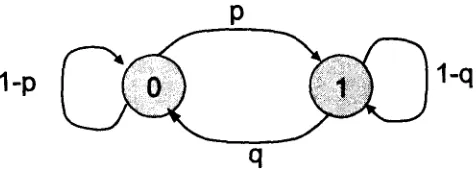
Markov model can be represented by a two-state diagram, for example in case of binary
images, as in Figure 3-2. This Figure consists of nodes 0 and 1, representing possible
states of the system, connected by arrows, representing the rate at which the system
operation transitions from one state to the other state. A state-to-state transition is
characterized by a probability distribution. The probabilities of the transition arrows
emanating from any state must sum to 1. Here, transition probability from state 1 to 0 is
3.4.2. Prediction with Partial Matching (PPM)
Some of the most effective results in data compression have been achieved by statistical
source modeling in combination with arithmetic coding. Specifically, prediction with
partial matching (PPM) has generated notable results. The PPM algorithm was proposed
by Cleary and Witten [CW1984]. Substantial improvements and analyses have been
presented since its introduction [Mitz2002]. The techniques which make use of the past
history of the data being encoded to give more efficient compression are known as
predictive coding schemes. There has been resurgence in the use of predictive coding in
its many forms. The latest JPEG standard for lossless image compression uses a
predictive coding algorithm [JPEG2009].
The PPM algorithm initially tries to use the largest context whose size is predetermined.
In case symbol to be encoded has not been encountered in this context, an escape symbol
is encoded and the algorithm tries to use the next smaller context. If, in this context the
symbol is not found, then the context size is reduced further. This process continues until
the context which has been previously encountered with this symbol has been found or it
can be concluded that the symbol has not been encountered in any of the contexts. In this
scenario, a probability 1/Mis used to encode the symbol (M is the size of the source
alphabet). For instance, while coding h of the string "matching", it is first check if the
string "match" has been encountered before, i.e. if h has occurred in context "mate". If it
has not appeared in this context, then escape is encoded and checking for the lower order
context, "ate", takes place. If this has also not occurred then again an escape flag is
transmitted and context "tc " is checked. In the scenario if we escape from every context
then that is a special "order - 1 " context in which every letter has equal probability or a
frequency 1.
3.4.3. Burrows - Wheeler Transformation (BWT)
The Burrows-Wheeler compression algorithm, introduced in 1994 by Michael Burrows
compression. The algorithm received considerable attention because of its Lempel-Ziv
like execution speed and its compression performance close to state-of-the-art PPM
algorithms.
It is based on a permutation of the input sequence - the Burrows-Wheeler Transformation
(BWT), also called Block Sorting, which groups symbols with a similar context close
together. In the original version, this permutation was followed by a Move to Front
(MTF) transformation and a final entropy coding (EC) stage. Later versions used
different algorithms which come after the Burrows-Wheeler transform, since the stages
after the Burrows-Wheeler transform have a significant influence on the compression rate
too. In many approaches the MTF stage is replaced by a different stage in order to
achieve a better ranking. Since the task of the MTF stage or its replacement is to
transform the local structure of the BWT output into a global structure the stage is called
a Global Structure Transformation (GST) as represented in Figure 3-3. Representatives of
GSTs are MTF, WFC, AWAF, IF, SIF and DC. A Run Length Encoding (RLE) stage,
which exists in many variations, is also common, mostly in front of the EC Stage
[BWT1994].
BWT ••^Glftv;
fWJ
Figure 3-3: A basic Burrows - Wheeler Compression scheme
3.4.4. Stochastic Learning-based Weak Estimators (SLWE)
A new family of "weak" estimators has been introduced recently [OR2005], known as
Stochastic Learning-based Weak Estimators (SLWE), and developed by using the
capability of dealing with data coming from different and time-varying sources, making it
suitable for, among other applications, a large range of files types which are transmitted
or stored in computer systems. This technique is used for the proposed delta Bloom filter