ISSN(Online): 2320-9801
ISSN (Print): 2320-9798
I
nternational
J
ournal of
I
nnovative
R
esearch in
C
omputer
and
C
ommunication
E
ngineering
(An ISO 3297: 2007 Certified Organization)
Vol. 4, Issue 3, March 2016
Dynamic Resolving of Edge Detection
Techniques for an Image
Nitty Sarah Alex1, Amrita S Menon2, Ashwini A3, Bhavya Shree B T4, C Neshwa Salih5
Assistant Professor, Dept. of Information Science & Engineering, New Horizon College of Engineering, Bangalore,
India1
B.E Student, Dept. of Information Science &Engineering, New Horizon College of Engineering, Bangalore, India2, 3,4,5
ABSTRACT: Edge detection is an image processing technique for finding the boundaries and edges of objects within images. The main purpose of edge detection is to simplify the image data in order to minimize the amount of data to be processed and can be used to enhance the image by filtering the noise. The image of any format and dimension is given as input, based on the noise level of input image the edge detection algorithms are dynamically chosen among Canny algorithm, Sobel algorithm and LoG algorithm. Thus, we provide a robust solution that is adaptable to the varying noise levels. The output is an image with the edges detected from the input image. In this paper, an overview of some of the existing methods and the problems faced are mentioned.
KEYWORDS: Edge detection; Canny algorithm; Sobel algorithm; LoG algorithm.
I. INTRODUCTION
Edge detection is an image processing segmentation technique which determines the presence of an edge or a line in an image. An edge is said to be the boundary between two homogenous regions. It can be detected by identifying the abrupt changes in the intensity values. Edge detection is a fundamental tool used in most image processing applications to obtain information from the frames as a precursor step to feature extraction and object segmentation. Applying an edge detection algorithm to an image filters out information that may be regarded as less relevant, while preserving the important structural properties of an image.One of the most important applications is edge detection for image segmentation. The process of partitioning a digital image into multiple regions or sets of pixels is called image segmentation. The common edge detection algorithms include Sobel, Canny, LoG, Prewitt and Roberts.
II. RELATED WORK
A. Edge Detection Methods
Edge detection is a fundamental tool used to simplify the image data in order to minimize the amount of data to be processed. In this paper, five edge detection techniques are used; Sobel Operator Technique, Prewitt Technique, Laplacian Technique, Canny Technique, Roberts Technique. The comparison of these techniques is carried out by using MATLAB SOFTWARE. [1]
In this paper the difference between the main object and the background is chosen based on the intensity of the greyscale. If the intensity is high, even a minute difference can be detected easily, but if the intensity is less there should be a larger difference between the object and the background. The threshold is identified to distinguish between the dark portions of the image from the light portion in order to filter out the undesired portions of the image. The greater the threshold is, clearer the edge processing effect is and the edge points are identified better.
ISSN(Online): 2320-9801
ISSN (Print): 2320-9798
I
nternational
J
ournal of
I
nnovative
R
esearch in
C
omputer
and
C
ommunication
E
ngineering
(An ISO 3297: 2007 Certified Organization)
Vol. 4, Issue 3, March 2016
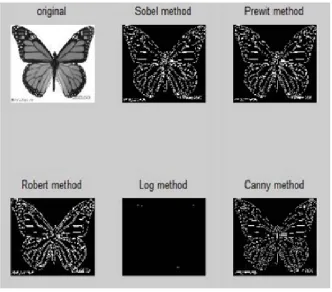
wasperformed on figure 1 of a butterfly where Canny yielded the best results. This was expected as Canny edge detection accounts for regions in an image. Canny yields thin lines for its edges by using non-maximal suppression.
B. Comparison of Various Edge Detection Techniques
Edge detection is the first step in applications like face recognition, computer vision algorithms etc. An edge in an image signifies the changes in intensity values. It becomes difficult to extract edges when there is noise in an image because noise also signifies the swift changes in the intensity value. The edge detection techniques- Roberts, Prewitt, Sobel and Canny are compared based on the parameters- MSE, RMSE and PSNR. [2]
An input image is taken which is of resolution 512x512. Each edge detection technique is applied on this image. The difference and similarity between all the edge detection operators can be shown by using the parameters Mean Square Error; this parameter is used to evaluate the performance of predictor and estimator, Root Mean Square Error; this parameter is used to measure the magnitude of varying quantities, Peak Signal to Noise Ratio; it is a ratio between maximum power of the signal and the power of corrupting noise. Comparison between the techniques is done using MATLAB SOFTWARE.
On the basis of MSE and RMSE, the Sobel operator shows the most similarity with the Prewitt and shows most dissimilarity with Canny. The Canny operator shows the most similarity with LoG and most dissimilarity with Roberts. The LoG operator shows the most similarity with the Zero Cross and shows most dissimilarity with Canny.
Peek signal to noise ratio (PSNR): It is ratio between maximum power of the signal and the power of corrupting noise. The more the value of PSNR the better is image reconstruction ability.
C. Comparison and Analysis for Edge Detection Algorithms based on SQI Image Enhancement
Image Enhancement plays an important role in the field of image processing. It is used to highlight the image information according to some specific needs and eliminates the unnecessary information. A self-quotient image (SQI) algorithm is proposed to obtain illumination invariant through the difference of original and smoothed image, and also the image is filtered using a weighted Gaussian filter. [3]
The simulation is done on MATLAB. Image enhancement is done on the input image and noise is removed using a Gaussian filter, then edge extraction is performed using different operators. The SQL algorithm is applied for Roberts, Sobel, Prewitt, LOG and Canny edge detection operators and their performance and characteristics are analysed. The analysis of the simulation results shows that, Roberts operator is simple but is sensitive to noise and detects horizontal and vertical edges better. Prewitt and Sobel have similar edge effect, they can filter out some noise but image gets blurred a little. LOG operator creates more continuous and smaller image edge and is also sensitive to noise. Canny operator can extract the most complete edge and better edge continuity superior to other operators.
This paper analysed some of the classic edge detection methods and compared their detection results using an input image. It is concluded that all images carry a certain degree of noise, therefore how to detect the edges accurately with the existence of noise is a long discussed issue.
III. PROPOSED SYSTEM
A. Methods used:
Sobel algorithm:
The Sobel operator is a discrete differentiation operator, computing an approximation of the gradient of the image intensity function. The Sobel operator is based on convolving the image with a small, separable, and integer-valued filter in the horizontal and vertical directions and is therefore relatively inexpensive in terms of computations. On the other hand, the gradient approximation that it produces is relatively crude, in particular for high-frequency variations in the image.
The operator uses two 3×3 kernels which are convolved with the original image to calculate approximations of the derivatives– one for horizontal changes, and one for vertical. If we define A as the source image, and Gx and Gy are
two images which at each point contain the horizontal and vertical derivative approximations respectively, the computations are as follows:
ISSN(Online): 2320-9801
ISSN (Print): 2320-9798
I
nternational
J
ournal of
I
nnovative
R
esearch in
C
omputer
and
C
ommunication
E
ngineering
(An ISO 3297: 2007 Certified Organization)
Vol. 4, Issue 3, March 2016
At each point in the image, the resulting gradient approximations can be combined to give the gradient magnitude, using:
Using this information, we can also calculate the gradient’s direction:
where, for example, Θ is 0 for a vertical edge which is lighter on the right side.
Canny algorithm:
The Canny edge detector is an edge detection operator that uses a multi-stage algorithm to detect a wide range of edges in images. A Gaussian filter is applied to smoothen the image in order to remove the noise. The equation for a Gaussian filter kernel of size (2k+1)×(2k+1) is given by:
The intensity gradient of the image is found by:
where, G and Θ are the edge gradient and direction for the first derivative in the horizontal direction (Gx) and the
vertical direction (Gy).
A non-maximum suppression technique is applied to get rid of spurious responses during edge detection. Double threshold is used to determine potential edges and the edges are tracked by hysteresis.
LoG Transformation:
Laplacian of Gaussian (LOG) operator finds the optimal filter of edge detection by ratio of the signal to noise of image. Firstly, a Gaussian function is used to low-pass smoothly filter image; then high-pass filter the Laplacian operator, according to the second derivative of zero, to detect the edges. Gaussian filter function is:
where letter σ2 is the standard deviation of the Gaussian filter, which determines the degree of smoothing of the image. By low-pass filtering the image f(x,y) we can get f(x,y)*G(x,y) and,
where is LOG operator.The input image is represented as a set of discrete pixels, a discrete convolution kernel is used that can approximate the second derivatives in the definition of the Laplacian.
B. Description of the proposed system
Each algorithm explained above, suits best only for some set of images. The proposed system aims at retaining the advantages of the algorithms by using all three techniques for detecting edges from an image.
An image of any format and dimension can be given as an input to the system
ISSN(Online): 2320-9801
ISSN (Print): 2320-9798
I
nternational
J
ournal of
I
nnovative
R
esearch in
C
omputer
and
C
ommunication
E
ngineering
(An ISO 3297: 2007 Certified Organization)
Vol. 4, Issue 3, March 2016
PSNR value is calculated for the three resultant images. The image with the least PSNR value is given as the output to the user
A graph is plotted to justify that the system gives the best output to the user
IV
.
SIMULATION AND RESULTSFig 1. Different edge detection techniques applied to an image of a butterfly
All five types of edge detection algorithms was performed on figure 1 of a butterfly where Canny yielded the best results. This was expected as Canny edge detection accounts for regions in an image. Canny yields thin lines for its edges by using non-maximal suppression.
ISSN(Online): 2320-9801
ISSN (Print): 2320-9798
I
nternational
J
ournal of
I
nnovative
R
esearch in
C
omputer
and
C
ommunication
E
ngineering
(An ISO 3297: 2007 Certified Organization)
Vol. 4, Issue 3, March 2016
The above graph gives a comparison between Sobel, Canny, Prewit, LOG, Roberts and Zero Crossing edge detection techniques on the basis of PSNR. PSNR shows quality of an image, it can be drawn that Sobel operator gives the most quality image when compared to others.
V.CONCLUSION
Edge detection is the first step in most of image processing applications. The edge detection algorithms are sensitive to noise, which indicates the swift changes in intensity values, this leads algorithms to falsely identify these changes as edges. Detecting the edge pixels in the presence of noise is an issue in edge detection algorithms. The gradient based edge detection algorithms are sensitive to noise. Canny edge detection algorithm overcomes this problem by filtering the noise from an image, but it is computationally expensive. Sobel algorithm is simple in its computation, its accuracy is not high, but its quality is adequate enough to be used in numerous applications.
REFERENCES
1. Ghassan Mahmoud HusienAmer, Dr. Ahmed Mohamed Abushaala, “Edge Detection Methods”, IEEE, 2015
2. Simranjit Singh, Rakesh Singh, “Comparison of Various Edge Detection Techniques”, 2nd International Conference on Computing for Sustainable Global Development, IEEE, pp. 393-396, 2015
3. Guanghui Deng, Zengli Liu, “Comparison and Analysis for Edge Detection Algorithms based on SQI Image Enhancement”, IEEE, pp. 3615-3617, 2015
4. O.Bezvesilniy, V.Vinogradov, D.Vavriv, K.Schiinemann, “Wavelet-Based Image Processing: Edge Detection and Noise Reduction”, 17th
International Conference on Applied Electromagnetics and Communications, pp. 123-126, 2003
5. Renyan Zhang, Guoliang Zhao and Li Su, “ A New Edge Detection Method in Image Processing”, Proceedings of ISCIT, pp. 430-433, 2005 6. P.Revathi, M. Hemalatha, “Classification of Cotton Leaf Spot Diseases Using Image Processing Edge Detection Techniques”, International
conference on Emerging Trends in Science, Engineering and Technology, pp. 169-173, 2012
7. Y. Kalpana, M.Padmaa, “An efficient edge detection algorithm for flame and fire image processing”, IEEE, pp. 696-700, 2014