University of Windsor University of Windsor
Scholarship at UWindsor
Scholarship at UWindsor
Electronic Theses and Dissertations Theses, Dissertations, and Major Papers
2013
Normalizing Surveillance: A Study of Cinematic Representation of
Normalizing Surveillance: A Study of Cinematic Representation of
Camera Surveillance
Camera Surveillance
Jolina Scalia University of Windsor
Follow this and additional works at: https://scholar.uwindsor.ca/etd
Recommended Citation Recommended Citation
Scalia, Jolina, "Normalizing Surveillance: A Study of Cinematic Representation of Camera Surveillance" (2013). Electronic Theses and Dissertations. 4744.
https://scholar.uwindsor.ca/etd/4744
This online database contains the full-text of PhD dissertations and Masters’ theses of University of Windsor students from 1954 forward. These documents are made available for personal study and research purposes only, in accordance with the Canadian Copyright Act and the Creative Commons license—CC BY-NC-ND (Attribution, Non-Commercial, No Derivative Works). Under this license, works must always be attributed to the copyright holder (original author), cannot be used for any commercial purposes, and may not be altered. Any other use would require the permission of the copyright holder. Students may inquire about withdrawing their dissertation and/or thesis from this database. For additional inquiries, please contact the repository administrator via email
Normalizing Surveillance:
A Study of Cinematic Representation of Camera Surveillance
by
Jolina Scalia
A Thesis
Submitted to the Faculty of Graduate Studies
through the Department of Sociology, Anthropology and Criminology in Partial Fulfillment of the Requirements for
the Degree of Master of Arts at the University of Windsor
Windsor, Ontario, Canada
2012
© 2012 Jolina Scalia
978-0-494-84885-2 Your file Votre référence Library and Archives
Canada Bibliothèque etArchives Canada Published Heritage
Branch
395 Wellington Street Ottawa ON K1A 0N4 Canada
Direction du
Patrimoine de l'édition
395, rue Wellington Ottawa ON K1A 0N4 Canada
NOTICE:
ISBN:
Our file Notre référence 978-0-494-84885-2 ISBN:
The author has granted a
non-exclusive license allowing Library and Archives Canada to reproduce, publish, archive, preserve, conserve, communicate to the public by
telecommunication or on the Internet, loan, distrbute and sell theses
worldwide, for commercial or non-commercial purposes, in microform, paper, electronic and/or any other formats.
The author retains copyright ownership and moral rights in this thesis. Neither the thesis nor substantial extracts from it may be printed or otherwise reproduced without the author's permission.
In compliance with the Canadian Privacy Act some supporting forms may have been removed from this thesis.
While these forms may be included in the document page count, their removal does not represent any loss of content from the thesis.
AVIS:
L'auteur a accordé une licence non exclusive permettant à la Bibliothèque et Archives Canada de reproduire, publier, archiver, sauvegarder, conserver, transmettre au public par télécommunication ou par l'Internet, prêter, distribuer et vendre des thèses partout dans le monde, à des fins commerciales ou autres, sur support microforme, papier, électronique et/ou autres formats.
L'auteur conserve la propriété du droit d'auteur et des droits moraux qui protege cette thèse. Ni la thèse ni des extraits substantiels de celle-ci ne doivent être imprimés ou autrement
reproduits sans son autorisation.
Conformément à la loi canadienne sur la protection de la vie privée, quelques formulaires secondaires ont été enlevés de cette thèse.
Normalizing Surveillance:
A Study of Cinematic Representation of Camera Surveillance
by
Jolina Scalia
APPROVED BY:
______________________________________________ Dr. Michael Darroch
School for Arts and Creative Innovation
______________________________________________ Dr. Danielle Soulliere
Department of Sociology, Anthropology, & Criminology
______________________________________________ Dr. Randy Lippert, Advisor
Department of Sociology, Anthropology, & Criminology
______________________________________________ Dr. John Deukmedjian, Chair of Defense
Department of Sociology, Anthropology, & Criminology
AUTHOR’S DECLARATION OF ORIGINALITY
I hereby certify that I am the sole author of this thesis and that no part of this thesis has been published or submitted for publication.
I certify that, to the best of my knowledge, my thesis does not infringe upon anyone’s copyright nor violate any proprietary rights and that any ideas, techniques, quotations, or any other material from the work of other people included in my thesis, published or otherwise, are fully acknowledged in accordance with the standard referencing practices. Furthermore, to the extent that I have included copyrighted material that surpasses the bounds of fair dealing within the meaning of the Canada Copyright Act, I certify that I have obtained a written permission from the copyright owner(s) to include such material(s) in my thesis and have included copies of such copyright clearances to my appendix.
ABSTRACT
ACKNOWLEDGEMENTS
I would first like to thank the members of my committee. To my external reader Dr. Michael Darroch – thank you for agreeing to be on my committee and for providing your guidance and wisdom whenever you were asked too. To my secondary reader Dr. Danielle Soulliere – thank you for fitting me into your busy schedule and providing valuable critiques which have helped strengthen my thesis. I owe the biggest gratitude to my advisor Dr. Randy Lippert. Randy sets a precedent of greatness that I hope all other thesis advisors follow. His hard work and dedication to my success will never be forgotten. I am eternally thankful. I appreciate all the time and effort that my entire committee has given to aid in the completion of my thesis. I could not have asked for better people to work with. A special thanks to Dr. Muhammad Shuraydi – thank you for providing your guidance and encouragement.
I would like to thank two fellow classmates and friends – Pat and Stephanie – your support and advice have helped me reached this point. As well, thanks to my close friends – Charli, Chelsey, Kari and Mary – and to two other classmates – Cassandra and Tony – who have always believed in my success. To my father and stepmother – thank you for relieving certain stressors from the equation of doing my undergraduate program and for providing your encouragement. To my siblings – Joe and Jeanine – thank you for listening to my ideas and presentations. Your comments, advice, love and support have guided me to finish one the most difficult challenges I have ever faced. To my mother – your love and unwavering support have meant more than words. I thank you for
everything that you have done to support my academic journey and life.
DEDICATION
To my mother and boyfriend,
TABLE OF CONTENTS
AUTHOR’S DECLARATION OF ORGINALITY iii
ABSTRACT iv
ACKNOWLEDGEMENTS v
DEDICATION vi
LIST OF TABLES ix
1. INTRODUCTORY REMARKS 1
Purpose of the Thesis 2
2. THEORETICAL FRAMEWORK 5
Normalization 7
3. LITERATURE REVIEW 9
Normalization Research 10
Surveillance Research 10
Surveillance in Cinema Research 13
4. METHODOLOGY: OPERATIONIZATION AND RESEARCH
PROCEDURES 17
Operationalization 17
Research Procedures 19
The Sample 22
5. RESULTS 24
Introduction 24
Content Analysis 24
Where and How Surveillance Occurred 25
Images Depicting Women and Minorities 28
Reasons for Surveillance 30
Plot Changes 33
Realism 34
Privacy 36
Resistance 38
The Efficacy of Camera Surveillance 41
Critical Discourse Analysis 46
The Camera Never Lies 47
Cameras That Malfunction Create Cause for Concern 48
Mass Media is a Form of Camera Surveillance 50
Camera Surveillance as a Normal Background 53
Cameras can Identify, Locate and Follow Persons 53
One can be Mischievous with Camera Surveillance 56
Images can be Altered 58
6. ANALYSIS 59
Introduction 59
How Films Normalize Camera Surveillance 60
The Efficacy of Camera Surveillance and Normalization 66
NOTES 72
REFERENCES 74
FILMOGRAPHY 78
APPENDIX A 79
APPENDIX B 80
APPENDIX C 81
LIST OF TABLES
Table 1: Space in which Images Were Captured 26 Table 2: Location of Viewing and Reviewing Images 27
Table 3: Reasons for Surveillance 32
INTRODUCTORY REMARKS
It is obvious technology is incorporated into modern daily life. Perhaps what is
unrecognized by the public is that many of these technologies are used for population
surveillance. This surge in technologies used for surveillance in society has transformed
affluent nations into ‘surveillance societies’ (Murakami Wood and Webster 2009; 2011).
Surveillance technologies exist in all realms, whether private or public; somehow these
technologies are able to manoeuvre their gaze into everyday existence without opposition
(Monahan 2010: 8). Although surveillance always has been present in society, recently
the technical capability to surveil has greatly increased. This is called the ‘new
surveillance’ (Marx 2002), and digital camera surveillance is its prototype (Lyon, Doyle
and Lippert 2012: 1).
In the era of new surveillance, the ability to use camera surveillance not only
includes corporations and governments but has been expanded into the general
population. Today for example, almost anyone with a cell phone with its standard camera
feature has the power to capture whatever image he/she desires. Due to advancements in
technology, camera surveillance can occur everywhere, any time, whether concealed or
overt (Koskela 2004) and can be administered by anyone.
Traditional surveillance suggests ‘serendipitous cloak-and-dagger or undercover
investigations into individual activities’ (Lyon 2007: 13) where direct or close
observation of the subject is required (Marx 2002: 11). However, with the advantages of
new surveillance technologies, the definition of surveillance has expanded and tends to
focus on the fact that it is used to collect personal data. Generally, ‘[s]urveillance can be
defined as the systematic monitoring of people or groups in order to regulate or govern
Purpose of the Thesis
This thesis focuses on camera surveillance,1 specifically images represented in
contemporary cinema, to lend understanding into the process of normalization of
surveillance within society. It is situated within the body of work called ‘surveillance
studies’(see Lyon 2007). Considered a cross-disciplinary field, surveillance studies tries
to understand new and existing forms of surveillance that scrutinizes populations (Lyon
2002: 2). However, normalization of surveillance has not been directly addressed in the
surveillance literature (but see Murakami Wood and Webster 2009; 2011). Therefore, a
central purpose of this thesis is identifying and describing the normalization of
surveillance.
Unfortunately, there appears to be a lack of concern by the citizenry about the
implications a surveillance society has for individuals (Murakami Wood and Webster
2009). The era of new surveillance yields loss of privacy (Holtzman 2006). Privacy
concerns surface when corporations, and even governments, needlessly collect and store
information about individuals which is often later sold to other corporations to develop
profiles of individuals (Haggerty and Ericson 2000: 616; Holtzman 2006: 10). Of equal
concern are other societal issues, including social inequality, which will be discussed in
detail later.
This thesis is interested in the normalization of surveillance through media,
particularly in cinematic representation of camera surveillance. Surveillance in the media
has been studied in many different forms from print to broadcast news (see Norris and
Armstrong 1999; McCahill 2003; Doyle 2006), as well as in entertainment (see
Andrejevic 2004; Doyle 2006; Murakami Wood and Webster 2009). However, less
camera surveillance images as a motif (Levin 2002). For instance, even a cursory
examination of films like Time Code and Faceless (the latter using actual camera
surveillance footage) reveals that some films use camera surveillance as the central point
of view through which the audience views the film. Other feature films use camcorders as
the narrator of the film, such as The Blair Witch Project, Cloverfield,and Quarantine. As
well, in fictional films it seems that scenes with camera surveillance images are also
likely to be used to create a plot twist, which is a major turn of events – such as when an
image captures the real culprit of a crime as in Snake Eyes. In addition, images are
increasingly used to address a minor change of direction in characters’ interests, which
includes identifying potential suspects from the camera surveillance image, such as in The
International or pursuing persons of interest through camera surveillance as in Enemy of
the State.
Therefore, it is legitimate to raise the question: what are the driving forces behind
surveillance normalization? Perhaps no force is more significant than that of mass media,
which also of course includes cinema. Mass media have the ability to influence the public
(Critcher 2006: 25-6) since they are viewed as ‘the principle vehicle for popular views,
ideology, and information’ (Rothe and Muzzatti 2004: 334). Generally, what people know
about surveillance ‘is mediated and largely determined by media representations’ (Norris
and Armstrong 1999: 63), and for the general population, media offer a window into
modern surveillance strategies (Gates and Magnet 2007: 284). People are more likely to
receive their information of camera surveillance practices from fictional depictions than
academic studies since, for example, ‘[m]any more people read Orwell than read
Research by Finn and McCahill (2010) and Barnard-Wills (2011) indicate that
there are two attitudes regarding public surveillance portrayed in the media: criticism and
acceptance. Thus, media portray citizens to be somewhat concerned about new and
existing uses of surveillance technology. However, the overall outcome appears to be
public acceptance of this technology when surveillance is focused on criminals and only
becomes criticized if it invades the privacy of law-abiding citizens (Finn and McCahill
2010; Barnard-Wills 2011).
In this thesis, I examine how Hollywood films facilitate the normalization of
surveillance within society. In particular, this thesis delves into the realm of Hollywood
cinema to lend understanding into messages that scenes with camera surveillance images
may impress upon its audience. This study was conducted in a North American context,
and therefore examines US (or ‘Hollywood’) cinema exclusively. The research was
conducted from the perspective of the audience rather than as an academic researcher. It
is essential to understand how US cinema depicts camera surveillance since US cinema is
viewed predominately throughout North America (Penny 2004: 209-10). This thesis seeks
to add to the surveillance literature and contribute to criminology by filling in a research
gap concerning normalization of surveillance. It does so by examining Hollywood cinema
for instances of normalization, which has never been previously explored in depth until
now.
It is important to distinguish this thesis research from two other interrelated areas
of surveillance studies. This research is not interested in the perspective of the cinematic
camera as a surveillance tool. As well, it is not directly interested in the audience as
The normalization of camera surveillance is an important issue to current Western
society. Camera surveillance in North America has been steadily and increasingly
implemented through the years. Although exact figures are difficult to determine (Smith
2012: 123), currently camera surveillance is very common in private or semi-private areas
such as malls, airports, taxi-cabs and universities (SCAN 2009: 12). Private surveillance
systems have been established longer and are more frequent than public operating
systems (Norris, McCahill and Murakami Wood 2004: 114). Public camera surveillance
systems gained momentum in the late 1990s and early 2000s (Walby 2006; Norris 2012),
and are generally located in metropolitan areas with an established downtown district.
Public camera surveillance systems are also found in public transits (Monahan 2006;
SCAN 2009) and schools (Dinkes et al. 2009). Camera surveillance can be a useful tool
to essentially keep a watchful eye on unfolding events. Unfortunately, often times it is
implemented or operates based on unsubstantiated suspicion and who gets watched by
whom reflects broader social inequalities, which in turn help to reproduce these types of
relationships (Monahan 2010: 90) within society. Therefore, the normalization of this
extensive camera surveillance, which threatens privacy rights of the individual and the
perpetuation of social inequalities, must be addressed.
THEORETICAL FRAMEWORK
This section seeks to further define surveillance and surveillance societies. The
subsection that follows provides some theoretical insight into how surveillance has
become normalized in society. The subsection also includes a discussion of Foucault’s
work on normalization and discourse in particular.
At its root, surveillance ‘start[s] with any elementary watching of some by another
word surveillance has a literal interpretation, where ‘sur’ derives from the French word
meaning above and ‘veiller’ meaning to watch. However, dictionary definitions rarely
‘capture current understandings of surveillance’ (Marx 2002: 10). This is especially the
case with camera surveillance specifically regarding ‘new surveillance’ which may seek
first to discover ‘patterns of interest’ rather than focus on ‘persons of interest’ (Marx
2002: 11). These patterns of interest are searched for by new ‘smart’ cameras that do not
require direct human observation (Ferenbok and Clement 2012). New surveillance is also
known by several other terms that encompass its relatively new capacity to surveil
anyone. These include ‘sousveillance’, created from the French words ‘sous’ (below) and
‘veiller’ (to watch) (Mann, Nolan, and Wellman 2003: 332; Lyon 2007: 13), and
‘sub-veillance’, from the Latin word ‘sub’ (below or under) (Lake 2010: 235).2 These new
types of surveillance are most commonly derived from the general concept of
‘synopticism’ – the ability for the many to watch the few (Mathiesen 1997). Surveillance,
at its core, encompasses visibility (Lyon 2007: 16). Since the focus of this thesis is
camera surveillance, it will be defined for the purpose of this thesis as a visual image
viewed after the fact or in real time through a camera for the purpose of data collection,
protection, voyeurism, or control of individuals or situations within itsgaze.
The study of surveillance in society became increasingly popular in the late
twentieth century (Lyon 2007: 22). Thereafter, surveillance studies gained recognition
and credibility with introduction of the open access journal Surveillance & Society, in
2002. Surveillance studies has largely acknowledged and readily used the concept of the
‘surveillance society’ to describe modern-day Western societies. The concept is
synonymous in media with the Big Brother state in Orwell’s novel Nineteen Eighty-Four
surveils its population; in these societies ‘the gaze is ubiquitous, constant, inescapable’
(Lyon 2007: 25). No matter where a person goes ‘some check occurs, some record is
made or some image is captured’ (Lyon 2007: 25) through a multitude of data
surveillance (dataveillance) and electronic surveillance systems used to identify risky
individuals(Roger 1994; for an example of the proliferation of dataveillance see Amoore
2006).
The UK is the leading symbol of the ultimate surveillance society (Murakami
Wood and Webster 2009; 2011). While camera surveillance is only one form of many
types of surveillance technology used in the UK, it is what makes the UK appear as a
surveillance society. Early estimations of camera surveillance in the UK were over four
million units but more recently were estimated at 1.85 million (Lyon et al. 2012: 1). It has
been determined that on average, a person walking the streets of London will be caught
on camera approximately 300 times daily (Holtzman 2006: 6; Monahan 2006: 3). As
discussed earlier, camera surveillance is also increasingly embedded in North America. It
appears that North America is moving in the direction (albeit slower than the UK) of
becoming a total surveillance society.
Normalization
To clarify, normalization refers to the process by which something becomes
normal or widely accepted within society. Michel Foucault contends that all norms (i.e.
something that has become normal), even the most basic that are needed to interpret and
understand the world, should not be blindly accepted sincethe refusal to accept norms
could lead to alternative ways of thinking. Refusal brings forth an ‘increase [in a]
person[’s] capacities and expand[s] their possibilities without simultaneously increasing
accept a norm as such means a person engages in and expands ‘the practice of freedom’
(Taylor 2009: 46). A norm ‘links the increase of capacities and expansion of possibilities
to an increase in and expansion of the proliferation of power within society’ (Taylor
2009: 47). Thus, ‘[n]ormalizing norms encourage subjects to become’ proficient at
executing ‘a narrowly defined range of practices’ (Taylor 2009: 47).
Foucault believes not every norm is normalizing, such as those norms that are
questioned and negotiated. Normalizing norms function to hinder critical analysis, and to
make the action or practice viewed as natural or needed (Taylor 2009: 47).Norms that
remain unquestioned are worrisome to Foucault, since they provide the differentiation
between abnormal and normal individuals and populations. From this differentiation
comes the ability for sanctioned interventions of both groups to produce or maintain
conformity to the norm and eradicate any potential resistance. Consequently, Foucault
believes that modern authority relies heavily on norms for legitimacy and power (Taylor
2009: 53).
Surveillance within society, especially camera surveillance, has become a societal
norm.Those under the gaze of camera surveillance are expected to continue daily life as
if no one is watching, to essentially ignore the camera surveillance, but to behave in a
manner appropriate to society. Citizens are expected to repeat these behaviours on a daily
basis, and the repetition of these behaviours helps create the acceptance of this norm.
Also, the media’s typically positive association with camera surveillance (see Norris and
Armstrong 1999; Andrejevic 2004; Gates and Magnet 2007; Barnard-Wills 2011), along
with citizens’ habitual watching of these media outlets, suggest that camera surveillance
is something for individuals to feel positive about,thus again aiding in its normalization.
(and other surveillance technologies) as a process that has become normalized in societies
since it has developed into a fact of life. It is a way of life that appears to have very
minimal resistance, which is problematic to Foucault. In fact, the general acceptance of
surveillance among citizens, whether forthright or from ignorance or indifference, is
much more commonplace than any form of resistance (Marx 2009: 303).
Normalization is also associated with Foucault’s work on discourse. Discourse
‘refers to groups of statements which structure the way a thing is thought, and the way we
act on the basis of that thinking. [Basically, it] is a particular knowledge about the world
which shapes how the world is understood and how things are done in it’ (Rose 2007:
142). Foucault believes that power resides in discourse, specifically, the power to
discipline ‘subjects into certain ways of thinking and acting’, which is not administered
solely in a top-down approach, but instead ‘subjects are produced through discourses
[themselves]’ (Rose 2007: 143). Therefore, power, like discourse, is rather dispersed.
Foucault (1979: 95 cited in Rose 2007: 143) acknowledged that ‘where there is power,
there is...a multiplicity of resistance’.Thus, many discourses compete to structure how
subjects understand the world; however, particular discourses are more dominant than
others. It is of interest to this research to uncover any competing discourses structuring
camera surveillance in cinema.
LITERATURE REVIEW
Several themes in the literature pertinent to this thesis research are evident in the
surveillance studies literature generally and in the surveillance in cinema literature more
specifically. The section on ‘Surveillance Research’ discusses social inequalities,
resistance, and the efficacy of camera surveillance, whereas the section on ‘Surveillance
scenes with camera surveillance images as tools for acceptance or as resistance of the
technology, and sub-veillance. However, the subsection ‘Normalization Research’ that
follows briefly discusses previous research on surveillance normalization.
Normalization Research
Recent literature on surveillance normalization focuses solely on the UK and only
briefly examines one media outlet that facilitates normalization (see Murakami Wood and
Webster 2009 and 2011). Murakami Wood and Webster (2009; 2011) argue that camera
surveillance provides the public with some easethat something is being done about
domestic crime. Second, it implies a form of brotherly care rather than just Big Brother; it
is a caring gaze over citizens and not solely a disciplinary gaze. Third, the media’s use of
surveillance as entertainment has made surveillance part of the UK’s cultural landscape.
Essentially, reality TV has helped citizens become accustomed to the fact that
surveillance is experienced in everyday life, and to take enjoyment from it; it has
‘train[ed] our eyes and minds for surveillance’ (Murakami Wood and Webster 2009:
264). Yet, their explanation alone cannot establish how surveillance has become
normalized, thus leaving a gap to be filled. This thesis therefore examines how North
America has normalized camera surveillance by analyzing scenes with camera
surveillance images in Hollywood cinema.
Surveillance Research
Within a surveillance society, everyone is suspect. This idea is true yet quite
misleading because it suggests that everyone is surveilled equally, when in actuality,
surveillance varies in intensity and intrusiveness (Lyon 2007: 25). Certain groups are still
targeted for more intensive surveillance for various reasons, including suspicion and
body parts(Norris and Armstrong 1999). As can be noted from above many social
inequalities arise due to surveillance technologies. Social inequalities refer to differential
treatments among groups based on social issues, which include (but are not limited to)
gender, class, and race (see Tepperman, Curtis and Kwan 2007). Generally, social
inequalities are established or maintained by two mechanisms: social sorting and
marginalizing surveillance (Monahan 2010: 9-10). Social sorting implies that groups are
organized based on characteristics, and that pressure is applied to the individuals involved
within each group to prevent deviation from their group. This is evident in commodity
consumption with the ‘preferential treatment of the relatively affluent [such as for
instance] discounts based on past purchases’ (Monahan 2010: 9). Traditional social
sorting was obviously discriminatory, whereas contemporary social sorting is viewed as
not necessarily so since people have a tendency to believe that these technological
systems are neutral and not inherently discriminatory (Monahan 2010: 10). Surveillance
is marginalizing since it focuses onmarginalized populations; it applies ‘enhanced control
[on] populations considered to be risky, dangerous, or untrustworthy’ (Monahan 2010:
10). This includes, for instance, the intensive surveillance of welfare recipients (Monahan
2010: 10). Therefore, not only are there individual concerns about surveillance systems
but social concerns as well, where in our contemporary society ‘[s]ocial exclusions and
inequalities become mere collateral damage’ (Monahan 2010: 11). One theme, therefore,
that this thesis explores is whether social inequalities have been depicted in cinema.
For something to become normalized it must receive little or no resistance.Marx
(2003) described 11 techniques of resistance to surveillance by surveillance subjects,
which also can be applied to resistance of camera surveillance. These techniques, used to
times may overlap in certain instances. Countersurveillance, as Marx describes it, is a
‘role reversal as subjects apply the tactics to agents’ (2009: 298), essentially turning the
surveillant gaze onto the surveillers. Koskela (2004) extends countersurveillance to
include private home webcams, since webcams empower the individual while resisting
the shame and desire to hide. In essence, by displaying their lives to millions these
individuals become free. Individuals gain power but not necessarily control as a result.3
A second theme in this thesis examines whether camera surveillance captures acts
of resistance to camera surveillance as discussed by Marx (2003) and extended by
Koskela (2004). As well, previous research suggests that surveillance is only perceived
negatively by citizens when used against those considered to be within society, such as
law-abiding citizens, rather than those who are not, such as criminals (Barnard-Wills
2011: 563; see also Finn and McCahill 2010).Therefore, I also determined what social
class or position (insider or outsider) the resistors belong to within the community. In
turn, questions of resistance were linked to whether the norm of camera surveillance is in
fact a normalizing norm as defined by Foucault.
Scholars worry that the lack of opposition to implementing more camera
surveillance systems has led citizens to forget that these systems pose real threats to both
individuals and groups within a society (Murakami Wood and Webster 2009; 2011).
What is most puzzling to scholars is the acceptance of camera surveillance in society
when there is a lack of actual evidence that these surveillance systems are truly efficient
(Lyon et al. 2012: 3). Most evaluations offer ambiguous conclusions or inconclusive
results (see Verga 2010). Independent and government studies time and again suggest that
camera surveillance is limited as an effective preventative measure since it is reliant upon
cross-international survey examining citizens’ perceptions of camera surveillance determined
that almost half of the respondents in North America believed camera surveillance to be
somewhat effective in reducing crime (Dawson 2012). But why is this the case when such
evidence is lacking? It is possible that cinema may overemphasize the efficacy of camera
surveillance. Thus, this thesis also assesses whether cinema depicts camera surveillance
as efficient for crime fighting purposes.
Surveillance in Cinema Research
While other areas of media have been heavily studied, cinema’s portrayal of
camera surveillance practices has been less widely discussed. Relatively little research
has examined surveillance in cinema. Usually within cinema, researchers study crime
films – typically defined as films that include some relation to crime and criminal justice
– by analyzing potential interpretations of what these films convey (for example see
Allen, Livingstone and Reiner 1998; Rafter 2006).
As established earlier, the embedment of scenes with camera surveillance images
appears tobe increasing in the cinema culture. Levin (2002) examined films from the
1990s to early 2000s and noticed that many newer films were more often using narration
of surveillance through a recorded image (allowing for the captured footage to narrate the
story), such as in Thelma and Louise, while even more recent approaches to narration
incorporate real time observation, such as in Snake Eyes, where characters watch live
monitors to follow persons of interest. Levin argues that there has been a shift in cinema
from spatial indexicality to a temporal indexicality, the latter being referred to as a
‘guaranteed’ fact, since it is uninterrupted by manipulation and occurs in ‘real time’
(2002: 592). Thus, ‘while cinema’s primary category was that of space (pro-filmic space,
(Levin 2002: 592). Accordingly, by taking on this new narration, cinema becomes a more
believable reality, since what viewers see in the real time image is happening at that
moment of viewing and is less susceptible to digital manipulation. Research, in general,
has linked camera surveillance to the perception of certain realism, especially if viewed in
real time (Levin 2002). Camera surveillance footage is associated with the notion that
‘seeing is believing’ and that the camera never lies (Doyle 2006: 211). The theme of
realism is examined in this thesis too.
In addition, this thesis explores Levin’s two suggested distinctions of the use of
camera surveillance and determined which is presented more frequently, but rather than
referring to Levin’s terms, ‘real time observations’ and ‘recorded’, I refer to them as
‘in-the-moment’ and ‘after-the-fact’, respectively. As well, since the use of these two
distinctions of in-the-moment and after-the-fact could involve crime deterrence, crime
capture, and/or types of resistance, I investigated these themes as well.
Most researchers studying surveillance in cinema attempt to discover concurrent
themes within films by analyzing several films at a time. Albrechtslund (2008) notes that
films, as well as television series, focused on disasters (e.g. terrorist attacks) typically
ignored ethical issues of the potential privacy invasion surveillers impose unto
surveillance subjects. These films and TV series engage in a utilitarian justification for
their gaze. In general, privacy violations have not been thoroughly examined in cinema
and, therefore, another theme this thesis explored was whether privacy has been violated,
and if so, whether it was somehow justified.
Kammerer (2004) analyzed three Hollywood films (Enemy of the State, Minority
Report,and Panic Room) with surveillance as the primary theme and found that a central
(2004), these films attest to the infallibility of the technology of surveillance; only human
misinterpretation of the images is error prone, and not the technology itself. This thesis
seeks to determine whether this is evident within Hollywood films too.
Turner’s (1998) research consists of a relatively large sample of films and
television series analyzed within the context of surveillance.Turner believes that the
overabundance of depictions of surveillance in media ‘transforms the will and practice of
the surveillance society into a spectacle’ (1998: 107) – which translates resistance of
surveillance ‘into objects or images of consumption’ (1998: 95) – and reduces the anxiety
of constant surveillance to that of voyeuristic pleasure. Turner believes these films reduce
‘audiences to passivity’ and acceptance of technology, while ‘Kammerer...view[s] these
texts as potentially progressive,...inspir[ing audiences] to question and resist negative
trends, while critically assessing technological changes as positives’(Lake 2010: 234).
These two distinct perspectives concerning the function of surveillance in cinema is
explored through this thesis, and linked to Foucault’s work on normalization.
More often cinematic researchers will discuss, at length, the relevance of one film
to contemporary society. In a study of the film Red Road, for example, Lake (2010: 232)
recognizes that traditional surveillers depicted in cinema are white, middle-class men and
that research largely classifies the distinction among the surveillers and surveillance
subjects as ideological, while ignoring other distinctions such as gender, race, class and
sexuality. Red Road is unique in that it recognizes other possible surveillers and
challenges traditional power dynamics for it is not the expected male doing the
surveilling, but rather a female voyeur. Lake describes the film as a ‘sub-veillance’
thriller and is considered to be so because women have traditionally never been in power.
traditionally positioned in social and political relations as subordinates’, such as children,
women, and non-white racial minorities. Lake’s view of sub-veillance and traditional
roles of power relations also relates to questions of inequalities noted earlier. Many
researchers in fact examine entire films that focus on surveillance like this. This thesis,
however, tries to move beyond the study of a single film or relatively small multiple film
analysis sample by using a broader sample. It examines a multitude of films across
various genres to understand how cinema is a conduit of messages for the acceptance of
camera surveillance specifically. Also, this previous research focused on plots rich with
scenes of camera surveillance images and technologies while films studied in this thesis
did not necessarily rely on surveillance, nor were they necessarily ‘crime films’; each film
in the sample (see Appendix B)needed only to include at least one scene with a camera
surveillance image.
As can be noted from the literature review above, normalization and cinema have
not been entirely overlooked in surveillance studies. And several key themes come out of
this previous research that should be addressed in this thesis research, which are social
inequalities, resistance, the effectiveness of camera surveillance for crime fighting,
privacy and realism. This research examines the subtle ways surveillance is incorporated
into films, just like in real life.
The overarching research question of this thesis is: how have Hollywood films
facilitated the normalization of surveillance within society? An examination of this topic
requires several subquestions based on the literature review and found in the paragraphs
that follow: Do scenes with camera surveillance images in cinema depict social
inequalities such as marginalization? Do these images depict public resistance to camera
suggest the efficacy of camera surveillance? Are camera surveillance images viewed
in-the-moment or as a recorded image after-the-fact, and do these images have anything to
do with crime deterrence, crime capture, or resistance? Was the camera surveillance
violating an individual’s privacy? Was camera surveillance depicted as capturing reality?
However, it should be noted that these questions are not mutually exclusive; often the
analysis of one question relates to another. As well, these questions and themes are not
exhaustive and do not limit the entire amount of research that took place within this
thesis. Other themes were identified during the research process.
METHODOLOGY: OPERATIONIZATION AND RESEARCH PROCEDURES
In what follows I describe how the subquestions were operationalized and
describe the research procedures in detail to answer how have Hollywood films facilitated
the normalization of surveillance within society?
Operationalization
First, do scenes with camera surveillance images in cinema depict social
inequalities such as marginalization? To examine this I determined who were the targets
of surveillance and why as well as who were the surveillers and whether the camera
surveillance system was being used for its supposed or stated purpose. In addition, I took
note of whether images contained sub-veillance by acknowledging the age, sex, race, and
social class of the surveillers and surveillance subjects, and through what technology the
surveillance had being undertaken (e.g. a security camera or a cell phone). If social
inequalities were depicted, I then determined whether the surveillance of the targeted
individual seemed justified based on the outcome in the film (e.g. targeted individual was
a criminal). From an audience perspective, the audience would most likely agree that
it was proven that the subject had stolen private property, hurt or killed others, especially
in cold blood. If these crimes, however, occurred as a result of a just cause, for instance,
the crime occurred in a case of self-defence, or occurred when a subject was reclaiming
an object that was rightfully theirs, and so on, then the audience would most likely not
agree with the surveillance.
According to law, a criminal is someone who has actually broken the criminal
code. In films, however, sometimes the antagonists (the criminals) are actually the
protagonists (the heroes). The audience often becomes connected with these individuals
and therefore want the criminal to succeed; however, the audience would not be outraged
if these criminal protagonists are being surveilled.
Do these images depict public resistance to camera surveillance as suggested by
Marx (2003) and extended by Koskela (2004)? For example, I determined whether
subjects hid from camera surveillance, or used it for empowerment. I then determined
whether resistors were considered to be generally law-abiding citizens or outsiders
(suspects or criminals) of society. At times, however, these categories were fluid and
overlapped.
Do images suggest the efficacy of camera surveillance? To determine this, I
examined whether camera surveillance captured a crime, the type of crime captured, and
whether criminals were eventually brought to justice (arrested or convicted) by the image.
Are camera surveillance images viewed in-the-moment or as a recorded image
after-the-fact, and do these images have anything to do with crime deterrence, crime capture, or
resistance? Once it was determined whether the camera surveillance image was being
viewed in real time or as a recording, it was then analyzed for any connection to crime
Was the camera surveillance violating an individual’s privacy? Citizens still
maintain certain privacy expectations, such as privacy from surveillance in one’s home or
in public restrooms (Lyon 2007: 174). I determined whether privacy was violated by
examining the location of the camera surveillance (e.g. home or public restroom), as well
as determining who was surveilling, why surveillance was being undertaken, and whether
surveillance subjects knew they were being surveilled. If privacy was determined to have
been violated, I then examined whether the intrusion was later justified based on the
outcome of the surveillance subjects (e.g. the person is actually a criminal).
Was camera surveillance depicted as capturing reality (what actually happened
versus what the camera surveillance captured)? Realism was determined through an
examination of whether there was doubt of the surveillance image (i.e. doubt over what
events the camera surveillance actually captured) by any observers of the image. This
question involved examining the dialogue of characters within the films.
Research Procedures
This thesis required two basic types of research methods. The first was a
quantitative content analysis, which is a popular method for examining media images
(Yar 2010: 70). Researchers take incidents of interest and catalogue them according to
established criteria to search for emerging patterns (Krippendorff 2004). However,
putting the incidents of interest into predetermined categories for this research would
have only limited the ability to detect patterns, as many times events cannot easily be
placed into mutually exclusive categories. Therefore, these incidents were not catalogued
into broad categories but instead were placed into categories that were reduced to their
minimal description. Categories were sometimes formed after the fact for a more
where, why, and when, and noted the frequencies of the answers. Appendix A contains all
aspects examined in the content analysis.
One major limitation of a content analysis, as Yar (2010: 71) acknowledges, is
that ‘counting the frequency or incidence of representations does little to help
[researchers] understand the meanings of those representations’. In order to better discern
meaning, therefore, a content analysis was accompanied by a qualitative critical discourse
analysis. This thesis is concerned with ‘the notion of discourse as articulated through
various kinds of visual images’ (Rose 2007: 146). More particularly this thesis is
concerned with those visual images depicting camera surveillance within cinematic
representation; thus, any film images that are of camera surveillance. A critical discourse
analysis allows researchers ‘to explore how images construct specific views of the social
world’ (Rose 2007: 146). A critical discourse analysis helps to uncover any competing
discourses to understand how Hollywood cinema constructs camera surveillance.
Thecriticaldiscourse analysis identified themes following two processes: open
coding and focused coding. The open coding began with the examination of images
without previously formulated categories (Babbie and Benaquisto 2002: 382); essentially
images were examined with ‘fresh eyes’ (Rose 2007: 157). Focused coding followed
open coding, for which I subjected the images to predetermined themes of interest
(developed from open coding), which provided the major themes for the final analysis
(Babbie and Benaquisto 2002: 382).Following Foucault’s work on discourse analysis
(see Rose 2007), this thesis is not interested in why scenes with camera surveillance
images are present in films, such as why producers or directors included the image, but
The two research methods were complimentary, and allowed for a better
interpretation of how each scene with a camera surveillance image could be relevant,
while taking into account how often similar events occurred in the sample. The
combination of the quantitative and qualitative research methods brings both rigour and
flexibility. A content analysis is more rigorous than a discourse analysis in the sense that
a content analysis is expected to be replicable (Krippendorff 2004: 18). A discourse
analysis is more flexible than a content analysis and allows for the capturing of new
themes without spending vast amounts of time revising categories and reviewing already
coded images (Rose 2007: 161).
I referred to the images of camera surveillance that I recorded as ‘camera
surveillance images’, which included both stills and moving documentation (or footage),
but excluded images from infrared cameras. The term also included both surveillance
from authority figures (e.g. state agencies and corporate elites) and non-authority figures
(e.g. non-state agents) using devices such as surveillance cameras, handheld cameras,
mobile phone cameras, webcams, handheld camcorders, or exposure to mass media
(newspaper and broadcast news).
The primary unit of analysis was not the entire film, but film scenes that depicted
camera surveillance images. To enter this sample, films had to incorporate at least one
scene of a camera surveillance image that created a plot change or provided doubt over
the image or captured a criminal act. Plot changes are divided into two categories: minor
and major. A ‘minor plot change’ is defined as an event captured on camera surveillance
and the viewing of the image changes the current direction of the plot, for instance, a
suspect is identified. These events are typically expected by the audience. A ‘major plot
the audience and not just characters in the film, such as figuring out the true culprit of a
crime. These images were then subjected to further analysis, such as determining whether
the image captured resistance to camera surveillance.
The Sample
To answer my research question this thesis engaged in a different approach from
almost all previous analyses of surveillance in cinema. Rather than examining one or a
few films at a time, I examined scenes from 30 Hollywood films that have been screened
in American and Canadian movie theatres from 1998 to 2011. Rather than only being
about surveillance this sample represented most genres including (but not limited to)
action, comedy, drama, horror, and thriller, and excluding animation or documentary
films. Also, the sample only included films that depicted the present time period, and
excluded films that depict the past or future. Films from the past were excluded since
many of them do not depict current capabilities of camera surveillance, as discussed
below. Films depicting the future were excluded since this thesis is more concerned with
how films depict camera surveillance in current times, rather than how camera
surveillance is perceived to be in the future (although it is acknowledged that these kinds
of films could also lead to normalization of camera surveillance). The reason for
narrowing the cinematic choices to Hollywood films, rather than all films made in
America, is that films that have been screened in theatres are more likely to reach a larger
audience than straight-to-DVD films.4The 30 films chosen (see Appendix B) should not
be considered exhaustive, however, it is an adequate sample size for research purposes.
Camera surveillance had been depicted in cinema long before the time period I
have targeted, dating back to the 1890s (Zimmer 2011). However, surveillance does not
the specific starting point of 1998 should not be viewed as a cap. However, since the
1990s there has been a movement away from analogue cameras (i.e. closed-circuit
television systems) and closed networks to digital techniques, which allow for better
quality and a greater ability to transmit, store, analyze, and encode images (Ferenbok and
Clement 2012: 220). Through Levin’s analysis of cinema, among others, it appears that
many of the films prior to 1998 relied on analogue cameras. Based on this fact, it is more
appropriate to study films featured since the late 1990s as these films likely used newer
digital surveillance systems, which currently tend to be the most prolific in western
societies.
Unfortunately, subtle incorporations of scenes with camera surveillance images
meant that no search engine would aid in determining my sample. Therefore, films were
gathered based on previous research, my previous knowledge of viewing the film, and
through recommendations from others. All films were (re-)watched from start to finish in
order to determine whether the film should enter into the sample.
A summary of selection criteria for this sample is as follows: films entered the
sample if they were released into American and Canadian movie theatres between 1998
and 2011; films depicted the present time period; and films included at least one scene
with a camera surveillance image, excluding infrared cameras, that was of relevance to
the plot or for other research purposes (i.e. including whether the image captured a crime
or identified a suspect).Films were rejected from the sample if they did not possess the
aforementioned criteria as well as if they were animated or documentary filmsand if they
depicted a time period in the past or future. All of the aforementioned themes helped to
discovered during the actually research process. The results are discussed in the next
section.
RESULTS
Introduction
A total of 30 films were included in this research, all of which are listed in
Appendix B. For films that were part of a series – classified as two or more films in a set
– only one film from the series was included for research purposes in order to not bias the
sample to a particular genre. The genre for each film was noted from the website IMDB,5
a popular website used to gather information about films and their various components.
The films varied in genre, though IMDB does not necessarily classify films into only one
genre but as many as three different genres. Genres included in this research were action,
adventure, comedy, crime, drama, horror, mystery, romance, and thriller.
This ‘Results’ section is divided into subsections. The first includes the findings
of the content analysis. The findings from the critical discourse analysis are then
discussed in the second subsection. It is appropriate to use different sections to discuss the
results of the two methods since, although there is some overlap between the two,
valuable information was gleaned by one method but not by the other.
Content Analysis
A total of 70 images were coded in the content analysis. At least one scene with a
camera surveillance image was coded per film and as many as five scenes were coded for
several individual films. Scenes with camera surveillance images were primarily coded if
either a minor or major plot change occurred or if the image captured important events
that did not lead to a change but were relevant to the research, such as an image that
repeatedly shown during the film, the image that provided the most relevance to the plot
was coded. This section discusses the findings through different subsections, previously
highlighted through the literature. The subsections begin with a discussion about: where
and how surveillance occurred, images depicting women and minorities, reasons for
surveillance, plot changes, realism, privacy, resistance, and lastly, the efficacy of camera
surveillance. Tables are provided for sections containing more than several categories
Where and How Surveillance Occurred
To answer where surveillance occurred, it was necessary to consider two separate
possible venues for surveillance. The first venue included the location of the actual
camera surveillance device. The second venue included the location in which camera
surveillance images were actually viewed or reviewed. Both venues yielded locations
contained in the same general categories – government, private company, personal
dwellings, public, and other – though the frequency of occurrences for these categories
did vary. The category ‘government’ includes camera surveillance that occurred in
government operated facilities, such as images captured or viewed in locations operated
by the CIA, FBI, or state police, as well as within court rooms, government buildings,
prisons, military bases, and the White House. For example, camera surveillance is
established and monitored in the CIA headquarters in the film Salt. The category ‘private
company’ includes areas owned by a private corporation, such as casinos, train stations,
stores, cruise ships, arenas, nightclubs, buses and hotels. In Snake Eyes, a camera
surveillance system was established within a privately operated casino and the images
were also viewed from within the security room of the casino. The category ‘personal
dwellings’ includes locations that are owned or rented by an individual and are
group of journalists establish camera surveillance in the hotel room next to their own in
order to surveil an individual in that hotel room. Images captured outside in public, such
as on streets, beaches, parks, and cities are categorized as ‘public’ locations. In Eagle
Eye, for instance, a camera surveillance drone is deployed to a small city in the Middle
East in order to identify terrorists. In another example, the recording of a discussion of
how a murder was about to take place was viewed outside in a city park in the film 15
Minutes. The category ‘other’ includes various and unknown locations, such as in
American Pie, where many different students were watching an image from a webcam in
their home or place of work.
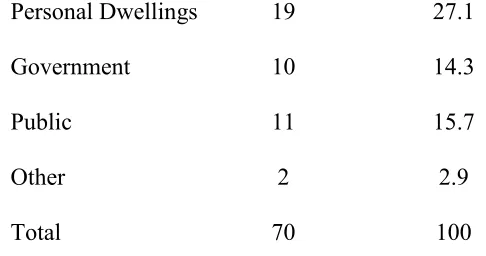
In scenes with camera surveillance images, images were most prevalently
capturedat the location of a private company, occurring in 28 scenes (40%). This was
then followed by images captured in personal dwellings with 19 scenes (27.1%), in public
with 11 scenes (15.7%), followed by in government buildings with ten scenes (14.3%)
and other locations with two scenes (2.9%). For location of viewingor reviewingcamera
surveillanceimages, 24 (34.3%) images were viewed at a private company, 22 images
(31.4%) in government locations, 17 images (24.3%) in personal dwellings, three images
(4.3%) in public, and four images (5.7%) in other locations. In this respect, the location of
camera surveillance devices as well as the location of viewing and reviewing camera
surveillance images both occurred most frequently within locations owned by a private
company. (See Table 1 for space in which images were captured and Table 2 for the
location of viewing and reviewing camera surveillance images).
Table 1: Space in which Images Were Captured
Number Percentage
Personal Dwellings 19 27.1
Government 10 14.3
Public 11 15.7
Other 2 2.9
Total 70 100
Table 2: Location of Viewing and Reviewing Images
Number Percentage
Private Company 24 34.3
Personal Dwellings 17 24.3
Government 22 31.4
Public 3 4.3
Other 4 5.7
Total 70 100
As well, in 37 scenes with camera surveillance images the images were captured
and viewed within the same location. Therefore, if the image was captured on private
property, there was approximately a 50 per cent chance that the image was also viewed
within that same private property. As an example, if an incident occurred at a casino or
airport, the image was viewed from the security room of these locations. If the location of
the camera surveillance was at a home the image was also viewed in another location of
the home. For instance, in Fracture, Ted Crawford (played by Anthony Hopkins) – a
wealthy entrepreneur – uses his camera surveillance to see if others outside of his home
commence his clever plan of being acquitted of his wife’s murder. However, in over half
of the scenes with camera surveillance images the images were viewed from different
locations than where the image took place. In The Bourne Ultimatum, for instance, a
reporter is followed by camera surveillance located in a train station, but the images are
being observed from the headquarters of the CIA. In Eagle Eye, a camera surveillance
drone is surveilling a small city in the Middle East while the images are being viewed
from a US military base. It thus appears as if camera surveillance can transcend
boundaries of space.
The majority camera surveillance images – 48 images (68.6%) – were captured
from camera surveillance intended to surveil. There were 19 camera surveillance images
(27.1%) captured from devices not intended to be used as surveillance, such as TV
broadcasts and print news (where approximately half of these images were found), as well
as handheld camcorders, webcams, cell phones, or cameras meant to capture sporting
events. For the remaining three camera surveillance images (4.3%) the type of camera
used to capture the image was unknown. Although the majority of images were from
camera surveillance, other means of capturing the image were also used, suggesting that
surveillance can not only be administered through a standard camera surveillance but
through any technology with the capability to capture an image.
Images Depicting Women and Minorities
In order to determine who the surveillerswereinthese films, 67 scenes with
camera surveillance images were eligible for coding. Two scenes were excluded because
the identity of the surveiller was unclear, and another was excluded because the image
was only viewed by artificial intelligence (in Eagle Eye). Of the eligible scenes with
specifically, when breaking down the 38 scenes with camera surveillance images, 27
scenes included women, 20 black men,and three included other racial minorities (Asian
and Arab). Five scenes depicted only female surveillers, ages ranging from adolescence to
middle-aged though all with upper class status. Only four scenes included black women.
Relatively few male and female surveillers seemed to be less than 30 years of age. Of the
67 scenes with camera surveillance images, 59 scenes included white men, whereas 29
(43.3%) included only white men, and 40 scenes included men of all races.No persons of
lower socioeconomic standing – as identified through character backstories in the film –
were depicted as surveillers.
Men were depicted far more often as surveillers than women, and women were
typically only surveillers when paired with men. Furthermore, although it would appear
that racial minorities were depicted often, black male surveillers were usually always in
the presence of and outnumbered by white male surveillers. Only on one occasion was the
sole surveiller black and on only one occasion did black surveillers outnumber white.
Therefore, the most frequently depicted surveiller is a white man, typically middle-aged.
As well, almost all of the surveillers were in positions of power, not just because they
were the ones surveilling but because they belonged to a state apparatus or private
security firm, and thus were granted permission to gaze.
It can be established that none of these films were sub-veillance films as defined
by Lake (2010). It appears that sub-veillance films are not as popular as traditional
surveillance films. However, there was a higher likelihood of finding sub-veillance scenes
embedded within traditional surveillance films. The presence of sub-veillance scenes was
still few and far between though. In the 30 films chosen, the only film to closely resemble
her adolescent daughter who are forced to spend the first night in their new apartment
trapped in their panic room while robbers break into their home. These women watch as
the robbers struggle to break into the panic room in order to get something of value that is
inside. For approximately three quarters of the film the women were the surveillers and
thus these were sub-veillance scenes. However, towards the end of the film the men
became the surveillers.
There were 57 eligible coded scenes with camera surveillance images for
surveillance subjects. Five scenes with camera surveillance images were excluded since
the images involved unknown subjects, indicating that although a person was in the
camera surveillance image their face was concealed. As well, an additional eight scenes
were excluded since images depicted objects (including vehicles, houses, and images of
written materials). Examining the race and sex of surveillance subjects, 25 camera
surveillance images (43.9%) included women and minorities: 14 included women (no
black women were depicted), eight were black men, and four included other minorities
(Hispanic, Asian, and Arab). Of the 57 scenes with camera surveillance images, 32
images (56.1%) included only white men. Thus, the typical surveillance subject was a
white man.
Reasons for Surveillance
There was large variation concerning why surveillance occurred, though there
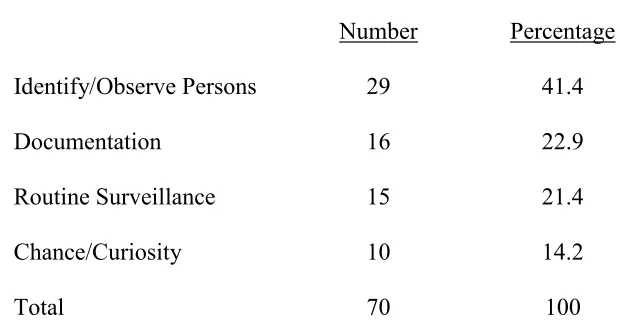
were several broad reoccurring themes. The most common reason for surveillance was
identifying or observing criminal suspects or persons of interest through camera
surveillance, which occurred in 29 scenes with camera surveillance images (41.4%). This
is discussed in greater detail below in the subsection on ‘The Efficacy of Camera
– occurring in 15 scenes (21.4%) – in which individuals usually noticed something of
interest through their routine monitoring of camera surveillance. In these circumstances,
surveillance systems were already established in a static location prior to knowledge of
events taking place, and any discovery was made as a result of individuals consistently
watching these cameras. For example, in the film After the Sunset, a camera surveillance
system was established around a valuable diamond to prevent theft. While watching the
camera surveillance, security officers witnessed a robbery taking place. Another common
reason for surveillance was that the camera that had captured the image was originally
used for documentation, occurring in 16 scenes (22.9%). In these circumstances, the
image was initially used to document a character’s personal life or some event but
through different circumstance became used for surveillance. For instance, in The Perfect
Getaway, a couple documented their wedding through pictures on a handheld camcorder,
and these pictures later provided a major plot change within the film. Furthermore, the
documentation on some occasions occurred due to news sources. In Showtime, a
television news channel overhears of a potential story on a police scanner and decides to
head to the location in order to film where this story may develop. At the same time a
drug deal is taking place, and moments later the dealers see their hideout on television
and assume the others involved in the drug transaction are police officers.
Ten scenes with camera surveillance images (14.2%) displayed the capturing of an
event on camera surveillance due simply to chance or curiosity. For example, a couple in
the film Vacancy is forced to spend the night in an isolated motel. The husband becomes
curious of the videotapes that happen to be on top of the television and decides to put one
of the tapes into the VCR. He watches the video as horrific (but believed at the time to be
examines it closely and begins to realize that the room depicted in the image is the exact
same room that he and his wife currently occupy. The couple eventually realizes that they
have entered a motel where people are murdered and videotaped for sport. In some scenes
with camera surveillance images the camera surveillance system was already established
but there was no routine observation of it. In Panic Room, Meg Altman (Jodie Foster) has
returned to her bed from a midnight bathroom run, though before she can return to sleep
she is disturbed by a blinding, bright light from the panic room in her bedroom. While in
the room to turn this light off, she notices movement in the camera surveillance image,
and begins to realize that there are strangers in her house. (See Table 3 for a summary of
the general reasons surveillance was undertaken).
Table 3: Reasons for Surveillance
Number Percentage
Identify/Observe Persons 29 41.4
Documentation 16 22.9
Routine Surveillance 15 21.4
Chance/Curiosity 10 14.2
Total 70 100
Regarding the general reasons why individuals are targeted for surveillance, it
would appear that these films did not depict social inequalities. For instance, women were
generally not the targets of surveillance by a voyeuristic male gaze. Black men were
rarely the targets of surveillance, and when they were it was usually for unjust reasons
such as in Enemy of the State where the targeting of a black man occurred because of a