University of Windsor University of Windsor
Scholarship at UWindsor
Scholarship at UWindsor
Electronic Theses and Dissertations Theses, Dissertations, and Major Papers
2013
Optimization of PHEV Power Split Gear Ratio to Minimize Fuel
Optimization of PHEV Power Split Gear Ratio to Minimize Fuel
Consumption and Operation Cost
Consumption and Operation Cost
Yanhe Li
University of Windsor
Follow this and additional works at: https://scholar.uwindsor.ca/etd
Recommended Citation Recommended Citation
Li, Yanhe, "Optimization of PHEV Power Split Gear Ratio to Minimize Fuel Consumption and Operation Cost" (2013). Electronic Theses and Dissertations. 4750.
https://scholar.uwindsor.ca/etd/4750
This online database contains the full-text of PhD dissertations and Masters’ theses of University of Windsor students from 1954 forward. These documents are made available for personal study and research purposes only, in accordance with the Canadian Copyright Act and the Creative Commons license—CC BY-NC-ND (Attribution, Non-Commercial, No Derivative Works). Under this license, works must always be attributed to the copyright holder (original author), cannot be used for any commercial purposes, and may not be altered. Any other use would require the permission of the copyright holder. Students may inquire about withdrawing their dissertation and/or thesis from this database. For additional inquiries, please contact the repository administrator via email
Optimization of PHEV Power Split Gear Ratio to
Minimize Fuel Consumption and Operation Cost
by
Yanhe Li
A Thesis
Submitted to the Faculty of Graduate Studies
through Electrical and Computer Engineering
in Partial Fulfillment of the Requirements for
the Degree of Master of Applied Science at the
University of Windsor
Windsor, Ontario, Canada
2012
Optimization of PHEV Power Split Gear Ratio to Minimize Fuel
Consumption and Operation Cost
by
Yanhe Li
APPROVED BY:
______________________________________________ Dr. Nader Zamani
Department of Mechanical Automotive & Material Engineering
______________________________________________ Dr. Xiang Chen
Department of Electrical and Computer Engineering
______________________________________________ Dr. Narayan C. Kar, Advisor
Department of Electrical and Computer Engineering
______________________________________________ Dr. Jonathan Wu, Chair of Defense
DECLARATION OF ORIGINALITY
I hereby certify that I am the sole author of this thesis and that no part of this thesis has been published or submitted for publication.
I certify that, to the best of my knowledge, my thesis does not infringe upon anyone’s copyright nor violate any proprietary rights and that any ideas, techniques, quotations, or any other material from the work of other people included in my thesis, published or otherwise, are fully acknowledged in accordance with the standard referencing practices. Furthermore, to the extent that I have included copyrighted material that surpasses the bounds of fair dealing within the meaning of the Canada Copyright Act, I certify that I have obtained a written permission from the copyright owner(s) to include such material(s) in my thesis and have included copies of such copyright clearances to my appendix.
ABSTRACT
A Plug-in Hybrid Electric Vehicle (PHEV) is a vehicle powered by a combination of an internal combustion engine and an electric motor with a battery pack. The battery pack can be charged by plugging the vehicle to the electric grid and from using excess engine power. The research activity performed in this thesis focused on the development of an innovative optimization approach of PHEV Power Split Device (PSD) gear ratio with the aim to minimize the vehicle operation costs.
Three research activity lines have been followed:
Activity 1: The PHEV control strategy optimization by using the Dynamic Programming (DP) and the development of PHEV rule-based control strategy based on the DP results.
Activity 2: The PHEV rule-based control strategy parameter optimization by using the Non-dominated Sorting Genetic Algorithm (NSGA-II).
ACKNOWLEDGEMENTS
I would like to express my earnest gratitude to my advisor, Dr. Narayan C. Kar. His guidance, assistance, patience, and encouragement have been of enormous importance to my research and the completion of the thesis. I would also like to thank my other committee members, for their helpful advice and comments.
It has been a great pleasure working in the CHARGE Lab at University of Windsor as a Master student. Many thanks to my fellow graduate students for their help, discussion, and all the good times we have had in the office: Anas Labak, Saeedeh Hamidifar, Seyed Mahdi Mousavi Sangdehi, Syeda Fatima Ghousia, Debarshi Biswas, Tudor Julien Carciumaru, James E. Kettlewell, Matthew L. Hurajt, Maryam Kazerooni, Golam Md. Zubaer Kaiser Khan andXiaomin (Sherry) Lu.
TABLE OF CONTENTS
DECLARATION OF ORIGINALITY ... iii
ABSTRACT ... iv
DEDICATION TO MY WIFE AND MY DAUGHTER ...v
ACKNOWLEDGEMENTS ... vi
NOMENCLATURE ...x
LIST OF TABLES ... xvii
LIST OF FIGURES ... xviii
CHAPTER I. INTRODUCTION 1.1 Motivation ...1
1.2 HEV Technologies Introduction ...7
1.3 Power Split Device Architecture Introduction ...12
1.4 Literature Review ...14
1.4.1 Modeling power-split system ...14
1.4.2 Energy management optimization of power-split HEVs ...15
1.4.3 Control strategy of power-split HEVs ...16
1.5 Contribution ...18
1.6 Outline of the Thesis ...20
II. MODELING PHEV SYSTEMS 2.1 Introduction ...21
2.2 Engine Model ...22
2.3 Motor/Generator Model ...23
2.4 Battery Model ...26
2.5 PSD Model...28
2.6 Powertrain Dynamic Model ...29
2.7 Vehicle Model ...31
2.8 Summary ...32
3.3 Dynamic Programming ...35
3.4 Reduction of Dynamic Programming Grid Size ...39
3.5 Simulation Results ...40
3.6 Summary ...41
IV. PHEV RULE-BASED CONTROL STRATEGY 4.1 Introduction ...45
4.2 PHEV Torque Balance Control ...46
4.3 PHEV Operation Modes ...47
4.4 Design of PHEV Energy Management Control Strategy ...48
4.5 Simulation Results ...53
4.6 Summary ...56
V. RULE BASED CONTROL STRATEGY PARAMETERS OPTIMIZATION 5.1 Introduction ...57
5.2 GA Terminology and Definition ...59
5.3 NSGA-II Description ...60
5.4 NSGA-II Objective Functions ...66
5.5 Simulations ...69
5.5.1. Baseline simulation ...69
5.5.2. Objective optimization for PSD gear ratio =3.0 ...69
5.5.3. Control strategy parameters optimization for PSD gear ratio =3.0 ...72
5.6 Summary ...79
VI. OPTIMAL DESIGN OF PSD GEAR RATIO 6.1 Introduction ...80
6.2 Determination of Initial PSD Gear Ratio ...81
6.3 PSD Planetary Gear Ratio Numerical Analysis ...83
6.3.1. Initial planetary gear ratio ...83
6.4 Planetary Gear Condition of Assembly ...86
6.5. PSD Gear Ratio Optimization Design ...87
6.6 Summary ...95
VII. CONCLUSIONS AND FUTURE WORKS 7.1 Summary and Conclusion ...97
7.2 Future Works ...99
APPENDIX A PHEV Vehicle Specification ...100 APPENDIX B UDDS and HWFET Driving Cycles ...101
REFERENCES ...103
NOMENCLATURE
List of Abbreviation
AERO All Electric Operation Range
AHS Allison Hybrid System
CAA Clean Air Act
CAFÉ Corporate Average Fuel Economy
CARB California Air Resources Board
CD Charge-Depleting
CS Charge-Sustaining
CVT Continuously Variable Transmission
DP Dynamic Programming
ECM Equivalent Fuel Consumption Minimization
ECMS Equivalent Consumption Minimization Strategy
EIA Energy Information Administration
EPA Environmental Protection Agency
EV Electric Vehicles
EVT Electric Variable Transmission
GA Genetic Algorithm
HEV Hybrid Electric Vehicles
LPG Liquefied Petroleum Gas
NSGA Non-dominated Sorting Genetic Algorithm
PHEV Plug-in Hybrid Electric Vehicles
PMP Pontryagin’s Minimum Principle
PSD Power Split Device
RESS Rechargeable Energy Storage System
SOC State of Charge
SQP Sequential Quadratic Programming
THS Toyota Hybrid System
UDDS Urban Dynamometer Drive Schedule
ULEVs Ultra Low Emission Vehicles
VTB Virtual Test Bed
ZEVs Zero Emission Vehicles
List of Symbols
F
A Frontal area of vehicle
D
C Coefficient of aerodynamic drag
F PSD internal foce
Fg Local gravitation force
Fr Rolling resistance force
Ft, , Force required at the vehicle wheel
lv
H Lower heating value of fuel
i Gear ratio between sun gear and carrier
Ic Inertia of carrier
idistance Crowding distance
Ie Inertia of engine
Ig Inertia of generator
Im Inertia of motor
Ir Inertia of ring gear
irank Nondomination rank
Is Inertia of sun gear
e
I
Combined inertia of enginem
I
Combined inertia of motorg
I Combined inertia of generator
f
m Engine fuel mass flow rate
O() Computation burden
Pbatt Battery power output
fuel
P Fuel consumption rate in MJ in MJ/time step
electric
P Power through the battery in MJ/time step
Pdem Demanded power
PMG MG power
Pt Population
Q Battery capacity
Qt Population after selection, crossover, and mutation
Rint Internal resistance
Rt Combined population
Rtire Radius of tire
SOCmax Lowest desired battery SOC
SOCmin Highest desired battery SOC
Tbrake Torque of hydraulic brake
Te Engine torque
Te_dr Torque from engine to driveline
Te_max Engine maximum torque
Te_min_opt Engine optimal lower torque
Te_opt Engine optimal torque
Te_start Engine start torque
Te-off Engine shut off torque
f
T Torque of final driveline
TMG MG torque
Tm-hi Maximum motor driving torque
Tm-lo Maximum motor driven torque
Tr Torque of ring gear
Treq Toque required on the wheel
Ts Torque of sun gear
Twheel Wheel torque
u Normal vector of plane A
v Normal vector of plane B
Zc Tooth number of carrier
Zf, Final gear ratio
Zr Tooth number of ring gear
Zs Tooth number of sun gear
Gradient of road
αe_opt_high Desired engine highest torque coefficient
αe_opt_low Desired engine lowest torque coefficient
αg_charge Desired generator charge torque coefficient
αm_discharge Desired motor discharge torque coefficient
fuel
Fuel convert energy consumption in MJ/time step
electric
Electricity convert energy consumption in MJ/time step
Energy price ratio
ωe_lau Engine Lowest speed
e
Engine speedMG
MG speeds
Speed of sun gearr
Speed of ring gears
Acceleration of sun gearr
Acceleration of ring gearc
Acceleration of carrierlau e_
Engine launch speed1
Engine directly driving efficiency
2
Motor directly driving efficiency
e
Engine efficiency at specified torque and speed
MG
MG efficiency at specified torque and speed
Grid
Charging efficiency
)
,
(
A
B
Angle between plane A and B Air density
n
LIST OF TABLES
Table 1.1. Euro VI – 2011/582/EC Engine Emission Standard ...2
Table 1.2. Heavy Duty Highway Compression-Ignition Engines & Urban Buses - Exhaust Emission Standards ...3
Table 1.3. Comparison of Emissions and Fuel Cost of X-vehicles ...9
Table 3.1. The Selected Grid Points in DDP ...41
Table 4.1 PHEV Operation Mode Analysis ...49
Table 4.2 Parameters of the PHEV Rule-based Control Strategy ...51
Table 4.3. Baseline Parameters of Rule–based PHEV Control Strategy ...51
Table 4.4. PHEV “IF-THEN” Rule-based Control Strategy ...52
Table 5.1. NSGA-II Elitism Procedure ...65
Table 5.2. PHEV Operations Costs and Fuel Consumptions with Baseline Rule–based Control Strategy ...73
Table 5.3. Objectives of the Output – 20 Tradeoff Solutions for 3 HWFET Driving Cycles ...74
Table 5.4. PHEV NSGA-II Simulation Results in UDDS Driving Cycles – Control Strategy Parameters and Operations Costs ...77
Table 5.5. PHEV NSGA-II Simulation Results in HWFET Driving Cycles – Control Strategy Parameters and Operations Costs ...78
Table 6.1. The Tooth Number Which Meet the Condition of Assembly From Gear Ratio 2.6 to 3.4 ...86
Table 6.2. The Differences of the Maximum and Minimum Fuel consumptions at Gear Ratio 2.6 to 3.4 ...88
Table A.1. PHEV Vehicle Specification...100
LIST OF FIGURES
Figure 1.1. World crude oil price have increased over 400% since 1998 (EIA, 2011) ...4
Figure 1.2. US HEV Sales ...7
Figure 1.3. HEV Configurations ...11
Figure 1.4. Single mode PSD system (Source: adapted from [5]) ...14
Figure 1.5. Dual mode PSD system (Source: adapted from [5]) ...14
Figure 1.6. PHEV configuration and energy flow ...18
Figure 2.1. Flow diagram of the backward-looking model ...21
Figure 2.2. Flow diagram of the forward-looking model ...21
Figure 2.3. Inputs and outputs of the engine model ...22
Figure 2.4. Engine fuel consumption map ...23
Figure 2.5. Inputs and outputs of the Motor/Generator model ...24
Figure 2.6. Generator efficiency map ...25
Figure 2.7. Electric motor efficiency map ...25
Figure 2.8. Inputs and outputs of the battery model ...26
Figure 2.9. Battery electrical equivalent circuit ...26
Figure 2.10 Battery internal resistance map with SOC ...27
Figure 2.11. Battery open circuit voltage map with SOC ...27
Figure 2.12. PHEV planetary gear set ...28
Figure 2.13. Free body diagram of planetary gear set ...30
Figure 2.14. Free body diagram of powertrain ...30
Figure 2.15. Vehicle free body diagram ...31
Figure 3.1. Numerical dynamic programming algorithm ...38
Figure 3.2. The limit trajectory boundaries ...40
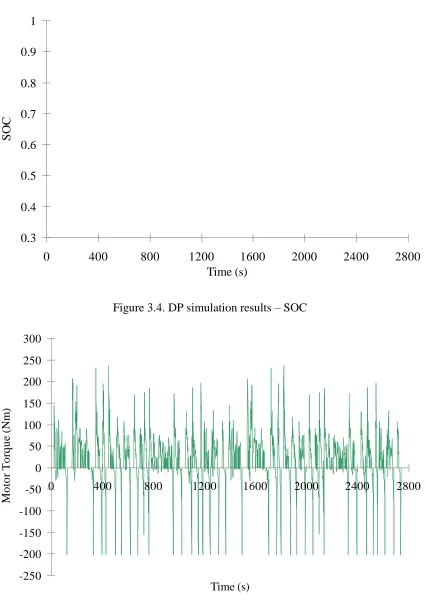
Figure 3.4. DP simulation results – SOC ...43
Figure 3.5 DP simulation results – Motor Torque ...43
Figure 3.6. DP simulation results – Engine Torque ...44
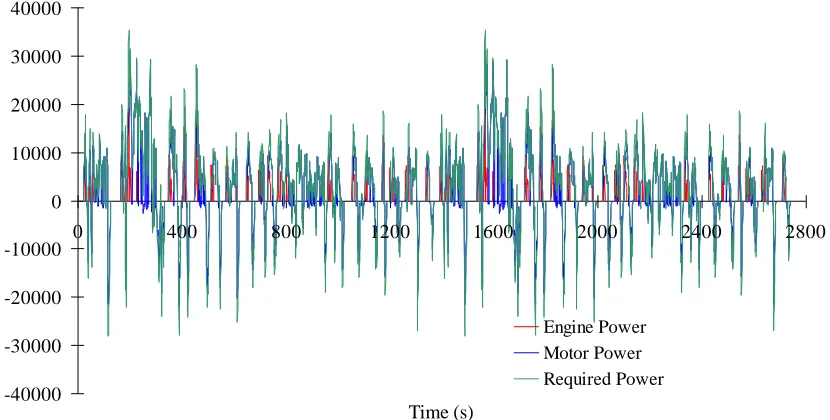
Figure 3.7. DP simulation results – Power ...44
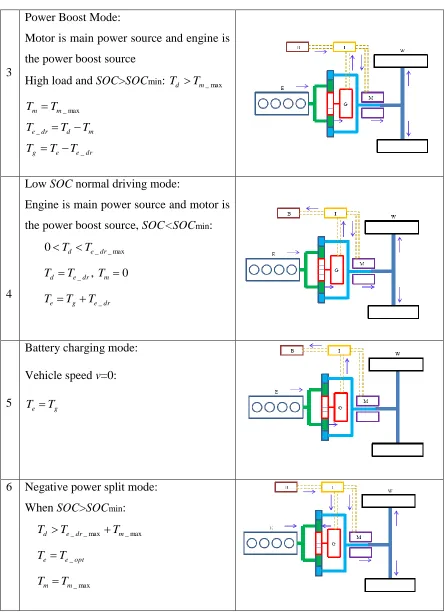
Figure 4.1. PHEV basic operation modes ...48
Figure 4.2. Rule-based Control Strategy simulation results – SOC ...54
Figure 4.3. Rule-based Control Strategy simulation results – Motor Torque ...54
Figure 4.4. Rule-based Control Strategy simulation results – Engine Torque ...55
Figure 4.5. Rule-based Control Strategy simulation results – Power ...55
Figure 5.1. Pareto optimal front ...60
Figure 5.2. Crowding-distance calculation ...63
Figure 5.3. NSGA-II Procedure ...64
Figure 5.4. The flowchart of multi-objective optimization algorithm of NSGA-II ...67
Figure 5.5. NSGA-II Pareto optimal results for UDDS ...75
Figure 5.6. NSGA-II Pareto optimal results for HWFET ...76
Figure 6.1. Flow chat of six-step approach to design PHEV PSD gear ratio ...81
Figure 6.2. Relationship between characteristic speed plane with maximum vehicle performance plane ...82
Figure 6.3. Planetary gear ratio versus maximum ring gear speed (r,max) ...84
Figure 6.4. Planetary gear ratio versus maximum carrier speed (c,max) ...84
Figure 6.5. Planetary gear ratio versus maximum sun gear speed (s,max) ...85
Figure 6.6. Initial PSD gear ratio ...85
Figure 6.7. Fuel consumption and operation cost for 1 UDDS driving for various PSD gear ratios ...89
Figure 6.9. Fuel consumption and operation cost for 3 UDDS driving cycles for various PSD gear ratios ...91 Figure 6.10. Fuel consumption and operation cost for 1 HWFET cycle for various PSD gear ratios ...92 Figure 6.11. Fuel consumption and operation cost for 2 HWFET driving cycles for
various PSD gear ratios ...93 Figure 6.12. Fuel consumption and operation cost for 3 HWFET driving cycles for
CHAPTER 1
INTRODUCTION
1.1 Motivation
The automobile has been making great contribution to our civilization since it was
invented over a century ago. It has become the necessary choice of transportation in our
daily life. In most countries, the automotive industry also has become one of the most
important segments. However, automobiles also are bringing the serious energy and
environmental problems to our communities due to the large amount of green-house gas
emissions accompany with the huge energy consumption. In the five major fuel
consuming sectors contributing to CO2 emission from fossil fuel combustion, 33% is
from the transportation sector in 2009 [1].
Because of the recognition of the influence of automotive to the environment, most of the
countries enacted the stringent emission standards. The European Union introduced the
emission Directive 2005/55/EC and its implementing Directive 2005/78/EC as amended
by 2006/51/EC, 2008/74/EC and 2011/582/EC and applies to all trucks, lorries and buses
sold in the EU market. This Directive lays down limit values for emissions of gaseous
and particulate pollutants and for the opacity of exhaust fumes from diesel, natural gas
and liquefied petroleum gas (LPG) engines, known as Euro IV, Euro V and Euro VI.
Table 1.1 is the Euro VI – 2011/582/EC which is the latest EU directive engine emission
The US emission standards were set by the Environmental Protection Agency (EPA),
which was formed in 1970 to develop and enforce regulations to protect the environment.
These standards focus on limiting the production of harmful tailpipe pollutants. Table 1.2
lists the heavy duty highway compression-ignition engines & urban buses exhaust
emission standards. The standards adopted after 2007 are more stringent levels on
NMHC, NOx, and PM compared with those between 2004 and 2006.
At the same time, because of decreasing global crude oil supplies, the price of crude oil,
according to the US Energy Information Administration (EIA) (2011) [2], is over 500%
higher than ten years ago (Figure 1.1) and is likely to continue to surge in the future
Table 1.1. Euro VI – 2011/582/EC Engine Emission Standard
Note: 1) Admissible level of NO2 may be defined later
2) Measurement procedure to be introduced by Dec. 31, 2012
3) Particle number limit shall be introduced by Dec. 31, 2012
C.I. - Compression Ignition; P.I. - Positive Ignition
WHTC - World Heavy Duty Transient Cycle
WHSC - World Heavy Duty Steady State Cycle
CO HC NMHC H4 NOx1) NH3 PM Mass PM Number 2)
mg/kWh ppm mg/kWh #/kWh
WHSC (C.I.) 1500 130 400 10 10 8×10¹¹
WHTC (C.I.) 4000 160 460 10 10 6×10¹¹
Table 1.2. Heavy Duty Highway Compression-Ignition Engines & Urban Buses -
Exhaust Emission Standards
Year
HC NMHC NMHC+NOx NOx PM CO Idle CO Smoke Useful Life Warranty Period
(g/bhp-hr) (% exhaust gas flow) (%)
(hrs/yrs/mile
s) (yrs/miles)
2004-2006 -
2.4 (or 2.5 with
a limit of 0.5 on
NMHC)
- 0.05 15.5 0.5 20/15/50
LHDDE:
-/10/110,000
MHDDE:
-/10/185,000
HHDDE:
22,000/10/
435,000
LHDDE:
5/50,000
All other HDDE:
5/100,000 2007+ - 0.14
2.4 (or 2.5 with
a limit of 0.5 on
NMHC)
0.2 0.01 15.5 0.5 20/15/50
Note: HHDDE - Heavy Heavy-Duty Diesel Engines
MHDDE - Medium Heavy-Duty Diesel Engines
LHDDE - Light Heavy-Duty Diesel Engines
because of shrinking oil supplies. Although Corporate Average Fuel Economy (CAFE)
was enacted by the US Congress in 1975 and sets fuel economy standards for cars and
light trucks (trucks, vans, and sport utility vehicles) sold in the US. The discussion of
reduction of fuel consumption is significant in the past fifteen years regarding shrinking
oil supplies and increasing oil demands. Future legislation is focused on reducing fuel
consumption and greenhouse gas emissions starting in 2013 based on EPA program
announcement. The program will include a range of targets which are specific to the
diverse vehicle types and purposes. Vehicles are divided into three major categories:
combination tractors (semi-trucks), heavy-duty pickup trucks and vans, and vocational
structure allows serious but achievable fuel efficiency improvement goals charted for
each year and for each vehicle category and type. By the 2018 model year, the program is
expected to achieve significant savings relative to current levels, across vehicle types.
Certain combination tractors – commonly known as big-rigs or semi-trucks – will be
required to achieve up to approximately 20 percent reduction in fuel consumption and
greenhouse gas emissions by model year 2018, saving up to 4 gallons of fuel for every
100 miles traveled. For heavy-duty pickup trucks and vans, separate standards are
required for gasoline-powered and diesel trucks. These vehicles will be required to
achieve up to approximately 15 percent reduction in fuel consumption and greenhouse
gas emissions by model year 2018. Under the finalized standards a typical gasoline or
diesel powered heavy-duty pickup truck or van could save one gallon of fuel for every
100 miles traveled. Vocational vehicles – including delivery trucks, buses, and garbage
trucks – will be required to reduce fuel consumption and greenhouse gas emissions by
approximately 10 percent by model year 2018. These trucks could save an average of one
gallon of fuel for every 100 miles traveled.
So the studies on fuel-saving and emission-reduction have been popular in recent years.
Most of the auto makers are looking the solutions from the Hybrid Electric Vehicles
Figure 1.1. World crude oil price have increased over 400% since 1998 (EIA, 2011)
Shortly after the US Congress adopted the 1990 Clean Air Act (CAA) Amendments, California state passed the “Low Emission Vehicle/Clean Fuel” program. California’s
emission limitation plan [3] was created by California Air Resources Board (CARB) and
sets a more stringent emission standard for CO, NOx, and formaldehyde. All the vehicles
sold in California by a manufacturer in a given year must meet an overall "fleet average"
emission requirement. The fleet average emissions requirement took effect in 1994 and
declines each year until 2003. Fleet averaging allows automobile manufacturers
flexibility to determine the volume and class of vehicle to manufacture and sell. The only
ZEVs in 1998, increasing to five percent in 2001 and to ten percent in 2003. Although the
auto makers invested a large amount of the money to develop the ZEVs, the public did
not show the enthusiasm to the pure battery powered vehicles. Honda announced to stop
the manufacture the EV-plus after 2 years launch, and GMC also did not make the EV1
after 2000 because of the low market demands.
Because of the major barriers to the immediate introduction of the electric vehicle:
insufficient battery capacity, lack of needed infrastructure, unresolved problems about the
safety, consumer resistance, and significantly higher purchase prices than conventional
automobiles, CARB revised the mandatory vehicle requirement for ZEVs and allowed
60% of the ZEVs can be replaced by the Ultra Low Emission Vehicles (ULEVs). Toyota
successfully introduced its HEV car Prius on the Japanese, European, and US markets
and proved that HEV is the new generation of the energy-saving vehicles and easy to be
accepted by the customers. HEV sales in US is growing steadily (Figure 1.2) [4]. From
1999, the first HEV sold in US, to 2010, almost 2 millions HEV on US roads. Although
there are still many unsolved challenges on the technologies and markets, the HEV,
particularly PHEV seems to be the most promising short-term solutions to reduce the fuel
consumption and emissions.
PHEVs with oversized batteries that can also be recharged using electric power from the
grid, have recently become a hot topic in the automotive industrial because of the
undoubted advantages in terms of emissions and fuel consumption deriving from the
Figure 1.2. US HEV sales
General Motor (GM) introduced the first PHEV “Chevrolet Volt” in US market in 2011 although GM called it “Extended-range Electric Vehicle”. However, PHEVs present
some additional challenges for control and optimization, due to the necessity of
accounting for the cost, energy depletion and pollution due to the use of electrical energy
in place of the fuel.
1.2 HEV Technologies Introduction
Per SAE J1711, the definition of an HEV is “A road vehicle that can draw propulsion
energy from both of the following sources of stored energy: 1) a consumable fuel and 2) a
rechargeable energy storage system (RESS) that is recharged by an electric
that is covered in this study is limited to the gasoline. RESS that is covered in this study
is the battery.
Comparing with the conventional vehicles, HEVs or PHEVs not only reduce the
green-house gas emissions, but also have less fuel cost (Table 1.3) [5]. HEVs were categorized
into serial and parallel HEV on the conventional concept. As the HEV development
getting more and more attentions, various designs and technologies emerge and were
applied to the production vehicles. The categorization and evaluation of HEV have been
an important project to be studied to direct the HEV development and research [6-9].
Considering the HEV powertrain functions, architectures, and vehicle packages, the
design of the HEV powertrain has a high level of degree of freedom. These designs can
be categorized by their degrees of hybridization or their powertrain configurations.
Based on the degree of hybridization, the HEVs can be categorized full hybrid and mild
hybrid. The hybridization always is determined into the ratio of the power of the
propulsion motor to that of the engine. A full hybrid, sometimes also called a strong
hybrid, is a vehicle that can run on just the engine, just the batteries, or a combination of
both. The full HEV can be operated at different distinct regimes: electric mode, cruise
mode, overdrive mode, battery charge mode, power boost mode, and negative split mode.
Mild hybrids are essentially conventional vehicles with some degree of hybrid hardware,
but with limited hybrid feature utilization. Typically they are a parallel system with
start-stop only or possibly in combination with modest levels of engine assist or regenerative
Table 1.3. Comparison of Emissions and Fuel Cost of X-vehicles
Emissions and Fuel Cost for a 100-Mile Trip
Vehicle Greenhouse Gas Emissions Total Fuel Cost
(compact sedans) (pounds of CO2 equivalent) (U.S. Dollars)
Conventional 87 lb CO2 $13.36
Hybrid Electric 57 lb CO2 $8.78
Plug-in Hybrid Electric 62 lb CO2 $7.10
All-Electric 54 lb CO2 $3.74
all-electric propulsion. A plug-in hybrid electric vehicle is one of the full hybrids, able to
run in electric-only mode, with larger batteries and the ability to recharge from the
electric power grid. And can be parallel or series hybrid designs. They are also called
gas-optional, or griddable hybrids. Their main benefit is that they can be
gasoline-independent for daily commuting, but also have the extended range of a hybrid for long
trips. Basically, the higher the hybridization the vehicle is, the more improvement of the
fuel economy and emissions are. The hybridization of Honda Civic is 15.9% which is the
mild hybrid. The hybridization of Toyota Prius is 62.3% which is the full hybrid.
Based on the powertrain system design, several kinds of hybrid electric vehicles have
been conceived, usually distinguished by their architecture, which is related to the path
that the power flow follows from the energy sources to the wheels. They are (see Figure
1.3):series hybrid, parallel hybrid, and power-split hybrid.
The series configuration is the simplest architecture in the hybrid electric vehicles. The
into the electric power and supplies the power to the power storage device through the
inverter, or to the propulsion motor directly. The serial HEV is driven by the propulsion
motor. The engine, as the auxiliary driving unit, extends the driving range of the vehicle.
The motor power is supplied by either a power-storage device, or a generator, or the
combination of both with a split ratio determined by the power management controller.
Since the engine operation is independent of the vehicle speed and road condition, it is
controlled to operate near its optimal condition most of the time. In addition, because the
mechanical power transition path is eliminated, the energy loss due to the torque
converter and the transmission is avoided. However, because of more processes to
convert and transform, the energy from the engine to the wheels results in the lower
efficiency. In addition, all of the serial elements, such as the engine, generator, and motor,
need the extra stand-by powers to meet the vehicle dynamics requirements.
In a parallel configuration, the single electric motor and the engine are installed such that
they can power the vehicle either individually or together. The engine mainly supplies the
power to drive the vehicle. Meanwhile the motor works as the auxiliary power unit. The
role of the motor is to assist the engine to operate efficiently and to capture regenerative
braking energy. Comparing with the series HEV, the engine is larger and more powerful,
while the motor is smaller and less powerful. The main advantage of the parallel hybrid
vehicle is the relatively high efficiency. The engine power is directly transferred to the
wheels and therefore no power conversion is needed. The main disadvantage of the
parallel hybrid vehicle is the engine speed is directly coupled to the vehicle speed and
road condition and therefore the engine can not be operated in the most economic point
a) Series Hybrid
b) Parallel hybrid
c) Power-split hybrid
Figure 1.3. HEV configurations
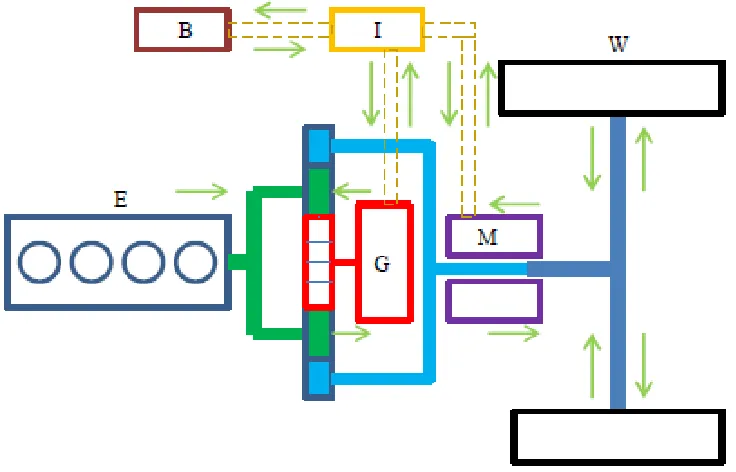
B: Battery
E: Engine
G: Generator
I: Inverter
M: Motor
T: Transmission
W: Wheel
-: Electric Link
The power-split configuration (also called series-parallel HEV) combines the parallel and
series powertrains. The power from the engine is split. One part of the power is
transferred to the wheels through a mechanical path. The other part flows to the wheels
via the electric path, which consists of the generator and the electric motor. A power split
device (PSD), which is a planetary gear set, connects the engine, motor, and generator to
work as a continuously variable transmission (CVT) and provides the advantage of
adjusting the engine in the economic operation range. The generator is used to control the
engine speed, the motor controls the engine torque. The generator is also used to convert
excessive engine power to electric power that can be stored in the battery. The motor is
operated for the power supply and for the recovery of energy during braking. Since only a
small part of the engine power flows through the electric path, most of the power will be
directly transferred to the wheels via a mechanical connection. This mechanical
connection has a high efficiency. Therefore, the efficiency of the power-split
configuration is high compared to the series.
1.3 Power Split Device Architecture Introduction
The earliest development of the power split mechanisms can be tracked back to 1969 [10].
But this power-split concept was not applied to passenger vehicles until the late 1990s.
The first production power-split passenger vehicle is the Toyota Hybrid System (THS)
[11] (Figure 1.4) which is known as the single mode PSD system. THS is vastly applied
on the Toyota HEVs, such as Prius, and becomes the front-runner on the market. The
advantage of the THS PSD is its relative simplicity and its increased performance over
competing hybrid designs. However, the performance and fuel economy at high speeds
high speed. This is common to many vehicle types, because actual driving conditions are
different than the idealized conditions in the laboratory testing, such as faster
accelerations and higher top speeds.
Another major design for power-split HEV on the market is the Allison Hybrid System
(AHSII) (Figure 1.5) [12] which is invented by GM as a dual-mode PSD system in 2003.
The main difference between single mode and dual mode PSD is the addition of clutches
and/or brakes to create different transmission configurations. This increases the number
of possible power flow paths through the transmission. The clutches are engaged and
disengaged based on the system information such as the engine/motor efficiency maps,
battery SOC, road load and driver demand to determine the operation mode. The dual-mode PSD system provides more efficient performance over a wider range of vehicle
loads than that achieved by the single-mode design. However, the additional mechanical
components will certainly increase both capital and maintenance costs.
Many other power split designs are developed by different companies. Bosch developed a
power split transmission with circulating power for the hybrid electric vehicles [13] in
2004. GETRAG tested their democar with axle-split and torque-split hybrid
transmissions to reduce the fuel consumption 24% and 35% respectively [14]. Ford
Motor Company installed the power split transmission in Ford Escape Hybrid and
brought to the market in 2004. Renault also developed a dual mode power split
Figure 1.4. Single mode PSD system (Source: adapted from [13])
Figure 1.5. Dual mode PSD system (Source: adapted from [13])
1.4 Literature Review
1.4.1 Modeling power-split system
The proper modeling and simulation tools can shorten the vehicle development timing,
reduce the development cost, validate the HEV control strategy, evaluate the vehicle
been done in the power split system modeling and simulation. A dynamic model (Zhang et al.) was created to evaluate an electric variable transmission (EVT) developed by Allison Transmission Division of General Motors [16]. The model is based on Kane's equations,
and the concept of generalized velocity is used. The EVT performance was simulated by
using the model. A mathematical model [17] of a vehicle with a power-split device based on
the steady-state performance was presented by the researchers from Michigan Technological
University (Rizoulis et al.). A math-based universal model [18] that presents different designs of power-split powertrains was created (Liu). This universal model presents the
powertrain dynamics regardless of the various connections of engine-to-gear,
motor-to-gear, and clutch-to-gear. A dynamic model (Zanasi et al.) of a planetary gear with internal elasticity [19] was presented. The model of the whole vehicle is given using the
Power-Oriented Graphs approach. A dynamic model [20] of a multi-regime hybrid
vehicle powertrain architecture (Wishart et al.) was presented to focus on the formulae governing the operation of the planetary gear systems in the powertrain and on the
performance of a more complex heavy-duty vehicle with varying loading conditions.
1.4.2 Energy management optimization of power-split HEVs
The research of the energy management optimizations has been done on the different
configuration of HEVs design. The global optimization and the local optimization of the
HEV energy management are two major research directions. The typical represents of the
global optimization are the Dynamic Programming (DP) [21]-[25] and Pontryagin’s
split HEVs energy management optimization have been published. Banvait et al. [35] studied the energy control strategy of the plug-in hybrid electric vehicle with PSD using
particle swarm optimization. Liu [36], [37] presented a stochastic dynamic programming
method and the equivalent consumption minimization strategy to optimize the single
mode power split HEV. Both approaches determine the engine power based on the
overall vehicle efficiency and apply the electrical machines to optimize the engine
operation. The performance of these two algorithms is assessed by comparing against the
simulation results. Bole [23] also presented a dynamic programming method and the
equivalent consumption minimization strategy to optimize the dual mode power split
HEV. The optimization results of dynamic programming and equivalent consumption
minimization compared with the developed rule-based control strategy simulation results.
Moura [24] presented a dynamic programming method with consideration of trade-off of
the fuel and electricity of usage and the fuel-to-electricity pricing to optimize the single
mode PHEV energy management.
1.4.3 Control strategy of power-split HEVs
The supervisory control system represents the vehicle level controller that coordinates the
sub-systems to satisfy certain performance targets. Control Strategy is the algorithm to make
the controller to achieve the vehicle energy management and control the power systems. It is
the vehicle “brain” and is the ultimate factor to determine the success or failure of a HEV
development. So far, most of the research on the HEV control strategy is still on the
computer simulation stage, particularly for the instantaneous optimal control strategy and the
vehicles because of the heavy burden computation and very expensive high performance
CPU. Although some vehicle OEMs, such as Toyota, GMC, Honda, are selling the HEVs
with developed control strategies, those control strategies are companies’ core technical
secrets and can not be published.
Most of the early HEV control strategies are the speed – based control algorithms [38], [39]
because it is simple and easy to be understood. The vehicle speed is the critical parameter in
the control strategy. When the vehicle speed is lower then the threshold setup, the engine will
be turned off. When the vehicle speed is higher then the threshold setup, the engine will be
started. However, the disadvantage of the speed-based control strategy is that when the
vehicle is driven at the high speed cruise, the engine may operate at the low efficiency zone.
The current control strategy is the torque-based control algorithm. The torque-based control
strategy reasonably distributes the torque required by vehicle wheel between the engine,
motor and generator to minimize the vehicle fuel consumption and emissions. The objective
of the control strategy is to improve the vehicle fuel economy and reduce the emissions, so
the rules to develop the control strategy are as follows:
Control the engine to be operated at high efficiency zone.
Keep the motor to be operated at high efficiency zone.
Maintain the battery SOC to be within the specific range.
The current presented torque-base HEV control strategies include:
Rule-based control strategy by adjusting the engine operation zone.
Global optimal control strategy by applying the optimal control theory.
Fuzzy logic or neural network intelligent control system.
Despite the early efforts, to my knowledge, the effects of the power-split planetary gear
ratios to the vehicle fuel consumptions and operation costs do not yet exist in the
literature. It is important and significant to optimize the PSD gear ratio to minimize the
vehicle fuel consumptions and operation costs.
1.5 Contribution
This thesis focuses on the process of the single mode power-split PHEV (Figure 1.6)
modeling, energy management optimization, ruled-based control strategy development,
and investigation of the effects of PSD gear ratios to the PHEV fuel consumptions and
operation costs. A dynamic power-split PHEV simulation model is derived. By using this
model, an optimal solution for the power-split PHEV with its benchmark performance is
provided through the dynamic programming. The rule-based control strategy is then
developed and the control strategy parameters are optimized by using the genetic
algorithm. The effects of PSD gear ratios to the PHEV fuel consumptions and operation
costs at the different driving cycles are finally discussed in this thesis. The main
contributions of the thesis include the following:
A backward-looking dynamic model of the power-split PHEV powertrain systems
is created. The engine, power-split device, motor/generator, battery, and vehicle
dynamics are integrated to perform a simulation. This simulation tool can be used
to analyze the interaction between sub-systems and evaluate vehicle performance
using measures such as fuel economy and operation costs.
An optimal control design procedure based on dynamic programming (DP) is
adopted in the power-split HEV fuel efficiency optimization study. DP is
employed to find the optimal operation of the power-split system and achieve the
benchmarks. The results are then applied to develop the real time control strategy
designs.
A rule-based control strategy based on the DP optimal results is developed. The
comparisons between the rule-based control strategy and optimal benchmarks are
discussed at different driving cycles. The developed rule-based control strategy is
then applied to investigate the PSD gear ratios to PHEV fuel consumptions and
The rule-based control strategy parameters of the power-split PHEV are
optimized by using non-dominated sorting genetic algorithm (II).
NSGA-II is employed to find the optimal control strategy parameters to minimize the
vehicle fuel consumptions and operation costs. The results provide the engineers
the fast and economic vehicle control strategy tunings.
An innovative six-step approach to design the power split PHEV planetary gear
ratio to minimize the fuel consumption and operation cost is presented.
1.6 Outline of the Thesis
The organization of this thesis is as follows. After the introduction in Chapter 1, the
development of an integrated model for power-split plug-in hybrid electric vehicles is
presented in Chapter 2. The optimal control by using dynamic programming is presented
in Chapter 3. Chapter 4 presents the development of the rule-based control strategy for
PHEV. Chapter 5 presents the optimization of rule-based control strategy parameters by
using genetic algorithm NSGA-II. An innovative design approach to optimize the PSD
gear ratio to minimize the vehicle fuel consumption and operation cost is developed in
Chapter 6. Finally, a summary of this thesis and suggested future work are presented in
CHAPTER 2
MODELING PHEV SYSTEMS
2.1 Introduction
Based on the level of details of the each modeled component, the vehicle model may be
steady-state, quasi-steady, or dynamic. For example, the ADVISOR [40], [41] model can
be categorized as a steady-state model, the PSAT [42] model as quasi-steady one, and
PSIM [43] and Virtual Test Bed (VTB) [44] models as dynamic. On the other hand,
based on the direction of calculation, vehicle models can be classified as forward-looking
models or backward facing models [40] (See Figure 2.1 and Figure 2.2). In a
forward-looking model, vehicle speed is controlled to follow a driving cycle during the analysis of
fuel economy, thus facilitating the controller development.
Figure 2.1. Flow diagram of the backward-looking model
When using backward-looking models, the control logic does not have to be considered
complicated system constraints because the models calculate the exact torque or speed
that a system requires and allow the controller to have only feasible control options. In
contrast, in forward-looking models, the controller considers constraints and component
losses and instantaneously makes decisions for the entire system. Therefore, the
controller needs to collect the information required from the components and produces a
control signal according to time-forward strategies. In this chapter, a backward-looking
simulation model is developed for the power-split plug-in hybrid vehicles. The simulation
model is implemented in the Matlab environment.
2.2 Engine Model
Figure 2.3 is the diagram of the inputs and outputs of the engine model. The inputs
include the engine output torque and speed, and the outputs required are engine operation
efficiency, fuel consumption rate, emissions, operation fuel cost. The inputs and outputs
of the engine model are just considered during analysis the PHEV energy management.
The theoretical engine model is not superior to the experimental engine model because of
the accuracy caused by the many assumptions and the expensive computer operation cost.
So the experimental engine model always used to simulate the HEV powertrain system.
In order to support the computation over long driving cycles, a look-up table is used that
provides torque as a function of engine speed and mass of fuel injected per cycle. The
engine dynamics are ignored. The assumption is made that the working condition is at
constant average level. The fuel consumption is evaluated by (2.1):
t tt e lv
e e e e t f f
H
T
dt
T
f
dt
m
m
0 0 0)
,
(
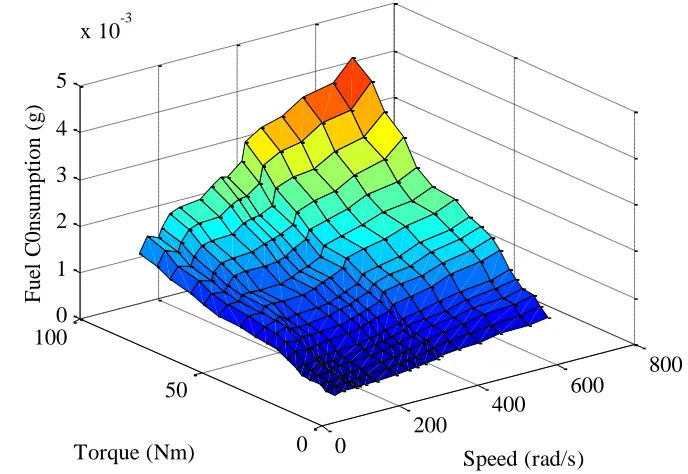
(2.1)The fuel consumption map, in g, of the engine as function of the engine speed and engine torque is shown in Figure 2.4.
2.3 Motor/Generator Model
Figure 2.5 is the diagram of the inputs and outputs of the motor/generator model. The
input is the motor/generator output speed. The model outputs include the motor/generator
output torque, power, efficiency and electricity operation cost.
0 200 400 600 800 0 50 100 0 1 2 3 4 5
x 10-3
Speed (rad/s) Torque (Nm) F ue l C 0ns um pt ion (g)
Figure 2.5. Inputs and outputs of the Motor/Generator model
Same as the engine model, the inputs and outputs of the motor/generator model are just
considered during analysis the PHEV energy management. The look-up tables provide
efficiency of the motor/generator as a function of the torque and speed. The
motor/generator is the function of torque and speed, η=f(T, ω). When motor/generator consumes the energy, which means the power flows from battery to the motor/generator,
the consumed power is represented by (2.2).
MG MG MG MG
T
P
(2.2)When the motor/generator generates electrical energy, which means the power flows
from motor/generator to the battery pack, the generated power is represented by:
P
MG
T
MG
MG
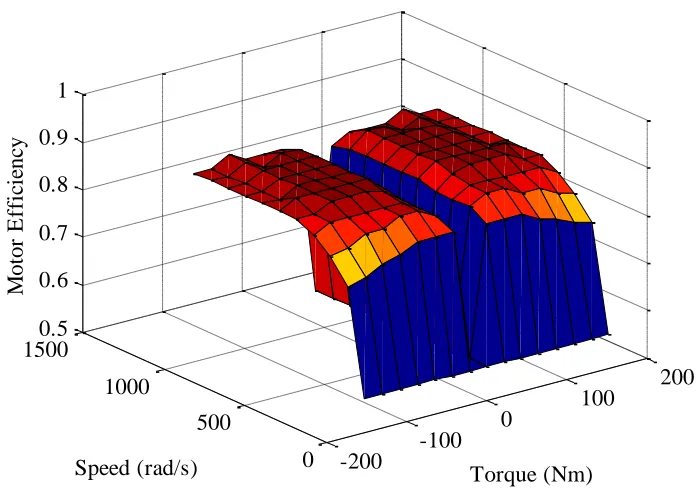
MG (2.3)Equations (2.2) and (2.3) will be used for the battery State-of-Charge (SOC) calculation. Figure 2.6 and Figure 2.7 are the efficiency maps for the Toyota Prius motor and
0 20 40 60 -1000 0 1000 0.4 0.5 0.6 0.7 0.8 0.9 Torque (Nm) Speed (rad/s) G ene ra at or E ff ic ie nc y
Figure 2.6. Generator efficiency map
-200 -100 0 100 200 0 500 1000 15000.5 0.6 0.7 0.8 0.9 1 Torque (Nm) Speed (rad/s) M ot or E ff ic ie nc y
2.4 Battery Model
Figure 2.8 is the relationship of the input and output of the battery model. The inputs
include the battery capacity Q, internal resistance Rint , open circuit voltage VOC, and battery power output Pbatt. The output is the battery SOC. The battery model is represented by an equivalent circuit with an internal resistance, as shown in Figure 2.9.
The battery Rint is the function of the SOC and the current direction Ibatt (Figure 2.10):
R
int
f
(
SOC
,
I
batt)
(2.4)The battery SOC is the function of the VOC (Figure 2.11):
)
(
V
OCf
SOC
(2.5)Both functions are obtained through the curve fitting based on the battery test results.
Figure 2.8. Inputs and outputs of the battery model
Figure 2.9. Battery electrical equivalent circuit
ernal
Rint IBatt
Batt
P
OC
Figure 2.10 Battery internal resistance map with SOC
Figure 2.11. Battery open circuit voltage map with SOC
The battery pack dynamics are associated with SOC, and SOC depends on the equivalent battery capacity Q and the current flowing through the battery IBatt:
Q
I
C
O
S
Batt(2.6)
The battery output power is a function of VOC, IBatt, and Rint:
int 2
R
I
I
V
This expression may be written in terms of SOC and solved to obtain the equation for SOC: int int 2
2
4
QR
R
P
V
V
C
O
S
OC
OC
Batt (2.8)The power required from the battery will be:
k C k MG MG MG BattT
P
(2.9)Where, k=1 when power flows to the battery and k=-1 when power flows away from the battery.
2.5 PSD Model
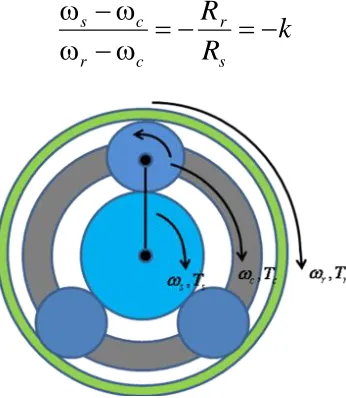
The planetary gear set is the core of the power split transmission as shown in Figure 2.12.
The planetary gear set consists of a ring gear, a sun gear, a carrier, and pinion gears
where the engine is connected to the carrier, the generator to the sun gear, and the motor
to the ring gear and final driveline. The basic gear ratio of the planetary gear set follows:
k
R
R
s r c r cs
(2.10)The relationships between the torques are:
s
T
ck
k
T
1
(2.11)
k
T
T
T
cr
f
1
(2.12) Figure 2.13 shows the free body diagram of planetary gear set. The relationships betweenthe torques are:
s s s s r s c c c r r r rT
FZ
I
Z
Z
F
T
I
T
FZ
I
)
(
(2.13)2.6 Powertrain Dynamic Model
Figure 2.14 shows the free body diagram of the powertrain. The torques determine the
rotational speeds in the transmission. The powertrain dynamic equations are following:
d f m r f r r m s g g g c e e eT
Z
T
T
Z
I
I
T
T
I
T
T
I
)
(
)
(
(2.14)Combining equations (2.10)–(2.14), and only considering the vehicle dynamics along the
longitidinal direction which is the dominating factor for the fuel economic, the
powertrain dyamic model can be derived:
Figure 2.13. Free body diagram of planetary gear set
2.7 Vehicle Model
Figure 2.15. Vehicle free body diagram
The propulsion system produces mechanical energy that is stored in the vehicle. The
amount of mechanical energy consumed while driving the vehicle depends on the
following effects:
The aerodynamic friction losses
The uphill driving losses
The rolling friction losses
The vehicle model is derived from the basic equation of solid-body motions (Figure 2.15):
r g ad
t
F
F
F
F
dt
dv
m
(2.17)2
5
.
0
C
A
V
F
g
mg
sin
(2.19)
F
r
f
rmg
cos
(2.20)2.8 Summary
The backward-looking model of PHEV was created in this chapter under Matlab
environment. It provided the necessary platform to simulate the PHEV fuel consumption
and study the control strategy. The main study in this chapter focused on following:
1. The look-up table based PHEV engine, motor/generator, and battery models were
created. Those models represent the static state of the systems. However, the
simulations will focus on the PHEV energy consumptions, so the model accuracy
is enough.
2. The dynamic PSD and powertrain system models were created based on the
system loads balances.
CHAPTER 3
OPTIMAL CONTROL OF PHEV
3.1 Introduction
The optimal energy management of HEV is a global optimization problem whose
objective is to determine the power split between the engine and the motor to minimize
the vehicle fuel consumption and operation cost. Comparing with other optimal
approaches, such as Pontryagin’s Minimum Principle (PMP) [45], [46], the Equivalent
Consumption Minimization Strategy (ECMS) [35], [46], the DP approach guarantees the
global optimal results and the results are unbeatable under the given driving cycles. In
this study, the DP approach was used to optimize the PHEV control strategy to minimize
the fuel consumption and operation cost.
3.2 Mathematic Model of Optimal Control
Figure 1.4 shows the PHEV configuration in this study. From the Figure 2.12 and
equation (2.14) and (2.15), the relationship of the torque on the wheels with the engine
torque and motor/generator torque can be derived:
f d f g r s f e r s r g g s e e s r m g r s e r s r r r f g r s m f e r s r m T i I Z Z i I Z Z Z T I Z T I Z Z T I Z Z I Z Z Z Z i I Z Z I i I Z Z Z I 2 2 2 2 2 2 ) ( ) ( ) ( ) ( (3.1)
f d m r g g s m m f r e g s r s m s r f r e s r g s r s e m s r f r e T I Z T I Z T I Z Z T I Z Z Z I Z Z Z Z Z Z I Z Z Z I I Z Z Z Z I ) ( ) ( ) ( ) ( ) ( 2 2 2 2 (3.2)
The relation of the motor speed and vehicle speed is written:
tire f m
Z
R
v
(3.3)The constrains of the components are as following:
T
e,min
T
e
T
e,max (3.4)
e,min
e
e,max (3.5)
T
g,min
T
g
T
g,max (3.6)
g,min
g
g,max (3.7)
m,min
m
m,max (3.8)
T
m,min
T
m
T
m,max (3.9)For a given drive cycle, the vehicle speed at the given time is known. Considering
equations (3.1) - (3.3), there are only two independent variables: motor torque Tm and generator torque Tg. The engine torque Te can be derived from the motor torque Tm and generator torque Tg. The engine speed can be derived from the engine torque Te.
The state variable of the PHEV is defined as following:
SOC(t) is the battery state of charge at the time t. it meets following constrain:
max
min
SOC
SOC
SOC
(3.11)The control variables are determined:
)]
(
),
(
[
)
(
t
T
t
T
t
u
m g (3.12)And they meet the constrains of (3.4) to (3.9).
Given the driving cycle, the PHEV optimal control can be expressed: it is desired to
determine a control law to minimize the performance measurement, from the initial state
)]
0
(
[
)
0
(
SOC
x
to the end of statex
(
t
f)
[
SOC
(
t
f)]
at the driving cycle timef
t
. The optimal function of the PHEV is:
f tdt
t
u
t
x
L
J
0))
(
),
(
(
(3.13)For the PHEV, the fuel consumption function includes the fuel consumption and
electricity consumption during the vehicle operation. The fuel consumption function can
be described:
)
(
)
(
)
(
),
(
(
x
t
u
t
fuel
t
electric
t
L
electric (3.14)3.3 Dynamic Programming
Dynamic Programming (DP) [47] which was developed by Bellman is a powerful tool to
global optimization. For a given driving cycle, the optimal operation strategy to minimize
fuel consumption, or combined cost of fuel/electricity consumption can be obtained.
Due to the nonlinear characteristics of the hybrid powertrain, it is not possible to solve
DP analytically. Instead, DP has to be solved numerically by some approximations.
Equation (3.13) is a continuously operating system which can be approximated by a
discrete system by considering N equally spaced time increments in the interval
f
t
t
0
. Due to the fact that the system level dynamics are the main concern toevaluate fuel economy over a long driving cycle, dynamics that are much faster than 1 Hz
could be ignored [48]. The sample time for the main-loop control problem is selected to
be 1 second. The discrete-time model of PHEV can be described as:
k
f
x
k
u
k
x
1
,
(3.15)The state variable is SOC: SOC
k1
SOC(k) f
Tm(k),Tg(k)
. (3.16) The cost function of the PHEV powertrain can be expressed as:
1 0 1 0)
,
(
N k Grid Batt electric fuel fuel N kP
P
k
u
k
x
L
J
(3.17)Assume that the fuel price ratio is β=0.65, which is consistent with the energy price in the
year 2010: $2.77 USD per gallon of gasoline and $0.1145 USD per kWh of electricity