Transactions of the 17th International Conference on Structural Mechanics in Reactor Technology (SMiRT 17) Prague, Czech Republic, August 17 –22, 2003
Paper # O03-6
Evaluation of the NPP Operator Cognitive Workload during an Emergency
Nilo Garcia Da Silva
1), Marco Antonio Bayout Alvarenga
1), Maysa Joppert Coelho
2)1) Brazilian Nuclear Regulatory Commission (CNEN), Rio de Janeiro, Brazil 2) Military Institute of Engineering (IME), Rio de Janeiro, Brazil
ABSTRACT
In this work, a method to evaluate Man – Machine Interfaces, comparing with the Model of Human Processor (MHP) utilized by the Combustion Engineering –CE in the SYSTEM 80+ design, was used in the licensing process of a Nuclear Power Plant, during the application of this methodology in the emergency procedure (EOP) for a Steam Generator Tube Rupture (SGTR) in the Angra-1 Westinghouse PWR NPP. The time needed for the operators to perform the tasks step by step in this procedure was calculated. This time was compared to that found in Goals Operators Methods and Selections Rules (GOMS) model, by which it is possible to carry out an evaluation of an operator cognitive workload for this accident using a structured cognitive processor. The criteria of the Standard ANSI/ANS-58.8-1994 were used to establish reaction and operational time for these tasks. Practical measures in the Angra-2 NPP full scope simulator were done for some steps of the SGTR emergency procedure. The time evaluation in the GOMS model has identified that there was a concentration of tasks in a specific time step, with the global time near the limits regulated in the Standard above, compared with the time from the CE methodology. Finally, after comparison of results among Angra-1 calculations, Angra-2 experiments and MHP calculations, recommendations were done to the Angra-1 NPP utility in order to improve some identified points.
Keywords: Man – Machine Interface, human factors, cognitive models and nuclear reactors operation
INTRODUCTION
The operator's tasks in a NPP are concentrated in the controls supervision. The plant performance is guaranteed through the operator's manual actions combined with controls’ automatic actions that are under operators' supervision. In this work the Model of Human Processor – MHP was applied to evaluate the cognitive workload for the operator's reactor activities, in the plant control room, during a steam generator tube rupture event, because this accident demands a high cognitive workload, affecting intensively the performance of a safety task.
Many of the man - machine systems don't work satisfactorily as they could because they impose requirements to the human operator incompatible with the way as a person acts, thinks, recalls, decides and answers, or, in other words, how the humans process the information, coherent with the human beings' cognitive architecture.
The main goal of this work is to propose a man – machine interaction evaluation method, using a study of case in which the model MHP/CE-Combustion Engineering [1], that was used in the licensing of a Nuclear Power Plant, comparing to the model GOMS [2] that enables the workload evaluation of an operator during an accident using a structured Cognitive Processor, different from that used by CE-80+, which doesn't use such processor. Modifications were done in the original program to adapt the GOMS’ commands to the actions used in the operator tasks. The study consists in the simulation of a Steam Generator Tube Rupture event in the control room of Angra-1 Nuclear Power Plant, considering the normal operation shift. This specific event demands from the shift the performance of several operational activities, fast decisions, as well as the accomplishment of many cognitive actions.
The proposed method can be used to evaluate the man –machine interface’s project, and to support the operator, in terms of automation or computational tool, in time steps where cognitive workload concentration occurs as well as in case of the operator doesn’t have enough time to perform all the foreseen tasks.
Beside this, the studies contribute for the establishment of a safety culture among nuclear plants operators. The acquisition of the safety culture concept is based on the dynamic process in the operational learning of all the topics that contribute for the nuclear safety increase, mostly those related to the attitudes and behavior standards. The temporal workload distribution of each operation shift member is evaluated in order to detect the possible situations, where this load approximates to the limit, or even being overtaken.
In order to reach this goal, this study adopts the parametric cognitive architecture MHP - Model Human Processor [3] used by CE in the project CE-80+.
The MHP architecture has four memories (long term memory, work memory, visual image and hearing information storage) and three processors (cognitive, perceptual and motor), each one characterized by parameters. A behavior laws set (specially, Fitts' law and Hick's law) increases the predictions.
for each task was predetermined, based in the event timeline, as analyzed in the Final Safety Analysis Report (FSAR), chapter 15.
The use of discreet steps was necessary because, depending on time demanded by the operator to perform an action, the event evolution will be different. To get the feedback of the results obtained by the computational programs, would be necessary the construction of an interface between the program that simulates the installation and that one simulating itself the operator.
There are several methods to calculate the workload: the performance measures, such as the psycho-physiological measures and the analytic methods. The more recent analytic methods recognize the dynamic nature of complex multitasks ambient, in which an adequate workload measures become necessary. For example, time line analysis is an important component in the programs TAWL (Task Analysis Work Load), TLAP (Time Line Analysis and Prediction) and W/INDEX (Work Load Index). However, all of these methods assume multiple processing or multiple resources channels to model operator's attention. The model CE - 80+ doesn't model the attention and the GOMS model incorporates a cognitive processor of production rules, built in the procedure steps, that are shot in parallel, reflecting the use of multiple resources processing. WINDEX, for example, doesn’t use such cognitive processing. Instead, it uses a Conflict Matrix with components reflecting the competition between each pair of processors (perceptual and motors) involved in the CONDITIONS and ACTIONS parts of a production rule.
THE STANDARD ANSI/ANS-58-8-1994
The standard ANSI/ANS-58.8 [4] establishes criteria for the time spent in the reaction to alarms, diagnosis and operational tasks related to accidents. These criteria will be used to determine the maximum workload allowed to the operator. Regarding these criteria, they emphasize the workload concept of time pressure as the rate between required time and time allowed by the task.
The criteria in the ANSI/ANS-58.8 establish time requirements related to the safety for nuclear plants to be used in the systems design. These criteria are used to determine the response in terms of minimum time interval for the operator’s actions to be carried out in order to mitigate Basic Project Events (BPE), resulting in reactor shutdown. By means of these criteria the designer can determine if the safety related systems will be started through operator's actions or automatic actions.
The response time criteria in the standard above was based in operator performance measurements obtained by Electric Power Research Institute (EPRI) and Westinghouse Electric Corporation. The data were collected automatically and afterwards refined through the use of statistical methods.
To understand the standard requirements, it will be necessary to define some terms:
• Event Beginning (tin) – time in which BPE has initiated.
• Event Indication (tind) – time in which the information is available, for example, one or more alarms, to
the operator, informing that a BPE happened.
• Closest Credited Action (tcac)– nearest time to the event beginning, following the tind, in which we can
take credit for an operator's action.
• Beginning Manual Action (tbma) – the point in time in which the analysis takes credit for the initiation of a manual action.
• Completed Safety Action (tcsa) – time in which operator's action is considered completed.
• Accomplished Safety Function (tasf) – time in which an indication is received, showing that a safety related system accomplished its safety function.
• Event Limit (tLim) – the nearest time to the event beginning, in which a limiting design requirement will
be violated, if a safety function can not be completed.
• Plant Condition (PC) – events classification in terms of occurrence probability, taking into account the criteria related to nuclear safety purpose. The event classification in terms of occurrence frequency is introduced in Table 1.
• Time Interval – elapsed time between two sequential discreet points.
Table 1 Events Classification
Plant condition(PC) Better occurrence frequency estimate (F) for Reactor Year
PC-1 Normal operation
PC-2 F≥10-1
PC-3 10-1 > F≥10-2
PC-4 10-2 > F≥10-4
PC-5 10-4 > F≥10-6
• Indication Time (Tiind = tind - tin) – time interval between BPE’s beginning and the first indication or alarm.
• Diagnosis (TIdiag = tcac - tind ) – time interval between first BPE's indication or alarm and the nearest time we can
take credit for the initiation of an operator action. During this time, it is to be supposed that the operators will verify the automatic actions, observe system parameters and plan subsequent actions in response to a BPE.
• Dead (TIdead = tbma - tcac) – time interval in which the analytic criteria will allow an operator's action be credited, but no safety action occurs in the analyzed sequence.
• Operator's Response (TIoperator = tcsa - tbma ) – time interval during which a safety action is initiated and
completed by the operator.
• Process Response (TIprocess = tcsf - tcsa ) – time interval between the instant when the operator's actions have been considered completed and the instant with indication that the safety function has been completed by the response of the mitigation equipment and the physical process following a BPE.
• Safety (TI safety = tLim - tcsf ) – time interval between the instant when the last safety function must be completed and the instant when the design limit will be reached without operator actions.
The standard ANSI/ANS 58.8 [4] establishes that, during the time interval TIdiag, no operator safety action
must be necessary (Table 2). All of the safety components and systems that must be started in the interval TIdiag, to
accomplish safety related functions or to avoid that some limiting design requirement be exceeded, must be initiated by the actions of the automatic protection devices.
Table 2. Minimum Time for Diagnosis in Specific Plant Conditions
Plant condition Minimum Time for diagnosis
2 5 minutes
3 10 minutes
4 e 5 20 minutes
SOURCE: Standard ANSI/ANS 58.8, 1994
For each analysis of an operator's action, a non-negative value of TI safety must be demonstrated, indicating that the design didn't exceed a limiting requirement.
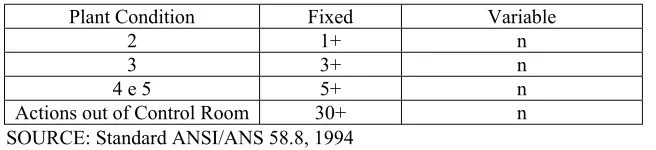
For each safety related action performed by the operator, the response time value TIoperatormust be calculated. The
TIoperatorduration reflects the BPE's complexity, provided by the number (n) of individual manipulations required to complete an action, as shown in the Table 3. For example, if an action needs 2 manipulations, then we will have a minimum time of 1 + 2 = 3 minutes, with the plant in the condition 2.
In the case of safety related actions, when the operator needs to perform controls outside the control room, the subinterval must be extended for 30 minutes to allow the operator an enough time for initial preparation and locomotion to the area where the actions will be accomplished.
Table 3. TIoperator - Subintervals (minutes) for each Plant Condition
Plant Condition Fixed Variable
2 1+ n
3 3+ n
4 e 5 5+ n
Actions out of Control Room 30+ n
SOURCE: Standard ANSI/ANS 58.8, 1994
The standard doesn't establish the method for the calculation of this time interval, TIoperator, allowing the choice of an appropriated method. One used by CE-80+, for example, is the accident time line simulated by calculation, which is in conformity with the requirements of the Standard ANSI/ANS-58.8. However, the Standard does not have a requirement about the cognitive workload in the time interval TIoperator. Therefore, it will remain, under the operator's point of view, if the cognitive workload is acceptable, considering all the tasks required by the safety related actions.
THE SGTR EVENT CHRONOLOGY
RESULTS
Spent Time Following the PO-E3 in the Angra-1 NPP Control Room
A table consisting of each emergency procedure step in the PO-E3 (Angra-1 NPP) was constructed, accompanying the total processing time for all of the procedure intervals and access time per parameter TA/P, as well as the remaining time TE. These parameters were based on the evaluation of the cognitive processing time, adding the perceptual reaction time, the cognitive decision time and the action implementation time in a specific equipment.
Table 4. Event chronology of SGTR in Angra-1, described in the Plant Operation Manual (PO-E3)
Procedure Step Step Goal Time
minutes
1 Verify if the RCPs must be stopped. 00:00
2 Level identification of the ruptured SG 01:10
3 Isolate ruptured SG 02:20
4 Level verification of ruptured SG 03:30
5 Verify the operational conditions of PZR relief isolation valves 04:00
6 Verify if SGs aren't failed 04:30
7 Verify the level variation of intact SG 04:50
8 Rearm the safety injection signals 05:20
9 Rearm the containment isolation signals, phases A and B. 05:30
10 Establish instruments air for the containment 05:40
11 All of 4160V buses energized 05:45
12 Verify if RHR pumps must be stopped. 06:00
13 Verify the pressure in ruptured SG greater than 24kg/cm2 06:30
14 Begin RCS cooling 06:45
15 Verify the pressure in ruptured SG stable or increasing. 08:45
16 Verify RCS subcooling 09:10
17 RCS pressure decreases 09:20
18 Verify the pressure increasing in RCS 17:45
19 Verify if the SI pumps can be stopped 18:00
20 Establish charging flow 18:10
21 Charging flow control to keep PZR's level 18:30
22 Confirms that the SI flow isn't required 18:45
23 Verify if containment spray must be interrupted. 19:20
24 Verify the reactor makeup system 20:10
25 Verify if the outlet line can be placed in service 20:30
26 Verifiy if the charging pumps suction are aligned for VCT 22:30
27 Control RCS pressure 23:00
28 Verify if diesels can be stopped 26:40
29 Minimize the contamination of the secondary 27:00
30 Turn on PZR's heaters 27:20
31 Verify RCP’s cooling 28:00
32 Verify RCP’s seals return flow 28:30
33 Verify RCP’s conditions 29:00
34 Verify if the source range detectors are energized 29:30
35 Align the equipments for the plant condition 30:00
The procedure PO-E3 was divided into intervals of 1 minute each, to enable the workload calculation for several steps. In case of few steps, we can extend the evaluation interval for 2 minutes or more.
The analysis is composed of four generic information processing: information collection, evaluation, performance in the controls and monitoring of the feedback. Time spent in each cognitive process is estimated for each task, taking into account the information collection and feedback process, as well as the evaluation and planning. Time calculation for control actions is done through the Fitts Law.
the time to collect (read), evaluate/plan, perform control actions and collect (read) the feedback information, inside the evaluated interval. The final value is subtracted of the available time in the evaluated interval, giving the remaining time TE. Taking as an example the first interval of 1 minute in the PO-3 procedure, we have:
TE = 1 minute – total spent time in minutes
Total Spent Time = processing time + correction time + control time
Total Spent Time = 0, 992 (4 choice reaction tasks)+3 (2 groups of 2 parameters in the same region of the instrument
panel)+2,40 (2 control parameters, using Fitts Law, where distance from panel is 4 feet and target size is 1 inch) = 6,39 seconds = 0,11 minute
Remaining Time (TE) = 1 minute – 0,11 minute = 0,89 minute
TA/P = ||total spent time – 60|| / Number of parameters in the time interval TA/P =||6,39 – 60|| / 6 = 8,9 sec
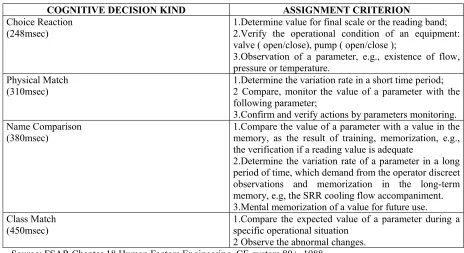
As TE approaches to zero and TA/P to 1 second (minimum time to move the head to a new direction), the design criterion tends to be violated. The estimated values for the time calculation, in the more complex decisions environment, that can't be reduced to simple decisions, were determined by specialists in operation. For each choice reaction, physical match, name comparison and class match, an average time was evaluated as bellow (see Table 5).
For the choice reaction time that is given by the uncertainty principle, assuming Ic = 150 [0 ~157] and n=2, we have: TCR=IC log2(n+1)=150 [0~157] log 2 (2+1) = 0,238[0 ~ 0,249] seconds, that was fastened in 0,248sec. For the rest
of the cognitive decisions, we have to use a combination of the processors cycles:
• Time of the perceptual processor cycle (τp=100[50~200]msec)
• Time of the cognitive processor cycle (τc=70[25~170]msec)
• Time of the motor processor cycle (τm=100[30~100]msec)
The values between brackets indicate average man (fast man ~ slow man) values. Then, for several types of physical accompaniment they must be calculated as follows:
1. Physical Match = ΤP + 2TC +Tm = 100 [50 ~200] + 2x(70 [25 ~ 170]) + 70[30 ~100] = 310[130 ~ 640], about
310msec
2. Name Comparison (specific parameter) =TP + 3Tc +Tm = 100 [50 ~200] + 3x(70 [25 ~ 170]) + 70[30 ~100]
=380[155 ~ 810], about 380msec
3. Class Match (specific event) =Tp+4Tc+Tm = 100 [50 ~200] + 4x(70 [25 ~ 170]) + 70[30 ~100] = 450[180 ~ 980],
about 450msec
Table 5. Criterion for each kind of Cognitive Decision
COGNITIVE DECISION KIND ASSIGNMENT CRITERION
Choice Reaction
(248msec) 1.Determine value for final scale or the reading band;2.Verify the operational condition of an equipment: valve ( open/close), pump ( open/close );
3.Observation of a parameter, e.g., existence of flow, pressure or temperature.
Physical Match
(310msec) 1.Determine the variation rate in a short time period;2 Compare, monitor the value of a parameter with the following parameter;
3.Confirm and verify actions by parameters monitoring. Name Comparison
(380msec) 1.Compare the value of a parameter with a value in thememory, as the result of training, memorization, e.g., the verification if a reading value is adequate
2.Determine the variation rate of a parameter in a long period of time, which demand from the operator discreet observations and memorization in the long-term memory, e.g, the SRR cooling flow accompaniment. 3.Mental memorization of a value for future use. Class Match
(450msec)
1.Compare the expected value of a parameter during a specific operational situation
2 Observe the abnormal changes. Source: FSAR Chapter 18 Human Factors Engineering, CE-system 80+, 1988
characterizes the steps 13, 14, 15 and 16 as having the highest cognitive workload, with TR value equal to 28,2 seconds. The steps 13 to 16 of the emergency procedure PO-E3 correspond to:
a) Step 13 - Verify if the Residual Heat Removal pumps must be stopped b) Step 14 – Verify if ruptured SG pressure is greater than 24 Kg/cm2
c) Step 15 - Start RCS's Cooling
d) Step 16 - Establish the charging flow for RCS
Time Evaluation Using GOMS Model
By means of the GOMS methodology, the simulation of the steps 13 to 16 of the Angra-1 PO-E3 Procedure [5] was realized. This set of steps corresponds to the interval between 06:00 and 07:00 minutes, that means, the seventh interval, when cognitive workload reached the maximum in MHP. The simulation results in the model GOMS provided a total time of 47,8 seconds. From this total, we have:
a) 10,5 seconds refer to the procedure steps that are usually accomplished by the shift foreman;
b) 12,65 seconds are operations in the plant secondary part: the vapor deviation system (SDV), that are accomplished by the secondary operator (BOP);
c) Subtracting the values in items a) and b), we obtain the amount of 24,65 seconds for this interval from 6 to 7 minutes.
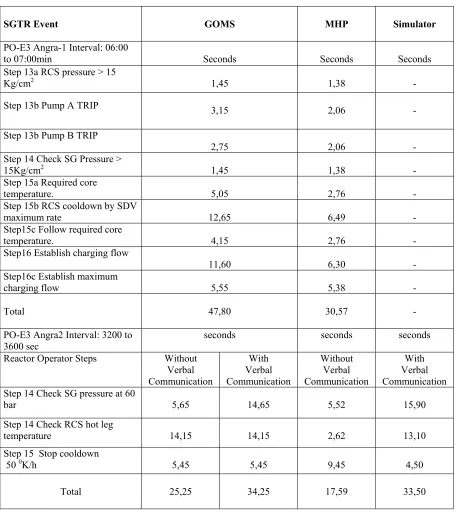
The CE's value of 30,57 seconds for this same interval underestimates the value of 47,8 seconds found in GOMS. As it is necessary to meet the minimum criterion of TA/P=1sec, with 22 variable, we will need 22 seconds at least. If we work with 47,8 sec, 12,2 sec will remain. Therefore, the access time criterion per parameter is violated. However, by the reasons a) and b) above, the tasks will be shared by other operation team members. On the other hand, the steps 14 and 15 of the Angra-2 NPP SGTR Procedure were calculated using the methodology GOMS, and the results were compared with the full scope simulator experiments for the same accident, where some experimental measurements were realized to evaluate the performance of an operator. In the Table 6, the comparative results of GOMS, MHP-CE and Angra-2-SGTR simulation are described.
As mentioned previously, by the table, we can verify that GOMS time values are superior to the MHP-CE ones that doesn't consider the time spent in the control of the tasks cognitive processing. The simulator results kept close to the GOMS values, for Angra-2 NPP, reinforcing the accomplished study.
Time Evaluation in the NPP Angra-2 Full Scope Simulator using the CE and GOMS Models
In the Angra-2 full scope simulator an event of steam generator tube rupture, without main steam activity limits violation and emergency cooling criterion was simulated by a reactor operator. The data are in the Tab. 6, corresponding to the steps 14, 15, 16, 17, 18 and 19 of the emergency procedure, part 3, chapter 3.4, section 5.2, pages 22 and 23, as described in the Operation Manual [7], according to the time interval of 3200 to 3600sec, as described in the FSAR, chapter 15. The initial conditions were: plant operating in 3 loops, about 60 percent of nominal power and RTGV event activated through the emergency cooling criterion, that means, low pressure in the primary system (smaller than 131 bar), pressurizer level < 2,28 m and main steam activity without limits violation.
After the event beginning, we observe automatic actions by means of the reactor control system, limitation system and reactor protection system. In the Angra-2 NPP, the reactor limitation and protection systems are hierarchically superior to the operators, and the automatic command of these systems can't be blocked by the operators. These are:
a) Reactor is shutdown, disconnected from the acid boric control and the emergency cooling system is aligned to the core trough the emergency lines;
b) Boric acid injection through the safety injection pumps and extra boration pumps, when pressurizer level falls below 2,28 m, due to the steam generator tubes leak;
c) Water level control of steam generators through the feedwater supply system in 10,2m; d) The primary system pressure is kept by the safety injection pumps.
The manual actions strategy are followed through the operation manual part 3, chapter 3.4, section 4.2, from the step 1(verify the plant conditions) to the step 26 (cool the plant through the residual heat removal system, RHR, to the condition of cold shutdown: 1bar and 50 °C). Particularly, the time spent by the operator to implement the steps 14 to the 19 in the simulator were measured and compared with calculations done through the GOMS and MHP methodologies. The results were placed in Tab. 6. These steps for a Angra-2 SGTR are:
a) Step 14 - Verify if the steam pressure in the intact steam generators is 60 bar and the core exit temperature is 2950C. The operator's actions were done in the main control display;
b) Step 15 – Stop the unit cooling to 500K/h, considering the Steam Deviation System (SDV) aligned. The operator's
auxiliary panel and time was measured after the operator positioning in front of the panel;
d) Step 17 – Auxiliary Cooling Systems - Re-establishment of the Volumetric Control System. The operator's actions were done in the central auxiliary panel and in the main control display;
e) Step 18 – Borate the reactor coolant system for 2200 ppm. The operator's actions were done in the main control display;
f) Step 19 – Block the departure of the Reactor Cooling Pump in the affected loop. The operator's actions were done in the central auxiliary panel.
Table 6. Cognitive Time Results of GOMS, MHP and Simulator
SGTR Event GOMS MHP Simulator
PO-E3 Angra-1 Interval: 06:00
to 07:00min Seconds Seconds Seconds
Step 13a RCS pressure > 15
Kg/cm2 1,45 1,38
-Step 13b Pump A TRIP 3,15 2,06
-Step 13b Pump B TRIP
2,75 2,06
-Step 14 Check SG Pressure >
15Kg/cm2 1,45 1,38
-Step 15a Required core
temperature. 5,05 2,76
-Step 15b RCS cooldown by SDV
maximum rate 12,65 6,49
-Step15c Follow required core
temperature. 4,15 2,76
-Step16 Establish charging flow
11,60 6,30
-Step16c Establish maximum
charging flow 5,55 5,38
-Total 47,80 30,57
-PO-E3 Angra2 Interval: 3200 to
3600 sec seconds seconds seconds
Reactor Operator Steps Without
Verbal Communication
With Verbal Communication
Without Verbal Communication
With Verbal Communication Step 14 Check SG pressure at 60
bar 5,65 14,65 5,52 15,90
Step 14 Check RCS hot leg
temperature 14,15 14,15 2,62 13,10
Step 15 Stop cooldown
50 0K/h 5,45 5,45 9,45 4,50
Total 25,25 34,25 17,59 33,50
CONCLUSIONS
that enables a better approach of the human information processing. The model GOMS uses a simple cognitive architecture implemented in the simulation atmosphere GLEAN 3 (8), that models the mechanisms and the capacity of the human information processing. It is a more refined system than MHP. Besides the perceptual processors for the hearing and visual information, as well as motor, manual and vocal processors, GOMS has its own cognitive processor that implements the commands written in the GOMSL language to accompany the Goals, using processors perceptual information, the Long Term memory LTM and the specific task properties that are being represented by tasks instantaneous calls descriptions.
Each perceptual processor has its own work memory. The visual processor, the tasks processor and the long term memory processor are limited to one object in focus for each time, corresponding the information concerning a memory long term task only or an item being activated for that time in the work memory. Finally, the cognitive processor carries out the GOMS's methods using a kind of language similar to a conventional computer program. These controls related to the cognitive tasks structure and work memory content are responsible for the additional time obtained by GOMS when compared to the MHP's calculation, explaining why the latter underestimates time allocated to perform the tasks in the operational procedure of a NPP.
The Recommendations to Improve the Operator Actions in the Angra-1 NPP
After the analysis of the time value for the implementation of each procedure task, it was verified that the time in the seventh and twentieth interval is very close to the minimum time, established by cognitive criterion. In this case, the operators workload is very high and this situation can mislead them to errors during the accomplishment of tasks in emergency procedures. It was verified with the simulator experiment, for the same accident, that some tasks are carried out in the automatic mode for Angra-2 NPP, as seen in the case of unit cooldown with rate of 50°K/h. In view of this comparison and having the above results as a support, we recommend the presence of a senior reactor operator, in the role of a shift adviser, during the implementation of the emergency procedure, PO-E3, to help in the tasks analysis, if it is impossible to acquire a computerized operational support or even systems automatization.
REFERENCES
1. SYSTEM 80 +, COMBUSTION ENGINEERING. Function and task analysis – final report, Human Factors Services, January 1989.
2. Kieras, D. A guide to GOMS model usability evaluation using NGOMSL and GLEAN 3, Michigan University, USA, 1999.
3. Card, S., Moran, T., Newell, A. The psychology of human- computer interaction. Lawrence Erlbaum Associates, New Jersey, 1983
4. ANSI/ANS 58.8, Time response design criteria and safety related operator actions. American Nuclear Society, USA.
5. ANGRA-1 MOU (PLANT OPERATION MANUAL), Emergency Operation Procedures. PO-E Safety Reactor
Shutdown and PO-E3 Steam Generator Tube Rupture, ELETRONUCLEAR, RJ, Brazil, 1998
6. HALDEN REACTOR PROJECT. Cognitive task analysis of SGTR scenario. Report 1996, 28 p. Halden, Norway,
1996.
7. ANGRA - 2 MOU ( PLANT OPERATION MANUAL ), Emergency Operation Procedures.-Part 3, Cap. 3.4, RJ,
Brazil, 2000.
8. HALDEN REACTOR PROJECT. GOMS analysis in evaluation tool in process control: an evaluation of ISACS-1