University of Windsor University of Windsor
Scholarship at UWindsor
Scholarship at UWindsor
Electronic Theses and Dissertations Theses, Dissertations, and Major Papers
1-1-1971
Involuntary nonconformity as a construct in social stress and
Involuntary nonconformity as a construct in social stress and
learning.
learning.
Roger Charles Mannell
University of Windsor
Follow this and additional works at: https://scholar.uwindsor.ca/etd
Recommended Citation Recommended Citation
Mannell, Roger Charles, "Involuntary nonconformity as a construct in social stress and learning." (1971). Electronic Theses and Dissertations. 6689.
https://scholar.uwindsor.ca/etd/6689
INVOLUNTARY NONCONFORMITY AS A CONSTRUCT
IN SOCIAL STRESS AND LEARNING
A Thesis
Submitted to the Faculty of Graduate Studies through the Department of Physical and Health Education in
Partial Fulfillment of the Requirements for the Degree of
Master of Physical and Health Education at the University of Windsor
by
ROGER CHARLES MANNELL
B.P.E., McMaster University, 1970 B.A., McMaster University, 1970
UMI Number: EC53092
INFORMATION TO USERS
The quality of this reproduction is dependent upon the quality of the copy
submitted. Broken or indistinct print, colored or poor quality illustrations and
photographs, print bleed-through, substandard margins, and improper
alignment can adversely affect reproduction.
In the unlikely event that the author did not send a complete manuscript
and there are missing pages, these will be noted. Also, if unauthorized
copyright material had to be removed, a note will indicate the deletion.
®
UMI
UMI Microform EC53092Copyright 2009 by ProQuest LLC.
All rights reserved. This microform edition is protected against
unauthorized copying under Title 17, United States Code.
ProQuest LLC
789 E. Eisenhower Parkway PO Box 1346
UNIVERSITY OF WINDSOR
FACULTY OF PHYSICAL AND HEALTH EDUCATION
I HEREBY RECOMMEND THAT THE THESIS PREPARED UNDER MY
SUPERVISION BY _ _
Roger MannellENTITLED _
Involuntary Nonconformity as a Construct in Social______Stress and Learning.__________________________________________________
BE ACCEPTED IN PARTIAL FULFILLMENT OF THE REQUIREMENTS FOR THE
DEGREE OF _
Masterof
Physical EducationThesis Advisor
ABSTRACT
University of Windsor
MANNELL, ROGER CHARLES Involuntary Nonconformity as a
Construct in Social Stress and Learning, University of Windsor,
1971. 5^ PP. (James Duthie)
The present study was designed to investigate the invo
luntary nonconformity construct empirically to determine if
practice and socially Induced stress influenced its effect.
An experimental task was devised which required the subjects
to make simultaneous responses to two sets of stimuli and
allowed two levels of automation and socially induced stress
to be presented to the subjects. The two groups under condi
tions of automation produced a significantly larger number of
inappropriate responses in the test trials than the non
automated control groups. Practice and socially induced
stress both tended to reduce the number of inappropriate res
ponses produced in the test trials. The differences were
significant at the 0.01 level and indicate that the involun
tary nonconformity construct provides a parsimonious explana
tion of the inappropriate responses which occurred. The
ability of social stress to buffer nonconforming responses
is further indication of the value of the construct in
explaining behavior in situations in which the individual
wishes to conform but may be unable to do so. The findings
may have application in many areas of sports where rules may
TABLE OF CONTENTS
Page
ABSTRACT ... il
Chapter
I THE PROBLEM... 1
Purpose ... 5
The Design of the Experiment... 6
Subjects ... ... ... 8
II RELATED LITERATURE... 9
Involuntary Nonconformity Construct ... 13
III METHODOLOGY... 1?
The Apparatus ... 19
Test Movement... 22
Experimental De s i g n... 23
IV RESULTS AND DISCUSSION... ... 28
Preliminary Trials ... 29
Test Trials (Lever Movement Times) ... 31
Test Trials (Incompatible Responses) ... 31
Discussion... 38
V SUMMARY AND CONCLUSIONS ... ^3
Conclusions ...
k?
LIST OF REFERENCES ... 51VITA ... 5^
CHAPTER I
THE PROBLEM
Physical educators draw heavily upon experimental psycho
logy in their study of such variables as learning, habit for
mation, information processing and practice schedules in
attempting to explain and control complex motor behavior in
sports' situations. In such situations the behavior dis
played by an individual is to be viewed, however, as socially
determined as well as the result of previously learned res
ponses. For a more complete understanding at this level,
behavior should be examined within a social-psychological con
text, taking into consideration such variables as group norms,
expectations and goals. We are investigating, in sport,
motor behavior within a social system which must include the
interactions and expectations of all participants.
Physical educators studying sport as a social phenomenon
view specific games and contests as functioning in closely
analogous ways to other social groups and systems. Motor
behavior is then socially relevant behavior and, since in the
human it is at one time or another learned, such behaviors
are likely to be closely integrated with the norms or expec
tations of the social system within which the individual fun
ctions, that is, one expects the motor behavior performed to
conform to the rules and norms which designate appropriate
2
be conforming or nonconforming with respect to the norms
which are a structural component of the game or contest such
as the offical rules, and expectations of team-mates, oppo
nents, audience, and coaches,
A great deal has been written concerning the formation
of social norms, their origin, enforcement, and the bases of
conformity and nonconformity to them. Conforming and non-
conforming behavior have been viewed as conceptually motivated
(conscious and voluntary) and thus directly available to the
Influence of social rewards and sanctions. The basic assump
tion that a deliberate conscious decision precedes the con
forming or nonconforming action is so much taken for granted
that little consideration has been given to other possible
sources of conforming behavior. La Fave (1968) has evolved a
construct which suggests that conformity and nonconformity
are not always the result of conscious decision, but that
much of repetitive social behavior is nonvoluntary due to the
automation of this behavior.
Experimental psychologists who have studied learning,
habit formation and the automation of behavior have suggested
that behavior, once conscious and voluntary, may under some
conditions become unconscious and nonvoluntary through auto
mation. Reference to the process of automation can be found
as early as Buchanan (1812) while in his essay “Habit" James
(1890) defended the evolutionary construct that "habits are
functional". The development of the construct of the automa
3
concept of functional autonomy which implies that behavior
can persist independently of the conceptual motivation stage.
Kimble and Perlmuter (1970) have examined and shown the exis
tence of such a process.
The motor behavior performed in a game is partially the
result of practice, learning and the establishment of habits.
In teaching games players the physical educator stresses prac
tice until those skills or responses deemed essential to goal
attainment and team success have become habitual — so auto
matic that a high probability of their occurrence can be
assumed whenever the appropriate stimulus situation arises.
La Fave stipulates that the automation of certain
social responses is originally functional since this allows
the individual to utilize his conceptual functioning pro
cesses for important decisions and intellectual activity.
Studies concerned with "time-sharing" and the automation of
motor behavior have provided some indication that when an
individual must attend to several tasks simultaneously and
make responses to both, automation of one of the tasks may
occur (Bahrick and Shelley, 1958. Bahrick, Noble, and Fitts,
195*0. The games player must perform those motor skills
directly related to scoring or achieving the game's objec
tives, interact with his team-mates and opponents, conform to
the formal rules of the game, and anticipate and plan game
strategies. Most of the time he must perform these various
functions simultaneously. Therefore, the multiplexity of the
him to automate the more repetitive and invariable of the
required responses.
The Involuntary nonconformity construct derived by
La Fave (1968) distinguishes a second type of nonconformity
based on the automatization of behavior. As the label sug
gests, the social behavior of concern is nonconformity to a
set of norms where the nonconformlty is not the result of a
conceptual decision, an error, or ignorance but rather it has
as its source an automated response which is no longer
socially appropriate due to a change in the norms which
govern that behavior. If certain motor responses in a game
become automated as previously suggested, a change in game
rules or a team's normative structure may produce involuntary
nonconformity.
If the validity of the involuntary nonconformlty con
struct be substantiated, more interesting and significant
questions may be examined. The construct provides a concep
tual framework from which the physical educator may predict
and explain motor behavior based on social determinants, as
well as previous learning behavior.
The present study tested the La Fave (1968) involuntary
nonconformity construct, utilizing a motor response as the
dependent variable and a task in which certain group norms
and forms of interaction could be altered. The study further
examined the effects of practice and socially induced stress
on the occurrence of the automated motor response after it
5
manipulated to produce the different treatment effects:
(1) Automation/Non-automation: A motor response was
either automated or not automated by subjects. Automation
was produced through repetition by the subject of a motor
response in a task which demanded two simultaneous responses
from him.
(2) Socially Induced Stress: This manipulation in the
present study determined whether the two subjects performing
the task worked as a group in which their motor responses
were a form of interaction and socially relevant,to the goals
of the group (high stress) or whether the two subjects per
formed the required task independently of each other with no
co-operation required (low stress).
Purpose
The purpose of the present study was first to test La
Fave's involuntary nonconformity construct as it applies to
motor behavior within the context of a game or contest by:
(1) Comparing the mean differences in the number of incompatible responses between groups in several stages of performing the newly required response.
The second purpose was to determine the effects of
learning and socially induced stress, through varying the
interaction permissible between subjects, on the occurrence
of involuntary nonconformity by:
1
6
(2) Comparing the mean differences of the number of incompatible responses between groups in the interaction condition and those in the no in teraction condition for three successive blocks of eight trials in the test trials.
The Design of the Experiment
1) Experimental Task: The task required the subject to
make two different responses to complex sets of stimuli. A
simple lever movement was utilized as the response to be
automated and this response did not vary regardless of the
differences in the stimulus throughout the preliminary trials.
The lever response was altered in the test trials so that the
two responses (designated as Ra and Rb) were incompatible
and mutually exclusive. The second response required the
subject to make a discrimination involving two alternatives
about the stimulus and record this decision by pressing one
of two buttons. The two tasks were performed simultaneously.
2) Experimental Groups: Based on the earlier distinc
tion between the automated and non-automated variable and
interaction and no interaction variable the following experi
mental groups were utilized:
1. Automated Interaction Group (AI): The sub jects in this group automated Ra in the pre liminary trials and attempted Rb in the test trials while performing the task as members of two-person groups.
ii. Automated No Interaction Group (AN): Each
7
iii. Non-automated Interaction Group (N/AI): The subjects in this group did not perform Ra in the preliminary trials and attempted Rb in the test trials while performing the task as members of two-person groups.
iv. Non-automated No Interaction Group (N/AN): Each subject in this group did not perform Ra in the preliminary trials and attempted Rb in the test trials while performing the task in dependently of the individual with whom she was being tested.
All four groups experienced two phases of the experiment;
the preliminary trials and the test trials. The two non-
automated groups performed the task in the preliminary trials
by only making the discrimination and appropriate decision
response. Two automated groups performed the task in the
preliminary trials by making both Ra and the discrimination
and decision response. All four groups performed, both Rb
and the discrimination and decision response in phase II
involving the test trials.
3) Analysis of the Data: The mean number of incompatible
lever responses (Ra when Rb was required) were computed for
each of the four groups for each of three blocks (eight
trials/block) of test trials. Where significant variance
existed, the relationships of the groups to one another were
calculated according to Newman-Keul’s procedure for comparing
individual means. This procedure would identify the existence
of any significant differences between adjacent means, which
were arranged in order of magnitude. Variance analysis was
also calculated in order to determine whether continued prac
tice and socially induced stress over the three blocks of
8
incompatible lever responses produced.
Subjects
Women physical education students at the University of
Windsor in 1971 were used in the present study. The ^8 sub
jects were volunteers from the first, second, and third years
and they volunteered for a scheduled testing time and were
tested in groups of two. The treatments were randomly
assigned to the subjects, with each group of 12 subjects
CHAPTER II
RELATED LITERATURE
Conforming and nonconforming to a social norm has been
viewed as a direct result of a conscious and voluntary deci
sion which precedes the actual performance of the behavior.
Following from this the decision to conform or nonconform is
generally assumed to be accessible to group pressures and,
therefore, an individual’s behavior is under the influence
of the group of which he is a member. Sherif (195b) has
stated that social norms refer to any criteria of experience
and behavior found in group interaction which regulates the
behavior of individual members in relevant stimulus situa
tions. Homans (19bl) considered conformity for its own sake
and conformity for social approval to be important determi
nants of conformity to a norm. Nonconformity would result
from an individual valuing an activity incompatible with con
formity strongly enough to give up the approval that the
conformity would have brought and finding some rewarding
activity that is incompatible with his conforming to a norm.
Krech et al. (1962) and Secord and Backman (196*0 in
their discussion of the related concepts of conformity, non
conformity, and group pressures imply that the individual
consciously trades conformity for rewards derived from the
group and that nonconformity results when greater reward is
available through making an incompatible response. The indi
10
or nonconform.
The research has examined,this conceptually motivated
conformity and nonconformity with respect to group pressures.
The power of group pressure to induce conformity of Judgement
in the individual is revealed in the well known experiments
of Asch (1951* 1952, 1956), in which he places an individual
under group pressure that can be systematically manipulated
and controlled. Crutchfield (1955) used a modified but simi
lar technique. Conformity is clearly seen to be Influenced
by group pressure or the resulting stress produced by con
flict between group expectations and individual desires.
In his classical essay, "HabitM, James (1890) spoke of
behavior which was not voluntary, that is, habits which
simplify our movements, make them more accurate and diminish
the conscious attention with which our acts are performed.
James stressed the functional role which habit plays in our
lives and felt that not only is it the right thing at the
right time that is done nonvoluntarily, but the wrong thing
is also, if it be an habitual action. Woodworth's (1918)
•'mechanisms may become drives" concept as well as Allport's
(1937) related construct of "functional autonomy" refer to
a similar type of process as that suggested by James.
Allport (1937) regards adult motives as being infinitely-
varied, and self-sustaining, contemporary systems growing
out of antecedent systems, but functionally independent of
them.
11
of behavior and uses the terms voluntary, nonvoluntary and
Involuntary, Voluntary action is assumed to be direct, and
these responses are said to be voluntary in which the essen
tial factor of choice, decision or desire is involved in the
action itself. Responses designated as involuntary are those
which the individual performs in spite of the fact that he
decides not to make them. In a more recent examination of
•’volition”, Kimble and Perlmutter (1970) conclude that a
voluntary response begins as nonvoluntary and changes with
age and experience so that it becomes voluntary. Later or
perhaps at the same time an opposite trend is taking place.
Highly practiced acts tend to recede from consciousness to
become routinized and automatic and in this sense nonvolun
tary. These authors feel the importance of this process of
automatizing behavior is that it allows certain aspects of
behavior to proceed while the individual devotes his atten
tion to more demanding enterprises. Prom their experiments
these authors found: involuntary responses become indepen
dent of their consequences, a fact revealed by relatively
great resistance to extinction, they occur promptly to the
appropriate signal, and conditions that call attention to
automatized responses inhibit them.
Fitts and Posner (1967) and La Fave (1970) while
working from different theoretical positions, have in their
respective multi-stage theories of learning of complex skills
described as a central component a stage at which the behavior
12
stages (Cognitive to Autonomous) and La Fave four stages
(Molecular to Molar/Molecular Relativity) all postulate a
transition from conceptual or voluntary behavior to automa-
tous behavior. This automatic behavior becomes less subject
to cognitive control, and less subject to interference from
other ongoing activities or environmental distractions. Thus,
a well-practiced task like dribbling a basketball may not
interfere with planning one*s next move.
The research involving time-sharing, that is the simul
taneous performance of two different tasks suggest several
important factors related to automation. First, under condi
tions of performing two tasks continued practice renders the
predictable activity not only less susceptible to inter
ference from a second task but permits the subject to utilize
more of his processing capacity in performing the second task.
Bahrick and Shelley (1958), Bahrick, Noble, and Fitts (195^)
support this and also utilize the secondary task to measure
the level of overlearning and automation in the more predic
table task. In these studies the assumed gradual change
from exteroceptive to proprioceptive control during prolonged
practice of repetitive tasks is labelled "automation".
Bahrick et al. (195^). Bahrick et al. (1952), and Brown
and Poulton (1961) indicate that when one of the two tasks is
perceived as more important it is performed with less decre
ment than the less important task, suggesting that more
attention and concern is given to the task perceived as most
13
Finally, Briggs and Wiener (1966) found that control
loading becomes very Important in simulators when used to
train for skills requiring time-sharing among a variety of
displays and control devices and to provide extensive training
for automation.
Involuntary Nonconformity Construct
Viewing an attitude as a concept which implies a thinking
process and, therefore, predisposing an individual to select
certain types of behavior, La Fave (1958) asked what would
happen if a conflicting attitude was substituted for one
which was originally the basis of an automatic habit; would
the old habit now viewed as inappropriate by its holder
extinguish immediately or would it persist? James (1890) in
stressing the functionalism of habits, failed to pursue the
instances he mentioned in which automatic habits have proved
dysfunctional. La Fave hypothesized that a conceptually
ordered response grown automatous will often trip its victim
up — before he can substitute a response corresponding with
his changed attitude. He labels the Interval for which the
old habit persists as the "habit lag" period.
The construct habit lag should not be confused with the
concept of negative transfer as both are descriptive of dif
ferent, though perhaps related, phenomena based on different
types of antecedent behavior. La Fave and Teeley (1967)
suggest that the concepts differ fundamentally in that habit
lag is based on nonconceptually motivated behavior while nega
the construct of negative transfer to be vague and not as
yet validated. Little research is available and consistent
findings are lacking concerning the negative transfer const
ruct. Negative transfer may only be operational in the early
stages of learning (Bruce, 1933)* The habit lag construct
concerns only incompatible responses (the conflict between
old habits and newly desired responses), whereas the negative
transfer construct involves the differential performance
resulting when the original behavior or response varies in
similarity to the second response.
Negative transfer deals with the situation in which an
individual is consciously performing a motor response fol
lowing training on a preceding task which differs in some way
from the present task. The habit lag and consequently the
involuntary nonconformity construct are more concerned with
the inadvertent production of an old habitual response rather
than a concern with the quality of performance of the new
response as it is affected by the old. Negative transfer
does not suggest that the old response will replace the new
response but rather that the previous response will produce
some decrement in performance of the newly required response.
The habit lag construct can be further differentiated so
that involuntary nonconformity is a subset of habit lag
events (La Pave and Teeley, 1967). The construct "attitude"
appears synonymous with conceptual motivation and habit refers
to the same type of learned behavior as does nonvoluntary
15
from which to build a theoretical approach to a second class
of conformity types. This allows two major, types of confor
mity to social norms, conformity which is based on conceptual
motivation and also nonconceptually motivated conformity. If
the social norm changes so that the nonconceptually motivated
conformity becomes inapt, it may, nevertheless, fail to extin
guish for a time. Normative change, then, even when accom
panied by a change of attitude may not prevent the individual
from involuntary nonconformity to the new norm.
The normal, socialized member of society has internali
zed from his culture many norms which manifest themselves in
the norms of those groups of which he is a member. However,
in rapidly changing societies where social mobility is rela
tively high, the individual must often learn to conform to
new social norms in conflict with the old social norms he
was conforming to automatically. This type of conflict may
cause an individual to inadvertently conform to an outmoded
norm before he is able to stop himself, which causes him to
nonconform involuntarily to the present norm.
The habit lag and involuntary nonconformity concepts
were tested in an experiment within the context of a basket
ball game at a Detroit Catholic School between a sixth grade
boy's team and an eighth grade girl's team, by girl's rules
(this experiment was conducted in the early 1960's when the
two sets of rules differed in operationally definable ways).
Consistent with predictions from habit lag and involuntary
16
than the girls by taking too many dribbles and crossing the
half court.
To the present, no research has been reported in which
the "habit lag" Interval has been examined. Similarly, no
research has been reported in which the effects of socially
induced stress on nonconceptually motivated behavior resul
ting from the occurrence of involuntary nonconformity has
been examined. Finally, well designed experiments have not
been carried out or has experimental evidence been provided
CHAPTEB III
METHODOLOGY
The La Fave and Teeley (1967) experiment, while provi
ding partial support for the involuntary nonconformity const
ruct, can not be interpreted as giving definite verification
due to the lack of control groups which would allow the
learning factor to be determined. The authors assumed that
the boy’s team had automated dribbling and center-line res
ponses in accordance with boy’s rules. To provide more strin
gent control and further examine the effects of socially
induced stress on involuntary nonconformity a laboratory
experiment was utilized for which a special instrument was
designed.
Experimentation with "time-sharing" suggested that not
only would an experiment requiring a subject to perform con-
commitantly two tasks facilitate the automation of the more
expected task, but the necessity of performing two tasks
simultaneously would provide an experimental situation
closely simulating the social or sport situation in which the
individual must cope with several sets of demands. The task
was also designed so to allow the experimenter to control the
amount of socially induced stress under which the subjects
performed. This control was accomplished by having all sub
jects performing in pairs in which some worked together as a
team and others as isolated individuals. The stressing or
18
sources: the above mentioned socially Induced stress and the
Influence arising from the demand characteristics of the task
and experimental setting Itself. The former set of factors
were manipulated by the experimenter and the latter were held
constant for all subjects. The experimental task provided
conditions of automation and non-automation and high stress
and low stress.
Involuntary nonconformity was treated in the present
study as the performance of the old automated response (Ra)
which a norm change had since rendered inappropriate. Ra
was considered to be an incompatible response in the above
situation. By providing control groups which had not auto
mated Ra the number of incompatible responses made strictly
due to the learning process could be compared to the number
of incompatible responses made due to both learning and
involuntary nonconformity.
The subjects in the present study were female physical
education students in their first, second, and third years at
the University of Windsor during the winter term of 1971.
The primary question was whether the automated and non-
automated treatments produced incompatible response diffe
rences which would be attributed to involuntary nonconformity.
A second question was whether the frequency of involuntary
nonconformity decreases with practice and whether socially
19
The Apparatus
The apparatus allowed the performance of two tasks*
1-Primary task requiring a simple •'expected" motor response,
2-Secondary task requiring vigilance, discrimination, and a
decision-making response (Illustration I).
Components of the Apparatus:
(1) a television video tape with a series of 90 five to
eight second sequences in which actual basketball action
occurred. Fifty per cent of these sequences showed a foul
being committed against the individual with the ball as he
was in the act of shooting or dribbling, and 50
%
contained nofoul. The foul and no foul sequences were randomly distri
buted. A "beep" dubbed onto the sound track was used to
indicate when the subject was to judge whether a foul had or
had not been committed; the "beep" sounded concommitantly
with the occurrence of the foul in some cases and concommi
tantly with a good check in others. The sequences were pre
sented continuously with the "beeps" occurring at periods
four to seven seconds apart. Audio feedback was also pre
recorded on the video tape supplying the correct decision
(foul or no foul) two seconds following the audio "beep" and
visual presentation.
(2) a lever which could be moved through a maze-like
slot was used for the simple expected motor response. Since
it was this response which was to be automated, a spring was
used to provide control loading which has been shown to faci
21
be moved down-left-down-left (Ra) or down-left-down-right
(Rb).
(3) two push-buttons, one for "foul" and one for "no
foul", were used by the subject to Indicate her decision.
(4-) two lamps, one green (foul) and one red (no foul),
were used to Indicate the subject's response. These lamps
were located in such a position that the subject could main
tain her vigilance of the television screen and still see the
lamps.
(5) a dual control panel was utilized with two of each
of the lever, push-buttons, and lamps. The right and left
halfs of the panel were identical with the lever located on
the right-hand side of each half and the buttons on the left.
A post with the lamps stood two feet above the back of the
panel in the center and a hood which could be removed divided
the lamps used to indicate the subject's own decision.
Measurement Apparatus:
Two chronoscopes were used to measure the movement time
for the lever responses permitting reading to the nearest one
thousandth of a second. These were connected into the lever
electrical system and the chronoscope was started when the
lever movement was initiated and stopped when the lever move
ment was complete. Two digital counters were similarly con
nected into the lever electrical system and depending which
of Ra or Rb was designated by the experimenter the counter
22
Functioning of Apparatus:
(1) the function of the push-buttons was to turn on the
appropriate lamp which would indicate to each subject her res
ponse (foul or no foul).
(2) the function of the lever response was to activate
the electrical system connecting the push-buttons and the
lamps. The lever had to be moved down-left-down-left or down-
left-down-right as designated by the experimenter before the
buttons could cause the lamps to light up.
(3) the master control panel allowed the experimenter
through a series of microswitches to control: (a) which
lever response (Ra or Rb) activated the push-button-lamp sys
tem and (b) which lamp system (subject's own or partner's)
was activated by lever response (a) or (b).
(4) the hood divider between the lamps when in position
allowed each subject to see only her own responses; when
removed each subject could see her own plus her partner's
responses.
Test Movement
To perform the tasks the subjects stood in front and
facing their respective sides of the panel. They placed
their right hands on the lever and two fingers of their left
hands on the push-buttons, and attended to the television
screen for the presentation of the stimuli basketball scenes.
When the subjects heard the "beep" and saw the situation to
be judged, they immediately responded by performing Ra or Rb
23
slot. The decision and subsequent response was made almost
simultaneously with the lever response since the subjects were
told that they must make their choice before the correct deci
sion was given. The lever had to be returned immediately to
the start and the push-button released after hearing the deci
sion given over the television sound system in preparation for
the next trial.
Experimental Design
Four groups were used in the present study: 1-Automated
interaction group (AI), 2-Automated no interaction group (AN),
3-Non-automated interaction group (N/AI), 4-Non-automated no
interaction group (N/AN).
EXPERIMENTAL TREATMENTS
Stress
High__________Low
Automated AI AN
Non-automated n/ai n/an
AI and AN performed both tasks in the practice and pre
liminary trials. These subjects were required to make Ra
for the 64 practice and preliminary trials while making deci
sions concerning the occurrence of fouls. Under the condi
tions of the experiment neither subject was able to see what
decisions the other was making. The instructions were
24
were given that were of interest. This lead the subjects to
treat the secondary task as the most important part of the
experimental situation. Bahrick et al. (195*0. Bahrick (1952),
and Poulton (1961) indicated that when one of the tasks is
perceived by the subject as more important it will receive
most of his conscious attention. Since involuntary noncon
formity is by definition the unconscious or involuntary pro
duction of a response, the ploy of leading the subjects to
believe the primary importance of the secondary task was an
attempt to make difficult and less probable their consciously
attending to the lever response. The subjects were instructed:
(1) that their lever responses activated their push-
button- lamp system and that they would be given
an error score if they did not light up their
lamp even if they pushed the right button.
(2) to make the lever response and decision when they
heard the *'beep" and saw the situation to be
judged.
(3) to perform both tasks as quickly as possible
because both the correctness of the decision
and the time to make the decision were to be
recorded.
(4) not to return the lever or release the button
until hearing the answer.
(5) to return the lever when the answer was given
even if either the lever response or decision
25
N/AI and N/AN performed only the discrlmination-decision
task In the preliminary trials (the lever response was not
needed here to activate the push-button-lamp system). These
subjects were told:
(1) to make a decision and push the appropriate
button when they heard the "beep” and saw the
situation to be judged.
(2) to make the decision as quickly as possible
because both the correctness and time of the
decision were to be recorded..
(3) not to release the button until the answer was
given.
All four groups in the second phase of
Zk
test trialsperformed both tasks. All groups had to make Rb while also
making the decisions required by the secondary task.
AN and N/AN. performed under conditions where Rb activated
their own lamp systems and the hood prevented either subject
from viewing the others' lamps. AN was told that they must
now move the lever to the right to activate their lamps and
this was demonstrated for them; they were not allowed to prac
tice. N/AN were given these Instructions after receiving
instructions concerning the function and operation of the
lever.
AI and N/AI performed under conditions where Rb activated,
not their own but their partner's push-button-lamp system, so
that each subject was dependent upon the other for activation
26
hood was removed so that each subject could see both her own
and her partner's decision. These subjects were told that
they would now be participating as a team in the next series
of trials and it was stressed that they were dependent upon
each other. It was indicated that they would be scored as a
team and the team would only receive a correct score when both
subjects recorded a correct response. Again both the quick
ness and correctness of the decision were stressed. The sub
jects were encouraged to interact verbally in co-ordinating
their responses.
Lever movement times were recorded for the
kk
preliminarytrials for AI and AN. Lever movement times were recorded for
the
2k
test trials for each group as well as the number ofIncompatible lever responses per block of eight trials.
The mean lever movement time per preliminary trial for
AI and AN were graphed and compared for similarities in the
performance and learning of Ra. Similarly, the mean lever
movement time per trial for all four groups was plotted for
the test trials. The mean number of incompatible lever res
ponses were computed for each of the four groups for each of
the three blocks of test trials.
Four groups of 12 subjects each were tested. The subjects
performed two at a time under the same conditions, so that
there were six experimental sessions per group. The testing
took approximately
k$
minutes as the subjects performed bothphases of the experiment during one session. The experimenter
27
subjects came to a session one of the four treatments was
randomly chosen to be used during that session, and the sub
jects were randomly assigned to a side of the apparatus. The
testing covered a period of two weeks.
A comparison of the mean number of incompatible responses
between groups AI and N/AI and groups AN and N/AN was made to
examine the involuntary nonconformity construct.
A comparison of the mean number of incompatible responses
on each succeeding block of eight trials between groups AI
and AN was made to determine the effects of socially induced .
stress on the frequency of involuntary nonconformity.
A comparison of the mean number of incompatible responses
on each succeeding block of eight test trials within groups
AI and AN was made to determine the effects of learning on
the frequency of involuntary nonconformity. The relationships
of the means to one another were calculated according to
Newman-Keul1s procedure for comparing individual means (Kirk,
CHAPTER IV
RESULTS AND DISCUSSION
The present study was designed to Investigate the invo
luntary nonconformity construct and determine the effects of
learning and socially induced stress on the occurrence of
involuntary nonconformity in young adult female subjects. To
achieve this, four groups under a combination of automated and
non-automated and interaction and non-interaction conditions
were used. The number of incompatible lever responses (Ra
when Rb was required) was the criterion used in testing the
following hypotheses to substantiate the involuntary noncon
formity construct:
(1) groups AI and AN would produce more incom
patible responses than their respective con
trol groups N/AI and N/AN on the initial
eight test trials when a norm change made Ra
inappropriate and Rb the required response.
It was further hypothesized that:
(2) the number of incompatible responses produ
ced by groups AI and AN in the test trials
would decrease from block one to block two
and block two to block three as practice
continued at performing Rb in accordance
with the new norm.
29
Finally, it was hypothesized that:
(3) group AI would produce fewer incompatible res
ponses than group AN for each of the three
blocks of eight test trials.
The time required to complete the lever movement was also
computed and investigated as a possible more sensitive measure
of the performance and learning occurring in both the preli
minary and test trials.
Preliminary Trials
Figure 1, showing the mean movement time per trial for
each of groups AI and AN, reveals the expected similarity in
response times over the full range of trials. Both groups
performed the lever response more rapidly with practice, but
the performance times for both groups showed little improve
ment after trial 20. Figure 2 incorporates the same movement
time data but the plotted points represent the mean movement
time per group over blocks of 11 trials. Groups AI and AN
produced times which differed more initially (0.12 seconds)
while over the last three sets of 11 trials these two groups
more nearly coincided producing curves closely parallelling
one another with differences of 0.06, 0.04, and 0 . 0 5 seconds.
Group AN had slightly faster mean movement times over all
FIGURE 1. GROUP AI AND AN MEAN MOVEMENT TIMES FOR THE PRELIMINARY TRIALS
1.10
1.00
X
Move- * 90 ment
Time
(Se- -80
conds)
.70
.60
• AI o AN
0 o • • o o • •
0 0 • •
* • *
°8
• • * ° °° o ° ° o ° o O ° 8 o 8 0O o # Y « 0
O o
w
o O O 0
10 15 20 25
Preliminary Trials
30 35 40 45
FIGURE 2. GROUP AI AND AN MEAN MOVEMENT TIMES PER 11 TRIALS FOR THE PRELIMINARY TRIALS
X Move ment Time (Se conds) .95 .90 .85 .80 .75 .70 .65
Blocks of 11 Trials
•
31
Test Trials (Lever Movement Times)
Lever movement times were obtained for groups AI, N/AI,
AN, and N/AN on each of the
2k
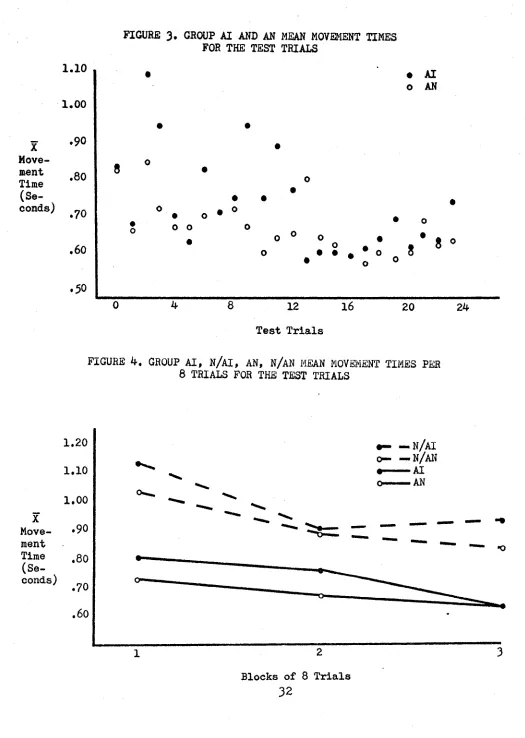
test trials. The mean movement time per trial for groups AI and AN was plotted in
Figure 3« From Figure 3 both groups AI and AN show greater
intertrial variance for the first 12 trials but after 12,
both groups showed greater consistency of movement time and
are represented by similar curves. Figure 4 shows that group
AN had slightly faster movement times for Rb over the first
two sets of eight trials (0.07 and 0.08 second difference)
while both groups AN and AI had the same mean movement time
over the last eight trials. Neither group improved greatly
after trial 12. Groups N/AN and N/AI produced slower move
ment times than groups AN and AI for the
2k
test trials(Figure
k
and 5)« This was the first time either groups hadperformed a lever response.
Test Trials (Incompatible Responses)
An analysis of variance was made of the incompatible res
ponse data provided by groups AI, N/AI, AN and N/AN during
the
2k
test trials. Comparisons of the mean number of incompatible responses for each of the three blocks of eight trials
were made between and within groups. The mean number of in
compatible responses produced for each block of eight trials
by each group and the F ratios for all possible comparisons
between and within groups are shown in Table 1. The level
of significance was set at 0.01. Minimally, one set of bet
FIGURE 3, GROUP AI AND AN MEAN MOVEMENT TIMES FOR THE TEST TRIALS
X Move ment Time (Se conds)
1.10
1.00
8
0 12 16 20 24
Test Trials
FIGURE 4. GROUP AI, N/AI, AN, N/AN MEAN MOVEMENT TIMES PER 8 TRIALS FOR THE TEST TRIALS
1.20
1.10
1.00
X
Move- *90
ment
Time .go
(Se-conds) _?0
.60
.n/ai -n/an •AI • AN
FIGURE 5. GROUP N/AI AND N/AN MEAN MOVEMENT TIMES FOR THE TEST TRIALS
1.40
1.30
• n/ai o n/an
1.20
X
Move- 1 1 0 raent
Time
& B ) 1-00
.90
.80
.70
o •
•
2
o o
• •
o
• o 8 • o
• ft • •
o 8 . • ° 0 o
o •
o o
• o
0 4 8 12 16 20 24
34
second set of eight trials with F ratios of 3 9 .55 and 24.20
respectively. Within group comparisons between successive
blocks of test trials are significant for both automated
groups AI and AN.
TABLE 1
Incompatible Response Means for All Groups
Groups
Block 1 (Trials 1-8)
Block 2 (Trials 9-16)
Block 3
(Trials 17-24) F Ratio
AI 1.83 0.42 0 . 0 0 34.63 *
N/AI 0.08 0 . 0 0 0 . 0 0 00.007
N/AN 0.1? 0 . 0 0 0 . 0 0 1.55
AN 2 . 2 5 1.17 0 . 0 0 22.64 *
F ratio 39.55 * 24.20 * 0 . 0 2 5
*p < 0 . 0 1
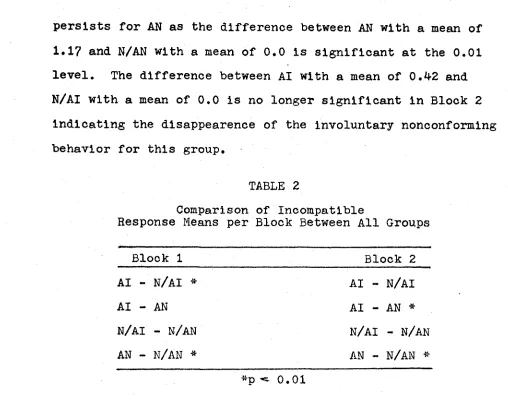
Table 2 indicates those comparisons of the means for
which significant differences were found between groups for
Blocks 1 and 2 which had significant F ratios. The involun
tary nonconformity construct was examined by comparing the
mean number of incompatible responses produced by the two
automated groups AI and AN with the two non-automated control
groups N/AI and N/AN respectively. Support is shown for the
construct in Block 1 with group AI having a mean of 1.83 and
group N/AI a mean of 0.08 which is significantly different at
the 0.01 level. Similarly, group AN with a mean of 2.25 was
significantly different from its control group N/AN with a
persists for AN as the difference between AN with a mean of
1.17 and N/AN with a mean of 0.0 Is significant at the 0.01
level. The difference between AI with a mean of 0.42 and
N/AI with a mean of 0.0 is no longer significant in Block 2
Indicating the disappearence of the involuntary nonconforming
behavior for this group.
TABLE 2
Comparison of Incompatible
Response Means per Block Between All Groups
Block 1 Block 2
AI - N/AI * AI - N/AI
AI - AN AI - AN *
N/AI - N/AN N/AI - N/AN
AN - N/AN * AN - N/AN *
*p ^ 0 . 0 1
Table 3 indicates those comparisons of the means for which
significant differences were found within groups between the
three blocks of test trials. The effects of learning and
socially induced stress on the frequency of the involuntary
responses were examined by making comparisons of the means
within the two automated groups and by comparing the means
between the two automated groups AI and AN over the three
blocks of trials. Group AI has a significant difference
between Blocks 1 and 2 only, while for group AN a significant
reduction in the number of incompatible responses is found
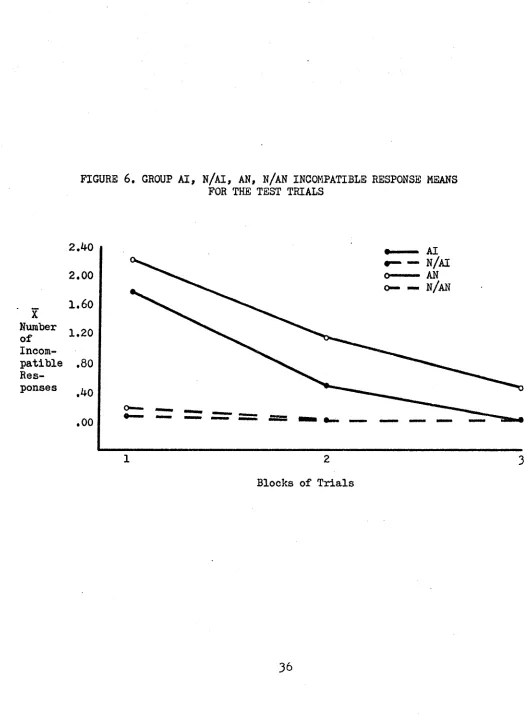
FIGURE 6. GROUP AI, N/AI, AN, N/AN INCOMPATIBLE RESPONSE MEANS FOR THE TEST TRIALS
2.40
2.00
1.60
X
Number . OA
of 1,40
Incom
patible .80 Res
ponses
.00
AI N/AI AN n/an
Blocks of Trials
37
clearly indicates that for both automated groups there is a
reduction in the number of incompatible responses with prac
tice with almost all subjects reaching error free performance
in trials 17 to 24.
TABLE 3
Comparison of Incompatible Response Means Between Blocks Within Groups AI and AN
Group AI Group AN
1 - 2 * 1 - 2 *
2 - 3 2 - 3 *
The effects of socially induced stress on involuntary
nonconformity can be seen through a comparison of the auto
mated groups AI and AN. In the first block of eight trials
the means for AI and AN were 1.83 and 2.25 respectively which
were not significantly different. The second block of eight
trials produced means of 0.42 and 1.17 which were signifi
cantly different, while no significant difference was found
for the third block of trials in which the means were 0 . 0 0
and 0.42. From Figure 6 the incompatible response means of
group AI were in all cases lower than that of group AN.
A second method of examining the data was carried out
to collaborate the findings which emerged from the above
analysis of variance. Identical between and within group
comparisons were made, using as the basis of the comparisons
the number of subjects reaching a criterion set at seven cor
38
The nonparametric, chi-square test (Freud, 1970; Griffin,
1 9 6 2) when applied revealed differences significant at the
. 0 5 level which corroborates the main findings arrived at
with the analysis of variance.
Discussion
The tasks were presented in such a way as to lead the
subjects to believe that the experimenter was evaluating the
correctness and speed of their decisions in calling basketball
fouls; that the lever response was only a preliminary movement
to permit the execution of this more Important decision task.
The perceptual and ideational aspects of the decision task,
it was hoped, would prevent the subjects from consciously
attending the lever response. No evidence was found to cause
the experimenter to suspect that the subjects believed other
wise; in most cases the subjects at the end of the session
inquired as to their success in calling fouls compared to
others, and in a considerable number of cases, argued about
the decisions given over the audio system. It was necessary
that the subjects became ego-involved with the basketball
evaluation task ensuring that they attended maximally to
this task. This decision task (judging basketball fouls)
was selected because it was believed that it would interest
physical education students. Observation of the subjects
during the experiment demonstrated that the task was both
ego-involving and challenging: comments of dismay at making
the wrong decisions were prevalent throughout, subjects in
39
when an incompatible response had been made and shouting
encouragement to each other.
The preliminary trials used to automate Ra by groups AI
and AN on the experimental task were instituted to ensure
that some level of automation was reached before correct per
formance on the total task could be achieved. A check on the
learning done by groups AI and AN prior to the test trials
was the lever movement times recorded during the .44 prelimi
nary trials. Little improvement on lever movement time over
the last
Zk
trials demonstrated by conventional measures thatlittle further learning can be inferred in this phase. Over
learning to some degree of automation was assumed to be occur
ring. The two groups while differing more initially, were
very similar in their movement times towards the end of the
preliminary session, and both groups entered the test trials
with little difference in mean movement time. This was
expected since both groups were under the same conditions
during the preliminary trials and the treatments were randomly
assigned to the subjects.
The mean movement times for the automated groups during
the test trials produced performance curves quite similar to
each other (Figure 6). As in the preliminary trials, group
AN maintained a slightly faster average speed of movement
over the first two blocks of test trials. Also, similar to
the preliminary trials, greater variance in the mean movement
time was found Initially with the means becoming more consis
40
The experimental treatment of no socially induced stress
versus socially induced stress appears to have produced no
differential effects on the movement times of groups AI and
AN. The introduction of a new response (Rb) for the test
trials seems to be responsible for the Initial increase in
mean movement time variance shown by both groups.
The non-automated groups which had no previous exposure
to Ra or Rb prior to the test trials produced mean movement
times which were much slower than those times of the auto
mated groups. The lever movement time measure which reflects
the actual performance of the movement itself, indicated that
for all groups, Rb was performed better with practice sug
gesting learning was occurring. A comparison of the automated
and non-automated group times suggests that even though Rb
was in conflict with Ra, positive transfer for the speed of
the lever movement occurred. It might be expected that as
involuntary nonconformity occurred, the mean movement times
would have increased, but the largest incompatible response
mean was 2.25 (that is, 2.25 incompatible responses out of
eight trials) and increased movement times on approximately
two out of eight trials would not significantly raise the
mean movement time.
The involuntary nonconformity construct was supported.
Groups AI and N/AI were both under task and socially induced
stress in the test trials, the only difference between these
two groups being that AI had previously automated Ra in con
41
with Ra. Groups AN and N/AN respectively were under similar
conditions of experience as AI and N/AI differing in that
they performed under conditions of task stress alone. The
incompatible responses produced by N/AI and N/AN were classi
fied as errors committed in the process of learning Rb. The
number of errors produced by these groups was very small and
not significant from zero. The incompatible responses pro
duced by AI and AN were classified as the result of learning
plus involuntary nonconformity. A comparison of groups AI
and N/AI and groups AN and N/AN indicated a significantly
greater number of incompatible responses was produced by the
automated groups — this difference was predicted by the
involuntary nonconformity construct.
The mean number of incompatible responses for groups AI
and AN when graphed (Figure 6) indicated that with practice,
a reduction in the frequency of involuntary nonconformity
occurred. Both groups showed a significant decrease from
Block 1 to Block 2 with only group AN decreasing significantly
from Block 2 to 3. No significant reduction may have been
observed for group AI from Block 2 to 3 due to a "bottom
effect". The decrease from Block 1 to 2 reduced the fre
quency of involuntary nonconformity in Block 2 to a level not
significant from zero.
The experimental conditions of task plus socially induced
stress can be equated with high stress while task stress alone
can be equated with a low stress condition. Groups AI and AN
42
comparison of the curves produced from the mean incompatible
response scores showed that for all three blocks of trials,
group AI had lower mean scores than group AN. For Block 1
no significant difference exists between AI and AN, but for
Block 2 the difference was significant at the 0.01 level.
For the third block of trials, no significant difference
existed between the means as neither mean was significantly
different from zero. High stress, in this case socially
induced, appeared to have no significant effect on the occur
rence of involuntary nonconformity initially, but increased
the rate at which involuntary nonconformity was inhibited and
reduced by the second block of trials as group AI produced
involuntary nonconformity not significant from zero one block
CHAPTER V
SUMMARY AND CONCLUSIONS
The present study strongly supported the La Fave involun
tary nonconformity construct as well as shedding light on
certain questions raised by the La Fave and Teeley (196?)
study. La Fave and Teeley were unable to account for the
incompatible responses resulting in the process of learning
the new responses. The addition of control groups which did
not automate the original response allowed the learning
variable to be considered in the present study. The highly
significant difference between experimental and control groups
(automated and non-automated) indicated that involuntary non
conformity provides a parsimonious explanation of the incom
patible responses produced over and. above those due to
learning.
La Fave and Teeley found it puzzling that the boy's team
made more errors during the second half of the game than the
first. Although they stated no hypothesis concerning the
learning variable, from habit lag it might have been expected
that habit lag errors would decrease as practice of the new
response as dictated by the rule change continued. These
authors suggested that such an expected decrease could have
been more than offset by lapses into old habit from Increasing
fatigue as the game progressed. The present experiment con
trolled for fatigue by utilizing a novel challenging response
44
with low energy cost and allowing subjects periodic rests.
As a result, the number of incompatible responses due to
involuntary nonconformity decreased significantly over time
with practice, supporting the belief that fatigue had inf
luenced the La Fave and Teeley results.
The experiment was also designed so that the lever res
ponse could be made a major component of co-operation and
interaction between the members of the dyad for the socially
induced stress groups. Subjects In groups AI and N/AI worked
in a dyadic situation during the test trials and the produc
tion of an incompatible response violated the norms of that
group as it hindered the groups performance on the experimen
tal task. Therefore, involuntary nonconformity by one of the
subjects would place that subject in a state of stress as a
result of violating the group norm. Groups AN and N/AN per
formed as individuals during the test trials and, therefore,
were not under socially induced stress if they nonconformed.
It was found that under conditions of socially induced stress
the frequency of involuntary nonconformity decreased more
rapidly over time with practice than when under conditions of
no socially induced stress.
The group may function as a source of stress for those
individuals who consciously or unconsciously nonconform. In
the consciously nonconformlng subject, the stress results
from the conflict between the individual’s decision and sub
sequent nonconforming response and the individual’s knowledge
45
Festinger’s (1957) construct of "cognitive dissonance". When
Involuntary nonconformity occurs, the resulting stress is a
function of a different set of conditions. The individual is
in agreement with the group as to the appropriate response
but has inadvertently nonconformed. The resulting stress is
not a function of the conflict of deciding to conform or non
conform but rather a function of wanting to conform and not
being able to do so. Therefore, the resulting stress does
not "pressure" the individual to change her attitude but
rather has the effect of putting her on the "alert" against
the future initiation of the involuntary behavior.
If it is accepted that the stress arising from involun
tary nonconformity places the individual on the alert, it may
be hypothesized that several factors will indicate this shift
in attention. A new response dictated by a norm change will
initially require conscious attention to the old response to
allow it to be Inhibited and the new response initiated. It
may be hypothesized that this decrease in the amount of atten
tion available for the other tasks or problems in the imme
diate social environment will cause a decrement in their
performance and, in some cases, a disruption of the behavior
itself. Bahrick et al. (195^). Bahrick (1952) and Poulton
(1961) by utilizing two tasks, both of which were evaluated
for performance, found that the greater the attention required
for one of the tasks the poorer the performance became on the
second task. A second hypothesis which could easily be tested
46
response in place of an old response which had been automated,
the time between the perception of the stimulus and initia
tion of the new response would increase. The increase in
reaction time reflects the time taken to inhibit the old auto
mated response, program the new response, and initiate the new
response. It is also possible that when an individual is able
to avoid involuntarily nonconforming, the cost may be deter
mined by measuring certain physiological variables which
indicate the individual’s level of arousal. The level of
arousal could be hypothesized to rise when the individual
prevents involuntary nonconformity from occurring and sub
stitutes the conforming response. The same line of reasoning
suggests that the level or arousal would decrease as the indi
vidual automated the conforming response.
No attempt was made to treat the variable stress in a
systematic way as research involving such theories as the
U-hypothesis of stress and performance would require. The
effect of socially induced stress on the occurrence and fre
quency of involuntary nonconformity in the involuntary non-
conformer and her motor performance of the response was the
major concern. The performance measure the "movement time"
did not appear to be effected by the stress, whereas the
frequency of involuntary nonconformity
did.The focus of the stress may be an Important variable in
predicting its effect on involuntary nonconformity. Stress
has the effect of reducing Involuntary nonconformity only
47
further involuntary nonconformity responses, that is, when the
stress prevents the subject from performing involuntarily. If
the stress is not specifically related to the involuntary non-
conforming response, then it would be predicted that the pro
bability of Involuntary nonconformity would be greatly
increased since this stress would tend to focus the subject's
attention elsewhere making it more likely for the stimulus
situation to elicit the old automated response involuntarily.
Conclusions
1) The effect of automating Ha was to make the subjects
more prone to involuntary nonconformance of Ra when
the rules had been changed making Rb and not Ra
appropriate.
2) With practice, the frequency of involuntary non
conformity decreased and the probability of the
new rule or norm being conformed to increased
significantly.
3) Subjects in the conditions of socially induced
stress decreased their frequency of involuntary
nonconformity more rapidly than those subjects
in conditions of no socially induced stress.
The involuntary nonconformity construct appears to be a
useful concept for examining the social psychological basis
of sport's activity and behavior since highly learned and
automated behavior characterizes sport's activity, and for
mal and informal sets of rules structure most games and con