ABSTRACT'
!
SIGMON,!JAMIE!DANIELLE.!!Development!of!High!Cell!Density!30!L!FedCBatch!Pichia&pastoris&
Fermentation!and!Optimization!of!in&situ!Methanol!Probe!Response!for!Automated!Control!
of!Recombinant!Protein!Expression.!!(Under!the!direction!of!Dr.!Michael!C.!Flickinger.)! !
Over!500!recombinant!proteins!have!been!expressed!using!the!methylotrophic!yeast!Pichia&
pastoris.!!The!strong!methanol!inducible!alcohol!oxidase!promoter!(pAOX1)!has!the!ability!
to! express! recombinant! proteins! with! reported! yields! up! to! 10! g/L.! !P.& pastoris! has! the!
capacity! to! grow! rapidly! to! high! cell! densities! on! the! order! of! prokaryotic! organisms,! yet! retains!advantages!of!higher!eukaryotes!for!protein!processing.!
!
A! robust,! 30! L! fedCbatch& Pichia& pastoris! fermentation! process! has! been! developed! on!
defined! media! with! biomass! densities! exceeding! 150! g/liter! WCW! achieved! by! glycerol!
feeding.!!This!project!involves!optimization!of!an!in&situ!dissolved!methanol!sensing!system!
to! control! gene! expression! which! includes! significantly! improving! sensor! response! time! from!12!minutes!to!2.8!minutes.!!Project!outcomes!include!startup!and!calibration!of!the! bioreactor! system! for! oxygen! transfer,! selection! of! process! control! parameters,! scaleCup! from!shake!flask!cultures,!rapid!inoculation!strategy,!and!implementation!of!onCline!residual! glycerol!monitoring!using!an!automated!sampling!system!integrated!with!a!YSI!analyzer.!!In! addition,!draft!SOPs!and!BRs!were!prepared!for!many!of!the!operational!systems!of!this!30! liter!fedCbatch!bioreactor!process.!
! ! ! ! ! ! ! ! ! ! ! !
©!Copyright!2014!by!Jamie!Danielle!Sigmon!
Development!of!High!Cell!Density!30!L!FedCBatch!Pichia&pastoris&Fermentation!and! Optimization!of!in&situ!Methanol!Probe!Response!for!Automated' Control!of!Recombinant!Protein!Expression' ' ' ' by! Jamie!Danielle!Sigmon! ! ! ! A!thesis!submitted!to!the!Graduate!Faculty!of! North!Carolina!State!University! in!partial!fulfillment!of!the! requirements!for!the!Degree!of! Master!of!Science! ! ! Biomanufacturing! ! ! Raleigh,!North!Carolina! ! 2014! ! ! ! APPROVED!BY:! ! ! ! ! ___________________________! ! ! ___________________________! !!!!!!! !!!!!!Dr.!Driss!Elhanafi! ! ! ! ! Dr.!Gisele!PassadorCGurgel!
DEDICATION) ) )
I"would"like"to"dedicate"this"thesis"to"my"family.""They"have"always"supported"my"endeavors"
BIOGRAPHY) ) )
Jamie"Sigmon"is"a"National"Science"Foundation"fellowship"recipient"for"her"graduate"studies" in" the" Biomanufacturing" Master’s" of" Science" program" at" North" Carolina" State" University."" She" received" her" Bachelor’s" of" Science" degree" in" Biochemistry" from" North" Carolina" State" University" in" May" 2011." " Subsequently," her" experience" working" as" a" chemical" analyst" at" Novozymes" (Franklinton," NC)" inspired" her" to" further" her" education" in" biomanufacturing."" While" continuing" partQtime" work" and" pursuing" her" thesis" research," she" studied" both" upstream" and" downstream" biomanufacturing" tracts" within" her" Master’s" program." " In" addition,"during"her"graduate"studies"Jamie"was"involved"with"a"program"funded"by"BARDA" (Biomedical"Advanced"Research"and"Development"Authority)"gaining"research"experience"in" viral"inactivation"and"purification"for"influenza"vaccine"manufacturing"at"Golden"Leaf"BTEC" (Biomanufacturing" Training" and" Education" Center)." " " She" also" worked" on" a" biopharmaceutical" technology" transfer" project" as" an" engineering" intern" within" Manufacturing" Technical" Sciences" at" Shire" (La" Jolla," CA)." " She" is" an" active" member" of" the" International"Society"for"Pharmaceutical"Engineering"(ISPE)"and"currently"holds"the"position" of"Public"Relations"Director"for"the"NCSU"student"chapter.""In"January"2014,"Jamie"will"begin" her"career"in"the"biopharmaceutical"industry"working"as"a"scientist"in"Global"Development" at"Novartis"(Holly"Springs,"NC).""Jamie"is"personally"dedicated"to"applying"her"skill"set"to"help"
improve"the"lives"of"patients"atQrisk"or"suffering"from"lifeQaltering"diseases.)
ACKNOWLEDGEMENTS) )
)
There"were"a"number"of"individuals"who"contributed"greatly"to"the"success"of"this"project.""I" would" first" like" to" acknowledge" Dr." Michael" C." Flickinger," research" advisor" and" thesis" committee"chair,"for"his"guidance"and"support"over"the"course"of"this"research"project.""I" would"further"like"to"mention"thesis"committee"members"Dr."Driss"Elhanafi"and"Dr."Gisele" PassadorQGurgel"for"their"contributions.""Several"student"researchers"were"integral"to"this"
Pichia& pastoris" research" project," including" visiting" graduate" students" Francesc" PadrèsQ Angelats" and" Adrià" Colomina" from" IQS" School" of" Engineering" (Barcelona," Spain)," NCSU" Chemical" and" Biomolecular" Engineering" undergraduates" Caitlin" Kurtz" and" Branson" Kinsey," and" NCSU" Biomanufacturing" graduate" student" Andrew" Omonde." " There" were" many" additional" supporters" from" BTEC" staff" and" faculty," including" Michele" Ray," Haiwei" Zhang," Michael"Ray,"and"Rob"Niklas.""Finally,"I"would"like"to"send"my"thanks"to"the"National"Science" Foundation" for" the" fellowship" funding" my" graduate" studies" in" the" Master’s" of" Science" in" Biomanufacturing"graduate"program.""
TABLE)OF)CONTENTS"
)
LIST)OF)TABLES)...)ix)
LIST)OF)FIGURES)...)x)
LIST)OF)EQUATIONS)...)xii)
LIST)OF)TERMS)...)xiii)
1.))OBJECTIVES)...)1)
2.))PICHIA&PASTORIS)...)3)
2.1.""History"of"Pichia&pastoris"Expression"System"..."3" 2.2.""Market"Demands"for"Biotherapeutics"..."3" 2.3.""Pichia&pastoris"as"a"Protein"Expression"Platform"..."3" 2.4.""Host"Strains"..."5" 2.5.""Methanol"Utilization"Phenotypes"..."6" 2.6.""Methanol"Metabolism"in"Pichia&pastoris"..."7" 2.7.""Transformation"Methods"..."8" 2.8.""Nutrient"Requirements""..."9" 2.9.""Bioreactor"Cultivation"of"Pichia&pastoris"..."10" 2.10.FedQBatch"Fermentation"..."11" 3.))BIOREACTOR)SYSTEM)...)13)
3.1.""System"Overview"..."13" 3.2.""Biostat®"CQDCU3"30"L"Bioreactor"..."13" 3.3.""In&situ&Dissolved"Methanol"Probe"..."15" 3.4.""Glycerol"monitoring"by"SegQFlow®"integrated"with"YSI"7100"MBSTM"..."16" 3.5.""BlueSens"CO2"and"O2"Gas"Analyzers"..."17" 4.))METHANOL)MONITORING)AND)CONTROL)SYSTEM)...)18)
4.1." Introduction"..."18" 4.1.1." Indirect"Methanol"Feed"Control"..."19" 4.1.2." Methanol"Sensing"Methods"..."19" 4.1.3." Dissolved"Methanol"Sensing"..."20"
4.1.4." Methanol"Feed"Rate"..."22" 4.2." Purpose"..."23" 4.3.""Experimental"Methods"..."23" 4.3.1.""Carrier"Gas"Rotameter"Calibration"..."23" 4.3.2.""Nitrogen"Flow"Rate"..."23" 4.3.3." Agitation"Rate"and"Tubing"Wall"Thickness"..."24" 4.3.4." SterilizationQinQPlace"(SIP)"Durability"..."24" 4.3.5." Effect"of"Methanol"Concentration"on"Response"Time"..."25" 4.3.6." Methanol"Stripping"..."25" 4.4.""Results"..."25" 4.4.1.""Carrier"Gas"Rotameter"Calibration"..."25" 4.4.2.""Nitrogen"Flow"Rate"..."26" 4.4.3." Agitation"Rate"and"Tubing"Wall"Thickness"..."27" 4.4.4." SterilizationQinQPlace"(SIP)"Durability"..."29" 4.4.5." Effect"of"Methanol"Concentration"on"Response"Time"..."29" 4.4.6." Methanol"Stripping"..."30" 4.5.""Discussion"..."31" 4.6.""Conclusion"..."34" 5.))BIOREACTOR)STARTUP)AND)CALIBRATION)...)35) 5.1.""Introduction"..."35" 5.1.1." Bioreactor"Sterilization"Procedure"..."35" 5.1.2." Oxygen"Mass"Transfer"..."35" 5.1.3." Sulfite"Oxidation"for"Determination"of"Oxygen"Transfer"Rate"..."37" 5.2.""Purpose"..."38" 5.3.""Experimental"Methods"..."38" 5.3.1." SIP"and"Sterility"Test"..."38" 5.3.2." DO"Probe"Response"Time"..."39" 5.3.3." Determination"of"Oxygen"Transfer"Rate"..."39" 5.3.4." DO"Controller"Test"Method"..."39"
5.3.5." Comparison"of"Optek®"and"OD600"Measurements"..."40"
5.4.""Results"..."40" 5.4.1." SIP"and"Sterility"Test"..."40" 5.4.2." DO"Probe"Response"Time"..."41" 5.4.3." Determination"of"Oxygen"Transfer"Rate"..."42" 5.4.4." DO"Controller"Test"Method"..."43" 5.4.5." Comparison"of"Optek®"and"OD600"Measurements"..."44"
5.5.""Discussion"..."45" 5.6.""Conclusion"..."47"
6.))BIOREACTOR)GBP)FERMENTATION)DEVELOPMENT)...)49)
6.1.""Introduction"..."49" 6.2.""Purpose"..."50" 6.3.""Experimental"Methods"..."50" 6.3.1.""Media"..."50" 6.3.2.""Bioreactor"Batch"Fermentation"..."52" 6.3.3.""Rapid"(5Q6"Minute)"Inoculation"Procedure"..."52" 6.3.4.""Automatic"pH"Control"at"5.0"..."52" 6.3.5.""FedQBatch"Fermentation"..."53" 6.3.6.""DO"Control"Cascade"..."53" 6.3.7.""Process"Repeatability"..."53" 6.4.""Results"..."54" 6.4.1.""Bioreactor"Batch"Fermentation"..."54" 6.4.2.""Rapid"(5Q6"Minute)"Inoculation"Procedure"..."54" 6.4.3.""Automatic"pH"Control"at"5.0"..."55" 6.4.4.""FedQBatch"Fermentation"..."57" 6.4.5.""DO"Control"Cascade"..."58" 6.4.6.""Process"Repeatability"..."59" 6.4.7.""Batch"Evolution"..."61" 6.5.""Discussion"..."62"
6.6.""Conclusion"..."62"
7.))FUTURE)WORK)...)63)
7.1.""Recombinant"Protein"Expression"..."63" 7.2.""ClosedQLoop"Methanol"Control"..."63" 7.3.""AtQline"OD600"Detection"using"PendoTECH"Turbidity"Sensor"..."64"
7.4.""Exhaust"Gas"Monitoring"..."64"
8.))REFERENCES)CITED)...)65) 9.))APPENDICES)...)67)
APPENDIX)A:""BRQ2180"SterilizationQInQPlace"for"Pichia&pastoris"Fermentation"with" Dissolved"Methanol"Probe"..."68"
APPENDIX)B:""Pichia&pastoris"30"L"Bioreactor"BRQ2180"Inoculum"Transfer"
Procedure"..."81"
APPENDIX)C:""Determination"of"kLa"in"30"L"Bioreactor"using"Modified"Sulfite"
Oxidation"Method..."86"
APPENDIX)D:""BRQ2180"In&situ&Methanol"Probe"Care"and"Maintenance"..."90"
APPENDIX)E:""Pichia&pastoris"Fermentation"Batch"Record"..."93" "
" "
"
)
LIST)OF)TABLES) )
Table)2.3.) Examples"of"recombinant"proteins"produced"by"Pichia&pastoris"..."5) Table)2.5.) Methanol"utilization"phenotypes"..."7"
Table)3.2.) Bioreactor"geometry"..."14"
Table)3.3.) Silicone"tubing"geometry"..."16"
Table)6.3.1.) P.&pastoris&defined"media"composition"(a)"Batch"media"(b))PTM4"(c)"FedQ
batch"media"..."51" !
! "
)
LIST)OF)FIGURES) )
)
Figure)2.6.) Methanol"metabolism"pathway"in"P.&pastoris"..."8)
Figure)2.7.) Stable"transformation"of"gene"of"interest"into"P.&pastoris"genome"by"
homologous"recombination"..."9" Figure)2.10.) Typical"threeQphase"cultivation"of"P."pastoris"with"glycerol"biomass"
generation"phase"(GBP),"transition"phase"(TP),"and"methanol"induction" phase"(MIP)"..."11" Figure)3.1.) Bioreactor"system"overview"..."13"
Figure)3.2.) Biostat®"CQDCU3"30"L"Bioreactor)(a))Photo)(b))Schematic"..."14"
Figure)3.3.) In&situ"methanol"probe)(a))Photo)(b))Schematic"..."16)
Figure)3.4.) SegQFlow®"module"and"YSI"7100"MBSTM"..."17)
Figure)4.1.) Comparison"of"methanol"control"methods"..."18)
Figure)4.1.3.) Methanol"diffusion"across"silicone"tubing"wall..."21)
Figure)4.4.1.) Calibration"curve"of"N2"rotameter"flow"..."26) Figure)4.4.2." (a)"Methanol"probe"response"signal"to"ln[MeOH]"over"N2"flow"rates"
136Q632"ml/min"(b)"Slope"of"response"and"time"of"response"for"N2"flow" rates"136Q632"ml/min"(c)"Calibration"curve"for"411"ml"N2/min"and"25°C""..."27" Figure)4.4.3.) Probe"response"to"agitation"range"300Q1000"rpm"(a)"Response"signal"for"
0.42"mm"tubing"(b)"Response"signal"for"0.28"mm"tubing"(c))Slope"of" response"for"0.42"mm"and"0.28"mm"tubing"(d)"Time"of"response"over"
tubing"area"(ToR/A)"at"increasing"agitation"speed"..."28"
Figure)4.4.4.) Effect"of"SIP"on"methanol"probe"response"as"a"function"of"tubing"wall"
thickness"and"agitation"speed""..."29)
Figure)4.4.5.) Effect"of"methanol"concentration"on"probe"response"time"..."30)
Figure)4.4.6.) Methanol"stripping"from"liquid"to"gas"phase)(a))Stripping"over"14.5"hour" time"course"(b))Determination"of"stripping"rate"over"70"minute"period" following"addition"(c))Effect"of"agitation"speed"on"stripping"rate"at"30°C" and"400"mbar""..."31"
Figure)5.4.1.) Media"hold"for"sterility"assurance.""Fixed"agitation"at"400"rpm,"fixed) airflow"at"12"slpm,"and"calibrated"DO"probe"at"30°C.""Depletion"of"
oxygen"over"time"would"indicate"microbial"growth"in"the"reactor"..."41"
Figure)5.4.3.) OTR"for"30"L"bioreactor"with"20"L"and"30"L"of"water"at"30°C"and"
atmospheric"pressure"over"agitation"speeds"of"400Q1000"rpm"..."43"
Figure)5.4.4.) Schematic"of"DO"control"cascade"test"method"..."44"
Figure)5.4.5.) Comparison"of"Optek®"inQline"turbitidy"probe"measurements"
to"offline"OD600"..."45" Figure)6.1." Typical"threeQphase"P.&pastoris"fermentation"highlighting"the"glycerol"
biomass"generation"phase"(GBP)""..."49" Figure)6.4.1." Batch"fermentation"runs"achieving"stationary"phase"after"22"hours"and"with"
average"final"OD600"="13.0"±"5.1"..."54" Figure)6.4.2.) Effects"of"inoculum"transfer"on"growth"lag"and"maximum"
specific"growth"rate"(μmax)""..."55" Figure)6.4.3.) pH"Control)(a))Batch"fermentation"with"control"using"buffered"media"
only"(b)"Triplicate"fedQbatch"fermentations"with"automatic"control"
at"5.0"by"5"M"NaOH"addition"..."56" Figure)6.4.4." FedQbatch"bioreactor"run"with"residual"glycerol"monitoring"..."57" Figure)6.4.5." Comparison"of"fixed"DO"control"to"cascade"control"at"30%"DOT"..."58" Figure)6.4.6." Process"repeatability"triplicate"fermentations"(a)"Averaged"data"points"
(b)"Individual"data"points"..."60" Figure)6.4.7.) Evolution"of"30"L"P.&pastoris"fermentation"runs"..."61"
LIST)OF)EQUATIONS)
" " "
Equation)2.4." " Conversion"of"LQhistidinol"to"LQhistidine"by"histidinol"
dehydrogenase"..."6"
Equation)4.1.3.(a)" Fick’s"First"Law"of"Diffusion"..."20"
Equation)4.1.3.(b)) Relationship"of"methanol"probe"signal"output"to"tubing" area,"tubing"permeability,"wall"thickness,"and"methanol"
concentration"..."21"
Equation)4.1.4.(a)" Methanol"mass"balance"..."22"
Equation)4.1.4.(b)" Methanol"uptake"rate"..."22"
Equation)5.1.2.(a)" Maximum"oxygen"uptake"rate"..."36"
Equation)5.1.2.(b)" Rate"of"gas"transfer"to"liquid"phase"..."36"
Equation)5.1.2.(c)" Oxygen"transfer"rate"from"gas"to"liquid"phase"in"a"
stirred"bioreactor"..."37"
Equation)5.1.2.(d)" Relationship"between"oxygen"transfer"requirements"and"a" microbial"culture’s"oxygen"uptake"rate"to"maintain"high"biomass" densities""..."37"
Equation)5.1.3." Sulfite"oxidation"chemistry"..."38"
Equation)5.4.3." Calculation"of"oxygen"transfer"rate"by"timed"sulfite"
oxidation"method"..."42" "
" " "
)
LIST)OF)TERMS) )
) ANOVA" " Analysis"of"variance" AOX" " " Alcohol"oxidase" CCA" " " Clean"compressed"air" CU" " " Concentration"units" DCU" " " Digital"control"unit" DCW" " " Dry"cell"weight" DO" " " Dissolved"oxygen"
DOT" " " Dissolved"oxygen"tension"
GBP" " " Glycerol"biomass"generation"phase" GC" " " Gas"chromatography"
GFRC" " " Gas"flow"ratio"control" HPW" " " High"purity"water" IR" " " Infrared"
kLa"" " " Volumetric"oxygen"mass"transfer"coefficient"(sQ1)" MeOH" " " Methanol"
MeOHUR" " Methanol"uptake"rate" MIP" " " Methanol"induction"phase" Mut" " " Methanol"utilization" OD600"" " " Optical"density"at"600"nm" OTR" " " Oxygen"transfer"rate" OUR" " " Oxygen"uptake"rate"
PI" " " Proportional"integral"control" PLC" " " Programmable"logic"controller" PTM" " " Pichia"trace"minerals"
slpm" " " Standard"liters"per"minute" SOP" " " Standard"operating"procedure" TP" " " Transition"phase"
TSB" " " Tryptic"soy"broth"
μmax" " " Maximum"specific"growth"rate"(hQ1)"
v/v" " " Volume"per"volume"
vvm" " " Vessel"volumes"per"minute" WCW" " " Wet"cell"weight"
1. #OBJECTIVES# #
Pichia&pastoris"is"widely"used"as"a"fed-batch"protein"expression"platform.""However,"many" research"and"industrial"fermentation"applications"do"not"directly"control"methanol"feeding" for"heterologous"protein"induction.""The"bioreactor"system"developed"in"this"thesis"contains" an"in&situ"dissolved"methanol"probe"that"can"be"used"for"tight"control"of"residual"methanol" concentration"resulting"in"optimized"culture"viability"and"recombinant"protein"expression."" This" thesis" outlines" the" development" of" a" 30" L" bioreactor"Pichia& pastoris" fermentation" process"and"improvements"to"the"methanol"sensing"system."
"
Heterologous"protein"expression"in"Pichia&pastoris"is"directly"proportional"to"cell"density.""In" order"to"maximize"productivity,"induction"of"the"strong"AOX1"promoter"should"occur"at"cell" densities" greater" than" 100" dry" cell" weight" (DCW)." " Fermentation" equipment," media," and" procedures" must" accommodate" biomass" generation" on" this" scale." " Furthermore," the" methanol"sensing"system"must"have"the"ability"to"rapidly"respond"to"changes"in"dissolved" methanol."
"
The"goals"of"this"thesis"to"achieve"high"biomass"density"and"controlled"methanol"induction" include:"
• Selection"of"bioreactor"operating"conditions"
• Equipment"calibration"methods"
• Scale-up"of"shake"flask"cultures"to"30"L"bioreactor"system"
• Development"of"glycerol"biomass"production"phase"on"defined"media"
• Implementation"of"process"monitoring"technology"
• Improvements"to"methanol"sensing"and"control"system"
•
Draft"Standard"Operating"Procedure"(SOP)"and"Batch"Records"(BR)"for"routine"fed-batch"recombinant"protein"production"using"this"process" "
Additional"overall"project"goals"include:"
• Total"process"automation"
• Defined"media"development"
• Scale-down"process"improvement"studies"in"micro-reactors"
• Development"of"transition"and"methanol"induction"phase"feeding"strategies"
• Routine,"automated"expression"of"recombinant"proteins"
2.##PICHIA&PASTORIS&
#
2.1.##History#of#Pichia&pastoris#Expression#System#
"
The" methylotrophic" yeast"Pichia& pastoris" (P.& pastoris)" was" discovered" in" 1969" by" Koichi" Ogata"for"its"ability"to"utilize"methanol"as"a"sole"carbon"source"for"growth.""Subsequently,"in" the"1970s"the"Phillips"Petroleum"Company"developed"P.&pastoris"fermentation"processes"for" bioconversion" of" methanol" (from" methane" gas)" to" both" yeast" biomass" and" single" cell" protein"for"supplementation"of"animal"feed.""As"a"result"of"the"oil"crisis,"the"cost"of"methane" gas"rose"significantly"and"Phillips"Petroleum"Company"partnered"with"the"Salk"Institute"of" Biotechnology/Industrial" Associates" Inc." (SIBIA," La" Jolla," CA)" to" develop"P.& pastoris" as" a" recombinant"protein"expression"system.""Phillips"Petroleum"Company"sold"the"P.&pastoris& expression" system" to" Research" Corporation" Technologies" (Tucson," AZ)" in" 1993" and" at" the" same" time" licensed" Invitrogen" Corporation" (Carlsbad," CA)" to" distribute"Pichia" technology" globally"(Sreekrishna,"2010;"Macauley-Patrick"et&al.,"2005)."
"
2.2.##Market#Demands#for#Biotherapeutics#
"
Global"demand"for"heterologous"proteins"and"bioproducts"is"rapidly"increasing.""In"2011,"the" protein"therapeutic"market"reportedly"reached"$105"billion"and"is"projected"to"reach"$143.4" billion" by" the" end" of" 2015" (RNCOS," 2012)." " In" order" to" meet" these" market" demands" it" is" important"to"have"production"systems"that"are"robust,"high-yield,"and"economically"viable" (Potvin"et&al.,"2012)."
"
2.3.&&Pichia&pastoris&as#a#Protein#Expression#Platform#
"
secrete"large"quantities"of"foreign"proteins,"(4)"rapid"growth"to"high"cell"densities,"and"(5)" capacity" for" post-translational" modifications." " P.& pastoris" is" as" simple" to" genetically" manipulate" as"Escherichia& coli& (E.& coli)" or"Saccharomyces& cerevisiae" (S.& cerevisiae)" and," additionally,"many"Saccharomyces"genetic"modification"techniques"can"be"directly"applied" to"P.& pastoris" (Invitrogen" Co.," 2010)." " The" strong" inducible" alcohol" oxidase" 1" promoter" (pAOX1)" allows" for" controlled" expression" of" recombinant" proteins" by" induction" with" low" concentrations"of"methanol.""P.&pastoris"is"one"of"the"most"productive"eukaryotic"protein" expression"systems&(Tolner"et&al.,"2006),"with"reported"expression"10-"to"100-"times"greater" than" that" of" S.& cerevisiae& (Invitrogen" Co.," 2010)(Table" 2.3.)." " Pichia& pastoris" boasts" expression"of"greater"than"500"recombinant"proteins"to"date"with"expression"levels"as"high" as"80%"of"total"secreted"protein"(Potvin"et&al.,"2012)."
"
Pichia& pastoris" also" has" the" ability" to" grow" rapidly" to" high" cell" densities" on" the" order" of" prokaryotic"organisms,"yet"retains"advantages"of"higher"eukaryotes"for"protein"processing." One"of"the"greatest"advantages"to"using"this"system"is"its"capability"for"post-translational" modifications," including" polypeptide" folding," glycosylation," methylation," acylation," and" proteolytic"adjustment"(Li"et&al.,"2007)."
"
Disadvantages" to" using" the" P.& pastoris& expression" system" include" high" expression" of" protease,"sensitivity"to"growth-inhibition"by"methanol"concentration,"potential"for"nutrient" deficiency" when" cultivated" on" defined" media," safety" and" toxicity" concerns" with" bulk" methanol"storage,"and"potential"for"complex"control"strategies"(Potvin"et&al.,"2012)."
"
Table# 2.3.""Examples"of"recombinant"proteins"produced"by"Pichia&pastoris"(Adapted"from" Invitrogen"Co.,"2010)"
"
" "
#
2.4.##Host&strains#
"
Untransformed"strains"require"supplementation"of"histidine"in"the"growth"media." "
!−ℎ!"#!$!%&'+2!!"#!!!"#!$!%&'!!"!!"#$%&'()&!!−ℎ!"#!$!%&+2!!"#$+!2!!!"
"
Equation#2.4.""Conversion"of"L-histidinol"to"L-histidine"by"histidinol"dehydrogenase" "
"
2.5.##Methanol#Utilization#Phenotypes#
"
Alcohol"oxidase"is"the"enzyme"expressed"by"Pichia&pastoris&for"the"metabolism"of"methanol."" Two"genes"are"responsible"for"expression"of"alcohol"oxidase,&AOX1"and"AOX2.""The"AOX1& gene"accounts"for"nearly"90%"of"alcohol"oxidase"expression"while"AOX2"is"responsible"for" approximately"10%"(Bawa"and"Darby,"2012).""The"two"alcohol"oxidase"genes"may"be"deleted" to" produce" methanol" utilization" phenotypes" different" from" the" wild" type." " The" three" possible"methanol"utilization"(Mut)"phenotypes"are"(1)"methanol"utilization"plus"(Mut+),"(2)" methanol"utilization"slow"(Muts),"and"(3)"methanol"utilization"minus"(Mut-).""The"Mut+"strain" retains"both"AOX1"and"AOX2"genes"and"metabolizes"methanol"at"the"wild"type"rate.""GS115" his4" Mut+&is" the" most" commonly" used"Pichia& pastoris" expression" strain." " MutS" strains" are" characterized"by"an"AOX1"gene"deletion.""In"this"situation,"the"AOX2"gene"is"responsible"for" alcohol" oxidase" synthesis" (Li"et& al.," 2007)." " Mut-" strains" have" deletions" in" both"AOX1" and" AOX2"genes.""They"are"not"capable"of"growing"on"methanol,"but"are"still"able"to"induce"high" expression"of"recombinant"proteins"from"the"AOX1"promoter."
"
Table#2.5.""Methanol"utilization"phenotypes""(Li"et&al.,"2007)"
" "
There" are" also" several" protease-deficient" strains" available" with" pep4" and" prb1" gene" deletions." " The" pep4" gene" encodes" for" proteinase" A," a" vacuolar" aspartyl" protease" responsible" for" activating" other" vacuolar" proteases." " Prb1" encodes" for" proteinase" B."""" Available"protease-deficient"strains"include"SMB1163"(his4&pep4&prb1),"SMB1165"(his4&prb1)" and"SMB1168"(his4&pep4)"(Li"et&al.,"2007)."
"
#
2.6.##Methanol#Metabolism#in#Pichia&pastoris& "
Regulation" of" the" AOX1" promoter" is" accomplished" by" repression," derepression" and" induction"mechanisms"(Invitrogen"Co.,"2010).""The"promoter"is"repressed"by"the"presence"of" carbon" sources" such" as" glucose" and" de-repressed" by" glycerol" or" the" absence" of" another" carbon" source." " Induction" occurs" under" de-repressed" conditions" in" the" presence" of" methanol." " Alcohol" oxidase" generated" by"AOX1" and/or"AOX2&gene" expression" oxidizes" methanol"to"formaldehyde.""Due"to"the"toxicity"of"methanol,"this"reaction"occurs"in"cellular" organelles" called" peroxisomes" (Figure" 2.6.)." " Hydrogen" peroxidase" in" the" peroxisomes" catalyzes"the"conversion"of"the"by-product"hydrogen"peroxide"to"water"and"oxygen."""
"
Figure#2.6.""Methanol"metabolism"pathway"in"P.&pastoris""(Bawa"and"Darby,"2012)" "
Formaldehyde" enters" two" pathways," a" cytosolic" dissimilatory" pathway" producing" cellular" energy"and"a"peroxisomal"assimilatory"pathway"resulting"in"biomass"production"(Bawa"and" Darby," 2012)." " Within" the" assimilatory" pathway," formaldehyde" reacts" with" xylulose" 5-monophosphate" in" the" presence" of" dihydroxyacetone" synthase" to" produce" dihydroxyacetone" (DHA)" and" glyceraldehyde-3-phosphate" (GAP)." " These" products" can" be" used"to"regenerate"xylulose"5-phosphate"and"also"result"in"biomass"production"(Bawa"and" Darby,"2012)."
#
2.7.##Transformation#Methods#
"
Stable"transformation"by"homologous"recombination"is"used"to"integrate"a"gene"of"interest" into"the"P.&pastoris"genome."""The"recombinant"vector"is"linearized"in"the"5’"AOX1®ion"by" digestion" with" restriction" enzymes" (Invitrogen" Co.," 2010)" and" a" single" crossover" event" occurs" with" homologous" regions" (Figure" 2.7.)." " Expression" yields" can" be" increased" by" multicopy" transformation" (Li" et& al.," 2007)." " Secretion" products" can" be" cloned" into" Invitrogen’s"pPICZa"vector"downstream"of"a"signal"sequence"(Tolner"et&al.,"2006)."
"
Figure# 2.7." " Stable" transformation" of" gene" of" interest" into" P.& pastoris" genome" by" homologous"recombination"(Invitrogen"Co.,"2010)"
# #
2.8.##Nutrient#Requirements#
"
Pichia&pastoris"is"reasonably"robust"in"its"ability"to"grow"on"relatively"simple"mineral"salts" media"(Jahic"et&al.,"2006).""Complex"medium"such"as"Yeast"Extract"Peptone"Dextrose"(YEPD" or"YPD)"is"sufficient"for"supporting"growth"requirements;"however,"complex"components"in" such" media" result" in" batch-to-batch" variability." " In" order" to" standardize" the" fermentation" process"and"further"optimize"growth"and"expression,"chemically"defined"media"is"preferred."" The"basic"media"requirements"for"growth"include"carbon,"nitrogen,"biotin,"salts,"and"trace" minerals."
"
demonstrated" higher" biomass" yields" compared" to" glucose" or" ethanol" (Bawa" and" Darby," 2012)." " Alanine," sorbitol" and" mannitol" have" also" been" examined" as" alternative" non-repressing" carbon" sources" (Macauley-Patrick"et& al.," 2005)." " These" have" shown" to" have" a" positive"impact"on"heterologous"protein"expression"in"Mut-"P.&pastoris&strains"in"comparison" to"glycerol"or"glucose"(Inan"and"Meagher,"2001)."
"
Ammonium"hydroxide"is"commonly"supplied"both"as"a"nitrogen"source"and"for"pH"control" (Macauley-Patrick"et&al.,"2005).""The"disadvantage"to"this"method"is"that"nitrogen"content"in" the" media" is" dictated" by" fluctuations" in" pH." " " Furthermore," increased" concentration" of" ammonium"in"the"medium"has"been"reported"to"inhibit"growth"and"prolong"the"lag"phase" (Macauley-Patrick"et&al.,"2005)."
"
2.9.##Bioreactor#Cultivation#of#Pichia&pastoris#
"
Due" to" the" high" cell" density," oxygen-enriched" aeration" is" often" required" for" glycerol" and" methanol"metabolism.""The"dissolved"oxygen"tension"(DOT)"should"be"controlled"at"levels" greater"than"20%"dissolved"oxygen"(DO)"in"solution"with"recommended"control"at"30-35%" (Invitrogen" Co.," 2002;" Li"et& al.," 2007)." " A" common" control" temperature" for" cell" growth" is" 30°C.""Temperatures"greater"than"32°C"can"result"in"cell"death,"but"lower"temperatures"may" be"advantageous"for"heterologous"protein"yields.""Reduced"temperature"has"the"effect"of" increased" mRNA" and" protein" stability" (lessened" thermal" denaturation)" and" minimized" proteolysis"(Macauley-Patrick"et&al.,"2005)."
"
P.&pastoris"has"the"ability"to"grow"within"a"broad"pH"range"of"3.0-7.0"with"an"optimum"pH" selected" based" on" recombinant" protein" stability" (Tolner"et& al.," 2006)." " Addition" of" an" antifoam"agent"is"necessary"to"eliminate"foam"in"the"headspace.""Aeration"rates"up"to"1.0" vvm"are"recommended"for"15"L"bioreactor"cultivation"(Invitrogen"Co.,"2002).""Actual""
aeration"operating"rate"should"be"determined"based"on"the"oxygen"transfer"capabilities"of" the"vessel"and"the"oxygen"demands"of"the"culture."
"
2.10.##FedVBatch#Fermentation#
"
A"three-phase"fermentation"process"typically"characterizes&Pichia&cultivation"(Figure"2.10.)."" These" consist" of" a" (1)" glycerol" biomass" generation" phase," (2)" transition" phase," and" (3)" methanol"induction"phase.""The"glycerol"biomass"generation"phase"(GBP)"is"approximately" 22-24"hours"of"rapid"biomass"production"with"specific"growth"rates"around"0.26"hr-1"(Tolner" et& al.," 2006;" Jahic"et& al.," 2006)." " Glycerol" concentration" in" the" media" during" this" phase" is" recommended"to"be"40"g/L"with"concentrations"exceeding"4%"v/v"inhibiting"growth"(Jahic"et& al.,"2006;"Invitrogen"Co.,"2002).""Final"cell"densities"at"the"end"of"the"GBP"can"reach"220"g/L" WCW"(Invitrogen"Co.,"2002)."
"
"
Figure#2.10.""Typical"three-phase"cultivation"of"P.&pastoris"with"glycerol"biomass"generation" phase" (GBP)," transition" phase" (TP)," and" methanol" induction" phase" (MIP)." " This" figure" describes" 5" L" bioreactor" Muts" biomass" concentration," methanol" concentration," and" recombinant"lipolytic"activity.""Methanol"induction"controlled"by"predictive"algorithm"with" PI"controller"and"concentration"analyzed"offline"with"gas"chromatography"and"online"with" MC-168"(PTI"Instruments)"(Cos"et&al.,"2006)"
The"transition"phase"(TP)"is"typically"achieved"by"a"slow"introduction"of"methanol"feed"and" cessation"of"glycerol"feed.""Pure"methanol"is"supplemented"with"Pichia"trace"minerals"(PTM)" solution"and"fed"to"the"fermentation"culture"(Invitrogen"Co.,"2002).""Adaptation"to"growth" on"methanol"occurs"after"approximately"2-4"hours"and"is"indicated"by"a"steady"reading"from" the" dissolved" oxygen" signal." " The" transition" phase" can" last" up" to" 10" hours" (Tolner"et& al.," 2006).#
"
The" methanol" induction" phase" (MIP)" is" designed" based" on" the" methanol" utilization" phenotype"and"optimal"protein"expression"levels.""Methanol"feed"rates"for"Mut+"strains"can" be" doubled" from" that" of" the" transition" phase," while" the" 3-4" times" slower" growth" on" methanol"of"Muts"requires"much"lower"feed"rates"(Invitrogen"Co.,"2010).""The"goal"of"MIP"is" to" provide" sufficient" concentrations" of" methanol" to" induce" the" promoter" while" avoiding" toxic" accumulation" (Bawa" and" Darby," 2012)." " Glycerol" is" also" fed" during" this" phase" as" a" carbon"and"energy"source"to"support"protein"expression.""Methanol"concentrations"should" be" maintained" below" 0.5%" (v/v)." " Other" methanol" induction" strategies" include" variable" ratios" of" mixed" glycerol-methanol" feeding" for" sustained" biomass" growth" and" increased" protein"expression"yields"(Bawa"and"Darby,"2012)."
3.##BIOREACTOR#SYSTEM#
"
3.1.##System#Overview# #
The"30"L"stainless"steel"bioreactor"(Biostat®"C-DCU3)"is"integrated"with"a"dissolved"methanol" probe,"an"autosampler"(Flonamics"Fisp®,"Seg-Flow®),"a"bioanalyzer"(YSI"7100"MBSTM),"and" sensors"on"the"inlet"and"exhaust"gas"lines"(BlueSens"BCpreFerm)(Figure"3.1.)."""
"
"
Figure#3.1.""Bioreactor"system"overview" "
3.2.##Biostat®#CVDCU3#30#L#Bioreactor#
"
"
Figure#3.2.""Biostat®"C-DCU3"30"L"Bioreactor"(a)"Photo"(b)"Schematic"(Cueva"Tello,"2012)" "
Table#3.2.##Bioreactor"Geometry"(Adapted"from"Cueva"Tello,"2012)"
# #
Probes" incorporated" into" this" unit" include" standard" antifoam," high" foam," temperature," dissolved"oxygen,"and"pH.""In"addition,"this"system"has"a"custom"probe"in-line"for"detection" of"dissolved"methanol."
#
3.3.##In&situ#Dissolved#Methanol#Probe" "
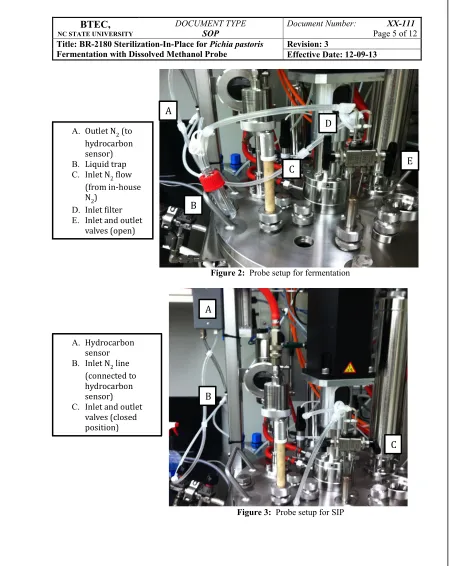
The" dissolved" methanol" probe" constructed" by" previous" researchers" (Cueva" Tello," 2012;" Berry,"2012)"is"shown"in"Figure"3.3(a)"and"(b).""The"probe"is"fabricated"of"a"hollow"stainless" steel" tube" (650" mm" long," 14" mm" diameter)" with" a" threaded" plug" fitting" a" port" in" the" bioreactor"head"plate.""Silicone"tubing"is"coiled"around"the"outside"tip"of"the"stainless"steel" rod" and" filtered" dry" nitrogen" flows" within" the" tubing" lumen." " Methanol" diffusion" occurs" through"the"silicone"tubing"wall"and"is"carried"by"the"nitrogen"gas"to"a"hydrocarbon"sensor" located"exterior"to"the"reactor."Valves"at"the"top"of"the"probe"can"be"closed"during"inAsitu" sterilization"of"the"bioreactor.""Two"sizes"of"silicone"tubing"were"investigated"in"this"thesis."" These"tubing"geometries"of"are"listed"in"Table"3.3."
"
A"tin"dioxide"semiconductor"gas"sensor,"Taguchi"Gas"Sensor"(TGS)"model"822"(Figaro,"Inc.," Japan)," is" used" for" detection" of" gas-phase" methanol." " Metal" oxide" detectors" have" low" conductivity" in" clean" air" (e.g." dry" nitrogen)." " Conductivity" detected" by" TGS-822" increases" with" increased" concentration" of" methanol" in" the" carrier" gas." " The" output" signal" from" the" sensor" is" acquired" by" LabVIEWTM"(National" Instruments" Corporation," Austin," TX)" data" acquisition"software"on"the"laboratory"computer."
"
Figure#3.3.""In&situ"methanol"probe#(a)#Photo"(Padrès-Angelats,"2012)"(b)"Schematic"(Cueva" Tello,"2012)"
"
Table#3.3.""Silicone"tubing"geometry"(Adapted"from"Padrès-Angelats,"2012)"
" "
"
3.4.##Glycerol#monitoring#by#SegVFlow®#integrated#with#YSI#7100#MBSTM#
#
Samples"are"collected"at"a"programmed"interval"by"an"inAsitu"sampling"probe"(Fisp®,""
Flownamics,"Madison,"WI)"that"contains"a"porous"frit"to"retain"the"cells"in"the"bioreactor"for" cell-free"sampling.""The"Fisp®"probe"is"integrated"with"Seg-Flow®"(Flownamics,"Madison,"WI)" to" divert" samples" to" the" YSI" 7100" MBSTM" (YSI" Inc.," Yellow" Springs," OH)" biochemistry" analyzer.""The"YSI"is"capable"of"detecting"analytes"in"solution"using"enzymatic"reactions.""The" assay" kit" currently" installed" provides" data" on" residual" glycerol" concentration" in" the" fermentation" broth," however" this" YSI" analyzer" system" can" be" modified" in" the" future" to" detect"a"variety"of"other"analytes"in"the"culture"broth."
"
# Figure#3.4.##Seg-Flow®"module"(left)"YSI"7100"MBSTM"(right)#
#
3.5.##BlueSens#CO2#and#O2#Gas#Analyzers#
#
BCpreFerm"(BlueSens,"Herten,"Germany)"carbon"dioxide"(CO2)"and"oxygen"(O2)"gas"analyzers" are" installed" on" the" inlet" and" exhaust" gas" lines." " These" are" coupled" with" mass" flow" controllers"and"FermVis"(BlueSens,"Herten,"Germany)"data"acquisition"software"for"future" vent"gas"analysis"of"Pichia&pastoris&fermentation."
"
4.##METHANOL#MONITORING#AND#CONTROL#SYSTEM# #
4.1.##Introduction# #
Methanol"concentration"must"be"tightly"controlled"to"effectively"induce"the"AOX1"promoter" yet"avoid"cytotoxic"levels"of"dissolved"methanol.""Methanol"feed"control"can"be"achieved"by" indirect" or" direct" methods." " Figure" 4.1." shows" oscillations" around" the" desired" dissolved" methanol" set" point" using" three" different" control" methods." " Cos" and" colleagues" (2006)" demonstrated" that" when" controlled" manually" based" on" a" discontinuous" signal," large" fluctuations"in"residual"methanol"concentration"occur.""These"types"of"fluctuations"can"lead" to" cell" stress," inadequate" induction" of" pAOX1," and" overfeeding." " Adding" proportional" integral" control" greatly" reduces" these" oscillations." " Cos" and" co-workers" (2006)" further" refined"the"process"control"using"a"model"to"control"the"set"point,"allowing"tight"control"of" methanol"feeding"at"the"set"point."
" "
#
Figure#4.1.##Comparison"of"methanol"control"methods.""Methanol"concentration"controlled" manually"(…),"PI"feedback"control"(__),"and"model-based"control"(-"-"-)#(Cos"et&al.,"2006)"
#
4.1.1.##Indirect#Methanol#Feed#Control# #
A"commonly"used"indirect"method"is"the"DO"spike"method.""When"a"carbon"source"becomes" limiting,"consumption"of"oxygen"decreases"and"thus"there"is"a"spike"in"dissolved"oxygen"in" the"culture.""This"method"is"used"both"to"determine"whether"glycerol"is"consumed"prior"to" entering" the" methanol" induction" phase" and" feeding" intervals" for" methanol" during" the" induction"phase"(Invitrogen"Co.,"2002)."""
"
A"model-based"indirect"method"for"controlling"methanol"fed-batch"cultures"is"based"on"the" specific"growth"rate,"µ,"during"the"induction"phase.""This"method"requires"complex"models"
that"are"exclusive"to"a"specific"P.&pastoris"strain"and"expressed"protein.""Enzymatic"analysis" of" alcohol" oxidase" production" may" also" be" used" to" indirectly" detect" residual" methanol" concentration" based" on" induction" of" the" AOX1" promoter" (Puhar"et& al.," 1980)." " However," enzymatic" analysis" is" discontinuous," requiring" time" for" sample" collection," sample" preparation," and" analysis." " Furthermore," this" option" does" not" provide" direct" information" about"methanol"concentration"in"solution."
#
4.1.2.##Methanol#Sensing#Methods#
"
Methanol" can" alternatively" be" controlled" directly" by" sensing" systems." " At-line" and" in-line" options"for"methanol"sensing"include:""(1)"gas"chromatography,"(2)"off-gas"flame"ionization" detection,"(3)"commercial"gas-phase"methanol"sensing"systems"and"(4)"tubing"coupled"to"a" semiconductor"sensor.""Gas"chromatography"is"expensive"and"slow.""Similar"to"enzymatic" analysis,"it"does"not"provide"a"continuous"signal"and"dilution"of"the"sample"may"occur"prior" to" reaching" the" GC" analyzer." " Researchers" have" investigated" the" use" of" an" off-gas" flame" ionization"detector,"concluding"that"results"were"not"robust,"being"influenced"by"agitation," temperature," and" uneven" flow" rates" (Austin"et& al.," 1992)." " Additionally," this" method" can" cause"condensation"buildup"in"tubing."
Commercial" gas-phase" methanol" sensing" systems" are" available" for" small-scale" fermentations." " Two" examples" include" the" in-line" Raven" Biotech" 2.1" probe" and" PTI" Instruments" MC-168" for" detection" of" methanol" in" the" exhaust" gas." However," a" simple" dissolved" methanol" probe" can" be" constructed" inexpensively" using" a" hydrocarbon" sensor" (e.g." Figaro" TGS-822)" coupled" to" an" in& situ" stainless" steel" rod" supporting" methanol" permeable" tubing" (e.g." silicone)" (Lee"et& al.," 1996;" Austin"et& al.," 1992;" Cueva" Tello," 2012)."" This" tubing" method" involves" diffusion" of" dissolved" gases" and" volatiles" through" the" semipermeable"tubing"wall"and"subsequent"gas"flow"through"a"detector"using"inert"carrier" gas"such"as"N2"(Austin"et&al.,"1992)."
"
4.1.3.##Dissolved#Methanol#Sensing#
"
The" dissolved" methanol" probe" constructed" by" previous" researchers" (Berry," 2012;" Cueva" Tello,"2012)"is"a"hollow"stainless"steel"rod"with"central"dry"nitrogen"feed"and"return"lines," external"silicone"tubing"for"diffusion,"and"a"threaded"plug"fitting"the"bioreactor"headplate" (Figure"3.3.)."
"
Fick’s"First"Law"of"Diffusion"can"be"used"describe"diffusion"of"methanol"across"the"silicone" membrane:"
"
!=!−!Δ!∆! =−!!!∆−!!!"
"
Equation#4.1.3.(a)""Fick’s"First"Law"of"Diffusion" "
and" therefore" the" concentration" of" methanol" is" constant" in" each." " Diffusion" across" the" membrane"must"also"account"for"impedance"from"both"the"liquid-silicone"boundary"layer" and" the" silicone-gas" boundary" layer" (Figure" 4.1.3.)." " The" liquid-silicone" boundary" layer" thickness" is" influenced" by" agitation" within" the" vessel." " Similarly," the" silicone-gas" phase" boundary"layer"thickness"is"influenced"by"the"carrier"gas"flow"rate"inside"the"tubing."
" "
"
Figure#4.1.3.""Methanol"diffusion"across"silicone"tubing"wall"(Padrés-Angelats,"2012)" "
Signal"output"from"the"hydrocarbon"sensor"is"proportional"to"the"exposed"tubing"area"(A)," the"permeability"of"the"silicone"tubing"for"methanol"(P),"the"concentration"of"methanol"in" the"liquid"phase,"and"the"inverse"of"the"tubing"wall"thickness"(Δx-1):"
"
∆!"#$"#!∝!∙ ∆!! ∙[!"#$]"
"
Equation#4.1.3.(b).""Relationship"of"methanol"probe"signal"output"to"tubing"area,"tubing" permeability,"wall"thickness,"and"methanol"concentration"
The"probe"construction"allows"for"a"specified"length"over"which"the"silicone"tubing"surface" can"be"coiled"and"therefore"this"parameter"can"be"considered"constant.""The"permeability" coefficient"of"methanol"in"silicone"is"also"constant"as"long"as"silicone"tubing"is"used.""Tubing" wall"thickness"and"methanol"concentration"impact"the"probe"signal.""
"
4.1.4.##Methanol#Feed#Rate#
"
Methanol"feed"rate"must"consider"not"only"dissolved"methanol,"but"also"cellular"uptake"rate" and"loss"of"methanol"to"evaporation"(stripping"rate).""The"mass"balance"for"methanol"feed" rate"is"shown"in"Equation"4.1.4.(a):"
"
!"#$!""# =!!"#$!"#$%&'(+!!!"#!"#$%%&'+!!"#$!"##$%&'(" "
Equation#4.1.4.(a)""Methanol"mass"balance" "
The"methanol"uptake"rate"(MeOHUR)"is"related"to"the"maximum"specific"growth"rate"(µmax)"
on" methanol," biomass" concentration" (X)" and" biomass" yield" on" methanol" (YX/MeOH)." " This" relationship"is"described"by"the"equation:"
"
!"#$%& =!!!"# ⋅!
!!/!"#$" "
Equation#4.1.4.(b)""Methanol"uptake"rate" "
During"the"methanol"induction"phase"µmax"decreases"to" 0.14"h-1"(Table"2.5)"and"methanol"
conditions" which" control" stripping" rate." " The" yield" on" methanol" and" specific" growth" rate" should"be"determined"experimentally"for"the"process"of"interest."
"
4.2.##Purpose#
"
The"primary"purpose"of"this"investigation"was"to"optimize"methanol"probe"sensitivity"and" response"for"tight"control"of"dissolved"methanol.""Parameters"investigated"include"carrier" gas"flow"rate,"tubing"wall"thickness,"agitation"speed,"and"methanol"concentration.""Probe" durability"following"sterilization-in-place"(SIP)"and"methanol"stripping"rate"under"operating" conditions"were"also"considered."
"
4.3.##Experimental#Methods# #
4.3.1.##Carrier#Gas#Rotameter#Calibration#
"
In-house"dry"nitrogen"was"used"as"a"carrier"gas"through"the"lumen"of"the"silicone"tubing"in" the" methanol" probe." " The" rotameter" on" the" N2" gas" line" was" calibrated" by" measuring" the" time" required" to" displace" 100" or" 200" ml" of" water" at" room" temperature" into" a" graduated" cylinder.""This"experiment"was"performed"in"duplicate"for"rotameter"settings"of"30,"60,"100," 200," and" 260" ccm" (Padrés-Angelats," 2012)." " A" calibration" curve" was" generated" for" conversion"of"N2"ccm"to"flow"rate"(ml/min)"at"25°C"(Figure"4.4.1.)."
"
4.3.2.##Nitrogen#Flow#Rates#
"
2012).""The"methanol"concentrations"were"chosen"to"target"the"control"range"for"the"probe," <"0.5%"v/v"dissolved"methanol"(<"124"mM).""Nitrogen"flow"rates"tested"were"136,"246,"300," 411,"522,"and"632"ml/min.""The"response"signal"was"determined"when"the"output"signal"(V)" from"the"probe"stabilized.""Response"time"was"recorded"at"90%"of"the"stabilization"signal."
#
4.3.3.##Agitation#Rate#and#Tubing#Wall#Thickness# #
Effects"of"agitation"speed"on"the"probe"response"signal"were"evaluated"in"the"bioreactor"at" 30°C," 30" L" volume," 411" ml/min" nitrogen" flow," and" 0.4" mm" wall" thickness" silicone" tubing."" Pure"methanol"was"measured"volumetrically"and"added"to"the"bioreactor"through"an"open" port"in"the"headplate.""Accounting"for"dilution"in"the"reactor,"final"methanol"concentrations" tested"were"8.1,"16.2,"24.3,"40.5,"64.8,"97.0,"129.1,"and"161.1"mM"(Padrés-Angelats,"2012)."" Agitation" rates" investigated" were" 300," 400," 500," 600," and" 800" rpm" controlled" by" the" bioreactor"digital"control"unit"(DCU).""Signal"and"time"were"determined"in"the"same"manner" as"described"in"4.3.2."
"
The"0.4"mm"wall"thickness"tubing"was"replaced"with"thinner"walled"tubing"(0.28"mm"silicone" tubing)"of"the"same"material"(Dow" Corning"Corp."Silastic).""The"agitation"rate"experiment" was"reproduced"with"an"additional"point"at"1000"rpm."
"
4.3.4.##SterilizationVInVPlace#(SIP)#Durability#
"
The"probe"was"subjected"to"sterilization"cycles"that"exceed"1"bar"in"pressure"and"maintain" temperature"at"121°C"for"30"minutes.""Inlet"and"outlet"carrier"gas"valves"were"closed"during" this" procedure." " The" N2" gas" line" was" redirected" to" bypass" the" probe" and" flow" directly" through" the" hydrocarbon" sensor." " Following" each" SIP" cycle" the" probe" response" was" measured"at"600,"800"and"1000"rpm.""This"experiment"was"executed"using"0.28"mm"wall" thickness"tubing."
4.3.5.##Effect#of#Methanol#Concentration#on#Response#Time# #
Concentrations" of" 0.4%," 0.6%," 0.8%," and" 1%" v/v" methanol" in" water" were" studied" to" determine"the"effect"of"concentration"of"response"time.""This"data"was"combined"with"data" generated"from"the"SIP"durability"study"(Padrés-Angelats,"2012).""
#
4.3.6.##Methanol#Stripping#
"
Methanol" stripping" experiments" were" performed" at" 30°C," 30" L" of" water," 1" vvm" airflow" (clean"compressed"air),"and"methanol"concentration"of"0.5%.""Agitation"speeds"of"600,"800," and" 900" rpm" were" tested." " The" initial" experiment" was" performed" overnight" (Figure" 4.4.6.(a)).""Stripping"rate"was"determined"by"selecting"a"representative"70"minute"window" over"which"stripping"was"greatest"and"the"slope"determined"by"linear"regression."
"
4.4.##Results# #
4.4.1.##Carrier#Gas#Rotameter#Calibration#
"
The"point"(0,"0)"was"added"to"fit"the"data"through"zero.""The"flow"rate"(ml/min)"of"house"dry" nitrogen"is"related"to"rotameter"setting"(ccm)"by"the"linear"equation"y"="2.7548x"+"25.7638" with"a"coefficient"of"determination,"R2,"of"0.992"(Figure"4.4.1.)"(Padrés-Angelats,"2012)."""
"
Figure#4.4.1.""Calibration"curve"of"N2"rotameter"flow"at"25°C"(Padrés-Angelats,"2012)."
#
4.4.2.##Nitrogen#Flow#Rate#
"
Figure" 4.4.2.(a)" shows" the" linear" relationship" between" methanol" concentration" and" response"signal"for"nitrogen"flow"rates"investigated.""The"slopes"of"these"regression"lines"are" plotted"as"a"function"of"flow"rate"in"Figure"4.4.2.(b).""The"slopes"stabilize"at"flow"rates"equal" and"greater"than"300"ml/min.""Figure"4.4.2.(b)"also"shows"that"the"time"of"response"(ToR)"in" seconds"for"flow"rates"tested"stabilizes"less"than"or"equal"to"411"ml/min.""The"calibration" curve"relating"methanol"concentration"to"output"signal"at"411"ml/min"is"provided"in"Figure" 4.4.2.(c).""