EXPERIMENTS AND SIMULATION OF TRANSFORMATION
INDUCED PLASTICITY UNDER MULTIAXIAL LOADING FOR A
16MND5 FERRITIC STEELS
M. Coret, A. Combescure, LMT-Cachan, 61 avenue du pr´esident Wilson,
94235 Cachan Cedex, France
e-mail : [coret][combescure]@lmt.ens-cachan.fr
ABSTRACT
This paper is concerned with the behaviour of a 16MND5 Steel (french PWR vessel material) under complex loading during phase transformation. A simple meso-model for multiphase materials is explained where each metallurgical phase is represented. Then, we describe a new thermo-mechanical experimental device for the analyse of transformation plasticity under coupled tension-torsion loading and give experimental results. Finally, we give the example of numerical simulation of a disk heated by a laser spot and compare the results with experimental results.
INTRODUCTION
During welding or heat-treatment operations or even during severe accidents in nuclear reactors, for ex-ample, on civilian nuclear facilities, steel parts are subject to large thermal and mechanical actions leading to complex, multiaxial local loads [7]. In these situations, the steel materials employed undergo phase transfor-mations under stress. Reliable numerical simulation of such processes and severe situations require the use of sophisticated models which take into consideration, on the one hand, the thermal, mechanical and metallurgi-cal (phase transformation) behavior of these steels and, on the other hand, the coupling effects between these various physical phenomena. Indeed, interactions do exist among thermics, mechanics and metallurgy. The work we are presenting is part of a continuous study [10] of the thermal, metallurgical and mechanical charac-terization of 16MND5 ferritic steel. In the previous works, coupling between thermics and mechanics, on the one hand, and thermics and metallurgy, on the other, was studied and modelled precisely [10]. In this study, we will focus more particularly on the influence of metallurgy on mechanics. Let us recall that if a mechanical loading is applied during the phase change there is a resulting residual strain called transformation induced plasticity (TrIP)[5, 9]. All the models proposed are based on experimental observations under uniaxial loading. However, a recent study [12] shows that transformation plasticity is influenced by the multiaxial character of the mechanical loading. Therefore, the main objective of our study is to expand the experimental data base of multiaxial load cases.
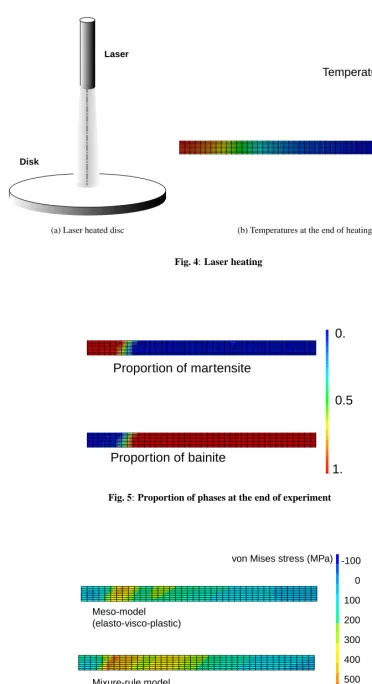
The paper has three parts. The first part deals with the meso-model developped, where the behaviours of each of the present phases in the materials are represented. In the second part, we describe a new thermo-mechanical experimental device. We show how the specimens react during phase transformation under different tension-torsion loadings. Finally, the third part is devoted to the use of the proposed model in order to simulate a test on disk heated by a laser spot, which is representative of a welding operation. Simulations and tests are compared.
MODELS
Two classes of models including phase transformation for steels are used (or studied). The most simple is an homogenous model where the phases is represented by an unique “equivalent” homogenised model. The same type of behaviour (elasto-plastic for example) whose caracteristics are calculated by a basic mixure rule [8, 6, 7]. Such models raises two main drawbacks : First, you can’t mix different type of behaviour (eg. elastoplastic for a phase and viscoplastic for the other phases) second the mixure of two viscous materials with different viscous exponents is not a viscous model with the mixure of the exponents. Others researchers adopt most fine models based on micromecanics considerations [2, 3]. However, these sophisticated models needs a lot of internal variables, thus they are not used to calculate real structures. Hence, we have looked for a new
SMiRT 16, Washington DC, August 2001 Paper # 2054
model most flexible than mixure rule model and less expensive in calculation than the second one. The model is denoted meso-model. The following rate equation describe the meso-model :
˙
Ethm E˙t
˙ Ept
Where ˙Et is the mean total strain rate, ˙Ept is the phase transformation strain rate and ˙Ethm is the mean thermo-elasto-visco-plastic strain rate. For each phase i we have make the voigt hypothesis wich writes :
˙ εthm
i E˙ thm
and we decompose this strain rate as usual :
˙ εthm
i ε˙ei
˙ εvp i ˙ εth i ˙ εtm i
Where ˙εei
˙ εvp i ˙ εth i ˙ εtm
i are respectively the elastic, viscoplastic, thermal and volume phase change strain rate of phase i. We then use for each phase the choosen material model and we obtain for each phase :
˙ σi fi
σ 1 i Ai T ˙ εthm i
In this equality, fi is the model equation, Ai the internal variables and σ
1
i the stress of the phase. Theses equations allow to calculate for a small time increment∆t the final stress stateσ
2
i for each phase. The homo-geneised stress is given byΣ
2 ∑n
i 1ziσ
2
i . In these equations, the strain rate for each phase are the usual values. ˙εtmi and ˙Eptare given by :
˙ εtm
i ˙za∆ε20 o
αγ
et E˙pt K
∆ε20o αγ
σ
y a f
za ˙zaΣ
D [8]
Let us observe that by this method we can choose any model for each phase i. This model have been im-plemented in CASTEM 2000 Code [11]. The mechanical phase model are the usual one hence we concentrate now in the transformation plasticity models.
EXPERIMENTS
The material studied is the French 16MND5 vessel steel whose composition is given in Table 1. This is a low-alloy, low-carbon steel. Like all ferritic steels, it can undergo a variety of transformations depending on the cooling rate.
Table 1: Chemical composition of 16MND5 in % mass
C S P Si Mn Ni Cr Mo Cu Co Fe
The tests are performed on a MTS TTC servo-electro-hydraulic tension-torsion machine and heating is provided by electromagnetic induction. Cooling is achieved by injecting argon inside the test specimen. The gas enters through the lower wedge brace, sweeps over the wall of the test specimen to cool it and escapes through the upper wedge brace (Figure 1).Various calibration tests showed that the heating rate may come close to 60oCs
1and the cooling rate to
40oCs
1. During the tests, the temperature is measured via twelve thermocouples welded in the useful zone. The strains (εandγ) are measured using a water-cooled MTS 632.68F biaxial high temperature extensometer. This extensometer was modified to reduce the distance between exten-sion rods to 15 mm.
The first tests concerned bainitic transformation. The onset of bainitic transformation is 600oC and, at that temperature, the yield stressσy of bainite is 100MPa [10]. All the specimens were heated at a rate of 10oCs
1and were maintained at a temperature of 900oC for 30 s, then cooled at a constant rate of
3oCs
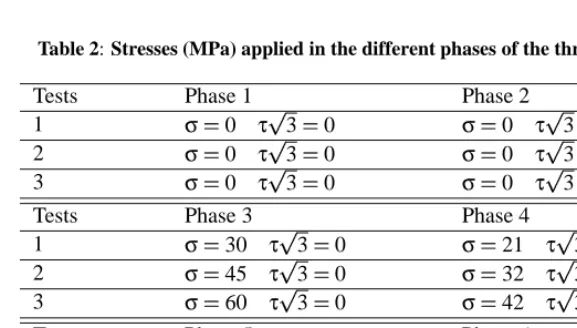
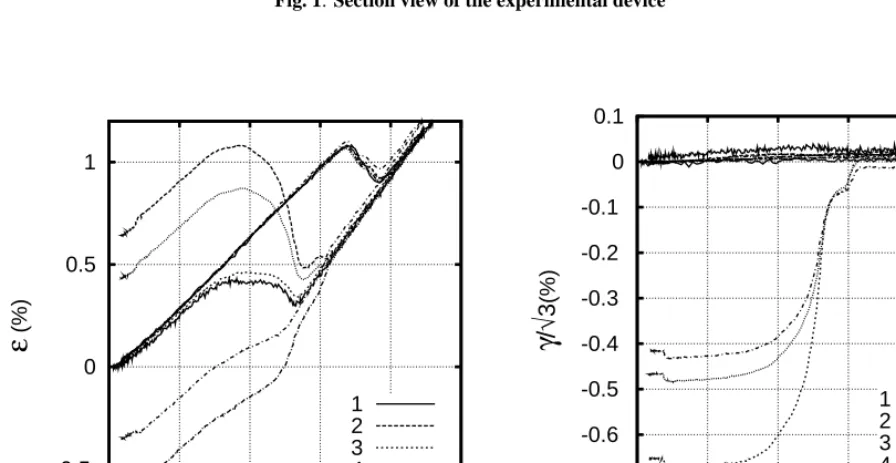
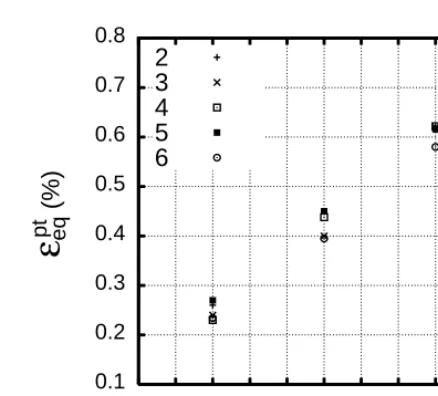
1. Three test specimens were used in this first series of tests. Each specimen was subjected to a succession of six thermomechanical load patterns as described on Table 2. Figure 2, show the axial and shear strains evolutions during the different phases of the third test. First, let us observe that the kinetics of the transformation is not affected by the mechanical loading, which can be easily deduced from the difference between the free dilatometry curve and the dilatometry curve under torque. This result is consistent with the works of Gautier [4], who observed no noticeable differences in the case of small applied loads. We also note that the shear strain remains constantly zero during heating. Qualitatively, we observe that a torque alone causes only a shear plastic strain, a force alone causes an axial strain and a torque plus a force generate axial and shear strains. We must now extract from these curves the transformation plastic strains. For this purpose, we consider that the total strain is the sum of the elastic strain, the thermal strain and the transformation plastic strain. Figure 3 represent the equivalent transformation plastic strain versus the equivalent von Mises stress. It is clear that for the bainitique transformation, transformation plasticity strain is proportionnal to the stresses deviatoric tensor.
Table 2: Stresses (MPa) applied in the different phases of the three tests
Tests Phase 1 Phase 2
1 σ 0 τ 3 0 σ 0 τ 3 30
2 σ 0 τ 3 0 σ 0 τ 3 45
3 σ 0 τ 3 0 σ 0 τ 3 60
Tests Phase 3 Phase 4
1 σ 30 τ 3 0 σ 21 τ 3 21
2 σ 45 τ 3 0 σ 32 τ 3 32
3 σ 60 τ 3 0 σ 42 τ 3 42
Tests Phase 5 Phase 6
1 σ
30 τ 3 0 σ 21 τ 3 21
2 σ
45 τ 3 0 σ 32 τ 3 32
3 σ
Top specimen grip
Test specimen Induction heater work coil
Lower wedge brace
Upper wedge brace
Controle atmosphere enclosure
Intlet of cooling argon
Outlet of cooling argon
Fig. 1: Section view of the experimental device
0
0
.5 1
ε
(%)
-0.4 -0.3 -0.2 -0.1 0
0
.1
γ
/
√
3
0
.1 0
.2 0
.3 0
.4 0
.5 0
.6 0
.7 0.8
20 25 3!
0 3!
5 4"
0 4"
5 5#
0 5#
5 6$
0 6$
5 7%
0
ε
eq(%)
σ
&
eq
(MPa)
2
3
4
'
5
6
pt
Fig. 3: Equivalent transformation plastic strain versus the equivalent von Mises stress
NUMERICAL SIMULATION
Laser
Disk
(a) Laser heated disc
100.
4
(
00.
700.
1000. Temperature °C
(b) Temperatures at the end of heating
Fig. 4: Laser heating
Proportion of bainite
Proportion of martensite
0.
0.5
1.
displacement (mm)
00. 50 100 150 200 250 300
-0.70 -0.62 -0.54 -0.46 -0.38 -0.30 -0.22 -0.14
0
*
.60 0
*
.02 0
*
.10
t
+
ime (s)
Meso-model
Mixure rule model
Experimental
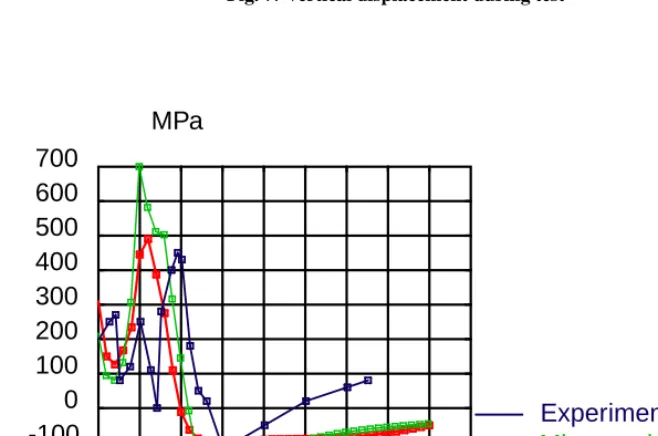
Fig. 7: Vertical displacement during test
Meso-model
mm
MPa
-300
- 200
-100
0
100
200
300
400
500
600
700
.00
90.00
Mixure rule model
Experimental
Fig. 8: Residual hoop stresses on higher face
CONCLUSION
REFERENCES
[1] N. Cavallo. Contribution `a la validation exp´erimentale de mod`eles d´ecrivant la ZAT lors d’une op´eration de soudage. Th`ese, INSA Lyon, Avril 1998.
[2] M. Cherkaoui and M. Berveiller. Micromechanical modeling of the martensitic transformation induced plasticity in steels. Smart Mater. Struct., Vol 9:pp 592–603, 2000.
[3] F.D. Fischer, G. Reisner, E.Werner, K. Tanaka, G. Cailletaud, and T. Antretter. A new view on transfor-mation induced plasticity (trip). Int. Jal. Plas., Vol 16:pp 723–748, 2000.
[4] E. Gautier, S. Denis, C. Liebaut, and S. Sj¨ostr¨om. Mechanical behaviour of fe-c alloy during phase transformations. Jal. Ph. IV, C3(4):pp 279–284, 1994.
[5] G.W. Greenwood and R.H. Johnson. The deformation of metals under small stresses during phase trans-formations. Proc. R. Soc., Vol 283:pp 403–422, 1965.
[6] N. Hamata, R. Billardon, D. Marquis, and A. Ben Cheikh. A model for nodular graphite cast iron coupling anisothermal elasto-viscoplasticity and phase transformation, Constitutive laws for engineering materials. ASME Press,C.S. Desai et al, 1991.
[7] T. Inoue and Z. Wang. Coupling between stress, temperature, and metallic structures during processes involving phases transformations. Mater. sci. and Tech., Vol 1:pp 845–850, 1985.
[8] J.B. Leblond, J. Devaux, and J.C. Devaux. Mathematical modelling of transformation plasticity in steel i. case of ideal-plastic phases. Int. Jal. Plas., Vol 5:pp 551–572, 1989.
[9] C.L. Magee. Transformation kinetics, microplasticity and aging of martensite in FE31Ni. Th`ese, Carnegie Inst. Technologie, Pittsburg PA, 1966.
[10] M. Martinez. Jonction 16MND5-INCONEL 690-316LN par soudage diffusion Elaboration et calcul des contraintes r´esiduelles de proc´ed´e. phdthesis, ENSMP, d´ecembre 1999.
[11] P. Verpeaux, T. Charras, and A. Millard. CASTEM 2000 : une approche moderne du calcul des structures. In J.-M. Fouet, P. Ladev`eze, and R. Ohayon, editors, Calcul des Structures et Intelligence Artificielle, volume 2, pages 261–271. Pluralis, 1988.
[12] J.C. Videau, G. Cailletaud, and A. Pineau. Experimental study of the transformation-induced plasticity in a cr-ni-mo-al-ti steel. Jal. de Ph., 6:pp 465–474, 1996.
Acknowledgements