Response of land configurations, IW/CPE ratios and
integrated nutrient supply systems on growth function, yield
and water use efficiency of French bean
(
Phaseolus vulgaris
L
.
PDR-14)
Binod Kumar
1*and G.R. Singh
21Krishi Vigyan Kendra, Kannauj, Chandra Shekhar Azad University of Agriculture and Technology, Kanpur, UP, India. 2Department of Agronomy, Narendra Deva University of Agriculture and Technology, Kumarganj, Faizabad, UP, India. *Corresponding author: [email protected]
Paper No. 274 Received: 24 March, 2014 Accepted: 16 September, 2014 Published: 17 December, 2014
Abstract
Field experiments were conducted during two consecutive years of 2010-11 and 2011-12 at Agronomy Research Farm of NDUA&T, Faizabad (UP.) India to study the response of land configurations, IW/ CPE ratios and integrated supply systems on growth function, yield and nutrient study of french bean (Phaseolus vulgaris L.) under indo-gangetic eastern plains zone of Uttar Pradesh.Significant increase was observed for plant height, number of branches and dry matter accumulation per plant at 60 and 90 days after sowing and at harvest under 1.0 IW/CPE moisture regime nourished with 75% RDF through chemical fertilizers + 25% N through biocompost at raised bed configuration. Higher growth attributes resulted maximum yield and yield attributes of French bean with sowing at raised beds, application of 75% RDF+25% N through biocompost and IW/CPE ratio of 1.0 as compared to rest of the treatments. Increasing moisture regimes decreased the water use efficiency and it was highest under sowing on raised beds, moisture regime at 0.6 IW/CPE ratio and 75 % RDF through chemical fertilizers + 25 % N through biocompost nutrient supply system. Higher yields of French bean was obtained with treatment combinations of sowing on raised beds, moisture regime at 1.0 IW/CPE ratio and 75 % RDF through chemical fertilizers + 25 % N through biocompost and it was most remunerative and sustainable under Indo-gangetic plains of UP.
Highlights
• Under raised bed land configuration growth functions and yields were more under 1.0 IW/CPE ratio moisture regime coupled with the application of 75% RDF + 25% N through biocompost nutrient supply system.
• Increasing frequency of irrigation at various growth stages decreased efficient utilization of water and water use efficiency (WUE) was maximum under 0.6 moisture regime where less amount of water was applied.
Keywords: IW/CPE ratio, integrated supply system, growth, yield, and water use efficiency.
In India, French bean was grown on an area of 10.8 mha., production of 4.87 mt. and productivity
of 450.9 kg ha-1 during 2010-11 (www.faostat.
org). The stagnation in the production of pulses was noted over the past two decades. This is mainly attributed due to the low yield
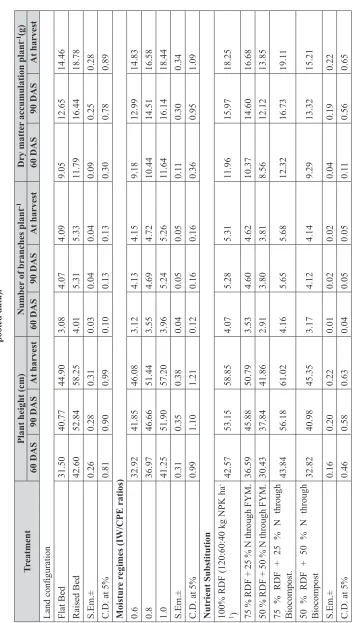
Table 1. Response of land configurations, IW/CPE ratios and integrated nutrient supply systems on gr
owth attributes of Fr
ench bean (T
wo years
pooled data).
Tr
eatment
Plant height (cm)
Number
of branches plant
-1 Dry matter accumulation plant -1(g) 60 DAS 90 DAS At harvest 60 DAS 90 DAS At harvest 60 DAS 90 DAS At harvest 31.50 40.77 44.90 3.08 4.07 4.09 9.05 12.65 14.46 42.60 52.84 58.25 4.01 5.31 5.33 11.79 16.44 18.78 0.26 0.28 0.31 0.03 0.04 0.04 0.09 0.25 0.28 0.81 0.90 0.99 0.10 0.13 0.13 0.30 0.78 0.89 e r
egimes (IW/CPE ratios)
32.92 41.85 46.08 3.12 4.13 4.15 9.18 12.99 14.83 36.97 46.66 51.44 3.55 4.69 4.72 10.44 14.51 16.58 41.25 51.90 57.20 3.96 5.24 5.26 11.64 16.14 18.44 0.31 0.35 0.38 0.04 0.05 0.05 0.1 1 0.30 0.34 0.99 1.10 1.21 0.12 0.16 0.16 0.36 0.95 1.09
kg NPK ha
- 42.57 53.15 58.85 4.07 5.28 5.31 11.96 15.97 18.25 % RDF + 25 % N through FYM. 36.59 45.88 50.79 3.53 4.60 4.62 10.37 14.60 16.68 % RDF + 50 % N through FYM. 30.43 37.84 41.86 2.91 3.80 3.81 8.56 12.12 13.85
+ 25 % N
through 43.84 56.18 61.02 4.16 5.65 5.68 12.32 16.73 19.1 1
+ 50 % N
potential of pulses. For increasing overall production, besides increasing area and productivity of traditional pulses attention also needs to be paid for introduction of non-traditional pulses (Gupta,
et.al. 1996). French bean (Phaseolus vulgaris L.) is one
of the important pulse crops, which has a high yield
potential of 18 to 25 q ha-1 depending upon cultivar.
Sowing on raised bed also has edge over flat sowing particularly under saline and alkali conditions, because it leads to shifting of salts besides the raised bed, leaving a salt free space for good crop stand at early stages of crop growth and facilitates microbial activities. Good aeration leads to easy and hasten rate of mineralization with greater nutrient and water use efficiencies. Lack of awareness among the farmers about the consequences of irrational use of water and lack of appropriate tools and instruments
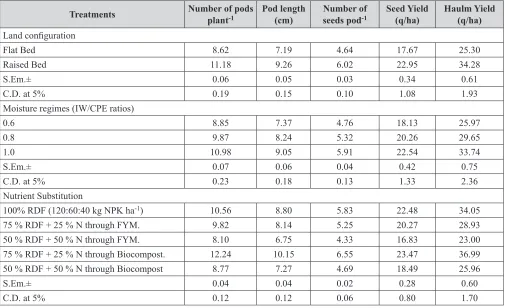
Table 2. Response of land configurations, IW/CPE ratios and integrated nutrient supply systems on yield attributes and yield of French bean (Two years pooled data).
Treatments Number of pods plant-1 Pod length (cm) Number of seeds pod-1 Seed Yield (q/ha) Haulm Yield (q/ha)
Land configuration
Flat Bed 8.62 7.19 4.64 17.67 25.30
Raised Bed 11.18 9.26 6.02 22.95 34.28
S.Em.± 0.06 0.05 0.03 0.34 0.61
C.D. at 5% 0.19 0.15 0.10 1.08 1.93
Moisture regimes (IW/CPE ratios)
0.6 8.85 7.37 4.76 18.13 25.97
0.8 9.87 8.24 5.32 20.26 29.65
1.0 10.98 9.05 5.91 22.54 33.74
S.Em.± 0.07 0.06 0.04 0.42 0.75
C.D. at 5% 0.23 0.18 0.13 1.33 2.36
Nutrient Substitution
100% RDF (120:60:40 kg NPK ha-1) 10.56 8.80 5.83 22.48 34.05
75 % RDF + 25 % N through FYM. 9.82 8.14 5.25 20.27 28.93
50 % RDF + 50 % N through FYM. 8.10 6.75 4.33 16.83 23.00
75 % RDF + 25 % N through Biocompost. 12.24 10.15 6.55 23.47 36.99
50 % RDF + 50 % N through Biocompost 8.77 7.27 4.69 18.49 25.96
S.Em.± 0.04 0.04 0.02 0.28 0.60
C.D. at 5% 0.12 0.12 0.06 0.80 1.70
for regulated and uniform application of the desired quantity of water at the appropriate time are the major causes of low water-use efficiency at the
field-level (Prihar et. al. 1974). Further, suggested
Materials and Methods
A field experiment was conducted during two consecutive years of 2010-11 and 2011-12 at Agronomy Research Farm of Narendra Deva University of Agriculture and Technology, Kumarganj, Faizabad (UP.) to study the impact of abiotic stress on growth, yield and moisture utilization pattern of French bean under saline-alkali soils of UP. Geographically, experimental site falls under sub-tropical zone in Indo-gangetic plains having alluvial calcareous soils and lies between 26.47°N latitude and 82.12°E longitude at an altitude of 113.0 meters above the mean sea level. The region receives mean annual precipitation of about 1280 mm. Out of which nearly 80% is received from mid June to end of September. The winter season is very cold, where as summer are hot and dry. Westerly hot winds start from the end of April and continue till the onset of monsoon. The treatment combinations comprised with two land
configuration viz., M1- flat and M2- raised bed, three
irrigation schedules (I1-0.6, I2-0.8 and I3-1.0 IW/CPE
ratio) and five nutrient supply system (S1- 100 % RDF
as 120:60:40 kg/ha NPK through chemical fertilizers,
S2- 75 % RDF + 25 % N through FYM, S3- 50 % RDF +
50 % N through FYM, S4- 75% RDF + 25 % N through
biocompost and S5- 50 % RDF + 50 % N through
biocompost) were conducted with split plot design
where land configuration and irrigation schedules were allocated to main plots while nutrient supply system were assigned to sub plots and replicated thrice. The experimental soil was silty loam (silt >56 %) in texture with indicating slightly alkaline in reaction with medium in organic carbon (0.28-0.32 %), low in available nitrogen (107.50-118.15 kg
ha-1) and medium in phosphorus (15.78-18.25 kg
ha-1) and high in available potassium (245.70-285.90
kg ha-1). French bean cultivar PDR-14 was sown in
first fortnight of October with aforesaid treatment and their combinations with 30×10 row to row and plant to plant spacing. Crop was fertilized as per respective treatments where half of inorganic N, full phosphorus, potash and organic N were applied at the time of sowing and remaining half nitrogen in two installments one at after first irrigation and second at pod initiation stage. Gap filling and thinning were done wherever necessary and harvesting was done when crop was fully matured. Observations on growth characters viz., plant height, number of branches, dry matter accumulation per plant at 60, 90 DAS and at harvest and yield attributes (number of pods, pod length and number of seeds per pod),
yield (seed and haulm ha.-1) at harvest stage were
recorded. Moisture utilization pattern and water use efficiency were also computed according to prescribed method as suggested by Ramdas, (1957).
Table 3. Responce of different moisture regimes on total water use (TWU) of French bean.
Moisture Regimes (IW/
CPE Ratio)
Number of
Irrigation Depth Of Irrigation (cm) Total Water Applied (cm) Effective Rainfall (cm) Total Water Use (cm)
2010-11
0.6 2 5 10 1.65 11.65
0.8 3 5 15 1.65 16.65
1.0 4 5 20 1.65 21.65
2011-12
0.6 2 5 10 8.04 18.04
0.8 3 5 15 8.04 23.04
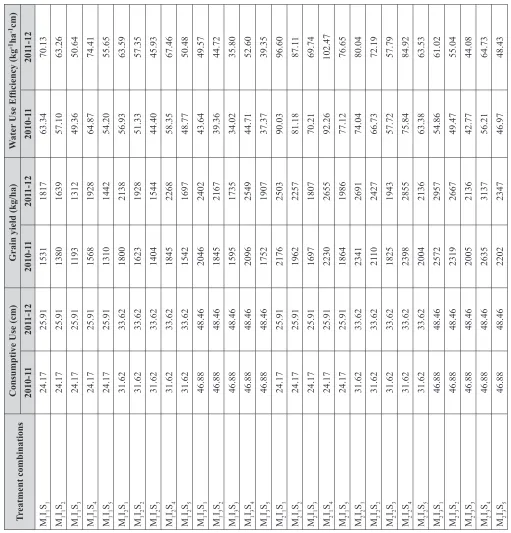
Table 4. Response of differ
ent tr
eatment combinations on water
use efficiency of Fr
ench bean.
Tr
eatment combinations
Consumptive Use (cm)
Grain yield (kg/ha)
W
ater
Use Efficiency (kg
Results and Discussion
Growth characters
Land configurations, irrigation schedules and nutrient supply system significantly influenced the growth characters (Table 1). The plant height, number of branches, dry matter accumulation per plant at 60 and 90 days after sowing and at harvest were obtained significantly higher when crop was sown on 15 cm raised bed as compared to flat bed land configuration. These results are in close conformity with results reported by Sangakkara (2004). IW/CPE ratio of 1.0 produced significantly higher plant height at 60, 90 days after sowing and at harvest as compared to other IW/CPE ratios. It was followed by irrigation at 0.8 than 0.6 IW/ CPE ratio irrigation schedules. At 60, 90 days after sowing and at harvest growth stages the values of number of branches and amount of dry matter accumulation were significantly more when French bean was irrigated at 1.0 IW/CPE ratio irrigation schedules which was followed by 0.8 and 0.6 IW/ CPE ratio irrigation schedules. Similar findings were also reported by Jukte et al (2007). Plant height and number of branches per plant at 60 and 90 days after sowing and at harvest were increased significantly with the application of 75% RDF + 25 % N through biocompost followed by 100 % RDF (120:60:40 kg/ha NPK), 75% RDF + 25 % N through FYM and 50 % RDF + 50% N through biocompost nutrient supply system. Significantly more dry matter accumulation per plant at 60 and 90 days after sowing and at harvest was recorded with 75% RDF + 25% N through biocompost as compared to 100 % RDF (120:60:40 kg/ ha NPK), 75% RDF + 25% N through FYM and 50% RDF + 50 % N through biocompost nutrient supply systems. This might be due to slow and steady supply and availability of nutrients through biocompost and FYM with accelerated mineralization under raised bed condition coupled with increased solubility at 1.0 IW/CPE ratio moisture regime. These results are
in accordance with the findings of Singh et al. (2011).
Yield and yield attributes
appearance of impact at varying degree of solubility.
Similar results were also reported by Kumar et al.
(2009) and Subbaiah et al. (2009).
Water use efficiency (WUE)
Data revealed (Table 3 and 4) that, increasing moisture regimes from 0.6 to 1.0 IW/CPE ratio increases the total water received from 11.65 to 21.65 cm and 18.04 to 28.04 cm during 2010-11 and 2011-12 respectively. Increase in total water utilization further increased the consumptive use of water which was highest under 1.0 IW/CPE ratio during both the years of study. This results in higher grain yield from 0.6 to 1.0 IW/CPE ratio moisture regime.
Water use efficiency (kg-1ha-1cm) was decreased with
increasing moisture regimes from 0.6 to 1.0 IW/CPE
ratio. Treatment combinations of M2I1S4 viz. sowing
on raised beds, moisture regime at 1.0 IW/CPE ratio and 75% RDF through chemical fertilizers + 25% N through biocompost was found to be most efficient utilizer of water for sustainable seed yield of French bean. Kundu and Sarkar (2009) found that the soil water play crucial role in yield and water use pattern of pulse crops and noted highest water use efficiency with lesser IW/CPE ratio of moisture regime.
Conclusion
Higher yields of French bean can be obtained under moisture regime of 1.0 IW/CPE ratio with application of 75% RDF through chemical fertilizers + 25% N through biocompost nutrient supply system. Sowing at fifteen cm high raised beds was proven to be most effective against water stagnation and alkalinity stress condition. Highest water use efficiency was
obtained under treatment combination of M2I1S1
(92.26 and 96.60 kg-1ha-1cm) and M
2I1S4 (90.03 and
102.47 kg-1ha-1cm) during 2010-11 and 2011-12,
respectively.
References
Gaur, Y.D. and Rao, Subba N.S., 1984. The need for Rhizobium phaseoli inoculation to eastablish amarican beans in India.
Current Science53: 430.
Gupta, P.K., Kalyan singh, Singh, U.N., Singh, R.N. and Bohra, J.S., 1996. Effect of moisture regime and fertility level on growth, yield, nutrient turnover and moisture use by French bean (Phaseolus vulgaris). Indian Journal of Agricultural Science66: 343-347.
Jukte, V. D., Lad, N. G., Aghav, V. D., Ingle, A. U. and Karad, M. L., 2007. Response of French bean to varying land layout and irrigation schedules. Journal of Soils and Crops 17(1): 78-81.
Kumar, R. P., Singh, O. N., Singh,Yogeshwar, Dwivedi, Sachchidanand and Singh, J. P., 2009. Effect of integrated nutrient management on growth, yield, nutrient uptake and ecnomics of french bean (Phaseolus vulgaris). Indian Journal of Agricultural Sciences79(2): 122-128.
Kundu, M. and Sarkar, S., 2009. Growth and evapotranspiration pattern of rajmash (Phaseolus vulgaris L.) under varying irrigation schedules and phosphate levels in a hot sub-humid climate. Agricultural Water Management96(8): 1268-1274.
Prihar, S.S., Gajri, P.R. and Narang, R.S., 1974: Scheduling irrigation to wheat using open pan evaporation. Indian Journal Agricultural Science44: 567-571.
Ramdas, L.A., 1957: Evaporation and potential evapotranspiration over the Indian sub-continent. Indian Journal of Agricultural Science27: 137-142.
Sangakkara, U. R., 2004: Effect of tillage and moisture levels on growth, yield and nodulation of common bean (Phaseolus vulgaris) and mungbean (Phaseolus radiatus) in the dry season. Indian Journal of Agronomics49(1): 60-63. Singh, B. K., Pathak, K. A., Verma, A. K., Verma, V. K. and
Deka, B. C., 2011. Effects of vermicompost, fertilizer and mulch on plant growth, nodulation and pod yield of French bean (Phaseolus vulgaris L.). Vegetable Crops Research Bulletin74: 153-165.
Subbaiah, P. V., Venkaiah, K., Naidu, M. V. S. and Ramavatharam, N., 2009. Effect of integrated phosphorus management on dry matter production, pod yield, quality and N, P and K uptake of French bean (Phaseolus vulgaris