pp. 69-92
THE IMPACT OF TEACHING SUMMARIZING ON EFL
LEARNERS’ MICROGENETIC DEVELOPMENT OF
SUMMARY WRITING
Rasoul Mohammad Hosseinpur ∗∗∗∗ Assistant Professor University of Qom, Qom [email protected]
Abstract
Summary writing is associated with lots of cognitive and metacognitive complexities that necessitates instruction (Hirvela & Du, 2013). Contrary to majority of studies carried out on summarization instruction, the present study addressed the underlying processes or microgenetic developments of the Iranian EFL learners’ summary writing. To this end, 41 male and female undergraduate students received instruction on summary writing for eight weeks. They were required to write five summaries during the first, second, fourth, sixth, and eighth sessions. The participants’ summaries were analyzed holistically by the TOEFL-iBT scoring guidelines and in terms of the number of instances of deletion, sentence combination, topic sentence selection, syntactic transformation, paraphrasing, generalization, invention, minor verbatim copying, and major verbatim copying. The findings revealed that some summarization strategies like invention, syntactic transformation, and generalization are more problematic and develop at later stages. The participants gave up major verbatim copying as they obtained a full appreciation of the conventions of authorship. However, many of them still used minor verbatim copying and patchwriting in their summary writing. The results imply that the students’ lack of awareness of the consequences of plagiarism as well as their insufficient general English and summary writing knowledge culminates in plagiarism.
Keywords: Summary writing, minor verbatim copying, major verbatim copying, microgenetic development
1. Introduction
Summary writing is one of the crucial and indispensable academic skills for second language (L2) learners (Yu, 2008). It seems that this skill is a complicated process which involves a number of cognitive and metacognitive activities. Kintsch and Van Dijk (1978) proposed a model for the development of an acceptable summary. Comprehension of the original text, condensation of the thoughts and ideas in the original text, and production of the ideas in one’s own words were the three processes involved in the production of an acceptable summary. Casazza (1993) stated that getting a full appreciation of the text, selecting and identifying important information and main idea of a text, eliminating trivial or redundant information, uniting similar ideas into categories, and writing in one’s own words were essential requirements for developing a good summary.
Summarization is clearly one of the most demanding and challenging academic activities for L2 learners (Hirvela & Du, 2013). Therefore, many researchers and practitioners recommend instruction and suggest that
effective summarization skills do not develop naturally (e.g., Keck, 2006;
Spack, 2004). Many studies have reported the positive effect of summarization instruction, suggesting that the learners’ overall summary
writing ability improves after instruction (e.g., Chen & Su, 2012; Choy & Lee, 2012; McDonough, Crawford, & De Vleeschauwer, 2014; Wichadee, 2013).
attempt to investigate the impact of instruction on English as a foreign language (EFL) learners’ microgenetic development of summary writing in the course of the time.
2. Literature Review
Numerous definitions have been proposed for an acceptable summary. Langan (1993, p. 120), for example, defined a summary as “the reduction of a large amount of information to its most important points.” Friend (2001, p. 3) regarded summarization as “the process of determining what content in a passage is most important and transforming it into a succinct statement in one’s own words.” More recently, Hedgcock and Ferris (2009) provided a more comprehensive definition of summarizing and suggested that:
Summarizing is both a reading and writing skill. Where reading is concerned, effective summarizing requires an understanding of the key ideas in a text and an ability to distinguish among main points (which belong in a summary) and supporting details (which typically do not). For writing, summarizing requires the writer to express the main points of a text she has read succinctly and in her own words. (p. 185)
as the last variable, was related to both content and language. Idris, Baba, and Abdullah (2011) developed a summary writing evaluation framework that particularly focused on the strategies used by the students. To come up with this system, they closely inspected the summaries of a group of experts, took out the strategies employed in the summaries, and proposed a set of syntax level strategies: deletion, sentence combination, copy-paste, syntactic transformation, and sentence reordering.
2.1 Factors influencing summary writing
Summary writing as a highly complex and challenging activity is influenced by many factors inside and outside the learners. These factors have an impact on both the quantity and the quality of the summary. Characteristics of the original text such as length, genre, and complexity; the task procedure like the presence or absence of the original text; and type of summary like writer-based and reader-writer-based are underscored by Hidi and Anderson (1986) as important parameters influencing summary writing activity. Hill (1991) proposed that text difficulty and organization, degree of comprehension, availability of text, audience, intended purpose, type of summary required, genre, and text length were the most influential factors in the summary writing process of L2 writers. Manchon, Murphy, and Roca de Larios (2007) suggested lexical proficiency in L2 as the most prominent language ability and knowledge that L2 writers call on in the process of summary writing. In the same vein, Baba (2009) investigated the impact of different aspects of the lexical proficiency on EFL learners’ summary writing ability in the Japanese context. She concluded that the ability to write definitions, the organization of semantic network of words, and the ability to metalinguistically manipulate words contributed significantly to summary writing in L2. Recent studies investigating L2 writers’ perceptions of summary writing have highlighted text comprehension and reformulating original text information as potential
challenges for L2 writers (e.g., Chen & Su, 2012; Choy & Lee, 2012).
progress in organization, structure and grammar. Chen and Su (2012) reported the positive impact of a genre-based approach to teaching summary writing. Their study was conducted in Taiwan with university students. They employed a pre-test/post-test design and evaluated the students’ summaries in terms of content, organization, vocabulary, and language use. The results revealed that the participants’ summary writing ability of a narrative source text improved considerably after the instruction and that the greatest progress was observed in the content and organization of the students’ summaries. Choy and Lee (2012) studied the effects of explicit summarization instruction in EFL context with low intermediate level students. They utilized Inquiry-based learning as a strategy to inspire independent thinking when the learners were busy with summary writing. The learners were instructed to practice word and phrase substitution and avoid copying the original sentences from the source text. The results demonstrated that the learners benefited from the
instruction; however, not equally. Wichadee (2013) compared a wiki-based approach, as one of the Web 2.0 social networking tools, to summary writing with traditional summary writing. The study was conducted in EFL context and utilized summary writing tests, a questionnaire, and products of summary writing. The results showed that both methods of summarization promoted the learners’ summary writing ability. Finally, in a recent study, McDonough et al. (2014) taught summarization strategies to EFL learners during a 17-week period. They analyzed the learners’ summaries in terms of the rhetorical organization and inclusion of original text information. They concluded that the learners reduced significantly their use of copied word strings and turned to modified word strings, suggesting that summary writing teaching gives rise to improved textual appropriation.
2.2 Microgenetic development
the psychological processes, Vygotsky (1987) distinguished four domains: (1) phylogenesis, which concerns the evolutionary development and history of
human species; (2) sociocultural history, which relates to development of humans and a particular culture throughout history; (3) ontogenesis, which
refers to the origination and development of an individual in their lifespan; and microgenesis, which focuses on cognitive changes and developments that occur over a relatively short period of time in a particular interaction and in a specific sociocultural setting.
New perspectives from Vygotsky’s sociocultural theory have found their way into second language learning and teaching (Lantolf & Thorne, 2006). Microgenetic approach is one of these promising contributions that gives second language acquisition researchers and practitioners fascinating insights into L2 acquisition and could be employed in both laboratory and classroom contexts (Siegler, 2006).
The term ‘microgenesis’ was first coined some 50 years ago by Werner (1956) to give an account of repeated measurements of the same participants over a period of time. The microgenetic analysis inspects change and development as it is actually occurring, thus attempting to recognize and illustrate its underlying processes and mechanisms. Siegler (2006) held that microgenetic approach sheds light on the path, rate, breadth, variability and source of change. Vygotsky (1978) believed that learners' mental development could be traced and proposed that the processes of change, instead of products or final outcomes of development, should be considered. He suggested that under certain conditions we can examine moment-by-moment changes or developments of the same participants over the course of transition in the ability of interest. The main rationale behind analyzing microgenetic development, as Vygotsky (1978) put it, is to "grasp the process in flight" (p. 68). Microgenetic analysis illuminates the origin and history of a particular learners’ knowledge or ability progress and directs attention to both the method and the object of study. This approach enables researchers to notice overt, in flight instance of learning as it actually happens during activity (Van Compernolle & Williams, 2012).
SELF-REGULATION" (p. 522). Lavelli, Pantoja, Hsu, Messinger, and Fogel (2004) suggested four key features of the microgenetic method:
1 Individuals are observed through a period of developmental change. That is, the changing individual is the fundamental unit of analysis. 2 Observations are conducted before, during, and after a period during which rapid change in a particular domain occurs. That is, observation is not simply conducted before and after the change takes place. 3 There is an elevated density of observations within the transition period. That is, observations are conducted at time intervals that are considerably shorter than the time intervals required for the developmental change to occur. For instance, if a developmental change takes place over several months, then observations should be conducted weekly or even more frequently.
4 Observed behaviors are intensively analyzed, both qualitatively and quantitatively, with the goal of identifying the processes that give rise to the developmental change. (pp. 42-43)
The microgenetic approach involves taking repeated measurements from the same participants over the course of transition in the domain of interest. This contrasts with the cross-sectional and longitudinal studies. Cross-sectional approaches do not reveal how change occurs, or what mechanisms underlie change. In the same vein, longitudinal approaches show that a change has occurred, but reveal little concerning how this happens. Both these traditional research designs, cross-sectional and longitudinal designs, let researchers observe only the products, and not the processes, associated with developmental change (Calais, 2008).
Summary writing is one of the most difficult and troublesome academic undertakings for L2 students (Hirvela & Du, 2013). Summarization is associated with complex mental processes and involves a number of cognitive and metacognitive activities. This inherent difficulty in summary writing has persuaded interested researchers and practitioners to assume that effective summarization skills do not develop naturally and require instruction (e.g.,
Keck, 2006; Spack, 2004). However, most instructional studies on summary
writing, and the process of summary development has been ignored. The present study, intended to probe into the process of developmental change or microgenetic development of EFL learners' summary writing. More specifically, this study planned to provide answer for the following research question:
What microgenetic changes do EFL learners' summary writing abilities undergo at different points of time during instruction?
3. Method 3.1 Participants
The students of two available classes at University of Qom were employed to take part in this study. The participants who accompanied the researcher throughout the research process were 41 male (No.18) and female (No. 23) undergraduate students majoring in English language and literature. The participants had received between 8 to 12 years formal English instruction at secondary school and different English language institutes in Iran, and the results of the Michigan Test of English Language Proficiency (MTELP) that they had taken just before the study indicated that they were mainly at Level 2 or intermediate level. They were mostly sophomore students that had taken advanced writing course with the researcher of the study and their ages ranged from 19 to 29.
3.2 Instruments and materials
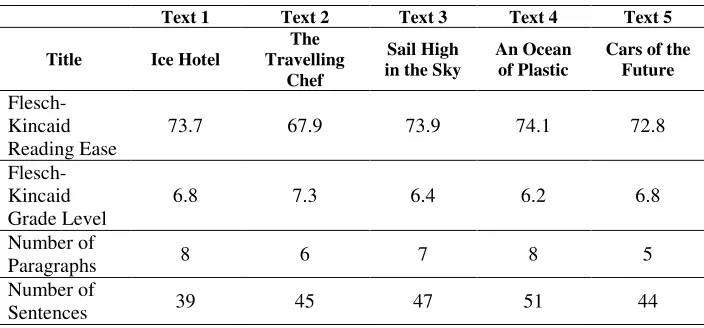
Flesch-Kincaid Grade Level were employed to calculate the syntactic complexity of the texts.
Table 1. The characteristics of the source texts
Text 1 Text 2 Text 3 Text 4 Text 5
Title Ice Hotel
The Travelling
Chef
Sail High in the Sky
An Ocean of Plastic
Cars of the Future
Flesch-Kincaid Reading Ease
73.7 67.9 73.9 74.1 72.8
Flesch-Kincaid Grade Level
6.8 7.3 6.4 6.2 6.8
Number of
Paragraphs 8 6 7 8 5
Number of
Sentences 39 45 47 51 44
During the instruction, the students learned summary writing as a part of their regular class program. In addition to summary writing, they worked on the structure and organization of an Introduction, Body, and Conclusion paragraph. In the same vein, they practiced developing different-rhetorical-style paragraphs (compare and contrast, problem and solution, cause and effect). Drawing on the Brown and Day’s (1983) and Idris et al.’s (2011) summary writing evaluation framework, different summary writing strategies- deletion, sentence combination, topic sentence selection, syntactic transformation, paraphrasing, generalization, and invention- were identified and instructed through different examples for eight weeks.
representing the whole point of a paragraph and ignore the rest of that paragraph in our summaries. In syntactic transformation, the learners realized how they could break down the syntactic structure of one or more sentences to make up a shorter sentence. Utilizing paraphrasing strategy, the researcher of the study taught the learners that they could substitute the original materials in the source text with similar words or phrases. The main point of generalization strategy was to demonstrate to the students that they could employ a single word or phrase or even a sentence to generalize a list of items or a bunch of ideas or concepts. Finally, in the process of invention, the participants practiced how to express the ideas in the source text using their own words. This process required the students to make use of new but succinct sentences to replace the source text sentences. Throughout the instruction process, it was emphasized that verbatim copying from original text is regarded as plagiarism, and the instructor provided the participants with ample reasons why exact copying should be avoided.
3.3 Data collection procedure
sessions all the strategies were instructed explicitly, and the following sessions were devoted to practicing them through modeling and different examples. However, after the treatment during the second, fourth, sixth, and eighth sessions, the participants were asked to summarize four texts of approximately 600 words in 45 minutes. They were said to produce summaries of about 200 words. In the process of summarization, they were not allowed to make use of their dictionaries but the source texts were at their disposals while they were wiring each summary.
3.4 Data analysis
The five summaries produced by the participants over eight weeks were analyzed. The TOEFL-iBT scoring guidelines used in Baba’s (2009) study was utilized to score the summaries holistically on a five-point scale by the researcher of the study and another nonnative professional who held a PhD in TEFL and was experienced in teaching writing skill. The scoring guidelines
evaluated the summaries on the basis of (1) main ideas incorporated; (2) the general organization; (3) language forms; and (4) verbatim copying from the
original source. The Pearson correlation coefficient was employed to estimate inter-rater reliability. Inter-rater correlations produced a satisfactory level of agreement for inter-rater reliability, approximately (r= .85). The average scores of the two raters represented the participants’ summary writing performance. Furthermore, repeated measures ANOVA and post-hoc comparison tests were utilized to examine the participants’ development over time.
4. Results
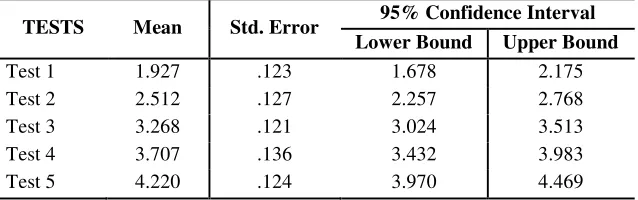
The participants of the study produced five summaries over eight weeks. Table 2 displays the descriptive statistics for the five tests. It could be seen that the overall mean scores of the students has undergone a gradual increase in the course of the time and over five summary writing sessions.
Table 2. Descriptive statistics for summary writing development
TESTS Mean Std. Error 95% Confidence Interval Lower Bound Upper Bound
Test 1 1.927 .123 1.678 2.175 Test 2 2.512 .127 2.257 2.768 Test 3 3.268 .121 3.024 3.513 Test 4 3.707 .136 3.432 3.983 Test 5 4.220 .124 3.970 4.469
Repeated measures ANOVA was employed to clarify whether there were significant differences among the mean scores of the students on the five tests. The results of the repeated measures ANOVA (F (4, 37) = 74.22, p = .000, partial η2
= .88 represented a large effect size, suggesting that the five tests marked significant differences from the first summary to the fifth one.
Table 3: Multivariate tests for the five summaries
Effect Value F Hypothesis df
Error df Sig.
Partial Eta Squared
T
E
S
T
S
Pillai's Trace .889 74.229 4 37 .000 .889 Wilks' Lambda .111 74.229 4 37 .000 .889 Hotelling's Trace 8.025 74.229 4 37 .000 .889 Roy's Largest
Root 8.025 74.229 4 37 .000 .889
To shed light on the differences among the five tests, exploratory comparisons were put to practice to compare the tests two by two. Table 4 illustrates the results of the post-hoc comparison tests revealing that the participants’ summary writing ability have improved significantly over time and during five summary writing sessions.
Table 4. Post-hoc comparison tests for the five summaries
(I) TESTS (J) TESTS
Mean Differenc
e (I-J)
Std.
Error Sig.
95% Confidence Interval for Difference Lower Bound Upper Bound Test 5
Test 1 2.293* .141 .000 1.875 2.711
Test 2 1.707* .106 .000 1.392 2.023
Test 3 .951* .098 .000 .659 1.244
Test 4 .512* .079 .000 .277 .747
Test 2 Test 1 .585* .078 .000 .354 .817
Test 3 Test 1 1.341
* .096 .000 1.055 1.628
Test 2 .756* .068 .000 .554 .958
Test 4
Test 1 1.780* .133 .000 1.385 2.176
Test 2 1.195* .087 .000 .936 1.454
Test 3 .439* .078 .000 .206 .672
*. The mean difference is significant at the .05 level.
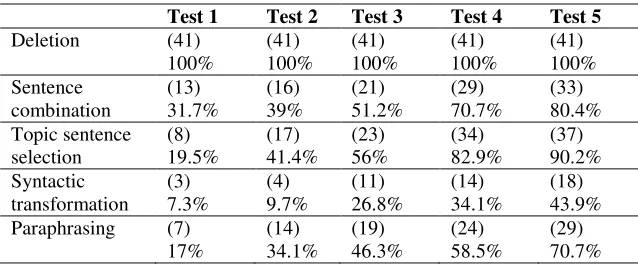
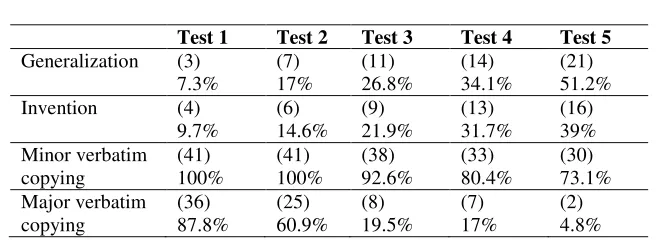
Scrutinizing the participants’ gradual progress or microgenetic development in summary writing was the whole point of this study. The research question of the study addressed this issue and the students’ summaries were examined at five different points in time in the course of the instruction to provide an answer to this question. Table 5 demonstrates the total number and the percentage of instances of deletion, sentence combination, topic sentence selection, syntactic transformation, paraphrasing, generalization, invention, minor verbatim copying, and major verbatim copying utilized by the students across the five summary writing sessions.
Table 5. The participants’ microgenetic development over the five summaries
Test 1 Test 2 Test 3 Test 4 Test 5
Deletion (41) 100% (41) 100% (41) 100% (41) 100% (41) 100% Sentence combination (13) 31.7% (16) 39% (21) 51.2% (29) 70.7% (33) 80.4% Topic sentence selection (8) 19.5% (17) 41.4% (23) 56% (34) 82.9% (37) 90.2% Syntactic transformation (3) 7.3% (4) 9.7% (11) 26.8% (14) 34.1% (18) 43.9% Paraphrasing (7)
Test 1 Test 2 Test 3 Test 4 Test 5
Generalization (3) 7.3% (7) 17% (11) 26.8% (14) 34.1% (21) 51.2% Invention (4)
9.7% (6) 14.6% (9) 21.9% (13) 31.7% (16) 39% Minor verbatim copying (41) 100% (41) 100% (38) 92.6% (33) 80.4% (30) 73.1% Major verbatim copying (36) 87.8% (25) 60.9% (8) 19.5% (7) 17% (2) 4.8%
As the table discloses, deletion was used by all the participants in all the data collection sessions. Approximately 31% of the participants or 13 students employed sentence combination strategies in their first summary which was written prior to the instruction. This trend increased steadily over time and mounted to 80.4% or 33 students in the fifth summary writing session. The table displays that the selection of topic sentence in the participants’ summaries has increased from 8 cases in the first summary to 37 instances in the last summary writing session. The low frequency of syntactic transformation in the first summary, 3 instances, implies that the learners were reluctant or unable to make use of this strategy. It seems that the treatment has slightly improved the students’ willingness or ability in using this strategy. The learners’ paraphrasing and generalization strategy use shows an unfaltering growth and reach from 17% and 7.3% to 70.7% and 51.2% respectively. Apparently, invention was the most difficult strategy for the learners, and they had the least achievement in acquiring this ability. Minor verbatim copying and major verbatim copying are the last items in the table. While the former exhibits a slight decrease over time, the latter displays a sharp decline after the instruction.
5. Discussion
The general findings of the study, consistent with the results of previous
studies (e.g., Chen & Su, 2012; Choy & Lee, 2012; Lee, 2010; Graham & Perin, 2007; McDonough et al., 2014; Wichadee, 2013), suggest the
demands a great amount of cognitive and metacognitive processing on the part of L2 learners. To come up with an acceptable and appropriate summary, one needs to get a full appreciation of the source text, identify main ideas, put aside minor details, condense the main ideas, and reformulate and express the important points in one’s own words. The ability to do this is not developed naturally and requires instruction.
Scrutinizing the participants’ microgenetic development in summary writing was the main purpose of the study. The overall results of the study highlighted the students’ summarization development over time. As table 5 displayed, all the participants were successful in employing deletion strategy, and in all data collection sessions, even prior to the instruction in the first session, all of them used this strategy to summarize the source text. This
finding supports previous findings (Brown & Day, 1983; Brown, Day, & Jones, 1983; Kim, 2001) that deleting unimportant or redundant information
is not a difficult strategy in summary writing. This can be elucidated in several ways. One possible explanation is that “copy-delete strategy” is the main strategy at the disposal of novice writers to resort to in the process of producing summaries. Another justification might be the fact that the participants of this study were all cognitively mature enough to realize that the whole point of summarizing a text is omission of its particular sections. However, a close inspection of the students’ summaries revealed that the quality of their deletion improved over time, and they came to realize that just detailed, trivial, and redundant information should be deleted.
In accordance with the findings in previous researches (e.g., Graham,
production, and (3) especially transition words or FANBOYS utilization appears to have had a positive impact on the learners’ summarization ability.
Topic sentence selection strategy involves selection of main idea sentences in source text. Important idea selection is “near verbatim use of a topic sentence from the text” (Brown & Day, 1983, p. 3). Contrary to Casazza (1993), the findings of the study indicated that selection strategy was one of the easiest strategies for the learners, and immediately after the treatment they started taking advantage of them in their summaries. The clarity of the topic sentences in the five original texts summarized by the learners could be one reason for the participants’ successful performance. The nature of the advanced writing course which mainly focuses on different components of a paragraph could be another justification.
Syntactic transformation involves breaking down the syntactic structure of one or more sentences to make up a shorter sentence. In contrast with Shi’s (2004) study which noted syntactic transformation as a popular strategy by her participants, the relatively infrequent employment of this rule by the participants of this study, in line with other studies (Kim, 2001; Sun, 2009),
suggests that after the invention strategy this strategy has been the most difficult one for the participants. The analysis of the learners’ summaries disclosed that they had mainly made use of simple structures such as relative clauses to reformulate and restructure their summaries. This stems from the fact that they had not received any appropriate instruction on summarization, and their writings lack “syntactic maturity” (Robinson & Howell, 2008). However, the treatment of this study improved this strategy slightly among the learners.
Plakans, 2009; Keck, 2006; Kim,2001; Shi, 2004). It seems that superficial
and word-level modifications are the first steps in the process of summarization. Howard (1999) referred to this kind of modification as “patchwriting” and described it as “copying from a source text and then deleting some words, altering grammatical structures, or plugging in one synonym for another” (p. xviii).
Employment of generalization strategy in the learners’ summaries reached from 7.3% in the first summary to 51.2% by the end of the treatment. It seems that about half of the participants had difficulty acquiring this strategy. In the same vein, Johns and Mayes (1990) asserted that their participants found this strategy difficult. Baba (2009) reported that her learners were not always successful in using this strategy. The difficulty associated with generalization strategy could be attributed to the learners’
insufficient vocabulary knowledge (Baba, 2009; Cohen, 1994) and inadequate reading comprehension ability (Esmaeili, 2002; Plakans, 2009) as well as the conceptual demands inherent in generalization (McDonough et al., 2014).
Invention strategy turned out to be the most challenging rule for the participants. This is not surprising because this strategy requires the learners to “add information rather than just delete, select or manipulate sentences already provided for them” (Brown & Day, 1983, p. 12). It could be speculated that the learners’ lack of linguistic resources (Keck, 2006) and self-confidence in producing materials similar to the ones in the source texts has culminated in the infrequent utilization of the invention strategy.
this tendency decreased sharply over time and reached to 4.8% by the end of the instruction. These results could be interpreted from different perspectives. It seems that the main reason for the participants’ copying large chunks from source texts is their lack of awareness of the consequences of plagiarism and legal rights and conventions of ownership and authorship. This claim supports the general findings from the literature that L2 writers, especially in EFL context, are not fully aware of the significance of the authorship right which has long been practiced and stressed in the Western contexts (e.g.,
Abasi, Akbari, & Graves, 2006; Banwell, 2003; Keck, 2006; Pennycook, 1996; Shi, 2004). Before the instruction, a large number of the participants were under the assumption that integrating large strings from the source texts was an acceptable and legitimate practice. However, as they became aware of the concept of authorship in the real sense of the word, the major verbatim copying cases reduced considerably in their summaries. Contrary to major verbatim copying, the instances of minor verbatim copying did not decrease substantially. Apparently, most of the learners have not regarded them as a serious problem to be incorporated in their summaries. Some researchers (e.g., McDonough et al., 2014) consider these shorter copied strings a positive movement toward professionalism in summary writing.
Another possible explanation for the participants’ heavy reliance on the source texts could be their insufficient reading comprehension ability
(Esmaeili, 2002; Plakans, 2009), vocabulary knowledge (Baba, 2009; Chen & Su, 2012; Choy & Lee, 2012; Wichadee, 2010), and paraphrasing and
summarizing ability (Chen & Su, 2012; Choy & Lee, 2012; Liao & Tseng, 2010; Roig, 2001; Wichadee, 2010). Lack of self-confidence and motivation in producing materials like the ones in the source texts might be another justification for the students’ plagiarism. As Hyland (2001) put it, many L2 writers usually compare their own production with original texts and notice a big gap. To bridge this gap, they resort to plagiarism instead of reformulating the ideas in their own words.
6. Conclusion and Implications
necessitates instruction. Contrary to majority of the studies carried out on summarization instruction, the present research addressed the underlying processes of summary writing. In other words, the microgenetic development of a group of Iranian EFL learners’ summary writing ability was documented at given points in time in the process of instruction. It came to light that the participants' overall summary writing ability increased over time, highlighting the fact that summarization ability does not develop naturally and requires appropriate instruction.
Closer investigation of the participants’ summaries revealed that some summarization strategies like invention, syntactic transformation, and generalization, in contrast with strategies like deletion, topic sentence selection, and sentence combination, are more problematic and develop at later stages. This implies that students need more practice on these strategies, and sentence-level practice could be considered a logical first step.
The results of this study and many other previous researches (e.g., Abasi
et al., 2006; Pecorari, 2003; Wheeler, 2009) substantiate this fact that students’ lack of awareness of the consequences of plagiarism as well as their insufficient general English and summary writing knowledge culminates in plagiarism. The substantial implication of this finding is that teachers especially in EFL context should raise students’ awareness of legal rights of authors and conventions of authorship. Improving students’ self-confidence and motivation to write in their own words without expecting to write like native speakers at early stages is another heavy burden on EFL teachers’ shoulders.
should be appreciated and encouraged because as Pecorari (2003) put it, “today’s patch writer is tomorrow’s competent academic writer” (p. 338).
References
Abasi, A. R., Akbari, N. & Graves, B. (2006). Discourse appropriation, construction of identities, and the complex issue of plagiarism: ESL students writing in graduate school. Journal of Second Language
Writing 15(2), 102-117.
Baba, K. (2009). Aspects of lexical proficiency in writing summaries in a foreign language. Journal of Second Language Writing, 18(3), 191– 208.
Banwell, J. (2003). Chinese and South East Asian students’ perceptions of plagiarism and collusion. Northumbria University, Retrieved 9, October, 2013 from www.jiscpas.ac.uk
Brown, A. L. & Day, J. D. (1983). Macrorules for summarizing texts: The development of expertise. Journal of Verbal Learning and Verbal
Behavior, 22 (1), 1–14.
Brown, A. L., Day, J. D., & Jones, R. (1983). The development of plans for summarizing for texts. Child Development, 54(4), 968-979.
Calais, G. (2008). Microgenetic analysis of learning: Measuring change as it occurs. National Forum of Applied Educational Research Journal, 21(3), 1-7.
Casazza, M. E. (1993). Using a model of direct instruction to teach summary writing in a college reading class. Journal of Reading 37(3), 202–208. Chen, Y. & Su, S. (2012). A genre-based approach to teaching EFL summary
writing. ELT Journal, 66(2), 184–192.
Choy, S. & Lee, M. (2012). Effects of teaching paraphrasing skills to students learning summary writing in ESL. Journal of Teaching and Learning, 8(2), 77-89.
Cohen, A. D. (1994). English for academic purposes in Brazil: The use of summary tasks. In: C. Hill & K. Parry (Eds.), From testing to
assessment: English as an international language (pp. 174–204).
Currie, P. (1998). Staying out of trouble: Apparent plagiarism and academic survival. Journal of Second Language Writing 7(1), 1-18.
Ellis, R. (2008). The study of second language acquisition. Oxford: Oxford University Press.
Esmaeili, H. (2002). Integrating reading and writing tasks and ESL students’ reading and writing performance in an English language test. Canadian
Modern Language Review, 58(4), 599–622.
Friend, R. (2001). Effects of strategy instruction on summary writing of college students. Contemporary Educational Psychology, 26(1), 3-24. Gebril, A. & Plakans, L. (2009). Investigating source use, discourse features,
and process in integrated writing tests. Spaan Working Papers in
Second or Foreign Language Assessment, 7, 47–84.
Graham, S. (1997). Executive control in the revising of students with learning and writing difficulties. Journal of Educational Psychology, 89(2), 223-234.
Graham, S. & Perin, D. (2007). Writing next: Effective strategies to improve
writing of adolescents in middle and high school. New York: Carnegie
Corporation.
Hedgcock, J. S. & Ferris, D. R. (2009). Teaching readers of English: Students,
texts, and contexts. New York: Routledge.
Hidi, S. & Anderson, V. (1986). Producing written summaries: Task demands, cognitive operations, and implications for instruction. Review
of Educational Research, 56(4), 473-93.
Hill, M. (1991). Writing summaries promotes thinking and learning across the curriculum-but why are they so difficult to write? Journal of Reading, 34(7), 536-539.
Hirvela, A. & Du, Q. (2013). Why am I paraphrasing? Undergraduate ESL writers’ engagement with source-based academic writing and reading.
Journal of English for Academic Purposes, 12(2), 87–98.
Howard, R. M. (1995). Plagiarisms, authorships and the academic death penalty. College English, 57(7), 788-806.
intellectual property in a postmodern world (pp. 87–95). New York: State University of New York Press.
Hyland, F. (2001). Dealing with plagiarism when giving feedback. ELT
Journal, 55(4), 375–381.
Idris, N., Baba, S., & Abdullah, R. (2011). Identifying students’ summary writing strategies using summary sentence decomposition algorithm.
Malaysian Journal of Computer Science, 24(4), 180-194.
Johns, A. & Mayes, P. (1990). An analysis of summary protocols of university ESL students. Applied Linguistics, 11(3), 253-271.
Keck, C. (2006). The use of paraphrase in summary writing: A comparison of L1 and L2 writers. Journal of Second Language Writing, 15(4), 261– 278.
Kim, S. A. (2001). Characteristics of EFL readers’ summary writing: A study with Korean university students. Foreign Language Annals, 34(6), 569–580.
Kintsch, W. & van Dijk, T. A. (1978). Toward a model of text comprehension and production. Psychological Review, 85(5), 363–394.
Langan, J. (1993). Ten steps to advancing college reading skills. Marlton, NJ: Townsend Press.
Lantolf, J. P. & Thorne, S. (2006). Sociocultural theory and the genesis of
second language development. Oxford: Oxford University Press.
Lavelli, M., Pantoja, A., Hsu, H., Messinger, D., & Fogel, A. (2004). Using microgenetic designs to study change processes. In D. M. Teti (Ed.),
Handbook of research methods in developmental psychology (pp.
40-65). Baltimore, Md.: Blackwell Publishers.
Lee, L. (2010). Exploring wiki-mediated collaborative writing: A case-study in an elementary Spanish course. CALICO Journal, 27(2), 260–276. Liao, M. & Tseng, C. (2010). Students’ behaviors and views of paraphrasing
and inappropriate textual borrowing in an EFL academic setting. Pan-
Pacific Association of Applied Linguistics, 14(2), 187–211.
McDonough, K., Crawford, W. J., & De Vleeschauwer, J. (2014). Summary writing in a Thai EFL university context. Journal of Second Language
Writing, 24(1), 20-32.
Ohta, A. S. (2005). Interlanguage pragmatics in the zone of proximal development. System, 33(3), 503-517.
Pecorari, D. (2003). Good and original: Plagiarism and patchwriting in academic second-language writing. Journal of Second Language
Writing, 12(4), 317-345.
Pennycook, A. (1996). Borrowing others’ words: Text, ownership, memory, and plagiarism. TESOL Quarterly, 30(2), 201-230.
Plakans, L. (2009). The role of reading strategies in integrated L2 writing tasks. Journal of English for Academic Purposes, 8(4), 252–266. Rivard, L. P. (2001). Summary writing: A multi-grade study of French
immersion and Francophone secondary students. Language, Culture
and Curriculum, 14(2), 171–186.
Robinson, L. K. & Howell, K. W. (2008). Best practices in curriculum-based evaluation and written expression. In A. Thomas & J. Grimes (Eds.),
Best practices in school psychology (pp. 439-452). Bethesda, MD:
National Association of School Psychologists.
Roig, M. (2001). Plagiarism and paraphrasing criteria of college and university professors. Ethics and Behavior, 11(3), 307-323.
Saddler, B. (2005). Sentence combining: A sentence-level writing intervention. The Reading Teacher, 58(5), 468-471.
Saddler, B. & Graham, S. (2005). The effects of peer-assisted sentence-combining instruction on the writing performance of more and less skilled young writers. Journal of Educational Psychology, 97(1), 43-54.
Saddler, B. & Saddler, K. (2010). Writing better sentences: Sentence-combining instruction in the classroom. Preventing School Failure,
54(3), 159-163.
Savage, A. (2010). Read this! 3: Fascinating stories from the content areas. Cambridge: Cambridge University Press.
Shi, L. (2004). Textual borrowing in second-language writing. Written
Siegler, R. S. (2006). Microgenetic analyses of learning. In D. Kuhn & R. S. Siegler, Handbook of child psychology (6th Ed.) (pp. 464-510). Hoboken, NJ: Wiley.
Spack, R. (2004). The acquisition of academic literacy in a second language: A longitudinal case study. In V. Zamel, & R. Spack (Eds.), Crossing
the curriculum: Multilingual learners in college classrooms (pp. 19–
46). Mahwah, NJ: Lawrence Erlbaum.
Sun, Y. (2009). Using a two-tier test in examining Taiwan graduate students’ perspectives on paraphrasing strategies. Asia Pacific Education Review, 10(3), 399–408.
Van Compernolle, R. A., & Williams, L. (2012). Promoting sociolinguistic competence in the classroom zone of proximal development. Language
Teaching Research, 16(1), 39-60.
Vygotsky, L. (1978). Mind in society: The development of higher
psychological processes. Cambridge, MA: Harvard University Press.
Vygotsky, L. (1987). The collected works of L. S. Vygotsky volume I: Thinking
and speaking. New York: Plenum Press.
Werner, H. (1956). Microgenesis and aphasia. Journal of Abnormal Social
Psychology, 52(3), 347-353.
Wheeler, G. (2009). Plagiarism in the Japanese universities: Truly a cultural matter? Journal of Second Language Writing 18(1), 17-29.
Wichadee, S. (2010). Using wikis to develop summary writing abilities of students in an EFL class. Journal of College Teaching and Learning, 7(12), 5–10.
Wichadee, S. (2013). Improving students’ summary writing ability through collaboration: A comparison between online wiki group and conventional face-to-face group. The Turkish Online Journal of
Educational Technology, 12(3), 107-116.