R E S E A R C H
Open Access
Genome replication engineering assisted
continuous evolution (GREACE) to improve
microbial tolerance for biofuels production
Guodong Luan
1,2, Zhen Cai
1*, Yin Li
1*and Yanhe Ma
3Abstract
Background:Microbial production of biofuels requires robust cell growth and metabolism under tough conditions. Conventionally, such tolerance phenotypes were engineered through evolutionary engineering using the principle of“Mutagenesis followed-by Selection”. The iterative rounds of mutagenesis-selection and frequent manual interventions resulted in discontinuous and inefficient strain improvement processes. This work aimed to develop a more continuous and efficient evolutionary engineering method termed as“Genome Replication Engineering Assisted Continuous Evolution”(GREACE) using“Mutagenesis coupled-with Selection”as its core principle. Results:The core design of GREACE is to introduce anin vivocontinuous mutagenesis mechanism into microbial cells by introducing a group of genetically modified proofreading elements of the DNA polymerase complex to accelerate the evolution process under stressful conditions. The genotype stability and phenotype heritability can be stably maintained once the genetically modified proofreading element is removed, thus scarless mutants with desired phenotypes can be obtained.
Kanamycin resistance ofE. coliwas rapidly improved to confirm the concept and feasibility of GREACE. Intrinsic mechanism analysis revealed that during the continuous evolution process, the accumulation of genetically modified proofreading elements with mutator activities endowed the host cells with enhanced adaptation advantages. We further showed that GREACE can also be applied to engineer n-butanol and acetate tolerances. In less than a month, anE. colistrain capable of growing under an n-butanol concentration of 1.25% was isolated. As for acetate tolerance, cell growth of the evolvedE. colistrain increased by 8-fold under 0.1% of acetate. In addition, we discovered that adaptation to specific stresses prefers accumulation of genetically modified elements with specific mutator strengths.
Conclusions:We developed a novel GREACE method using“Mutagenesis coupled-with Selection”as core principle. Successful isolation ofE. colistrains with improved n-butanol and acetate tolerances demonstrated the potential of GREACE as a promising method for strain improvement in biofuels production.
Keywords:Mutagenesis coupled-with Selection, GREACE, Genome replication engineering, Continuous evolution, Strain improvement
* Correspondence:[email protected];[email protected]
1CAS Key Laboratory of Microbial Physiological and Metabolic Engineering,
Institute of Microbiology, Chinese Academy of Sciences, No. 1 West Beichen Road, Chaoyang District, Beijing 100101, China
Full list of author information is available at the end of the article
Background
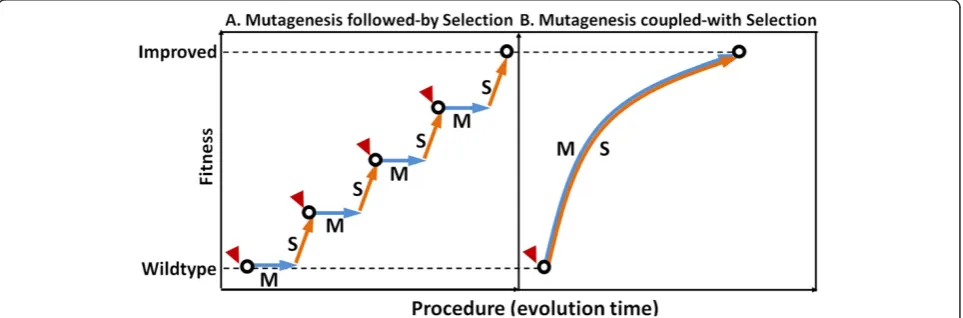
Efficient microbial production of biofuels from renew-able resources requires robust cell growth and strenew-able metabolism under tough industrial conditions, repre-sented by inhibitory components in substrates and toxic products [1,2]. Microbial tolerance to these inhibitory environmental factors is a complex phenotype usually controlled by multiple genes [3,4], and thus is difficult to be engineered by targeted metabolic engineering ap-proaches [5]. Instead, such complex phenotypes can be more effectively improved by evolutionary engineering approaches [6]. Examples of evolutionary engineering in-clude successive passage for metabolic evolution [7-9], physical and chemical mutagenesis [10], global transcrip-tion machinery engineering [2,11], artificial transcriptranscrip-tion factors engineering [12,13], and ribosome engineering [14]. All these methods use “Mutagenesis followed-by Selection”as core principle, meaning that firstly introdu-cing genetic diversity by spontaneous mutations, ex-ogenous mutagens, or genetic perturbations, followed by selection of desired phenotypes [6]. Using such methods, iterative rounds of mutagenesis-selection and frequent manual interventions are often required, resulting in discontinuous and inefficient strain improvements, as shown in Figure 1A.
To address the discontinuity of the existing evolution-ary engineering approaches and improve the engineer-ing efficiency, we devised a novel method termed as
“Genome Replication Engineering Assisted Continuous Evolution, GREACE”, which uses “Mutagenesis coupled-with Selection” (Figure 1B) as its core principle. The key element of this novel method is to introducein vivo con-tinuous mutagenesis mechanisms into microbial cells that
are subsequently subjected to continuous selective conditions. Mutagenesis and selection can therefore be coupled to minimize manual interventions, thus pro-viding possibilities to develop a continuous and efficient phenotypes-improving process (Figure 1B). Practically,
in vivocontinuous mutagenesis can be achieved by intro-ducing genetic perturbations into genome replication machinery so as to trigger inaccurate genome replica-tions. Hypermutable cells with significant genome di-versities can therefore be obtained. Offspring cells with mutated genomes that survived the increased selective pressures will be selected during the continuous enrich-ment processes, and the genomic feature of evolved cells with improved phenotypes can be stably maintained once the elements triggering the inaccurate genome replication are removed from the individually isolated cells.
In this work, we proved the concept of GREACE and tested the efficiency of GREACE using Escherichia coli
as a model. Genetically modified proofreading elements of the DNA polymerase complex (ε subunit encoded by
dnaQ gene) were used to trigger perturbations on gen-ome replication forin vivocontinuous mutagenesis. We firstly proved the feasibility and intrinsic mechanisms of GREACE by improving kanamycin resistance of E. coli. Secondly we show that n-butanol and acetate tolerances ofE. coli, two important microbial tolerance characteris-tics, can also be efficiently improved using this method.
E. coli mutants obtained through the GREACE process showed significantly improved tolerances to n-butanol and acetate, demonstrating the potential of GREACE as an effective and universal approach to improve tough physiological traits required by biofuels production. Fur-thermore, we discovered a phenomenon that adapting to
specific environments calls for specific genetically modi-fied proofreading elements, which may provide insights into understanding and application of evolutionary en-gineering for strain improvement.
Results
Procedure of the“Genome Replication Engineering Assisted Continuous Evolution”
The core idea of GREACE is to introduce genetic per-turbations into genome replication machinery, so that
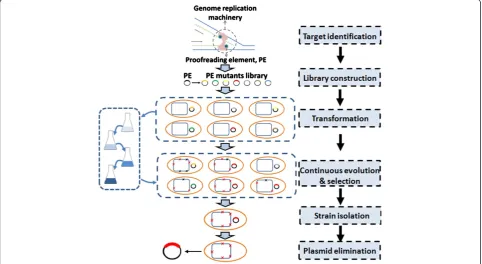
in vivo continuous mutagenesis can be coupled with simultaneous phenotypes selection. A typical flowchart of GREACE is described in Figure 2. To achieve an inaccurate genome replication, genetic perturbations on genome replication machinery are generated by constructing a mutant library of a proofreading elem-ent (PE) gene, designated as PEM-lib. Subsequelem-ently, the PEM-lib is transformed into the wildtype strain. Inaccurate genome replication will be triggered in cells containing PEs with decreased proofreading activities, thus continuously generating offspring cells containing different genomic mutations. Notably, the diversity of the PEM-lib will help to generate cells with various genome replication mutation rates and mutation type preferences, ensuring the highest genomic diversity in offspring cells.
When cells containing a genetically modified PEs are cul-tivated under gradually increased selective pressures, only the offsprings with accumulated adaptive mutations can survive and thus to be finally selected. Most importantly, the genome replication will return to regular state once the genetically modified PE is eliminated from the selected cells, so that the genomic features and the evolved pheno-types can be stably maintained.
Proof of concept for GREACE by engineering kanamycin resistance ofE. coli
To prove the concept of GREACE, we took E. coli as a model strain and selected kanamycin resistance as a phenotype for testing. Among the various cellular proof-reading elements including the genes responsible for base selection, exonucleolytic editing, MMR (Methyl-directed Mismatch Repair), and DNA repair [15-18], we chose the
dnaQ gene which encodes the εsubunit of E. coli DNA polymerase III. This subunit is the only one with 3′->5′ exonuclease activity in DNA polymerase III, the major DNA polymerase ofE. coligenome replication, and it was reported to guarantee both the polymerization and error-editing process of DNA replication. Moreover, the stron-gest mutator phenotypes that have been known were resulted from deficiencies of the dnaQ gene [17,19,20].
Thus, dnaQwas selected as the proofreading element to be engineered.
A mutant library of dnaQ gene (pQ-lib) with the size of 106 and average mutation rates of 2–3 amino acids per gene product, was constructed by error-prone PCR. pQ-lib, together with the control vectors pQ-dnaQ (car-rying wildtypednaQ), and the empty vector pUC18, was transformed into E. coli cells, respectively. All cultures were serially transferred in media containing serial concentrations of kanamycin (15 μg/ml, 100 μg/ml, 200 μg/ml, and 300 μg/ml; X μg/ml kanamycin will be designated as KanX). As shown in Figure 3A, no obvious growth differences were observed among three groups grown in Kan15. Upon increasing the kanamycin concentrations, growth and adaptation advantage of the pQ-lib group became obvious. Finally, the pQ-lib group was able to grow in Kan300, while the pUC18 and pQ-dnaQ groups failed to grow in Kan200 and Kan100, respectively, suggesting the pQ-lib group had a stron-ger adaptability.
To understand why pQ-lib group showed such adapta-tion advantages, cultures containing 108cells were col-lected from pQ-lib, pUC18, and pQ-dnaQ carrying strains grown at each kanamycin concentration and spread onto plates containing higher kanamycin concen-trations (cells from Kan0, Kan15, Kan100, and Kan200 liquid culture were spread on plates containing Kan15,
Kan100, Kan200, and Kan300, respectively). As shown in Figure 3B, growths of the three groups in Kan0 did not make difference on generation of Kan15 resistant col-onies. Growth of the pQ-lib group in Kan15 liquid cul-ture generated more Kan100 resistant colonies than that of the controls, similar results were observed for pQ-lib group grown in Kan100 and Kan200. This suggested that pQ-lib group was able to generate kanamycin-resistant cells more rapidly.
To investigate the dynamic changes of the diversity of pQ-lib during the evolution process, 30 colonies of the pQ-lib group were randomly picked at the end of culti-vations at each kanamycin concentration. Plasmids were
extracted from these colonies and the dnaQ mutants
therein were sequenced. As shown in the pie charts of Figure 3B, the diversity of pQ-lib decreased dramatically,
and one mutant termed as dnaQ KR5-2 was enriched,
from undetectable level in Kan0 to 100% in Kan200. To verify whether the observed adaptation advantages
were endowed bydnaQ KR5-2, plasmid
pQ-dnaQ-KR5-2 was retransformed into fresh E. coli cells and culti-vated under kanamycin stress. As expected, E. coli cells carrying dnaQ KR5-2 indeed exhibited increased evo-lution speed and adaptability. In Kan15 and Kan100,
the dnaQ KR5-2 carrying strain grew to OD600 of
1.02 (±0.07) and 0.28 (±0.05) after cultivation for 48 hours, which were 3–4 fold higher than those of the
Figure 3Engineering kanamycin resistance ofE. coliwith GREACE. (A)E. colicells transformed with pQ-lib, pUC18, and pQ-dnaQ were pre-cultivated in LB medium and then 1:100 serial diluted in gradually increased kanamycin concentrations, from Kan15 to Kan300. Error bars presented the standard deviation of growth analysis for 3 independent evolution experiments.(B)Cells carrying the above three plasmids were sampled at the end of the kanamycin resistance evolution process. Appropriate 108cells were spread on plates with kanamycin concentration
two control strains carrying pQ-dnaQ and pUC18 (Additional file 1: Figure S1). These results confirmed that adaptation advantages ofdnaQKR5-2 under stressful conditions.
To quantitatively evaluate and compare the rates of gen-erating genomic DNA mutations (termed as mutation rates for short) by different dnaQmutants, we chose the widely used rifamycin resistant colony generation fre-quency as an indirect indicator [21-23]. Mutation rates de-termination based on this indicator showed that E. coli
cells carrying pQ-dnaQ-KR5-2 exhibited a 317-fold in-creased mutation rate than that of the wildtype control, confirming that introducing genetic perturbation into gen-ome replication machinery indeed triggered inaccurate genome replication.
According to the design principle of GREACE, pheno-types obtained by GREACE should be stable and herit-able. To confirm the stability of kanamycin resistance, plasmid pQ-dnaQ-KR5-2 was eliminated from the kana-mycin resistant strain E. coli KR1. We found that the kanamycin resistance could be well maintained after plasmid elimination (Additional file 1: Figure S2).
GREACE can be successfully applied to engineer n-butanol and acetate tolerances
Recently, E. colihas been proved to be a promising host for biobutanol production [24-26]. However, n-butanol tolerance ofE. coliis a bottleneck hampering further in-crease of n-butanol titer, as n-butanol is highly toxic to microbial cells. Many efforts have been made to improve and analyze butanol tolerance of E. coli [13,27-30]. We then wanted to test if GREACE can be used to improve n-butanol tolerance of E. coli, a tougher physiological trait comparing with kanamycin resistance. We applied a similar procedure to engineering n-butanol tolerance –
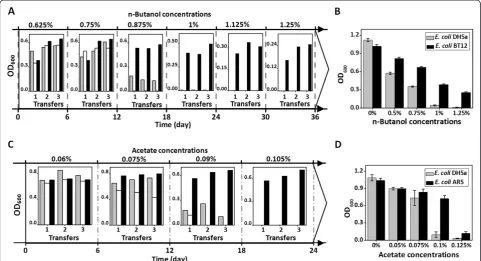
E. coli cells carrying pQ-lib were serially transferred in media containing gradually increased n-butanol con-centrations. Considering that improvement of complex traits such as n-butanol tolerance might require accumu-lation of much more adaptive mutations [31,32], the pQ-lib carrying cells were transferred in each n-butanol concentrations for three times, upon full growth, before transferring to the next higher butanol concentration.
Figure 4A showed that pQ-lib carrying cells exhibited a better adaptability to the increased n-butanol concentrations. After continuous cultivations and selections, pQ-lib group could grow in medium containing n-butanol concentra-tion of 1.25% (vol/vol, the same below), while n-butanol concentrations of 0.875% and 0.75% were lethal to the
E. coli cells carrying pUC18 and pQ-dnaQ, respectively.
The dnaQ mutant dominating the n-butanol tolerance
evolution process was isolated and termed asdnaQ BR1. Further analysis revealed that dnaQ BR1 endowed the host with a 2839-fold increased mutation rate, much
higher than that ofdnaQKR5-2 selected under kanamy-cin stress.
After plasmid elimination, an E. coli strain, desig-nated as BT12, was obtained. Growth assay revealed that E. coli BT12 performed growth advantages upon n-butanol challenge (Figure 4B). At an n-butanol con-centration of 0.75%, growth of E. coli BT12 reached a doubled OD600 value after 48 hours cultivation com-pared with the wild type strain. When n-butanol con-centration reached 1.25%, no growth was detected for the wildtype, while E. coli BT12 was still able to grow (25% OD600 value of that under no n-butanol stress).
n-Butanol shock experiments revealed that E. coli
BT12 showed a higher cellular stability and tolerance under an extreme lethal n-butanol concentration. After exposure to 2% n-butanol for 1 hour, the survival rate of
E. coli BT12 was over 100-fold higher than that of the wildtype cells (Additional file 1: Figure S3). We further tested the stability of the n-butanol tolerance of E. coli
BT12. After frozen at−80°C for 2 weeks and serially trans-ferred for 30 passages, the n-butanol tolerance of E. coli
BT12 could be well maintained, indicating that good genetic stability and traits heritability can be retained upon GREACE (Additional file 1: Figure S4).
Acetate tolerance is another important trait for biofuels production. Concentrated acetate in hemicelluloses hydro-lysates severely inhibited growth and metabolism of microbial cells, thus restricting conversion and pro-duction efficiency [33-35]. GREACE was also success-fully applied to improve E. coli tolerance to acetate. As shown in Figure 4C, the inhibitory effects of acet-ate on the evolved cells were sharply reduced after transferring E. coli cells carrying pQ-lib in gradually increased acetate concentrations for 24 days. pQ-lib carrying cells successfully adapted to an acetate con-centration of 0.105% (vol/vol, the same below), while the control could hardly grow in a lower concentra-tion of 0.09%. After plasmid eliminaconcentra-tion, an E. coli mu-tant AR5 was obtained. AR5 cells showed an 8-fold increased OD600 as compared to that of the wildtype strain when grown in the presence of 0.1% acetate (Figure 4D). The dnaQ mutant dominating the acetate tolerance evolution process was isolated and termed as AR6-1, endowing host E. coli cells with an 87-fold increased mutation rate.
Characterization ofdnaQmutants selected from different conditions
Three differentdnaQmutants (KR5-2, BR1, and AR6-1), which endowed the host with different mutation rates, were enriched during the evolution process against in-creased concentrations of kanamycin, n-butanol, and acetate. To investigate whether these enriched dnaQ
in independent evolution processes, we performed paral-lel experiments for acquiring kanamycin resistance, n-butanol tolerance, and acetate tolerance. The finally enricheddnaQmutants from each process were isolated, sequenced, and analyzed. In the parallel experiments for acquiring kanamycin resistance, nine different dnaQ
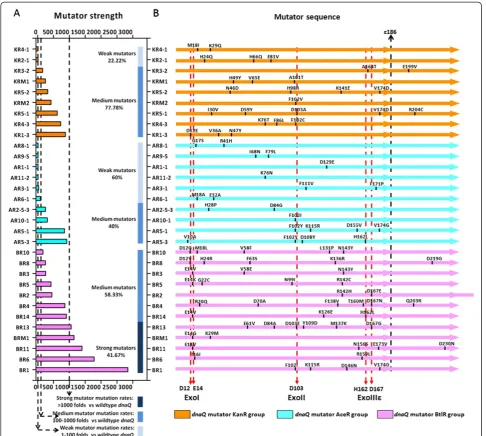
mutants were isolated from 10 independent evolution processes. This suggests that the evolution process for acquiring kanamycin resistance is not dependent on one preferable dnaQ mutant. Similar results were also ob-served in parallel processes for acquiring n-butanol tol-erance (12 parallel experiments) or acetate toltol-erance (10 parallel experiments). All dnaQ mutants isolated were different. Sequences of the dnaQ mutants isolated were shown in Figure 5B. As expected, all of the se-lected mutants endowed the host cells with elevated mutation rates, ranging from 7.7 folds (dnaQ KR4-1) to 2839 folds (dnaQ BR1) (Figure 5A), which indicated
the genetically modified dnaQ mutants enriched in
GREACE could serve as endogenous mutators to acceler-ate evolution.
We determined the mutation rates of all 31dnaQ mu-tants isolated from parallel experiments, and grouped
them into three types based on the increment of the mu-tation rates over that of the wildtypednaQ gene (termed as mutator strength for short): weak mutators (1–100 folds), medium mutators (100–1000 folds), and strong mutators (>1000 folds). As shown in Figure 5A, n-butanol stress tended to select strong mutators. A large proportion (5/12) elevated mutation rates of host cells by over 1000 folds, while no weak mutators were found. Acetate stress tended to select weak mutators, as most (6/10) of them falling into the weak group. Kanamycin
stress tends to select dnaQ mutants with medium
mutation rates, as the majority (7/9) showed medium strengths. This suggested that acquiring desired physio-logical traits required assistance of mutators with specific mutator strength. Calculation of average strengths of the mutators obtained in acquiring n-butanol toler-ance (BtlR group, 959.8-fold increase), kanamycin resisttoler-ance (KanR group, 375.3-fold increase), and acetate tolerance (AceR group, 249.4-fold increase) also supported this indica-tion. Sequencing analysis revealed a positive relationship between the average mutator strengths and average amino acids substitution numbers in eachdnaQmutant. Among the BtlR group, an average of 3.9 amino acids substitutions
were found in each mutant, while the substitutions for KanR and AceR group were 2.9 and 2.1, respectively.
Analysis of the locations of the amino acids substitu-tions promoted understanding of the decreased proof-reading activities of the selected dnaQ mutants. Many efforts have been made to disclose the relationship be-tween sequence and structure characteristics of the ε subunits encoded by dnaQ gene [16,36]. The 3′ -> 5′ exonuclease activities of theεsubunit was mainly deter-mined by the N-terminal 186 amino acids (designated as
ε186) [37]. In this study, most of the mutation (88 out of 94) from all the 31dnaQmutants existed within theε186 region (Figure 5B), demonstrating that ε186 played key roles in proofreading. Three conserved regions essential for proofreading, ExoI, ExoII, and ExoIIIε [38,39], have been recognized inε186. As expected, a large portion of amino acid substitutions of the selected dnaQ mutants were located in or quite close to these three regions, meaning high possibilities to disturb the natural proof-reading function of the respective gene products.
Discussion
The accurate genetic information transfer guarantees the genetic and phenotypic stability of organism, and it re-quires complex and precise mechanisms on multiple stages [18]. However, these hierarchal and precise mecha-nisms turn to be serious barriers for engineering complex phenotypes. To overcome such barriers, we developed GREACE, which implements a novel principle“ Mutagen-esis coupled-with Selection”, and thus enables microbial evolution under stressful conditions in a continuous and efficient way.
As for microbes, expanding offspring genome diver-sities by elevating replication mutation rates to achieve rapid adaptation and competitive advantages in harsh environments has been discovered and verified both
in vivo[40-42] andin silico[43,44]. Various natural mu-tator genes have been isolated and analyzed. However, some of them failed to work under some harsh condi-tions, e.g. high temperatures [45,46]. The GREACE method implants a pool of genetically modified proof-reading elements into host cells to act as“evolution ac-celerator”, thus provides multiple mutators with diverse characteristics which might guarantee accelerated evolu-tion of host cells under diverse condievolu-tions.
Accelerating microbial evolution by mutators with ele-vated mutation rates during genome replication have been reported previously [47-49]. All these studies used a single specific mutator with a certain mutation rate. However, out work provided the first evidence that adap-tation to specific conditions prefers accumulation of spe-cific mutators, especially with spespe-cific mutator strengths. This finding was partially supported by Loh et.al [50], who found a narrow range of mutation rates (10–47 folds in-crease) dominated a designed laboratory survival competi-tion. It has also been predicted by mathematical models that microbial survival and adaptation to different select-ive pressures might require different amounts and types of adaptive mutations, thus different mutagenesis strengths might be preferred [44]. These results benefit understand-ing and application of evolutionary engineerunderstand-ing strategies for strain improvement, and further support the necessity for using GREACE method, which generated a library of mutators. Characterization of thednaQmutants selected from GREACE under different conditions provided inter-esting clues to understand the intrinsic mechanisms of this novel approach. A universaldnaQmutant that can ef-fectively improve all physiological traits might not exist, while a group of dnaQ mutants may be helpful, as the most preferablednaQmutants will be enriched during the evolution process.
In comparison with other phenotype-improving ap-proaches generating global disturbances by introduc-tion and maintaining of exogenous plasmids [2,11,12], GREACE endows the microbes with stable and heritable
phenotypes through scarless manipulations. Genotype sta-bility and phenotype hereditasta-bility of the mutants can be maintained at any stage of evolution when the genetically modified proofreading elements are removed from the evolved mutants, and that provides great convenience for further genetic manipulation and application of mutants, e.g. introduction of the metabolic pathway for products synthesis.
Evolutionary engineering has been widely applied to optimize biofuels-producing related characteristics, espe-cially for improvement of substrates utilization and in-hibitors tolerant capacities [51-53]. GREACE provides a powerful new tool for evolutionary engineering, as the continuous and exhaustless genetic diversities generated by GREACE can provide nearly every possible solution while the synchronous selection will direct the most advantageous ones. Besides the cellular tolerance pheno-types engineered in this work, GREACE can also be expected to be applied for improving the metabolic cap-acities of biofuels in combination with the newly arising evolutionary metabolic engineering approach, which establishes the linkage between products synthesis and cell growth [54-56]. In addition, diverse improved phenotypes in mutants evolved by GREACE could be efficiently integrated in a single strain with multiple improved traits by methods like genome shuffling [1,57]. Hence, GREACE can be considered as a prom-ising strain improving approach with wide application potentials.
Conclusions
A novel method termed as “Genome Replication
Engineering Assisted Continuous Evolution”(GREACE), using “Mutagenesis coupled-with Selection” as core principle was developed to improve microbial tolerance for biofuels production. The GREACE method introduced anin vivomutagenesis mechanism into microbial cells by introducing a group of genetically modified
proof-reading elements of the DNA polymerase (ε subunit
encoded by dnaQ gene) to accelerate the evolution
process under stressful conditions. The genotype stability and phenotype heritability can be stably maintained once the genetically modified proofreading element is removed, thus scarless mutants with desired phenotypes can be obtained.
Methods
Strains and culture conditions
E. coli DH5α (TAKARA) was used for plasmids con-struction, phenotype evolution, and mutation rates evalu-ation.E. colicells were grown aerobically in Luria-Bertani medium at 37°C, unless there are special instructions. Antibiotics and kanamycin, n-butanol, and acetate were supplemented as required.
Plasmid and library construction procedures
The nativednaQgene and promoter fragment were both
amplified from the E. coli DH5α genomic DNA with
Phusion DNA polymerase, using primer pairs dnaQ-F/ dnaQ-R, and dnaQProm-F/dnaQProm-R, respectively (Additional file 1: Table S1). The dnaQ fragment was cloned into the EcoRI and HindIII sites in pUC18 and
the dnaQ promoter sequence was used to replace the
lac promoter between the BspQI and EcoRI sites. The final plasmid was named as pQ-dnaQ.
Error-prone PCR was employed to construct a dnaQ
mutant library, with primer pairs of dnaQ-EP-F/dnaQ-EP-R (Additional file 1: Table S1). A standard error-prone PCR protocol was taken, and the mutation rate was con-trolled by adjusting concentrations of manganese and magnesium ions. The products was purified, digested and inserted into EcoRI and NdeI sites of the pQ-dnaQ plas-mid to replace the wild type dnaQ gene. The ligation system was transformed into E. coli DH5α cells. After cultivation on agar plates, about 106 transformants were obtained and scrapped off, and then the plas-mids were extracted to generate a library named as pQ-lib. All enzymes used for DNA manipulation are from NEB.
Evolution and phenotype selection
E. coli DH5α cells that were respectively transformed with pQ-lib, pQ-dnaQ, and pUC18 were transferred into
fresh LB medium containing 100 μg/ml ampicillin
(Amp100 for short) and grown overnight. Then the broth was serially transferred under gradually increased stress conditions. All of the evolution experiments in this part were performed with 10 ml LB media supplemented with Amp100 and serial concentrations of kanamycin, n-butanol or acetate, and cultivated at 37°C, unless there are special instructions. To evaluate cell densities, OD600was monitored by microplate reader at 600 nm with a sample volume of 200μl.
(i) Kanamycin resistance: 300 μl of overnight cul-ture broth of the transformants was inoculated into 10 ml LB medium containing Amp100 and Kan15, and cultivated for 2 days. Then 300 μl of the culture broth (with an OD600value adjusted to 0.2 by fresh LB medium) was transferred to LB medium containing Amp100 and Kan100, and cultivated for 2 days. The transfer and
selection processes were repeated to LB media containing Kan200 and Kan300.
On each selection level, about 108cells from the broth were spread on LB agar plates containing Amp100 and kanamycin concentrations of the next selection level, and cultivated for colony counting. For example, cells from Kan100 broth would be spread on plates containing Kan200.
On each selection level, the culture broth was spread on LB agar plates containing Amp100 and incubated over-night. 30 single colonies were selected randomly and the
dnaQmutants carried were isolated and sequenced. (ii) Butanol tolerance: evolution process for n-butanol tolerance ofE. coliwas similar to that described for kanamycin resistance. After a pre-cultivation in 0.5% of n-butanol, culture broth was stepwise transferred to LB media containing Amp100 and n-butanol with grad-ually increased concentrations from 0.625% to 1.25%. In-oculation volume and cell densities for the three groups were adjusted to the same. On each n-butanol concen-tration, three transfers were performed before inocula-tion into a higher level. Each cultivainocula-tion was performed for 48 hours. Tubes used in n-butanol tolerance evolu-tion were sealed off with parafilm to avoid n-butanol evaporation.
(iii) Acetate tolerance: evolution process for acetate tolerance of E. coli was similar that described for n-butanol tolerance. Cultivations were performed in serial acetate concentrations of 0.06%, 0.075%, 0.09%, and 0.105%.
Plasmid elimination
The plasmid in the finally evolved strain was eliminated by serial transfer in LB medium without ampicillin but supplemented with the corresponding selective pressure (e.g., high concentrations of kanamycin or butanol or acetate). An appropriate amount of culture was spread on the agar plate with the same concentration of select-ive pressure before each transfer for colony visualization. Thirty single colonies were streaked on agar plate with ampicillin and those with ampicillin sensitivity were re-gard as the plasmid-cured ones. Typically 5–10 transfers are sufficient to isolate plasmid-cured strain maintaining the evolved phenotypes.
Growth assay
rpm were performed for 48 hours before calculation of OD600to evaluate the cell densities.
Shock experiment
To explore tolerance and stability of E. coli BT12 strain under extreme lethal n-butanol stress, shock experi-ments were performed with 2% (vol/vol) of n-butanol. Procedure of the shock experiment was similar with pre-viously introduced [58]. E. coli BT12 and E. coli DH5α cells were cultivated overnight at 37°C in LB medium, and then diluted at a ratio of 1:100 with fresh LB medium and grown at 37°C to OD600 of 0.3~0.5. The cultures were then diluted with LB to OD600of 0.3, and n-butanol was added to final concentrations of 2% (vol/ vol). After incubation at 37°C for 1 hour, the cultures were serially diluted, plated on LB agar plates and culti-vated at 37°C overnight for photographing.
Determination of mutation rate
All of the selected dnaQ mutators were retransformed into E. coli DH5α strain with clean genetic background to determine the mutation rate. We calculated gener-ation frequency of rifamycin resistant mutant cells to evaluate the mutation rates of the host cells, a method that has been applied widely in types of microbes [59,60].E. colicells transformed with specificdnaQ mu-tant were spread on LB agar plates and cultivated over-night in 37°C. Three colonies were inoculated into fresh LB medium containing Amp100 and grown overnight. Approximately 107cells from the cultivation broth were spread on LB agar containing Amp100 with or without 100μg/ml of rifamycin, and incubated in dark for 2 days. The rifamycin resistant colonies and total colonies were counted, and CFU data were used for determination of mutation rates.
Additional file
Additional file 1: Table S1.Primers used for plasmids and library construction in this work.Figure S1.Growth assay ofE. colistrains carrying the pQ-dnaQ-KR5-2, pQ-dnaQ, and pUC18 plasmids in kanamycin concentrations of 15μg/ml (A) and 100μg/ml (B).Figure S2.Growth assay of theE. coliKR1 (pQ-dnaQ-KR5-2) andE. coliKR1 under kanamycin stress with (A) or without (B) Amp100.Figure S3.Shock experiment by 2% n-butanol of the n-butanol tolerant strainE. coliBT12.Figure S4.Growth assay of the n-butanol tolerant strainE. coliBT12 in serial n-butanol concentrations with or with pre-treatment.
Abbreviations
GREACE:Genome replication engineering assisted continuous evolution; PE: Proofreading element; KanX: Xμg/ml kanamycin; Amp100: 100μg/ml ampicillin; LB: Luria-Bertani.
Competing interests
The authors declare that they have no competing interests.
Authors’contributions
GDL and ZC designed and performed the research. GDL, ZC, and YL analyzed the data. GDL, ZC, YL, and YHM wrote the manuscript. YL and YHM supervised the project. All authors read and approved the final manuscript.
Acknowledgements
This work was supported by National Basic Research Program of China (973 program, 2011CBA00800), and National High Technology Research Program of China (863 program, 2012AA022100).
Author details
1CAS Key Laboratory of Microbial Physiological and Metabolic Engineering,
Institute of Microbiology, Chinese Academy of Sciences, No. 1 West Beichen Road, Chaoyang District, Beijing 100101, China.2University of Chinese
Academy of Sciences, Beijing 100049, China.3State Key Laboratory of Microbial Resources, Institute of Microbiology, Chinese Academy of Sciences, Beijing 100101, China.
Received: 4 June 2013 Accepted: 24 September 2013 Published: 27 September 2013
References
1. Patnaik R, Louie S, Gavrilovic V, Perry K, Stemmer WPC, Ryan CM, del Cardayre S:Genome shuffling ofLactobacillusfor improved acid tolerance.Nat Biotechnol2002,20:707–712.
2. Alper H, Moxley J, Nevoigt E, Fink GR, Stephanopoulos G:Engineering yeast transcription machinery for improved ethanol tolerance and production.
Science2006,314:1565–1568.
3. Stephanopoulos G, Alper H, Moxley J:Exploiting biological complexity for strain improvement through systems biology.Nat Biotechnol2004,
22:1261–1267.
4. Brynildsen MP, Liao JC:An integrated network approach identifies the isobutanol response network ofEscherichia coli.Mol Syst Biol2009,5:277. 5. Nielsen J:Metabolic engineering.Appl Microbiol Biotechnol2001,55:263–283. 6. Petri R, Schmidt-Dannert C:Dealing with complexity: evolutionary
engineering and genome shuffling.Curr Opin Biotechnol2004,15:298–304. 7. Meynial-Salles I, Soucaille P:Creation of new metabolic pathways or
improvement of existing metabolic enzymes by in vivo evolution in Escherichia coli.Methods Mol Biol2012,834:75–86.
8. Auriol C, Bestel-Corre G, Claude JB, Soucaille P, Meynial-Salles I:Stress-induced evolution of Escherichia coli points to original concepts in respiratory cofactor selectivity.Proc Natl Acad Sci USA2011,108:1278–1283.
9. Meynial Salles I, Forchhammer N, Croux C, Girbal L, Soucaille P:Evolution of a Saccharomyces cerevisiae metabolic pathway in Escherichia coli.Metab Eng2007,9:152–159.
10. Parekh S, Vinci VA, Strobel RJ:Improvement of microbial strains and fermentation processes.Appl Microbiol Biotechnol2000,54:287–301. 11. Alper H, Stephanopoulos G:Global transcription machinery engineering:
A new approach for improving cellular phenotype.Metab Eng2007,
9:258–267.
12. Park KS, Lee DK, Lee H, Lee Y, Jang YS, Kim YH, Yang HY, Lee SI, Seol W, Kim JS:Phenotypic alteration of eukaryotic cells using randomized libraries of artificial transcription factors.Nat Biotechnol2004,22:459.
13. Lee JY, Yang KS, Jang SA, Sung BH, Kim SC:Engineering butanol-tolerance inEscherichia coliwith artificial transcription factor libraries.Biotechnol Bioeng2011,108:742–749.
14. Ochi K:From microbial differentiation to ribosome engineering.
Biosci Biotechnol Biochem2007,71:1373–1386.
15. Echols H, Goodman MF:Fidelity mechanisms in DNA replication.Annu Rev Biochem1991,60:477–511.
16. Maki H, Horiuchi T, Sekiguchi M:Structure and expression of thednaQ
mutator and the RNase H genes ofEscherichia coli: Overlap of the promoter regions.Proc Natl Acad Sci USA1983,80:7137–7141. 17. Scheuermann R, Tam S, Burgers PMJ, Lu C, Echols H:Identification of the
epsilon-subunit ofEscherichia coliDNA polymerase III holoenzyme as the
dnaQgene product: a fidelity subunit for DNA replication.Proc Natl Acad Sci USA1983,80:7085–7089.
18. Kunkel TA, Bebenek R:DNA replication fidelity.Annu Rev Biochem2000,
69:497–529.
20. Fijalkowska IJ, Schaaper RM:Mutants in the Exo I motif of Escherichia coli dnaQ: Defective proofreading and inviability due to error catastrophe.
Proc Natl Acad Sci USA1996,93:2856–2861.
21. LeClerc JE, Li B, Payne WL, Cebula TA:High mutation frequencies among
Escherichia coliandSalmonellapathogens.Science1996,274:1208–1211. 22. Matic I, Radman M, Taddei F, Picard B, Doit C, Bingen E, Denamur E, Elion J:
Highly variable mutation rates in commensal and pathogenicEscherichia coli.Science1997,277:1833–1834.
23. Schaaper RM:Mechanisms of mutagenesis in the Escherichia coli mutator mutD5: role of DNA mismatch repair.Proc Natl Acad Sci USA1988,
85:8126–8130.
24. Atsumi S, Hanai T, Liao JC:Non-fermentative pathways for synthesis of branched-chain higher alcohols as biofuels.Nature2008,451:86–U13. 25. Dellomonaco C, Clomburg JM, Miller EN, Gonzalez R:Engineered reversal
of the beta-oxidation cycle for the synthesis of fuels and chemicals.
Nature2011,476:355–U131.
26. Shen CR, Lan EI, Dekishima Y, Baez A, Cho KM, Liao JC:Driving Forces Enable High-Titer Anaerobic 1-Butanol Synthesis in Escherichia coli.
Appl Environ Microb2011,77:2905–2915.
27. Atsumi S, Wu TY, Machado IM, Huang WC, Chen PY, Pellegrini M, Liao JC:
Evolution, genomic analysis, and reconstruction of isobutanol tolerance in Escherichia coli.Mol Syst Biol2010,6:449.
28. Reyes LH, Almario MP, Winkler J, Orozco MM, Kao KC:Visualizing evolution in real time to determine the molecular mechanisms of n-butanol tolerance in Escherichia coli.Metab Eng2012,14:579–590.
29. Zingaro KA, Papoutsakis ET:GroESL overexpression imparts Escherichia coli tolerance to i-, n-, and 2-butanol, 1,2,4-butanetriol and ethanol with complex and unpredictable patterns.Metab Eng2013,15:196–205. 30. Zingaro KA, Papoutsakis ET:Toward a Semisynthetic Stress Response
System To Engineer Microbial Solvent Tolerance.Mbio2012,3:5. 31. Rutherford BJ, Dahl RH, Price RE, Szmidt HL, Benke PI, Mukhopadhyay A,
Keasling JD:Functional genomic study of exogenous n-butanol stress in
Escherichia coli.Appl Environ Microbiol2010,76:1935–1945.
32. Mao SM, Luo YAM, Zhang TR, Li JS, Bao GAH, Zhu Y, Chen ZG, Zhang YP, Li Y, Ma YH:Proteome reference map and comparative proteomic analysis between a wild typeClostridium acetobutylicumDSM 1731 and its mutant with enhanced butanol tolerance and butanol yield.J Proteome Res2010,9:3046–3061.
33. Chundawat SPS, Beckham GT, Himmel ME, Dale BE:Deconstruction of lignocellulosic biomass to fuels and chemicals.Annu Rev Chem Biomol Eng2011,2:121–145.
34. Mira NP, Palma M, Guerreiro JF, Sa-Correia I:Genome-wide identification of
Saccharomyces cerevisiaegenes required for tolerance to acetic acid.
Microb Cell Fact2010,9:79.
35. Pena PV, Glasker S, Srienc F:Genome-wide overexpression screen for sodium acetate resistance inSaccharomyces cerevisiae.J Biotechnol2013,
164:26–33.
36. Hamdan S, Carr PD, Brown SE, Ollis DL, Dixon NE:Structural basis for proofreading during replication of theEscherichia colichromosome.
Structure2002,10:535–546.
37. Perrino FW, Harvey S, McNeill SM:Two functional domains of the epsilon subunit of DNA polymerase III.Biochemistry-Us1999,38:16001–16009. 38. Morrison A, Bell JB, Kunkel TA, Sugino A:Eukaryotic DNA polymerase
amino acid sequence required for 3'-> 5' exonuclease activity.Proc Natl Acad Sci USA1991,88:9473–9477.
39. Blanco L, Bernad A, Salas M:Evidence favoring the hypothesis of a conserved 3'-5' exonuclease active-site in dependent DNA-polymerases.Gene1992,112:139–144.
40. Giraud A, Matic I, Tenaillon O, Clara A, Radman M, Fons M, Taddei F:Costs and benefits of high mutation rates: adaptive evolution of bacteria in the mouse gut.Science2001,291:2606–2608.
41. Trobner W, Piechocki R:Competition between isogenicmutSandmut+
populations ofEscherichia coliK12 in continuously growing cultures.
Mol Gen Genet1984,198:175–176.
42. Gibson TC, Scheppe ML, Cox EC:Fitness of anEscherichia colimutator gene.Science1970,169:686–688.
43. Taddei F, Radman M, MaynardSmith J, Toupance B, Gouyon PH, Godelle B:
Role of mutator alleles in adaptive evolution.Nature1997,387:700–702. 44. Tenaillon O, Toupance B, Le Nagard H, Taddei F, Godelle B:Mutators,
population size, adaptive landscape and the adaptation of asexual populations of bacteria.Genetics1999,152:485–493.
45. Horiuchi T, Maki H, Sekiguchi M:New conditional lethal mutator (dnaQ49) inEscherichia coliK12.Mol Gen Genet1978,163:277–283.
46. Tanabe K, Kondo T, Onodera Y, Furusawa M:A conspicuous adaptability to antibiotics in theEscherichia colimutator strain,dnaQ49.Fems Microbiol Lett1999,176:191–196.
47. Selifonova O, Valle F, Schellenberger V:Rapid evolution of novel traits in microorganisms.Appl Environ Microbiol2001,67:3645–3649.
48. Shimoda C, Itadani A, Sugino A, Furusawa M:Isolation of thermotolerant mutants by using proofreading-deficient DNA polymerase delta as an effective mutator inSaccharomyces cerevisiae.Genes Genet Syst2006,
81:391–397.
49. Abe H, Fujita Y, Takaoka Y, Kurita E, Yano S, Tanaka N, Nakayama K: Ethanol-tolerantSaccharomyces cerevisiaestrains isolated under selective conditions by over-expression of a proofreading-deficient DNA polymerase delta.J Biosci Bioeng2009,108:199–204.
50. Loh E, Salk JJ, Loeb LA:Optimization of DNA polymerase mutation rates during bacterial evolution.Proc Natl Acad Sci USA2010,107:1154–1159. 51. Gonzalez-Ramos D, van den Broek M, van Maris AJ, Pronk JT, Daran JM:
Genome-scale analyses of butanol tolerance inSaccharomyces cerevisiae
reveal an essential role of protein degradation.Biotechnol Biofuels2013,
6:48.
52. Sanchez RG, Karhumaa K, Fonseca C, Nogue VS, Almeida JRM, Larsson CU, Bengtsson O, Bettiga M, Hahn-Hagerdal B, Gorwa-Grauslund MF:Improved xylose and arabinose utilization by an industrial recombinant
Saccharomyces cerevisiaestrain using evolutionary engineering.
Biotechnol Biofuels2010,3:13.
53. Koppram R, Albers E, Olsson L:Evolutionary engineering strategies to enhance tolerance of xylose utilizing recombinant yeast to inhibitors derived from spruce biomass.Biotechnol Biofuels2012,5:32.
54. Jarboe LR, Grabar TB, Yomano LP, Shanmugan KT, Ingram LO:Development of ethanologenic bacteria.Adv Biochem Eng Biotechnol2007,108:237–261. 55. Jantama K, Zhang X, Moore JC, Shanmugam KT, Svoronos SA, Ingram LO:
Eliminating Side Products and Increasing Succinate Yields in Engineered Strains ofEscherichia coliC.Biotechnol Bioeng2008,101:881–893. 56. Zhang X, Jantama K, Moore JC, Shanmugam KT, Ingram LO:Production of
L-alanine by metabolically engineeredEscherichia coli.Appl Microbiol Biotechnol2007,77:355–366.
57. Stephanopoulos G:Metabolic engineering by genome shuffling - Two reports on whole-genome shuffling demonstrate the application of combinatorial methods for phenotypic improvement in bacteria.
Nat Biotechnol2002,20:666–668.
58. Chen T, Wang J, Yang R, Li J, Lin M, Lin Z:Laboratory-evolved mutants of an exogenous global regulator, IrrE fromDeinococcus radiodurans, enhance stress tolerances ofEscherichia coli.Plos One2011,6:e16228. 59. Miller JH, Funchain P, Clendenin W, Huang T, Nguyen A, Wolff E, Yeung A,
Chiang JH, Garibyan L, Slupska MM, Yang HJ:Escherichia colistrains (ndk) lacking nudeoside diphosphate kinase are powerful mutators for base substitutions and frameshifts in mismatch-repair-deficient strains.
Genetics2002,162:5–13.
60. Sasaki M, Yonemura Y, Kurusu Y:Genetic analysis ofBacillus subtilis
mutator genes.J Gen Appl Microbiol2000,46:183–187.
doi:10.1186/1754-6834-6-137