Soft Computing Based Relevant Image Retrieval by Using GLCM and Annotation
Pooja Tripathi1, Parikshit Tiwari2
Department of Computer Science & Engineering RGPV Bhopal
Abstract— as the quantity of web clients are expanding every day. This work concentrates on the retrieval of pictures by using the visual and annotation characteristics of the images. In this work two kinds of features are utilized for the bunching of the picture dataset. So Based on the comparability of content and CCM components of the picture bunches are made. For bunching here genetic approach is utilized. Two phase learning genetic algorithm named as teacher learning based optimization was utilized for clustering. Here client pass two kind of queries first was content while other is image, this assistance in choosing suitable cluster for retrieval of picture. Analysis was done on genuine and artificial set of pictures. Result demonstrates that proposed work is better on various assessment parameters as contrast with existing strategies.
Keywords— Digital Image Processing, Feature extraction, Information Extraction, Re-ranking.
I. INTRODUCTION
WITH the quick development of computerized gadgets, web frameworks, and web innovations, video information these days can be effectively caught, put away, transferred, and shared over the Web. Albeit general search engines have been all around created, looking video content over the Web is as yet a big issue. Normally, most search engines record just the metadata of recordings and inquiry through a text based approach. In any case, without the comprehension of media content, general web search tools have restricted limit of recovering pertinent video data successfully. Along these lines, there is much degree to enhance the retrieval execution of customary meta-information based web search tools through exploiting media content. With the development and spread of computerized cameras in regular utility the quantity of pictures in Humanal and online accumulations develops day by day. For instance, the FlickrTM photograph store now comprises of more than four billion pictures. Such tremendous picture databases require productive strategies for exploring, marking, and retrievaling.
Clients need to see similar pictures relating to their inquiry inside the underlying pages of the query items. Along these lines starting from text based query items, a framework that can list the outwardly important pictures in the primary places and move the unessential pictures to the end, is probably going to give client fulfillment and
be a contrasting option to visual based search engines. So this work concentrate on the objective of choosing important pictures given a query term, i.e. Discovering pictures indicating content that many people connect with the query term. All the more particularly work expect to take care of this picture retrieval issue on a huge scale group database, for example, Flicker where pictures are frequently connected with various sorts of client created metadata, e.g. labels, date and time, and area.
The picture search is depending on the pertinence or significance of a picture is relative to the quantity of pictures indicating similar substance. As it consider group databases, i.e. databases with pictures from a wide range of creators/picture takers, this suspicion is advocated by the accompanying: If a picture has many close neighbors all demonstrating a similar substance and being related with comparable metadata then the separate pictures' creators concur this is an essential shot of the individual feature.
The primary trouble in such an approach is to sensibly characterize the closeness between two pictures, i.e. to decide whether two pictures demonstrate a similar substance. The creators in [17] figure the pictures' separation in light of the quantity of coordinating nearby components between two pictures. This approach functions admirably for milestones or item pictures as in such cases ordinarily many pictures exist demonstrating precisely the same. In any case, while hunting down query classes or scenes it can't hope to dependably coordinate the nearby picture descriptors. In this manner we utilize a more modern picture depiction in view of programmed content investigation. Besides we don't depend entirely on the consequently extricated visual substance portrayal for similitude definition, yet we likewise abuse a picture depiction in light of the accessible metadata. All the more particularly we additionally utilize a portrayal in view of the creator's labels.
II. RELATED WORK
procedures and libraries to producing vocabulary and does the retrieval easy.
Alfanindya et al. [3] displayed a technique for CBIR by utilizing SURF with BOW. To start with, they utilized SURF to processed intrigue focuses and descriptors. At that point, they made a visual word reference for each gathering in the COREL database. They finished up from their examinations that their technique beats some different strategies as far as precision. The significant test in their work was that the proposed technique is profoundly regulated. It implies that they need to decide the quantity of gatherings before they perform classification.
Satish Tunga et al. [4] showed a close examination of CBIR systems. This paper presents a succinct outline on business related to the invigorating fields of substance based image recuperation and gives a survey of the works did in this field. This paper furthermore analyzed the diverse methods of insight used for isolating the wonderful low level components and distinctive partition measures to find the closeness between images in diminishing the semantic crevice between the low level components and the anomalous state semantic thoughts. A dialog of different methodologies of CBIR and examination of different systems as for information are additionally made.
In [5] paper, author proposed a novel unsupervised hashing strategy called unsupervised bilinear Local hashing for envisioning adjacent part descriptors from a high dimensional component space to a lower-dimensional Hamming space by methods for lessened bilinear projections rather than a solitary far reaching projection framework. Unsupervised bilinear Local hashing takes the lattice explanation of neighborhood incorporates as data and protects the image to-image structures of close-by components in the meantime.
Vadivel, an et. al., [6], did a point by point examination of the properties of the shading space, HSV (Hue, Saturation and Value) laid complement on the visual impression of a photo pixel with the assortment in hue matrix and power estimations of the pixel. Using the results of this examination, they chose the relative importance of hue matrix and constrain in light of the submersion of a pixel and associated this thought in Co-occurrence matrix period for content-based image recuperation (CBIR) from tremendous databases. In ordinary Co-occurrence matrix, each pixel contributes just to one a player in the CCM. Regardless, they proposed a technique using delicate choice that adds to two fragments of a CCM for each pixel.
III. PROPOSED WORK
Overview of Different Modules:- Whole work is dividing into different modules base on the steps of calculation from the user query to final output on the screen. In fig. it is seen that there are two different modules. First include query pre-processing. Then in second phase by utilizing the initial rank of the image receive images and generate there features, of each image is generate, after this find distance from one image feature to other query.
Visual Pre-Processing
Read an image implies making a framework of similar dimensions of the image at that point fill the grid relate to the pixel intensity of the image at the cell in the grid. In this progression image is resize in defined measurement. As various images have diverse dimension while creating or fetching image. So change of each is done in this progression. This can be comprehend as though one image have a measurement of the 40X40 and other image has the measurement of 39X38 then it have to resize it either in 40X40, so it framework operation can be effectively perform on both lattice. One more work is to change over all images in gray image format. An alternate image formats are RGB, HSV, and so forth organize so dealing with single configuration is required.
Grey Level Co-occurrence Matrix (GLCM)
In this feature four values are calculate form the image before calculation image is transform into its equivalent gray format. Here various parameters like Energy, Entropy, Inverse Difference and Contrast is evaluated by below formulas. Here m is image two dimension matrix while i, j are position in the matrix.
Euclidian Distance:- In order to compare image from image among various distance formula Euclidian formula was used. It is shown in below equation where X, Y image matrices are.
Base on the minimum distance value between query and dataset image rank is assigned to the image. This is considering as final rank of the work.
Generate Population:- Here assume some cluster
centers from the different images of dataset. This is generating by the random function which select fix number of document cluster for the centroid. This can be understand as let the number of centroid be Cn, then one of the possible solution is {C1, C2, …..Cn}. In the similar fashion other possible solutions are prepared which can be utilizing for creating initial population matrix (PM).
Fitness Function:- For finding difference between
images Eludician Distance formula is use for evaluating the similarity between the image visual features while annotations of the image is also consider for finding the image distance as well. The Euclidean distance d between two images X and Y is calculated by d = [SUM ((X-Y). ^2)] ^0.5. Following Step will find distance between the selected populations for finding the teacher in the population.
1. Loop x = 1: PM 2. Loop n = 1: N
3. D [n, x] = Dist (PM[x], n) // Here Dist is a Euclidean function
4. endLoop 5. endLoop
6. SßSum (D) // Sum matrix row wise
7. [V Visual_Index] ßSort(S) // Sort matrix in increasing order
So the matrix D contain all the values of the centriod distance from the document then find the minimum distance which will evaluate specify best possible solution.
In similar fashion annotations are used for calculating the centroid distance from the other images in the dataset. So number of same keywords is considering as the similarity measure for filtering the image to the relevant cluster. As higher the number of similarity
closeness is high. Now sort the similarity matrix in descending order to assign the image to the centroid as per the annotations. So this feature gives its separate index to the population of the genetic algorithm name as Annotation_Index. Hence final index can be calculated by the below operation:
Final_Index = Annotation_Index*X1 +Visual_Index*X2
Where X1 and X2 are weight for the features range between 0 to 1.
Select Best solution:- Main motive of this step is to find best solution from the generated population. Here each possible solution is evaluated for finding the distance from each centroid image so that image closer to the centroid is cluster together. Then calculate the fitness value which gives overall rank of the possible solution.
Cross-Over:- Top possible solution after sorting will act as the best for other possible solutions. Now selected solution will modify other possible solution by replacing fix number of centroid as present in best solution. By this all possible solution which acts as student will learn from best solution.
This difference modifies the existing solution according to the following expression Xnew, i = Difference (Xteacher, i, Xstudent, i). Where Xnew, i is the updated value of Xstudent, i. Accept Xteacher, i value.
Testing Phase:- In this phase user has submit text query and image as the input in the system. Here visual query is preprocessed first than calculate the GLCCM feature from the image, next fetch keywords from the user query and find the most relevant cluster from the store image dataset.
Cluster Score:-Here user query distance is calculated from each cluster center where Euclidian distance of the visual features of query image are compared with cluster center is compared. In similar fashion query keywords are compared with the cluster center images. So cluster having maximum number of matched keywords and minimum distance from the cluster is considered as the highest score of the cluster.
Rank relevant Image:-Finally distance from the images in the cluster is calculated from the query imager where Euclidian distance of the visual features of query image are compared with cluster center is compared. Relevant Rank is obtained by arranging cluster image in the decreasing order, of the distance from visual query feature.
In this portion of the paper various comparing parameters are explained with their formula. Later values obtained from the experiment is tabulated in form of comparison between proposed and UBLH method. Finally discussion of different tables and graph are done for the complete understanding of results.
Evaluation Parameter:- To test outcomes of the work following are the evaluation parameter such as Precision, Recall and F-score.
Precision = TP / (TP+ FP) Recall = TP / (TP + TN)
F-measure = 2 * Precision * Recall / (Precision + Recall)
Where TP: True Positive
TN: True Negative
FP: False Positive
Execution Time:-This parameter evaluates execution time of the algorithm that is time taken by the method for fetching the images from the dataset as per user query request. It is expected time required for image retrieval should be less.
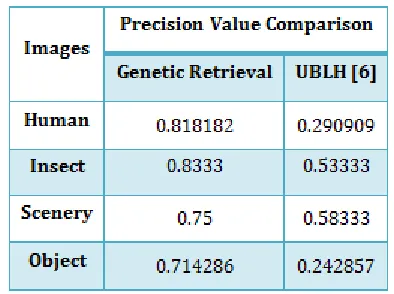
Table 1. Precision comparison of Genetic Retrieval and UBLH methods.
As above table 1 proved that proposed work has increase the relevancy precision score as compare to the previous method UBLH. This is due to the inclusion of the textual or annotation property in the retrieval system. Here precision was increased by removing the irrelevant images on the basis of user query and annotations. So most of the relevant images remained in the pool for visual features extraction.
Table 2. Recall comparison of Genetic Retrieval and UBLH.
As above table 2 proved that proposed work has increase the relevancy recall score as compare to the previous method UBLH. This is due to the inclusion of the textual or annotation property in the retrieval system. Here recall was increased by removing the irrelevant images on the basis of user query and annotations. So confusion among images get reduce a lot as less number of visual features are need to be extract from the remaining images.
Table 3. Execution time comparison of Genetic Retrieval and UBLH methods
As above table 3 shown that proposed work execution time is less as compare to the previous methodology used in [6]. Here time was reducing by removing the irrelevant images on the basis of user query and annotations. So less number of visual features are needed to be extracting from the proposed work.
As above table 4 proved that proposed work has increase the relevancy f-measure score as compare to the previous method UBLH. This is due to the inclusion of the textual or annotation property in the retrieval system. Here f-measure was increased by removing the irrelevant images on the basis of user query and annotations. So confusion among images get reduce a lot as less number of visual features are need to be extract from the remaining images.
V. CONCLUSIONS
In the exploration of Image recovery, there are a great deal of accomplishments in picture semantic feature; they can be connected to content-based picture recovery to examine the move between visual elements and semantic elements of the pictures. This paper uses the new blend of textual and also visual components for positioning the picture as both make the re-positioning procedure all the more capable, which is appeared in results. Clustering of image dataset by a genetic approach has made an efficient cluster for making effective image retrieval. Here it is demonstrated that utilization of single element reduces the accuracy of the work, so multiple feature can increase the accuracy as done in this work. In future one can adapted other feature combination with encryption for data security as well.
REFERENCES
[1]. S. Kaur and Dr. V. K. Banga, “Content Based Image Retrieval: Survey and Comparison between RGB and HSV”, model amritsar college of eng. & technology, Amritsar, India, 2013.
[2]. Liu, J. “Image retrieval based on bag-of-words model “. Cornell University Library: 1304.5168,2013. [3]. Alfanindya, A., Hashim, N., & Eswaran, C.
“Content-Based Image Retrieval and Classification using speeded-up robust features (SURF) and grouped bag-of-visual-words (GBoVW) “. In Technology, Informatics, Management, Engineering, and Environment (TIME-E), 2013 International Conference on (pp. 77-82). IEEE. 2013.
[4]. Satish Tunga, D. Jayadevappa and C. Gururaj, A Comparative Study of Content Based Image Retrieval Trends and Approaches, International Journal of Image Processing (IJIP), Volume (9) : Issue (3) : 2015 Pg.: 127- 155.
[5]. Li Liu, Mengyang Yu, and Ling Shao, “Unsupervised Local Feature Hashing for Image Similarity Search ”. IEEE TRANSACTIONS ON CYBERNETICS, VOL. 46, NO. 11, NOVEMBER 2016.
[6]. A. Vadivel, A. K. Majumdar and S. Sural, “Perceptually smooth CCM generation from the HSV color space for content based image retrieval”, International Conference on Advances in Pattern Recognition, (2003).
[7]. Dahane, G. M., & Vishwakarma, S., “Content Based Image Retrieval System”, IJEIT, Vol. 1, (2012), Pp. 92-96.
[8]. Chun, Y. D., N. C. Kim, And I. H. Jang, "Content-Based Image Retrieval Using Multi resolution Color And Texture Features", Multimedia, IEEE Transactions On, Vol. 10, No. 6 (2008), Pp. 1073-1084.
[9]. Ju, Y. A., "Face recognition using local statistics of gradients and correlations", Proc. European Signal Processing Conf., (2010).
[10].Meng Wang, Hao Li, Dacheng Tao, Ke Lu, and Xindong Wu “Multimodal Graph-Based Reranking for Web Image Search. IEEE Transaction on image processing Vol. 21, NO. 11, November 2012.