420
Improved Performance of Wi-MAX System Using Turbo Code Modulation
Technique and TEMT
Sonam Pyasi1, Mrs. Megha Soni2 M. Tech. Scholar, Department of EC
BTIRT, Sagar (M.P), India [email protected]
ABSTRACT:- Communication systems need for regeneration of consistent information by controlling errors in a noisy environment and study in the field of Worldwide Interoperability for Microwave Access system (Wi-MAX) or communication system is much needed as communication services. Wi-max network are used Orthogonal Frequency Division Multiplexing (O-FDM) with QAM (Quadrature Amplitude Modulation) modulation techniques. Our proposed technique Trellis-encoder with modulation technique (TEMT). Proposed encoder technique is improved performance of wi-max system as compare existing encoder (3D-TC). Wi-Max network performance by using turbo codes and setting all network parameters to achieve performance optimization. For different transmission conditions BER performance has been simulated. Communication system is that the afterward generation broadband wireless technology that offers higher vary and bandwidth compared to the opposite out there broadband wireless access technologies like Wi-Fi and ultra broadband family of standards. The simulation is based on the Wi-MAX physical layer which adopted an O-FDM model in the transmitter and receiver. WiMAX system by using different modulation techniques likes 4-QAM for modulator and demodulator. The signal is transmitted through the channel and it is received at the receiver end .Proposed algorithm probability of error, the lower order modulation scheme also has the lower BER at low SNR. Proposed algorithm minimizing BER at low SNR .Proposed approach is explained to facilitate the Wi-Max Mobile networks in terms higher data handling capacity and less noise susceptibility. Mat lab Tool is used to develop the O-FDM model and analysis the performance of WiMAX system. Proposed encoder interleave is also used and objective qualities due to better information data, and improves the SNR performance with larger data sizes and minimizes the bit error rate based on TEMT.
Keywords:- Wireless Network, WiMAX, OFDM, Adaptive Modulation Techniques, BER, Wireless Fidelity, Phase Shift Keying, Quadrature Phase Shift Keying, Trellis Encoder with Modulation Technique, interleave. Higher Data Handling Capacity.
I. INTRODUCTION
The growth of the use of the data networks leads to the requirement for new communication networks with higher data rates. The telecommunication business is additionally going to modification, with a requirement for a bigger range of services, like video conferences, or applications with multimedia system contents, wireless
communication has permeated nearly all acts of human life. WiMAX stands for the worldwide ability for microwave access. It’s a telecommunications protocol that has fixed and mobile web access. WiMAX could be a wireless digital communications system, additionally called IEEE 802.16 that's supposed for wireless "metropolitan area networks". WiMAX will offer broadband wireless access up to thirty miles for mounted stations, and three ten miles for mobile stations. Worldwide ability for Microwave Access could be a 4G technology and wireless communications normal designed to supply 28to 40 megabit-per-second data rates. Error free transmission is one in all the most aims in wireless communications [1].Modern wireless communication systems supply completely different services like oral communication & amplifier; multimedia system services to the users. Because it needs high rate, this can be not achieved by single carrier communication because it suffers from multipath fading & amplifier; inter image interference. Thus Orthogonal Frequency Division Multiplexing (OFDM) is considered because of the higher candidate for recent technology because it provides high spectral efficiency, robustness against multipath fading .OFDM has been chosen for prime rate communication & wide deployed in several wireless communication standards like DAB, DVB & WiMAX [2].
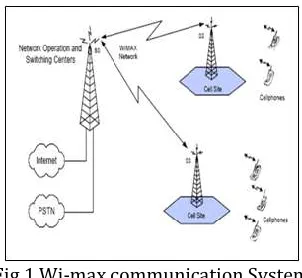
Fig 1 Wi-max communication System
421 realize the synchronization, it must adopt synchronization algorithm of smaller calculation quantity. In the meantime, it should have the higher examination of the first moment. Characteristics of WiMAX following.
I. Wimax data rates 5.5 to 70 Mbps. Standard 802.16e II. Wimax used Modulation scheme BPSK, QPSK, QAM. III. It is used Mesh Topology and Frequency band s 2.4
GHz, 3.5GHz, 5GHz.
IV. Wimax used Physical layer Direct Sequence Spread Spectrum (DSSS), Frequency Hopping Spread Spectrum (FHSS), and Orthogonal Frequency Division Multiplexing.
V. The WiMAX normal is internationally accepted and therefore the normal is maintained and authorized by WiMAX forum covers fixed, portable and mobile deployments.
VI. It covers up to 30 miles however in practice, it covers only six miles.
VII. WiMAX media access management is intended to support a large variety of users, with multiple connections per terminal.
VIII. It’s a quality using WiMAX offers large mobility especially IEEE 802.16e-2005[4].
OFDM adaptative Technology: Orthogonal Frequency Division Multiplex, OFDM may be a special case of multicarrier transmission, the adaptative OFDM technique is mentioned with differing kinds. The bit error possibility of various OFDM subcarriers transmitted in time dispersive channels depends on the Frequency domain channel transfer operates. The occurrence of bit errors is often focused in a very set of many light subcarriers, whereas within the alternative subcarriers usually, no bit errors are determined. OFDM divides a band channel into narrowband sub channels to mitigate ISI. The options of OFDM in multi user system are. In multiuser systems these sub channels are often allotted among totally different users, Orthogonal allocation: Multiuser OFDM, Semi orthogonal allocation: Multicarrier CDMA, spatial techniques facilitate to mitigate interference between users, OFDM overlaps sub streams, Sub streams separated in receiver, Minimum sub stream separation is B/N, total biological warfare is B, Impaired by temporal order interference, frequency offset, and fading, used by the CATV community and assigns a set of accessible carriers to every user [5].
Digital Modulation Techniques
1. Binary section shift keying: In BPSK, the section of a continuing amplitude carrier is switched between 2 values according to the two possible signals M1 and m2 love binary one and zero severally. This modulation is that the most strong of all the PSKs since it takes the best level only ready to modulate at one bit/symbol of noise or distortion to create the demodulator reach an incorrect call. It is, however, and then is unsuitable for prime data-rate applications. BPSK is functionally equivalent to 2-QAM modulation. The BPSK signal is
equivalent to a double sideband suppressed carrier amplitude modulated wave. Therefore a BPSK signal is often generated using a balanced modulator. Demodulation in BPSK Receiver needs the reference of transmitter signal so as to properly conform section, thus it's necessary to transmit carrier alongside signal. It needs complex and costly receiver circuitry. It offers sensible BER for low SNR giving power efficiency.
2. QPSK - quadrature section Shift Keying: quadrature section Shift Keying has double the information measure efficiency of BPSK. For each single modulation symbol, 2 bits are transmitted. The section of carrier takes on four
equally spaced values like zero, π/2, π, 3 π/2.The two
modulated signals, every of which might be thought-about to be a BPSK signal, are summed to supply a QPSK signal. QPSK transmitters and receivers are further difficult than those for BPSK. However, with trendy physical science technology, the penalty in value is very moderate. Like BPSK, there are section ambiguity problems at the receiving end, and differentially encoded QPSK is usually used in practice e [6].
II. EXISTING WORK
It is existing work based on BPSK transmitter is used along with Additive white Gaussian noise (AWGN) channel and BPSK receiver. The PSK modulation scheme for SDR is proposed to pick the constellation size that offers the best reconstructed signal quality for each average SNR. The audio signal transmission quality is evaluated and also the performance of the linear modulation is compared. It shows for a given SNR, less complicated modulation schemes tend to own higher quality, giving lower bit rates. BPSK has higher quality for given SNR as compared to different modulation schemes. Therefore, it's used because the basic mode for every physical layer. It’s the most coverage vary among all transmission modes [7].
In [8] Jagdish D. Kene et al. have presented Turbo code gives relatively better performance as compare to convolution codes. . Turbo code offers an impressive cryptography gain terribly near Shannon limit for AWGN channel to realize most output (Typical Wi-Max application). The target of this paper is to review the Mobile Wi-Max system performance by exploitation turbo codes and setting the system parameters to realize performance optimization. For various transmission conditions BER performance has been simulated. Finally for the performance optimization of mobile Wi-Max system the effect of various Decoding algorithms, Frame size and Code rates are considered for simulation to evaluate the system performance. Improvement achieved within the options of Mobile Wi-Max system for a specific choice of set of parameters has been reported.
WI-422 MAX is used for analysis which uses modulation techniques like QPSK, QAM-16 on OFDMA carrier support. The transmitter and receiver are considered ideal and Additive white Gaussian noise is introduced by channel. The maximum transmitted power is constant, regardless of the used modulation. . It shows that higher SNR are needed to draw out the signal at intervals identical BER because the modulation ranges of bits per image will increase. In Fig.1 the Bit Error rates verses Signal-to-Noise Ratios for different modulation techniques are presented.
In [10] Kahveci S. have presented Performances of Zigzag coding with high-level modulations on Wi-MAX system. The Wi-MAX which is a technology of OFDM base provides wireless communication from one-point to multi-point. In this study, for fixed and mobile Wi-MAX systems performance analysis of different modulation types and Zigzag encoder schemes is investigated. One of the important advantages of the error correction codes has no need re-transmission of data packets. The results of proposed Zigzag-coded modulation show that they have a good performance at least other techniques.
In [11] Lee M. Garth et al. has proposed Novel Orthogonal Codes for Spectrally-Encoded OFDM Systems in Fading Channels. In this paper, a unique orthogonal spreading code has been planned for spectrally- encoded (SE) OFDM, a.k.a., spread-time (ST) OFDM with capricious pulse form. it's been shown that it's potential to retain the orthogonally of the code within the presence of tail truncation by time windowing and in a very general multipath fading channel during which users expertise completely different frequency property simply by modifying the user code words. Simulation results show that the proposed codes can achieve single user performance when the code length is twice the number of users [1]
In [12] Paz Portela et al. have presented Performance Comparison between the Air Interfaces of LTE and Mobile Wi-MAX. Shown that there is no doubt nowadays that Orthogonal Frequency Division Multiplexing (OFDM) is the dominant technology in the area of mobile wireless access. The objective of this work is to analyze and compare the performance and spectral efficiency of 3GPP Long Term Evolution (LTE) and mobile Worldwide Interoperability for Microwave Access (Wi-MAX). Both technologies (based in OFDM) are the dominant options to provide mobile broadband access today, and in the near future
In [13] Rakesh Kumar Jha et al. Has conferred an inspiration of our Worldwide ability for Microwave Access network performance for QoS watching and optimization resolution for Bachelor of Science (Base Station) with transmission application. In the communication sector, the optimal objective is to equate quality and cost. Due to its large coverage area, low cost
of deployment and high speed data rates. WiMAX is a promising technology for providing wireless last-mile connectivity. Physical and MAC layer of this technology refer to the IEEE 802.16e standard, which defines 5 different data delivery service classes that can be used in order to satisfy Quality of Service requirements of different applications, such as VoIP, videoconference, FTP, Web, etc. In this paper we have made six scenarios. Here two types of MAC layer QoS are used and they are UGS and rtPS having application of Voice over IP (VoIP) and MPEG respectively. Also the traffic priority for UGS is high as compared to rtPS. In every situation the quantity of fastened nodes (Fixed Subscriber Stations) and Mobile nodes (Mobile Subscriber Stations) are totally different. to hide additional nodes or if nodes are outside the coverage space over one SB are needed.
In [14] Askar S et al. have presented "Performance evaluation of IEEE802.16-2004 WiMAX with fixed high fading channels,", WiMAX (Worldwide Interoperability for Microwave Access) is a promising technology which can offer high speed data, voice and video service to the customer end, which is presently, dominated by the cable and digital subscriber line (DSL) technologies. The performance assessment of WiMAX systems is dealt with. The biggest advantage of Broadband wireless application (BWA) over its wired competitors is its increased capacity and ease of deployment. This work are to model and simulate the fixed OFDM IEEE 802.16d physical layer under variant combinations of digital modulation (BPSK, QPSK ) over diverse combination of fading channels
In [15] P Omprakash et. al. present an Adaptive modulation enables a WiMAX system to optimize the throughput based on propagation conditions. IEEE802.16 (WiMAX) system support BPSK, QPSK, 16-QAM and 64-QAM and the access scheme is OFDM. This paper presents the performance of different variants of transmission control protocols with different modulation schemes when density of mobile nodes changes.
III. SIMULATION TOOL AND RESULTS ANALYSIS (a)SIMULATION TOOL-MATLAB
423 explore and visualize ideas and collaborate across different disciplines with signal and image processing, communication and computation of results. MAT-LAB provides tools to acquire, analyze, and visualize knowledge, modify you to induce insight into your knowledge during a division of the time it'd take victimization spreadsheets or ancient programming languages. MAT-LAB (matrix laboratory) could be a multi paradigm numerical computing state of affairs and fourth generation artificial language. It’s developed by maths
work; MATLAB permits matrix strategies, plotting of perform and knowledge, implementation of formula, construction of user interfaces with programs. MATLAB is meant primarily for mathematical computing; an optional tool box uses the MuPAD symbolic engine, permitting access to symbolic computing capabilities. It’s
simulating on mat research lab 2013a and for this work we use Intel 1.4 GHz Machine and OS window7, window-xp etc.
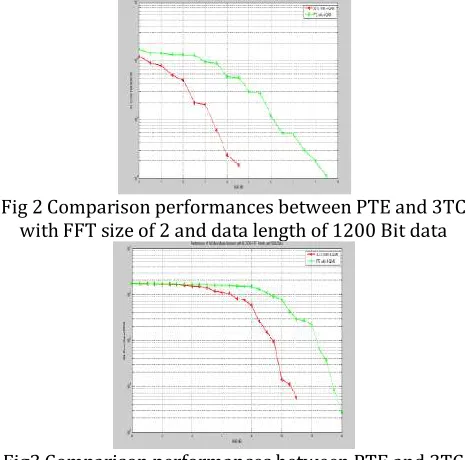
(b) Results Analysis Based on Data Size of 1200 In this experimentation based on data size 1200 and BER performance of QAM and basic size of 4-QAM modulation techniques are presented for the different fft 2-sizes of O-FDM system used for WIMAX systems over the AWGN channels. Compare our Proposed Trellis-Encoder (PTE) and 3-turbo code (3TC) with 4QAM. In this simulation process is BER values are show the proposed encoder PTE get more BER values as compare to existing encoder 3TC get less values of BER.
(i)Comparison performances between PTE and 3TC with FFT size of 2 and data length of 1200.PTE and 3TC with 4QAM. In this simulation process is BER values are show the proposed encoder PTE get more BER values as compare to existing encoder 3TC get less values of BER.
Fig 2 Comparison performances between PTE and 3TC with FFT size of 2 and data length of 1200 Bit data
Fig3 Comparison performances between PTE and 3TC with FFT size of 4 and data length of 1200 Bit data (ii) Comparison performances between PTE and 3TC with FFT size of 4 and data length of 1200.PTE and 3TC with
4QAM. In this simulation process is BER values are show the proposed encoder PTE get more BER values as compare to existing encoder 3TC get less values of BER.
(iii) Comparison performances between PTE and 3TC with FFT size of 8 and data length of 1200. PTE and 3TC with 4QAM. In this simulation process is BER values are show the proposed encoder PTE get more BER values as compare to existing encoder 3TC get less values of BER.
Fig4 Comparison performances between PTE and 3TC with FFT size of 8 and data length of 1200 Bit data (d) Comparison performances between PTE and 3TC with FFT size of 16 and data length of 1200. PTE and 3TC with 4QAM. In this simulation process is BER values are show the proposed encoder PTE get more BER values as compare to existing encoder 3TC get less values of BER. SNR achieved at the BER rate of the order of 10-3 is increased from 3.5 dB to 6.6. While SNR at BER of the order of 10-3 is increased from 6.6 dB to 9.3 dB as FFT size is doubled.
Fig5 Comparison performances between PTE and 3TC with FFT size of 16 and data length of 1200 Bit data
IV. CONCLUSION
424 success developed using Matlab software system. Our proposed BER performance Improved of WI-MAX system using Turbo Code Modulation Technique and TEMT .In this part a proposed approach is a called as proposed TEMT with Wi-MAX O-FDM. The results of simulation show that the bit error rate improved WIMAX system based on TEMT. In future used the present encoder makes system significantly robust against noise and interference. In future take on better modulation technique using some applications and filters will make system better for Wimax network channels having noises in data transmission.
REFERENCES
[1]. Deepak Pareek, “WiMAX: Taking Wireless to the
MAX,” Auerbach Publications, 2006.
[2]. Jiang T., Wu Y., “An Overview: Peak-to-average power
ratio reduction techniques for OFDM signals‖, IEEE
Transactions on Broadcasting, vol. 54, no. 2, pp. 257–
268, Jun 2008 .
[3]. R. Prasad, “Introduction” in OFDM for Wireless
Communications Systems, London, United Kingdom: artech House, 2004, pp. 11-14.
[4]. Kumar, “Introduction to Broadband Wireless
Networks” in Mobile Broadcasting with WiMAX:
Principles, Technology and Applications, New York, USA: Focal Press, 2008, pp. 24-50
[5]. S. J. Vaughan-Nichols, “Mobile WiMAX: The Next
Wireless Battleground,” in IEEE Comp. Soc. Mag. vol.
41, Jun. 2008, pp. 16-18.
[6]. Rajesh R. Bhambare, Dr. Rajeshree D. Raut, “A Survey
on Digital Modulation Techniques for Software
Defined Radio Applications”, International Journal of
Computer Networks and Wireless Communications, ISSN: 2250-3501, Vol.3, No3, June 2013.
[7]. Muhamad Islam, M. A. Hannan, S.A. Samed , A.
Hussain, “Bit-Error- Rate for modulation technique
using software defined Radio”, International
conference on electrical Engineering and Informatics,5-7August 2009,Malaysia,pp.445-447. [8]. Jagdish D. Kene Dr. Kishor D. Kulat, “Performance
Optimization Of Physical Layer Using Turbo Codes: A Case Study Of Wi-Max Mobile Environment”, International Conference on Emerging Technology Trends in Electronics, Communication and Networking, IEEE, 2012.
[9]. Aldrian Tarniceriu, Bogdan Iordache, “An Analysis on
Digital Modulation Techniques for Software Defined
Radio Applications”, Semiconductor Conference,
2007, International CAS Oct. 15, 2007, Volume 2, pp.571-574.
[10]. Kahveci, S., "Performances of Zigzag coding with high-level modulations on Wi-MAX system," Signal Processing and Communications Applications Conference (SIU), 2012 20th , vol., no., pp.1,4, 18-20 April 2012.
[11]. Amir R. Frozen, Lee M. Garth, “Novel Orthogonal Codes for Spectrally-Encoded OFDM Systems in Fading Channels, 2011.
[12].Paz Portela, N.A.; Rodriguez Diaz, B., "Performance Comparison between the Air Interfaces of LTE and Mobile Wi-MAX," Latin America Transactions, IEEE (Revista IEEE America Latina), vol.11, no.4, pp.1001, 1006, June 2013.
[13].Rakesh Kumar Jha, Idris Z. Bholebawa, Upena D.
Dalal,” Location Based Performance of WiMAX Network for QoS with Optimal Base Stations (BS)”,
Wireless Engineering and Technology, Volume 2, No.3, July 2011.
[14].Askar, S. Raweshidy H.S. ,"Performance evaluation of IEEE802.16-2004 Wi-MAX with fixed high fading channels," Wireless and Microwave Technology Conference (WAMICON), 2011 IEEE 12th Annual , vol., no., pp.1,6, 18-19 April 2011. 0.2, pp. 91-93, 2006.
[15].P Omprakash, R Sabitha,” Performance Analysis Of Tcp Over Wimax”, Electronics Computer Technology
(ICECT), 2011 3rd International Conference on, Volume 6 2011.
[16].Askar, S. Raweshidy H.S. ,"Performance evaluation of IEEE802.16-2004 Wi-MAX with fixed high fading channels," Wireless and Microwave Technology Conference (WAMICON), 2011 IEEE 12th Annual , vol., no., pp.1,6, 18-19 April 2011. 0.2, pp. 91-93, 2006.
[17].Patidar, M.; Dubey, R.; Jain, N.K.; Kulpariya, S., "Performance analysis of Wi-MAX 802.16e physical layer model," Wireless and Optical Communications Networks (WOCN), 2012 Ninth International Conference on , vol., no., pp.1,4, 20-22 Sept. 2012. [18]. W. Su, S. N. Batalama and D. A. Pados, “On Orthogonal
Space-Time Block Codes and Transceiver Signal
Linearization”, IEEE commun. Lett, vol 10, n
[19]. Neha, Dr. Charanjit Singh, “ Survey on Intercarrier
Interference Self-Cancellation techniques in OFDM
Systems”, International Journal of Engineering
Science and Innovative Technology (IJESIT) Volume 2, Issue 2, March 2013.
[20]. https://www.edgefx.in/types-of-modulation-techniques-with-applications/
[21].MuhamadIslam, M. A. Hannan, S. A. Samed, A. Hussain, “Bit- Error Rate for modulation technique using software defined radio. International Conference on Electrical Engineering and Informatics, 5-7 August 2009, Malaysia, pp.445-447 [22]. John D. Oetting, “A Comparison of Modulation
Techniques for Digital Radio”, IEEE Transactions on