Brock Education Journal, 27(1), 2017
Editorial
Double Special Issue: Academics and Activists: Advocating for Equity, Justice, and Action Dolana Mogadime, Abby Ferber………p.1
Introduction:
An Analysis of Articles and Key Concepts Featured in the Double Special Issue Dolana Mogadime, Abby Ferber………pp.2-9
Epistemologies of Silence
Spy Dénommé-Welch, Jennifer Rowsell………...pp.10-25
“Deluded and Ruined”: Diana Bastian—Enslaved African Canadian Teenager and White Male Privilege
Afua Cooper………pp.26-34
Making Visible and Acting on Issues of Racism and Racialization in School Mathematics Jhonel A. Morvan………pp.35-52
Teaching the Possible: Justice-Oriented Professional Development for Progressive Educators
Mollie A. Gambone……….…pp.53-66
Moving From Chasm to Convergence: Benefits and Barriers to Academic Activism for Social Justice and Equity
Barbara Rose………pp.67-78
Feminist Scholar-Activism Goes Global: Experiences of “Sociologists for Women in Society” at the UN
Daniela Jauk………pp.79-100
Book Review: Gendered Journeys: Women, Migration, and Feminist Psychology
Editorial Double Special Issue:
Academics and Activists: Advocating for Equity, Justice, and Action
Dolana Mogadime Editor-in-Chief Brock University
Abby Ferber Guest Editor
University of Colorado at Colorado Springs
This Double Special Issue was envisioned as an international collaborative endeavor between colleagues located at educational institutions in both Canada and the United States. The White Privilege Symposium Canada (WPSC) event, an initiative of the Anti-Racism Task Force held at Brock University from September 30 – October 1, 2016, set the stage for the inception of this collaboration. With the focus on knowledge mobilization and dissemination of social action research and activism, a call for papers in the Canadian-based Brock Education: A Journal of Educational Research and Practice and the U.S.-based Understanding and Dismantling Privilege (UDP) journals sought to disseminate the work of racial justice scholars, activists, and artists who are interested in publishing their contributions. The two journals provide a platform for our mutual desire to exchange knowledge across Canadian and U.S. borders, specifically regarding strategies and action plans used by individuals and organizations striving to merge duality between environments—that is, the world of social activists and that of academics. These works provide inroads into a critical understanding about White privilege as articulated through heterogeneous writings, reflections, workshops, and papers offered at WPSC.
Here, we briefly describe some of the highlights from the UDP journal but also wish to emphasize the range of additional dynamic pieces featured in the UDP Special Issue. Therefore, we invite the reader to review those additional works in detail in UDP itself. By way of example, Taylor Leeal Gibson (2017) provided a traditional Hodensosaunee Thanksgiving address and welcome at the WPSC’s opening ceremony. We later asked him to think about sharing his reflections on the theme of the symposium. So too, the keynotes from Dr. Eddie Moore, Jr. (2017) and Debby Irving (2017) are published in UDP. While our focus was on the burgeoning knowledge exchange at WPSC 2016, we also were keenly interested in publishing the work of a wider and broader range of authors who have a vested interest in the theme, “Academics and Activists: Advocating for Equity, Justice, and Action.” As such, the Double Special Issue recognizes the connections among social justice advocate groups located in educational institutions across the spectrum from the K–12 school setting through to the postsecondary system. The reader is invited to review both journals for a richer understanding about the intersecting themes raised in both.
Brock Education: A Journal of Educational Research and Practice https://secure3.ed.brocku.ca/brocked/
Mogadime & Ferber Introduction: Double Special Issue
2
Introduction: An Analysis of Articles and Key Concepts Featured
in the Double Special Issue
Dolana Mogadime Editor-in-Chief Brock University
Abby Ferber Guest Editor
University of Colorado at Colorado Springs
The first article of the Brock Education Journal’s special issue is Spy Dénommé-Welch and Jennifer Rowsell’s (2017) “Epistemologies of Silence.” They provide autoethnographic reflections on how silence manifests through myriad experiences borne of social relations and political realities. The reader learns about how two very separate cultural trajectories, one shaped by Anishinaabe ancestry (Spy) and the second by Irish–British-settler hidden memories (Jennifer), merge temporarily by way of methodologically interrogating epistemologies of silence, although manifested in disparately distinct senses. As Dénommé-Welch explains,
my work is a culmination of life experience and artistic practice that builds on multiple art forms and epistemologies, which in part aims to disrupt colonial histories and hegemonic discourses, which are all too often prevalent in the Arts and systems of education. However, not only does this process conceivably present the space(s) to disrupt colonialism, but it also can become a mode used to re-examine the implications of silence and its part in suppressing Indigenous knowledges, histories, and expressions of autonomy. (p. 12)
While looking through the lenses of research conducted, Rowsell articulates the process of unearthing the silencing of Black youth in schools. The coauthors speak to the converges and overlaps from their respective research observations that illuminate how “Western culture has placed great emphasis on the notion of speech/voice, in quite literal and figurative ways, either by emphasizing or demarking separation between ‘dominant’ and ‘minoritized’ voices. This has directly and indirectly contributed to forms of oppression and the subjugation of Indigenous and racialized voices” (p. 13). The authors seek to expose
the knowledge gaps among its citizens, as well as the violent nature of colonialism wherein select Euro-colonial narratives and knowledge systems have prevailed and contributed to the mythology of today’s Canada. Building on the notion of fragmentation, and the potentiality for disrupting mythology, together we weave vignettes—snippets and pieces of knowledge—to form a type of narrative of voiced silence, and examine how our combination of vignettes function as a kind of monograph to underscore notions of silence. (p. 14)
The coauthors proceed to offer up a set of methodological research processes for studying and probing silence. Their examination of silence in images lends a connection to Afua Cooper’s study of the image of the burial record for Diana Bastian.
Mogadime & Ferber Introduction: Double Special Issue
safe haven for southern African American slaves seeking freedom through the Underground Railroad to Canada. As Cooper explains, “when we place Black women at the centre of Canada’s historical and colonial past, we come to a new understanding of the power and privilege White men possessed, and the catastrophic impact it had on Black women’s bodies” (p. 26). Cooper’s analysis of the document critiques the problem that though physically and sexually violated, Bastian’s aggressor did not face any retribution because notions of White privilege and White supremacy deemed Bastian as property of her capture. Cooper states, “Bastian was owned by Loyalist Abraham Cuyler and taken advantage of by George More, one of Cuyler’s friends and colleagues. These men were part of the colonial elite, and therefore in many respects can be described as founding fathers of an emerging Canadian nation” (p. 27).
Jhonel Morvan (2017), in ‘Making Visible and Acting on Issues of Racism and Racialization in School Mathematics,’ disrupts the racialized racist silences that allow student success in the discipline of mathematics to continue to be privileged and accessible to elite students in ways that reproduce the “White power structure” in society. What is of interest in Morvan’s article is the fact that his argument is supported by a Toronto District School Board report that points to the racial inequities regarding school success “that makes such connections clear” and “present as ethical dilemmas that people in all educational settings must deal with on a constant basis” (p. 37). Morvan insists on the importance of galvanizing stakeholders into action. For Morvan, we cannot purport to endorse equity without first acknowledging how inequities occur. Morvan’s article is twofold in its approach: He first highlights how math is racialized then urges stakeholders to go beyond the equity rhetoric by way of his call to action that involves an “ethic of care” and the “ethic of critique.”
The collection of three articles thus far are based in Canada. The next is U.S. based, while the last two are internationally based and adopt a global perspective. Mollie A. Gambone (2017) in “Teaching the Possible: Justice-Oriented Professional Development for Progressive Educators,” examines a forum for the professional development of 800 educators. Gambone’s study is timely in that it delves into the current issues confronting educational professional development organizations. Gambone analyzes the program offered, using qualitative content analysis and discourse analysis as a vehicle for examining questions regarding the organizations’ and participants’ willingness to engage with justice-oriented curriculum. She anchors the rationale for her examination in the following problematic: “providing justice-oriented professional development for progressive educators has historically been a site of tension” (p. 50). The forum under examination is the Progressive Education Network’s 2015 national conference. Gambone’s study is innovative in its use of thematic analysis of the workshop abstracts based on the extant literature. She articulates the urgency of this work as follows:
This study aims to understand how professional development is designed as a site for progressive educators to engage with justice-oriented curricula. Findings indicate that in order for students to be engaged, democratic citizens, they must work alongside role model educators (Giroux & McLaren, 1986) who listen to and honor the truth in perspectives different than their own (Ladson-Billings, 1995). (p. 54)
Gambone’s study is unique, in that it merges the discussion of the research literature on social justice oriented approaches with the work on progressive educators through both content analysis and discourse analysis. She arrives at three themes:
Mogadime & Ferber Introduction: Double Special Issue
4 (2) Reframing social issues, which encouraged the participants to understand how social issues are commonly framed, then analyze how these issues could be experienced or perceived by others. These sessions highlighted the importance of perspective, historical significance, and societal or political structures that perpetuate inequality;
(3) Understanding diverse perspectives, which delineated specific causes or groups of people for whom sessions aimed to raise awareness. The causes most commonly advocated for were: the environment, LGBT/gender/sexuality issues, disability, community issues, and issues of race and culture. (p. 60)
Gambone offers a research approach that can be used by other activist researchers interested in learning how organizations deliver on opportunities for professional learning among educators, particularly those focused on merging the divisiveness between progressive education on one end and social justice education on the other.
Barbara Rose (2017), in “Moving From Chasm to Convergence: Benefits and Barriers to Academic Activism for Social Justice and Equity,” queries “the difficult process of defining and balancing the worlds of academia and activism, as if each world is on a different side of a chasm that can’t be reached” (p. 68). Rose argues for the importance for standing with institutional change at the structural level. Using Scholarly Personal Narrative (SPN) methodology, she writes about the trajectory in her thinking toward becoming and living as an academic activist.
In a manner that is both transparent and authentic, Rose expresses both the challenges and affirmations she has witnessed and fought for in both her research endeavors and work toward institutional change. She asserts that view as follows: “I have been influenced by events in both my scholarly and personal lives that reflect points of chasm and convergence” (p. 70). Turning to the research literature, Rose provides examples of activist researchers who have articulated what it means to live in “outsiderhood” and experience the liminality within institutions because of their activism. Such examples used by Rose stem from cultural studies and scholars who have taken on a counternarrative within the discipline itself. The examples are many, including women’s studies and critical race theory. What is evident to Rose is
In addition to academic activists being in a place of liminality, it can be argued that the scholarship of academic activism is similarly situated, lacking theoretical constructs or methodologies that are widely used across disciplines. Although most disciplines have theoretical frameworks that are used by activists within their academic field, the dearth of interdisciplinary theory specific to academic activism isolates academic activists from each other and reduces opportunities to provide examination of collective context, themes, meaning, and strategies. (p. 69)
Rose argues for the uses of SPN across disciplines and points out that it has been utilized to write about the work of activist scholars who support social justice issues in their scholarship and work on the ground.
In “Feminist Scholar-Activism Goes Global: Experiences of ‘Sociologists for Women in Society’ at the UN,” Daniela Jauk argues for public sociology as a means to bridge the gap between “academy and activism.” In fact, she insists that Sociologists for Women in Society (SWS) is an important case example of a bridge between the divide. Jauk’s work serves to
Mogadime & Ferber Introduction: Double Special Issue
representing experiences and challenges of SWS members’ engagement with UN policy development since the mid-nineties. I demonstrate that SWS does justice to its mission of serving as an activist organization through its work in the global arena. The activism of SWS-members increases visibility of feminist sociology, disrupts hegemonic discourse, and offers opportunities for concrete social change, particularly through linking activism, mentoring, and teaching. (p. 80)
Jauk discusses a subsample that includes 11 interviews with both former and present-day members of SWS as well as those who have been pivotal to SWS contributions at the United Nations. She clearly incorporates her “own white, western, working class, transnational feminist lens to examine the interview transcripts of feminist scholar-activists” and in so doing she “interrogates opportunities and limitations for feminist scholarship activism around the Commission on the Status of Women (p. 80).
We now turn to the pieces published in Understanding and Dismantling Privilege that are part of a Double Special Issue with Brock Education Journal. UDP begins with Taylor Gibson’s (2017) opening address, in which he pays homage to his grandparents and the teachings he came to value as a young child. Gibson is an educator, and his Thanksgiving address educates the listening audience about ancestors’ knowledge as pedagogy. Gibson is followed by a joint Keynote presented by Dr. Eddie Moore, Jr. and Debby Irving (2017) that we are pleased to be able to share here. Moore introduces the White Privilege Conference WPC to a Canadian audience, and candidly discusses his motivations and goals for initiating the conference almost 20 years ago.
In his first publication to explicitly discuss the rationale behind the WPC, Moore shares insights from his own ongoing journey. He emphasizes the importance of starting with the self, and the impossibility of skipping the deep personal work that we each must do. He then moves from the self to systems. Confronting the common misunderstanding that examining White privilege is about making White people feel guilty, the shift to systems work is essential: “This is not about evil bad White people or blame and shame. I am saying evil bad White supremacy. … Systems change people all the time. Time to think about changing the system” (Moore & Irving, 2017, p. 9).
Debby Irving expands upon Moore’s analysis by demonstrating how the dynamics of White privilege and supremacy have played out throughout her own life as a White woman. She moves between both the personal and systemic levels, emphasizing the manner in which White supremacist institutional practices privilege individual White people, all the while making it seem normal.
Mogadime & Ferber Introduction: Double Special Issue
6 Hilary Brown and Dolana Mogadime (2017) met over a period of a year to discuss what it means to teach about social justice and diversity in teacher education programs. Their conversations were documented using a recording device and followed research processes that align with duoethnography. The two researchers ask critical questions about their positionality as White and as Black and the impact that had on the curriculum and on the teaching, and learning environment they provide for their teacher education students. The view was to invite their students into these similar critical conversations. Brown and Mogadime argue that if teacher education programs are vested with preparing teacher education students to embrace identities that affirm diversity, then the students will similarly need to undergo genuine critical conversations about race, gender, sexuality, and class. The researchers surmise that their role involves modeling and documenting how these conversations might take place through duoethnography.
The next article “First Nation, Métis, and Inuit Education Leads: Transforming Education by Sharing Our Praxis,” by Katherine Samuel (an author who felt compelled to use an anonymous name), provides an insider’s analysis of the dangers and opportunities inherent in the Ontario Ministry of Education’s new requirement that each school board hire a dedicated “First Nation, Métis, and Inuit Education Lead” (Leads are not required to be indigenous themselves). This decision is aligned with many individual schools’ efforts to teach about Canada’s colonial history, and to bring in the voices, stories, and perspectives of indigenous peoples. As one would expect, the author finds varying degrees of commitment and success. Too often, the anonymous author finds
educators teaching about “safe” concepts such as medicine wheels, regalia, and artwork, yet teachers become uncomfortable and even resistant to teaching about the violent nature of colonialism, such as land dispossession, racism, or governmental policies that continue to shape the lives of both Indigenous and non-Indigenous people. These latter topics have been identified as “dangerous” by educators, and teachers have the discretion and ability to omit these topics from their lessons. (p. 45)
The author is in a unique position to try to change this as part of a program to work with specific model schools to move past these and other obstacles. The author’s goal is
to establish the purpose and direction for Indigenous education for these model schools. This direction will involve guiding educators to think critically about the work that they are doing. …While teaching about culture is an important part of the work … I want them to consider how they are complicit in settler colonialism, and to alter their classrooms by teaching about Canada’s racist and colonial history. I want to teach them how to educate others about Indigenous sovereignty, treaties, the Indian Act, residential schools, acts of resistance, and more. (p. 47)
Mogadime & Ferber Introduction: Double Special Issue
Given the lack of experience that many white college students have with racial diversity, many are fearful of making mistakes in diversity education (Bedard, 2000; Kivel, 1996; Sleeter, 1992). This fear holds many white students back from authentically engaging in diversity education in the first place (DiAngelo, 2012). Using mindfulness, white college students can become more resilient and prepared for challenging interactions that may occur in diversity education. (p. 58)
The author provides some concrete examples educators and leaders can adopt in any setting. The next contribution “What Can You Do When You Don’t “Fit the Mold”? Dismantling White Privilege Affecting Career Advancement in the Education System,” by another anonymous author, recounts one Chinese Canadian man’s experience working in the education system, and the constant micro aggressions and micro insults he suffers. At numerous points, he stops to consider what he is willing to sacrifice to succeed in a system designed to exclude people like him. We are privy to each decision along the way, and his growing commitment to not abandon his sense of self and culture. Each confrontation is placed within the context of the broader research on the topic. Weaving together personal narrative, research, and concrete strategies, the author shares this man’s strategies as well as his success in confronting an institution that is central to reproducing White privilege. Some of these challenges corroborate with Mogadime’s (2008) research, signaling that the issues raised by Anonymous have been enduring for racialized teachers.
Aron shares her very personal journey with readers. Episodes of her life show her transformation from a naïve white child educated in the South, to an adult who has gone back to fill in the gaps in her education. Her contribution reflects the critical questions she asked about incidents in her life. For example, she recounts her sense of Southern pride in receiving an award from the Daughters of the American Revolution in a hall that she later learns barred Marian Anderson from performing there because she was Black. Individuals on the path to examining their own White privilege must go back and examine their earliest assumptions about who they are, asking what stories were excluded, and who was excluded in the process of developing a self-affirming identity. On this path, she interrogates memories of friends and family, material culture, and the civil rights movement, juxtaposing the original affective experience with what she now knows. As Aron acknowledges, we are now fortunate to have many publications that explore the continuous personal transformations of White people examining their own White privilege, and while we may find similarities and patterns, each story in uniquely individual.
Mogadime & Ferber Introduction: Double Special Issue
8 capitalism, democracy, and nature, using metaphors and memories as her creative tools. We witness that very little has changed as we hear echoes of the stories shared by Aron. Read in conjunction with each other, listening to a White elder and a Black youth, we gain even greater insights into the repetitive production of White privilege. The reader may be left feeling despair, yet Kyle concludes with a challenge and a call to action we can’t turn away from.
Finally, it is important and striking to note that multiple contributors have chosen not to use their real names as authors for fear of possible retaliation or other negative consequences. For example, the author of “‘What Can You Do When You Don’t “Fit the Mold”? Dismantling White Privilege Affecting Career Advancement in the Education System’” explains that she has decided to
conceal her identity because she has been advised by her teacher’s union that “your employer views you as the ‘public’ face of the organization, and it has been accepted in law that school boards are employers that have reputations to protect. If you are commenting in a public manner on an issue that could be viewed to negatively tarnish the reputation of the board there could be disciplinary action laid against you. (cover page) This statement alone emphasizes the critical importance of the work in which all of these authors are engaged, as well as the necessity of online, open-access journals like these that are willing to take risks. In the end, it is up to you, our readers, to add your voices and your commitment to this movement for equity, justice, and action.
Mogadime & Ferber Introduction: Double Special Issue
References
Anonymous. (2017). What Can You Do When You Don’t “Fit the Mold”? Dismantling White Privilege Affecting Career Advancement in the Education System. Understanding and Dismantling Privilege, 7(2), 67-74.
Aron, P. L. (2017). Reflections: A White Southerner’s Story. Understanding and Dismantling Privilege, 7(2), 76-86.
Ashlee, K. (2017). Utilizing Mindfulness and Contemplative Practices to Promote Racial Identity Development for White College Students. Understanding and Dismantling Privilege, 7(2), 55-65.
Brown, H. and Mogadime, D. (2017). Advocacy for Diversity Begins with the Self: Unleashing Silenced Stores: A Duoethnographic Account. Understanding and Dismantling Privilege, 7(2), 16-38.
Cooper, A. (2017). “Deluded and Ruined”: Diana Bastian, enslaved African Canadian teenager and White male privilege. Brock Education: A Journal of Educational Research and Practice, 27(1), 26-34.
Dénommé-Welch, S., & Rowsell, J. (2017). Epistemologies of silence. Brock Education: A Journal of Educational Research and Practice, 27(1), 10-25.
Gambone, M. A. (2017). Teaching the possible: Justice-oriented professional development for progressive educators. Brock Education: A Journal of Educational Research and Practice, 27(1), 53-66.
Gibson, T. L. (2017). Traditional Hodensosaunee Thanksgiving Address and Welcome. Understanding and Dismantling Privilege, 7(2), 2-4.
Jauk, D. (2017). Feminist scholar-activism goes global: Experiences of “Sociologists for Women in Society” at the UN. Brock Education: A Journal of Educational Research and Practice, 27(1), 79-100.
Kyle, M. (2017). Poetry Examining the Edges. Understanding and Dismantling Privilege, 7(2), 88-92.
Mogadime, D. (2008). Racial differential experiences of employment equity for women teachers: one teacher’s narrative of resistance and struggle. Journal of Black Studies, 39(1), 85- 108.
Moore, E., Jr., & Irving, D. (2017). White Privilege Symposium Canada: Opening Keynote. Understanding and Dismantling Privilege, 7(2), 6-14.
Morvan, J. A. (2017). Making visible and acting on issues of racism and racialization in school mathematics. Brock Education: A Journal of Educational Research and Practice, 27(1), 35-52.
Rose, B. (2017). Moving from chasm to convergence: Benefits and barriers to academic activism for social justice and equity. Brock Education: A Journal of Educational Research and Practice, 27(1), 67-78.
Dénommé-Welch and Rowsell Epistemologies of Silence
Epistemologies of Silence
Spy Dénommé-Welch Brock University
Jennifer Rowsell Brock University
Abstract
This paper engages some of the philosophical and epistemological underpinnings of silence, and its implications for teaching and learning both within and beyond educational settings. In this exploration, the authors draw on self-reflexive observations, woven throughout the paper as a series of vignettes, to explore questions of silence and its impacts on their respective teaching, research, and professional practice. Similarly, the authors apply this approach while taking into consideration different expressions and meanings of silence and how this can offer new understanding of culture and identity, including social and political issues, through arts, performance, and arts-based research.
Keywords: silence; epistemology; autoethnography; reflexivity; praxis
Spy Dénommé-Welch, Ph.D., is an Assistant Professor, multi-disciplinary scholar, composer and writer, and Assistant Professor in the Faculty of Education at Brock University. His research focuses on Indigenous topics in education, arts, and music. He is a recipient of the Social Sciences and Humanities Research Council Insight Development Grant, and is currently investigating issues of Indigenous identity through visual culture and music. He has a list of composing/writing credits, including the Dora-nominated opera, Giiwedin (2010), Sojourn (2017), Bottlenecked (2017), Spin Doctors, for clarinet, violin and piano (2015); Victorian Secrets (2015); Bike Rage (2013). He is a member of the Playwrights Guild of Canada and the Canadian Music Centre.
Email: [email protected]
Jennifer Rowsell, Ph.D., is Professor and Canada Research Chair at Brock University where she directs the Centre for Research in Multiliteracies. Her research interests include: applying multimodal, arts-based practices with youth across formal and informal contexts; documenting children’s digital and media practices and epistemologies; and, longitudinal home ethnographies applying visual methods. She is co-editor of The Routledge Handbook of Literacy Studies with Kate Pahl, University of Sheffield. She is co-editor of the Routledge Expanding Literacies in Education series with Cynthia Lewis, University of Minnesota.
Dénommé-Welch and Rowsell Epistemologies of Silence
“Speaking in and through stories then becomes a way to engage self-transformation, a kind of rite of passage.”
-Marie Battiste, Decolonizing Education: Nourishing the Leaning Spirit, 2013, p. 17
It is plausible that silence carries many implications for teaching and learning, within and beyond educational settings, while raising the following question: Who is or is not given the space or a platform to “speak,” and who is listening? Similarly, for those who may or may not choose to communicate through words, body language or other forms of expression, another question emerges: Are they still being heard? Invariably, the notion of silence is rather nuanced as it can serve or be used for political, social and cultural acts. Arguably, such acts of silence can potentially represent or enact forms of oppression or resistance. Therefore, how does the making of silence or the creation of sound perpetuate articulations of colonialism, and is it possible to subvert silence in a manner that it becomes a modality for resistance? Suffice it to say when considering these questions, it is crucial to understand what types of silence are being created, when and where, and what are the consequences or outcomes of these manifestations?
Silence or lack thereof does not necessarily imply that it will carry similar meanings across time and place, or situation even. Silence is forever subject to shift and change, regardless of context and circumstance. For instance, within the context of an artistic work and practice, the notion of silence could easily mean one thing to a composer or musician, while something entirely different to a playwright or performance artist. More specifically a combination of musical rests in a composer’s score would very likely have a different affect or meaning from that of an actor or storyteller’s use of dramatic pause in a play or reading. In turn this could have vastly different and varied affects upon an audience or group of listeners’ who are experiencing the work. Invariably, the implications of silence are also varied within the context of education and classrooms, where educators and learners may or may not easily navigate such pedagogical nuances.
Dénommé-Welch and Rowsell Epistemologies of Silence
Reflective Silence
In this paper, we have come together to look at how silence can support or otherwise obstruct epistemological transformation in teaching and learning, within classrooms and real-world situations. To this effect we incorporate our own voices, as a means to position our respective identities and work as scholars. This enables us to speak to some of the nuances that are embedded within the themes of this paper, and to critically examine the interplay between dominant and marginalized narratives.
Spy:
I am an artist and an academic with Anishnaabe ancestry. I originally grew up in northeastern Ontario in the same region as some of my ancestors, and have always held a deep appreciation for the Arts. Increasingly, through my work I have encountered and witnessed moments in which aesthetic experience has presented new possibilities for decolonizing hegemonic discourses of knowledge and epistemology. Although I have trained and practiced in the Arts for several years now, I have progressively developed a self-reflexive practice built around the ontology of Indigenous knowledge, drawing on my years of work in multimedia, theatre, opera, and performance. In this manner, I have often found myself grappling with decolonization methodologies through performance (Dénommé-Welch & Montero, 2014), aesthetics and expression. Similarly, what is often categorically described as forms of interdisciplinarity within some academic circles is in fact a process by which I have used to (re)examine ways of developing Indigenous autonomy and forms of reclamation through the intersections of art, Indigenous ontology and knowledge systems. Consequently, my work is a culmination of life experience and artistic practice that builds on multiple art forms and epistemologies, which in part aims to disrupt colonial histories and hegemonic discourses, which are all too often prevalent in the Arts and systems of education. However, not only does this process conceivably present the space(s) to disrupt colonialism, but it also can become a mode used to re-examine the implications of silence and its part in suppressing Indigenous knowledges, histories, and expressions of autonomy. Throughout this paper I hope to share some of these articulations, alongside my colleague, Jennifer Rowsell, and speak to the overlapping observations we have made about silence through our respective work, experience and histories. Finally, through my work I strive to investigate ways of (un)/(re)learning new forms of resistance, and to examine and understand the nuances of silence and its impact on different expressions of knowing and being.
Jennifer:
Dénommé-Welch and Rowsell Epistemologies of Silence
experiences and as such they are idiosyncratic and not necessarily in need of exposing vulnerabilities – silence shapes shifts around our identities. Silence has become a recurrent motif in my life because, like all of us, I carry with me silent stories and I am fascinated by the silent stories research participants have shared with me over the years. Silent stories are memories that play out during our everyday lives and that drive ways of thinking and being in the world.
I began my graduate work focusing on traces of identities, beliefs, values and epistemologies within literature and gradually moved into photographs, films and digital worlds. As a researcher, I frequently ask: Is there a story within this text? Are there traces of identities embedded in its materiality? What is the story of the text’s production? Keenly interested in how identity, culture, beliefs, and interests shape and influence meaning making, I take an ethnographic account of meaning making by documenting how subjectivities, contextual factors and social practices become embedded in texts. I examine objects and material worlds closely, as traces of identity. Silence plays a role in my work through the ways that I take account of what is absent, silenced, or lost over time and across spaces. To me, as MacNaughton (2005) notes, “If we know what has been lost from history, we can change how we see and understand our relationships with each other now” (p. 152). Locating what has been lost, silenced, hidden, or removed traces absences of the past in the present and helps to excavate silenced thoughts, beliefs and hopes. With Spy, we speak to the overlapping observations we have made about silence through our respective work, experience and histories.
Sharing our stories throws into relief some of our differences, yet we are both equally fascinated by the mercurial nature of silence. Silence can be positively and negatively construed. One can be silenced and rendered invisible. Or, one can be thoughtful and reflective in silence. Silence can be steeped in culture, social practices, and religion. In the following sections, we weave together theoretical questions and methodologies through a series of vignettes, used to underscore and frame the complexities and nuances of silence, which is particularly helpful in guiding our analysis of different epistemological meanings of silence.
Silence as a form of Violence, or How Violent is Silence?
Dénommé-Welch and Rowsell Epistemologies of Silence
resulting in the fragmentation of the ontologies of diverse knowledge systems. Such fragmentation can and does present challenges with accessing knowledge and better understanding of our collective histories within and beyond Canada. However, this exposes the knowledge gaps among its citizens, as well as the violent nature of colonialism wherein select Euro-colonial narratives and knowledge systems have prevailed and contributed to the mythology of today’s Canada. Building on the notion of fragmentation, and the potentiality for disrupting mythology, together we weave vignettes – snippets and pieces of knowledge – to form a type of narrative of voiced silence, and examine how our combination of vignettes function as a kind of monograph to underscore notions of silence.
Studying Silence
Our approach to probing silence involved a series of meetings where we talked through our common and divergent thinking about silence and discussed possible approaches to writing on this topic, including the use of self-reflexivity. Then, we drew on our respective pedagogical approaches and research to analyze how silence circulates and meanders through our work as a strong, recurrent theme. Our writing therefore involved observational fieldwork, interview data with young people, and action research methods. To interpret and analyze silence as a theme and recurrent motif, we use constant comparison (Strauss & Corbin, 1990) across various research studies. In the paper, there are excerpts of pedagogical moments and research studies that serve as vignettes of silence – telling instances of silence enacted or felt as a presence.
Silence in Research
Researchers sometimes hide in the shadows of their sites and ethnographic researchers, in particular, often hide in the shadows of contexts to document people, actions, movements, places and spaces, and the stuff or objects that represent the focus of research studies. Conducting research can be and so often is silent in nature with threads and connections coming together in fieldnotes as a mapping of moments. There have been many moments over the course of research studies when Jennifer sat in silence observing and documenting what she sees across different contexts, but equally, there have many research moments filled with interaction, collaboration and co-research with silence playing a role as she concentrated with children and young people to make things.
Dénommé-Welch and Rowsell Epistemologies of Silence
of the research, any silence was shared by co-researchers. She is far more at ease with being in the web of activity and taking part in the research. This is where the “naturalness” comes from – a sense of being a part of the whole experience and immersed in the culture and context. It is documenting stories that enriches the silence and that mutually constitutes the research. In the next few sections Jennifer details varied perspectives on the topic of silence that she has experienced in her work.
Like Jennifer, Spy’s encounters and interactions with silence in research have been complex, which often raises philosophical questions. For instance, as an educator and scholar, Spy has often grappled with the implications of research, particularly being a person with Indigenous ancestry who is keenly aware of the historical paradigms and structures of power responsible for the displacement and subjugation of Indigenous peoples’ identity and culture and their relationship to their lands and histories. Such forms of oppression have indeed impacted the ways in which research has engaged with and silenced Indigenous peoples’ worldviews and knowledge systems. Linda Smith (1999) argues: “The word itself, ‘research’, is probably one of the dirtiest words in the indigenous world’s vocabulary. When mentioned in many indigenous contexts, it stirs up silence, it conjures up bad memories, it raises a smile that is knowing and distrustful” (p. 1). Undoubtedly, the idea that research “stirs up silence” is a powerful marker of just how delicate the line is when engaging with Indigenous communities that have historically been traumatized by the effects of colonization, imperialism, and various forms of unethical treatment.
Dénommé-Welch and Rowsell Epistemologies of Silence
resistance? What manifests in the learning process when an entire group chooses not to speak, or when silence is imposed?
Silent Interests
The silence that Jennifer discusses in this vignette is a different kind of silence. The vignette features a student who is rendered silent at school, who is at times overlooked and who would prefer not to be silent. Some students want to be silent, perhaps even garner strength and power through silence. Such is not the case for the young man in this vignette. As Director of a tutoring centre for three years, Jennifer has encountered many children and teenagers who struggle with literacy at school. More often than not these students have low grades in school literacy, but nevertheless they have rich and eclectic interests that are silenced if not absent at school. There is one young man who stands out for Jennifer because of the stark contrast between Cole (pseudonyms are used throughout) at school and Cole in the tutoring centre. David Kirkland (2013) talks about “an unknown story” that is rarely told about Black males and indeed Jennifer has noted a similar degree of silence around young men in middle and high school in terms of their ruling passions (Barton & Hamilton, 1998) and burning interests. By looking ethnographically at how young people engage in their everyday textual interactions it soon becomes clear that there are such rich, manifold literacy engagements that they have that are silenced in formal schooling. Composing music, designing architectural worlds in Minecraft (Rowsell & Simon, 2017), writing stories (Rowsell, 2014a), making films (Rowsell, 2014b), there are so many interests that are not present within more regulatory, formalized learning environments and their absence is thrown into relief when you see them come alive in other contexts. Cole is a poignant example because he has so many interests from science and technology, to gaming, to cadets and he exhibits such passion when he talks about them.
Over the course of doing research studies with Cole as a participant, Jennifer had many opportunities to speak with Cole’s Mum who gave us some wise advice about him, “find a subject that peaks his interest and he cooperates and will find different ways to seek out information.” After receiving this advice, we asked Cole about new things that he has learned and without fail, he would extemporize on his topic de jour. The whole research team worked with Cole and we all witnessed his love of information and curating facts. Cole is upfront and ebullient about his aptitude for information gathering and research skills:
I do research and projects on my iPad – anything that crosses my mind I research. For instance, today I looked up – what is energy? Everything is energy, but on the website that I was on, it said that energy is an object that is everything. The cosmos is another word for everything and the world. Our planet is an asteroid – everything has its own energy (personal communication, March 10th, 2015)
Dénommé-Welch and Rowsell Epistemologies of Silence
Silent Tensions
Tension as a form of silence can have a profound impact on a person’s mental, physical, spiritual and emotional state. Patsy Rodenburg, who is a voice coach and theatre director, states: “Not all tension is useless; some tension is very useful. Without tension as part of the framework, as in, say, a suspension bridge or a skyscraper, our bodies would collapse into a heap on the floor” (1992, p. 120). Spy’s observations of silent tension in teaching has often presented itself in a myriad of ways, and depending on the circumstance and context, can introduce new understandings of ourselves, our interactions with the world, our use of voice, and our interactions with silence. Rodenburg (1992) argues that “so much of the tension that blocks our voice is used unnecessarily. […] Healthy and appropriate tension, like the fight and flight tension required to survive an event like shock, is necessary for survival” (p. 120).
Over the years, Spy’s encounters of working in the theatre hall as an artist and the classroom as an educator have presented many moments of tension, necessary and unnecessary. Yet such moments, whether seemingly trivial or mundane, have often illustrated how tension can be the catalyst for unsuspecting change. For Spy, these moments of silent tensions have opened up new, and often more substantial moments for epistemological interventions through teaching and learning, through art making and production. Surprisingly or not, such moments have emerged in the most ordinary ways, such as through the simple listening or viewing a musical composition or a guided theatre warm-up exercise or a guiding seminar question. Invariably, these moments are intrinsically linked to an individual’s learning process, or experience of the world, where deeper meanings are made in moments of silent self-reflection, or in the moments where we are either challenged by our own belief systems and worldviews, or by those of others’ which confront our own boundaries of knowledge and experience.
Dénommé-Welch and Rowsell Epistemologies of Silence
a breaking of the universal rules, and a sense of the interplay of necessary and unnecessary tension. Ultimately, such actions illustrate the ongoing need to challenge the tension of silence and epistemology.
Silence in Movement
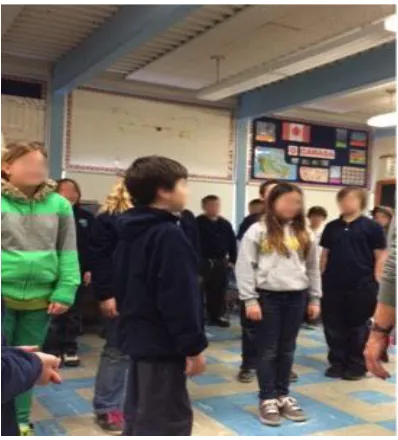
Susan Sontag (1969) claims that “the artist who creates silence or emptiness must produce something dialectical: a full void, an enriching emptiness, a resonating or eloquent silence” (p. 11). Over the course of her research examining representational dimensions of literacy, Jennifer has done movement work with elementary students (Rowsell & McQueen-Fuentes, 2017) and she has observed how movement offers a generative, fecund silence in line with Sontag’s enriching notion of silence. Watching children complete movement exercises and create tableaux offers a kind of powerful silence because bodies become channels of meaning (i.e. there is a complete absence of and role for language). As a part of a SSHRC-funded research project, Jennifer and Glenys McQueen-Fuentes completed movement exercises with grade 5 students as a part of their science unit. There was a specific day during the movement work that stands out:
We asked them, when you find your centre stay there – how do you feel when you do this?
A few students said … “I feel weird” And Glenys asked …Weird good or weird bad – “Weird Good!!” they said.
It is one of the only times that we used silence in our movement work and we had no idea that it would have such an impact.
(fieldnote, March 27, 2014)
For Jennifer, the day stood out because she devoted the afternoon to mindful meditation work. The one activity that students responded to most is called “centring.” In the photograph there is some sense of the calmness and equanimity that the exercise imbued in students.
Dénommé-Welch and Rowsell Epistemologies of Silence
Most of the movement work that was completed involved sound and gesture, but the silent work was enriching and eloquent. What was intriguing about the centring exercise was the insistence on silence, which took a few minutes to get used to, but once they were silent – they appeared to not want to come out of it. It is a literal sense of silence that stood out for Jennifer and Glenys.
Silence in Images
In Camera Lucida: Reflections on Photography, Barthes (1980) talks about photography as an “advent of myself as other: a cunning dissociation of consciousness from identity” (p. 12). In her photographic work with youth, Jennifer and Peter Vietgen (Rowsell & Vietgen, 2017) ask young people to actively project their identities, interests, thoughts and beliefs in conceptual photographs. Such images demonstrate more of a photographic association with identity – the antithesis of Barthes’ conception of a photograph as a dissociation of consciousness. But, at the same time, Barthes talks about connecting with sensorial, phenomenological worlds and this resonates strongly with what Jennifer witnessed over the course of her photography projects with secondary school students. Barthes describes photography as a wound that “I see, I feel, hence I notice, I observe, and I think” (p. 26). As teenagers involved in Jennifer and Peter’s research developed and storyboarded photographs, they spoke at length about emotions and making their photographs emotionally laden. There were many moments throughout Jennifer and Peter’s photography projects when she saw what Barthes calls punctum in photographs. Within the silence and shadows of many of the photographs that teenagers produced over the course of their six-week research study, there were wounds, pricks that pierced through photos. Thinking about silence in relation to conceptual photographs that secondary students shot, there were many photos that exploited the impact of muted lighting, soft colours, filter effects, artefacts and clothing to create silence in photos. They did this in order to display what Barthes calls punctum in photos. Punctum is a detail “i.e., a partial object” (p. 43). Punctum has the power of expansion. According to Barthes, studium is the impact of photo – what it says to the viewer, where punctum is the prick or pop in the photo. Barthes claims that the studium is coded, but the punctum is not coded – it is sudden, spontaneous and pricks out to the viewer (p. 47).
Secondary students involved in the photography project had their own way about moving from silence to punctum in photos that they produced, as became clear in the reflections of Heather:
…. like one main part that stands out amongst the rest of it like a photograph I took of a kitchen with a chair pulled out … it was the pulled out chair that stood out. (personal communication, 2014).
Dénommé-Welch and Rowsell Epistemologies of Silence
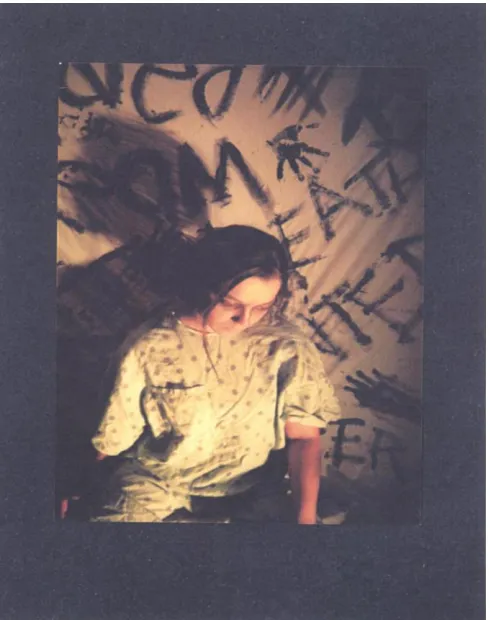
To illustrate the juxtaposition of silence in photographs next to a prick, or punctum to use Barthes’ term of meaning and emotion, there are two photographs featured in Figures 2 and 3. Figure 2 is entitled Madness and there is punctum in the shadow of the head silhouetted on the dirty sheet with writing on it. As if there is another figure appearing behind the young woman, she sits catatonic with her gaze fixed on something in the distance. There is silence in the darkness surrounding the figure and then a burst of light filtered onto a gowned figure. The darker areas around the corners of the photograph represent more silent, quieter elements and the suffusion of light in the middle represents the prick of life and energy.
In Figure 3, the young woman who captured this image talked about taking hours to set up the shot perfectly. The sepia tone, the blood on the walls, the dimmed light serve as an ideal backdrop against the woman’s piercing eyes and fixed gaze. Photographic elements sit in silence like the light in the back, but what pricks the viewer are the translucent eyes staring out at the viewer. There is tremendous, powerful movement in her stance. The punctum is in her eyes and in the fixed gaze. Punctum is most present in the hand with fingers gripping the carpet.
Dénommé-Welch and Rowsell Epistemologies of Silence
Figure 3. Silence and Punctum in Jade’s Photograph.
Silence as Island
“An artist has to understand silence
An artist has to create a space for silence to enter his work Silence is like an island in the middle of a turbulent ocean”
- Marina Abramovic, Walk Through Wall, 2016, p. 308
Dénommé-Welch and Rowsell Epistemologies of Silence
seems such moments of “disruption” of silence – like tiny islands - invokes notions of dissent that challenges dominant spaces that exists much like the turbulent ocean that artist Marina Abramovic describes. Why not the other way? Why must silence exist as an island and not an ocean? Why must there be turbulence? Conceivably, the turbulent ocean enacts forms of oppression, much like a symphony of voices talking at a board meeting, where voices continue to talk over each other, only marginally listening to one another or obeying their own notion of Robert’s Rules of Order (Robert, 1915). Who is Robert anyway? Why “his” rules and order? Moreover, who ultimately constructs these ideas of behaviour, and who follows them unquestioningly?
Silence invites all kinds of misunderstandings and misassumptions, but then again it also has the potential for self-reflection wherein one’s own judgement or biases are called into question. For instance, why does one assume that the “minoritized” voice only speaks when needed or necessary, such as in moments where it is seen as necessary to address or redress forms of social inequity or injustice? Is it proper to assume that only certain voices can speak to certain issues, and only at certain times? Needless to say, silence can conceivably trigger new methods for deconstructing notions of sound, voice, and dominant discourses and hegemony. Then, of course, what occurs when the rules of silence are broken, assuming there are any rules to begin with?
Conclusion
In writing this paper, we have both had occasion to “rescript” what we think of as the meaning of silence. While silence raises many possibilities for critical analysis and discourse, it also brings to the forefront some of the deeper questions and meanings of knowledge production, asking what voices are heard over those that are marginalized. Brown and Strega (2005) deconstruct these very notions, arguing that research and practice often results in “only certain information, generated by certain people in certain ways” as being accepted or qualified as “truth” (p. 7). Through our discursive analysis of our research, teaching and practice, we have drawn attention to a myriad of ways that silence can be used to greatly effect different understandings of the self and culture. We examined how silence operates in different artistic practice and forms, including movement, theatre, music, and images. Moreover, while incorporating autoethnographic strategies we also discussed some of our own experiences and encounters with silence, thus bringing to the fore multiple layers of meaning that take into account different forms of knowledge production. In these layers we encounter different ways that knowledge is created, carried, acknowledged, and understood. In some cases, silence is remembered in memory, other times it dwells in the body, building (if not storing) an archive of knowledge. Indigenous actor, writer and educator Monique Mojica (2009) also writes about the body as being an organic site of stored knowledge, and whether it is silent or has been silenced, it is “an endless resource, a giant database of stories. Some we lived, some were passed on, some dreamt, some forgotten, some we are unaware of, dormant, awaiting the key that will release them” (p. 97).
Dénommé-Welch and Rowsell Epistemologies of Silence
silence is focusing on forms of representation such as images, music, space, and movement, which is one way that we chose to disentangle silence. Within the featured vignettes there were individuals who were silenced or at least felt silenced like Cole. Being silenced moves one to the margins and in many ways subjugates someone. At school, Cole never feels like he can indulge his desire to talk about the topics that interest him with teachers or peers. Spy considered silence in relation to space and his praxis. He offers a rich instructional moment when a classroom environment shifted with the introduction of silence – moving from a space rife with tension eventually to one at ease, even in congruence with silence. Silence is used here as a deliberative practice to change the ethos of the class. Similarly, Jennifer profiles a moment during a research study on movement when silence slows down the pace of the schooling context, adjusting the rhythm and energy to a meditative pace/mood. As a coda, the second last vignette is a more ambivalent rendition of silence in images. Akin more to Cole and his sense of being silenced, the featured photos have opaque, liminal elements that fade into the background next to the punctum. But, does that render them silenced? Or, does it make them part of the visual narrative?
Dénommé-Welch and Rowsell Epistemologies of Silence
References
Abramovic, M. (2016). Walk through walls. New York, NY: Crown Archetype.
Battiste, M. (2013). Decolonizing education: Nourishing the learning spirit. Saskatoon, SK: Purich Publishing Limited.
Barthes, R. (1980). Camera Lucida: Reflections on photography. New York, NY: Hill and Wang.
Barton, D., & Hamilton, M. (1998). Local literacies: Reading and writing in one community. London, UK: Routledge.
Brown, L., & Strega, S. (2005). Transgressive possibilities. In L. Brown & S. Strega (Eds.), Research as resistance: Critical, Indigenous, and anti-oppressive approaches (pp. 1–18). Toronto, ON: Canadian Scholars’ Press.
Dénommé-Welch, S. & Montero, K.M. (2014). De/colonizing preservice teacher
education: Theatre of the academic absurd. Journal of Language and Literacy Education, 10(1), 136-165.
Kirkland, D. (2013). A search past silence: The literacy of young Black men. New York, NY: Teachers College Press.
Kovach, M. (2009). Indigenous methodologies: Characteristics, conversations, and contexts. Toronto, ON: University of Toronto Press.
MacNaughton, G. (2005). Doing Foucault in early childhood: Applying poststructural ideas. London, UK: Routledge.
Mojica, M. (2009). Stories from the body: Blood memory and organic texts. In S. E. Wilmer (Ed.), Native American performance and representation (pp. 97–109). Tucson, AZ: The University of Arizona Press.
Robert, H. M. (1915). Robert’s rules of order revised for deliberative assemblies. Chicago, IL: Scott, Foresman.
Rodenburg, P. (1992). The right to speak: Working with the voice. London, UK: Routledge.
Rowsell, J. & Simon, R. (In Press). Engaging with artifactual worlds. In K. Peppler (Ed.), The Sage Encyclopedia of Out-of-School Learning. London: Sage. pp. 572- 587.
Rowsell, J., & McQueen-Fuentes, G. (2017). Moving parts in imagined spaces:
Community arts zone's movement project. Pedagogies: An International Journal, 12(1), 74-89.
Rowsell, J. (2014b). “The mood is in the shot”: The challenge of moving-image texts to multimodality. Talk and Text, 34(3), 307-324.
Rowsell, J. (2014a). Toward a phenomenology of contemporary reading. The Australian Journal of Literacy and Language, 37(2), 117-127.
Rowsell, J. & Vietgen, P. (2017). Embracing the Unknown in Community Arts Zone Visual Arts. Pedagogies: An International Journal, 12(1), 90-107.
Sontag, S. (1969). The aesthetics of silence. In S. Sontag (Ed.), Styles of radical will (pp. 3-34). New York, NY: Farrar, Strauss and Giroux.
Smith, L. T. (1999). Decolonizing methodologies: Research and Indigenous peoples. London, UK: Zed Books.
Dénommé-Welch and Rowsell Epistemologies of Silence
Cooper “Deluded and Ruined”: Diana Bastian
“Deluded and Ruined”: Diana Bastian—Enslaved African Canadian Teenager and White Male Privilege
Afua Cooper
Dalhousie University
Abstract
This essay explores the vulnerability of enslaved African Canadian Black women by examining the death of Diana Bastian, an enslaved Black teenager who in 1792 was raped by George More, a member of the Governing Council of Cape Breton, Nova Scotia. Though Bastian begged for assistance during the resultant pregnancy, More denied her such aid and cast her aside. Bastian further appealed to More’s brother, a local magistrate, who also denied Bastian any help, and Bastian died giving birth to the twins More sired. Bastian’s owner, Abraham Cuyler, appeared to have been absent from the province at the time of Bastian’s rape, pregnancy, and labour. Bastian’s brief and tragic history is told in her death certificate recorded at the St. George’s Anglican Church, Sydney. This very succinct document brings to light the story of racial and sexual abuse on the Canadian frontier, and helps us to understand the marginal status of Black women’s lives in colonial Canada. I suggest in this essay that when we place enslaved Black women at the centre of Canada’s historical and colonial past, we come to a new understanding of the power and privilege White men possessed, and the catastrophic impact it had on Black women’s bodies.
Keywords: Slavery, rape, Black women, Loyalist migrations, Canadian colonialism, Cape Breton, Nova Scotia
Afua Cooper is the former James R. Johnston Chair in Black Canadian Studies, at Dalhousie University. She currently is cross-appointed to the departments of History, and Sociology and Social Anthropology. Her research expertise includes Slavery, freedom, and abolition in Canada and the African Diaspora, Black women’s history, African Canadian intellectual history, and African Diaspora cultures. Afua is also a celebrated poet and novelist.
Cooper “Deluded and Ruined”: Diana Bastian
This short essay is a homage to Diana Bastian (or Bustian), an enslaved Black teenager of Sydney, Cape Breton, Nova Scotia. Bastian lived most of her life as a slave in obscurity, but entered historical consciousness as a result of her rape, pregnancy, and subsequent death. We are able to learn of Bastian’s tragic story because of a brief burial-record document inserted in the St. George’s Anglican Church’s burial registry in Sydney.
Canada is not often acknowledged as a site of slavery even though in this country the enslavement of Black people had been institutionalized from the early decades of the European colonial project in the 17th century to 1833, when the British government abolished slavery in its colonies, Canada included (Cooper, 2006). Canada has created an image of itself as a “haven” for fleeing American Underground Railroad freedom seekers due to the fact that slavery was abolished there at least 30 years before abolition occurred in the United States in 1865 (Berlin, 2015). In creating and maintaining this image as a haven or “freedom’s land,” Canadians have banished from their collective memory their own history of enslaving. Thus, the enslavement of Blacks in Canada, as a historical process, is still largely unknown within Canadian historical studies as a whole (Cahill, 1995; Cooper, 2006; Elgersman, 1999; Whitfield, 2016).
This essay then acts as a corrective to the marginalization of the story of slavery in Canada. In 1792, Diana Bastian, a 15-year-old enslaved Nova Scotian girl, died giving birth to twins. Her body was wantonly used and her life stolen and broken by White men, and the system of slavery itself. Bastian was owned by Loyalist Abraham Cuyler and taken advantage of by George More, one of Cuyler’s friends and colleagues. These men were part of the colonial elite, and therefore in many respects can be described as founding fathers of an emerging Canadian nation.
A dominant Canadian foundational chronicle is that of Canada as a site of goodness and mercy. Yet this myth would be punctured were we to place the bodies of brutalized enslaved Black women at the centre of this telling. Placing enslaved Black women at the centre allows us to see how their bodies are critical to an understanding of constructed colonial narratives. Slavery, violence, brutality, and the attendant White male privilege are some of the suppressed stories of our past.
Cooper “Deluded and Ruined”: Diana Bastian
Figure 1. Burial record of Diana Bastian.
The story begins with a rape, that of Diana Bastian. It ends with her death giving birth to twins. George More, a White naval officer and member of the government’s Executive Council, was the rapist. The record states that Bastian “was deluded and ruined at Government House by George More, Esq. the naval officer and one of Gov. Macarmick’s Council” (see Figure 1). Using 18th century euphemistic language—deluded and ruined were code words for rape or sexual violation—the writer of the document tells us that George More raped Bastian and thus “ruined” her. More committed the heinous act at the Cape Breton government chambers, the very place from which the colony was administered, and where he worked and carried out his duties as a member of the Executive Council. The insert for the September 15, 1792 St. George’s church burial records reveals that sad and tragic fact of Bastian’s abuse and demise (Nova Scotia Archives, 2017).
Cooper “Deluded and Ruined”: Diana Bastian
Black community. It could be that she left blood relatives behind in Albany, or other parts on the North and Northeast, as the American Revolution had convulsed the 13 colonies and divided families, slave and free, Black and White, and sent thousands of Loyalists as refugees to the four corners of the earth. Rebels (or patriots) seized slaves and other property belonging to Loyalists, and thousands of Blacks who were owned by rebels fled to British lines. Additionally, White loyalists reading the writing on the wall fled as fast as they could with as many enslaved Blacks they could feasibly take with them. For sure, Bastian’s Black community (slave or free) was divided by the Revolution as did the community from which her owner came (Gilbert, 2012; Pulis, 1999).
Abraham Cuyler
Bastian’s owner, Abraham Cuyler, was a prominent Loyalist born in a Dutch New York family. He was the last mayor of Albany under British colonial rule. Cuyler had the distinction of being the third member of his family to become Mayor of Albany, and he held this position until 1776, when the 13 colonies revolted against Britain. Cuyler sided with the Crown, which lost the war. As a result of his allegiance to Britain, the former mayor lost a lot. As a Loyalist he was beaten and jailed by the victorious Americans, and they seized his lands and home (Flick, 1901). Finally, in 1784 (a year after the peace was signed) he fled to Canada, first to Montreal where military governor Frederick Haldimand made him “inspector of refugees.” In Quebec, Cuyler was part of a community of thousands of Loyalist refugees who had fled the new United States. In Canada, this dispossessed group called on the British government to support them by compensating them for their loss. For many Loyalists this meant finding them new homes in friendly colonies, with gifts of land grants, tools, seeds, farming implements, and money, and for some, positions in the colonial service.
Haldimand realized that there was not enough land in Quebec to parcel out to the exiled, destitute, and disgruntled Loyalists, so he looked to the newly ceded colony of Cape Breton as a possible destination for loyalist immigrants (Sutherland, Tousignant, & Dionne-Tousignant, 1983). Cuyler himself also eyed Cape Breton, and convinced Haldimand that he could successfully settle thousands of the Quebec Loyalists in Cape Breton (Cuyler, 1784; Sutherland et al., 1983).
Cape Breton, which had been seized from France during the Seven Years’ War, was left underdeveloped, but now because of the Loyalist emergency it became open for British settlement. Cuyler received permission to migrate with a group of Loyalists domiciled at Quebec, and in the fall of 1784 eventually took 140 of such settlers with him to Cape Breton. The Loyalists first arrived in Louisburg, the old French capital, but eventually Cuyler himself acquired property and settled in Sydney, a new town founded largely by Loyalists and newly arrived settlers from England. As settlers—Loyalists and English—arrived in Cape Breton, a government was organized. It was not large enough to have a legislature, and so an Executive Council was established. Though it was its own colony, it was subservient to Nova Scotia. Joseph Frederick Wallet DesBarres, a Swiss military official working in the employ of the British Crown, was sent from England as Lieutenant Governor. The Executive Council would help DesBarres govern the colony (R. J. Morgan, 1987).