
V
IDEO
SCENE
UNDERSTANDING
:
S
EMANTIC-
BASED REPRESENTATION,
T
EMPORALV
ARIATIONM
ODELING ANDM
ULTI-T
ASKL
EARNINGNegar Rostamzadeh
Advisor
Prof. Nicu Sebe
Universit`a degli Studi di Trento
the foreground of a video to make an already-trained, off-the-shelves, picto-rial deformable model work well on a body pose estimation working well for an unseen dataset. The second category covers methods that induce temporal variation information to video descriptors. Many video descriptors are based on global video representations, where, frame-based descriptors are combined to a unified video descriptor without preserving much of the temporal informa-tion content. To include the temporal informainforma-tion content in video descriptors, we introduce a descriptor, namely, the Hard and Soft Cluster Encoding. The descriptor includes how similar frames are distributed over a video timespan. We present that our approach yields significant improvements on the human fine-grained daily living action recognition task. The third category includes a novel Multi-Task Clustering (MTC) approach to leverage the information of unlabeled videos. Our proposed method is on human fine-grained daily living action recognition application. People tend to perform similar activities in the similar environments. Therefore, a proper clustering approach could determine patterns of fine-grained activities during some learning process. Our proposed MTC approach rather than clustering the data of each individual separately, capture more generic patterns across users over the training data and hence leads to remarkable recognition rates. Finally, we discuss opportunities for future applications of our research and conclude with a summary of our contri-butions to video understanding.
Keywords
Computer Vision, Machine Learning, Video Understanding, Enriching Video
Representations, Modeling Temporal Variation
My Ph.D. was an amazing and unforgettable journey. Not only I entered to the world of research, but also I started my Ph.D. in a new country and a totally new environment. All these years I had the support and love of my best friend, my husband, Mojtaba. We started the path of Ph.D. together and he was always kept me motivated. No matter what we were going through, he was always giving me his love and support. So many things in our life have changed during the path of our Ph.D. but he was always there for me. My next big thanks go to my supervisor, Nicu. He helped me entering the world of research. His kind smile was always a great motivation for me to keep going. He was always supportive of my decisions and giving me advice when I needed it. If it was not because of him and amazing flexibility in our group, Mhug, under his direction, I was not able to explore the world of research and industry as much as I did. He was not only a great supervisor but also a great friend to me. Huge thanks go to Jasper Ujilings, who was my colleague and was co-supervising me on a few projects in Mhug. I learned a lot from his experiences. During my Ph.D. I spent a summer at the Multimedia and Vision lab at the University of Queen Marry in London under the supervision of Yiannis Patras. He was always full of ideas and helped me a lot with ideas and exploring different directions. My next journey was at MILA (former LISA) in the University of Montreal under the supervision of Aaron Courville. I was lucky that I had his support. He was a great sample of a person who was deeply exploring the problems, ideas, and solution and at the same time enjoying the research path. I had a great
time doing research under his direction. MILA is directed by Yoshua Bengio. I learned from him to think big and he also made me really interested in open-sourcing and sharing knowledge for the sake of science. Seeing Yoshua not only caring about the world of research but also about the humanity and posting his ideas about important events in the world, made me think more about what is happening in the world and how we can have an impact for good. In MILA, I was co-supervised by Chris Pal. He was a really nice person and always could think of interesting applications to apply interesting research ideas on them. My next journey was at Google in the Machine Intelligence team directed by Blaise Aguera y Arcas. Working on his team was one of my best experiences during my Ph.D. He was an amazing leader and an awesome person. He nurtured a diversified and happy team of researchers, engineers, and designers. If one day, I want to lead a research or industrial team, I will try to do it the way that he is doing. His caring about all team members and endless support meant a lot to me. I also want to thank my manager at Google, Seymour, my co-hosts, Iwona and Emily, who were so supportive of me, Andrea, Francesca and Anna at the UNITN doctoral school, Myriam, Linda and Angela at MILA. My next thanks go to all my friends and colleagues in Mhug (University of Trento), MILA (University of Montreal), MMV(Queen Mary University of London) and Google. I was so lucky to be surrounded with many amazing people who helped me through my Ph.D. path. Then my friends who were always supportive of me. Farnaz, Faranak and Shahrzad who were unconditionally supporting me and were always there for me. My friend and kung fu master, Ostad Mahnoush, Shirin. My amazing researcher friends who make me being a proud woman in Tech by their love and support, Jamie, Amy, Timnit, and Adriana. Finally my amazing family, my mom, my dad and my brother, Pouya for their love and support.
1 Introduction 1
1.1 Problem Statement . . . 4
1.2 Contribution of this work . . . 6
1.2.1 Efficient Combination of Low and High level Features in Videos . . . 7
1.2.2 Modeling Temporal Variation of Features in Videos . . . 8
1.2.3 Recognizing Activities of Daily Living in Videos . . . . 9
1.3 Outline . . . 10
2 Efficient combination of low and high level features in videos 11 2.1 Enhanced semantic descriptors for functional scene categorization 13 2.1.1 Related Work . . . 14
2.1.2 Our method . . . 16
2.1.3 Results . . . 18
2.1.4 Conclusions . . . 21
2.2 Human Pose Estimation considering Dense Trajectories Length . 23 2.2.1 Related work . . . 25
2.2.2 Proposed Approach . . . 27
2.2.3 Experiments and Results . . . 41
2.2.4 Conclusion . . . 44
3 Modelling Temporal Distribution of Features 45
3.1 Time Matters! Capturing Variation in Time in Video using
Fisher Kernels . . . 46
3.1.1 Introduction . . . 46
3.1.2 Related Work . . . 47
3.1.3 Modelling Variation in Time . . . 48
3.1.4 Experiments . . . 49
3.1.5 Conclusions . . . 56
3.2 Cluster Encoding For Modeling Temporal Variation In Video . . 57
3.2.1 Related work . . . 58
3.2.2 Method . . . 59
3.2.3 Experimental Setup . . . 62
3.2.4 Results and Discussions . . . 63
3.2.5 Conclusion . . . 66
4 Daily Living Activities Analysis in Videos 69 4.1 Daily Living Activities Recognition via Efficient High and Low Level Cues Combination and Fisher Kernel Representation . . . 70
4.1.1 Related Work . . . 71
4.1.2 Our Method . . . 73
4.1.3 Results . . . 79
4.1.4 Conclusions and Future Work . . . 85
4.2 It’s all about Habits: Exploiting Multi-Task Clustering for Ac-tivities of Daily Living Analysis . . . 86
4.2.1 Related Work . . . 88
4.2.2 Multi-task Clustering . . . 90
4.2.3 Activity of Daily Living Analysis . . . 97
4.2.4 Conclustions . . . 100
5 Conclusion and future work discussion 105
2.1 Details on experimental setup . . . 18
2.2 Results on the ADL Rochester pose dataset and comparison
with the State-of-the-art results, ‘’l” represents left body parts
and ‘’r” right body parts. As it is presented in the table, our
model has better results than the other reported state-of-the-art
results on this dataset, except for the left-shoulder . . . 43
3.1 Comparison with State-of-the-Art (SoA) in terms of Mean
Av-erage Precision (MAP) on MediaEval 2012. . . 54
3.2 Comparison with State-of-the-art on UCF50 Human Action
Recog-nition. . . 55
3.3 Comparison with state-of-the-art on the ADL Daily Activity
Recognition dataset. . . 55
3.4 Accuracy results for different approaches stating explicitly the
used features. For the Blip10k dataset, V denotes visual
fea-tures. The results obtained by our approaches are depicted in
bold. . . 65
4.1 Accuracy of different parts of the body. For most of the cases,
applying FG-OF-HOG local descriptor achieves a better
detec-tion accuracy. The last column represents the overall
perfor-mance. Bold numbers show which single-descriptor works
bet-ter on the correspondent part. . . 82
4.2 Activity recognition performance: (a) our approach: descriptor
accumulation over a video sequence vs. Fisher Kernel
repre-sentation for different body pose estimation methods (b)
Perfor-mance comparison with the state-of-the-art on the ADL dataset. 84
4.3 Clustering results on Rochester ADL dataset: comparison of
different methods using accumulation features. . . 102
4.4 Clustering results on Rochester ADL dataset: comparison of
different methods using fisher kernel features. . . 102
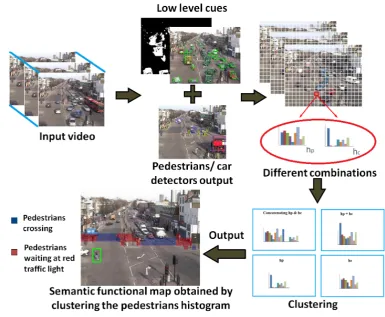
2.1 An overview of the pipeline we propose for analyzing traffic
scenarios. . . 14
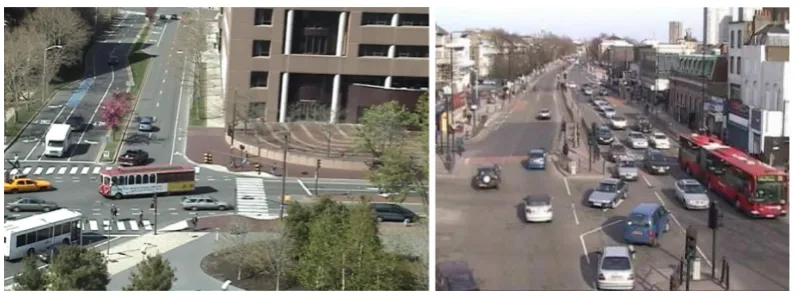
2.2 Dataset used. (Left) MIT Traffic and (Right) QMUL Junction
dataset . . . 19
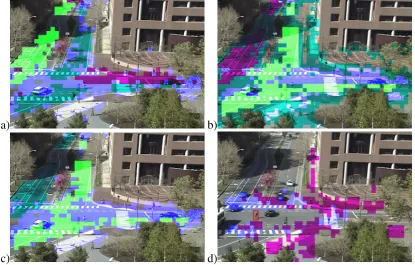
2.3 MIT dataset. Scene segmentation based on (a) semantic, (b)
non-semantic, (c) car semantic and (d) pedestrian semantic
de-scriptors. . . 20
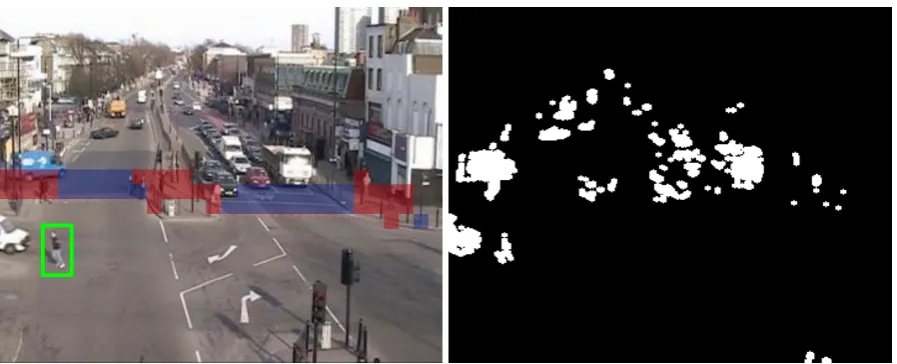
2.4 (Left) Anomaly. Pedestrian detected outside associated
seman-tic map. (Right) corresponding Foreground mask. . . 22
2.5 The general framework: (a) presents the input video, and the
frame (b) is a single frame from the video a. (d) presents the
pose estimation result that is obtained from the (a) by the
image-based DPM pose estimation method. (c) is a video with the
length of L frames around the frame (b). (e) is the DTL map that is obtained from the dense trajectories over the video (c).
(e) presents the regions of the scene that has more dynamics
with hot color. In the formula, SDT Lw presents the value of the
DTL map that is only involve on top of the wrist local scores of
the DPM approach. λ is not a fix number and it is obtained in
an iterative way. . . 29
2.6 A body-configuration sample annotation from the FLIC dataset:
(a) presents the pose annotation (b) drawn lines for augmenting
the training data (c) presents the final augmented ground-truth
over training data. The numbers of torso and the numbers
be-tween wrist-elbow and elbow-shoulder are not presented in the
figure to increase the clarity of main parts. . . 32
2.7 Sample frames from the pose-in-the-wild and videopose2 datasets
are presented in the left and the DTL of these frames are
pre-sented in right. . . 34
2.8 Motion relevancy descriptor: Given the frame F andλ = λcur,
using the formula presented in Figure 2.2.2, estimated pose
pre-sented in (a) is obtained. Around the detected wrists a bounding
box with 9 small patches with the fixed length of d is drawn. Optical flow between the given frame (a) and its adjacent frame
is computed and quantized (b). (c) presents the histogram of
quantized motion for the central patch of the left wrist (hC) and
the rest of the patches (hB1, ..., hB8). We circular shift the hC bins to place the dominant bin in the middle (in the figure we
shifted it by +2 bins). So we obtain h0C (d). Then we circu-lar shift the histograms of the rest patches (hBi) with the same
shifting value (in this sample+2) to obtain h0Bi presented in (e). Afterwards, we circular shift the location of every patch by +2 patches, andh00Bi are obtained (f). Finally theM oRl is built with
the way that we present in (g). M oRr is also computed with the
same way but around the right wrist (h). The final descriptor
then is computed by concatenatingM oRl and M oRr. . . 37
our proposed data augmentation and by applying our proposed
Pose-DTL approach. . . 42
2.10 Pose in the wild dataset: The figures compare our pose-DTL
approach with Rohrbach et al. [82], Park and Ramanan [68]
and Cherianet al. [16] approaches. . . 42
3.1 Mean Average Precision (MAP) while varying the number of
cluster centres on the MediaEval 2012 training set. . . 50
3.2 Classification accuracy on half of UCF50 sports while varying
the number of cluster centres (8-fold cross-validation). . . 51
3.3 Classification accuracy on ADL daily activity recognition on
half the dataset while varying the number of cluster centres. . . . 52
3.4 Experiments on the Rochester ADL dataset: (a) the performance
of different encoding approaches with a fixed BoW extraction
method; (b) the performance when using a fixed encoding method
(TSC) and different frame-based representations. The
perfor-mance using the best pipeline on the Blip10k dataset is shown in
(c). All the graphs are shown when the vocabulary size changes
from 1 (no temporal variation) to 5 (highest temporal variation). 67
4.1 An overview of the pipeline we propose for human action
recog-nition. . . 71
4.2 A sample frame and its corresponding ground truth: (a) body
pose tree showing the numbers in the correct positions (b)
bound-ing boxes. . . 79
4.3 Body parts detection accuracy at varying parameters (a) γ, β
whileα = 1; (b) λ, η while α = 0; (c) α. . . 81
4.4 Body configuration obtained with (a) [141] and (b) our method,
including the information of the foreground mask in the body
pose estimation (c). . . 83
4.5 Body configuration obtained with (a) [141] and (b) our method,
including the information of the optical flow in the body pose
estimation (c). . . 83
4.6 Overview of the considered problem: no matter where you are,
in the morning you probably have breakfast and use a knife to
cut food to pieces. In this work we exploit this and other
infor-mations about people habits to perform ADL analysis proposing
a novel multi-task clustering approach. . . 88
4.7 Rochester ADL dataset: a sequence depicting the activity
an-swering phone and the computed body parts. . . 98
4.8 Rochester ADL dataset: feature representation for a single frame. 98
4.9 Performance variation at different value of for Task 2 of the
Rochester ADL dataset. . . 101
Introduction
Automatic video scene understanding and activity analysis are active research
topics in computer vision. The interest in video analysis is motivated by the
promise of important applications in several fields, such as patient monitoring,
ambient assisted living, security (e.g. video recording in banks) and traffic con-gestion analysis (e.g., at junctions) and more recently self-driving cars. The au-tomatic video analysis systems are proposed against the traditional approaches
that employed humans to review the videos and extract the interesting
activi-ties and events from them. The extreme goal of such investigations is to design
a system that is comparable with human in understanding, summarizing and
indexing a video scene. In this framework, semantic information is the
infor-mation that a human can directly preserves by observing a scene. Such as the
information that shows which objects are presented in the scene. In terms of
this definition, semantic information is on the opposite side of the low-level
cues such as local-motion or local-appearance. Particularly in this work we
address three interesting video scene understanding scenarios:
1. Semantic functional complex scene categorization.
2. Human body-pose estimation in videos.
3. Human fine-grained daily living action recognition.
4. Video retrieval, genre recognition and human action recognition in wild
and realistic scenarios.
To address the first scenario, we propose approaches to understand and divide
a complicated scene into meaningful regions based on the functionality of the
objects present in the scene (QMUL Junction1 andMIT traffic dataset2).
To address the second scenario, we propose approaches to embed temporal
information into a dynamic frame-based pictorial model, for the task of pose
estimation in videos.
For addressing the third category, we proposed approaches to distinguish
be-tween fine-grained activities that differ only slightly in motion and appearance
and are performed indoor in scene with static background (ADL Rochester
dataset). For thefourth category, we propose approaches on multimodal datasets (MediaEval, Blip10000), and classifying the genre of movies from a
combi-nation of audio and video data and classifying complex activities that are
per-formed outdoors in scenes with dynamic background (such asUCF50andUCF101
datasets ).
Each of these scenarios is interesting and difficult for the following reasons:
(i) Understanding complicated traffic scenarios containing pedestrians and
cars moving in many different directions with a variety of velocities is
a very complex task. In this work, we employ a novel approach for
seman-tic functional categorization of such scenes and show results on2standard
crowded traffic scenes: QMUL Junction and MIT traffic datasets.
(ii) Human body pose estimation in realistic scenarios with a noisy
back-ground is a very challenging task due to occlusions and range of body
movements (Pose in the Wilddataset). In video scenarios, with static back-ground and high resolution such as ADL Rochester dataset, estimating the
1
http://www.eecs.qmul.ac.uk/˜sgg/QMUL_Junction_Datasets/Junction/ Junction.html
2www.ee.cuhk.edu.hk/xgwang/MITtraffic.html
pose is easier but it is challenging due to another reason: ‘’For old age
homes, nursing homes soon personal care robots will be deployed in near
future. Human detection, pose estimation with high accuracy is a
require-ment. Also the models used should not be memory intensive.”3
(iii) Analyzing daily living scenarios is a challenging task. First of all, in such a
scenario, different activities differ only slightly in motion and appearance.
In some cases, the differences in appearance of the subjects who perform
the same task are more evident than the difference in activities. Moreover,
one activity can be performed in many different ways, while two different
activities may be performed in a very similar manner with respect to
mo-tion and appearance. For example, dialing and answering the phone are
activities only slightly different in terms of hand movements. Particularly,
if we consider the Activity of daily living Rochester dataset, the difference
between two activities in most cases is limited to taking phone, banana or knife from the table, shelf, or refrigerator and doing slightly different other activities (e.g. eat snack and drink water).
(iv) Analyzing sports activities performed in a complex and dynamic
back-ground is also extremely challenging. We showcase our approaches on
the UCF50 and UCF101 dataset which consists of videos that are taken from youtube. This dataset is very challenging due to large variations in
camera motion, object appearance, pose and scale, viewpoint, cluttered
background and illumination conditions. The video clips of the
differ-ent activity may share some common features, such as the same person,
similar background, similar viewpoint, and so on. We are also applying
our approaches on Multimodal data (Blip10000and MediaEval datasets), which are challenging due to the variation in the data, the length of videos
and the realistic nature of videos.
3wikipedia on applications of human body pose estimation approaches
1.1. PROBLEM STATEMENT
1.1
Problem Statement
Here we address three main problems in the state-of-the-art and briefly explain
how we address them:
(i) Most of the works in the literature use motion information butdiscard the
high-level information coming from the source of motion. We address
this gap particularly in (1) human activity recognition scenarios and (2)
semantic functional scene categorization.
In human action recognition scenario, the parts of the body involved in a
task should be considered, otherwise, some activities may not be
distin-guishable (e.g. push and kick). In Traffic scenarios, without knowing the source of a detected motion, it is difficult/impossible to semantically
cate-gorize the scene. For an anomaly detector, it is also important to know if a
motion belongs to a pedestrian or a car. It is being recognized that using the
high-level information coming from the detectors allows a deeper
compre-hension of the scene. The reason why the use of detectors in video scene
analysis has not yet been widespread is because in many video analysis
cases lots of different detectors should be applied or the occlusions prevent
obtaining a good detection performance (e.g., the case of UCF101, Medi-aEval datasets). Moreover in the case of human pose estimation, many scenarios, such as pedestrian monitoring, suffer from occlusions and the
performance of the detectors is not always good enough to be relied upon.
However, in a daily living scenario, the person is monitored by a camera in
a controlled environment and the body is clearly visible and mostly not
oc-cluded. In the case of Traffic analysis, sparse information that comes from
detectors provide a deeper comprehension of the scene. Traffic analysis
sparse information that comes from detectors provide a deeper
compre-hension of the scene. We aim to exploit high-level information and exploit
them in more scenarios. For doing this an efficient and accurate body
pose estimator is required. In the case of body pose estimation, a
signifi-cant drop in accuracy has been observed when a detector is trained on one
dataset and it is evaluated on a different one [81]. The reason is that for
some cases there are not enough samples in the training set. As the detector
gives more priority to the positive samples of the training set, the chance of
detecting uncommon (w.r.t positive samples) body poses decreases. A pos-sible solution to this is to set the body pose ground-truth for the new dataset
and re-train the classifier. However, this procedure is very expensive and
requires a consistent delay every time a new dataset has to be analyzed.
Instead of training another classifier on the new dataset, we propose to use
the already trained classifier, but we provide some additional information
from the new dataset. In the case of body pose estimation in videos, we
propose to use long-term motion information(Dense Trajectories and Op-tical flow) and embedding sufficient amount of this information into our pose-estimator framework. Sufficiency of motion cues in our approach is
evaluated by our proposed Motion Relevancy descriptor, which we will
thoroughly explain in the second chapter of the thesis.
In the case of complicated scenarios where the number of semantic classes
is not defined, it is impossible to know a priori the number of detectors to
be used to capture the nature of objects. In addition applying too many
different detectors does not seem to help the action recognition process.
For example in the UCF101 sport dataset, even for the clips that show the
same activity, there are different kinds of objects that are present in the
scene. In such cases, we apply a combination of low-level cues to capture
extra information.
(ii) In video analysis, another important problem is how to adequately
cap-ture temporal information. Until recently, most video retrieval systems
relied mostly on single representative video frames where time is ignored
1.2. CONTRIBUTION OF THIS WORK
for efficiency reasons [108]. Recent work simply accumulates features
over a whole video sequence [2, 22, 99]. Such accumulation may capture
more information but also mixes up the information, disregarding the
ap-pearance variation over time. For example, when a car approaches and
then turns a corner, there are first straight movements followed by turning
movements. It is clear that both types of movements do not happen at the
same time. Because of this, we want to have a representation which keeps
this distinction and model the distribution of features in time.
In this third chapter of this thesis, we propose two novel video
represen-tations to capture temporal variation. Specifically, we firstly propose to
use the fisher representation on global features [69], which was recently
introduced for modeling the spatial variation in a Bag-of-Words
frame-work [17].
Then we propose the use of Temporal Fisher Kernel and Temporal VLAD
representations on several bag-of-words representations of different
low-level features to model the temporal variation. Finally, we propose a new
Temporal Soft Cluster encoding to capture the features distributions in
time.
(iii) Classifying Activities of Daily Living (ADL) is a challenging and
im-portant task because some of the videos that are associated with various
classes differ only slightly. In addition, very similar videos may present
two different activity classes. On the other hand, we address the task of
ADL classification, when some of the labels of the activities are not
avail-able. We propose a Multi-Task Clustering approach to classifying
par-tially labeled data.
1.2
Contribution of this work
The main contributions of this theis are detailed as follows.
1.2.1 Efficient Combination of Low and High level Features in Videos
Enhanced semantic descriptors for functional scene categorization
In this work4, we present a novel approach which combines semantic
infor-mation with low level features extracted from a complex video scene. The
proposed method for video scene understanding relies on a bag-of-words
ap-proach, in which, typically, visual words contain information of local motion,
but information regarding what generated such motion is discarded. Instead, in
our framework, the semantic information is embedded in the visual words and
it allows to automatically obtain semantic categorization of the scene. We show
the effectiveness of our method in a traffic analysis scenario: in this case, two
main semantic classes, pedestrians and vehicles, are discovered. We present
our results on two publicly available datasets (1) MIT Traffic dataset (2) Queen
Mary Junction dataset.
Human Pose Estimation considering Dense Trajectories Length
In this work5, we present an approach for human body pose estimation in videos.
Our approach is built upon a Deformable Part-based Model (DPM). We intro-duce a new descriptor namely, Dense Trajectories Length (DTL). Embedding
DTL in a DPM framework, biases the wrists locations to areas with significant motion. The contribution of DTL is optimized in an iterative way and by the help of Motion Relevancy (MoR) descriptor. In fact, we investigate the effec-tiveness of motion information in predicting body poses in videos. For example
embedding the motion information in some frames help the pose estimation and
in some frames, it may downgrade the results. We address this issue and
op-timize the contribution of motion to reach an opop-timized pose estimation in all
video frames. We evaluate our approach on two publicly available datasets (1)
4This paper is published in the International Conference on Pattern Recognition (ICPR) 2012
5This work is part of my research output during my internship at MMV lab, University of Queen Mary of
London. This research is mainly supervised by Prof. Ioannis Patras
1.2. CONTRIBUTION OF THIS WORK
Pose in the Wild and (2) ADL Rochester Pose datasets.
1.2.2 Modeling Temporal Variation of Features in Videos
Time Matters! Capturing Variation in Time in Video using Fisher Kernels
In video global features are often used for reasons of computational efficiency,
where each global feature captures information of a single video frame. But
frames in video change over time, so an important question is: how can we
meaningfully aggregate frame-based features in order to preserve the variation
in time? In this work6 we propose to use the Fisher Kernel to capture variation
in time in video. While in this approach the temporal order is lost, it captures
both subtle variation in time such as the ones caused by a moving bicycle and
drastic variations in time such as the changing of shots in a documentary.
Our work should not be confused with a Bag of Local Visual Features
ap-proach, where one captures the visual variation of local features in both time
and space indiscriminately. Instead, each feature measures a complete frame
hence we capture variation in time only.
We show that our framework is highly general, reporting improvements
us-ing frame-based visual features, body-part features, and audio features on three
diverse datasets: We obtain state-of-the-art results on the UCF50 human ac-tion recogniac-tion datasetand improve the state-of-the-art on theMediaEval 2012 video-genre benchmark and on theActivities of Daily Living Rochester dataset.
Cluster Encoding For Modeling Temporal Variation in Video
Classical Bag-of-Words methods represent videos by modeling the variation of
local visual descriptors throughout the video. In this approach they mix
varia-tion in time and space indiscriminately while these dimensions are
fundamen-tally different. Therefore, in this work7 we present a novel method for video
6This paper is published in the ACM Multimedia 2013
7This paper is published in International Conference of Image Processing (ICIP) 2015
representation which explicitly captures temporal variation over time. We do
this by first creating frame-based features using standard Bag-of-Words
tech-niques. To model the variation in time over these frame-based features, we
introduce Hard and Soft Cluster Encoding, novel techniques to model variation
inspired by the Fisher Kernel [1] and VLAD [2]. Results on the Activities of Daily Living Rochester [3] and Blip10000 [4] datasets show that our method yields improvements of respectively 6.6% and 7.4% over our baselines. On
Blip10k we outperform the state-of-the-art by3.6%when using only visual
fea-tures.
1.2.3 Recognizing Activities of Daily Living in Videos
Daily Living Activities Recognition via Efficient High and Low Level Cues Combination and Fisher Kernel Representation
In this work8 we propose an efficient method for activity recognition in a daily
living scenario. At feature level, we propose a method to extract and combine
low- and high-level information and we show that the performance of body
pose estimation (and consequently of activity recognition) can be significantly
improved. Particularly, we propose an approach extending the pictorial
de-formable models for the body pose estimation from the state-of-the-art. We
show that including low level cues (e.g. optical flow and foreground) together with an off-the-shelf body part detector allows reaching better performance without the need to re-train the detectors. Finally, we apply the Fisher Kernel
representation that takes the temporal variation into account and we show that
we outperform state-of-the-art methods onActivities of Daily Living Rochester
dataset.
8This paper is published in International Conference on Image Analysis and Applications (ICIAP) 2013
1.3. OUTLINE
It’s all about Habits: Exploiting Multi-Task Clustering for Activities of Daily Living Anal-ysis
Motivated by applications in areas such as patient monitoring,
telerehabilita-tion and ambient assisted living, analyzing activities of daily living is an
ac-tive research topic in computer vision and image processing. In this research9,
we address the problem of everyday activity recognition from unlabeled data
proposing a novel Multi-Task Clustering (MTC) approach. Our intuition is that,
when analyzing activities of daily living, we can take advantage of the fact that
people tend to perform the same actions in the same environment (e.g. people working in an office environment use to read and write documents). Thus, even
if labels are not available, information about typical activities can be exploited
in the learning process. Arguing that the tasks of recognizing activities of
spe-cific individuals are related, we resort on multitask learning and rather than
clustering the data of each individual separately, we also look for clustering
re-sults which are coherent among related tasks. Extensive experimental rere-sults
show that our method outperforms several state-of-the-art approaches by up to
11%on the Rochester activities of daily living dataset.
1.3
Outline
The remaining part of this thesis is organized as follows. In Chapters 2, we
present our work on combining low- an high-level information in videos for the
tasks of Semantic Functional Categorization of traffic scenseandHuman body-pose estimation in wild and daily living activities. In Chapter3, we present our work on modeling the temporal varition in videos. In Chapter4, we studyDaily Living Activities Analysis in Videos. Finally, conclusions are drawn in Chapter
5.
9This paper is published in International Conference on Image Processing (ICIP) 2014
Efficient combination of low and high level
features in videos
Visual surveillance in dynamic scenes is an important area, strongly driven by
many potential applications such as traffic scene understanding and behaviour
monitoring. One important research question in video understanding is how to
enrich the descriptors with high-level semantic information or low-level
infor-mation and in an efficient framework. This chapter1, consists of the following
studies:
• In section 2.1, we present a novel approach which combines semantic
in-formation obtained from two classes of detectors (pedestrian and vehicle detectors), with low level features extracted from a complex video scene (motion). In this research, we rely on a bag-of-words framework.
In our framework, the semantic information is embedded in the visual
words and it allows to automatically obtain semantic categorization of the
scene.
We present the effectiveness of our framework on two publicly available
datasets: (1) MIT traffic and (2) QMUL Junction datasets.
1The research presented in section 2.1is published in the International Conference of Pattern Recognition
(ICPR2012) [146] and the presented research in section2.2is a part of my research outputs during an internship at MMV lab in the University of Queen Marry of London, where I was supervised by Dr. Ioannis Patras
• In section 2.2, we present a novel approach for the task of human
body-pose estimation in videos. In a Deformable Part-based Model (DPM), we enrich the appearance descriptors (hog) in the semantic class of wrists, by information derived from the Length of Dense Trajectories (DTL) passing through different location of the scene. The contribution of DTL, then is optimized in an itterative framework. We present our results on two
publicly available datasets: (1) ADL Rochester pose estimation and (2)
Pose in the Wild datasets.
2.1
Enhanced semantic descriptors for functional scene
cat-egorization
Recently, non-object-centric approaches for the analysis of dynamic scenes
have gained popularity and have been proven effective for many application
sce-narios, e.g. extraction of salient activities [145], scene semantic segmentation [48], etc. In particular, in the case of complex scenarios with many targets and occlusions, they are preferred to the classic object detection/tracking schema
be-cause they are not subject to the problem of broken trajectories or to the curse of
dimensionality when trying to consider the spatio-temporal correlation between
many targets. In a nutshell, non-object-centric methods rely on low level cues
(e.g. local motion and foreground) that are analyzed in a bag-of-words frame-work. Firstly, a visual codebook of the scene is generated, where visual words
generally encode information about the local motion in the scene. Secondly, the
video is divided into (i) short clips (or spatial patches) and for each of them a
bag-of-visual-words is build. Starting from this bag-of-words representation of
a video stream, statistical models such as Probabilistic Topic Models (PTM) are
deployed in order to mine (i), the typical patterns of behavior and the anomalies
from the scene or (ii), the spatial segmentation of the scene, where patches with
similar motion behavior are assigned to the same semantic area. This approach
has shown to be robust to noise; however, there are some limitations.
Switch-ing from an object-centric to a non-object-centric perspective, the method gains
in robustness w.r.t noise and to broken trajectories; however, at the same time,
the information about the semantic of the objects causing the detected motion
(e.g. cars, pedestrians, etc.) is discarded. As a consequence, it is difficult to reason about topics extracted as they do not always correspond to high-level
description of the scene according to a human observer. In this work, we focus
on this aspect and propose the use of enhanced semantic descriptors, as a step
towards filling the semantic gap between object-centric and non-object-centric
2.1. ENHANCED SEMANTIC DESCRIPTORS FOR FUNCTIONAL SCENE CATEGORIZATION
Figure 2.1: An overview of the pipeline we propose for analyzing traffic scenarios.
approaches. We show our results on publicly available datasets and compare
them with recent related work.
2.1.1 Related Work
In the last decades, the bag-of-words paradigm has been widely adopted firstly
in still images analysis [17, 25] and then in dynamic scenes analysis [126, 65,
59]. This paradigm is composed of two main steps: (i) codebook generation (ii)
bag-of-words formation and clustering. In detail, the first phase corresponds
to the definition of the scene descriptors and thus it strongly influences the
fi-nal results and the effectiveness of the method. In other words, if the features
the scene, or some important information is discarded in this phase, the topics
extracted during the second phase may not be a representative synopsis of the
scene observed. In particular, by discarding semantic information in this
pre-liminary step of the analysis, the final topics extracted may not correspond to
the high level segmentation generated by a human observed. This problem has
been addressed by [49] with Object Bank for still images analysis: the intuition
is that scene descriptors are combined with information of the objects in the
scene. While obtaining state-of-the-art performance, this method is found to be
very expensive when a large number of categories is considered (as in the case of
still images). In the case of video scene analysis, much effort has been devoted
to enrich the descriptors with additional information beyond motion. Messing
et al. [59] used descriptors which encode information of both local motion and appearance, in order to distinguish between actions with similar motion but
dif-ferent appearance (e.g. eating snack from eating banana) and between actions with similar appearance but different motion (e.g. peeling banana from eating banana). Additionally, they used sparse information provided by a face detector
to augment their features with relative position information. Shitrit et al. [101] track people by linking sparse information of people detection into tracklets.
This approach is proven to be more effective in term of robusteness and
com-plexity then recursively track from frame to frame. Sangminet al. [66] detected functional objects in traffic scenes (e.g. delivery track) by using features which encode relation and actions w.r.t the scene context. Chen et al. [15] proposed the use of motion features (MoSIFT) to encode static image appearance features
together with motion information.
Based on [124], Papageorgiu et. al [67] proposed a general object detection scheme using Haar wavelets and SVMs and applied it for face, pedestrian and
car detection. Other works focused specifically on pedestrian [125] or car [149]
2.1. ENHANCED SEMANTIC DESCRIPTORS FOR FUNCTIONAL SCENE CATEGORIZATION et al. [149] devised a car detection scheme exploiting global structure and local texture features. In order to reduce human efforts in the labeling task,
meth-ods based on semi-supervision or active learning have been proposed [83, 64].
Finally, a relevant work [133] proposed a method for adapting a generic
pedes-trian detector to specific traffic scenes, exploiting multiple cues such as size and
motion.
2.1.2 Our method
Similarly to Turek et al. [118], our aim is to perform a semantic segmentation of the scene, where the scene element categories are primarily defined by their
behavior, rather then their appearance or shape. In particular, Turek et al. [118] use a hierarchy of motion features. They divide the scene into several patches
and for each patch a codebook histogram is formed. Patches are then clustered
according to their histograms’ similarity and the patches belonging to the same
cluster are associated to the same functional category. Differently from them, in
our work the semantic information of the entity causing the motion is embedded
in the descriptor. This is obtained by combining information provided by the
pedestrian and vehicle detectors with local motion information.
For the pedestrians and cars detector we rely on [125]. For low level cues
ex-traction, we use Lucas Kanade algorithm [114] for optical flow combined with
dynamic Gaussian-Mixture background model [109]. Motion vectors are
quan-tized into 8 possible directions while patches with only static points and
suf-ficient foreground are considered associated to a static event (e.g pedestrian stopped at red traffic light waiting to cross the street). Then, for each patch we
build 2histograms of 9 bins each (8bins identify motion and 1bin is for static
events).
In details, our method is formulated as follows. We divide our scene into
Nx × Ny patches. Then, for each of these patches pi,j, where i = 1, ..., Ny
by analyzing a video sequence of at least30minutes of length. In particular, we
consider a couple of framesiandi−Is at a time, whereIs is the step for optical
flow computation. For each framei, we compute the corresponding foreground
mask Fi and, still on frame i, we run the car and the pedestrian detectors. We
define BPi = {b1, ..., bNi
P} and B
i
C = {b1, ..., bNi
C} as the resulting bounding
boxes found, localizing respectively pedestrians (P) and cars (C), The bounding
box bk = (x, y, w, h), with k = 1, ..., NKi and K = {P, C}, is defined by the
coordinate of its upper left corner(x, y)and its size(w, h). NKi is the number of
items found, which varies at each framei. Every time a static or a motion event
is detected, it is counted as an occurrence in the corresponding hP or hC
his-togram, depending on if it is included, respectively, in one of the bounding box
fromBP or BC. Once the histograms of the patches are built, we cluster them
in order to obtain the spatial segmentation of the scene. Similarly to [118], we
label cells by using k-means and mean-shift. We obtain4spatial segmentations
by considering for clustering:
• 18 bins semantichistograms, obtained by concatenating hP andhC
• 9 bins non semantichistograms, obtained by summinghP with hC,
• 9 bins only-car semantichistograms hC
• 9 bins only-pedestrian semantichistograms hP
The effect of differently combininghP andhC are discussed in the experimental
session. Once the semantic maps of the scene are built, they can be used for
further analyses of events in the scenes.
It is worth noting that in application with crowded scene scenarios the object
centric paradigm based on detection/tracking is not reliable because of the high
risk of tracking failures and the curse of dimensionality. However, the use of
sparse information provided by the object detectors combined with low level
2.1. ENHANCED SEMANTIC DESCRIPTORS FOR FUNCTIONAL SCENE CATEGORIZATION
Table 2.1: Details on experimental setup
no
fps video frame size patch size n
o patches
frames duration W ×H sW ×sH Nx×Ny
MIT Traffic 162000 30 1h30’ 720×480 15×15 48×32
QMUL Junction 90000 25 1h 360×288 12×12 30×24
centric methods; respectively these advantages include (i) robustness to noise
and reduced computational complexity on one side and, on the other one, (ii)
encoding semantic information of the entities interacting in the scene.
Another advantage of the method is that we can perform an analysis of the scene
at two different levels of optical flow. This allows to detect objects at different
speeds, like in the case of cars and pedestrians. In fact, by using a low value
of Is, the shift measured of a slow moving object (e.g., a pedestrian) is close to zero and thus it is detected as a static event. On the other side, by increasing
the value ofIs, we can detect the motion of slow moving object, but the motion
cues extracted for high speed object tend to be very noisy. In our experiment
we set IsC = 5 andIsP = 10.
2.1.3 Results
We show our results on two public datasets: MIT Traffic dataset2 and QMUL
Junction dataset3. Sample frames extracted from these two datasets are shown
in Fig. 2.2; details on the datasets and the experimental setup are summarized in
Table2.1. Our semantic segmentation method’s results are visually displayed in
Fig. 2.3and 2.4, respectively for the MIT Traffic and QMUL Junction datasets.
Figure 2.2: Dataset used. (Left) MIT Traffic and (Right) QMUL Junction dataset
MIT Traffic dataset
Visual inspection of our segmentation results on the MIT Traffic dataset (Fig.
2.3) against the path model reported and exploited in [133], shows that our
pro-posed method performs comparably while being extremely simple and cheap
to implement. It requires, in fact, the availability of a detector for the objects
of interest in the scene and makes use of simple and well-known features, such
as optical flow: for both the requirements, extensive literature and code are
available. Figure2.3(b) shows that with our method, by using only non
seman-tic descriptors, some areas like zebra crossing are not distinguished. By using
semantic descriptors the areas associated to pedestrians or cars are better
dis-tinguished, as it can be seen in Fig.2.3(a). Still, as observable from Fig.2.3(c)
and Fig.2.3(d), clustering the two histograms separated may provide the best
solutions. In (c) we distinguish between different cars lanes, associated to the
different main motion directions, while in (d) we can distinguish between two
different conceptual areas for pedestrians: zebra crossing (highlighted in blue)
and sidewalks (in violet). In Fig.2.3(d) additionally we show an example of
anomaly that can be detected by using the semantic pedestrian map generated,
2.1. ENHANCED SEMANTIC DESCRIPTORS FOR FUNCTIONAL SCENE CATEGORIZATION
a) b)
c) d)
QMUL Junction dataset
In Fig. 2.4 a sample case of a pedestrian detected in an unusual position w.r.t
the pedestrian semantic map of the scene is depicted. Due to its highly cluttered
background, we could not get a reliable pedestrian detector to work with this
dataset. Still, relying on ground-truth knowledge on some pedestrian positions
we are able to infer, thanks to semantic scene segmentation, anomalies in the
pedestrian behavior (e.g., crossing outside of zebras). Interestingly, observing
the semantic pedestrian map shown in Fig2.4(a), we notice that the two
discov-ered clusters correspond to two conceptually different areas: i) zebra crossing,
shown in blue, and ii) the waiting areas at the intersection between sidewalks
and zebra crossings when the pedestrian traffic light is on red (shown in red).
Our intuition is that the algorithm proposed by [124] could benefit in terms of
speed, to some extent, and, more significantly, of a reduction in false positives
by discarding detection sub-windows containing less than a given amount of
foreground (shown in Fig.2.4(b)). Additionally, the semantic maps obtained by
using the ground truth on pedestrians could be used for the same goal of [133]
(i.e., filtering out false positives from automatically gathered training data in a
novel scene). In future works we plan to present an extension of such algorithm
in this direction.
2.1.4 Conclusions
We proposed a novel method which relies on the classical bag-of-words model
but instead of ignoring the semantic information as it is typically done in the
literature we include it in our descriptors. We presented results on two
traf-fic datasets where two semantic object categories (cars and pedestrians) are
present. While proving their effectiveness on anomaly detection tasks (e.g.
pedestrian on the car lane), semantic maps can be useful for other tasks as shown
2.1. ENHANCED SEMANTIC DESCRIPTORS FOR FUNCTIONAL SCENE CATEGORIZATION
Figure 2.4: (Left) Anomaly. Pedestrian detected outside associated semantic map. (Right) corresponding Foreground mask.
involve considering other scenarios and extending the current object detector to
2.2
Human Pose Estimation considering Dense Trajectories
Length
The problem of human body pose estimation in both images and videos has
drawn increasing attention during the last few years [14, 91, 142]. The
inter-est in human pose inter-estimation is mainly motivated by its applications in human
action recognition [82, 84, 143], sign language translation [14] and video
un-derstanding [38]. Recent studies show that improvement in Human Pose
Esti-mation contributes to better Action Recognition performance [29, 84, 143]. In
fact, involving the information derived from high-level detectors, decreases the
ambiguity in fine-grained action recognition.
Human Pose Estimation is challenging due to body-range of motion, degrees of
freedom and shape from different views, invisibility or barely visibility of some
of the body-parts, clutter backgrounds and variety of clothing.
According to the state-of-the-art approaches, the head and the neck are usually
very well localized by applying the classical pose estimation models in single
images and videos [16, 142]. However, the wrists, elbows and shoulders are
much more challenging. Movements and poses of these challenging body-parts
are more important for recognizing the human actions.
Some recent approaches devoted their effort on improving the localization of
challenging body-parts, (i.e. wrist, elbow) [14,16]. Similar to [14,16], we con-centrate on improving the upper/lower arm (i.e; shoulders, elbows and wrists) accuracy rates.
We assume that When a person is performing an action, the wrists move more than the other parts of the body.
Rostamzadeh et. al. [84] states involving the number of flows between every two sequential frames can improve the accuracy of wrists localization more than the other body-parts. Based on this assumption, we introduce a descriptor
2.2. HUMAN POSE ESTIMATION CONSIDERING DENSE TRAJECTORIES LENGTH
of a certain frame. We name the descriptor as Dense Trajectory Length map
descriptor or shortly DTL. Then using DTL with spatial-based features of each frame, helps enhancing the wrist localization. Finally using dynamic
program-ming, the localization of elbows and shoulders are refined upon achieving a
better wrists location.
The initial assumption of associating wrists locations to the most dynamic places
of a scene, in practice, has some limitations that we address in this study: (1)
During any activity, there may be some fraction of a second that the wrists are
not moving much, or their length of 3D movement is not reflected well in 2D
because of the camera view. (2) There may be clutter motion coming from the
background, that could potentially mislead the detection (e.g: sea waves in the background). The camera movement may also affect the motion pattern for some frames. (3) There are also some frames, which the pose estimation
rely-ing on the initial image-based features yields almost a perfect accuracy rate. In
these cases involving the information coming from the DTL not only doesn’t improve the localization rate but also may worsen it.
To avoid downgrading the high quality predictions obtained from our initial
image-based model, we estimate the relative importance of the DTL over the
spatialfeatures.In order to estimate the importance of theDTLfeature, we intro-duce a feature inspired from the SIFT descriptor but over the temporal domain. Our new feature is obtained from (i) an initial wrist localization together with
(ii) the motion cues (i.e. optical flow) and is entitled motion relevancy (MoR). MoR estimates how much the motions around predicted wrists are relevant to a valid prediction. As a summary our two main contributions in this paper are as following:
• We use the DPM framework on the frames of a video but with a differ-ent cost function at the leaf nodes that are associated with the wrists. In
with significant motion. Finally, the whole pose estimation framework
op-timizes all body joints locations simultaneously using dynamic
program-ming.
• We propose an iterative approach to optimize the contribution of DTL in our proposedDPMframework. Consequently, we improve the localization accuracy of wrists, elbows and shoulders.
We apply our approach on two publically available datasets, (1) Rochester
Ac-tivities of Daily Living (ADL) pose [84] and (2) Pose in the Wild [16]. The
rest of the paper is organised as follows: In section 2.2.1, we discus about the
related works on pose estimation in images and videos. Section 2.2.2 presents
the details of our approach. In section2.2.3, we present the effectiveness of our
approach through the experiments. In section2.2.4, we draw a conclusion.
2.2.1 Related work
Yang and Ramanan [140] proposed an image-basedDeformable body Part Model. They consider body-parts as deformable parts that are relied upon a Tree-based
model and using dynamic programming optimizing the location of different
body joints. Our3Dhuman pose estimation model is built upon the2D-DPM[140] pose estimation model.
In general, most of the state-of-the-art Human Pose Estimation approaches in videos can be divided intotwo major categories:
1. The first category includes methods that consider there is at least one frame
with correctly detected body-parts. Then the detection of the joints in the
other frames becomes a tracking problem [76].
2. The second category covers methods that optimize body-joints localization
2.2. HUMAN POSE ESTIMATION CONSIDERING DENSE TRAJECTORIES LENGTH
In the first category either (i) the body pose is manually annotated in a few frames [11, 13] or (ii) an approach is developed to automatically recognize the
frames that the initial image-based pose estimator works reasonably good on
them [76, 150]. These approaches (namely, strike a pose) basically assume
that in every performed action, there are at least a few frames that estimated
poses, are easily recognizable regarding a few predefined poses [76, 150]. For
the next step, these approaches worked on the tracking problem.
In the second category, either (i) an image-based approach is applied as an ini-tial estimation and then the estimated poses are adjusted according to the
tem-poral information [84] or (ii) the estimated body poses in consequent frames
are jointly optimized in both spatial and temporal domains [14, 16], which is
usually time consuming and computationally expensive.
Our approach falls into the first branch of the second category. In our
ap-proach, we assume that when a person is performing an action, the wrists move more than the other parts of the body. The assumption is basically motivated by the future work suggestions of [16], and [84] that states involving the
num-ber of flows between every two sequential frames can improve the accuracy of
wrists localization more than the other body-parts. Based on this assumption, we introduce a descriptor that models the number of dense trajectories that pass
through every location of a certain frame. We name the descriptor as Dense Trajectory Length map descriptor or shortlyDTL.
Many state-of-the-art approaches on Pose-Estimation learn a structured model
by employing a set of low/mid-level features. Some recent cascade approaches
[91, 92], learn a coarse to a fine sequence of discriminative models using the
information being present in space and time. In the cascade approaches a
top-down model is trained [91, 92]. This top-down model (1) narrows down the
searching space for a perfect pose candidate, and (2) avoids extracting
stage. Thus, the cascade approaches are successful models particularly in terms
of efficiency.
Apart from the efficiency and computational cost of feature extraction, some
features are better in capturing some types of poses, when the same features
provide some redundant information for the other frames/images. For example,
skin map helps wrist localization when people wear long sleeve. However, this
may not be a very successful feature when people wear a swimming suit or short
sleeve shirts. The given example suggests the contribution of some features for
the pose estimation task over various frames shall be considered.
In the cascade approaches [91, 92], including or excluding a feature, is
de-pendent on a binary classifier. In our approach, instead of predicting the
pres-ence of a descriptor (namely, DTL) using a binary classifier, we measure the importance of the given descriptor in a given frame.
In some of the state-of-the-art pose-estimation approaches on videos, an
off-the-shelves image-based pose-estimator(e.g. DPM) is refined by (1) employing the information content of the motion direction (tracking) [104] and (2)
improv-ing the consistency of detected poses on consequent frames [102].
In this study, we use theDeformable Part-based Model (DPM) [140] frame-work but we employ a different cost function at the leaf nodes that are associated
with the wrists in order to bias the wrist location towards areas of significant
mo-tion. Then using the dynamic programming, all body joints are simultaneously
localized and their positions are optimized.
2.2.2 Proposed Approach
In this section, we present our method forPose Estimation in videos. Body-pose estimation in videos plays a key role in important computer vision applications
such as Human Action Recognition. A good estimation over the wrists
loca-tion, ease understanding the performed action [84, 143]. Therefore, it would
2.2. HUMAN POSE ESTIMATION CONSIDERING DENSE TRAJECTORIES LENGTH
are the most challenging parts to detect in pose estimation problem [14,16,93].
Rostamzadeh et alshows [84], leading the detection of body-parts to the regions with high motion, improves the wrists localization significantly more than the
other body-parts. Cherian et. al.[16] propose, as an extension to their work, to enrich the wrist model by encouraging the alignment of wrists position to the
regions with high motion.
Involving the number of flows in a small region around every candidate
loca-tions (as a descriptor), help improving the pose estimation from an image-based
approach [84].
According to [16, 84], wrists move more than the other parts. Inspired by
[16, 84], we employ the DTL feature to refine the initial localization of wrists.
First, instead of considering only the flow between 2 consecutive frames, we consider the length of the dense trajectories that path through different regions
of every given frame by introducing the DTL feature map. We use the De-formable Part-based Model (DPM), due to its computational efficiency and rea-sonable performance [142]. The deformable mixture-of-parts model, or shortly
DPM model, is proposed for single images [142].
We use DPM framework, but we add an additional scoring term (i.e. DTL score) at the wrists. The DTL term, biases the estimation towards areas of sig-nificant motion in a period of time. Then using the dynamic programming all
body-joints are simultaneously optimized.
DTL helps localization of wrists and consequently all body-joints. The DTL is defined as number of flows that pass through a certain location over a short period of time. The details of computing theDTL descriptor is presented in the following subsections.
Then relative importance of involving DTL descriptor in a DPM framework is estimated automatically through a set of classifiers. More specifically, in every
step of an iterative process, a binary classifier checks whether the
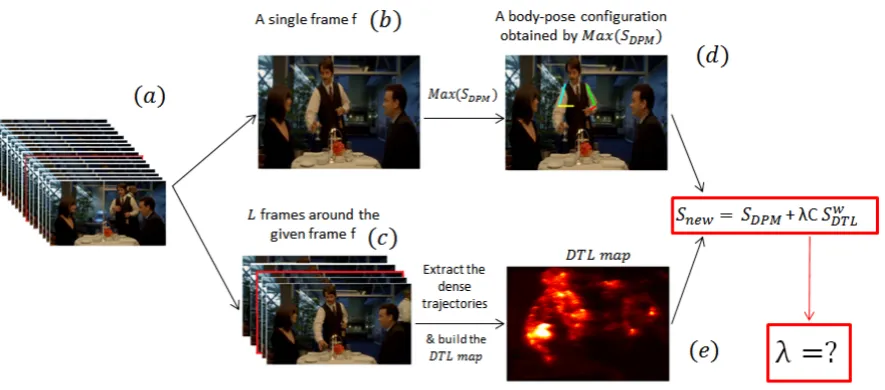
Figure 2.5: The general framework: (a) presents the input video, and the frame (b) is a single frame from the video a. (d) presents the pose estimation result that is obtained from the (a) by the image-basedDPM pose estimation method. (c) is a video with the length of Lframes around the frame (b). (e) is theDTLmap that is obtained from the dense trajectories over the video (c). (e) presents the regions of the scene that has more dynamics with hot color. In the formula,SDT Lw presents the value of theDTLmap that is only involve on top of the wrist local scores of theDPMapproach.λis not a fix number and it is obtained in an iterative way.
not. The iteration then is continued till the classifier returns a negative value.
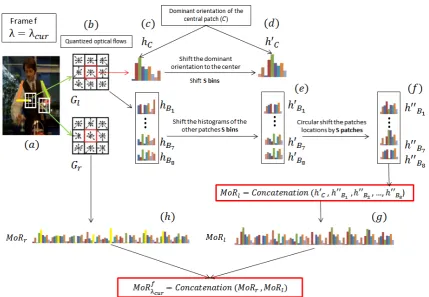
Thereof, we control the impact of theDTL feature on the modifiedDPM model. In order to train the classifiers, we calculate the Motion Relevancy or shortly
MoR descriptor around the localized wrists in every iteration-steps. This
de-scriptor models the distribution of movements around the dominant flow
direc-tion. We employ the MoR descriptor to evaluate whether the motion around the detected wrists on that step reveals meaningful information to help the pose
2.2. HUMAN POSE ESTIMATION CONSIDERING DENSE TRAJECTORIES LENGTH
Deformable Part-based Model
We build our pose estimation approach on the image-based deformable mixture of part model (DPM)[142] that has apictorial structure. In a pictorial structure human body is modelled as a graph, G=(V, E). Nodes (V) present body-parts (e.g; elbows, head) and edges (springs between parts) model the geometric con-sistency between body-parts(E) [26].
In a pictorial structure body is presented as an ideal template. Adeformation
is defined as replacement of springs, while the structure of the model is
pre-served. Deformationsover the ideal structure present possible body-configurations. According to [26], each possible body configuration is given a score. The
ideal estimated pose in the image I (with the size (w, h)) is computed through
optimizing the body-configuration score as follows:
S(P, I) = X
i∈V
φ(pi, I) + X (i,j)∈E
ψ(pi−pj) (2.1)
φ(pi, I), represents local score of the part i in the location pi of the given
image I.
Wherepi = (xi, yi)and∀i ∈ {1,2, ..., n} :xi ∈ {1,2, ..., w}, yi ∈ {1,2, ..., h}, n = the number of body-parts).
The local score, φ(pi, I), presents the appearance similarity of any possible
lo-cations pi and partiof the body. Formula 2.1, according to [142], local
appear-ance model is a HoG descriptor extracted from a block around the pixel location
pi and the given joint at the center of the part i.
Pairwise score (deformation model), ψ(pi − pj) is the relative location of the joints i and j. The pairwise score, ψ(pi −pj), measure the probability of
geometric configuration of the (i,j)pairs [26].
P is the set of corresponding body-part locations: P = {p1, p2, ..., pn}.
[142], but for the simplicity we skip presenting details related to the types in the
formula, as it is not related to our contributions.
S(P, I) presents the body-configuration score. Maximizing S(P, I)
regard-ing to the placements of body-parts and mixture components, gives the optimal
body-configuration.
Moreover, following [142] we search for human in different scales in an
image pyramid. So the possible locations of body-parts, pi, is in a grid with a
specific resolution of the imageI.
In the DPM model, the body relational graph is presented as a tree. There is no loop in a Tree representation and every joint except the root has only one
parent. Thereby, we optimizeS(P, I) efficiently with dynamic programming in
polynomial time [142].
We defineTpi as a sub-tree of the general body tree that has the rootpi.
In this way,∀i ∈ {1, ..., n} : S(Tpi, I), is the score for a tree with the nodek
as its root:
S(Tpi, I) = φ(pi, I) +
X
j∈kids(pi)
[S(Tpj, I) + ψ(pi −pj)] (2.2)
Since every part has only one parent, a message is passed from every child, j
to its parent i. We define the children of the part i as kids(pi). Leaves of the
tree,pk, k ∈ T reeLeavesdon’t have any kids and their corresponding sub-tree
is presented by only a single node:
S(Tpk, I) = φ(pk, I) (2.3)
We iterate over all body-parts starting from the leaves and move upstream to
the root part (i.e ; head, part 1 according to Figure 2.2.2).
As it is presented in figure 2.2.2.c, we give the body number 1 to the root.
General body configuration is presented by Tp1 and optimizing the S(Tp1, I)
2.2. HUMAN POSE ESTIMATION CONSIDERING DENSE TRAJECTORIES LENGTH
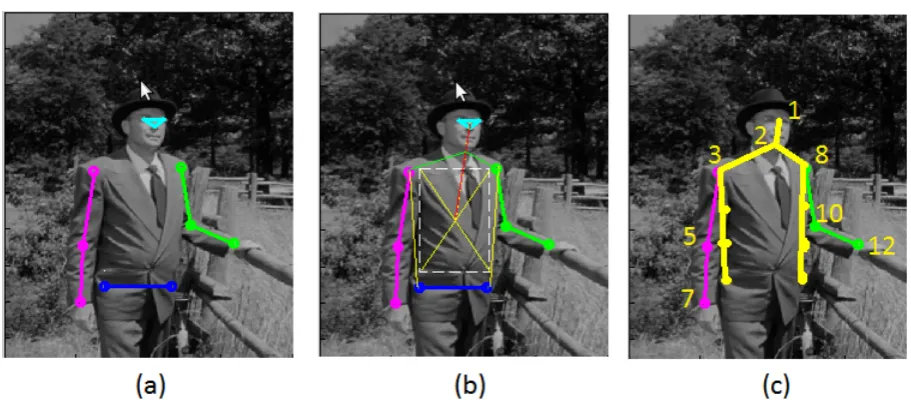
Figure 2.6: A body-configuration sample annotation from the FLIC dataset: (a) presents the pose annotation (b) drawn lines for augmenting the training data (c) presents the final augmented ground-truth over training data. The numbers of torso and the numbers between wrist-elbow and elbow-shoulder are not presented in the figure to increase the clarity of main parts.
The inference corresponds to maximizing the score function of the root,
S(Tp1, I) over placements and types of different parts. So the optimized root
score gives the optimum body-configuration.
Exploiting the Dense Trajectory Length (DTL) feature in a Deformable Part-based Model (DPM)
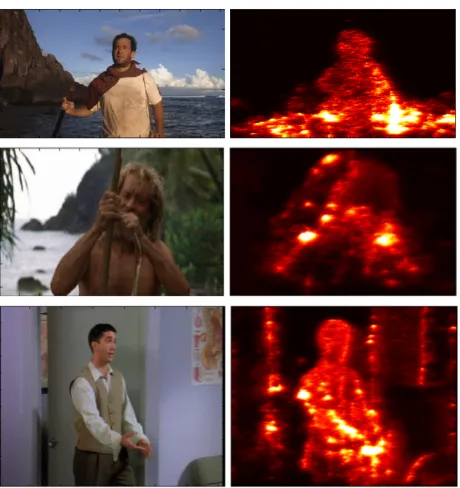
In this section, we explain the procedure of building the DTL feature map. In order to build the DTL feature map for every frame, we first extract the dense trajectories feature [130] of the given video.
In this section, we present a summary over the (i) dense trajectory extraction
(ii) building the DTL map and (iii) linear interpolation of theDTL map. To ex-tract the dense trajectories we follow the setting proposed by [130]: We densely
sample feature points on a spatial grid byw×w pixels blocks. Then any spacial
For different spacial scales dense optical flow field is computed on all
spa-cial locations of different grid scales. Then we densely track all the sampled
points through every part of the video for the fixed length ofL frames without
additional costs on top of the second stage.
After extracting the dense trajectories for all different scales, we build theDTL
feature map. Given a frame-sequence I = {I1, I2, ..., Ik} , we make the DTL map for the frame f (f {1, ..., k}) as follow: Consider LTi,jf , as the location
(i, j) of the frame f. (1 6 i 6 hf, 1 6 j 6 wf, while hf and wf are
respec-tively the height and width of the framef)
Then we extract the dense trajectories with the trajectory length ofLframes for
the given frame-sequence (video). T Ri,j,fs is the euclidean length of the
trajec-tory that is started from the framesand path through the locationLTi,jf in frame
f, while s 6 f 6 s+ L. Based on the initial setting this trajectory stops at the
frames+L. TheDTL featurefor framef in the location(i, j)is then computed as follows:
Di,jf =
s=f+L−1
X
s=f−L+1
T Rsi,j,f (2.4)
In this formulation fors > k and s < 1, T Ri,j,fs = 0.
Equation2.4presents the values ofDTL map for any given pixel location(i, j). As the dense trajectories are extracted on a grid space with the size of w, no
value is available for the pixels that are not on the grid. Thus we first consider
the values of these pixels as 0. Then, we apply a median filter with sizew×w
2.2. HUMAN POSE ESTIMATION CONSIDERING DENSE TRAJECTORIES LENGTH

![Figure 2.9: Pose in the wild dataset: The figures compare the DPM [141] results trained on FLICdataset, without data augmentation, with our proposed data augmentation and by applying ourproposed Pose-DTL approach.](https://thumb-us.123doks.com/thumbv2/123dok_us/532738.2053137/58.595.69.492.487.695/gures-flicdataset-augmentation-proposed-augmentation-applying-ourproposed-approach.webp)