Open Access
Primary research
Quality of life in mentally ill, physically ill and healthy individuals:
The validation of the Greek version of the World Health
Organization Quality of Life (WHOQOL-100) questionnaire
Maria Ginieri-Coccossis*
1, Eugenia Triantafillou
1, Vlasis Tomaras
1,
Ioannis A Liappas
1, George N Christodoulou
2and George N Papadimitriou
1Address: 1First Department of Psychiatry, Medical School, University of Athens, Greece and 2Hellenic Mental Health and Research Centre, Athens,
Greece
Email: Maria Ginieri-Coccossis* - [email protected]; Eugenia Triantafillou - [email protected]; Vlasis Tomaras - [email protected]; Ioannis A Liappas - [email protected]; George N Christodoulou - [email protected];
George N Papadimitriou - [email protected] * Corresponding author
Abstract
Objective: The World Health Organization Quality of Life (WHOQOL-100) questionnaire is a generic quality of life (QoL) measurement tool used in various cultural and social settings and across different patient and healthy populations. The present study examines the psychometric properties of the Greek version, with an emphasis on the ability of the instrument to capture QoL differences between mentally ill, physically ill and healthy individuals.
Methods: A total of 425 Caucasian participants were tested, as to form 3 groups: (a) 124 psychiatric patients (schizophrenia n = 87, alcohol abuse/dependence n = 37), (b) 234 patients with physical illness (hypertension n = 139, cancer n = 95), and (c) 67 healthy control individuals.
Results: Confirmatory factor analysis was performed indicating that a four-factor model can provide an adequate instrument structure for the participating groups (GFI 0.92). Additionally, internal consistency of the instrument was shown to be acceptable, with Cronbach's α values ranging from 0.78 to 0.90 regarding the four -domain model, and from 0.40 to 0.90 regarding the six-domain one. Evidence based on Pearson's r and Independent samples t-test indicated satisfactory test/retest reliability, as well as good convergent validity tested with the General Health Questionnaire (GHQ-28) and the Life Satisfaction Inventory (LSI). Furthermore, using Independent samples t-test and one-way ANOVA, the instrument demonstrated good discriminatory ability between healthy, mentally ill and physically ill participants, as well as within the distinct patient groups of schizophrenic, alcohol dependent, hypertensive and cancer patients. Healthy individuals reported significantly higher QoL, particularly in the physical health domain and in the overall QoL/ health facet. Mentally ill participants were distinctively differentiated from physically ill in several domains, with the greatest difference and reduction observed in the social relationships domain and in the overall QoL/health facet. Within the four distinct patient groups, alcohol abuse/dependence patients were found to report the most seriously compromised QoL in most domains, while hypertensive and cancer patients did not report extensive and significant differences at the domain level. However, significant differences between patient groups were observed at the facet level. For Published: 13 October 2009
Annals of General Psychiatry 2009, 8:23 doi:10.1186/1744-859X-8-23
Received: 19 March 2008 Accepted: 13 October 2009
This article is available from: http://www.annals-general-psychiatry.com/content/8/1/23
© 2009 Ginieri-Coccossis et al; licensee BioMed Central Ltd.
example, regarding the physical domain, physically ill participants reported more compromised scores in the pain/discomfort facet, while mentally ill participants in the facets of energy/fatigue, daily living activities and dependence on medication.
Conclusion: The findings of the study indicate that the Greek version of WHOQOL-100 provided satisfactory psychometric properties supporting its use within general and pathological populations and in the context of national and crosscultural QoL measurement.
Introduction
During the last few decades, the measurement of quality of life (QoL) has played a key role in the evaluation of patients and treatment outcomes [1-4]. QoL measure-ment aims to assess the subjective nature of QoL, captur-ing self-perceptions of current state of life and health [5]. At present, the majority of QoL measurement tools avail-able for assessing patients in mental or physical health-care can be grouped into two main categories: (a) generic instruments, examining QoL as a multidimensional con-cept with cultural, social, psychological and health dimensions, suitable for healthy and clinical populations, and (b) disease-specific instruments, measuring specific areas of health, functioning and QoL relevant to a partic-ular disease and treatment [6-8]. In addition, health-related QoL (HRQOL) measurements prioritise patients' point of view regarding their health, supporting thus the application of holistic, interactive and patient-centred medical practices [9].
It is worth noting that an increase of crosscultural compar-isons in the field of health is directly related to QoL meas-urements, used as valid indicators of healthcare outcomes. Such measurements are regularly tested within specific populations, cultural settings and social environ-ments in order to secure the validity and reliability of their use in clinical trials and research [10,11]. Consequently, in the last two decades, there has been a substantial increase in validation studies for crossculturally applica-ble QoL measurements, providing multiple benefits for patients, clinicians, researchers and decision makers worldwide [12,13].
The World Health Organization Quality of Life (WHOQOL-100) questionnaire: Crosscultural QoL measurement
QoL is a broad-ranging concept affected in a complex way by the person's physical health, psychological state, per-sonal beliefs, social relationships and the relationship to salient features of the individual's environment [14].
In the 1990s, the World Health Organization (WHO) ini-tiated an international project aiming at the development of a comprehensive QoL measurement system for healthy and non-healthy populations, suitable for comparisons across different cultures and settings [15]. The project
originally started in 15 different sites around the world, with the use of common protocols that were agreed on the basis of consensus. The diversity of national languages and the continuity of interaction among the participating countries were preconditions for collaboration, necessary for the development of a genuine crossculturally valid sys-tem of measuring QoL. Within this framework, qualitative procedures (focus groups) and quantitative and statistical methods were used for defining, refining and testing the instrument's psychometric properties [16]. The use of multilevel crosscultural methodology among the partici-pating sites intended to safeguard conceptual and seman-tic equivalence between the different language versions of the instrument that could be developed. Furthermore, the specific methodology is used today as a prototype for val-idation protocols in developing new WHOQOL language versions.
Thus, the WHOQOL international initiative resulted in the development of a QoL measurement system, the WHOQOL-100 questionnaire, comprised of 100 items grouped into 25 facets (or factors). One of the facets meas-ures overall quality of life/health. The remaining 24 facets were originally organised in 6 domains: (1) physical health, (2) psychological health, (3) level of independence, (4) social relationships, (5) environment and (6) spirituality/religion/ personal beliefs. Each facet includes four items, rated on a five-point Likert scale, with higher scores indicating more positive evaluations of the specific facet items. Domain and facet raw scores can also be transformed onto a 0 to 100 scale, according to documented procedures included in the relevant WHO guidelines [14,16,17].
In addition, examining the possibility of grouping the WHOQOL-100 facets into a smaller number of compre-hensive domains, the original six-domain structure was later reduced into a four-domain model by the WHOQOL
Group, comprising: (1) physical health (merging the level
of independence domain), (2) psychological health
(merg-ing the spirituality/religion/personal beliefs domain), (3)
social relationships and (4) environment [13]. The facets comprising each domain are outlined later in this report (see Table 1).
psycho-metric properties were produced, as in the case of the first
Dutch validation study (Cronbach's α 0.71 to 0.93 across
the six domains) [18]. Additionally, its application in the UK revealed significant QoL outcomes for people attend-ing a pain management programme, indicatattend-ing satisfac-tory overall internal consistency and reliability for most facets and domains except for the pain and discomfort facet, which had a marginal outcome [19].
Furthermore, the WHOQOL-100 four-factor model has been proposed in a number of studies as a more suitable fit than the original six-domain structure. For example, examining the equivalence between the Hindi and Eng-lish versions of the WHOQOL-100 in north India, the results of confirmatory factor analysis suggested a satisfac-tory fit for a four-factor structure (Comparative Fit Index (CFI) = 0.82) in and across both language versions [20]. Similarly, using the WHOQOL-100 in patients with chronic diseases and in their caregivers in China, the results of principal component analysis produced four factors accounting for 61% of the total variance [21]. Additionally, according to a recent Dutch validation study
with a population of adult psychiatric outpatients, a four-factor structure was revealed with satisfour-factory CFI (0.90), only with the exception of two facets (physical environ-ment and transport), which were omitted from the instru-ment [22].
Since the development of the WHOQOL-100, great emphasis has been given to the validation of WHOQOL in different language versions, with the view to enhance the possibility of performing valid crosscultural compari-sons. The WHOQOL-100 has been described as a valid and reliable instrument for use among ill and healthy population groups [10,20]. Its wide application across countries and populations may be observed in several studies, for example: (a) diabetic patients in Croatia,
whereby the obtained Cronbach's α values for the
domains were found satisfactory (physical 0.95, psycho-logical 0.89, social 0.76 and environmental 0.92), indicat-ing that the instrument was reliable and valid for this particular population [23]; (b) psychiatric patients in
Tur-key, where good internal consistency was also obtained (α
range: 0.67 to 0.87 across domains) [24]; (c) depressed Table 1: Discriminant validity of the World Health Organization Quality of Life (WHOQOL-100) questionnaire: Domain/facet differences between mentally ill and physically ill participants (Independent samples t- test)
WHOQOL-100 domains/facets Mentally ill (n = 124) Physically ill (n = 234) t-test p value
Physical health 59.06 (16.76) 61.44 (17.84) 1.22 0.221 Pain and discomfort 62.61 (24.80) 55.80 (24.13) -2.51 0.012 Energy and fatigue 52.06 (20.91) 57.79 (20.10) 2.52 0.012 Sleep and rest 64.14 (27.17) 62.60 (27.19) -0.510 0.610 Mobility 67.99 (24.39) 67.40 (22.95) -.226 0.821 Activities of daily living 55.91 (22.81) 65.37 (20.12) 4.03 0.000 Dependence on medication 52.85 (26.88) 61.58 (27.95) 2.84 0.005 Working capacity 57.30 (25.93) 61.86 (24.21) 1.65 0.100 Psychological health 56.66 (18.97) 64.74 (13.21) 4.70 0.000 Positive feelings 45.66 (20.99) 51.89 (18.14) 2.92 0.004 Thinking, earning, memory and concentration 58.18 (21.12) 67.84 (15.80) 4.86 0.000 Self-esteem 58.65 (23.05) 68.46 (16.81) 4.59 0.000 Bodily image and appearance 65.74 (23.99) 70.76 (21.11) 2.03 0.042 Negative feelings 46.85 (20.85) 49.66 (22.93) 1.13 0.258 Spirituality/religion/personal beliefs 58.31 (23.63) 67.73 (16.63) 4.38 0.000 Social relationships 54.05 (17.36) 65.32 (16.85) 5.95 0.000 Personal relationships 59.61 (20.59) 75.22 (17.42) 0.756 0.000 Social support 56.50 (22.81) 64.95 (22.37) 3.37 0.001 Sexual activity 45.93 (23.44) 53.14 (22.42) 2.74 0.006 Environment 59.75 (12.28) 58.76 (13.18) -0.691 0.490 Physical safety and security 60.70 (18.56) 51.81 (20.08) -4.07 0.000 Home environment 64.73 (18.19) 66.64 (17.85) 0.951 0.342 Financial resources 48.88 (25.07) 59.24 (26.32) 3.59 0.000 Health and social care: availability and quality 62.85 (17.24) 55.98 (18.40) -3.42 0.001 Opportunities for acquiring new information and skills 56.77 (17.67) 56.01 (15.39) -0.418 0.676 Participation in and opportunities for recreation/leisure 54.88 (19.85) 53.73 (18.93) -0.538 0.591 Physical environment 64.51 (18.69) 63.11 (18.99) -0.668 0.505 Transport 64.11 (22.90) 63.51 (23.75) -0.229 0.819 Overall quality of life and general health 50.00 (22.47) 57.61 (18.26) 3.45 0.001
patients in the UK and Argentina, demonstrating the func-tionality of the WHOQOL-100 to identify reduced QoL in this population [25]; (d) individuals in India, where a Hindi version of WHOQOL-100 was considered an appropriate instrument for comprehensively assessing QoL in healthcare settings [26]; (e) psychiatric patients in Italy, where the usefulness of WHOQOL-100 was observed in assessing QoL in schizophrenic patients and comparing their reports with their proxies, using the QOL-P (derived from WHOQOL-100) [27]; and (f) trau-matised Iranian refugees resettled in Sweden, where the instrument was found valuable in assessing the relation-ship between QoL, psychopathological manifestations and coping [28].
Regarding the instrument's responsiveness to treatment change, QoL changes were identified in chronic pain patients in the UK who participated in a pain manage-ment programme [19], in moderately depressed patients following medical treatment [29], in a group of alcoholic patients in Greece following a specialised in-hospital detoxification programme [30], as well as in a group of American women after childbirth [31].
Aim of the study and research hypotheses
The aim of the present study was to examine the validity and reliability of the WHOQOL-100 Greek version and assess its suitability for identifying differences in QoL between mentally ill, physically ill and healthy individu-als.
In the context of examining discriminant validity, the authors made the assumption that distinct differences would be found between healthy participants and patient groups. Specifically, in several validation studies poorer QoL has been reported in physically ill populations, including patients with chronic fatigue syndrome and patients with different types of physical illness [18,5].
Furthermore, QoL differences were assumed between psy-chiatrically ill and physically ill participants due to the fact that, in the body of relevant literature, mentally ill indi-viduals across age groups are found to report a substan-tially compromised QoL in different domains. In the present study, it was assumed that lower QoL scores
would be observed in the WHOQOL-100 social
relation-ships and psychological health domains [32,33].
It is further noted that investigation of QoL differences between patients with psychiatric disorders and those suf-fering from organic or physical illness is limited and not systematically reported in the international literature. Thus, for instance, findings from a validation study in China have shown that schizophrenic patients differ in QoL from various groups of physically ill patients [21].
Additionally, in the context of Dutch, Turkish and Argen-tinean WHOQOL-100 validation studies, mentally ill individuals, including schizophrenic, depressed or patients with other psychiatric disorders, have reported several QoL impairments [22,24,25].
In addition, regarding mentally ill participants, QoL dif-ferences were assumed to exist between two distinct diag-nostic categories: schizophrenic and alcohol abuse/ dependent patients. Specifically, it was expected that the latter group of patients would report poorer QoL in sev-eral or most of the WHOQOL-100 domains because of recent consumption-related psychopathology and multi-ple acquired deficits in physical and psychological health, in social life, family, work and financial well-being [34-37].
Regarding physically ill individuals, the assumption was made that participants with hypertension and cancer would report reduced QoL in physical and mental health related domains. Regarding WHOQOL domains and fac-ets, it was hypothesised that QoL deficits would probably be obtained in the facets of pain/discomfort (in the physical health domain) and in experiencing positive feelings (in the
psychological health domain). Recent studies indicate that both of these clinical populations were found to report reduced physical and emotional well-being: hypertension symptoms seem to have a greater negative impact on physical related and mental related scores, while patients with different types of cancer have reported compromised emotional well-being (with the use of different QoL instruments) [38,39].
With reference to the examination of convergent validity, using other relevant validated instruments, it was assumed that specific WHOQOL-100 domain scores would relate to scores obtained from similar scales, such as the Life Satisfaction Inventory (LSI), or similar sub-scales, such as those included in the General Health Ques-tionnaire (GHQ-28). In this respect, it was expected that
the WHOQOL-100 overall QoL/health facet would
corre-late with the GHQ-28 and LSI total scores. Additionally, the physical health domain was expected to show high cor-relations with the GHQ-28 somatic symptoms and the
anxiety/insomnia subscales; the psychological health
domain was hypothesised to demonstrate high correla-tions with the GHQ-28 severe depression subscale, while the social relationships domain would correlate with the total LSI score.
Concerning the environment domain, comprising a variety
is proposed on the basis that these two instruments do not include similar items examining perceived environmental
aspects. At best, the environment domain would show a
moderate correlation with the total LSI scale score, which contains two items (hobbies and financial status) that
seem to have an affinity with two facet items of the
envi-ronment WHOQOL-100 domain that is participation in rec-reation/leisure and financial resources (see section on Instruments and specifically the description of the LSI questionnaire).
Finally, it was assumed that within a 3 to 4-week reassess-ment period, the domain values produced by the healthy participants would demonstrate satisfactory correlations of test/retest reliability, similarly to other validation stud-ies, such as the Canadian and the US versions of WHO-QOL-100 [31,40].
Methods
Participants
The sample was recruited following the guidelines of the WHO protocol for New Centers, according to which it was recommended to include a minimum of 250 individuals with a disease or impairment and 50 'well persons' [41]. Recruitment of participants was conducted on the basis that chronically ill individuals, either with physical or psy-chiatric illness, would be suitable for a validation study investigating discriminatory QoL differences and deficits. Thus, a total sample of 425 Caucasian Greek individuals, who voluntarily participated in the study, comprised 3 groups: (a) participants with psychiatric disorders (n = 124), (b) participants with physical illness (n = 234), and (c) healthy participants as a control group (n = 67). Com-parisons between patients with physical and mental disor-ders and with a healthy control group have been reported in the context of the Danish WHOQOL validation study [42].
Regarding mentally ill participants, two distinct groups of patients were included: (1) chronic psychiatric outpa-tients diagnosed within the schizophrenia-psychotic
spec-trum (n = 87), who were using community mental health services and receiving antipsychotic medication (inclu-sion criteria for these patients identified the absence of major physical or neurological disorders), and (2) psychi-atric inpatients, who were consecutively admitted with a diagnosis of alcohol abuse/dependence (n = 37), and were hospitalised within a 5-week detoxification pro-gramme [30]. Both groups were recruited from the Athens University Psychiatric Hospital and were all confirmed as having fulfilled the relevant criteria for their particular dis-order according to the Diagnostic and Statistical Manual of Mental Disorders, fourth edition (DSM-IV) [43].
With reference to the physically ill participants, two differ-ent groups were included: (1) hypertensive patidiffer-ents diag-nosed by their physicians with moderate or severe hypertension (n = 139), and (2) cancer patients, including approximately 50% women with breast cancer, and none of them in palliative care or chemotherapy within the pre-vious year (n = 95). Inclusion criteria for both groups of physically ill participants identified patients who were undergoing treatment during the previous 5 years. Recruitment of patients took place in relevant outpatient units at public general hospitals located in the same area as the above-mentioned psychiatric services.
Finally, a group of healthy participants was recruited (n = 67), identified as a gold standard group, unmatched for sociodemographic variables. Specifically, healthy pants were younger and more educated than the partici-pants of the illness groups (Table 2). They were recruited from the administrative personnel of public health and research services of the same area. Recruiting healthy indi-viduals as a control group provided the opportunity to compare QoL variables between healthy and clinical groups, and test the discriminatory power of the instru-ment within these populations. Furthermore, the healthy control group was used for test/retest reliability, requiring a re-administration of the instrument within 3 to 4 weeks on the basis that significant changes were not expected to occur in the elapsed time.
Table 2: Sociodemographic characteristics for physically ill, mentally ill and healthy participants
Physically ill (n = 234) Mentally ill (n = 124) Healthy (n = 67)
Age 60.71 (11.11) 40.79 (11.88) 32.75 (8.12)
Gender 75 (32.1) 83 (66.9) 20 (29.9)
Male/female 159 (67.9) 41 (33.1) 47 (70.1)
Years of education 9.15 (3.83) 11.25 (3.55) 14.97 (2.65) Marital status:
Single 17 (7.3) 72 (58.1) 30 (44.8)
Married/cohabitating 168 (71.8) 35 (28.2) 34 (50.7)
Postmarital (separated, divorced, widowed) 49 (20.9) 17 (13.7) 3 (4.5)
In accordance with the study's protocol, all subjects were volunteers. They had been informed of their rights to refuse or discontinue participation and each individual signed a consent form, according to the ethical standards of the Helsinki Declaration of 1975, as revised in 1983. Ethical approval for the study was obtained from the sci-entific committee of the Department of Psychiatry of the University of Athens. All participants were screened for their ability to take part in the study, including literacy.
Instruments
The total sample of participants completed the selected self-report questionnaires, including WHOQOL-100, LSI and GHQ-28, which were administered by appropriately trained healthcare personnel and under standardised con-ditions. Health and life satisfaction measurements were selected on the basis of being suitable for performing validity testing for QoL.
The WHOQOL-100 Greek pilot version
The instrument was translated following a multifaceted procedure in accordance with the guidelines documented by WHO [44]. In addition, facet structure, comprehen-siveness, linguistic and cultural suitability were examined with the use of focus group methodology [45]. The instru-ment's sensitivity to clinical change has been already investigated in a pre/post design for patients following an alcohol detoxification programme, yielding highly satis-factory outcomes [30]. Higher facet or domain scores are indicative of more positive perceived QoL evaluations.
LSI
This is a generic 13-item measurement tool, previously validated in Greek populations and revealing a 4-factor model (general well-being, family life, financial status/ occupation, and mental and general health) [46,47]. The instrument has demonstrated good internal consistency
(Cronbach's α 0.82), including items that examine the
level of satisfaction regarding different aspects of an indi-vidual's life: physical state, mental state, psychological health, occupation, financial status, relationships with partners, sexual life, family life, role in the family, friends and acquaintances, hobbies, physical appearance, and general QoL. A higher total score is indicative of greater self-reported life satisfaction.
GHQ-28
This is a widely used self-report questionnaire of general health, designed by Goldberg for the purpose of detecting mental health problems in non-clinical settings [48]. The instrument can identify short-term changes in mental health and is often used as a screening tool for psychiatric cases in a number of medical settings including general practice. The GHQ 28-item version, which was used in this study, has been validated demonstrating good
psy-chometric properties within Greek populations (internal consistency, validity with indices of sensitivity, specificity, positive predictive value, negative predictive value and overall misclassification rate) [49]. The GHQ scale pro-vides a total score, as well as separate scores for four sub-scales regarding health: (a) somatic symptoms, (b) anxiety and insomnia, (c) social dysfunction and (d) severe depression. A lower score is indicative of a more positive self-perception regarding health. In the context of the present study, GHQ-28 scores have been reversed in order to correspond with the direction of all the scores in the above-mentioned questionnaires.
Statistical analyses
Data sets were analysed using SPSS for Windows, V.13.0 (SPSS, Chicago, IL, USA). A range of statistical tests were used, including confirmatory factor analysis. Internal
con-sistency was examined by calculating the Cronbach's α for
each domain, both in the six-domain and four-domain models and across the three participating groups (healthy,
mentally ill, and physically ill). Independent sample t
-tests were used, in order to identify the instrument's abil-ity to discriminate between healthy/non-healthy and between mentally ill/physically ill participants. Addition-ally, analysis of variance (ANOVA) (with post hoc Scheffe) was used to test for differences among the distinct patient groups (schizophrenic, alcoholic, hypertension, cancer). The Pearson's r was used to test the instrument's ability to converge and harmonise with other instruments measur-ing similar constructs. Thus, convergence was examined between the WHOQOL-100, the subscales of the GHQ-28 and the total scores of GHQ-28 and LSI scales in the total sample. Finally, to determine the test/retest reliability of
the instrument, Independent samples t-tests were used to
confirm that no significant differences were evident between the initial and the subsequent assessment (3 to 4
weeks) in the healthy group participants. Pearson's r was
also used to identify consistency of responses between the two measurements.
Results
Using the Kolmogorov-Smirnov test of goodness of fit, the variable scores in the total sample appeared to have non-normal distributions. However, when data was examined separately in each participating group, it was generally found to conform to a normal distribution.
Subjects
ver-sions [41]. Thus, sociodemographic differences were expected to be observed among the participating groups in the present study. Characteristics of the three groups are displayed in Table 2.
Structure of WHOQOL-100
Confirmatory factor analysis was performed demonstrat-ing that the four-domain model of physical health, psy-chological health, social relationships and environment was a good fit for the specific populations studied, accounting for 60% of the total variance. GFI indices dem-onstrated index values of 0.92, therefore meeting the required criteria (values of 0.90 or higher are considered a reasonable level of fit for the model). Additionally, model
χ2 testing revealed no significant differences between the
hypothesised structure and the observed data (p > 0.05).
Internal consistency
Internal consistency of the instrument was examined using Cronbach's α coefficient [50]. It was applied to both
six- and four-domain models and the overall QoL/health
facet, across the three participating groups (healthy, men-tally ill, and physically ill). In the four-domain model, sat-isfactory scores were obtained for each subsample, ranging from 0.78 to 0.90, indicating good internal
con-sistency for all domains and the overall QoL/health facet
(Table 3). Internal consistency was also examined in the six-domain model producing domain values ranging
from 0.40 to 0.90 (Table 4). Comparing the α values
between the two models, lower values were identified in the six-domain model regarding the physical health domain (the value for the healthy group was 0.40, the physically ill 0.50, and for the mentally ill 0.65).
Discriminant validity
Differences regarding the WHOQOL-100 domain scores were investigated between: (a) healthy participants and the total population of ill participants, (b) between partic-ipants with psychiatric disorders and those with physical illness, and (c) across four distinct clinical groups (schiz-ophrenic, alcoholic, hypertension, and cancer).
Inde-pendent samples t-tests and one-way ANOVA (with post
hoc Scheffe) demonstrated the instrument's ability to
dis-criminate between the participating groups (healthy,
mentally ill and physically ill), and within the four patient groups. Additionally, discriminant validity was examined for gender and age.
It was observed that the healthy control group achieved significantly higher mean scores than the total patient population (mentally ill and physically ill), for all
domains except the environment (Table 5). Differences in
scores are particularly evident for the physical health
domain, and the overall QoL/health facet, demonstrating
that healthy participants reported significantly higher scores in these two health-related QoL domains, which may be considered as good indicators of health.
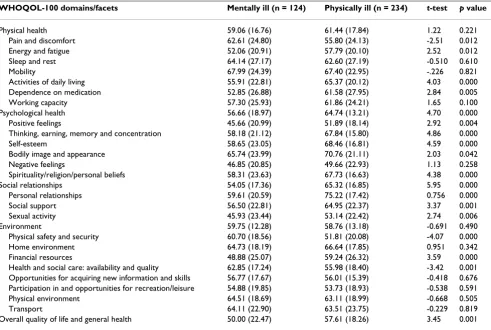
In addition, significant differences regarding the WHO-QOL domain and facet mean scores were identified between mentally ill and physically ill participants in a number of facets and across all, with the exception of the
physical health and environment domains (Table 1).
Regard-ing facet scores within the physical health domain, it is
observed that physically ill participants reported
statisti-cally compromised scores in the pain/discomfort facet, as
expected, while mentally ill participants reported compro-mised scores in the facets of energy/fatigue, daily living activ-ities and dependence on medication.
Regarding the psychological health domain, mentally ill
participants indicated significantly more compromised
scores in all but the negative feelings facet, while, as
expected, both psychiatrically and physically ill partici-pants reported considerable distress as seen in the consid-erably low scores in the negative feelings facet.
For the domain of social relationships, mentally ill partici-pants indicated significantly lower scores than physically ill in all facets, supporting the proposed hypothesis that psychiatric participants would report QoL deficits, partic-ularly regarding their social well-being.
Finally, in reference to the environment domain, physically ill participants indicated lower scores in the safety/security
and health services facets, while psychiatrically ill partici-pants reported lower scores in the financial resources facet, as expected. The remaining facets did not provide
signifi-Table 3: Cronbach's α coefficients for the four-domain World Health Organization Quality of Life (WHOQOL-100) questionnaire in physically ill, mentally ill and healthy participants
WHOQOL four domains Physically ill (n = 234) Mentally ill (n = 124) Healthy (n = 67)
Physical health 0.86 0.80 0.86
Psychological health 0.78 0.87 0.79
Social relationships 0.85 0.84 0.85
Environment 0.90 0.90 0.90
Overall QoL/health 0.82 0.83 0.83
cant differences between these two clinical groups. Regarding the overall QoL/health facet, mentally ill partici-pants reported significantly lower scores than the physi-cally ill, as expected.
Further, one-way ANOVA and post hoc Scheffe were used
to examine discriminant validity within the four distinct patient groups, wherein a number of QoL differences were identified (Table 6). It was observed that WHOQOL-100 domain mean differences between the two physically ill groups (cancer and hypertensive) were not as great as they appeared to be between the psychiatric groups (schizo-phrenic and alcoholic). Additionally, the lowest domain mean scores were observed in the alcohol abuse/depend-ence group, particularly in the overall QoL/health facet. The calculation of F values provided evidence of systematic
differences across groups particularly in the overall QoL/
health facet. The Scheffe test was used for multiple com-parisons between the four groups. In the case of cancer and hypertensive participants, the results showed that QoL domain differences between these two patient groups are not statistically significant. By contrast, signifi-cant differences were observed between schizophrenic and alcoholic participants, with the latter presenting lower QoL scores (p < 0.001).
Given the diverse age ranges across the different groups of participants (range: 18 to 82), the instrument's ability to highlight age differences was investigated. Thus, partici-pants who were younger than 45 years old were compared
to those above 45. The cut-off point for age was set in accordance with the WHO protocol concerning the vali-dation of new language versions [41]. Participants under
45 indicated higher scores in the environment domain
(Mann-Whitney test p < 0.05, z value 1,97). Additionally,
a non-significant tendency was observed in the physical
health domain.
Investigating gender differences in the total population of participants across WHOQOL-100 domain scores, no sig-nificant differences were found between male and female participants.
Convergent validity
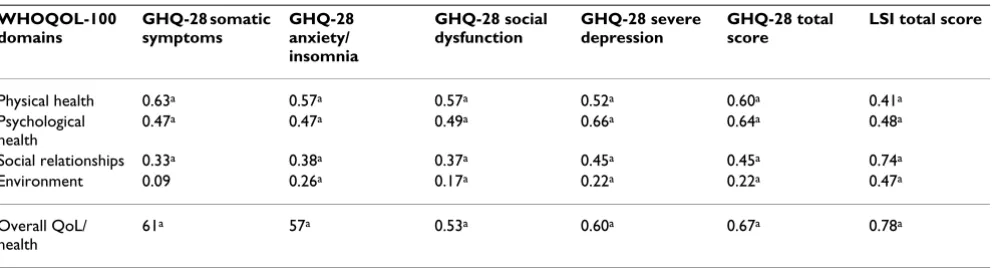
Convergent validity was investigated using the Pearson's r, with results supporting the proposed assumptions (Table 7). Using the whole sample (healthy, mentally ill, and physically ill), the instrument's physical health domain was highly related to the GHQ-28 subscales of somatic symp-toms, anxiety/insomnia, and social dysfunction, as well as to the GHQ-28 total score. Additionally, high correlations
were observed between the WHOQOL-100 psychological
health domain and the following: (a) the GHQ-28 severe depression subscale, (b) the GHQ-28 total score, and (c) the total LSI score. Moreover, in agreement with the pro-posed hypotheses, a moderate relationship was obtained
between the WHOQOL-100 social relationships domain
and the GHQ-28 social dysfunction subscale, reflecting a moderate content affinity between them. Further, the Table 4: Cronbach's α coefficients for the six-domain World Health Organization Quality of Life (WHOQOL-100) questionnaire in physically ill, mentally ill and healthy participants
WHOQOL six domains Physically ill (n = 124) Mentally ill (n = 234) Healthy (n = 67)
Physical health 0.50 0.65 0.40
Psychological health 0.70 0.80 0.60
Level of independence 0.73 0.85 0.80
Social relationships 0.85 0.84 0.85
Environment 0.90 0.90 0.90
Spirituality/religion/personal beliefs 0.80 0.90 0.90
Overall QoL/health 0.82 0.83 0.83
QoL = quality of life.
Table 5: Discriminant validity of the World Health Organization Quality of Life (WHOQOL-100) questionnaire: Domain differences between healthy and total patient group participants (Independent samples t- test)
WHOQOL domains Healthy (n = 67) Total patient group (mentally/physically ill; n = 358) t-test p value
Physical health 76.27 (13.07) 60.62 (17.49) -4.44 0.00 Psychological health 69.99 (12.00) 61.93 (15.90) -3.58 0.00 Social relationships 72.57 (14.00) 61.42 (17.83) -4.84 0.00 Environment 57.07 (11.39) 59.10 (12.87) 1.20 NS Overall QoL/health 69.12 (15.14) 54.97 (21.12) -5.47 0.00
Values are mean (SD) unless otherwise stated. p < 0.05.
WHOQOL-100 social relationships domain yielded a signif-icantly high correlation with the total LSI score.
Finally, the WHOQOL-100 overall QoL/health facet yielded
the highest correlations with the total GHQ-28 and LSI
scores. The WHOQOL-100 environment domain
demon-strated low correlations with all GHQ-28 health subscales and as hypothesised, a moderate correlation with the total LSI score (r = 0.47).
Test/retest reliability
The healthy group was reassessed for test/retest reliability
analysis. An Independent samples t-test indicated no
sta-tistical differences in domain mean scores between the two administrations of the WHOQOL-100 instrument. Test/retest reliability was also confirmed by the use of the Pearson correlation, which demonstrated consistency of responses between first and second administration (r = 0.66, p < 0.01).
Discussion
The results of the present study provide evidence on the psychometric properties of the WHOQOL-100 Greek ver-sion in terms of structure, internal consistency, discrimi-nant and convergent validity, and test/retest reliability.
The overall findings were observed to support the pro-posed hypotheses.
Exploring the factor structure of the WHOQOL-100 in the Greek version, a four-factor solution was identified as a satisfactory fit. This finding is in agreement with interna-tional results showing that the WHOQOL-100 four-factor model may be a reasonable fit across different cultures [10,12,13]. Both the six- and the four-domain models have been used reliably in international QoL research. The four-domain model was employed in several validation studies with general and clinical populations [20-22].
With regards to the instrument's internal consistency, it
was generally well supported, with satisfactory alpha
scores in the four domains across the three groups, as shown in Table 3, indicating that the instrument is an internally reliable tool for the assessment of quality of life
in Greek populations. In the six-domain structure, alpha
scores were satisfactory in all but the physical health
domain (Table 4). It is noted that in the four-domain
model, the domain of physical health contains more items,
which were obtained due to the merging of the items of
the level of independence domain within the physical
health domain. Added items may account for more satis-Table 6: Differences in World Health Organization Quality of Life (WHOQOL-100) questionnaire domain scores among four patient groups by analysis of variance (ANOVA)
WHOQOL-100 domains Schizophrenia (n = 87) Alcohol (n = 37) Hypertension (n = 139) Cancer (n = 95) F p value
Physical health 61.45 (14.76) 53.43 (19.81) 60.44 (17.57) 62.90 (18.23) 2.73 0.044 Psychological health 59.08 (18.66) 50.95 (18.71) 64.37 (12.82) 65.27 (13.81) 9.98 0.000 Social relationships 55.44 (17.74) 50.78 (16.19) 63.64 (16.63) 67.78 (16.96) 13.70 0.000 Environment 59.02 (12.26) 61.45 (12.34) 56.23 (13.33) 62.46 (12.10) 5.04 0.002 Overall QoL/health 56.34 (20.71) 35.07 (19.33) 57.68 (17.34) 57.55 (19.62) 20.33 0.000
Values are mean (SD) unless otherwise stated. p < 0.05. QoL = quality of life; SD = standard deviation.
Table 7: Convergent validity: Correlations between World Health Organization Quality of Life (WHOQOL-100) questionnaire domains, General Health Questionnaire (GHQ-28) subscales and total scores of GHQ-28 and Life Satisfaction Inventory (LSI) (Pearson's correlation coefficient) for the total sample (n = 425)
WHOQOL-100 domains
GHQ-28 somatic symptoms
GHQ-28 anxiety/ insomnia
GHQ-28 social dysfunction
GHQ-28 severe depression
GHQ-28 total score
LSI total score
Physical health 0.63a 0.57a 0.57a 0.52a 0.60a 0.41a
Psychological health
0.47a 0.47a 0.49a 0.66a 0.64a 0.48a
Social relationships 0.33a 0.38a 0.37a 0.45a 0.45a 0.74a
Environment 0.09 0.26a 0.17a 0.22a 0.22a 0.47a
Overall QoL/ health
61a 57a 0.53a 0.60a 0.67a 0.78a
a p < 0.01.
factory alpha scores observed in the composite physical health domain.
Investigating the instrument's ability to discriminate between healthy and non-healthy populations, the find-ings are in accordance to the hypotheses demonstrating that healthy participants reported considerably higher scores in several domains, specifically in the physical health
domain and the overall QoL/health facet (Table 5). This
was expected, since the healthy control group was consid-ered as a positive standard on the basis that participants were healthy, younger and more educated than the partic-ipants in the two clinical groups. It can be argued that in
this case, the domain of physical health and the facet of
overall QoL/health may stand as discriminatory indicators between healthy and non-healthy populations. The above findings are in agreement with several WHOQOL-100 val-idation studies, which indicate significantly higher QoL values for healthy cohorts in the physical health, as well as the psychological health domains [5,20,24,51].
In addition, assumptions regarding differences between physically ill and mentally ill participants were con-firmed, with the latter experiencing significantly lower QoL in several domains (Table 1). As expected, psychiatric patients reported considerable interpersonal and social deficits, as well as lack of social support as measured by
the facets of WHOQOL-100 social relationships domain. It
is argued that this domain proves to be of high discrimi-natory value for ill mental health, reflecting in particular the deficits of patients who suffer from chronic and debil-itating mental disorders. This finding is in agreement with other WHOQOL outcomes indicating that psychiatric patients, such as the schizophrenic, experience poor social well-being and lack of social network support [52].
According to the findings, participants with mental disor-ders reported more extended deficits in most of the facets of the psychological health domain, as well as poorer overall QoL/health. This is in agreement with previous WHOQOL-100 studies, wherein there was evidence of poor psycho-logical well-being in depressed patients [53]. In the present study, mentally ill participants indicated deficits in their emotional and cognitive functioning and, as expected, they reported poorer scores in the respective fac-ets of self-esteem, difficulties in thinking, learning, memory and concentration, as well as in their capacity for endorsing
spiritual beliefs (Table 1).
It is noteworthy that both psychiatric and physically ill
groups reported a high level of negative feelings in the
respective facet. As originally thought, cancer and hyper-tensive patients may have poor emotional well-being, which corresponds to their reports of experiencing high
levels of negative feelings, such as depression, anxiety,
anger or distress (as examined in the respective WHOQOL facet). It seems that physically ill patients indicated expe-riencing dysfunctional feelings induced by their condition of health. However, these feelings did not affect their over-all psychological functioning. By contrast, psychiatric patients did experience several psychological deficits, such as lower levels of self-esteem and cognitive difficulties.
Investigating further differences in perceived physical health, significant differences between physically ill and mentally ill participants were obtained particularly at the WHOQOL facet level. Thus, while differences were not observed regarding the domain level of physical health, sig-nificant differences were identified within-domain facets. Specifically, psychiatrically ill participants, as it was
expected, reported experiencing a lower level of energy,
more difficulty in carrying out daily living activities, and a higher level of dependence on medication (Table 1). Moreo-ver, it is noted that the facet of pain and discomfort signifi-cantly differentiated the two patient populations (physically ill versus mentally ill). As expected, cancer and hypertensive participants experienced a higher level of physical pain affecting their everyday life. It should be thus pointed out that while total scores in a specific domain may not provide sufficient group differences, facet scores within domains may, by contrast, reveal important health-related QoL deficits, which may provide distinctions between different diagnostic patient groups.
Regarding physical well-being, it is argued that both groups of mentally ill and physically ill participants may experience physical symptoms that can compromise their QoL. For example, psychiatric patients frequently report complaints of persistent and frustrating nature, such as sleep difficulties or somatic pain, and identify several physical manifestations comorbid to psychiatric disorders [54]. It is thus possible that the psychiatric participants experienced poor physical health that may correspond to the physically ill participants' negative health perceptions, due to the severity of their illness (cancer, severe hyperten-sion). On this occasion, it is recommended that psychiat-ric healthcare may develop specialised interventions to address physical needs and provide relevant promotion programs, in order to enhance physical health and well-being in mentally ill individuals.
study and it could be obtained with the analysis of the GHQ-28 data.
Regarding the environment domain, significant differences
were identified between the two patient populations in reference to related facets. Specifically, as expected,
men-tally ill individuals indicated worse financial conditions
than physically ill participants (Table 1). It is well known that a great number of psychiatric patients are not able to maintain a stable and productive work status. Also, psy-chiatric participants in this study indicated enjoying a greater availability and better quality of health services and social care, as well as experiencing more safety and security regarding their environment. These results may be group-specific reflecting the effect of mental healthcare and psychosocial support that participants were provided with at the time of the study. As mentioned in the meth-odology section, the psychiatric patients were either attending an outpatient rehabilitation programme or were hospitalised in a specialised inpatient detoxification unit. In both cases, patients were provided with psychoso-cial services that may create feelings of safety and induce favourable perceptions of environmental factors, such as access to and quality of health services.
Overall, the findings reveal the presence of QoL differ-ences between the two participating clinical populations, each indicating, respectively, illness-specific QoL deficits including compromised emotional and social well-being, poorer physical well-being, and particular environmental restrictions. These areas of reduced QoL need to be addressed separately for mentally ill and physically ill individuals in the context of healthcare services. Moreo-ver, it is argued that the development of a comprehensive quality of life agenda may be useful in order to provide disease-specific, patient-focused and individualised QoL rehabilitation services for individuals suffering from chronic illness, either mental or physical [32,39,51,56,57].
On investigating further the discriminatory ability of WHOQOL-100 among the four distinct patient groups, as expected, marked QoL deficits were reported by the alco-hol abuse/dependence group of patients on most
WHO-QOL domains and the overall QoL/health facet. Again, the
findings could be useful in both clinical practice and research. For example, QoL deficits effected in relation to the disorder or condition under investigation, in this case alcohol dependence, can be identified as indicators for planning interventions, while QoL gains can be assessed following abstinence, treatment or psychosocial pro-grammes [30,36].
Concerning cancer and hypertensive patients, very slight QoL domain differences were identified between these
groups, as seen in Table 6 (the Scheffe test did not provide significant differences). It could be argued that this find-ing may reflect that both patient groups could be sharfind-ing common health perceptions or beliefs concerning suffer-ing from a serious life-threatensuffer-ing illness (cancer or hypertension), which at the same time is considered to be a chronic one. It is noted that such perceptions may char-acterise cancer patients as well as hypertensive partici-pants especially those diagnosed with severe hypertension. In this case, patients receive medication and are aware of being at high risk for serious cardiovas-cular problems.
Investigating QoL differences between age groups, younger individuals reported better QoL regarding their
physical health and environment. It could be argued that cer-tain facets in the environment domain, such as ability for recreation and ability for acquiring new information and skills, could distinguish younger from older participants. Associ-ations between age and QoL have been reported in the rel-evant literature, for example higher age coinciding with less satisfaction with one's social relationships [22].
Regarding gender, no significant differences were identi-fied in the total sample. Taking into consideration that gender differences in QoL are not systematically evident, it would be beneficial to explore such differences in future studies across different participating groups. Gender dif-ferences may be found at the level of specific facets or items (for example items on negative emotions, or anxiety and depression) on the basis that there is evidence from previous studies, which show that women in general tend to report higher levels of depression and anxiety [58,59].
In reference to the WHOQOL-100 convergent validity, the findings provided evidence of satisfactory correlations between QoL, life satisfaction and self-reported health, supporting our hypotheses that specific QoL domains would show association to related subscales in other instruments. Thus, convergent validity, as tested in the
total sample, indicated that the WHOQOL-100 overall
QoL/health facet significantly correlated with overall assessments of the LSI and GHQ-28 instruments. In addi-tion, as expected, strong correlations were found between:
(a) the physical health domain (examining physical
symp-toms and well-being), and the related GHQ-28 subscale of somatic symptoms, as well as the overall assessment of
GHQ-28; (b) the psychological health domain (examining
psychological well-being) and the related GHQ-28 severe depression subscale, as well as the overall GHQ-28
meas-urement; and (c) the social relationships domain
Finally, the observed low correlations between the envi-ronment domain and the GHQ-28 and LSI measurements were expected, due to little conceptual affinity with these
measurements. The environment domain is comprised of
several factors examining a number of different environ-mental aspects. However, in the GHQ-28 and LSI meas-urements, a component of equivalent conceptual broadness is not included (which would be necessary for a robust convergence testing).
Regarding test/retest reliability, the findings supported the ability of the WHOQOL-100 to provide similar responses when readministered within a 3 to 4-week period to a healthy group of individuals who had not undergone any clinical intervention, or were not expected to have any changes in their lifestyle or health during this interval.
Overall, the findings of the present study converge with the results provided by previous WHOQOL-100 valida-tion studies on different language versions. For example, the WHOQOL-100 US version, which was tested in a size sample of 443 adults (including 251 chronically ill partic-ipants, 128 healthy adults, and 64 childbearing women), demonstrated a satisfactory level of internal consistency (alpha range: 0.82 to 0.95 across the 6 domains), as well as reproducibility (intraclass correlation coefficient (ICC) range: 0.83 to 0.96 at 2-week retest interval), responsive-ness to change in clinical conditions (as shown by pre-dicted score change (effect size) in women after childbirth), convergent validity (with the use of 2 ques-tionnaires, the Short Form-36 questionnaire, and the Sub-jective Quality of Life Profile), and discriminant validity between the diverse groups of that study [31].
Similarly, regarding the validation study in the UK using a sample of 106 chronic pain patients, the WHOQOL-100 demonstrated good overall internal consistency reliability for all facets (except for the pain and discomfort facet, which was marginal), good concurrent validity, as well as very good responsiveness to clinical change [19]. Further-more, the WHOQOL-100 Dutch version, which was tested in a sample of 220 individuals (147 healthy people and 73 chronic fatigue syndrome patients), demonstrated
a fairly good internal consistency (alpha range: 0.71 to
0.93 across the 6 domains), a good construct validity using a number of instruments including the Sickness Impact Profile and the Fatigue Impact Scale, as well as dis-criminatory capacity between the healthy and the chronic fatigue syndrome patients [18].
Additionally, the WHOQOL-100 Danish validation study provided QoL assessment in 257 individuals consisting of 4 patient groups with mental and physical disorders. The participating groups comprised individuals with: (1) schizophrenic disorder or depression, (2) diabetes
melli-tus, (3) severe chronic physical illness, such as arthritis, heart disease and hypertension, (4) gynaecologic disor-ders and (5) a group of healthy controls. The analysis revealed adequate internal consistency of the instrument (alpha range: 0.88 to 0.95 across the WHOQOL-100 domains) and satisfactory discriminant validity between the five population groups across the WHOQOL-100 domains. The differences between these groups were sta-tistically significant (p < 0.0001) apart from the domain of spirituality [42].
Finally, the Canadian version of WHOQOL-100, which was tested with a convenience sample of 144 people, demonstrated satisfactory test/retest and consistency reli-ability (range: 0.71 to 0.89 across domains) and was able to differentiate between healthy and ill populations, pro-viding support for construct validity [40].
Conclusion
Investigation into the basic psychometric properties of the WHOQOL-100 Greek version produced satisfactory
results. It is worth noting that the WHOQOL environment
domain did not contribute strongly as a component in the QoL measurement. This finding was observed in other validation studies, showing that the ability of the WHO-QOL to distinguish between and across populations is
mainly observed in the physical health and psychological
health domains rather than in the environment and social relationships domains [20,51,60].
Although no significant differences were identified at the
environment domain level between physically ill and men-tally ill participants, differences were observed at the facet level. Thus, specific environmental issues seem to bear particular value for the mentally ill, such as the facet of
financial resources and, for those hospitalised, the facet of
physical safety and security. It is argued that this finding may reflect the fact that patients' perceptions and evaluations of these specific environmental facets could be critically influenced by their health status, whereas other facets referring to home environment, could be assessed inde-pendently of the respondents' health condition. Also,
cer-tain facets, as for example the facet of acquiring new
knowledge and skills, may be age dependent identifying younger individuals. It would be useful to investigate such hypotheses with suitable cohorts.
Finally, it is noted that the domain of social relationships
has shown the ability to discriminate significantly between psychiatric and non psychiatric clinical popula-tions, both at the domain and facet level. Regarding the
inves-tigation in specifically selected groups with distinct differ-ences in their physical well-being, as well as in the way they perceive their illness and condition of health.
Regarding limitations, it is noted that methodological issues in the present study can be raised, as is the case with several other WHOQOL validation studies. As mentioned earlier, WHO guidelines for new language versions [16,41] were followed throughout the present study. Val-idation studies may use different methodologies, as for example selecting groups that could be equivalently con-trolled for social demographic data as in control clinical studies. In the current study, the participating groups were recruited on convenience. Thus, differences were expected to appear in terms of sample sizes, as well as age and gen-der across groups. Provided that a matched control group methodology was adopted, the QoL differences observed between the participating groups are likely to be more robust. Thus, controlling sociodemographic variables would enhance investigation across specific diagnostic populations, which was however beyond the scope of the present validation study.
Overall, the WHOQOL-100 Greek version has demon-strated good reliability and internal consistency, converg-ing well with similar measurements, whilst successfully differentiating between different patient groups. It is an instrument that may be used to measure treatment bene-fits reflected on QoL changes in Greek patients, providing healthcare professionals with important and even crucial patient-reported measurements. WHOQOL-100 assess-ment may contribute to the growing crosscultural study of QoL, particularly in groups of patients for whom a more extended QoL investigation is needed, as in the case of developing patient-focused services and health policies. Additionally, such outcomes are useful not only for indi-vidual patient monitoring, but also for service evaluation of mental and physical healthcare, as well as crosscultural comparisons. It is noted that as clinical trials expand inter-nationally, it is essential to develop instruments that measure quality of life across cultures in a valid and relia-ble way.
Competing interests
The authors declare that they have no competing interests.
Authors' contributions
MGC: conception, design, data collection, analysis and interpretation, preparation of manuscript. ET: data collec-tion, analysis and interpretacollec-tion, preparation of manu-script. VT: interpretation and editing. IAL: analysis, interpretation and comments on first draft. GNC: design, interpretation, comments on first draft, editing. GNP: comments on the final draft, editing.
Acknowledgements
The authors wish to express their appreciation to WHO for providing technical assistance and expertise into the use of WHOQOL measure-ment. They also greatly appreciate the contribution of the participating patients and the administrative personnel, as well as the health profession-als involved in the study.
References
1. Sanders C, Egger M, Donovan J, Tallon D, Frankel S: Reporting on quality of life in randomized controlled trials: bibliographic study. BMJ 1998, 317:1191-1194.
2. Sloan JA, Frost MH, Berzon R, Dueck A, Guyatt G, Moinpour C, Sprangers M, Ferrans C, Cella D, Clinical Significance Consensus Meeting Group: The clinical significance of quality of life assess-ments in oncology: a summary for clinicians. Support Care Can-cer 2006, 14:988-98.
3. Crosby RD, Kolotkin RL, Williams GR: Defining clinically mean-ingful change in health-related quality of life. J Clin Epidemiol 2003, 56:395-407.
4. Skevington MS: Investigating the relationship between pain and discomfort and quality of life, using the WHOQOL. Pain 1998, 76:395-406.
5. Skevington SM: Measuring quality of life in Britain: introducing the WHOQOL-100. J Psychosom Res 1999, 47:449-459. 6. Fayers P, Machin D: Quality of life: assessment, analysis and
interpretation. Chichester, UK: John Wiley & Sons Ltd; 2000. 7. Salek S: Compendium of quality of life instruments. Liphook,
UK: Euromed Communications Ltd; 2004.
8. MAPI Research Institute: QOLID: the quality of life instruments database. [http://www.qolid.org].
9. Carr AJ, Higginson I: Measuring quality of life: are quality of life measures patient centred? BMJ 2001, 322:1357-60.
10. Skevington SM: Advancing cross-cultural research on quality of life: observations drawn from the WHOQOL development.
Qual Life Res 2002, 11:135-144.
11. Bullinger M: Ensuring international equivalence of quality of life measures: problems and approaches to solutions. In Qual-ity of life assessment: international perspectives Edited by: Orley J, Kuyken W. Berlin, Germany: Springer-Verlag; 1994:33-40. 12. Orley J, Kuyken W: Quality of life assessment: international
perspectives. Heidelberg, Germany: Spinger-Verlag; 1994:41-60. 13. Power M, Bullinger M, Harper A, The World Health Organization
Quality of Life Group: The World Health Organization WHO-QOL-100: tests of the universality of quality of life in 15 dif-ferent cultural groups worldwide. Health Psychol 1999,
5:495-505.
14. The WHOQOL Group: The development of the World Health Organisation Quality of Life assessment instrument (the WHOQOL). In Quality of life assessment: international perspectives Edited by: Orley J, Kuyken W. Berlin, Germany: Springer-Verlag; 1994:41-60.
15. The WHOQOL Group: Study protocol for the World Health Organization Project to develop a quality of life assessment instrument (the WHOQOL). Qual Life Res 1993, 2:153-159. 16. The WHOQOL Group: The World Health Organization
Qual-ity of Life assessment (WHOQOL): development and gen-eral psychometric properties. Soc Sci Med 1998, 46:1569-1585. 17. The WHOQOL Group: The World Health Organization Qual-ity of Life assessment (WHOQOL): position paper from the World Health Organization. Soc Sci Med 1995, 41:1403-1409. 18. De Vries J, Van Heck GL: The World Health Organization
Qual-ity of Life assessment instrument (WHOQOL-100): valida-tion study with the Dutch version. Eur J Psychol Assess 1997,
13:164-178.
19. Skevington SM, Carse MS, Williams AC: Validation of the WHO-QOL-100: pain management improves quality of life for chronic pain patients. Clin J Pain 2001, 17:264-275.
20. Saxena S, Quinn K, Sharan P, Naresh B, Yuantao-Hao , Power M:
Cross-linguistic equivalence of WHOQOL-100: a study from North India. Qual Life Res 2005, 14:891-7.
Publish with BioMed Central and every scientist can read your work free of charge "BioMed Central will be the most significant development for disseminating the results of biomedical researc h in our lifetime."
Sir Paul Nurse, Cancer Research UK
Your research papers will be:
available free of charge to the entire biomedical community
peer reviewed and published immediately upon acceptance
cited in PubMed and archived on PubMed Central
yours — you keep the copyright
Submit your manuscript here:
http://www.biomedcentral.com/info/publishing_adv.asp
BioMedcentral 22. Masthoff ED, Trompenaars FJ, Van Heck GL, Hodiamont PP, De Vries
J: Validation of the WHO Quality of Life assessment instru-ment (WHOQOL-100) in a population of Dutch adult psy-chiatric outpatients. Eur J Psychiatry 2005, 20:465-473.
23. Pibernik-Okanovic M: Psychometric properties of the World Health Organisation quality of life questionnaire (WHO-QOL-100) in diabetic patients in Croatia. Diabetes Res Clin Pract 2000, 51:133-43.
24. Orsel S, Akdemir A, Dag I: The sensitivity of quality-of-life scale WHOQOL-100 to psychopathological measures in schizo-phrenia. Compr Psychiatry 2004, 45:57-61.
25. Bonicatto SC, Dew MA, Zaratiegui R, Lorenzo L, Pecina P: Adult outpatients with depression: worse quality of life than in other chronic medical diseases in Argentina. Soc Sci Med 2001,
52:911-919.
26. Saxena S, Chandiramani K, Bhargava R: WHOQOL-Hindi: a ques-tionnaire for assessing quality of life in health care settings in India. Natl Med J India 1998, 11:160-165.
27. Becchi A, Rucci P, Placentino A, Neri G, de Girolamo G: Quality of life I patients with schizophrenia-comparison of self-report and proxy assessments. Soc Psychiatry Epidemiol 2004, 39:397-401. 28. Ghazinour M, Richter J, Eisemann M: Quality of life among Iranian
refugees resettled in Sweden. J Immigr Health 2004, 6:71-81. 29. Skevington SM, Wright A: Changes in the quality of life of
patients receiving antidepressant medication in primary care: validation of the WHOQOL-100. Br J Psychiatry 2001,
178:261-7.
30. Ginieri-Coccossis M, Liappas IA, Tzavellas E, Triantafillou E, Soldatos C: Detecting changes in quality of life and psychiatric symp-tomatology following an in-patient detoxification pro-gramme for alcohol-dependent individuals: the use of WHOQOL-100. In Vivo. 2007, 21(1):99-106.
31. Bonomi AE, Patrick DL, Bushnell DM, Martin M: Validation of the United States' version of the World Health Organisation Quality of Life (WHOQOL) instrument. J Clin Epidemiol 2000,
53:1-12.
32. Katschnig H, Freeman H, Sartorius N: Quality of life in mental dis-orders. Chichester, UK: John Wiley & Sons Ltd; 1998.
33. Sciolla A, Patterson TL, Wetherell JL, McAdams LA, Jeste DV: Func-tioning and well-being of middle-aged and older patients with schizophrenia: measurement with the 36-item short-form (SF-36) health survey. Am J Geriatr Psychiatry 2003,
11:629-637.
34. Schuckit MA: Alcohol, anxiety and depressive disorders. Alc Health Res World 1996, 20:81-85.
35. Morgan MY, Landron F, Lehert P, New European Alcoholism Treat-ment Study Group: Improvement in quality of life after treat-ment for alcohol dependence with a camprosate and psychosocial support. Alcoholism 2004, 28:64-77.
36. Liappas I, Ginieri-Coccossis M: Alcohol dependence syndrome and quality of life: review of the problem. Exartisis Sci J Addict 2005, 8:41-54.
37. Longabaugh R, Mattson ME, Connors GJ, Cooney NL: Quality of life as an outcome variable in alcoholism treatment research. J Stud Alc 1994, 55:119-129.
38. Erickson S, Williams B, Gruppen L: Relationship between symp-toms and health-related quality of life in patients treated for hypertension. Pharmacotherapy 2004, 24:344-350.
39. Holzner B, Kemmler G, Sperner-Unterweger B, Kopp M, Dunser M, Margreiter R, Marschitz I, Nachbaur D, Fleischhacker WW, Greil R:
Quality of life measurement in oncology-a matter of the assessment instrument? Eur J Cancer 2001, 37:2349-56. 40. Malzahn A, Page G: Field Testing the WHOQOL-100 in
Can-ada. Can J Nurs Res 2006, 38:106-123.
41. World Health Organization: Resources for New Centers.
Geneva, Switzerland: WHO; 1996.
42. Norholm V, Bech P: The WHO Quality of Life (WHOQOL) questionnaire: Danish validation study. Nord J Psychiatry 2001,
55:229-235.
43. American Psychiatric Association: Diagnostic and statistical man-ual of mental disorders. 4th edition. Washington DC, USA: American Psychiatric Association; 1994.
44. World Health Organization: WHOQOL user manual. Geneva, Switzerland: WHO; 1998.
45. Ginieri-Coccossis M, Antonopoulou V, Triantafillou E, Christodoulou GN: Translation and cross-cultural adaptation of WHOQOL-100 in Greece: parts I & II. Psychiatry Today 2001, 32:5-16. 46. Fountoulakis K, Iakovides B, Iakovides A, Christofides A,
Ierodia-konou C: The validation of the Life Satisfaction Inventory (LSI) in the Greek population. Psychiatriki 1997, 8:292-304. 47. Muthny FA, Koch U, Stump S: Quality of life in oncology patients.
Psychother Psychosom 1990, 54:145-160.
48. Goldberg D: Manual of the General Health Questionnaire.
Windsor, UK: NFER-Nelson; 1978.
49. Garyfallos G, Karastergiou A, Adamopoulou A, Moutzoukis C, Ala-giozidou E, Mala D, Garyfallos A: Greek version of the General Health Questionnaire: accuracy of translation and validity.
Acta Psychiatr Scand 1991, 84:371-378.
50. Nunnally JC, Bernstein H: Psychometric theory. New York, USA: McGraw-Hill; 1994.
51. Wesolowski T, Szyber P: Usage of the WHOQOL-100 as a trial of objective estimation of quality of life in end stage renal dis-ease patients treated with renal transplantation. Pol Merkur Lekarski 2004, 17:260-6.
52. Hasanah CI, Razali MS: Quality of life: an assessment of the state of psychosocial rehabilitation of patients with schizophrenia in the community. J R Soc Health 2002, 122:251-255.
53. Angermeyer MC, Holzinger A, Matschinger H, Stengler-Wenzke K:
Depression and quality of life: results of a follow-up study. Int J Soc Psychiatry 2002, 48:89-99.
54. Osborn DPJ: The poor physical health of people with mental illness. West J Med 2001, 175:329-332.
55. Ginieri-Coccossis M, Triantafillou E, Tomaras V, Rabavilas A: Quality of life group intervention in the context of psychosocial reha-bilitation services. In Soma and psyche Athens, Greece: Interna-tional Society of Psychopathology of Expression and Art Therapy; 2003:75-78.
56. Herrman H, Hawthorn G, Thomas R: Quality of life assessment in people living with psychosis. Soc Psychiatry Epidemiol 2002,
37:510-518.
57. Ginieri-Coccossis M, Theofilou P, Synodinou C, Tomaras V, Soldatos C: Quality of life, mental health and health beliefs in haemo-dialysis and peritoneal haemo-dialysis patients: investigating differ-ences in early and later years of current treatment. BMC Nephrology 2008, 9:14.
58. Marcus SM, Young EA, Kerber KB, Kornstein S, Farabaugh AH, Mitch-ell J, Wisniewski SR, Balasubramani GK, Trivedi MH, Rush AJ: Gen-der differences in depression: findings from the Star*D study. J Affect Disord 2005, 87:141-150.
59. Kessler RC: Epidemiology of women and depression. J Affect Disord 2003, 74:5-13.