Basic soil chemical properties after 15 years in a long-term tillage
and crop rotation experiment**
Reinhard W. Neugschwandtner1 *, Jiřina Száková2, Vera Pachtrog1, Pavel Tlustoš2, Jindřich Černý2, Martin Kulhánek2, Hans-Peter Kaul1, Pia Euteneuer3, Gerhard Moitzi3, and Helmut Wagentristl3
1Institute of Agronomy, Department of Crop Sciences, University of Natural Resources and Life Sciences Vienna (BOKU), Austria 2Department of Agro-Environmental Chemistry and Plant Nutrition, Faculty of Agrobiology, Food and Natural Resources,
Czech University of Life Sciences Prague, Czech Republic
3Experimental Farm Groß-Enzersdorf, Department of Crop Sciences, University of Natural Resources and Life Sciences Vienna (BOKU), Austria
Received February 20, 2019; accepted November 27, 2019
*Corresponding author e-mail: [email protected] **This work was supported by the Austrian Agency for International Mobility and Cooperation in Education, Science and Research (OeAD) and the Centre for International Cooperation in Education (DZS) of the Czech Republic within the program AKTION Austria – Czech Republic (2014-2015).
A b s t r a c t.Basic soil chemical properties were assessed in a long-term tillage and crop rotation experiment 15 years after its establishment on a Chernozem in Raasdorf (Austria) with four tillage treatments – mouldboard ploughing, no-till, deep conser-vation tillage and shallow conserconser-vation tillage – and two crop rotations. The following parameters were assessed: pHCaCl2, pHH2O, electrical conductivity, cation exchange capacity, total nitrogen, total organic carbon and total carbon. Among which, pHCaCl2, pHH2O, and total carbon increased with soil depth while electri-cal conductivity, cation exchange capacity, total nitrogen, and total organic carbon decreased with soil depth. The differences between tillage treatments occurred after 15 years in the upper soil layer from 0-5 cm with higher values of electrical conductivity under no-till, deep conservation tillage and shallow conservation tillage than with mouldboard ploughing, higher values of cation exchange capacity and total nitrogen for no-till than for mould-board ploughing (with deep conservation tillage and shallow conservation tillage showing intermediate values) and more total organic carbon for no-till and deep conservation tillage than for mouldboard ploughing. At a 5-10 cm depth, electrical conductiv-ity was higher for no-till than for mouldboard ploughing. Values of pHCaCl2 and pHH2O did not differ between tillage treatments in any soil layer. In deeper soil layers, tillage did not affect the ana-lysed parameters. Crop rotation did not affect any of the anaana-lysed soil chemical properties.
K e y w o r d s: tillage, soil depth, long-term experiment, soil properties, no-till
INTRODUCTION
Tillage systems are generally categorized in terms of conventional tillage using a mouldboard plough to turn over the soil, conservation tillage using a chisel plow, disk plow, harrow disk or cultivators, and no-till where seeds are sown directly into the untilled soil. In conventional tillage, all crop residues are incorporated while in conservation till-age or no-till these residues remain partly or completely on the soil surface.
From a global perspective, the conventional tillage sys- tem is increasingly being superseded by the reduced tillage approaches. Whereas the plough is still dominant in Europe, conservation tillage and no-till are broadly applied in North and South America and in Australia (Derpsch et al., 2010). In a review of crop yields from several European coun-tries, yields from no-till were within the 5% range of those obtained by mouldboard ploughing (Soane et al., 2012). Under Pannonian climate conditions on a Chernozem in Eastern Austria, winter wheat yields were generally at similar levels for conventional, conservation and no-till with no-till resulting in higher yields in very dry years and conventional and conservation tillage resulting in higher yields with higher amounts of rainfall during the vegetation period (Neugschwandtner et al., 2015a). Moitzi et al. (2019) reported for this experiment, that the direct energy input in no-till and shallow conservation tillage during crop cultiva-tion was considerably lower than in mouldboard ploughing.
This may result in an increase in the energy efficiency of these tillage systems, especially during dry years, when ploughless tillage systems tended to respond with competi-tive yields (Neugschwandtner et al., 2015a).
The economic benefits of no-till include a reduction in fuel consumption and working time; both could be reduced by establishing wheat with no-till on a silty loam Chernozem as opposed to conventional establishment (i.e. using a heavy cultivator for stubble cultivation and a mouldboard plough and subsequent seeding, using a pow-er harrow and a seeding machine) by about 85% (Moitzi
et al., 2013; Szalay et al., 2015). The ecological benefits of no-till include an increase in biotic activity, especially earthworms, and of soil organic carbon, less soil erosion and lower carbon emissions (due to less fuel consumption) (Derpsch et al., 2010).
Tillage operations alter nutrient dynamics on a short-term scale through changes in the physical properties of the soil and the incorporation of crop residues and mineral or organic fertilizers. These effects accumulate in the long-term and an additional system effect builds up (Pekrun et
al. 2003). Soil physical characteristics like soil aggregate stability, bulk density, pore volume and pore size distri-bution, infiltration and penetration resistance (Liebhard, 1993b; Liebhard, 1994; Liebhard et al., 1994; Liebhard
et al., 1995) and soil chemical characteristics such as soil pH, soil organic matter and soil nutrients (Liebhard, 1993a; Neugschwandtner et al., 2014) are influenced by these long-term changes.
The aim of this study was to assess the influence of four different soil tillage systems and two crop rotations on basic soil chemical parameters in soil layers fifteen years after establishing a static field trial on a Chernozem in eastern Austria. Several soil characteristics which were assessed in 2003, seven years after the start of the experiment, have been reported earlier by Neugschwandtner et al. (2014).
MATERIALS AND METHODS
The long-term experiment was carried out in Raasdorf (48° 14’ N, 16° 33’ E; altitude: 153 m a.s.l) in eastern Austria on the experimental farm of BOKU University. Raasdorf is located close to the east of Vienna, Austria, on the edge of the Marchfeld plain, an important crop production region in the north-western part of the Pannonian Basin. The silty loam soil is classified as a Chernozem of alluvial origin and is rich in calcareous sediments. The mean annual tempera-ture is 10.7°C and the mean annual precipitation is 543 mm (1983-2012).
The long-term experiment, which was established in 1996, is set up with a split-plot design using four replica-tion blocks and involves two factors: the tillage system is assigned to the main plots (24 × 40 m) and crop rotation to the subplots (12 × 40 m). Fertilization is performed on a crop specific basis according to good agricultural practice, e.g. winter wheat was fertilized with calcium ammonium nitrate (27% N) at a rate of 130 kg N ha-1.
The tillage variants include: (1) Mouldboard plough-ing (MP) after harvest to a soil depth of 25-30 cm. The loosened soil is turned over and therefore residues are fully incorporated into the soil. (2) No-till (NT): Direct drilling in un-tilled soil with a disc drill without the previous remov-al of residues. A totremov-al herbicide (glyphosate) is applied before sowing for weed control. (3) Deep conservation till-age (CTd) to a soil depth of 20-25 cm is performed using a wing share cultivator and every four years a subsoiler is used to a depth of 35 cm. A part of the plant residues remain on the soil surface. (4) Shallow conservation tillage (CTs) to a soil depth of 8-10 cm using a wing share cultivator. A high share of the plant residues remain on the soil surface. Two flexible crop rotations are performed on subplots with sugar beet (rotation A; grown in four years) or maize (rotation B; grown in four years) as central crops. Both rotations frequently included winter wheat (in a total of seven years), as rotation effects on this crop shall be tested within this long-term experiment. Rotation A had a further two years of maize and in one year each, sunflower and spring durum wheat. Rotation B had a further two years of oilseed rape and one year each of sugar beet and soybean. Both rotations had in the four years (2008-2011) before sampling, the same crops but in a different time course: Rotation A – maize, winter wheat, sugar beet and winter wheat; Rotation B – winter wheat, maize, winter wheat and sugar beet. Crop residues were left on the field.
Soil sampling was performed with soil probes (Purckhauer type, core diameter: 30 mm) in 5 cm steps at depths ranging from 0-30 and in 10 cm steps at depths rang-ing from 30-50 cm from the 7th to 9th of November, 2011. A mixed sample was composed per plot for each sampled layer consisting of 30 equally sized subsamples randomly collected from the individual plots. The samples were air-dried, homogenized and sieved (2 mm). The crops grown before sampling were harvested in July (rotation A: winter wheat) and in October (rotation B: sugar beet).
The soil pH was determined in a distilled water extract (pHH2O; 50 ml, w/v = 1:10) after 1 h of extraction and in a 0.01 mol l-1 calcium chloride solution (pH
modified Dumas combustion method at 960°C with a CNS elemental analyser (vario MACRO cube CNS; Elementar Analysensysteme GmbH, Langenselbold, Germany).
Statistical analyses were performed using software SAS version 9.2. An analysis of variance (PROC MIXED) was performed and the means were separated by the least sig-nificant differences (LSD), while the F-test indicated the factorial effects at the significance level of p < 0.05. Based on analysis of variance results, the data are presented as the main effects of depth or as tillage × depth interactions. As no significant differences were observed for crop rotation, means are indicated for each rotation (overall depths and tillage treatments). The Pearson correlation coefficient for analysed parameters was calculated for the depth of 0-5, 5-30, and 30-50 cm.
RESULTS AND DISCUSSION
The experimental site is characterized by a calcareous soil with an alkaline reaction. Values of pHCaCl2 were lower than those of pHH2O as soil extraction with CaCl2 causes a higher release of hydrogen ions into the solution com-pared to a soil extraction with H2O (Gavriloaiei, 2012).
Both pHCaCl2 and pHH2O decreased with soil depth with pHCaCl2 (Fig. 1A) showing a more homogenous distribution up to a 25 cm depth while pHH2O gradually decreased with every sampled layer (except for similar values between a 10-15 and 15-20 cm depth). The vertical gradient of pHCaCl2 has already been reported for this experiment after seven years (Neugschwandtner et al., 2014). Similarly to pH, an increase in calcium carbonate (CaCO3) was found in this experiment seven years after its initiation (Neugschwandtner et al., 2014), as CaCO3 buffers the soil pH (Blume et al., 2019).
There were no differences in pH between tillage treat- ments. This finding is consistent with those of other long-term tillage experiments; e.g. on a sandy loam soil in the Northern Great Plains after 12 years (Aase and Pikul, 1995), under temperate conditions on a Luvisol in France after 32 years (Limousin and Tessier, 2007), and in a semi-arid, subtropical environment on a Luvisol in Australia after 9 years (Thomas et al., 2007). A higher acidity with no-till in the upper soil layers was reported from other stu- dies which attributed this effect to acidification processes
such as the mineralization of organic matter and the nitri-fication of surface-applied N fertilizer (Franzluebbers and Hons, 1996; Limousin and Tessier, 2007; López-Fando and Pardo, 2009). However, the effects of no-till on pH were reported to occur in a more pronounced way at an early stage; whereas no significant differences between no-till fields run for more than 6 years and conventionally tilled fields were observed (Crozier et al., 1999).
Crop rotation did not affect pHH2O (A: 8.38, B: 8.40) and pHCaCl2 (A: 7.58, B: 7.59). After 7 years, however, a lower pHCaCl2 had been observed after oilseed rape com-pared to after maize (Neugschwandtner et al., 2014). The effects of crop rotation can occur, as soil pH is a soil pro- perty with short-term changes, e.g. during the decomposi-tion of crop residues (Hulugalle and Weaver, 2005), due to rhizosphere processes (Kotková et al., 2008) and with different fertilizer systems (Vašák et al., 2015). There were probably no differences, as the same crops but in a different time course have been grown in both rotations in the last four years.
There was a significant tillage × depth interaction for the electrical conductivity (EC) (Fig. 1B). The EC was low-er with MP than with NT, CTd and CTS at a 0-5 cm depth and with MP compared to NT (with CTd and CTs showing intermediate values) at a 5-10 cm depth. At a 0-5 cm depth, the EC of NT was with 175 μS cm-1 1.18-fold higher
com-pared to MP with 148 μS cm-1. Below a 10 cm soil depth, the EC did not differ among tillage treatments. A higher EC with NT compared to MP was also found by Martínez et al.
(2013) to a depth of 2 cm with no differences below 2 cm, by Rahman et al. (2008) at a 0-10 cm depth and by Perez-Brandán et al. (2012) for NT compared to MP and CT at a 0-20 cm soil depth. Higher organic matter contents in NT caused an increase in electrolyte concentrations (Rahman
et al., 2008). On the other hand, Chatterjee and Lal (2009) reported diverse results for EC with no differences between NT and MP on three sites and higher values of EC on one side for either NT or MP. A lower EC with NT up to a 1.2 m depth has been described by Dalal (1989), this was attri- buted to an increased water movement and a higher soil aggregation with NT. Crop rotation did not affect EC (A: 145 μS cm-1, B: 140 μS cm-1). The EC in all treatments was well below the values causing negative yield responses (Steppuhn et al., 2005).
There was a significant tillage × depth interaction for the cation exchange capacity (CEC) (Fig. 1C). In the up- permost soil layer from 0-5 cm, the CEC was ranked as fol-lows: NT ≥ CTd, CTs ≥ MP. At a 0-5 cm depth, the CEC of NT was with 127 mmol kg-1 1.10-fold higher compared to MP with 115 mmol kg-1. The CEC decreased from the first to the second layer (5-10 cm) in the treatments NT, CTd and CTs, thereby reaching similar values as MP. Further down, there was a slight decline of CEC to a depth of 30 cm nd a more pronounced decline up to 50 cm. CEC pro-vides a rough index of the shrink-swell potential and is
a measure of soil structural resilience to tillage (Triantafilis
et al., 2009). An increase in CEC with no-till was already reported by Lal et al. (1990) for coarsely textured soils. The CEC is strongly influenced by soil organic matter due to its high degree of negative charges and therefore its ability to absorb cations (Scheffer et al., 2010). CEC decreases when soil organic matter depletes (Curtin et al., 2015). Crop rotation did not affect CEC (A: 110 mmol kg-1, B: 112 mmol kg-1).
Total N (Nt) showed an interaction between tillage × depth. In the uppermost soil layer from 0-5 cm, the highest Nt contents were observed with NT and the lowest in MP (with CTs and CTd showing intermediate values). At a 0-5 cm depth, the Nt of NT was with 0.2449% 1.22-fold higher compared to MP with 0.2995%. Downward up to a 30 cm depth, there are no differences in the Nt content between tillage treatments (Fig. 1D). After seven years, the Nt had been higher in this experiment at 0-10 cm for NT, CTd and CTs than MP with no differences between tillage treatments below a 10 cm depth (Neugschwandtner et al., 2014). A higher Nt with NT in the uppermost soil layer is attributed to the surface accumulation of residues whereas intensive soil mixing dilutes the concentration and accelerates the mineralization of organic matter (Salinas-García et al.,
2002; Spiegel et al., 2007; Hou et al., 2012). Furthermore, the soil nitrogen cycle is influenced through tillage opera -tions with a slower oxidation rate of ammonium into nitrate in no-till soil (Laine et al., 2018).
Crop rotation did not affect Nt (A: 0.22%, B: 0.22%) as already reported for this experiment after seven years (Neugschwandtner et al., 2014). However, differences in Nt between crop rotations could have been expected, as
the amount of N remaining on the field with crop residues and as soil mineral nitrogen after harvest differ signifi -cantly between crops (Neugschwandtner and Kaul, 2015; Neugschwandtner et al., 2015c, d).
A higher total organic carbon content (TOC) was observed with NT and CTd than with MP in the upmost 5 cm (with CTs showing intermediate values) (Fig. 1E). Between 5-10 cm, CTd and CTs had higher TOC con-tents than NT and MP (not significant). The TOC of NT was compared to MP 1.41-fold higher at a 0-5 cm depth (1.92% versus 1.36%) and 1.07-fold higher at a 5-10 cm depth (1.50% versus 1.40%). A sharp decline of TOC was observed for NT (by 22%) from the first to the second soil layer and for CTs (by 16%) from the second to the third soil layer. In contrast, CTd and especially MP showed a more homogenous TOC distribution in the upper soil layers to a depth of 25 cm. From 25-50 cm, a pronounced decline of the TOC content was observed for all tillage treatments. Limousin and Tessier (2007) and Thomas et al. (2007) have also reported an accumulation of TOC with NT in the top soil layer and then a rapid vertical decline. Spiegel et al.
in Austria. MP showed a lower but more homogenous dis-tribution in TOC content, which is attributed to intensive soil mixing and accelerated organic matter mineralization (Salinas-García et al., 2002; Spiegel et al., 2007).
Crop rotation did not affect TOC (A: 1.38%, B: 1.37%). A similar observation was made in this experiment after seven years (Neugschwandtner et al., 2014). However, dif- ferent crops in rotation show differences in the amount and composition of residues (Neugschwandtner and Kaul, 2016a, 2016b; Neugschwandtner et al., 2015b), which might provoke differences between rotations in TOC. As stated previously, the same crops, but in a different time course have been grown in both rotations over the last four years.
Total carbon (TC) in the soil decreased with soil depth (Fig. 1F). Tillage treatments did not affect the TC. Although in the first 0-5 cm depth, the TC of NT, CTd and CTs tended to be higher compared to MP (tillage × depth – p = 0.10, not significant). TC in the soil includes TOC and total inorganic carbon (TIC), which is primarily calcium (and magnesium) carbonate (Guo et al., 2016). Calcium carbon-ate (CaCO3) was assessed in this experiment seven years after its initiation with no differences in CaCO3 between tillage treatments (Neugschwandtner et al., 2014). The differences in TC among tillage treatments after 15 years reflect those of TOC, so obviously no substantial changes in TIC have occurred. No tillage effect on CaCO3 was also reported by Fernández-Ugalde et al. (2009), but Moreno et
al. (2006) observed that the natural leaching loss of CaCO3
was notably reduced by conservation tillage due to the greater retention of water in the soil profile. Crop rotation did not affect TC (A: 4.15%, B: 4.17%).
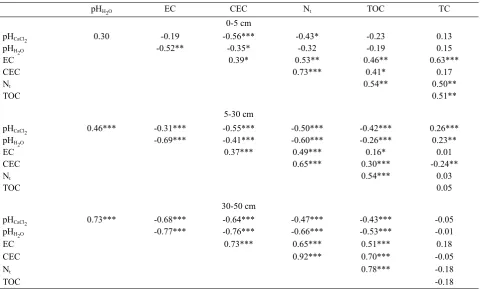
Correlations were calculated for the analysed param-eters at a 0-5 cm depth, a 5-30 cm depth (up to the end of the plow layer) and at a 30-50 cm depth (subsoil) (Table 1). In the 0-5 cm soil layer, the following parameters did not correlate with each other: pHCaCl2 with pHH2O and EC, pHH2O with Nt, pHCaCl2 and pHH2O with TOC, and TC with pHCaCl2, pHH2O and Nt. However, there was a significant ne-gative correlation of pHCaCl2 with CEC and Nt, and of pHH2O with EC and CEC, as well as a positive correlation among EC, CEC, Nt and TOC, and of TC with EC, Nt and TOC.
Our findings at a 0-5 cm depth are partly in agreement with results from the 0-10 cm soil depth of tillage experiments performed on a Aquultic Hapludalfs (Shukla et al., 2006), a Luvisol (Thomas et al., 2007) and an Andisol (Rahman
et al., 2008), in which there was also a negative correla-tion of pHH2O with EC, a positive correlation among N, EC, and TOC but a negative correlation of pHH2O with Nt and with TOC.
At a 5-30 cm and 30-50 cm depth, pHCaCl2 and pHH2O cor-
related significantly, but showed a negative correlation with EC, CEC, Nt and TOC. Furthermore, EC, CEC, Nt and TOC were positively correlated with each other. At a 5-30 cm depth, TC was positively correlated with pHCaCl2 and pHH2O and negatively with CEC. No correlation was found for TC at a 5-30 cm depth with EC, Nt and TOC and also with all
Table 1. Pearson correlation coefficient for analyzed parameters
pHH2O EC CEC Nt TOC TC
0-5 cm
pHCaCl2 0.30 -0.19 -0.56*** -0.43* -0.23 0.13
pHH2O -0.52** -0.35* -0.32 -0.19 0.15
EC 0.39* 0.53** 0.46** 0.63***
CEC 0.73*** 0.41* 0.17
Nt 0.54** 0.50**
TOC 0.51**
5-30 cm
pHCaCl2 0.46*** -0.31*** -0.55*** -0.50*** -0.42*** 0.26***
pHH2O -0.69*** -0.41*** -0.60*** -0.26*** 0.23**
EC 0.37*** 0.49*** 0.16* 0.01
CEC 0.65*** 0.30*** -0.24**
Nt 0.54*** 0.03
TOC 0.05
30-50 cm
pHCaCl2 0.73*** -0.68*** -0.64*** -0.47*** -0.43*** -0.05
pHH2O -0.77*** -0.76*** -0.66*** -0.53*** -0.01
EC 0.73*** 0.65*** 0.51*** 0.18
CEC 0.92*** 0.70*** -0.05
Nt 0.78*** -0.18
TOC -0.18
of the other parameters in the subsoil. Obviously, soil depth had a strong influence over the correlation between the ana -lysed parameters.
CONCLUSIONS
1. Compared to mouldboard ploughing, no-till increased the electrical conductivity, cation exchange capacity, total nitrogen and total organic carbon in the uppermost soil lay-er (0-5 cm); whlay-ereas, pHCaCl2 and pHH2O were not affected by tillage. In the uppermost soil layer, a positive correlation between electrical conductivity, cation exchange capacity, total nitrogen and total organic carbon was observed.
2. In the 5-10 cm soil depth, electrical conductivity was the only parameter significantly affected by tillage (with higher values for no-till than for mouldboard ploughing).
3. In deeper soil layers, tillage did not affect basic soil characteristics. Different crop rotations had no effect on the analysed basic soil chemical properties after 15 years.
Conflict of interest: The Authors do not declare con-flict of interest.
REFERENCES
Aase J.K. and Pikul J.L., 1995. Crop and soil response to long-term tillage practices in the northern Great Plains. Agron. J., 87, 652-656.
https://doi.org/10.2134/agronj1995.00021962008700040008x
Blume H.-P., Brümmer G.W., Horn R., Kandeler E., Kögel-Knabner I., Kretzschmar R., Stahr K., and Wilk B.-M., 2019. Scheffer/Schachtschabel: Lehrbuch der Bodenkunde. Springer-Verlag GmbH, Berlin – Heidelberg.
https://doi.org/10.1007/978-3-662-49960-3_10
Chatterjee A. and Lal R., 2009. On farm assessment of tillage impact on soil carbon and associated soil quality parame-ters. Soil Till. Res., 104, 270-277.
https://doi.org/10.1016/j.still.2009.03.006
Crozier C.R., Naderman G.C., Tucker M.R., and Sugg. R.E., 1999. Nutrient and pH stratification with conventional and no-till management. Commun. Soil Sci. Plant Anal., 30, 65-74. https://doi.org/10.1080/00103629909370184
Curtin D., Fraser P.M., and Beare M.H., 2015. Loss of soil organic matter following cultivation of long-term pasture: Effects on major exchangeable cations and cation exchange capacity. Soil Res., 53, 377-385.
https://doi.org/10.1071/sr14173
Dalal R.C., 1989. Long-term effects of no-tillage, crop residue, and nitrogen application of properties of a vertisol. Soil Sci. Soc. Am. J., 53, 1511-1515.
https://doi.org/10.2136/sssaj1989.03615995005300050035x
Derpsch R., Friedrich T., and Kassam A., 2010. Current status of adoption of no-till farming in the world and some of its main benefits. Int. J. Agric. Biol. Eng., 3, 1-25.
Fernández-Ugalde O., Virto I., Bescansa P., Imaz M.J., Enrique A., and Karlen D.L., 2009. No-tillage improvement of soil physical quality in calcareous, degradation-prone, semiarid soils. Soil Till. Res., 106, 29-35.
https://doi.org/10.1016/j.still.2009.09.012
Franzluebbers A.J. and Hons F.M., 1996. Soil-profile distribu-tion of primary and secondary plant-available nutrients under conventional and no tillage. Soil Till. Res., 39, 229-239. https://doi.org/10.1016/s0167-1987(96)01056-2
Gavriloaiei T., 2012. The influence of electrolyte solutions on soil pH measurements. Rev. Chi. Bucharest, 63, 396-400.
Guo Y., Wang X., Li X., Wang J., Xu M., and Li D., 2016.
Dynamics of soil organic and inorganic carbon in the crop-land of upper Yellow River Delta, China. Scient. Rep., 6, art. no. 36105.
https://doi.org/10.1038/srep36105
Hou R., Ouyang Z., Li Y., Tyler D.D., Li F., and Wilson G.V., 2012. Effects of tillage and residue management on soil organic carbon and total nitrogen in the North China Plain. Soil Sci. Soc. Am. J., 76, 230-240.
https://doi.org/10.2136/sssaj2011.0107
Hulugalle N.R. and Weaver T.B., 2005. Short-term variations in chemical properties of Vertisols as affected by amounts, carbon/nitrogen ratio, and nutrient concentration of crop residues. Commun. Soil Sci. Plant Anal., 36, 1449-1464. https://doi.org/10.1081/css-200058489
ISO 11260, 1994. Standard of soil quality - Determination of effective cation exchange capacity and base saturation level using barium chloride solution. International Organization for Standardization, Geneva.
https://doi.org/10.3403/01074513u
Kotková B., Balík J., Černý J., Kulhánek M., and Bazalová M., 2008. Crop influence on mobile sulphur content and arylsulphatase activity in the plant rhizosphere. Plant Soil Environ., 54, 100-107. https://doi.org/10.17221/2776-pse
Laine M., Rütting T., Alakukku L., Palojärvi A., and Strömmer R., 2018. Process rates of nitrogen cycle in uppermost top-soil after harvesting in no-tilled and ploughed agricultural clay soil. Nutr. Cycl. Agroecosys., 110, 39-49.
https://doi.org/10.1007/s10705-017-9825-2
Lal R., Logan T.J., and Rausey N.R., 1990. Long-term tillage effects on Mollic Ochraqualf in North-west Ohio. Soil Till. Res., 15, 371-382.
https://doi.org/10.1016/0167-1987(90)90110-y
Liebhard P., 1993a. Einfluß der Primärbodenbearbeitung auf pH-Wert, Calcium-, Phosphat- und Kaliumgehalt von Ackerböden im oberösterreichischen Zentralraum (Teil 2). Bodenkultur, 44, 303-315.
Liebhard P., 1993b. Einfluß der Primärbodenbearbeitung auf Textur und organische Substanz von Ackerböden im oberösterreichischen Zentralraum (Teil 1). Bodenkultur, 44, 199-210.
Liebhard P., Eitzinger J., and Klaghofer E., 1994. Einfluß der Primärbodenbearbeitung auf Infiltration und Bodenwasser-vorrat im oberösterreichischen Zentralraum (Teil 4). Bodenkultur, 45, 297-311.
Liebhard P., 1994. Einfluß der Primärbodenbearbeitung auf Lagerungsdichte, Porenvolumen und Porengrößenverteilung von Ackerböden im oberösterreichischen Zentralraum (Teil 3). Bodenkultur, 45, 125-138.
Limousin G. and Tessier D., 2007. Effects of no-tillage on chemi- cal gradients and topsoil acidification. Soil Till. Res., 92, 167-174. https://doi.org/10.1016/j.still.2006.02.003
López-Fando C. and Pardo M.T., 2009. Changes in soil chemi-cal characteristics with different tillage practices in a semi- arid environment. Soil Till. Res., 104, 278-284.
https://doi.org/10.1016/j.still.2009.03.005
Martínez E., Fuentes J.-P., Pino V., Silva P., and Acevedo E., 2013.
Chemical and biological properties as affected by no-tillage and conventional tillage systems in an irrigated Haploxeroll of Central Chile. Soil Till. Res., 126, 238-245.
https://doi.org/10.1016/j.still.2012.07.014
Moitzi G., Neugschwandtner R.W., Kaul H.-P., and Wagentristl H., 2019. Energy efficiency of winter wheat in a long-term till-age experiment under Pannonian climate conditions. Eur. J. Agron., 103, 24-31.
https://doi.org/10.1016/j.eja.2018.11.002
Moitzi G., Szalay T., Schüller M., Wagentristl H., Refenner K., Weingartmann H., Liebhard P., Boxberger J., and Gronauer A., 2013. Effects of tillage systems and mechanization on work time, fuel and energy consumption for cereal crop-ping in Austria. Agric. Eng. Int.: CIGR J., 15, 94-101.
Moreno F., Murillo J.M., Pelegrín F., and Girón I.F., 2006.
Long-term impact of conservation tillage on stratification ratio of soil organic carbon and loss of total and active CaCO3. Soil Till. Res., 85, 86-93.
https://doi.org/10.1016/j.still.2004.12.001
Neugschwandtner R.W., Liebhard, P., Kaul H.-P., and Wagentristl H., 2014. Soil chemical properties as affected by tillage and crop rotation in a long-term field experiment. Plant Soil Environ., 60, 57-62.
https://doi.org/10.17221/879/2013-pse
Neugschwandtner R.W. and Kaul H.-P., 2015. Nitrogen uptake, use and utilization efficiency by oat-pea intercrops. Field Crops Res., 179, 113-119.
https://doi.org/10.1016/j.fcr.2015.04.018
Neugschwandtner R.W., Liebhard P., Kaul H.-P., and Wagentristl H., 2015a. Winter wheat yields in a long-term tillage experiment under Pannonian climate conditions. Plant Soil Environ., 61, 145-150.
https://doi.org/10.17221/820/2014-pse
Neugschwandtner R.W., Wagentristl H., and Kaul H.-P., 2015b.
Concentrations and uptake of macro and micronutrients by chickpea compared to pea, barley and oat in central Europe. J. Kulturpflanzen, 67, 404-409.
Neugschwandtner R.W., Wagentristl H., and Kaul H.-P., 2015c.
Nitrogen yield and nitrogen use of chickpea compared to pea, barley and oat in Central Europe. Int. J. Plant Prod., 9, 291-304. https://doi.org/10.17557/tjfc.69076
Neugschwandtner R., Ziegler K., Kriegner S., Wagentristl H., and Kaul H.-P., 2015d. Nitrogen yield and nitrogen fixa-tion of winter faba beans. Acta Agric. Scand. Sect. B Soil Plant Sci., 65, 658-666.
https://doi.org/10.1080/09064710.2015.1042028
Neugschwandtner R.W. and Kaul H.-P., 2016a. Concentrations and uptake of macronutrients by oat and pea in intercrops in response to N fertilization and sowing ratio. Arch. Agron. Soil Sci., 62, 1236-1249.
https://doi.org/10.1080/03650340.2016.1147648
Neugschwandtner R.W. and Kaul H.-P., 2016b. Concentrations and uptake of micronutrients by oat and pea in intercrops in response to N fertilization and sowing ratio. Bodenkultur, 67, 1-15. https://doi.org/10.1515/boku-2016-0001
ÖNORM L 1083, 1999. Chemische Bodenuntersuchungen - Bestimmung der Acidität (pH-Wert). Österreichisches Normungsinstitut, Wien.
Pekrun C., Kaul H.-P., and Claupein W., 2003. Soil tillage for sustainable nutrient management. In: Soil Tillage in Agroeco- systems (Ed. A. El Titi). CRC Press, Boca Raton, 83-113. https://doi.org/10.1201/9781420040609.ch4
Perez-Brandán C., Arzeno J.L., Huidobro J., Grümberg B., Conforto C., Hilton S., Bending G.D., Meriles J.M., and Vargas-Gil S., 2012. Long-term effect of tillage systems on soil microbiological, chemical and physical parameters and the incidence of charcoal rot by Macrophomina phaseolina (Tassi) Goid in soybean. Crop Prot., 40, 73-82.
https://doi.org/10.1016/j.cropro.2012.04.018
Rahman M.H., Okubo A., Sugiyama S., and Mayland H.F., 2008.
Physical, chemical and microbiological properties of an Andisol as related to land use and tillage practice. Soil Till. Res., 101, 10-19.
Salinas-García J.R., Velázquez-García J. de, Gallardo-Valdez M., Díaz-Mederos P., Caballero-Hernández F., Tapia-Vargas L.M., and Rosales-Robles E., 2002. Tillage effects on microbial biomass an nutrient distribution in soils under rain-fed corn production in central-western Mexico. Soil Till. Res., 66, 143-152.
https://doi.org/10.1016/s0167-1987(02)00022-3
Scheffer F., Schachtschabel P., and Blume H.-P., 2010.
Lehrbuch der Bodenkunde. Spektrum Akademischer Verlag, Heidelberg.
Sims J.R. and Haby V.A., 1971. Simplified colorimetric determi-nation of soil organic matter. Soil Sci., 112, 137-141. https://doi.org/10.1097/00010694-197108000-00007
Shukla M.K., Lal R., and Ebinger M., 2006. Determining soil quality indicators by factor analysis. Soil Till. Res., 87, 194-204. https://doi.org/10.1016/j.still.2005.03.011
Spiegel H., Dersch G., Hösch J., and Baumgarten A., 2007.
Tillage effects on soil organic carbon and nutrient availabil-ity in a long-term field experiment in Austria. Bodenkultur, 58, 47-58.
Soane B.D., Ball B.C., Arvidsson J., Basch G., Moreno F., and Roger-Estrade J., 2012. No-till in northern, western and south-western Europe: A review of problems and opportu-nities for crop production and the environment. Soil Till. Res., 118, 66-87. https://doi.org/10.1016/j.still.2011.10.015
Steppuhn H., van Genuchten M.T., and Grieve C.M., 2005.
Root-zone salinity: II. Indices for tolerance in agricultural crops. Crop Sci., 45, 221-232.
https://doi.org/10.2135/cropsci2005.0221
Szalay T., Moitzi G., Liebhard P., and Weingartmann H., 2015.
Influence of different tillage systems on fuel consumption and requirement of working time in winter wheat cropping in a semiarid area of production. Bodenkultur, 66, 39-48.
Thomas G.A., Dalal R.C., and Standley J., 2007. No-till effects on organic matter, pH, cation exchange capacity and nutri-ent distribution in a Luvisol in the semi-arid subtropics. Soil Till. Res., 94, 295-304.
Triantafilis J., Lesch S.M., La Lau K., and Buchanan S.M., 2009.
Field level digital soil mapping of cation exchange capacity using electromagnetic induction and a hierarchical spatial regression model. Aust. J. Soil Res., 47, 651-663.
https://doi.org/10.1071/sr08240
Vašák F., Černý J., Buráňová Š., Kulhánek M., and Balík J., 2015.