INTERNATIONAL JOURNAL FOR MATHEMATICS TEACHING AND LEARNING 2018, Vol. 19.1, 22-46
22
Conceptual and Procedural Angle Knowledge: Do Gender and
Grade Level Make a Difference?
Utkun Aydın MEF University [email protected]
The study examined differences in students’ conceptual and procedural knowledge of angles among two grades and gender. Participants were 382 sixth and 376 seventh graders from a metropolitan city in Turkey. Turkish students’ conceptual and procedural knowledge of angles declined from sixth to seventh grade. Gender differences were found for procedural knowledge, but not for conceptual knowledge. Since conceptual and procedural knowledge of angles may have significant influences on the essential subsequent topics in geometry, we need to seriously consider the implications of these gender- and grade-related differences and pay attention particularly to males in Grade 7. The patterns of Turkish students’ conceptual and procedural angle knowledge were discussed, and educational implications were offered.
Keywords:Conceptual knowledge; procedural knowledge; angles; geometry; gender; grade
Introduction
Theories of learning and instruction underlined the pivotal role that knowledge plays in students’ cognitive development and learning process (De Jong & Ferguson-Hessler, 1996; Rittle-Johnson & Koedinger, 2005). According to Hiebert and Lefevre (1986), organized knowledge requires individuals to internalize a concept that is being taught, the meaning related to a procedure they are implementing, and interconnections built between them. Mathematical competence therefore relies mostly on how one develops knowledge of concepts and of procedures (Rittle-Johnson & Schneider, in press). Rittle-Johnson, Siegler, and Alibali (2001) have posited that conceptual and procedural knowledge do not develop independently but rather iteratively, with gains in conceptual knowledge leading to gains in procedural knowledge, which in turn trigger new gains in conceptual knowledge.
Conceptual and procedural angle knowledge Aydin
23
of 6th and 7th graders. The findings may lead to a better understanding of gender and grade level issues related to geometrical knowledge that is considered to be important for the development of spatial knowledge (Soury-Lavergne & Maschietto, 2015) and visual thinking (Battista, 2007; Clements & Battista, 1992).
The issue of individual differences on student knowledge of angles is particularly interesting, as it has not been fully elucidated in the literature. Furthermore, the existent literature on students’ development of knowledge has been often investigated in the domains of counting (Gelman, Meck, & Merkin, 1986), single-digit addition (Baroody & Gannon, 1984), multi-digit addition (Hiebert & Wearne, 1996), fractions (Hallett, Nunes, & Bryant, 2010), decimal fractions (Moss & Case, 1999), percent (Lembke & Reys, 1994), and mathematical equivalence (Knuth, Stephens, McNeil, & Alibali, 2006). The topics studied in this bulk of studies have been mainly limited to mathematics, particularly arithmetics. By contrast, there has been very little research on geometry topics. There has, of course, been a vast amount of research on students’ spatial and geometrical knowledge (Clements & Battista, 1992), but relatively few studies investigate individual differences in geometrical knowledge as opposed to conceptual and procedural angle knowledge (e.g., Mitchelmore, 1997, 1998). Whereas mathematical knowledge development is worth exploring, the individual differences in geometrical knowledge within a specific domain, especially the angles concept, would also be informative to curriculum designers and mathematics teachers.
Conceptual and procedural angle knowledge Aydin
24
The Importance of Angles
Concept of angle comprises a fundamental portion of the content of the geometrical knowledge middle school students need to possess. Both national (Ministry of National Education [MoNE], 2013) and international (e.g., National Council of Teachers of Mathematics [NCTM], 2000) curriculum documents recommend that students develop some understanding of angles before entering high school. The MoNE, for example, recommended that students should develop the abilities to “use knowledge of basic geometric concepts and drawings including angles” (p. 7) to “select appropriate methods to solve problems related to angles” (p. 29) throughout Grades 5-8. Similarly, the NCTM recommended that students should come to the study of geometry in the middle grades with informal knowledge about angles; and with experience in visualizing and drawing angles (p. 233).
Obviously, the angle concept is central to the development of geometrical knowledge (Clements & Burns, 2000; Krainer, 1991) and important for students to understand at an early age (Mitchelmore, 1998). Further, the lack of a solid understanding of angle concepts can make understanding and working with functions more difficult later on (Moore, 2013). However, developing a thorough understanding of angles is challenging for many students (Clements & Battista, 1992). Students often experience difficulties with angle measurement (Clements & Burns, 2000; Freudenthal, 1983), operations with angles (Smith et al., 2014; Usiskin, 1987), abstracting and generalizing angles (White & Mitchelmore, 2010), recognizing angles in different contexts (Mitchelmore, 1997, 1998), solving real-life problems related to angles (Munier, Devichi, & Merle, 2008).
Part of the reason angles are difficult to understand may stem from the fact that an angle can be defined using a variety of representations. Clements and Burns (2000) described two common ways of representing angles: (1) the static representation depicting an angle as a pair of rays with a common endpoint, and (2) the dynamic representation displaying an angle as the amount of rotation necessary to bring one of its rays to the other ray without moving out of the plane. In practical terms, Henderson and Taimina (2005) described an angle as a geometric figure (i.e., a part of the plane included between two rays meeting at their endpoints), an angle as a dynamic figure (i.e., a turn or rotation), and an angle as a measure. Viewed together, an understanding of an angle as a multifaceted concept incorporating both two representations requires students to expose adequate knowledge of concepts and of procedures related to angles and that it is slow to develop over time as students move through grade levels (Casas-García & Luengo-González, 2013; Lehrer, Jenkins, & Osana, 1998). Therefore, it is important to understand individual differences in using knowledge of concepts and of procedures related to angles.
Knowledge of Angles
Conceptual and procedural angle knowledge Aydin
25
Several researchers have offered definitions for both knowledge types (De Jong & Ferguson-Hessler, 1996; Hiebert & Lefevre, 1986; Rittle-Johnson & Koedinger, 2005). The conceptual and procedural knowledge framework derives essentially from the common view among researchers (Rittle-Johnson et al., 2001; Star, 2005, 2007) that conceptual knowledge is knowledge that is known deeply, while procedural knowledge is knowledge that is known superficially. In this regard, conceptual knowledge is characterized most clearly as a “connected web of knowledge, a network in which the linking relationships are as prominent as the discrete pieces of information” (Hiebert & Lefevre, 1986, p. 3). Procedural knowledge, on the other hand, is composed of knowledge that is memorized by rote with some computational skills (Baroody, 2003). In this vein, researchers measured students’ conceptual knowledge through tasks that mobilize declarative knowledge (i.e., primary level of relationships) in the context of “what” and “which” type of questions or that energize conditional knowledge (i.e., abstract level of relationships) in the context of “why” type of questions. Conceptual knowledge was therefore considered a combination of building relationships between existing bits of knowledge that mirrors primary level of relationships (i.e., declarative knowledge) and abstract level of relationships (i.e., conditional knowledge). Henceforth, these particular knowledge types were not classified as declarative and conditional knowledge rather introduced as conceptual knowledge. Students’ procedural knowledge, on the other hand, was measured by tasks including the manipulation of algorithms that, to some extent, reflect “how” type of questions.
The following lines discuss their definitions and how they apply to knowledge of angles in detail. The definitions are elaborated upon here because the study was concerned with investigating gender- and grade-related differences in conceptual and procedural knowledge of angles.
Conceptual Angle Knowledge
In discussing conceptual knowledge, Star (2005) indicated that conceptual knowledge includes knowledge of concepts in a cognitive domain, including definitions and facts, and their interrelations. That is, the relationships built by conceptual knowledge pervade the individual facts and propositions so that all pieces of information are linked within and among one another in an incorporated network. As conceptual knowledge involves abstract and general principles (Byrnes & Wasik, 1991), it can be implicit or explicit, and thus does not have to be verbalizable (Rittle-Johnson, Schneider, & Star, 2015).
Conceptual and procedural angle knowledge Aydin
26
Procedural Angle Knowledge
Procedural knowledge can be defined as knowledge of procedures, including subcomponents of a correct algorithm (Rittle-Johnson & Koedinger, 2005). From this description, it involves applying sequential action steps and automatized techniques for solving problems (Bisanz & LeFevre, 1990). Hiebert and Lefevre (1986) distinguish between two parts of procedural knowledge: 1) knowledge of formal language of mathematics, or symbolic representation of mathematical ideas, and 2) knowledge of rules or algorithms used to complete mathematical tasks.
Both types of procedural knowledge can be mapped to the case of angles. A student who recognizes that it is conventional to use the fact “the sum of complementary angles is 90°” to represent a pair of complementary angles is demonstrating the first type of
procedural knowledge. A student who can execute the “add-and-subtract” algorithm to calculate the unknown complementary angle demonstrates the second type of procedural knowledge, which encompasses knowledge of computational rules, techniques, and algorithms.
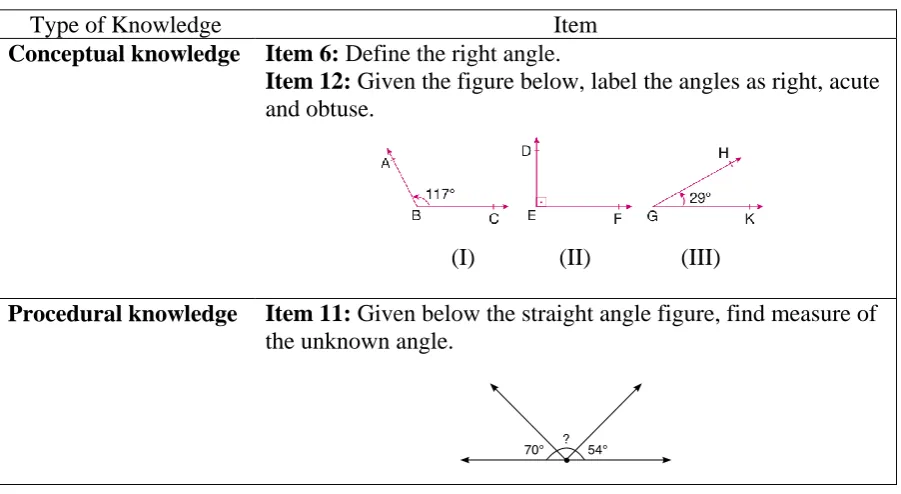
It should also be noted that conceptual and procedural knowledge are not always displayed in isolation. In particular, tasks influence students by directing their attention to a specific content and by indicating ways of processing information (Doyle, 1983). Accordingly, a task that reflects conceptual knowledge also incorporates procedural knowledge or vice versa depending on the task content. For instance, in relation to the items used in the present study, stating a correct definition for the right angle (see Item 6 in Figure 1) can be considered a matter of conceptual knowledge. It is not uncommon, however, for students to include the “add-and-subtract” algorithm for the complementary angles in a stated definition. Simply providing an accepted definition for right angle reflects knowledge of concepts. Including the “add-and-subtract” method reflects knowledge of procedure. Hence, when one states a definition for the right angle, there is the potential to display both conceptual and procedural knowledge. One’s definition for the right angle might include a descriptive statement that it is a type of angle, which equals 90° along with the algorithm used for determining it.
Type of Knowledge Item
Conceptual knowledge Item 6: Define the right angle.
Item 12: Given the figure below, label the angles as right, acute and obtuse.
(I) (II) (III)
Conceptual and procedural angle knowledge Aydin
27
Item 15: In the figure below s(𝐾𝑂𝐿̂) = 55°. Compute s(𝑅𝑂𝑁̂ ).
Figure 1. Specimen Items of the AT
Gender and Grade Level Differences
The effects of gender and grade level on conceptual and procedural knowledge in geometry are poorly understood. However, previous empirical findings related to mathematics provide some insight to guide further examination of patterns in which gender and grade level are related to conceptual and procedural knowledge of angles.
There is no specific study, so far as we know, on the existence of gender and grade level differences in conceptual and procedural knowledge of angles, although reports of individual differences in conceptual and procedural knowledge of fractions (e.g., Hallett, Nunes, & Bryant, 2010; Hallett, Nunes, Bryant, & Thorpe, 2012), addition/subtraction (e.g., Gilmore & Bryant, 2006), single-digit addition (e.g., Canobi, 2005; Canobi, Reeve, & Pattison, 2003), and single-digit multiplication (e.g., Mabbottt & Bisanz, 2003) do exist. In common, researchers concluded that students may take different pathways when acquiring conceptual and procedural knowledge and that there are individual differences in the way that they combine conceptual and procedural knowledge. Students’ conceptual and procedural knowledge have been found to become more strongly correlated or more effectively possessed as they gain experience in the domain. That is, for instance, as they move from kindergarten to Grade 2 (Canobi et al., 2003), from Grade 2 to Grade 4 (Gilmore & Bryant, 2006), from Grade 4 to Grade 5 (Hallett et al., 2010) and to Grade 6 (Mabbott & Bisanz, 2006), from Grade 7 to Grade 8 (Schneider, Rittle-Johnson, & Star, 2011), and from Grade 6 to Grade 8 (Hallett et al., 2012). Some findings, however, did not support this developmental trend indicating that no significant differences in the iterative relations between conceptual and procedural knowledge appear among females and males attending to middle school (e.g., Rittle-Johnson & Star, 2007; Rittle-Johnson et al., 2001).
Conceptual and procedural angle knowledge Aydin
28
More specifically, turning first to the gender differences, a broad body of literature has examined the performance differences between females and males on spatial/verbal (e.g., Battista, 1990) and graphics/diagrammatic tasks (e.g., Lowrie & Diezmann, 2011). In relation to the types of geometrical knowledge outlined in the present study, males’ advantage might be particularly pronounced in the case of spatial task that require the possession of procedural knowledge (Halpern, 2000; Halpern, Benbow, Geary, Gur, Hyde, & Gernsbacher, 2007). Although performance differences in such tasks are widely acknowledged (Else-Quest, Hyde, & Linn, 2010; Hyde et al., 1990; Linn & Petersen, 1985), Spelke (2005) indicated that these differences between females and males have disappeared in the recent years. Nevertheless, a substantial body of literature (Vasilyeva, Casey, Dearing, & Ganley, 2009; Vasilyeva & Bowers, 2006; Voyer et al., 1995) has documented moderate differences favoring males in performing spatial tasks that require the generation and manipulation of geometric figures (procedural knowledge). In contrast, the verbal tasks that require using conceptual knowledge were not likely to show a male advantage: a small disparity was found in favor of females. A bulk of research also showed that females performed relatively well compared to males when using known algorithms (Kimball, 1989; Sabers, Cushing, & Sabers, 1987) and performing numeric computations (Kim, Plake, Wise, & Novak, 1990; McGraw, Lubienski, & Struchens, 2006) that require displaying procedural knowledge. Some studies have found no evidence of gender differences in logical reasoning (e.g., Battista, 1990) or geometric proof writing (e.g., Senk & Usiskin, 1983) that call for conceptual knowledge activation.
To account for these differences with reference to the knowledge of angles, Smith et al. (2014) designed a task-based interview to understand the way 3rd and 4th grade students build relationships among angles, angle types, and angle measurement (conceptual knowledge) as they completed the tasks. Although, the learning outcomes were reported for all the students who participated in the interview, it was interesting to detect that researchers chose two students (one female and one male) from Grade 3 to describe in detail regarding the criteria that the male student showed considerable gains in conceptual knowledge (from 20% to 100%) whereas the female student did not demonstrate any learning gains at all (answering zero questions correctly).
Conceptual and procedural angle knowledge Aydin
29
struggled with using such multiple representations to define angle types by using the size of angles (conceptual knowledge) and thus had difficulties with conceiving of 0°, 180°, and 360° angles (procedural knowledge). Mitchelmore (1998) supported this declining trend by
showing that students in Grade 2, compared to students in Grade 4 and Grade 6, were more able to recognize dynamic (e.g., the action of opening a pair of scissors) angle-related similarities (procedural knowledge). On the other hand, students in Grade 4 and Grade 6 tended to easily recognize static (e.g., the result of the opening) angle-related similarities (conceptual knowledge) than students in Grade 2 did.
Further evidence for the existence of differences in conceptual and procedural angle knowledge between students in lower and higher grade levels was obtained by Simmons and Cope (1990) in an analysis of Grade 2-Grade 7 students’ basic knowledge of angles. They found that students in higher grades (Grades 5, 6, and 7) were not able to estimate the size of 60°, 90°, and 120° angles (procedural knowledge). Besides, neither students in higher grades (Grades 5, 6, and 7) nor in lower grades (Grades 2, 3, and 4) were able to label internal/external angles (conceptual knowledge). In a collective manner, although the Grade 4 classroom enrolled in Devichi and Munier’s (2013) study was able to understand right angle (conceptual knowledge) and make estimations of angle size based on side length (procedural knowledge), the Grade 3 classroom was not. This result was not surprising given the findings from Clements and Burns (2000) emphasizing that even above-average ability students’ in Grade 4 encountered difficulties with the definition of angle measure (conceptual knowledge) and the development of strategies for angle measure by establishing benchmarks such as 90° (procedural knowledge).
The Current Study
In studying conceptual and procedural knowledge, researchers have been overly focused on mathematics domains particularly arithmetics, while neglecting the potential importance that geometry domains such as angles might have. In addition, gender and grade level differences in conceptual and procedural knowledge of angles are under-researched. The present study aims to address these gaps. Specifically, I aimed to contribute to the literature by bringing the two types of angle knowledge (conceptual and procedural) on the scene and to show possible gender and developmental trends in the use of conceptual and procedural angle knowledge. I attempted to address the following research questions which had not been thoroughly elucidated in previous research: (1) Are there gender and grade level differences in terms of conceptual and procedural angle knowledge?; and (2) Are gender and grade level differences, if any, consistent across conceptual and procedural angle knowledge? In line with the exploratory nature of this study, no specific hypotheses were given a priori.
Method
Participants
Conceptual and procedural angle knowledge Aydin
30
analysis was conducted by using Little’s MCAR test (Little, 1988). In this regard, the item non-response in the data set (i.e., demographic and outcome variables) was examined. Results revealed that the data were missing completely at random (MCAR) (p= .635, p > .05). Given the low percentage of overall nonresponse rate (3%) of the data and that, the data are MCAR; the listwise deletion procedure that would give unbiased estimates (Cohen, 1998) was used. Following that, 55 cases (22 sixth and 33 seventh graders) were eliminated due to the following: showing insincerity in their responses (e.g., scored 0 in the total test), not completing the test, multivariate outliers (6 cases), or missing demographic information (e.g., gender not specified), leaving 360 sixth and 343 seventh graders, with a total of 703 students (380 females and 323 males) (see Table 1).
Table 1
Distribution of Grade Levels by Gender
Grade 6 Grade 7 Total
Females 177 203 380
Males 183 140 323
Total 360 343 703
Instrument
Angles Test (AT). All outcome variables were drawn from the students’ scores on the AT developed by the researcher. The 18-item open-ended AT was designed to demonstrate student knowledge on angles (see Figure 1 for specimen items) within a broad base of fundamentals covered at both elementary (Grades 1-4) and middle (Grades 5-8) school levels.
Conceptual and procedural angle knowledge Aydin
31
complementary and supplementary angles given inside or outside the two dimensional figures (Procedural Knowledge). In these years, they also become more competent in building relationships between angles and angle measures (Conceptual Knowledge). When students move toward higher grades, they become relatively more comfortable with defining, classifying, and symbolizing angles (Conceptual Knowledge) and applying, implementing, and exploring angle-related algorithms (Procedural Knowledge).
In line with the recommendations of the Standards for Educational and Psychological Testing (AERA, APA, & NCME, 1999), the development and validation of the AT were conducted within five phases: question generation and refinement, pilot study, exploratory factor analysis, confirmatory factor analysis, and reliability analysis. The whole test is available upon request from the researcher.
In Phase 1: Question generation and refinement, an initial 30-item question pool on knowledge of angles (e.g., definitions, symbols, and facts related to the angle concept, properties related to the angle types, visual representations of different angle types based on their measurement, and angles word problems) was constructed in the light of learning objectives for angles (MoNE, 2013) utilizing national exam archives (e.g., MoNE Level Determination Exam Questions, 2010–2014) and journal articles (e.g., Mitchelmore, 1997; Smith et al., 2014). The test items were then refined through providing evidence based on expert evaluations (two mathematics teachers and a mathematics educator). The three experts confirmed that the content of the AT was appropriate to measure middle school students’ basic knowledge of angles. In Phase 2: Pilot study, the AT was administered to 494 students attending to a public school other than the ones involved in the main study. Participants included 157 sixth, 181 seventh, and 156 eighth graders. A scoring scheme, which reflected the potential fully correct, partially correct, and incorrect responses was developed by the researcher. The correct, partially correct, and incorrect answers were scored 2, 1, and 0, respectively. The possible scores on AT ranged from 0 to 36. The researcher scored students’ responses and then randomly selected 100 cases to be checked by the mathematics educator, who was involved in the present study for expert evaluation. In order to establish the extent of consensus on use of the scoring rubric for the AT, inter-rater reliability coefficient was computed. The intraclass correlation (ICC) value of .83 indicated a quite high reliability (Cohen, 1998) and the internal consistency of the scoring rubric.
Conceptual and procedural angle knowledge Aydin
32
a reasonable size (> .30) to define its relevant factor (Hair, Black, Babin, Anderson, & Tatham, 2006). The communalities were above .30 (from .32 to .85), demonstrating that all the items fit well with the other items in its factor (Hair et al., 2006). This analysis guided to form the names of the content/context that are represented in each of the two dimensions: conceptual knowledge and procedural knowledge. The scores on the first factor, conceptual knowledge (10 items), reflected students’ knowledge of concepts, definitions, symbols, and facts related to the angles. The scores of the second factor, procedural knowledge (8 items), reflected students’ knowledge of procedures, methods, and techniques related to the applications of angles.
In Phase 4: Confirmatory factor analysis (CFA), the AT was administered to 205 students attending to a public school other than the one involved in the pilot study. Participants included 88 sixth, 62 seventh, and 55 eighth graders. Procedures for conducting CFA have been described elsewhere (e.g., Jöreskog & Sörbom, 1993) and are not further detailed here. The analysis was conducted by using LISREL 9.2 (Jöreskog & Sörbom, 2012). Fit indices recommended by Jöreskog and Sörbom (1993) were the ratio of chi-square to the degrees of freedom (χ2/df), root mean square error of approximation (RMSEA), root-mean-square residual (RMR), goodness-of-fit index (GFI), adjusted-goodness-of-fit index (AGFI), and comparative fit index (CFI). Schreiber, Stage, King, Nora, and Barlow (2006) suggested substantively interpretive models with chi-square ratios of three or less, a RMSEA from .06 to .08, a RMR below .08, a GFI above .90, an AGFI above .90, and a CFI above .90 as good fitting. In brief, results of the CFA revealed that the obtained fit indices for the two-factor model were χ2 (451.42, N = 205) = 1.21, RMSEA = .05, RMR = .06, GFI = .97, AGFI = .91, and CFI = .96. These indices suggested that the model fits the data, thus confirming that the underlying structure of the AT is formed by two factors that assess conceptual and procedural knowledge.
Finally, in Phase 5: Reliability analysis results showed that the Cronbach’s alpha coefficients were satisfactory (Cohen, 1998) for both conceptual (𝛼 = .77) and procedural (𝛼 = .71) knowledge, as well as for the total knowledge of angles on the AT (𝛼 = .83).
Data Collection
Conceptual and procedural angle knowledge Aydin
33
Data Analysis
To examine research questions, a multivariate approach to analysis of variance was performed with two independent (gender and grade level) and two dependent (conceptual knowledge and procedural knowledge) variables. A 2 x 2 multivariate analysis of variance (MANOVA) was conducted to examine the mean differences in terms of knowledge of angles for females and males and for those of different grade levels. MANOVA is an extension of analysis of variance for use when you have more than one dependent variable (Pallant, 2013). It is a robust statistical method that controls or adjusts for the increased risk of Type 1 error (i.e., the incorrect rejection of a true null hypothesis) (Tabachnick & Fidell, 2007). For multivariate results Wilks’ Lambda was applied. For multivariate results, the Wilks’ Lambda criterion was applied using the significance level .05. To present the effect size partial eta squared (partial 𝜂2) was calculated separately. Preliminary assumption testing on sample size, normality, linearity, multicollinearity, and homogeneity of variance matrices (i.e., Levene’s test, p > .05) was conducted and no violations were detected. All the analyses were conducted by using IBM SPSS 21.0 (SPSS Inc., 2012).
Results
Descriptive Statistics
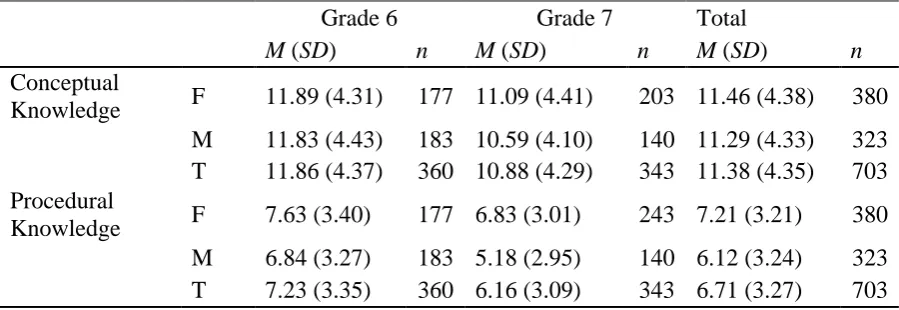
The means and standard deviations of conceptual and procedural knowledge scores were presented by gender and grade level in Table 2. From an overall perspective, middle grade students’ procedural knowledge scores were lower than their conceptual knowledge scores (see Table 4). Besides, there seemed to be a general pattern of reduced scores in students’ conceptual and procedural knowledge for both females and males in Grade 7. In general, both the conceptual and procedural knowledge scores were lower in Grade 7, gender differences seemed apparent in procedural knowledge but not in conceptual knowledge (see below for significance tests). Correlations among two knowledge measures were .67 in Grade 6 and .55 in Grade 7 (see Table 3).
Table 2
Means and Standard Deviations of Conceptual and Procedural Knowledge Scores by Gender and Grade Level
Grade 6 Grade 7 Total
M (SD) n M (SD) n M (SD) n
Conceptual
Knowledge F 11.89 (4.31) 177 11.09 (4.41) 203 11.46 (4.38) 380 M 11.83 (4.43) 183 10.59 (4.10) 140 11.29 (4.33) 323 T 11.86 (4.37) 360 10.88 (4.29) 343 11.38 (4.35) 703 Procedural
Knowledge F 7.63 (3.40) 177 6.83 (3.01) 243 7.21 (3.21) 380 M 6.84 (3.27) 183 5.18 (2.95) 140 6.12 (3.24) 323 T 7.23 (3.35) 360 6.16 (3.09) 343 6.71 (3.27) 703
Conceptual and procedural angle knowledge Aydin
34 Table 3
Variable Correlations for Grade 6 (upper triangle) and Grade 7 (lower triangle) and Internal Consistency Estimates (alpha)
1 2 𝛼 (6th)
1. Conceptual knowledge - .67** .79
2. Procedural knowledge .55** - .68
𝛼 (7th) .77 .65 -
Note. Grade 6: n = 360; Grade 7: n = 343. **All correlation coefficients are statistically significant, ps < .01.
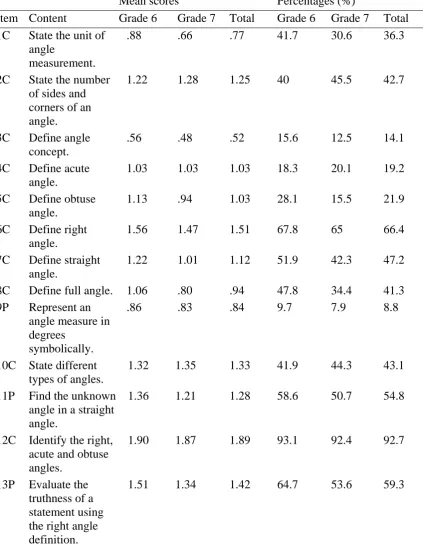
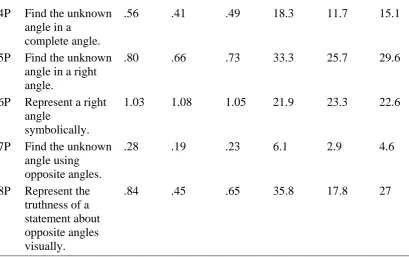
In addition, mean scores and percentages were calculated for each item (see Table 4). The mean scores along with the percentages represented, to some extent, the acquisition level of knowledge, and thus used as indicators of the most difficulties that students encountered in conceptual and procedural knowledge. Not surprisingly, the results in Table 4 demonstrated that overall, the mean scores of conceptual knowledge items were higher than procedural knowledge items within sixth and seventh graders as well as among the total sample of middle graders. As can be noticed, students were the most competent in identifying whether the given angle measure represents the right, acute, and obtuse angle (Item 12C) and defining the right triangle (Item 6C) in Grade 6 (M = 1.90 and M = 1.56, respectively) and Grade 7 (M = 1.87 and M = 1.47, respectively). In contrast, they had the most difficulties with evaluating the angle measure given the exterior angles of a triangle (Item 17P) and finding the angle measure given the two intersecting lines (Item 14P) in Grade 6 (M = .28 and M = .56, respectively) and Grade 7 (M = .19 and M = .41, respectively). In other words, there seemed to be a general reduction in procedural knowledge for both sixth and seventh graders, but the reduction tended to be greater for students in Grade 7.
Gender and Grade Level Effects on Conceptual and Procedural Knowledge of Angles
As can be observed in Table 5, results revealed that there was a statistically significant difference between females and males on the combined conceptual and procedural knowledge, F(2, 698) = 17.03, p = .00; Wilks’ Lambda = .95; partial 𝜂2 = .047. In addition, there were statistically significant differences among Grade 6 and Grade 7 students on a linear combination of conceptual and procedural knowledge, F(2, 698) = 12.97, p = .00; Wilks’ Lambda = .96; partial 𝜂2 = .036. It is noteworthy, the partial 𝜂2 values were small based on Cohen’s criteria (1998), demonstrating that both gender and grade level had a small effect size. More specifically, this implied that gender and grade level accounted for 4% and 3% of the total variation in the combined knowledge of angles, respectively.
Conceptual and procedural angle knowledge Aydin
35
variance in conceptual knowledge was attributable to differences in grade level. On the other hand, for conceptual knowledge the effect of gender did not reach statistical significance (see Table 5). Notice that gender effect (𝜂2 = .001) on the conceptual knowledge scores is trivial (negligible effect).
Table 4
Means and Percentages of Conceptual and Procedural Knowledge Items Across Grade Level
Mean scores Percentages (%)
Item Content Grade 6 Grade 7 Total Grade 6 Grade 7 Total 1C State the unit of
angle
measurement.
.88 .66 .77 41.7 30.6 36.3
2C State the number of sides and corners of an angle.
1.22 1.28 1.25 40 45.5 42.7
3C Define angle concept.
.56 .48 .52 15.6 12.5 14.1
4C Define acute angle.
1.03 1.03 1.03 18.3 20.1 19.2
5C Define obtuse angle.
1.13 .94 1.03 28.1 15.5 21.9
6C Define right angle.
1.56 1.47 1.51 67.8 65 66.4
7C Define straight angle.
1.22 1.01 1.12 51.9 42.3 47.2
8C Define full angle. 1.06 .80 .94 47.8 34.4 41.3 9P Represent an
angle measure in degrees
symbolically.
.86 .83 .84 9.7 7.9 8.8
10C State different types of angles.
1.32 1.35 1.33 41.9 44.3 43.1
11P Find the unknown angle in a straight angle.
1.36 1.21 1.28 58.6 50.7 54.8
12C Identify the right, acute and obtuse angles.
1.90 1.87 1.89 93.1 92.4 92.7
13P Evaluate the truthness of a statement using the right angle definition.
Conceptual and procedural angle knowledge Aydin
36 14P Find the unknown
angle in a complete angle.
.56 .41 .49 18.3 11.7 15.1
15P Find the unknown angle in a right angle.
.80 .66 .73 33.3 25.7 29.6
16P Represent a right angle
symbolically.
1.03 1.08 1.05 21.9 23.3 22.6
17P Find the unknown angle using opposite angles.
.28 .19 .23 6.1 2.9 4.6
18P Represent the truthness of a statement about opposite angles visually.
.84 .45 .65 35.8 17.8 27
Note. C: Conceptual knowledge, P: Procedural knowledge
Table 5
2 x 2 MANOVA Results for Gender and Grade Level Differences in Conceptual and Procedural Angle Knowledge
Univariate
Source Multivariate Conceptual knowledge Procedural knowledge
Fa p
partial F
b
p
partial F
b
p
partial
Grade 12.97 .00* 0.036 9.57 .00* 0.014 25.97 .00* 0.036 Gender 17.03 .00* 0.047 0.74 0.38 0.001 25.57 .00* 0.035
Grade x
Gender 1.75 0.17 0.005 0.43 0.51 0.001 3.17 0.07 0.005
Note: Multivariate F ratios were generated from Wilks’ Lambda statistic. aMultivariate df = 2, 698, bUnivariate df = 1, 699. * p < .05
Conceptual and procedural angle knowledge Aydin
37
Figure 2.Conceptual Knowledge Scores for Females and Males
Conceptual and procedural angle knowledge Aydin
38
Figure 3. Procedural Knowledge Scores for Females and Males
Discussion
Conceptual and procedural knowledge in mathematics have been studied extensively in the recent past. However, how students acquire conceptual and procedural knowledge with reference to individual differences related to gender and grade level has rarely, if ever, been examined. In the current study, I extended the existing research by examining the individual differences in conceptual and procedural knowledge within the context of angles.
The results support the idea that gender and grade level differences in conceptual and procedural angle knowledge do exist. The present study started by validating the two constructs that are generally accepted as the most common types of mathematical knowledge (Hiebert & Lefevre, 1986). Two components of knowledge applied to a specific geometry domain – conceptual and procedural angle knowledge – were tested in a CFA model, which provided support for the integrity of the measurement. Then using these validated constructs, potential gender and grade level differences were examined. Particularly, for the factor grade, the results showed that students in higher grades tended to have lower scores for both knowledge constructs. However, gender differences were somewhat different for each construct. For the research questions, the analysis found that:
(1) There were statistically significant mean differences in conceptual and procedural angle knowledge favoring students in Grade 6.
Conceptual and procedural angle knowledge Aydin
39 knowledge favoring females.
(3) Although no statistically significant gender differences were found for conceptual angle knowledge, inspection of the mean scores revealed female superiority. (4) Females and males had very similar patterns showing lower conceptual and procedural angle knowledge in higher grade levels of schooling.
Gender Differences
Results revealed that females had higher procedural angle knowledge scores than males. This corroborates the findings in mathematics achievement studies cited in the introduction. Importantly, when females and males were split according to grade level the same gender patterns were observed at sixth and seventh grade levels. The data agree with studies using Grade 6 and/or Grade 7 samples (Hallett et al., 2012; Mabbott & Bisanz, 2006; Schneider et al., 2011). They also suggest that mathematical knowledge gender patterns typically seen in higher grade levels can surface in early years of schooling (Levine et al., 1999; Voyer et al., 1995), in contrast to studies which found no gender differences in middle school samples (Rittle-Johnson & Star, 2007; Rittle-Johnson et al., 2001). More importantly, consistent with previous research on geometry in general and spatial thinking in particular (e.g., Kimball, 1989; McGraw et al., 2006), there was some evidence from this sample suggesting that reduced procedural angle knowledge may occur with respect to gender in favour of females.
Several reasons for apparent angle knowledge differences between females and males have emerged from the literature. On the one hand is the biological argument, frequently offered by researchers (e.g., Benbow & Stanley, 1982; Halpern, 2000), indicating that sex hormones modulate performance on specific cognitive tasks. The environmental argument, on the other hand, have often focused on the differential experience and socialization (for reviews see Friedman, 1989; Voyer et al., 1995), stating that, for instance, no gender differences in mathematics would be found if females were to take the same number of math-related courses as males. A range of alternative explanations may be possible for the female superiority in angle knowledge found in this study. First, it is possible that female students in the present study were likely to answer procedural angle knowledge questions given the evidence from previous research: When gender differences occur in samples of young children, females often score better on tests of computation that require procedural knowledge and males score better on tests of application that require conceptual knowledge (e.g., Kimball, 1989).
Conceptual and procedural angle knowledge Aydin
40
A cautionary note, however, should be made regarding the results. Recall that although no significant gender difference in conceptual knowledge was found, an overall inspection of the mean scores showed that females were more apt to perform well on conceptual knowledge questions than males did. Whatever the content of the AT questions might require conceptual or procedural knowledge, the whole test itself, might have reminded students of a classroom math test which was designed to cover what has been learned in class. A quantitative study such as that presented here cannot provide any clear answer as to which of these explanations best account for the existence of gender differences in procedural knowledge and non-existence of gender differences in conceptual knowledge, although it may serve to guide further research in more productive directions and provide considerable practical import. These gender-related issues need to be further investigated in future research. Conducting interviews with students and teachers could provide researchers a clear lens for understanding the big picture.
Grade Level Differences
Regarding developmental changes, results were consistent with previous research suggesting that students tend to have reduced conceptual and procedural angle knowledge as they mature (e.g., Mitchelmore, 1997; 1998). Supporting the downward developmental trend found in other research (e.g., Mitchelmore & White, 2000), the lower conceptual and procedural angle knowledge scores in higher grade levels call for serious attention. Because both conceptual and procedural angle knowledge tend to have significant influences on geometrical knowledge (see Clements & Burns, 2000; Krainer, 1991; Mitchelmore, 1998), the assisting potentials and facilitating roles of these cognitive constructs need to be capitalized. The tendency of weakening conceptual and procedural angle knowledge over middle school years implies that there may be something wrong in the classroom environment or in the curriculum content that need attention.
Conceptual and procedural angle knowledge Aydin
41
alarmingly great, the relatively consistent findings of research showing a general decline of conceptual and procedural angle knowledge in Grade 7 call for a re-examination of geometry classes in higher grades. As “differences are not deficiencies” (Halpern, 2000, p. 8), in any case, there may be a range of alternative explanations for the developmental patterns found here. These patterns need to be replicated in different grade levels for generalization and the reasons for such patterns need further examination.
Implications
Whereas the developmental patterns of conceptual and procedural angle knowledge tended to be very similar for females and males, there were some subtle gender differences that may have important educational implications. First, the differences between females and males were larger in the later years than early years of schooling (e.g., M = 6.83 for females’ procedural knowledge in Grade 7 vs. M = 5.18 for males). Although the differences were not large (e.g., 𝜂2 = .04 for this comparison), mathematics educators may ask: Is it the mathematics curriculum content or the pedagogy that has led to the males’ relatively lower conceptual and procedural knowledge? Can something be done to the middle school curriculum to make conceptual and procedural knowledge more appealing to males? Previous research has shown that although more males than females have positive attitudes towards mathematics (Hannula, 2002), their sense of competency tended to drop faster than females (Jacobs, Lanza, Osgood, Eccles, & Wigfield, 2002). Teachers may provide versatile support for males in higher grade levels suffering from conceptual/procedural knowledge activation: (1) prompt males to grow positive attitudes towards conceptual and procedural knowledge by putting emphasis on the importance of knowledge of concepts/procedures, and the relationships among them, and (2) develop multidimensional tests including both conceptual and procedural knowledge tasks in order to increase males’ confidence levels in the activation of these knowledge types. For instance, teachers may use multiple representations from the history of the angle concept such as introducing students first how the early Greeks attempted to classify everything in life into one of ten Aristotelian categories (Aristotle, 1980): substance, quantity, quality, relation, time, place, position, possession, passion, and action, and then asking them to categorize an angle in one of these categories (i.e., the angle is a quantity, namely, a distance between the lines containing it). Based on the categorizations, teachers may further request students to draw an angle and then to draw various other angles that could reflect the unfolding of the activation of conceptual and procedural knowledge.
Limitations
Conceptual and procedural angle knowledge Aydin
42
families in a low-to-middle socioeconomic location, the developmental patterns may not generalize to other students with higher socioeconomicstatus.
Also the present study used items including only angle concepts, relations, and measures. Since student knowledge activation in specific cognitive tasks may differ from one another (Lowrie & Diezmann, 2011) and performance patterns may differ across different mathematics content (Spelke, 2005), further research should investigate the patterns of development in specific tasks (e.g., diagrammatic) and content (e.g., triangles). Because females and males may differ in their conceptual and procedural knowledge as they grow up (Bielinski & Davison, 1998), the patterns may not be the same in certain specific tasks and content. Finally, gender and grade level-related differences in conceptual and procedural knowledge may vary among different cultures (Kimball, 1989). Cultural characteristics may have specific influences on students’ development in conceptual and procedural knowledge, which may influence performance in geometry in different ways. Further research may therefore consider using samples from different countries to facilitate cross-cultural comparisons.
Conclusions
To conclude, the present study found that both females and males tended to have lower conceptual and procedural angle knowledge in higher grade levels, which are known to affect mathematics learning outcomes. Whereas males tended to have lower conceptual and procedural angle knowledge scores than females, females’ higher scores did not sustain through later years of schooling. Since conceptual and procedural angle knowledge have important influences in geometry achievement, mathematics teachers, mathematics educators, and curriculum designers need to consider ways to improve and sustain these knowledge types, particularly in higher grade levels for both females and males. Whilst the findings imply the need for urgent attention to creating a productive classroom environment in which middle school students would find challenge and engage themselves actively in displaying conceptual and procedural knowledge, further research is required to determine the causes/correlates of individual differences in different types of knowledge. In order to improve students’ learning of geometry, further theoretical analysis of geometry topics that includes not only knowledge of the concepts and the procedures required by students, but includes the interrelationship between these two types of knowledge is the focus of future research.
References
AERA, APA, & NCME. (1999). Standards for educational and psychological testing. Washington DC: Author.
Aristotle (1980). Categoriae (Aristotle’s Categories and Propositions) (H. G. Apostle, Trans.). Grinnell, Iowa: Peripatetic Press.
Baroody, A. J. (2003). The development of adaptive expertise and flexibility: The integration of conceptual and procedural knowledge. In A. J. Baroody & A. Dowker (Eds.), The development of arithmetic concepts and skills: Constructing adaptive expertise studies. Mahwah, N.J.: Lawrence Erlbaum Associates, Inc.
Baroody, A. J., & Gannon, K. E. (1984). The development of the commutativity principle and economical addition strategies. Cognition and Instruction, 1(3), 321−339.
Bartlett, M. S. (1954). A note on the multiplying factors for various chisquare approximations. Journal of the Royal Statistical Society, 16(Series B), 296–298.
Conceptual and procedural angle knowledge Aydin
43
Battista, M. T. (1990). Spatial visualization and gender differences in high school geometry. Journal for Research in Mathematics Education, 21(1), 47-60.
Battista, M. T. (2007). The development of geometric and spatial thinking. In F. Lester (Ed.), Second handbook of research on mathematics teaching and learning (pp. 843-908). Charlotte, NC: Information Age Publishing.
Benbow, C. P., & Stanley, J. C. (1982). Consequences in high school and college of sex differences in mathematical reasoning ability: A longitudinal perspective. American Educational Research Journal,
19(4), 598-622.
Bielinski, J., & Davison, M. L. (1998). Gender differences by item difficulty interactions in multiple-choice mathematics items. American Educational Research Journal, 35(3), 455-476.
Bisanz, J., & LeFevre, J. A. (1990). Strategic and nonstrategic processing in the development of mathematical cognition. In D. F. Bjorklund (Ed.), Children’s strategies: Contemporary views of
cognitive development (pp. 213–244). Hillsdale, NJ: Lawrence Erlbaum Associates, Inc.
Bransford, J. D., Brown, A. L., & Cocking, R. R. (2001). How people learn: Brain, mind, experience, and school. Washington, DC: National Academy Press.
Byrnes, J. P., & Wasik, B. A. (1991). Role of conceptual knowledge in mathematical procedural learning.
Developmental Psychology, 27(5), 777−786.
Canobi, K. H. (2005). Children’s profiles of addition and subtraction understanding. Journal of Experimental Child Psychology, 92(3), 220-246.
Canobi, K. H., Reeve, R. A., & Pattison, P. E. (2003). Patterns of knowledge in children's addition.
Developmental Psychology, 39(3), 521.
Casas-García, L. M., & Luengo-González, R. (2013). The study of the pupil’s cognitive structure: the concept of angle. European Journal of Psychology of Education, 28(2), 373-398.
Casey, M., Nuttall, R., & Pezaris, E. (2001). Spatial-mechanical reasoning skills versus mathematics self-confidence as mediators of gender differences on mathematics subtests using cross-national gender-based items. Journal for Research in Mathematics Education, 32(1), 28–57.
Cattell, R. B. (1978). The scientific use of factor analysis. New York: Plenum Press.
Chazan, D. (1993). High school geometry students' justification for their views of empirical evidence and mathematical proof. Educational Studies in Mathematics, 24(4), 359-387.
Clements, D. H., & Battista, M. T. (1992). Geometry and spatial reasoning. In D. A. Grouws (Ed.),
Handbook of research on mathematics teaching and learning (pp. 420-464). New York: Macmillan. Clements, D. H., Battista, M. T., & Sarama, J. (1998). Development of geometric and measurement ideas. In
R. Lehrer & D. Chazan (Eds.), Designing learning environments for developing understanding of geometry and space (pp. 201–225). Mahwah, NJ: Erlbaum.
Clements, D. H., & Burns, B. A. (2000). Students' development of strategies for turn and angle measure.
Educational Studies in Mathematics, 41(1), 31-45.
Cohen, J. (1998). Statistical power analysis for the behavioral sciences. Hillsdale, NJ: Erlbaum.
Couto, A., & Vale, I. (2014). Pre-service teachers' knowledge on elementary geometry concepts. Journal of the European Teacher Education Network, 9, 57-73.
De Jong, T., & Ferguson-Hessler, M. G. M. (1996). Types and qualities of knowledge. Educational Psychologist, 31(2), 105-113.
Devichi, C., & Munier, V. (2013). About the concept of angle in elementary school: Misconceptions and teaching sequences. The Journal of Mathematical Behavior, 32(1), 1-19.
Doyle, W. (1983). Academic work. Review of Educational Research, 53(2), 159-199.
Duatepe-Paksu, A., & Ubuz, B. (2009). Effects of drama-based geometry instruction on student achievement, attitudes, and thinking levels. The Journal of Educational Research, 102(4), 272-286.
Else-Quest, N. M., Hyde, J. S., & Linn, M. C. (2010). Cross-national patterns of gender differences in mathematics: a meta-analysis. Psychological Bulletin, 136(1), 103.
Freudenthal, H. (1983). Didactical phenomenology of mathematical structures. Dordrecht: Reidel.
Friedman, L. (1989). Mathematics and the gender gap: A met-analysis of recent studies on sex differences in mathematical tasks. Review of Educational Research, 59(2), 185-213.
Gelman, R., Meck, E., & Merkin, S. (1986). Young children's numerical competence. Cognitive Development, 1(1), 1−29.
Gilmore, C. K., & Bryant, P. (2006). Individual differences in children's understanding of inversion and arithmetical skill. British Journal of Educational Psychology, 76(2), 309-331.
Conceptual and procedural angle knowledge Aydin
44
Hallett, D., Nunes, T., & Bryant, P. (2010). Individual differences in conceptual and procedural knowledge when learning fractions. Journal of Educational Psychology, 102(2), 395.
Hallett, D., Nunes, T., Bryant, P., & Thorpe, C. M. (2012). Individual differences in conceptual and procedural fraction understanding: The role of abilities and school experience. Journal of Experimental Child Psychology, 113(4), 469-486.
Halpern, D. F. (2000). Sex differences in cognitive abilities. Mahwah, NJ: Lawrence Erlbaum Associates. Halpern, D. F., Benbow, C. P., Geary, D. C., Gur, R., Hyde, J. S., & Gernsbacher, M. A. (2007). The science
of sex differences in science and mathematics. Psychological Science in the Public Interest, 8, 1–51. Henderson, D. W., & Taimina, D. (2005). Experiencing geometry. Euclidean and non-Euclidean with
history. New York: Cornell University.
Herbst, P., & Brach, C. (2006). Proving and doing proofs in high school geometry classes: What is it that is going on for students?. Cognition and Instruction, 24(1), 73-122.
Hiebert, J., & Carpenter, T. P. (1992). Learning and teaching with understanding. In D. A. Grouws (Ed.),
Handbook of research on mathematics teaching and learning (pp. 65-97). New York: Macmillan. Hiebert, J., & Lefevre, J. (1986). Conceptual and procedural knowledge in mathematics: An introductory
analysis. In J. Hiebert (Ed.), Conceptual and procedural knowledge: The case of mathematics (pp. 1– 27). Hillsdale, NJ: Lawrence Erlbaum Associates, Inc.
Hiebert, J., & Wearne, D. (1996). Instruction, understanding, and skill in multidigit addition and subtraction.
Cognition and Instruction, 14(3), 251−283.
Hollebrands, K. F. (2007). The role of a dynamic software program for geometry in the strategies high school mathematics students employ. Journal for Research in Mathematics Education, 38(2), 164–192.
Hyde, J., Fennema, E., & Lamon, S. (1990). Gender differences in mathematics performance: A meta-analysis. Psychological Bulletin, 107(2), 139–155.
Jacobs, J. E., Lanza, S., Osgood, D. W., Eccles, J. S., & Wigfield, A. (2002). Changes in children’s self-competence and values: Gender and domain differences across grades one through twelve. Child Development, 73(2), 509–527.
Jones, K. (2000). Providing a foundation for deductive reasoning: Students' interpretations when using dynamic geometry software and their evolving mathematical explanations. Educational Studies in Mathematics, 44(1-2), 55-85.
Jöreskog, K., & Sörbom, D. (1993). Structural equation modeling with the SIMPLIS command language. Hillsdale, NJ: Lawrence Erlbaum Associates.
Jöreskog, K. G., & Sörbom, D. (2012). LISREL 9.1 [Computer software]. Lincolnwood, IL: Scientific Software International.
Kaiser, H. F. (1974). An index of factorial simplicity. Psychometrika, 39(1), 31-36.
Keiser, J. M. (2004). Struggles with developing the concept of angle: Comparing sixth-grade students' discourse to the history of the angle concept. Mathematical Thinking and Learning, 6(3), 285-306. Kimball, M. M. (1989). A new perspective on women's math achievement. Psychological Bulletin, 105(2),
198.
Kim, H., Plake, B. S., Wise, S. L., & Novak, C. D. (1990). A longitudinal study of sex-related item bias in mathematics subtests of the California Achievement Test. Applied Measurement in Education, 3(3), 275-284.
Knuth, E. J., Stephens, A. C., McNeil, N. M., & Alibali, M. W. (2006). Does understanding the equal sign matter? Evidence from solving equations. Journal for Research in Mathematics Education, 37(4), 297−312.
Krainer, K. (1991). Consequences of a low level of acting and reflecting in geometry learning–Findings of interviews on the concept of angle. In F. Furinghetti (Ed.), Proceedings of the Fifteenth Annual Conference of the International Group for the Psychology of Mathematics Education (pp. 254–261). Assisi, Italy.
Leder, G. C., Pehkonen, E., & Törner, G. (2006). Beliefs: A hidden variable in mathematics education? (Vol. 31). Springer Science & Business Media.
Lehrer, R., Jenkins, M., & Osana, H. (1998). Longitudinal study of children's reasoning about space and geometry. In R. Lehrer & D. Chazan (Eds.), Designing learning environments for developing understanding of geometry and space (pp. 137-167). Mahwah, NJ: Erlbaum.
Lembke, L. O., & Reys, B. J. (1994). The development of, and interaction between intuitive and school-taught ideas about percent. Journal for Research in Mathematics Education, 25(3), 237−259.
Levine, S. C., Huttenlocher, J., Taylor, A., & Langrock, A. (1999). Early sex differences in spatial skill.
Conceptual and procedural angle knowledge Aydin
45
Linn, M. C., & Petersen, A. C. (1985). Emergence and characterization of sex differences in spatial ability: A meta-analysis. Child Development, 56(6), 138–151.
Little, R. J. (1988). A test of missing completely at random for multivariate data with missing values. Journal of the American Statistical Association, 83(404), 1198-1202.
Lowrie, T., & Diezmann, C. M. (2011). Solving graphics tasks: Gender differences in middle-school students. Learning and Instruction, 21(1), 109-125.
Mabbott, D. J., & Bisanz, J. (2003). Developmental change and individual differences in children's multiplication. Child Development, 74(4), 1091-1107.
Mayberry, J. (1983). The van Hiele levels of geometric thought in undergraduate preservice teachers. Journal for Research in Mathematics Education,14(1), 58–69.
McGraw, R., Lubienski, S. T., & Strutchens, M. E. (2006). A closer look at gender in NAEP mathematics achievement and affect data: Intersections with achievement, race/ethnicity, and socioeconomic status.
Journal for Research in Mathematics Education, 37(2), 129-150.
Moss, J., & Case, R. (1999). Developing children's understanding of rational numbers: A new model and an experimental curriculum. Journal for Research in Mathematics Education, 30(2), 122−147.
Ministry of National Education (MoNE) (2013). Ministry of National Education Archives (2010–2014).
Mitchelmore, M. C. (1997). Children's informal knowledge of physical angle situations. Learning and Instruction, 7(1), 1-19.
Mitchelmore, M. C. (1998). Young students’ concepts of turning and angle. Cognition and Instruction, 16(3), 265–284.
Mitchelmore, M., & White, P. (1998). Development of angle concepts: A framework for research.
Mathematics Education Research Journal, 10(3), 4-27.
Mitchelmore, M. C., & White, P. (2000). Development of angle concepts by progressive abstraction and generalisation. Educational Studies in Mathematics, 41(3), 209-238.
Moore, K. C. (2013). Making sense by measuring arcs: A teaching experiment in angle measure. Educational Studies in Mathematics, 83(2), 225-245.
Munier, V., Devichi, C., & Merle, H. (2008). A physical situation as a way to teach angle. Teaching Children Mathematics, 14(7), 402-407.
National Council of Teachers of Mathematics. (2000). Principles and standards for school mathematics. Reston, VA: Author.
Owens, K., & Outhred, L. (2006). The complexity of learning geometry and measurement. In A.Gutierrez & P.Boero (Eds.), Handbook of Research on the Psychology of Mathematics Education: Past, Present and Future (pp. 83-116). Sense Publishers.
Pallant, J. (2013). A step by step guide to data analysis using IBM SPSS survival manual. Berkshire: McGraw-Hill.
Rittle-Johnson, B., & Koedinger, K. R. (2005). Designing knowledge scaffolds to support mathematical problem solving. Cognition and Instruction, 23(3), 313–349.
Rittle-Johnson, B., & Schneider, M. (in press). Developing conceptual and procedural knowledge of mathematics. In R. Kadosh, & A. Dowker (Eds.), The Oxford handbook of numerical cognition. Oxford, UK: Oxford University Press.
Rittle-Johnson, B., Schneider, M., & Star, J. R. (2015). Not a one-way street: Bidirectional relations between procedural and conceptual knowledge of mathematics. Educational Psychology Review, 27(4), 587-597. Rittle-Johnson, B., Siegler, R. S., & Alibali, M. W. (2001). Developing conceptual understanding and
procedural skill in mathematics: An iterative process. Journal of Educational Psychology, 93(2), 346. Rittle-Johnson, B., & Star, J. R. (2007). Does comparing solution methods facilitate conceptual and
procedural knowledge? An experimental study on learning to solve equations. Journal of Educational Psychology, 99(3), 561.
Sabers, D., Cushing, K., & Sabers, D. (1987). Sex differences in reading and mathematics achievement for middle school students. The Journal of Early Adolescence, 7(1), 117-128.
Schneider, M., Rittle-Johnson, B., & Star, J. R. (2011). Relations among conceptual knowledge, procedural knowledge, and procedural flexibility in two samples differing in prior knowledge. Developmental Psychology, 47(6), 1525.
Schreiber, J. B., Stage, F. K., King, J., Nora, A., & Barlow, E. A. (2006). Reporting structural equation modeling and confirmatory factor analysis results: A review. The Journal of Educational Research, 99(6), 323−337.
Conceptual and procedural angle knowledge Aydin
46
Simmons, M., & Cope, P. (1990). Fragile knowledge of angle in turtle geometry. Educational Studies in Mathematics, 21(4), 375-382.
Smith, C. P., King, B., & Hoyte, J. (2014). Learning angles through movement: Critical actions for developing understanding in an embodied activity. The Journal of Mathematical Behavior, 36, 95-108. Soury-Lavergne, S., & Maschietto, M. (2015). Articulation of spatial and geometrical knowledge in problem
solving with technology at primary school. ZDM, 47(3), 435-449.
Spelke, E. S. (2005). Sex differences in intrinsic aptitude for mathematics and science?: A critical review.
American Psychologist, 60(9), 950.
SPSS (2012). IBM SPSS Statistics for Windows, Version 21. Boston, Mass: International Business Machines Corporation.
Star, J. R. (2005). Re-conceptualizing procedural knowledge. Journal for Research in Mathematics Education, 36(5), 404-411.
Star, J. R. (2007). Foregrounding procedural knowledge. Journal for Research in Mathematics Education,
38(2), 132-135.
Star, J. R., & Stylianides, G. J. (2013). Procedural and conceptual knowledge: exploring the gap between knowledge type and knowledge quality. Canadian Journal of Science, Mathematics and Technology Education, 13(2), 169-181.
Swafford, O. J., Jones, G. A., & Thornton, C. A. (1997). Increased knowledge in geometry and instructional practice. Journal for Research in Mathematics Education, 28(4), 467-483.
Tabachnick, B. G., & Fidell, L. S. (2007). Using multivariate statistics. Boston: PearsonEducation.
Tsamir, P., Tirosh, D., Levenson, E., Barkai, R., & Tabach, M. (2016). Developing a mathematically rich environment for 3-year-old Children: The case of geometry. In T. Meaney, O. Helenius, M. L. Johasson, T. Lange, A. Wernberg (Eds.) Mathematics Education in the Early Years (pp. 325-340). Springer International Publishing.
Usiskin, Z. (1982). Van Hiele levels and achievement in secondary school geometry (Final report of the Cognitive Development and Achievement in Secondary School Geometry Project). Chicago: University of Chicago, Department of Education. (ERIC Document Reproduction Service No. ED 220 288). Vasilyeva, M., & Bowers, E. (2006). Children’s use of geometric information in mapping tasks. Journal of
Experimental Child Psychology, 95(4), 255-277.
Vasilyeva, M., Casey, B. M., Dearing, E., & Ganley, C. M. (2009). Measurement skills in low-income elementary school students: Exploring the nature of gender differences. Cognition and Instruction, 27(4), 401-428.
White, P., & Mitchelmore, M. C. (2010). Teaching for abstraction: A model. Mathematical Thinking and Learning, 12(3), 205-226.
Wigfield, A., & Eccles, J. S. (2000). Expectancy-value theory of achievement motivation. Contemporary Educational Psychology, 25(1), 68–81.