Working with the Dynamic Perpendicular Quadrilateral in a Whole
Class Setting: Supporting Students in Developing a Hierarchical
Classification of the Kites
Susan K Forsythe
Open University [email protected]
This paper describes how a dynamic figure was used as the basis for a task designed to support students in developing the hierarchical classification of the kites and their subsets. Following on from a previous study using the task with pairs of students, I describe how I embedded the task into a pedagogical sequence of activities, which included class discussion and an animation of the dynamic figure. The findings from this study, essentially the final iteration of a larger Design Based Research study, show how the task can be effectively used in a whole class context. The dynamic nature of the figure together with the narrative descriptions of what happens to the figure under dragging can be shown to be valuable in the development of geometrical concepts and in particular the inclusion of the rhombus as a subset of the kites.
Introduction
Geometry is a valuable part of mathematics because it allows students to use their spatial intuition, gleaned from their lived experience of the world, to make connections with mathematical concepts. Geometry affords students the opportunity to form reasoned arguments based on geometrical figures to convince themselves and others. This forms the basis of analytical thinking and can facilitate students to create networks of geometrical concepts, and eventually to the skills of conjecture and deductive reasoning. An example of analytical thinking is the concept of inclusion when applied to the properties of 2D shapes. For example the squares can be considered to be special cases of the rectangles but this only follows if the definition of the rectangle by its properties has been constructed in such a way that the square can be considered to be a special case. However, students often hold definitions of the square and rectangle which place them into discrete classes which creates challenges to the development of the concept of inclusion.
The study recounted in this paper was the final iteration of a Design Based Research study (Forsythe, 2015, provides an account of the first three iterations, working with pairs of students). The aim of the study was to explore whether a task working with a figure created in a Dynamic Geometry Software (DGS) environment could act as the catalyst for the development of analytical reasoning in geometry in particular of the inclusion of the rhombus in the set of kites, both of which are examples of the perpendicular quadrilateral. The dynamic nature of the figure provides the potential for students to think and reason in a qualitatively different way from how they think and reason about static figures constructed on paper. Working with a dynamic figure can provide a novel context for students to re-examine what they understand about the properties of 2D shapes.
The Dynamic Perpendicular Quadrilateral and the First Iterations of the Study
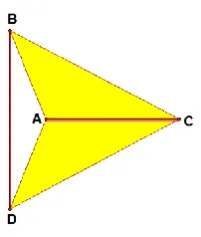
diagonals (AC 6 cm and BD 8 cm) which I have called bars. The endpoints of the bars are joined to form the quadrilateral ABCD as seen in Figure 1.
Figure 1. The Dynamic Perpendicular Quadrilateral (DPQ)
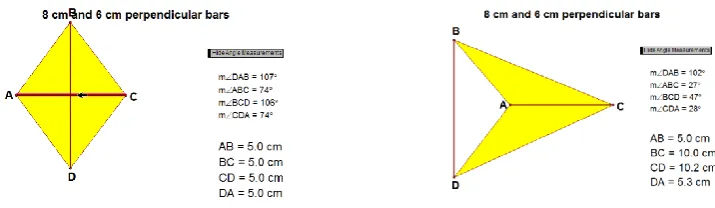
Many shapes can be generated such as kites, right angled triangles, a rhombus, etc, by using the computer mouse to move (i.e. drag) the bars inside the DPQ (see figure 2). If students are encouraged to describe the properties of the bars, which in quadrilaterals are the diagonals, then this can provide a different perspective through which to form shape definitions.
It is important to note that, although not included in the screen shots, the measurements of sides and angles were displayed in the file containing the DPQ, which allowed the students to check known side and angle properties.
kite ‘upside down’
kite
Arrowhead kite rhombus Isosceles
triangle
Figure 2. The DPQ in the positions for 2 kites, an arrowhead kite, a rhombus and an isosceles triangle
In the earlier iterations I observed that students used four different dragging strategies (Forsythe, 2015): wandering dragging, guided dragging (both described by Arzarello et al, 2002), refinement dragging, and a specific dragging strategy that preserved the symmetry of the figure where one diagonal was dragged along the line of the other one so as to act as its perpendicular bisector. I called this strategy Dragging Maintaining Symmetry (DMS). When used on the Dynamic Perpendicular Quadrilateral, DMS generates a family of kites with the rhombus at the middle position, isosceles triangles when the dragged diagonal touches the endpoints of the other diagonal, and arrowhead kites when the dragged diagonal moves past the endpoints of the other diagonal (see figure 2).
B
C A
D
D C A
B B
C A
This implies that the rhombus (and isosceles triangle) is a special case of the kites. However, the students in the first iterations of the study held strong prior definitions of the kites and rhombus which placed them in discrete classes, mitigating against the idea of inclusion of the rhombus in the kites. They typically reported that the DPQ could generate four kites (or a small multiple of four) in the four different orientations, in which the bars were positioned to give a typically proportioned kite. If I suggested they move the bar a little bit more this figure was adjusted to ‘eight’ or ‘twelve’. In order for students to gain an appreciation of the rhombus as included in the family of kites I posited that they needed to perceive that there are an infinite number of kites which could be made. This can follow from the perception that, as the rhombus appears at the mid-point of the dragging it must be a member of the family of kites generated by DMS. It seemed that the tendency to only recognise kites in familiar proportions prevented the students from perceiving that an infinite number of kites could be generated, meaning that the kite positions just before and after the middle (rhombus) position were not being acknowledged.
Manon-Erez and Yerushalmy (2007) conducted a study and observed that students who demonstrated Van Hiele level 3 reasoning were able to visualise a dynamic figure under dragging as continuously morphing between infinite versions of itself. This led me to ask whether the converse would be true. Would facilitating students to notice a shape continuously morphing help them to develop level 3 reasoning, in this case by showing them an animation of the DPQ under DMS?
After the first two iterations of my study I decided to test whether asking the student participants in iteration 3 to watch an animation of the DPQ under DMS would enable them to see the figure moving between many more kite positions than they had previously noticed. This was indeed the case. Watching the animation became the catalyst in challenging the students’ thinking as they were able to notice the DPQ continuously morphing through a possibly infinite number of kites, with the rhombus as the mid-point. Recorded dialogue indicated that student thinking was challenged, they noticed kites in many more different positions and their dialogue indicated that there was development in the direction of analytical thinking (Forsythe, 2015).
Before going on to describe the study undertaken with a whole class, I will consider the theoretical background to geometrical reasoning, how humans conceptualise dynamic figures, and finally the affordances of working with a whole class.
Learners’ Perception of Geometric Figures
The Figural Concept and Personal Figural Concepts
A geometric figure drawn on paper appears to be a specific example of a shape but in mathematics it is used to represent a whole class of figures. For example a drawing of a kite represents the class of all kites not just the particular example on paper. Fischbein (1993) described a geometric figure as having conceptual properties which include the definition that generates the properties of the figure, along with its figural nature; the visual image of its spatial qualities (the square-ness of a square, the circular nature of a circle). The fusion of these two is what Fischbein called the figural concept. However, students often have their own, ‘personal figural concepts’ (Fujita and Jones, 2007) which may be based on early learning experiences of seeing shapes in a particular orientation and proportion.
strongly held definitions for shapes which put them into discrete classes. This may result from the way that shapes are introduced to students in their early school years when, for example, they are taught informal definitions which exclude the squares from the set of rectangles (Dabell, 2014) and only see these shapes oriented so that one of their sides acts as the base. It also appears that some inclusions are easier to accept than others. Okazaki (2009) observed that students, of 9-10 years of age, agreed with rhombuses being included in parallelograms whilst they disagreed that rectangles are included in parallelograms. Okazaki found that students recognised tacit properties of rectangles and squares which included the 90 degree angles and that this property was held so strongly that it precluded the inclusion properties of rectangles and squares in any shape where the angles were not right angles. Fujita and Jones (2007) have suggested a hierarchy of difficulties among the acceptance of inclusive relations. They observed that students, in a study they conducted, found it easier to accept the inclusion of rhombuses in parallelograms than the inclusion of squares in rectangles.
The Van Hiele Levels for Geometric Reasoning
Moving from shape definitions which are exclusive of potential subsets of shapes, known as partitional classification (De Villiers, 1994), towards shape definitions which are inclusive, indicates an increasing level of sophistication in geometrical reasoning. Levels of reasoning in geometry can be categorised according to a framework originally described by Van Hiele (1986). In brief, and for the purposes of this paper, level one is the visual level at which students recognise shapes in a holistic sense. Level two is the descriptive level where students are able to label shapes and describe their properties. Students who reason at level two tend to categorise shapes into discrete classes (De Villiers, 1994) such as defining a kite as a quadrilateral with two smaller equal sides at the top and two longer equal sides at the bottom. Level three is the informal deductive level and hierarchical classification of shapes falls into this level (ibid). Hence, in order to reason at level three more flexibility is required in the way shapes definitions are constructed.
If students are to develop the concept of inclusion then they may need to modify their previously held definitions of shapes to support the understanding of one set of shapes as the subset of another. This implies that they need to look at shapes in a completely novel way to give them the chance to construct new definitions of shapes and working with dynamic shapes in a DGS environment could provide a context through which this is done.
Cognitive Apprehensions: Reasoning from Geometrical Diagrams
Duval (1995) provides an alternative framework for describing geometric thinking which considers how students reason about and work with visual representations of geometric figures. He argued that figures (by this he meant geometric diagrams) have a heuristic role and that to understand how a figure functions heuristically we need to consider its underlying cognitive complexity. Duval described four aspects of a figure which he named cognitive apprehensions. In the way he used the term ‘figure’ Duval differs slightly from Fischbein who used the term only to denote the theoretical object.
Perceptual apprehension: the ability to recognise the figure by its shape and recognition of sub-figures within the figure, for example visualising two pairs of congruent right-angled triangles within the kite.
Discursive apprehension: the ability to think about and to describe the figure, which includes articulating its properties. The development of the ability to use mathematical language is important in the development of students’ mathematical reasoning. Certain words or expressions in mathematics convey a complex web of ideas which form a mathematical concept and help to support students’ formation of concepts in mathematics (Lee, 2006). As students discuss geometrical principles using their geometrical vocabulary they develop their skills of explanation and justification. Duval (1998) also linked visualisation to the discursive process when a student describes what they are seeing and uses this as part of their reasoning process. Operative apprehension: this relates to physically or mentally operating on the figure in
order to learn more about it. Duval also linked operative apprehension to visualisation as a cognitive process (Duval, 1998) which helps students to solve problems using some of the gestalts to operate on the figure, e.g. to split it into sub-figures or transform the figure in some way, which he referred to as figural change. However, if operative apprehension is figurative change then this surely includes attention to the change in a dynamic figure under dragging. Indeed Leung (2011) claimed that when students use specific dragging strategies in order to operate on the figure to discover its geometrical properties, operative apprehension is brought to the fore.
Conceptualising Dynamic Figures
A figure in a dynamic geometry environment is an instantiation of a figure which has been constructed according to its properties, so that it will keep its properties when ‘dragged’ on the computer screen. For example if the figure has been constructed according to the geometrical properties of a square, when it is dragged it can change size, orientation and position, but it remains a square. The drag mode is a powerful affordance which is responsible for the visual dynamic nature of DGS figures and effectively provides the main vehicle for students to interact with the figures on the screen (Leung and Lopez-Real, 2002). Thus, it allows the screen image to represent the external version of the figural concept because it embodies the conceptual definition of the figure along with its visual shape (Mariotti, 1995).
When students work with a dynamic figure, their visualisation and reasoning about it is affected by the dynamic figural change occurring when the figure is dragged (a good description of operative apprehension). Students working in pairs or discussing their work in a whole class setting will talk about what they notice thus bringing discursive apprehension to the fore. Sinclair et al (2009) state that students engage in narrative thinking whilst interacting with dynamic figures under dragging and that this narrative is important in developing their understanding of geometry. Narratives have a sequential process, being accounts of events occurring over time which students can use to reason about mathematical relationships amongst the objects in the screen figure (ibid).
which is intuitive to expert mathematicians making it accessible even for students who may find this kind of imagery difficult to imagine. For all these reasons I would argue that reasoning about a static geometric figure is different to reasoning about a dynamic figure although they may be representations of the same theoretical object. In particular dragging allows the students to use operative apprehension because dragging causes figural change.
Dragging the Dynamic Perpendicular Quadrilateral Whilst Maintaining Symmetry
Dragging Maintaining Symmetry (DMS) describes an on-screen activity where students drag the bars, keeping one bar as the perpendicular bisector of the other bar, preserving the symmetry of the figure. Its pedigree arose from the ‘dummy locus’ dragging identified by Arzarello et al (2002) in their study of the cognitive aspects of using the drag mode in Dynamic Geometry. In dummy locus dragging students drag an object along a path in order to keep a property constant, although they are usually not aware of the path, hence the term ‘dummy locus.’ Further to this Baccaglini-Frank and Mariotti, (2010) described Maintaining Dragging where the student undertakes what appears to be dummy locus dragging with the intention to keep a specific property of the shape. DMS is a form of Maintaining Dragging where, in the DPQ, the ‘cross bar’ acts as the perpendicular bisector of the other bar, thus generating a kite (Forsythe, 2015). The interesting point which can be taken from the DMS strategy is that when it is used on the DPQ it generates a family of kites with the rhombus at one point and isosceles triangle at two points on the dragging journey. This provides the potential to use the figure as a pedagogical tool for the development of the concept of inclusion of the rhombus as a special member of the kite family (with interesting discussions to be had about the isosceles triangles).
A Whole Class Task Using the DPQ
Learning in a Whole Class Context
Having trialled and modified the task using the DPQ with pairs of students I wanted to find out whether it would be effective with a whole class of students since the classroom is the context in which most students learn mathematics. In addition the students in the classroom could be a resource for each other and bring into play the socio-constructivist aspects of learning as they discuss their developing mathematical ideas. Vygotsky (1978) said that children actively construct their own knowledge and understanding of the world by building on the knowledge they already have and in the cultural context in which they live. The school mathematics class is a small mathematical community with the teacher as expert. It is the teacher’s role to introduce their students to new mathematical concepts, and the tools which would support the learning of new concepts (Sutherland, 2007).
advanced than their peers, can prove to be an invaluable resource and influence the development of the other students (Sinclair and Moss 2012).
Methods and Analysis
In the remainder of this paper I will describe how I worked with a class of thirty-one students aged 12 to 13 who had not previously worked with a DGS program, for three sessions of fifty minutes each. The class were setted according to prior achievement which was above average for their age.
I used a Design Based Research approach (Cobb et al., 2003; Design-based Research Collective, 2003) to develop and trial a pedagogical task, using the DPQ, with ten pairs of thirteen year old students over three iterations of evaluation and improvement, and finally with a whole class of students. In a Design Based Research study, a pedagogical intervention based on learning theory and designed to improve learning, is developed and tested over several iterations, and the learning theory itself is further scrutinised and tested (Lamberg and Middleton, 2009). The pedagogical intervention in this study was the task using a dynamic figure which could be manipulated on a computer screen, and the research explored how students’ geometrical reasoning developed while they undertook the task in the DGS environment. The learning theory which was pertinent to the research was that of geometric reasoning outlined earlier.
The paper focuses on the fourth iteration where the task was modified to be used in a whole class context and explores whether it can be used as an effective pedagogical tool in the classroom to develop geometrical thinking.
Data comprised my recollections written straight after the lessons, photographs of students’ work, the on-screen recordings (using image capture software) and dialogue from the whole class lesson based on the dynamic figure and the posters which each student made at the end of the study. Essentially this study is the final iteration of the larger Design Based Research Study.
Data from the whole class lessons is qualitative and as such the analysis of the data is based on interpretation and reflection. I refer to Cohen et al (2003, p. 282) who gives four generalised stages of analysis:
Generating natural units of meaning (short episodes from the classroom sessions) Classifying, categorising and ordering those units of meaning (deciding on sub
-themes which describe the episodes, grouping these sub--themes into larger -themes) Structuring narratives to describe the data (a description of the on-screen activity
linked to dialogue and linked to students’ conceptualisation of the dynamic figure under dragging)
Interpreting the data (attempting to see the overall picture of how the students conceptualise shapes and their properties in the DGS environment).
Table One
Links Between Student Activity and the Van Hiele Levels of Geometric Reasoning
Description of reasoning
Flexibility of the personal figural concept
Exclusive or inclusive definitions held
How the student sees the DPQ under dragging
Van Hiele 1 Visual, holistic Typically holds a strong personal figural concept based on the typical representation which may include orientation of the shape
Shapes classified by partition into discrete classes because of their appearance
Views the DPQ as taking on the shape of a small number of examples
Van Hiele 2 Descriptive, understands the conceptual nature of shapes
Likely to hold a personal figural concept where the typical representation influences the perceived properties the shape Shapes classified by partition into discrete classes underpinned by the student’s list of shape properties
Views the DPQ as taking a discrete number of examples
Van Hiele 2-3 Student begins to consider that there are several ways to describe a shape using different sets of properties
Student is starting to consider that some shapes may be described in new ways
Student is beginning to question whether certain shapes could be special cases of other shapes
Views the DPQ as taking the form of a very large number of discrete shapes generated by tiny movements of the bars.
Van Hiele 3 Informal deductive reasoning,
understanding how the properties generate the shape
A more flexible figural concept is held which relies on the conceptual properties
Shapes classified hierarchically into inclusive sets.
Views the DPQ as a continually morphing shape
Overall Aims of the Three Sessions
The aim was to test whether working with the Dynamic Perpendicular Quadrilateral could be an effective intervention to develop the concept of inclusive relations, particularly for the rhombus as a special case of the kites, within a whole class context. I included the activities of working with the computer files and watching the animation within a pedagogical sequence of activities designed to support the development of the concept of inclusive relations. An important part of this pedagogical sequence was interactive whole class discussion bringing into play the socio-cultural aspects of learning.
“The most powerful way of introducing students to new mathematical ideas is to work creatively with a whole class so that students become collectively aware of the potential of new mathematical tools: new mathematical knowledge” (Sutherland, 2007, p.43).
Activities in the Whole Class Lessons
students put one bar over the other and imagined what shapes they could make if they joined the ends of the bars. The second additional constraint given was that one bar crossed the other at its mid-point i.e. now acted as the perpendicular bisector of the other, and the students were asked to imagine what shapes could be made. Students sketched some of these shapes on mini white boards. After this I added the final constraint that both bars crossed at their mid-points, i.e. were the perpendicular bisectors of each other. Only the rhombus results from this final stipulation when starting with unequal bars. The activities with the geo-strips were designed to mimic constructive classification of shapes (De Villiers, 1994) where each additional constraint produces a subset of the shapes generated in the previous stage.
Students worked in pairs on laptop computers with the computer file containing the dynamic figure constructed around 8 cm vertical and 6 cm horizontal bars. They were asked to investigate what shapes they could generate and to use the displayed measurements, of side lengths and angles, to try and make the shapes as accurate as possible.
After the activities with both the geo-strips and the dynamic computer figure students were asked to draw the shapes they had made, describe the shape properties and also describe the relative positions of the bars in order to generate the shapes.
The dynamic figure was projected from my laptop computer onto a whiteboard. Using a radio mouse, volunteer students dragged the figure into different shapes. During this activity a whole class discussion ensued where I posed questions such as:
o What has to be true to make that shape an accurate arrowhead?
o How could we make that an accurate kite?
o Are arrowheads and kites the same thing (in response to one pupil suggesting an arrowhead is a concave kite)?
The students watched the animation of the figure under DMS and were asked to describe what happened to the figure.
Class discussions explored whether shapes generated whilst dragging to keep one bar as the perpendicular bisector of the other might form a family of shapes.
Finally in the third lesson the students were asked to each make a poster illustrating what they had learned from the previous two lessons.
Reasoning about the Properties of the Shapes
In preparing the sequence of activities for the three lessons, I hoped to see evidence of developing reasoning in the students’ dialogue as measured using the Van Hiele levels. This was indeed the case although care needs to be taken when making such claims. Class discussion is known to be effective in helping students to develop their mathematical reasoning but is not such a useful tool to measure development in individual students. The worksheets students completed in the second session and the posters they each individually made in the third session provides better evidence for more individual development.
Individual Student Comments Whilst they Worked with the Geo-strips and Mini-Whiteboards
In the first activity the students used the geo strips to find shapes which could be made whilst keeping the diagonals perpendicular and then later keeping one diagonal as the perpendicular bisector of the other. They found it hard to articulate how the bars were positioned with each other and preferred to show me visually how they were positioned in their drawings on mini-whiteboards. In their description of the properties of the bars and the other properties of the shapes, students often referred to the diagram they had drawn. The figural aspect and its particular representation were clearly dominant. Aaron had drawn a kite and a square, both represented in the in typical ‘right way up’ style.
To make a kite:
Aaron: So you get the 5 centimetre bar and you put it anywhere on the 7 centimetre line but then the 7 centimetre line has to be in the middle of the 5 centimetre line.
Susan: What’s the difference between a square and a kite?
Aaron: A square is regular because all the sides are the same length and the sides are going either sideways or up and down. And a kite is more irregular with diagonal lines and all the lines are the same length.
Hence the kite has been described by the process of placing the diagonals (bars) and the square has been described by the property of equal sides and with reference to its typical orientation (from a holistic perception of the square). These descriptions are suggestive of a mixture of Van Hiele level one and level two reasoning.
Class Discussion Focused on the DPQ Projected on the Interactive Whiteboard
To provide some support to articulate the positions of the bars and the properties of the shapes, I projected the perpendicular quadrilateral onto the white board through my laptop computer and asked student volunteers to generate specific shapes by dragging the figure using a radio mouse, which could be passed round the room. I then encouraged the students to articulate properties of the bars and the properties of the sides and angles in the shape. It can be seen in the dialogue below that the use of mathematical language by me and some students in the class became a catalyst for the improved use of mathematical language by other students. This is important for the development of concepts as noted by Lee (2006).
Susan: You’re going to make a shape so that one bar bisects the other.
Figure 3 The arrowhead
Susan: OK, thank you very much. Do people agree? Which bar bisects the other?
Jacob: AC bisects BD
Susan: Is that an accurate arrowhead? What has to be true to make that an accurate arrowhead?
David: The AB length the same as the AD length. The CD length the same as the BC length.
In this excerpt Jacob can be seen to have mirrored my use of the word ‘bisect’ to tell me which bar bisected the other. David described the side properties of a kite by referring to specific sides in the displayed kite.
I decided to ask the students to consider the properties of the sides and angles of the figure and suggested that the rhombus might be a special parallelogram. Jayne made a suggestion:
Jayne: Doesn’t a parallelogram have no lines of symmetry and that does?
Jayne’s comment shows that her definition of the parallelogram (like many other students) uses a partitional classification which classifies the parallelogram and rhombus as distinct shapes. The typical parallelogram presented to students e.g. through textbooks, shows a shape with two longer parallel sides and two shorter parallel sides and no line symmetry, only rotational symmetry. This may have contributed to Jayne’s personal figural concept (Fujita and Jones, 2007) of a parallelogram which excludes the rhombus. A rhombus, has two lines of symmetry, and therefore cannot be deemed a special parallelogram if a parallelogram is defined as having no line symmetry.
Operative Apprehension in Evidence
The two episodes below appear to show that students were mentally moving the shapes with reference to what they had seen happen when the bars were dragged in the DPQ.
Jacob: Isn’t it a concave kite?
Susan: That’s an interesting thought. Go on then.
Jacob: Erm, because it’s like a kite but where the A is, if you pulled it out it would be a kite. If you move the line (he meant bar) across.
Figure 4. Bar AC was moved left and right to demonstrate a kite (although the end point was a rhombus) and back to the arrowhead
This movement suggested that Jacob conceptualised the arrowhead as a kite which had been dynamically changed by dragging one bar symmetrically through the shape. He was using operative apprehension (Duval, 1995) first mentally and then on screen when he dragged the bar AC.
The DPQ under DMS also generates isosceles triangles in four different positions. Does this mean the isosceles triangle is in the DPQ family of kites? I asked the class whether they thought the triangle was a special version of a perpendicular quadrilateral since we had made it from one.
Helen: A quadrilateral has four sides
Aftab: When you crossed them over there were four points because there was one of them sticking out. When the point is on the same line, the A point is on the same line as BD, that means there are only three points.
Students’ Worksheets Showing Shape Diagrams, Description of the Bars, List of Shape Properties
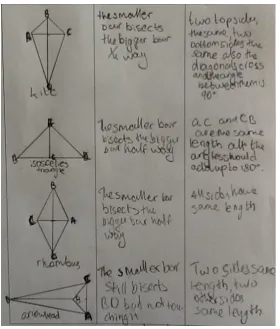
Figure 5. An example worksheet
In this worksheet, which was typical of those produced by the students, evidence for Van Hiele level 2 thinking can be seen, i.e. the student can identify properties of the shape. Note that the kite is proportioned so that the smaller bar is one quarter of the way up the longer bar, a commonly presented kite (a personal figural concept). The properties are described using partitional classification so that the kite is listed as having two different sizes of equal length sides and the rhombus with four equal sides. The student has noted that one bar bisects the other for each shape drawn, although they have it the wrong way round since BD bisects AC.
Students’ descriptions of the kite are the most illuminating. Some described the bars for the specific kite they had drawn, e.g. describing one bar as being above the middle or one third of the way down. Other students described the kite in more general terms, e.g. “that one bar crosses the other at any point” or that “you can make an infinite number of these (kites) by moving the shorter bar up or down the longer bar”. These last two descriptions are indicative of movement towards Van Hiele level three reasoning since the student is validating kites in less typical presentations.
the whole class discussions. Then Kerry called me over, very excited to tell me what she had just discovered:
Kerry: A kite and an arrowhead have the same properties
Susan: A kite and an arrowhead have the same properties?
Kerry: Yes
Susan: Well what are the properties?
Kerry: Two sets of adjacent equal lines, two pairs of equal angles and one line of symmetry
Susan: That’s very good. So what’s the difference between the kite and the arrowhead?
Kerry: That BD is more, it’s more concave
Susan: What about the bars for a kite and the bars for an arrowhead?
Kerry: If you continue the line then they’re like the same.
Susan: What is the same?
Kerry: They both, the line BD bisects AC.
Susan: OK so that’s what’s the same about them
Kerry: BD cutting, bisecting AC
Susan: OK and what’s different about the bars for a kite and an arrowhead
Kerry: That AC is further away from BD
Kerry used the perceptual nature of the shape properties of kites and arrowheads in her thinking about these shapes. She was able to perceive BD as the bisector of AC even when the line segment labelled BD did not touch the line segment AC in the arrowhead (if you continue the line they’re the same). Thus, she was able to view arrowheads and kites as having the same properties, a movement towards Van Hiele level three reasoning.
On Watching the Animation: Insights into Students’ Reasoning, using
Evidence from the Posters
Arrowhead kite
Isosceles triangle
kite rhombus kite Isosceles
triangle
Arrowhead kite
Figure 6. Seven positions of the animated DPQ
D
C
A B
D
C
A B
D C
A B
D C
A
B
D C
A
B
D C
A
B D
C
A
In the previous paper I described what happened when two pairs of students watched the animation of the DPQ under DMS and how they noticed the shapes in between the beginning and end of the dragging journey. In the whole class lesson there was also a discussion but this involved only some of the members of the class (perhaps those brave enough to make a public comment) so I have presented evidence from the posters that each student made in the third session.
An Infinite Number of Kites
An impromptu conversation took place whilst pupils worked on their posters. Some students discussed whether there were an infinite number of kites or just a lot (but a finite number). The students who said there was a finite number appeared to be thinking about physically moving the bar a little bit along each time. The students who said there was an infinite number appeared to be thinking theoretically if the bar could be moved an infinitesimal amount (or as one boy said “0.0000000000000000 recurring 1”). This would suggest that viewing the animation did have an effect on the way the students perceived the shapes generated from the DPQ.
Comments on the posters included ‘these shapes are mostly kites’, and ‘special kinds of kites’. However, it is necessary to look more closely at their comments to ascertain whether the students truly understood the concept of inclusion. One student wrote:
You can move even one millimetre and it will be another shape.
This comment does suggest that the student continued to think in terms of (a large number of) discrete positions. However, this is a step towards the understanding of continuous change.
Another student wrote:
The smaller line (i.e. bar) must always bisect the other. So is the isosceles triangle really acceptable? Or if it bisects it just before the end is it a kite technically?
This student has wondered if the figure continues to be a kite right up until the point when it becomes an isosceles triangle. Their thinking had been perturbed by the new ideas with which they had been confronted, perhaps as a result of watching the animation.
A Family of Kites?
Nineteen of the posters mentioned the shapes generated as being special types of the kite and many noted common properties (e.g. bar AC bisects bar BD for all the shapes).
These four shapes, namely a kite, isosceles triangle, arrowhead and rhombus all have one thing in common, they all have a perpendicular bisector. They all belong to the same family because all of them have a certain property when the bars AC bisect bars BD.
(Describing the animation) When slided along a certain line segment of a certain size, then 4 shapes are formed: a kite, an arrowhead, an isosceles triangle and a rhombus. The shapes always have two equal sides.
The second part of the comment indicates the use of operative apprehension as figural change due to sliding the line segment (bar) to generate the four types of shape.
Discussion
DPQ and added the animation to the task, which supported students in iteration three to visualise many more kites than they had when manually dragging. In the fourth iteration, described in this paper, the task was modified so that it could be used in a whole class context as part of a pedagogical sequence of activities. Whilst I was not able to analyse the reasoning of individual students in depth in the same way as when I worked with pairs of students, I was able to use a number of recorded conversations, written work and the individual posters to analyse the development of discussion within the class.
The recorded dialogue and students’ written work indicate a change in the discourse of the class over the three sessions. Van Hiele level 1 and 2 reasoning was in evidence at the beginning of the first session. By the end of the study there was evidence of a move towards level three reasoning where students perceived that dragging the bar (which acted as the perpendicular bisector of the other bar) generated many kites, including kites at their limit, i.e. close to the rhombus or isosceles triangles. Willingness to perceive these unusual shapes as kites was an aspect that developed over the course of the three sessions.
The data provides an insight into the discursive apprehension of the students; their reasoning about the properties of the shapes and connections between shapes. This is linked to operative apprehension when students describe how the bars move inside the DPQ and how this changes the figure. A description of figural change can be considered to be a short narrative as the student gives a chronological account such as “When slided along a certain line segment of a certain size, then 4 shapes are formed”.
As noted earlier the students were able to see displayed side and angle measurements next to the DPQ. When the students manually dragged the DPQ, or watched the animation, they were able to check side and angle properties of the figure, which helped them to accept that kites in unusual proportions (e.g. near to the rhombus position) were indeed kites using the properties of the shapes, which is indicative of Van Hiele level two reasoning. This supported the move towards level three reasoning for those students who perceived that the DPQ generated a rhombus when the perpendicular bisector was at the middle position with only a millimetre movement needed to generate a kite. The next stage, which as Mamon-Erez and Yerushalmy (2007) noted is linked to level three reasoning, would be to perceive the DPQ as being under continuous change.
are not in the typical representation of a kite, such as the DPQ when the positions of the bars are very close to the equilateral triangle or rhombus. As one student wrote on their poster
“…if it bisects it before the end is it a kite technically”?
The cognitive apprehension framework developed by Duval (1995) describes how students reason about figures. However it is possible to facilitate the use in students of the parts of the framework. In particular, operative apprehension is facilitated by dragging in a DGS environment and, as shown in this paper, has the potential to develop students’ reasoning from Van Hiele level 2 to 3. This can be supported by discursive apprehension when the student describes the changes in the DPQ that they see on the screen.
The value of using Dynamic Geometry as a medium for developing students’ geometrical reasoning lies in two ways. Firstly, the dynamic figure embodies the properties used in its construction, which students can explore by dragging the figure to see what changes and what stays the same. In this the dynamic figure acts as the external version of the figural concept, in the shape which it has generated and its geometrical properties, such as perpendicular diagonals. When the DPQ is dragged to maintain the symmetry of the figure (DMS) this generates the kite by default, which is a soft construction (Healy, 2000) since the property of symmetry (or one bar acting as perpendicular bisector of the other bar) must be carefully maintained through the student dragging using their judgement; ‘by eye’.
Secondly, the dynamic aspect of the figure allows students to reason through narrative as they note the invariant properties, through interaction with the figure through the drag mode. So that describing the bar as moving through the DPQ while it continues to bisect the other bar, and noting which properties of the figure are invariant can support the student in developing the concept of inclusion. However, the development of mathematical concepts by students is a complex process which necessitates that they are given time to work on tasks which support this development. This process will take different amounts of time and experience for each student.
Conclusion
The main focus of this study was to explore whether a task using a dynamic figure designed to help students to develop understanding of a hierarchical classification in 2D shapes can be effective within a whole class context. The dynamic nature of the DPQ, embedded within a pedagogical sequence of activities which includes class discussion appears to have supported the students to look at the shapes in a new way. Attending to the position of the diagonals (bars) inside the figure in general, and the shapes which are generated in particular, gave the students the opportunity to the concept of inclusion of, in this case, the rhombus in the set of kites. Observing the animation of the DPQ appears to have helped many of the students to notice more kites than they had previously when manually dragging the DPQ. The dynamic nature of DGS has the potential to encourage a narrative through which to challenge students to construct new concepts in geometry, such as the hierarchical classification of 2D shapes.
References
Arzarello, F., F. Olivero, D. Paola and O. Robutti (2002). A cognitive analysis of dragging practices in Cabri environments, ZDM,Vol. 34(3), pp. 66-72.
Baccaglini-Frank, A and Mariotti, M. A. (2010). Generating conjectures in Dynamic geometry: The maintaining dragging model. International Journal of Computing in Mathematics Learning 15: 225-253 Cobb, P., Confrey, J., diSessa, A., Lehrer. R., Schauble. L. (2003). Design Experiments in Educational
Cohen, L., Manion, L. and Morrison, K. (2003) Research methods in education. Routledge-Falmer. London Dabell, J. (2014). Faulty rectangles. Mathematics Teaching, 239, 38–39
De Villiers, M. (1994) The role and function of a hierarchical classification of quadrilaterals. For the learning of mathematics 14 (1): 11-18
Design-based research collective, (2003). Design based research: An emerging paradigm for educational enquiry. Educational researcher, 32 (1): 5-8
Donald, M. (2001). A mind so rare: The evolution of human consciousness. WW Norton & Company. New York.
Duval, R. (1995), Geometrical pictures: kinds of representation and specific processings. In R. Sutherland and J. Mason (Eds), Exploiting Mental Imagery with Computers in Mathematics Education. Berlin: Springer Duval, R. (1998) Geometry from a cognitive point of view. In C. Mammana and V. Villani (Eds) Perspectives
on the teaching of geometry for the 21st century. Kluwer Academic Publishers
Fischbein, E. (1993), The theory of figural concepts. Educational studies in mathematics. 24(2) : 139-162
Forsythe, S.K., (2015). Dragging maintaining symmetry: can it generate the concept of inclusivity as well as a family of shapes?. Research in Mathematics Education, 17(3), pp.198-219.
Fujita, T. and Jones, K. (2007). Learners’ understanding of the definitions and hierarchical classification of quadrilaterals: towards a theoretical framing. Research in Mathematics Education 9(1) :3-20
Jackiw, N. (2012). The Geometers Sketchpad version 5.05 [Computer software]. Emeryville, CA: Key Curriculum Press.
Lamberg, T.D. and Middleton, J.A., 2009. Design research perspectives on transitioning from individual microgenetic interviews to a whole-class teaching experiment. Educational Researcher, 38(4), pp.233-245.
Lee, C. 2006. Language for learning mathematics: Assessment for learning in practice. McGraw-Hill Education, OUP
Leung, A., & Lopez-Real, F. (2002). Theorem justification and acquisition in dynamic geometry: a case of proof by contradiction. International Journal of Computers for Mathematical Learning, 7(2), 145-165. Leung, A. (2008). Dragging in a Dynamic Geometry Environment through the lens of variation. International
Journal of Computers for Mathematical Learning 13:135-157
Leung, A. (2011) An epistemic model of task design in dynamic geometry environment. ZDM Mathematics Education 43: 325-336
Mamon Erez M and Yerushalmy M, 2007. “If you can turn a rectangle into a square, you can turn a square into a rectangle...” Young students experience the dragging tool. International journal of computers for mathematical learning 11: 271-299
Mariotti, M. A. (1995). Images and concepts in geometrical reasoning. In R. Sutherland and J. Mason (Eds), Exploiting mental imagery with computers in mathematics education. Berlin: Springer
Okazaki, M. (2009) In Tzekaki, M., Kaldrimido, M. and Sakonidis, H. (Eds). Proceedings of the 33rd
Conference of the International Group for the Psychology of mathematics education, Vol 4, pp. 249-256. Thessaloniki, Greece: PME
Sinclair, N., Healy, L., & Sales, C. O. R. (2009). Time for telling stories: Narrative thinking with dynamic geometry. ZDM, 41(4), 441-452.
Sinclair, N., & Moss, J. (2012). The more it changes, the more it becomes the same: The development of the routine of shape identification in dynamic geometry environment. International Journal of Educational Research, 51, 28-44.
Sutherland, R. (2007). Teaching for learning mathematics. McGraw-Hill International.
Van Hiele, P. M. (1986) Structure and Insight. Academic press