Copyright © The Author(s). All Rights Reserved. Published by American Research Institute for Policy Development DOI: 10.15640/jpbs.v6n1a5 URL: https://doi.org/10.15640/jpbs.v6n1a5
The Influence of Prudence, Cognitive Ability, and Personality on Risk Aversion
Regina Natasha
1& Yanuar Nanok Soenarno
2Abstract
We conduct this experiment to observe the effect of prudence, cognitive ability, and personality correlating with risk-averse decision. In this experiment, we make binary choices between risky lotteries that distinguish prudent from imprudent individuals. We also gave them tasks to measure their cognitive ability and neuroticism personality. We find that a more positive neuroticism personality and lower cognitive ability correlate with greater risk-averse decision making while prudence has an insignificant effect on risk-averse.
Keywords: prudence, cognitive ability, personality, risk aversion, psychological factors 1. Introduction
Humans can’t separate themselves with making decisions. They are supposed to make decisive choices that affect further situations every day. These decisions always come with risks. (Woodford et al., 2017), however, people often feel reluctant to risks, especially in economic activities. They tend not to accept fair bets, even if they have that occasional chance to get more valuable prizes. They do all of that in order to avoid uncertain results in the future.
According to empirical works, psychological factors often affect the degree of risk aversion. These factors may vary from individual to individual. However, it’s clear that prudence takes a significant part in risk aversion. Therefore, (Breaban et al., 2016) said that higher order risk attitudes; prudence and temperance, complement the role of risk aversion in economic decision making.
A study that correlates imprudence with poor decision-making shows that careless people tend to get into financial problems (Noussair et al., 2014). Therefore, we need to know what aspects that could cause this imprudent decisions-making. For example, an investor is faced with a situation that forces them to choose some investment. There’s always this most prudent and dominant psychological factor that influence their decisions. Elster (1998), Hermalin and Isen (2000) said that in any decision-making process, one will certainly involve one’s emotions. Emotional involvement in decision-making process often makes them irrational, causing them to act only by instinct instead of in-depth analysis. This kind of decisions not only dangerous but also come with high risks. Investor irrational actions are usually driven by specific emotions such as fear, greed, and panic. Investors that belong to this risk averter group tend to avoid risks. Instead, they are more likely to invest in assets that provide fixed income such as deposits, bonds or shares that classified as blue chips. These investors are aware of not expecting an optimal investment return, fixing their profits in the stable and minimal state.
1 Jl. Kayumanis X No. 9, East Jakarta 13130, Indonesia. Regina is currently taking Economy-Accounting as a major at Atma Jaya
University in Jakarta, Indonesia. This is her last semester and willbe graduate at Mei 2018. Mukhlasin, the head of accounting study program gave her the chance to write an international journal. This is the first journal that she write for her thesis. [email protected], +62 85697928985
2Jl. JendralSudirman No.51, RT.5/RW.4, South Jakarta 12930, Indonesia.Mr. Yanuar is Regina’s mentor thesis. He is an
There’re also significant differences between people with higher cognitive abilities (IQ) and the lower one. The higher one usually lives longer, earns more, has more work experience, reacts faster and be more vulnerable to visual illusions (Jensen, 1998). However, although there is a various phenomenon associated with IQ, only a few are considered having the impact on decision-making and risk avoidance. Hence, in this research, we want to observe further regarding this matter and compare it with psychological aspects in the context of decision-making and risk aversion.
2. Theoretical Background
Before making a decision, people generally think about the risks that come with the decision. Frequently, people are reluctant to risk. According to Breaban, et al (2016), empirical work has shown that risk aversion is often influenced by psychological factors such as prudence, cognitive ability, and personality.In the realm of saving behavior, prudence decides how savings behavior change as future income becomes riskier (precautionary saving, Kimball, 1990). Noussair et al., (2014), who study a large number of samples of demographically representative individuals, found that those who indicate more prudent decision-making also have greater savings, lower debt, more wealth and higher educational attainment.
Breaban., et al (2016) observed that larger cognitive abilities, as measured by Raven test scores, can be associated with greater prudence. Cognitive ability here is distinguished between higher cognitive ability individuals and the lower cognitive ability individuals. These aspects create the different approach to risk-aversion in the scope of prudence.
Personality also plays some important roles that could affect individual in making decisions, including risk aversion. Because each person has a different personality, against risks, their nature and actions may vary. This study will minimize the scope so that it will only discuss one kind of personality that is neuroticism, correlating with risk aversion.
Hence, we can say that either prudence, cognitive ability, or personality are directly related to risk aversion. The following will describe their respective hypotheses regarding their impact on risk aversion.
2.1 Prudence
In our scope, prudence is precaution acts that determine one decision towards a problem, including risks. The more prudent someone is, the more cautious he will be toward risks. This is supported by (Marilen, 2008) with her explanation regarding Kimball’s theory of precautionary. It is said that absolute prudence is defined as the gradient of probability in two separate events yet contained in linear equations. The effect of prudence is hugely on precautious and hence having a very strong impact on risk aversion because risk only can be realized if someone is cautious. For example, a stock expert will have a natural sense of danger when a critical stock is going to drop. Though according to Dionne and Eeckhoudt (1985), a connection between prudence (precautious) and risk-aversion also has an ambiguous effect on optimum business levels. The intuition of this result is simple. For example, it is optimal for a risk-neutral agent not to make any effort so that the accident will happen with certainty. In this situation, a hard effort will cause a risk, since the probability of an accident will be less than one entity which makes it not desirable for risk-averse agents. So according to them, prudence only will strengthen the will of not averting risk. This can be true, if only if the situation is neutral. However, in a critical moment as we defined in the introduction, this logic can’t be accepted because it missed some aspects of accounts such as options variety and psychological conditions at the time.
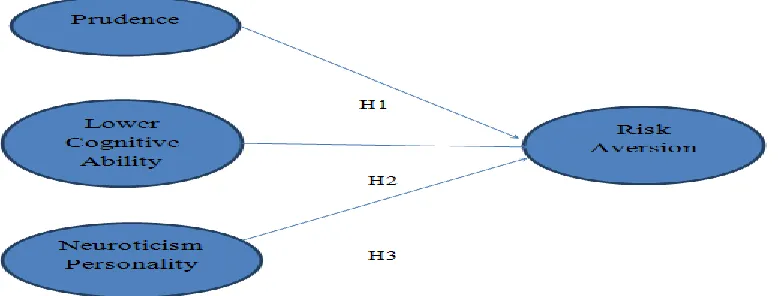
We conclude that decision-makers’ cautiousness, suggesting prudence, must have a significant effect in risk-aversion. A cautious decision will likely create a positive effect on risk risk-aversion. With that logic, we can say the same to a cautious linear subject that is prudence. Hence, we can formulate the first hypothesis of this study as beneath:
H1: Prudence has a positive and significant effect on risk aversión 2.2 Cognitive Ability
A rational person would focus on reasons and tend to delay things when making a decision in order to reduce the uncertainty and avoid the risk to obtain a rational explanation in the framework of decision-making. For example, investors are assumed willing, able to receive and analyze all available information based on rationality thinking.
A rational investor tries to control the factors that can influence the behavior of market participants in the future such as information and forecasting. This is done by gathering as much information as possible. The purpose of investment activity is not to gain a quick profit, but a steady increase in investment, in a relatively long period (long-term). These investors are willing to take risks if it is known that the investment is not profitable in the short term but safe for the long term. If the goal cannot be achieved with a certain level of risk (or even without risk), then at least the risk must be controlled (Natapura, 2009).
According to Frederick (2005), researchers can ignore cognitive abilities because they are more interested in the average effects of some experimental manipulations. On this view, individual differences (in intelligence or other things) are perceived as distractions - only as an unexplained "unexplained" source of variants. Second, most research is done on college students, who are widely considered to be quite homogeneous. Third, characterizing performance differences in cognitive tasks requires terms ("IQ" and "talents" and such) that many fear because of their relationship to discriminatory policies. In short, researchers may be reluctant to learn something they do not find attractive, which is not felt much difference in the subject area obtained easily, and that will get them into trouble. But as expressed by Lubinski and Humphreys (1997), the abandoned aspects do not cease to operate because they are abandoned, and there is no good reason to ignore the possibility that general intelligence or more specific cognitive abilities are important decision-making factors in the face of risk aversion. Based on research of Dohmen et al. (2017), an individual with a higher cognitive ability is significantly more willing to take risks in the lottery experiments compared with an individual who has a lower cognitive ability who is more likely to be risk-averse. Someone with lower cognitive ability tends to retreat and do not want to get greater results if it has a big risk. He prefers to get moderate results with lesser risk.
Therefore, the second hypothesis in this study can be formulated as follows: H2: Lower cognitive ability has a positive and significant effect on risk aversion. 2.3 Personality
Decision-making in terms of risk-related is also influenced by psychological factors such as personality. According to Crysel et al. (2013) personality is an individual way of interacting, reacting, and acting with other individuals and is often shown through measurable characteristics. Personality is a dynamic and organized set of characteristics possessed by a person that uniquely influences their environment, cognitions, emotions, motivations, and behaviors in various situations.
Based on research conducted by Goldberg, L. R. (1990), it is known that there is five personality that is extraversion, conscientiousness, and openness personalities to experience which tends to choose investment instrument with high-risk level, while personality with the character of agreeableness and neuroticism will tend to choose the instrument of low investment risk. But this study will not discuss deeply this five personalities. We will only discuss further the personality of neuroticism.
Neuroticism is a personality dimension that assesses one's ability to withstand stress. Positive characteristics of neuroticism are called Emotional Stability. Individuals with emotionally stable tenders calm when facing a problem, confident, have a firm stand. While the negative characteristics of Neuroticism are emotional instability associated with high anxiety and highly sensitive (John et al., 2008). These individuals tend to have a pessimistic outlook that may affect their willingness to assume investment risks (Joyce & L, 2013). And they experience nervousness that is “a little worse than normal” in a given situation or someone who is “a bit more cautious” before making a big deal. Not everyone that is jealous, anxious, or guilt-stricken can be regarded as a neurotic person, and many people that are neurotic do not show signs of anxiety. But there is some proof that those with the neuroticism personality type do seem to experience more anxiety than those without anxiety. According to Rammstedt& John (2007), neuroticism is a person who is easily anxious, angry, depressed, influenced by others, and carried away emotion.
Figure 1Research Model 3. Experimental Design and Procedure
3.1 The Participants and the Setting
The participants of this study consisted of 100 students from Atma Jaya Catholic University in Jakarta. The average age was 21 years and at their last year in the university which 51% of the subjects were female. All of the participants studied Economics and business majority in accounting. The subjects were recruited among the students of two Management Accounting classes. The experiment consisted of 4 phases. At the start of each phase 1 to 4, separate instructions were read aloud.
3.2 Procedures and Data Gathered
In the first phase of the experiment involves 9 direct pairwise choices. Each consists of a choice between one lottery that would be preferred by a prudent individual and an alternative that would be preferred by the imprudent decision maker in which both are related to risk aversion. An example of a choice as presented to participants can be found in Figure 2. In both stages, all subjects were presented with all the lotteries in the same order.
LEFT RIGHT
+Rp40.000,00 50%
50% Rp100.000,00 50% Rp100.000,00 50% -Rp40.000,00
+Rp40.000,00 50% Rp40.000,00 50% Rp40.000,00
-Rp40.000,00
Figure2 Example of a choice from phase 2 of the experiment
Analogously, if she chooses the prudent option in 4 or fewer instances, the individual is said to be imprudent and not a decision maker related to risk aversion.
Choice # Lottery displayed on left Lottery displayed on right % of instances in which
prudent choice was made
1 (10+(4_-4)4) (10_4+(4_−4)) 88.0***
2 (6+(1_-1)1) (6_1+(1_−1)) 79.5***
3 (12+(2_-2)3) (12_3+(2_−2)) 79.5***
4 (9+(2_-2)3) (9_3+(2_−2)) 74.7***
5 (8+(4_−4)4) (8_4+(4_−4)) 83.1***
6 (6+(1_−1)3) (6_3+(1_−1)) 73.5***
7 (7+(2_−2)2) (7_2+(2_−2)) 85.5***
8 (11+(3_−3)3) (11_3+(3_−3)) 88.0***
9 (13+(4_−4)4) (13_4+(4_−4)) 85.5***
(x_y) indicates a lottery with an equal probability of receiving either x or y; outcomes in tens of thousandsrupiah; *** indicates significant difference at 1% level from the random choice between left and right option, binomial test, two-sided.
Table 1 Prudent lotteries used and choice proportions
The second phase of the experiment, cognitive ability is measured using Raven's advanced progressive matrix test (Raven et al., 1998), a protocol commonly used to measure intelligence. The task involves choosing the correct selection of eight alternative possibilities to complement the 3-by-3 abstract matrix of abstract symbols in a consistent pattern. Because of the limited amount of time available in our experiment, we used the short form of the test proposed by Bors and Stokes (1998) that consists of 12 tasks. Each subject was given a total of 10 minutes to complete the 12 tasks and was allowed to revise the answers if time allowed.
In the third phase of the experiment consists of a questionnaire designed to obtain a classification of personality. More specifically, we use The Big Five Personality Test by TRUITY. But this study of its scope is narrowed by examining only the personality of neuroticism. Answers to the questionnaire about the subject personality were given a choice on a scale of 1 (inaccurate) to 5 (accurate) totaling 52 numbers within 15 minutes. In addition, background information on subjects regarding age and gender was also collected. There is some previous evidence that the dimensions of neuroticism are positively associated with risk aversion (Nicholson et al., 2005; Becker et al., 2012). We are unaware of any previous work that connects personality characteristics and prudence. For the final phase of our experiment, we conducted a Risk-Taking Test to measure the score of risk-averse that was scientifically validated by PsychTests. This test consists of 58 questions in 30 minutes. From the test number 1 to 43 subjects can choose the answer between 1. Completely Agree; 2. Completely Agree- Somewhat Agree / Disagree; 3. Somewhat Agree / Disagree; 4. Somewhat Agree / Disagree- Completely Disagree; 5. Completely Disagree. While the test number 44 until the last number require all the participants to choose one statement that best describes the subject itself related to risk selection.
Thus, for each participant, we observe as they perform the tests given as research data to measure the prudence (phase 1), cognitive ability (phase 2), personality dimension (phase 3), and the last test to measure risk aversion (phase 4). Figure 3 below shows the timeline of the experiment.
Phase 1 Phase 2 Phase 3 Phase 4
Measurement: Prudence preference Cognitive ability Personality (Neuroticism) Risk Averse
Task: 9 pairwise choices
between lotteries 12Raven’s matrices tests progressive The Big Five personality tests Risk Test Taking
Duration: Variable 10 minutes 15 minutes 30 minutes
Figure 3 Timing of Experiment
The design we have selected is meant to document correlate with decision-making on risk aversion, rather than causal relationships. Identifying the correlation of risk aversion in decision-making is the purpose of this study.
Instruction phase 2
Instruction phase 3 General and
phase 1 instructions
4. Discussion
4.1 Hypothesis Testing Results
Data analysis was obtained by using SPSS software linear regression analysis to know the influence of prudence, lower cognitive ability, and neuroticism personality to risk aversion. The analysis results of simple regression which includes R-square value, F-value, parameter coefficient and t-value of existing parameters can be seen in Table 2.
Variable Beta t- value
Constant 43.614 2.259
Prudence 3.372 1.148
Lower Cognitive Ability .286 2.902 ***
Neuroticism Personality 11.408 1.861 *
R- square .262
Adj R- square .223
F-test 6.671
Dubir-Watson 1.670
p-value .000
*** Significant level of 1% ** Significant level of 5% * Significant level of 10% Table 2 Regression results for the model under test
A clear majority of individuals in the study were prudent. 26% (26 of 100) of subjects made a prudent decision at every opportunity. Another 50% (50 of 100) made a prudent choice between 5 and 9 times, indicating that they have a chance to do so. Thus, 76% of individuals are classified as prudent. 24% (24 of 100) of subjects made 4 or fewer prudent choices are classified as imprudent.
Prudence is the first variable in this study. When viewed theoretically, prudence has an effect on risk-averse but this is not in line with the result. The results mean that prudence has an insignificant correlation to risk-averse and do not supportresearch conducted byKimball (1990) that the absolute prudence is a theory of precautionary saving that very similar to the theory of risk aversion based on the concept of prudence. Prudence defines the measures or how strong an investor’s motive to demand a prevention premium that is equal to a small and actuarially neutral risk. If an investor more absolute prudent, it means the more equivalent precautionary premium he will demand a certain level of risk.
These experiment results are similar to those observed by Ebert and Wiesen (2011) for the correlation of prudence and risk-averse. Based on these results, there is a difference between theoretical and empirical literature on prudence and risk-averse relationships. There are various theories about the results of prudence research, but only a few of prudence studies that support the relevance and validity of the theory.
But the result of this study supports, the opinion of Lubinski and Humphreys (1997), the abandoned aspects do not cease to operate due to abandonment, and there is no good reason to ignore the possibility that general intelligence or more specific cognitive abilities are important decision-making factors in the face of risk aversion.Sowe cannot ignore cognitive abilities because, in this view, individual differences (in intelligence or otherwise) are not perceived as distractions- just as unexplained diversity.
The results of this study are consistent with the results of Dohmen et al. (2017) which says that individuals with higher cognitive ability are significantly more willing to take risks compared with those people who have a lower cognitive ability who are more likely to be risk-averse. We find a significant relationship between cognitive ability and the measure of risk aversion, which the results based on the experimental measures are not due to confusion. An individual who has higher cognitive ability tend to think everything in detail for every decision to be taken. Usually, before an individual makes a decision, he first thinks of alternatives to be taken. If the results to be obtained from the alternative will be greater than the result of the risk, then he will take the alternative. But if he finds some alternative that can produce something profitable he will compare some of these alternatives with the aim of getting the maximum profit. For example, if he is faced with two alternatives, the first alternative is more favorable than the second alternative, but both beneficial alternatives are directly proportional to the risks, so someone with higher cognitive ability will still choose the first alternative with more favorable outcomes and equal risks. Therefore, higher cognitive ability people are more likely to take risks in order to obtain a favorable outcome. While a person with lower cognitive ability, if he sees an opportunity to get great results but has a high risk, he tends to retreat and do not want to move forward to get that great result. He prefers to get moderate results with little risk. So people who have lower cognitive ability can be regarded as a risk-averse person.
The last variable to be discussed is the neuroticism personality. The results of the research proved the same as the theory that neuroticism personality has a significant correlation to risk-averse. Neuroticism personality is related to high levels of negative life occurrence, low levels of psychosocial functioning and with poor parenting, which in turn are associated with the children’s level of psychosocial functioning and symptoms (Hodgins et al, 2002). These findings suggest that neuroticism is not a disorder but the influence of parental behavior that affects the mental health of their children. The trait of neuroticism may play a critical role in the development of depressive disorders, conferring an inherited vulnerability and leading to parental behavior associated with impaired functioning among the children.
Based on the research that has been done, the results show that those who have the tendency to high neurotic score show significant pressure when facing uncertainty because they tend to think only from the negative sides. Therefore, they choose to be silent or even retreat when faced with challenges or circumstances that make them uncomfortable. Those who exhibit a neurotic tendency seem to do something they can try to avoid negative consequences and events, and this causes them to become more cautious in life while simultaneously becoming much more productive, as it shows a significant boost to success and avoids negative issues.
5. Conclusions
The focus of the study here is to better understand the connection between prudence, cognitive ability, and personality correlate to risk-averse decisions. The results of statistic test show that prudence, cognitive ability, and personality simultaneously have no significant effect on risk-averse. Therefore, the first hypothesis in this study is unacceptable, meaning that prudence partially has no significant correlation to risk-averse. While the second, and the third hypothesis are accepted, that means, cognitive ability and neuroticism personality partially has a significant correlation to risk-averse.
The limitations of this study are the variables are limited to prudence, cognitive ability, and personality, so it is advisable for researchers to further add other research variables such as emotional state and stress levels. According to Breaban et al. (2016), there is an important connection between emotional state and risk preference. Emotions and risk aversion have established a clear and important relationship because specific emotions such as fear, anger, and happiness associated with decision-making related to risk aversion.While based on research from Robbins and Judge (2002), stress is a dynamic condition where an individual is faced with opportunities, limitations or demands in accordance with expectations of the results he wants to achieve in important or uncertain conditions. Therefore, stress assessed can play a role in influencing risk avoidance decision making. The number of limited respondents also become an obstacle in this research.
Acknowledgements
We are grateful for valuable comments and suggestions by Mukhlasin, the head of accounting study program who gave us a first chance to write the international journal. We also thank Angel Tjong, Haudy, Richard Lay, Veronica Angel, Novia Felicia, and James Abraham for their help with conducting the experiment. Furthermore, we thank all the participants who involved in this experiment.
References
Becker, A., Dekkers, T., Dohmen, T., Falk, A., &Kosse, F.(2012). The relationship between economic preferences and psychological personality measures. Annu. Rev. Econ, 4, 453-478.
Bors, D. A., & Stokes, T. L.(1998). Raven’s advanced progressive matrices: norms for first-year university students and the development of a short form. Educ. Psychol. Meas, 58, 382-398.
Breaban, A., Kuilen G., &Noussair C. N.(2016). Prudence, Emotional State, Personality, and Cognitive Ability. Working Paper, Tilburg University.
Crysel, L. et al. (2013). The Dark Triad and risk behavior. Personality and Individual Differences, 54, 35-40. Deck, C., & Schlesinger, H. (2010). Exploring higher order risk effects. Rev. Econ. Stud, 77, 1403-1420. Deck, C., & Schlesinger, H. (2014). Consistency of higher order risk preferences. Econometrica, 82, 1913-1943. Dionne, G., &Eeckhoudt, L. (1985). Self-insurance, self-protection and increased risk aversion. Economics Letters,
vol. 17, issue 1-2, 39-42.
Dohmen, T., Falk, A., Huffman, D., &Sunde, U. (2017). Are Risk Aversion and Impatience Related to Cognitive Ability? Discussion Paper No. 2735. Available at ftp://ftp.iza.org/dps/dp2735_ov.pdf
Ebert, S., &Wiesen, D. (2011) Testing for Prudence and Skewness Seeking. Management Science, 57, 1334-1349. Eeckhoudt, L., &Gollier, C. (2005). The impact of prudence on optimal prevention. Economic Theory, 26, 989-994. Elster,J. (1998). Emotions and economic theory, Journal of Economic Literature, 36.
Frederick, S. (2005). Cognitive reflection and decision making. Journal of Economic Perspectives, 19, 25-42.
Goldberg, L. R. (1990). An alternative “Description of personality”. The Big-Five factor structure.Journal of Personality and Social Psychology, 59, 1216-1229.
Hermalin, B &Isen, A.M. (2000). The effect of effect on economic and strategic decision making. Johnson Graduate School of Management, Working Paper, Cornell University.
Hodgins, S., Faucher, B., Zarac, A., et al. (2002). Children of parents with bipolar disorder: A population at high risk for major affective disorders. Child and Adolescent Psychiatric Clinics of North America, 11, 533- 553. Jensen, Arthur R. (1998). The gFactor: The science of mental ability. Westport, Praeger.
John, O. P., Robins, R. W., &Pervin, L. A. (2008). Handbook of personality theory and research. The Gulford Press. Joyce, K., & L, N. K. (2013). The influence of personality trait and demographics on financial decision making among
generation y. Young Consumers, 230-243.
Jullien, B., Salanié, B., &Salanié, F. (1999) Should more risk-averse agents exert more effort? Geneva Papers on Risk and Insurance Theory, 24, 19-28.
Kimball, M.S. (1990). Precautionary savings in the small and in the large. Econometrica, 58, 53–73.
Marilen, P & Claudiu, E. (2008). Relationship between risk aversion, prudence, and cautiouness, available at: http://oeconomica.uab.ro/upload/lucrari/1020081/32.pdf
Natapura, C. (2009). Analisisperilaku investor institusionaldenganpendekatan analytical hierarchy process. JurnalIlmuAdministrasidanOrganisasi, 16, 180-187.
Nicholson, N., Soane, E., Fenton-O’Creevy, M., &Willman, P. (2005). Personality and domain-specific risk taking. J. Risk Res, 8, 157–176.
Noussair, C. N., Trautmann, S. T., & van de Kuilen, G. (2014). Higher order risk attitudes, demographics, and financial decisions. Rev. Econ. Stud, 81, 325–355.
Rammstedt, B., & John, O. P. (2007). Measuring personality in one minute or less. Journal of Research in Personality, 41, 203-212.
Raven, J., Raven, J. C., & Court, J. H. (1998). Manual for raven’s progressive matrices and vocabulary scales. Section 4: The advanced progressive matrices. Harcourt Assessment.
Robbins, S. P., & Judge. (2009). Perilakuorganisasi. SalembaEmpat, 1, 513-517.
Woodford, M., Li, Ziang.,&Khaw, M. W. (2017). Risk Aversion as a Perceptual Bias. Working paper.