Wayamba Journal of Animal Science – ISSN: 2012-578X; P1698- P1705, 2018 First Submitted July 02, 2018; Number 1525699031
EFFECT OF REPLACING CORN GRAINS WITH POTATOES ON GROWTH PERFORMANCE IN BEETAL BUCKS
1Khan AK,2*Ahmad N, 3Mohsin I, 4Ahmad S
1Department of Livestock Production, University of Veterinary and Animal Sciences, Lahore, Pakistan; 2Department of Livestock Production, University of Veterinary and Animal Sciences, Lahore, Pakistan; 3Department of Livestock Production, University of Veterinary and Animal Sciences, Lahore, Pakistan; 4Department of Animal Nutrition, University of Veterinary and Animal Sciences, Lahore, Pakistan
*Corresponding author:- [email protected]
Eighteen male goats aged 1.2 years with an average weight 40 ± 2 kg were used to determine the effects of potato inclusion on growth performance of Beetal male goats. Animals were divided into three equal groups and assigned for control and two experimental diets containing potatoes, which was at 0% (TMR1), 7% (TMR2), and 14% (TMR3), respectively. The results showed that dietary treatments had a significant effect on feed intake. Whereas potato feeding up to 7% or 14% did not influence (P > 0.05) the average daily weight gain in Beetal male goats when compared to control diet. Digestibility coefficients of dry matter, crude protein, ether extract and crude fiber did not change significantly, whereas digestibility of crude ash was lower (P < 0.05) in goats fed 7% potatoes in the diet, when compared to rest of the treatment groups. Blood glucose and blood urea nitrogen levels did not change (P > 0.05) in Beetal male goats fed on zero% (control), 7% and 14% potatoes. Potatoes feeding did not affect the fecal score (P > 0.05) among all the dietary treatments in Beetal male goats. The total mixed ration (TMR) having 7% potatoes were having lowest price and relatively more body weight gain, when compared with those Beetal male goats fed zero% (control) or 14% potatoes based TMR. It could be concluded that potato can be successfully fed to Beetal male goats without any adverse effect on the performance. Also, potatoes can be used economically in the formulation of sheep rations.
Keywords: Beetal male goats, Potato, Growth performance
Livestock is playing a key role in the agricultural sector as well as in the country's economy by producing basic food items like milk and meat. Goats are a vital source of income for many landless farmers, which deserve great attention at both micro and macro levels. According to Food and Agriculture Organization Corporate Statistical Database (FAOSTAT, 2008), total goat population in the world is 861.9 million numbers, whereas total meat production is 280 million metric tons. In Pakistan, the total population of goats is 87 million numbers (15% of the total world population), which contributes for 701 metric tons of the meat in the form of mutton from sheep and goat (Anonymus, 2017). In Pakistan, average meat production is 17.0 kg per animal (Aziz, 2010).
Table 1: Feed Composition of Different Ration
Ingredients Inclusion% As such Basis
T1 T2 T3
Oat Silage 35 35 35
Rhodes Grass Hay 5 5 4
Corn grain 20 11 8
Wheat bran 10 10 7
Potatoes 0.0 7.0 14
Molasses 8.5 8 6
Soybean meal 10 11 12
Canola meal 11 12 13
Mineral mixture 0.50 1 1
Protected fat 0 0 0
Total 100 100 100
Table 2: Mean daily dry matter (gm) intake in Beetal male goats fed on the varying potatoes level.
Treatments Mean ± SD (gm)
Zero% Potatoes (control) 90574.50c ± 8337.78
7% Potatoes 116855.00b ± 3028.64
14 % Potatoes 133541.17a ± 2294.45
P-Value 0.0001
a-c Superscripts on different means within column exhibit significant difference (P≤0.05)
gain and more milk production in sheep and goats (Duyet et al. 2003).
Addition of potatoes in feeding small ruminants has led to an improvement in the feed intake, digestibility and feed conservation efficiency (Megersa et al. 2013). Dry matter (DM) of potatoes ranges from 15-25 %, ether extract 3.75%, depending upon the storage conditions, time duration in storage and the variety or quality of potatoes as well. Potatoes also have more crude protein 16 to 17% than that of the corn on a DM basis. Feeding of potatoes is economical and can help to improve the livelihoods of small scale farmers working in mixed crop and livestock production system (Jata et al. 2011). Potatoes could be an economical alternative source of feed instead of grains or concentrates, when fed at a moderate level (Schroeder, 2012). In terms of total production, potato is included among the five most important food crops in developing countries (Horton, 1987). Potatoes played important role to increase body weight gain and to enhance milk production (Duyet et al. 2003). The digestibility of energy and fiber in potato diets were high, although the nitrogen
digestibility was low because of the poor digestibility of potato protein (Dominguez, 1992). Improvements were observed in the feed intake, feed conservation efficiency, digestibility, dressing percentage, carcass weight and rib eye area by addition of potatoes in goat feed (Megersa et al. 2013). The goal of this trial was to estimate the influence of feeding different levels of potatoes on growth performance, digestibility, fecal scoring, blood biochemistry of Beetal male goats and its economical importance. The data obtained in this trial will be used to access the growth performance associated with economical potatoes feeding.
MATERIALS AND METHODS Study Location:
The trial was carried out at Small Ruminants Training and Research center (SRT&RC) UVAS, B block, Ravi campus, Pattoki. Total duration of the trial was 9 weeks, including the adaptation period.
Experimental animals and feed:
Eighteen Beetal male goats aged approximately 1.2 years with average live weight 40±2 kg were randomly assigned to
Table 3: Mean daily weight gain (g) in Beetal male goat fed at varying levels of potatoes
Treatments Mean ± SD (gm) daily
Control (TMR-1) 107.6±1.16
7% Potatoes (TMR-2) 122.2±0.92
14 % Potatoes (TMR-3) 123.3±1.40
P-Value 0.8092
Table 4: mean daily fecal score of Beetal male goats fed at varying levels of potatoes
Treatments Fecal score ± SD
Zero% Potatoes (control) 1.37 ± 0.01
7% Potatoes 1.35 ± 0.03
14 % Potatoes 1.41 ± 0.05
P-Value 0.4279
three dietary treatments, i.e. T1 (oat silage based TMR without potatoes), T2 (oat silage based TMR with 7% potatoes on dry matter basis), T3 (oat silage based TMR with 14% potatoes on dry matter basis) as shown in table 1, with 6 animals/treatment and housed in pens of identical size. The animals had free access to water. All animal husbandry practices were adopted throughout the trial. Rations were formulated according to NRC (2001) recommendation. Diet was offered @ 4% of body weight. All the diets were designed on a DM basis. Feed offered was manually mixed before offering to each animal. In all treatments feed was offered to animals individually. Refusal was weighed on a daily basis to calculate DMI. During the adaptation period animals was dewormed and vaccinated according to routine farm practices.
Date collection:
The dry matter intake (DMI) of animals was calculated by using this formula (Dry matter (Kg) = Dry matter offered (Kg) – Dry matter refused (Kg)). The rate of weight gain per day was recorded over a specified period of time. The weight gain was, according to this formula (Weight gain (Kg) = Recent weight (Kg) ̶ Previous weight (Kg)). Fecal score was recorded daily (Burke et al. 2013). Feed efficiency was calculated at the end of trial by dividing weight gain on dry matter intake. Blood samples were taken two times, at the start and at the end of the trial. Blood glucose and blood urea nitrogen was analyzed using calorimetric kits. The gain to feed ratio was calculated at the end of trial for each experimental group.
The digestibility study was carried out for a
period of 5 days at the end of the experiment. For this purpose six Beetal male goats (n=2/treatment) were randomly selected. Each animal was kept separately, and the feces were collected for twenty four hours in plastic bags. The total manure for each animal was weighted, comprehensively mixed, out of which 25% sample was taken for proximate estimation. (Tawila et al.2008)
Statistical Design:
One-way ANOVA technique was used for analyzing purposes. GLM procedures were used in SAS software. Treatment means were separated through least significant difference (LSD) test. Following method was used:
Yij = µ+Ʈi+Ԑij Where,
Yij = Observation of dependant
variable recorded on ith treatment µ = Population mean
Ʈi = Effect of ith treatment (i=1, 2, 3)
Ԑij = Residual effect of jth observation
in ith treatment NID ̴ 0= σ2
RESULTS
Dry matter intake (DMI) was recorded on a daily basis in Beetal male goats fed on fluctuating levels of potatoes in the feed. The daily mean DMI in Beetal male goats on the 0, 7 and 14% potatoe diets were 90574.50c ± 8337.78 gm, 116855.00b ± 3028.64 gm and 133541.17a ± 2294.45 gm respectively( 2). Mean daily dry matter intake was highest (133541.17a ± 2294.45 gm) in goats with 14% potatoes in the diet and was lowest in the control group (90574.50c ± 8337.78 gm) having 0% potatoes in the diet.
Table 5: Mean value of DMI, CP, EE, CF and CA of Beetal Male Goats feces fed at varying levels of potatoes.
Parameters
Treatment
Dry Matter (DM)
(%)
Crude Protein (CP)
(%)
Ether Extract
(EE) (%)
Crude fiber (CF)
(%)
Crude Ash (CA)
(%)
Control 38.20 ± 1.76 9.65 ± 0.15 3.29 ± 0.04 10.65 ± 4.17 18.35b ± 0.63 7% Potatoes 39.81 ± 4.30 8.90 ± 0.60 3.29 ± 0.02 6.34 ± 3.44 14.98c ± 0.61 14 % Potatoes 34.21 ± 2.01 7.95 ± 0.05 3.26 ± 0.04 6.41 ± 4.94 23.46a ± 0.30
P-Value 0.4720 0.0960 0.7940 0.7356 0.0035
Table 6: Mean value feed efficiency of Beetal Male Goats fed at varying levels of potatoes.
Treatments FE ± SD
Control (TMR-1) 0.000076865 ± 0.000011478
7% potatoes (TMR-2) 0.000058584 ± 7.1970019E-6
14%potatoes (TMR-3) 0.000066123 ± 0.000011963
P-Value 0.4782
Table 7: glucose level of Beetal male goats fed on varying levels of potatoes
Parameters Glucose (mg/dl)
Treatments Initial Final
Control 0.14 ± 0.01 0.14 ± 0.01
7% Potatoes 0.17 ± 0.01 0.15 ± 0.01
14 % Potatoes 0.16 ± 0.02 0.14 ± 0.01
P-Value 0.3141 0.6448
Table 8: Blood urea nitrogen level of Beetal male goats fed on varying levels of potatoes
Parameters BUN (mg/dl)
Treatments Initial Final
Zero% Potatoes (control) 0.20 ± 0.01 0.19 ± 0.01
7% Potatoes 0.21 ± 0.03 0.18 ± 0.01
14 % Potatoes 0.19 ± 0.01 0.19 ± 0.01
P-Value 0.9418 0.8733
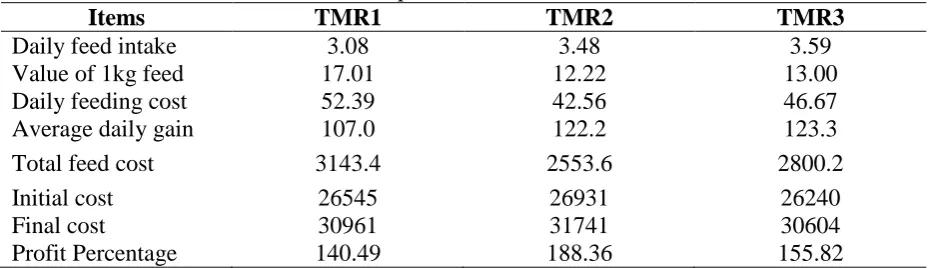
Table 9: Economic evaluation for the experimental rations
Items TMR1 TMR2 TMR3
Daily feed intake 3.08 3.48 3.59
Value of 1kg feed 17.01 12.22 13.00
Daily feeding cost 52.39 42.56 46.67
Average daily gain 107.0 122.2 123.3
Total feed cost 3143.4 2553.6 2800.2
Initial cost 26545 26931 26240
Final cost 30961 31741 30604
Profit Percentage 140.49 188.36 155.82
different levels of potatoes was recorded on a weekly basis during the experiment period.
Mean daily weight gain per head in Beetal male goats were 107.6 ± 1.16 gm, 122.2 ±
0.92 gm and 123.3±1.40 gm on 0% (control), 7% and 14% potatoes respectively (Table 3). Potato feeding up to 7% or 14% did not influence (P > 0.05) the average daily weight gain in Beetal male goats when compared to control diet.
Fecal scores of Beetal male goats fed on variable dietary treatments were recorded on a daily basis. The daily fecal score of Beetal male goats was 1.37 ± 0.01, 1.35 ± 0.03 and 1.41 ± 0.05 on 0% (control), 7% and 14% potatoes respectively (Table 4). The highest fecal score was observed in 14% potatoes (1.41 ± 0.05), followed by control treatment (1.37 ± 0.01) and the lowest fecal score was recorded in the diet having 7% potatoes (1.41 ± 0.05) in Beetal male goats.
The digestibility of feces was check after the end of trial and statistically DMI, CP, EE, CF digestibility did not change (P > 0.05) by dietary treatments, but digestibility of crude ash was higher (P < 0.05) in the control group and in goats fed 14% potatoes in the diet (P < 0.05), whereas digestibility of crude ash was lower (P < 0.05) in goats fed 7% potatoes in the diet, when compared with rest of the treatment group.(Table 5)
Feed efficiency was recorded on a weekly basis in Beetal male goats fed on variable dietary treatments. The feed efficiency was 0.000076865 ± 0.000011478, 0.000058584 ± 7.1970019E -6 and 0.000066123 ± 0.000011963 in control, 7% and 14% potatoes feeding in Beetal male goats respectively (Table 6).
Blood biochemistry of the Beetal male goat was done by taking blood from the external jugular vein, using the sterilized disposable syringe of 10 ml, on the first day of research and then at the end of the research trial. The blood was transferred into the EDTA coated vacutainer tubes and was centrifuged for 5 minutes @3000 RPM in the laboratory. Blood glucose and blood urea nitrogen was analyzed using calorimetric kits, but blood glucose and blood urea nitrogen levels did not change (P > 0.05) in Beetal male goats fed on zero% (control), 7% and 14% potatoes.(Table 7 and 8)
The gain to feed ratio was calculated at the end of the trial for each experimental group.The price was 17.01, 12.22 and 13 Rupees for control, 7% and 14% potatoes
based diets. The total mixed ration (TMR) having 7% potatoes were having lowest price and relatively more body weight gain, when compared with those Beetal male goats fed zero% (control) or 14% potatoes based TMR. The profit percentage was 188% for 7% potatoes based TMR as compared to140% and 150% in control and 14% potatoes based TMR (Table 9)
DISCUSSION
The DMI intake was significantly effected among all the dietary treatments. Group three fed on total mixed ration (TMR3) was having the higher DMI followed by group two TMR2 and then group one TMR1(Table 2). The results of the experiment were in line with Sugimoto et al. (2006), who reported that when the feeding level of potatoes increased, the dry matter intake (DMI) of animals also increased. Khalid at al. (2013), found that feed intake of ruminants increased, when potatoes were added in the ruminant ration compared with that of the control diet. Some other researchers concluded that the addition of the potatoes in the diet above 20% inclusion resulted in the decreased dry matter intake (DMI) in ruminants (Duynisveld and Charmley 2002; Radunz et al.2003; Duynisveld et al. 2004). Charmley at al. (2006), investigated that cattle show positive response to the addition of the potatoes in the diets offered to them by showing a small increase in voluntary dry matter intake, however, increases in diet having potatoes resulted in a drop in dry matter intake. Some researchers, however, were having different findings regarding DMI of the potatoes. Omer and Tawila (2008), reported that dry matter intake decreased progressively with the increase in quantity of potatoes in the total mixed ration (TMR). In another study, Omer et al. (2010), fed 25 and 50% potatoes as a yellow corn replacement to the Baladi goats or Ossimi sheep and found a nonsignificant effect on the feed intake.They noticed that sheep did not respond to change the average daily weight gain.
rations.. Radunz et al. (2003), described that increasing the different level of potatoes in feed decreased average daily gain and feed efficiency from 0-30% in ruminants. A researcher found that by increasing the potatoes level in the diets to replace yellow corn from 0 to 40% did not affect the average body weight or weight gain of the sheep but higher inclusion level of potatoes up to 50% decreased the above mentioned growth parameters. (Soltan at al., 2005). Fiems et al. (2013), fed 18 kg of potatoes on a daily basis in its treatment groups, which did not affect the average daily weight gain (ADWG) rather decreased the ADWG from 1.09 kg to 1.04 kg in ruminants. They also added that feeding large amounts of potatoes besides feeding concentrates had an adverse effect on ADWG because the fibrousness of the diet increased, resulting in a 25% reduction in daily weight gain and also decreased energy efficiency.
The digestibility of crude protein (CP) dry matter intake (DMI), crude fiber (CF) and ether extract (EE), did not change except the digestibility of crude ash (CA), which showed a nonsignificant difference among all three dietary treatments in Beetal male goats. The findings of the current study were in line with the Tawila et al. (2008), who found no difference in digestibility of DM, CF and EE among all the rations based on 0%, 25% and 50% potatoes as a yellow corn replacement in Baladi goat. Omer et al. (2010), informed that dietary treatment did not affect the CF digestibility but 25% or 50% replacement of yellow corn with potatoes in sheep improved (P < 0.05) the digestibility of CP and DM. In another study, Omer et al. (2011) described that digestibility coefficients of DM, OM, CF, EE did not affected by dietary treatments. There is limited published literature available about the effect of feeding varying levels of potatoes on the fecal score of Beetal male goats. The daily fecal score of Beetal male goats fed varying levels of potatoes did not change (P > 0.05) among all three experimental groups. The mean daily fecal score of Beetal male goat was 1.37 ± 0.01, 1.35 ± 0.03 and 1.41 ± 0.05 on zero% (control), 7% and 14% potatoes respectively (Table 4.3).
Inclusion of potatoes in Beetal male goat diets decreased the overall daily feeding expenses on the trial rations. Omer et al. (2010), reported that potatoes were an economical source of feed for making less expensive ration ration. Similarly, (Omer and Tawila, 2008 and Omer et al. 2010) for sheep, observed that potatoes can be a cheap substitute for feedlot animals. Omer et al. (2011) described that by gradually increasing the inclusion of potatoes in ration as a corn replacement, the feed price per kg weight gain, reduced and net revenue increased. Dhingra at al. (2013) concluded that utilization of potato and by products of the food industries helped in reducing the feeding cost of ruminants. A scientist reported that for a better animal production performance, the most appropriate way is to use potatoes in the feed as a suitable replacement for the concentrate. (Fiems et al., 2013)
Feed efficiency of Beetal male goat fed at varying levels of potatoes did not change (P > 0.05) among all the experimental groups (Table 4.5), which means potatoes, feeding resulted in similar feed efficiency as were observed with that of feeding corn to the Beetal male goats. Radunz et al. (2003), described that by increasing the level of potatoes from 0-30% feed efficiency was increased, but feed efficiency was decreased by feeding 40% of the potatoes to the ruminants. Similarly, Duynisveld et al. (2004), investigated that the substitution of corn with the potatoes, in beef cattle ration, improved the feed conversion efficiency. Another scientist, described that dietary treatments markedly increased the feed conversion ratio in ruminants fed diets based on different levels of potatoes (Omer et al., 2011).
Feeding different levels of potatoes to the Beetal male goat did not change (P > 0.05) the blood glucose levels and the blood urea nitrogen levels as well (P > 0.05) (Table 4.4 and 4.5), which means that the Beetal male goats fed varying levels of potatoes performed equally well without any change in bloody biochemistry parameters as were observed in those fed corn based diet (control group). The conclusions of the current research are in coincides with the
outcomes of Omer et al. (2011), who observed that partial replacement of potatoes with corn in the ruminant ration had no negative effect on blood glucose and blood urea nitrogen level (P > 0.05).
REFERENCES
1. Abijaoude J, Morand-Fehr P, Tessier J, Schmidely P, Sauvant D. 2000. Diet effect on the daily feeding behaviour, frequency and characteristics of meals in dairy goats. Livest Sci. 64: 29-37. 2. Anonymous, 2017 : Clive
Dalton. Sheep www.life-Styleblock.co.nz
3. AOAC 2001 Official Methods of Analysis 17th edition,
Association of Analytical
chemists, Washington, DC, USA 4. Aziz MA. 2010. Present status of
the world goat populations and their productivity. World 861: 1 5. Boyles, Stephen.2000. Feeding
potato processing wastes and culls to cattle.Extention work 6. Burke J, Miller J, Terrill T, Orlik
S, Acharya M, Garza J, Mosjidis J. 2013. Sericea lespdeza as an aid in the control of Emeria spp. in lamb’s. Vet. Parasitol 193: 39-46.
7. Charmley E, Nelson D, Zvomuya F. 2006. Nutrient cycling in the vegetable processing industry: utilization of potato by-products. Cand. J Anim Sci. 86: 621-629. 8. Dhingra D, Michael M, Rajput H,
Chopra S. 2013. Utilization of potato processing waste for compound cattle feed. J.Ag.Eng. 37: 40-45.
9. Duyet HN, Son ND, An N, Thuan TT. 2003. Effect of high dietary levels of sweet potato leaves on the reproductive performance of pure and crossbred Mong Cai sows. Livest. Res. rural dev. 15 10. Duynisveld J, Charmley E,
Mandell I, Aalhus J 2004. Replacing corn or barley with potato processing by-product in
beef finishing diets improves feed conversion efficiency and alters carcass fat distribution. In j.of dairy sci, Volume 87. (AMER DAIRY SCIENCE ASSOC 1111 N DUNLAP AVE, SAVOY, IL 61874 USA), pp. 158-158.
11. Duynisveld J, Charmley E. 2018. Potato processing waste in beef finishing diets; effects on performance, carcass and meat quality. Anim Produ Sci. 58: 546-552.
12. Duynisveld JL, Charmley E. 2002. Beef cattle can
successfully be fed 80% potato waste in the finishing diet. J. Anim.Sci. 80
13. Fiems L, De Boever J, Vanacker J, De Brabander D. 2013. Effect of cull potatoes in the diet for finishing Belgian Blue double-muscled cows. Animal Behav. 7: 93-100.
14. Food and Agriculture Organization Corporate
Statistical Database (FAOSTAT) (2008):
http://faostat.fao.org/default.aspx 15. Growth Performance, Carcass
Characteristics and Fatty Acid Composition of Carcass Fats in Holstein Steers 18 (4): 490-496 16. Jata SK, Nedunchezhian M,
Misra R. 2011. The Triple ‘f’(food, fodder and fuel) Crop Sweet Potato [Ipomoea batatas (L.) Lam.]. Orissa review December.
17. Khalid AFE, Elamin KM, Amin AE, Eldar AAT, Mohamed ME, Mohammed MADA, Hassan HE. 2013. Effects of using fresh sweet potato (Ipomoea batatas) vines on performance and milk yield of lactating nubian goats. J. of Anim Sci Advan. 3: 226-232. 18. Megersa T, Urge M, Nurfeta A.
and carcass characteristics of Sidama goats fed a basal diet of natural grass hay: Trop Anim Health Prod. 45: 593-601. 19. Omer H, Ali F, Ibrahim S. 2011.
Utilization from potato by-products as untraditional source of energy in growing rabbit diets. American-Eurasian J. of Agri & Envir Sci. 11: 883-892.
20. Omer H, Tawila M. 2008. Growth performance of growing Baladi goats fed diets containing different levels of sun dried peel potato waste. Egyp J. of Nutr and feeds. 11: 453-468.
21. Omer HA, Abdel-Magid SS, Ahmed SM, Mohamed MI, Awadalla I. 2010. Response to partial replacement of yellow corn with potato processing waste as non-traditional source of energy on the productive
performance of Ossimi lambs. Trop Anim health and prod. 42: 1195-1202
22. Omer HA, Abdel-Magid SS, Salman FM, Ahmed SM, Mohamed MI, Awadalla IM, Zaki MS. 2011.Using potato processing waste in sheep rations. Life science journal-acta Zhengzhou university overseas edition 8: 733-742.
23. Radunz A, Lardy G, Bauer M, Marchello M, Loe E, Berg P. 2003. Influence of steam-peeled potato-processing waste inclusion level in beef finishing diets: Effects on digestion, feedlot performance, and meat quality . J. of anim sci. 81: 2675-2685. 24. Schroeder K. 2012. Feeding Cull
Potatoes to Dairy and Beef Cattle University of Wisconsin
Extension, Portage County 25. Soltan M, Abdella M, Abou-Seif
R, Hassan M. 2005. Using of tomato and potato by products as partial replacements for soybean meal and yellow corn in practical diets for the common carp, cyprinus carpio. Egyp J. of Nutri and feeds. 8: 257-272.
26. Sugimoto M, Saito W, Ooi M, Sato Y, Saito T, Mori K. 2006. The effects of potato pulp and feeding level of supplements on digestibility, in situ forage degradation and ruminal
fermentation in beef steers.J. of Anim Sci . 77: 587-594.
27. Tawila M, Omer H, Gad SM. 2008. Partial replacing of concentrate feed mixture by potato processing waste in sheep rations. Cellulose. 20: 26.73.