Economic Power Dispatch Problem via
Complementarity Problem Approach
Ahmad M. Al-Fahed Nuseirat
Ajloun National University, Ajloun, JordanEmail: [email protected]
Nabeel I. Tawalbeh
Faculty of Engineering, University of Jordan, Amman, Jordan Email: [email protected]
Shakir Al-Musili
Technological Education Expert,Directorate General of Technological Education, Ministry of Manpower, Sultanate of Oman Email: [email protected]
Abstract—In this paper, a Complementarity Problem approach to solve the Economic Dispatch Problem (EDP) is presented. The problem is formulated as, Linear Complementarity Problem (LCP) when the transmission losses are neglected and Nonlinear Complementarity Problem (NCP) if the transmission losses are included in the power balance equation. The presented approach is more compact and needs less CPU time compared with other methods and algorithms presented in the literature. The main ideas of this work is presented via numerical examples.
Index Terms—economic dispatch problem, Linear Complementarity Problem (LCP), Nonlinear Complementarity Problem (NCP)
I. INTRODUCTION
Economic Dispatch Problem (EDP) is an important issue in power system operation. The goal of the EDP is to minimize an objective function that reduces the power generation cost while satisfying various physical and operational constraints. The outcome of this approach is expected to improve output scheduling of online units. Under any load condition, EDP determines the power output of each plant (and each generation unit within the plant) which minimizes the overall generation cost [1]. In the traditional EDP, the fuel cost function of a generator has been approximately represented by a quadratic function. Many efforts have been made to solve this problem [2]. Several optimization techniques, such as gradient method, lambda iteration and Newton’s methods have been used. In these methods the solution is affected by the incremental cost curves, which are piecewise linear and monotonically increasing, to find the global minimum. Furthermore, recent research [3], [4] proved that although conventional linear programming methods are simple and have high search speed, they have certain drawbacks and limitations.
During the last two decades, the EDP has been solved using several alternative methods such as Artificial Neural Networks [5], [6], Evolutionary Programming (EP) [7]-[9], genetic algorithms (GA) [10], [11], Fast Genetic Algorithm (FGA) [12] Particle Swarm Optimization (PSO) [13], [14].
In this paper, a Complementarity Problem approach to the solution of Economic Dispatch Problem (EDP) with quadratic cost function is presented. The problem formulation is based on the minimization of the generation cost subject to demand and transmission losses constraints and constraints introduced by upper and lower bounds on generated power of each unit. Two cases are considered: i) without transmission losses and ii) subject to transmission losses. In case (i) the problem formulation results finally in a Linear Complementarity Problem (LCP). In case (ii) the problem gets hard nonlinear and its formulated in a compact form as a Nonlinear Complementarity Problem (NCP). For the solution of these types of problems many algorithms and software have been developed recently [15], [16].
The rest of the paper is organized as follows: In section two the problem formulation is shown, section three outlines numerical examples that illustrate the performance of the suggested approach in comparison with other methods, finally the conclusion is discussed in section four.
II. PROBLEM FORMULATION
are the power balance equation and the upper and lower limits on the generated power by each unit.
A. Economic Dispatch without Transmission Losses
In this case the problem is to minimize the objective function subject to constraints of the demand load and minimum and maximum limits on the power output of the units. The mathematical optimization problem is as follows:
=1
min =
( )n t i i
i
F F P (1)
2 =1
=
n
i i i i i i
a P b P c
Subject to:
=1 =
n i Di
P P (2)
, , for = 1, 2, ,
i min i i max
P P P i n (3)
where:
i unit number
n number of units
Fi(.) fuel cost function of the unit i
Pi power from the
th
i generator
PD demand load
Pi, max upper limit of the
th
i generator
Pi, min lower limit of the
th
i generator
Equation (3) can be written in the following form [17]:
' ''
, ,
= 0, = 0
i i i min i i max i
P P P P P P (4)
Adding these equations we obtain: ' ''
, ,
=
i i i max i min
P P P P (5) and since Pi'0 this equation can be written in term of
' i P : ' , ,
i i max i min
P P P (6) The first equation in (4) can be written in terms of the new variable Pi' to obtain the power from the ith
generator:
' ,
=
i i i min
P P P (7) Substituting (7) in (1) and (2) the optimization problem can be expressed in terms of Pi' as follows:
' , =1
minimize =
( )n
t i i i min i
F F P P (8) Subject to the following constraints:
'
,
=1 =1
=
n i D
n i mini i
P P P (9) ' 0
i
P (10)
Constraint (9) can be written in the form of two inequality constraints:
'
,
=1 =1
n i D
n i mini i
P P P (11)
'
,
=1 =1
n n
i D i min
i i
P P P
The problem described by the (8), (10), and (11) is an optimization problem, which contains both equality and inequality constrains, needs the deployment of the Karush-Kuhn-Tucker (KKT) optimality conditions [18]. Therefore these equations are rewritten in matrix form as follows:
' ' '
minFt = (P)tDP g Pt kt (12) subject to:
'
eP PD ePmin (13) '
eP eP
PD min
'
IP Pmax Pmin
'
P 0 here
1 1 1, 1
2 2 2, 2 , 2 0 0 2 0 0 = , = 2 0 0 min min
n n n min n
b a P
a
b a P
a
b a P
a D g 2 1 1 1, 1 1, 2
2 2 2, 2 2,
2
, ,
and =
min min min min
n n n min n n min
c b P a P
c b P a P
c b P a P
k
e is 1 × n is vector of ones, I is n × n identity matrix,
' ' ' '
1 2
= [ , , , ]
P P P Pn t , Pmin = [P1,min,P2,min, ,Pn min, ]t and Pmax = [P1,max,P2,max, ,Pn max, ]t.
The Karush-Kuhn-Tucker (KKT) Lagrange for the dispatch problem given by (12) and (13) is [19]:
L(P')tDP'g Pt 'kt (14) '
(eP eP )
t
D min
P
'
( eP eP )
t
D min
P
' '
( ) ( )
u IP P P y P
t t
max min
where
, , u, and y are the Lagrange multipliers associated with the constraints. The Karush-Kuhn-Tucker (KKT) necessary optimality conditions for the above problem are:' ' = 2DP g e
'
=eP eP 0
D min
L
P
'
= eP eP 0
D min
L
P
'
=IP P P 0
u
max min
L
Introducing the nonnegative slack variables v, v, and the previous KKT conditions can be written as:
'
2 =
y DP etetIu g (16) '= eP eP D min v P '= eP eP D min v P ' =
IP P P
max min
Comparing (16) with (5) we conclude that
' ' ' '
1 2
=P = [ , , , ]
P P Pn . Substituting in the above equation we obtain:
'
2 =
y DP etetIu g (17) '= eP eP D min v P '= eP eP D min v P '' '=
P IP Pmax Pmin
where, the nonnegative variables fullfil the following complementarity conditions:
y0, P'0, y Pt '= 0 (18) 0, 0, = 0
t
v v
, 0, = 0
0
t
v v
'' ''
, , = 0 u0 P 0 u Pt
The system of (17) and (18) is a standard Linear Complementarity Problem (LCP) which can be written in the following form:
=
w Mz q (19) , , = 0
w0 z0 w zt
where 2
= ,
D e e I
e 0 0 0
M
e 0 0 0
I 0 0 0
t t = , g eP q eP P P D min D min max min P P ' =
w yv v Pt and z=P' ut B. Economic Dispatch with Transmission Lines Losses
The EDP is considered here with the presence of transmission losses. Equation (2) is modified to account for such losses as follows:
=1
=
n i D Li
P P P (20)
where PL is the total transmission loss and is given by the following equation [1]:
0 00
=1 =1 =1
=
n n n
L i ij j i i
i j i
P P B P B P B (21)
Using (7) and (21) in (20) the power balance constraint reduces to:
' ' '
0
( ) 2
eP P tB Pmint B B P (22) =PD ePminPmint BPmin
0 00
B P B
min
where B, B0, and B00 represent the B-coefficients of transmission loss formula.
Equation (22) can be written in a more compact form as follows:
'
'( ) =
e P tB V P Q (23) here e is 1 × n is vector of ones, and V = 2N +B0 where N = PtminB and
0
00=
Q PDePmin N B PminB
Equality constraint given by (23) can be replaced by two inequality constraints
'
'( )
e P tB V P Q (24)
'
'( )
e P B V P Q
t
The Karush-Kuhn-Tucker (KKT) Lagrangian for the dispatch problem defined by the (5), (10), (12), and (24) is:
' ' '
= (P)tDP g Pt kt
L (25)
'
'( )
e P B V P Q
t t
'
' ( )e P B V P Q
t t ' ' ( ) ( )
u IP P P y P
t t
max min
where
, , u, and y are the Lagrange multipliers associated with the constraints. The KKT necessary optimality conditions for the above problem are:' ' = 2DP g
P L (26)
'
2( )e P B V
t t
'
2( ) =
e P B V u y 0
t t
'
' = e (P) B V P Q 0 t L
'
'= e (P) B V P Q 0
t L '
=IP P P 0
u
max min
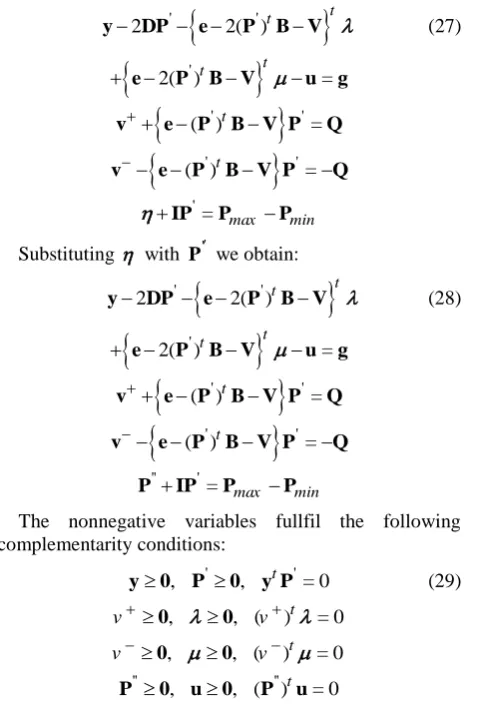
Introducing the nonnegative slack variables v, v, and
these KKT conditions can be written as:
' '
2 2( )
y DP e P tB V t (27)
'
2( ) =
e P B V u g
t t
( ')
' =v e P tB V P Q
'
'( ) =
v e P tB V P Q
' =
IP P P
max min Substituting with P' we obtain:
' '
2 2( )
y DP e P tB V t (28)
'
2( ) =
e P B V u g
t t
'
'( ) =
v e P tB V P Q
( ')
'=v e P tB V P Q
'' '=
P IP Pmax Pmin
The nonnegative variables fullfil the following complementarity conditions:
' '
, , = 0
y0 P 0 y Pt (29) , , ( ) = 0
0 0
t
v v
, , ( ) = 0
0 0
t
v v
'' , , ( '') = 0 P 0 u0 P tu
The system of (28) and orthogonality conditions (29) form a standard Nonlinear Complementarity Problem (NCP) which can be written as follows:
, ( ) , ( ) = 0
z0 M z 0 z M zt (30) where
'
=
z P ut
III. NUMERICAL EXAMPLES
In this section, numerical examples are given to illustrate the developed method. The formulated LCP can be solved using iterative methods, Newton methods, and pivoting methods [20]. Here the LCP problem is solved using the MATLAB code pathlcp.m (written and maintained jointly by Michael C. Ferris and Madison and
Todd Munson) [15]. On the other hand the formulated Nonlinear Complementarity Problem NCP can be solved using different algorithms addressed in the literature, in this work the MATLAB LMMCP.M developed and written by Kanzow and Petra is used [16]. Kanzow and Petra reformulated the NCP to nonlinear Least Square method and then they apply a Levenberg-Marquardt-type method to find the solution.
TABLEI. RESULTS OF FCGA,GAAC, AND LCP FOR 6-UNIT SYSTEM
Method Load P1 (MW) P2 (MW) P3 (MW) P4 (MW) P5 (MW) P6 (MW) Ft ($/h)
FCGA 1800 250.49 215.43 109.92 572.84 325.66 325.66 16585.85
GAAC 1800 248.14 217.74 75.20 587.8 325.56 325.56 16579.33
LCP 1800 247.9995 217.7192 75.1816 588.0397 325.53 325.53 16579.33
A. Examples without Transmission Lines Losses
1) First test system
The first system has six thermal units with the following cost functions and their associated constraints for each unit:
2
1= 0.001562 1 7.92 1561
F P P
1
100P 600
2
2 = 0.00194 2 7.85 2310
F P P
2
100P 400
2
3= 0.00482 3 7.97 378
F P P
3 50P 200
2
4 = 0.00139 4 7.06 4500
F P P
4
140P 590
2
5= 0.00184 5 7.46 5295
F P P
5
110P 400
2
6 = 0.00184 6 7.46 3295
F P P
6
110P 400
Table I shows the results of the proposed method compared with a fuzzy logic controlled genetic algorithm (FCGA) [10] and a genetic algorithm based on arithmetic crossover (GAAC) [11] when the load demand was 1800 MW. Its clearly evident from this table that the solution of the LCP results in terms of operation costs is exactly the same as that obtained by the GAAC method, while the FCGA method produces higher operation cost. In general, strong correlation is evident between results obtained from all these methods.
2) Second test system
TABLEII. GENERATION UNIT’S DATA
Unit No. Pmin (MW)
Pmax (MW)
Cost Coefficients a ($/MW2h) b ($/MWh) c ($/h) 1 0 680 0.00028 8.1 550 2 0 360 0.00056 8.1 309 3 0 360 0.00056 8.1 307 4 60 180 0.000324 7.74 240 5 60 180 0.000324 7.74 240 6 60 180 0.000324 7.74 240 7 60 180 0.000324 7.74 240 8 60 180 0.000324 7.74 240 9 60 180 0.000324 7.74 240 10 40 120 0.000284 8.6 126 11 40 120 0.000284 8.6 126 12 55 120 0.000284 8.6 126 13 55 120 0.000284 8.6 126
TABLEIII. RESULTS USING LCP FOR 13-UNIT TEST SYSTEM
Pd (MW) 550 1350 1800 2200 2960
P1 0 64.8369 108.4478 306.2611 9 680
P2 0 60.8917 106.8636 290.6486 360
P3 0 60.8917 106.8636 290.6486 360
P4 60 156.7656 178.1567 179.9999 180
P5 60 156.7656 178.1567 179.9999 180
P6 60 156.7656 178.1567 179.9999 180
P7 60 156.7656 178.1567 179.9999 180
P8 60 156.7656 178.1567 179.9999 180
P9 60 156.7656 178.1567 179.9999 180
P10 40 156.7656 178.1567 179.9999 180
P11 40 54.9446 102.0583 58.2402 120
P12 55 54.9446 102.0583 58.2402 120
P13 55 54.9446 102.0583 58.2402 120 Total cost ($/h) 7540.0254 13874.4067 17599.2799 20845.1192 27291.1680
Total P (MW) 550 1349.9997 1800 2200 2960 CPU time (s) 0.003744 6 0.010296 0.011076 0.010296 0.007332
Here, a standard IEEE 30 bus test system is used as a third test case. The generation unit’s data in the IEEE 30 bus test system are given in Table IV. The solution of the obtained NCP produces the amount of the generated power of each unit that results in the minimum generation cost. As mentioned previously the MATLAB program (LMMCP.M) written by Kanzow and Petra [16] is used to solve the problem. The obtained results for different load demand are shown in Table V.
The results of the proposed formulation of the IEEE 30 bus system are compared with other methods such as Evolutionary Programming IDE [7] and EP-OPF [8], fast genetic algorithm approach (FGA) [12], Pattern Search (PS) and a combination of Genetic Algorithm and Patern Search (GA-PS) [21], and Hybrid Self-adaptive Differential Evolution Methods SADE-ALM [22]. The load demand was 283.4 MW and the obtained results are shown in Table VI.
TABLEIV. IEEE30BUS TEST SYSTEM GENERATION UNIT’S DATA
Unit No. P2 P2
Cost Coefficients
a ($/MW2h) b ($/MWh) c ($/h) 1 50 200 0.00375 2 0 2 20 80 0.01750 1.75 0 3 15 50 0.06250 1 0 4 10 35 0.00834 3.25 0 5 10 30 0.02500 3 10 6 12 40 0.02500 3 0
TABLEV. RESULTS USING NCP FOR IEEE30BUS TEST SYSTEM
Pd (MW) 117 170 220 283.4 330 380 435
P1 50.9986 96.6509 137.0558 176.2631 198.2098 200 200
P2 20 29.3137 38.8954 48.3829 53.7786 71.7666 80
P3 15 15 17.7638 20.8706 22.7593 28.4625 49.9150
P4 10 10 10 22.7129 34.9339 35 35
P5 10 10 10 12.4533 16.6445 30 30
P6 12 12 12 12 15.4892 28.4646 40 Total cost ($/h) 288.2469 429.1655 582.0141 801.7211 976.6427 1186.9352 1404.1008
Total P (MW) 117.9986 172.9647 225.7149 292.6829 341.8153 393.6937 434.9150 PL (MW) 0.9986 2.9647 5.7149 9.2829 11.8153 13.6937 14.9150 CPU time (s) 0.015444 0.012792 0.016536 0.019188 0.021996 0.020748 0.021372
TABLEVI. RESULTS OF IDE,EP-OPF,FGA,PS,GA-PS,SADE-ALM AND NCP FOR 6-UNIT SYSTEM
Method P1 (MW)
P2 (MW)
P3 (MW)
P4 (MW)
P5 (MW)
P6 (MW)
Ft (MW)
PL
($/h) CPU Time IDE 181.6329 50.12272 20.15867 10 10.46971 12 794.9129 9.30433 1.466409 EP-OPF 173.848 49.998 21.386 22.630 12.928 12 802.404 9.4791 NA
FGA 189.613 47.745 19.5761 13.8752 10 12 799.823 9.6897 0.125 PS 175.727 48.6812 21.4282 22.8313 12.0667 12 802.015 9.3349 NA GA-PS 175.6627 48.6413 21.4222 22.6219 12.3806 12 802.0138 9.3286 NA SADE-ALM 176.1522 48.8391 21.5144 22.1299 12.2435 12 802.404 9.491 NA NCP 176.2631 48.3829 20.8706 22.7129 12.4533 12 801.7211 9.2829 0.0192
IV.CONCLUSION
In this paper a new approach for the formulation of the economic power dispatch problem is presented. The problem without transmission losses taken into account in the power balance equation is formulated as Linear Complementarity Problem (LCP). Taking into account transmission losses the problem gets hard nonlinear, and a Nonlinear Complementarity Problem (NCP) is formulated to present an efficient solution. Recently many efficient algorithms and software have been devised and developed. Numerical examples given section 3 shows that, in comparison with other methods, the presented approach provides an efficient, time saving, highly accurate, and cost effective technique with evident strong correlation with other well known established techniques.
REFERENCES
[1] A. J. Wood and B. F. Wollenberg, Power Generation Operation and Control, 2nd ed., New York: Wiley, 1996.
[2] I. Ciornei and E. Kyriakides, “Recent methodologies and approaches for the economic dispatch of generation in power systems,” International Transactions on Electrical Power, vol. 23, vol. 7, pp. 1002–1027, 2013.
[3] J. Sharma and A. Mahor, “Particle swarm optimization approach for economic load dispatch: A review,” International Journal of Engineering Research and Applications 1, – , 2013.
[4] A. Tikalkar and M. Khare, “Economic load dispatch using linearly decreasing inertia weight particle swarm optimization,” International Journal of Emerging Technology and Advanced Engineering, vol. 4, no. 1, 2014.
[5] J. Kumar and G. B. Sheble, “Clamped state solution of artificial neural network for real-time economic dispatch,” IEEE Trans. on Power Systems, vol. 10, no. 2, pp. 925–931, 1995.
[6] K. Y. Lee, A. Sode-Yome, and J. H. Park, “Adaptive hopfield neural network for economic load dispatch,” IEEE Trans. on Power Systems, vol. 13, no. 2, pp. 519–525, 1998.
[7] P. Surekha and S. Sumathi, “An improved differential evolution algorithm for optimal load dispatch in power systems including transmission losses,” IU-JEEE, vol. 11, no. 2, pp. 1379–1390, 2011.
[8] J. Yuryevich and K. P. Wong, “Evolutionary programming based optimal power flow algorithm,” IEEE Trans. on Power Systems, vol. 14, no. 4, pp. 1245–1250, 1999.
[9] P. Somasundaram and K. Kuppusamy, “Fast computation evolutionary programming algorithm for the economic dispatch problem,” European Transactions on Electrical Power, vol. 16, no. 1, pp. 35–47, 2006.
[10] Y. H. Song, G. S. Wang, P. Y. Wang, and A. T. Johns, “Environmental/Economic dispatch using fuzzy logic controlled genetic algorithms,” IEE Proc. Gener. Transm. Distrib., vol. 144, pp. 377-382, July 1997.
[11] T. Yalcinoz, H. Altun, and M. Uzam, “Economic dispatch solution using a genetic algorithm based on arithmetic crossover,” in Proc. IEEE Porto Power Tech. Conf., Porto, Portugal, Sept. 2001. [12] M. S. Kumari and M. Sydulu, “A fast computational genetic
algorithm for economic load dispatch,” Int. Journal of Recent Trends in Engineering, vol. 1, no. 1, pp. 349–356, 2009.
[13] Z. L. Gaing, “Particle swarm optimization to solving the economic dispatch considering the generator constraints,” IEEE Trans. on Power Systems, vol. 18, pp. 1187–1195, 2003.
[14] P. Vu, D. Le, N. Vo “A novel weight-improved particle swarm optimization algorithm for optimal power flow and economic load dispatch problems,” in Proc. IEEE PES Transmission and Distribution Conference and Exposition, 19-22 April 2010, pp. 1-7.
[15] M. C. Ferris and T. S. Munson. (2000). Complementarity problems in GAMS and the PATH solver. Journal of Economic Dynamics & Control, (24)165–188. [Online]. Available: ftp://ftp.cs.wisc.edu/math-prog/solvers/path/matlab
[16] C. Kanzow and S. Petra, “On a semismooth least square formulation of complementarity problems with gap reduction,” Optimization Methods and Software, vol. 19, no. 5, pp. 507–525, 2004.
[17] G. V. D. Laan and A. J. J. Talman, “An algorithm for the linear complementarity problem with upper and lower bounds,” Journal of Optimization Theory, vol. 62, no. 1, pp. 151-163, 1989. pp. 13 22
, vol. 3, no.
[18] Y. Han, P. Young, and D. Zimmerle, “Optimum generation units dispatch for fuel consumption minimization,” presented at the 50th IEEE Conference on Decision and Control and European Control Conference, Orlando, FL, USA, December 12-15, 2011.
[19] R. Fletcher, Practical Methods of Optimization, John Wiley, 2000. [20] K. G. Murty, Linear Complementarity: Linear and Nonlinear
Programming, Berlin: Heldermann Verlag, 1988.
[21] Y. Labbi and D. B. Attous, “A hybrid GA-PS method to solve the economic load dispatch problem,” J. of Theoretical and Applied Information Technology, vol. 15, no. 1, pp. 61–68, 2010. [22] B. Thitithamrongchai and B. Eua-arpon, “Self-adaptive
differential based optimal power flow for units with non-smooth fuel cost functions,” J. of Electrical Systems, vol. 3, no. 2, pp. 88– 99, 2007.
Ahmad M. Al-Fahed Nuseirat received his Diploma in Electrical Engineering from National Technical University, Athens, Greece, in 1984 and The PhD in Robotics From Aristotle University of Thessaloniki, Greece, in 1991. October 1991 to February 1992 he worked in the Division of Electronics and Computers At Aristotle University of Thessaloniki as Researcher for the BRITE project. Since February 1992 to Sept. 2007 he joined the Department of Electrical Engineering at Al-Isra University, Amman, Jordan, and he served as, a Dean of Faculty of Engineering 1993-1998 and 2000-2005, Dean of Faculty of Science 1998 to 2000. February 2006 to February 2006 He served as a Professor and Dean of Engineering at International University for Science and Technology (IUST), Damascus Syria on leave for Al-Isra University. February 2007 to September 2007 he served as Vice-President at Al-Isra University. Since September 2007 to October 2008 he joined Al-Hussein Bin Talal University, Maan, Jordan as Professor and vice President for academic affairs. October 2008 to October 2012 he joined the International University for Science and Technology as Professor and Vice President for Administrative Affairs. Since October 2013 till now he is the president of Ajloun National University, Ajloun, Jordan. He published around 30 articles in journals and conferences.
Dr. Nuseirat is a member of IEEE, IEEE Robotics and Automation Society, and Jordan Engineers Association (JEA). Dr. Nuseirat is now the Editor-in-Chief of JEA Journal of Electrical Engineering. He chaired the organising committee of The AMSE Conference on Modelling and Simulation (MS’8 Jordan), and he served as a co-chair or member of the organising committee of JIEEEC conference for many years.
Nabeel I. Tawalbeh did his BEE from Damascus University, Syria in 1985, and PhD fromWarsaw University of Technology Warsaw Poland in 1997. He is a full-time faculty member on the Electrical Engineering Department of the University of Jordan since 2008, where he is currently an Associate Professor of Electrical Engineering. He is certified as Consultant electrical power engineering by Jordan Engineer Association. He is Chairman of IEEE Power Engineering Chapter and Dielectrics and Electrical Insulation Society PES & DEIS 2010-2014. He is an elected of board member of the Conference on Electrical Insulation and Dielectric Phenomena IEEE CEIDP for the years of 2014-2016. He was one of the organizing committee of international conference of Applied Electrical Engineering and Computing Technologies (IEEE AEECT). He was a Vice Chair and a power track chair of the Conference IEEE AEECT, Amman Jordan 3-5/12/2013.
Shakir Al-Musili received his B.Sc. degree from the College of Engineering, University of Baghdad, in 1981. After national service, Dr. Al-Musili worked in the adhesives industry as a Production Engineer for several years. In 1986 he joined the Department of Electrical and Electronics Engineering at Loughborough University of Technology, UK, as Teaching and Research Assistant working towards his Ph.D. degree which was awarded in 1991, specializing in the field of Power Electronics and Machine Drives.