Integration of experimental and computational methods for identifying geometric,
thermal and diffusive properties of biomaterials**
Jerzy Weres1*, Sebastian Kujawa1, Wiesław Olek2, and Łukasz Czajkowski2 1Faculty of Agriculture and Bioengineering, Institute of Biosystems Engineering, 2Faculty of Wood Technology, Department of Mechanical Engineering and Thermal Techniques,
Poznań University of Life Sciences, Wojska Polskiego 28, 60-637 Poznań, Poland
Received October 3, 2015; acceptedApril 18, 2016
*Corresponding author e-mail: [email protected]
**This work was financially supported by the National Science Centre of Poland under the research grant No. 2011/01/B/NZ9/ 03169.
A b s t r a c t. Knowledge of physical properties of biomaterials is important in understanding and designing agri-food and wood processing industries. In the study presented in this paper compu-tational methods were developed and combined with experiments to enhance identification of agri-food and forest product proper-ties, and to predict heat and water transport in such products. They were based on the finite element model of heat and water transport and supplemented with experimental data. Algorithms were pro-posed for image processing, geometry meshing, and inverse/direct finite element modelling. The resulting software system was com-posed of integrated subsystems for 3D geometry data acquisition and mesh generation, for 3D geometry modelling and visualiza-tion, and for inverse/direct problem computations for the heat and water transport processes. Auxiliary packages were developed to assess performance, accuracy and unification of data access. The software was validated by identifying selected properties and using the estimated values to predict the examined processes, and then comparing predictions to experimental data. The geometry, thermal conductivity, specific heat, coefficient of water diffusion, equilibrium water content and convective heat and water transfer coefficients in the boundary layer were analysed. The estimated values, used as an input for simulation of the examined processes, enabled reduction in the uncertainty associated with predictions.
K e y w o r d s: biomaterials, heat and matter transport, 3D geometry meshing, inverse finite element, system integration
INTRODUCTION
Computer predictions of heat and water transport in complex agri-food and forest products are essential for designing and managing advanced technological process-es and controlling the quality of products. Uncertainty of such modelling depends on the adequacy and reliability of data used to represent the geometric, thermal and diffusive
properties of biomaterials in mathematical structures. In the case of heating, cooling, drying, and rewetting it has gene- rally been accepted that the 3D geometry, thermal conduc- tivity, specific heat, coefficient of water diffusion, equili- brium water content and convective heat and water trans- fer coefficients in the boundary layer are the most important quantities affecting the accuracy of modelling (Chen et al., 2009; Fanta et al., 2014; Olek et al., 2011; Nowakowski et al., 2013; Perré and Turner, 2007; Weres and Jayas, 1994; Weres and Olek, 2005; Wu et al., 2004). Experimental approaches to determine the physical properties listed above have not been effective. The reason is in the com-plexity of agri-food, wood and wood-based products, and in the transient, quasi-linear character of the processes.
Insufficient and often erroneous and contradictory knowledge of geometric, thermal and diffusive properties of biomaterials leads to inappropriate control of thermal treatment and storage conditions, with a consequence of deterioration of the quality characteristics of products. Therefore, indirect approaches combining experimental and computational methods have emerged to acquire trust-worthy values of the physical properties of biomaterials and to enhance representation of the adequate data in numerical models for predicting the heat and water transport pro-cesses. The authors analysed and combined the following groups of methods:
3D geometry modelling of investigated products based on the algorithms of initial processing, edge detection and 3D shape measurement of investigated products (Frączek and Wróbel, 2009; Nowakowski et al., 2013; Rogge et
al., 2014; Szczypiński et al., 2015; Weres et al., 2014a). Problems were found in the studies to attain satisfactory representation of the 3D product geometry, including exter-nal surfaces and interexter-nal boundaries between components, for further implementation in numerical models of the trans-port processes. Additionally, 3D geometry modelling can be supported with algorithms of visualization of changes in the properties during heat and water transport processes in space and time (Balcerzak et al., 2015; Fanta et al., 2014; Klaas et al., 2013; Leng et al., 2013; Pieczywek et al., 2011; Weres et al., 2014a; Zhang, 2013). Further improvements in algorithms for fast visual representation of 3D geometry models, enhanced with visualization of changes in physical properties in space and time during thermal and diffusive processes are needed.
Inverse and direct finite element analysis based on the algorithms of identification of thermal and diffusive properties of investigated products and prediction of the product behaviour during heat and water transport processes (Nguyen and Boyce, 2011; Olek et al., 2005, 2011; Ruggiero et al., 2011; Siatkowski et al., 2010a; Weres and Olek, 2005; Weres et al., 2009). Problems of estimation of unknown or unreliable property values were discussed in the papers, and further research is needed to improve the algorithms for reducing the uncertainty of mathematical modelling.
The objective of the study was to integrate experimental and computational methods to design an information system which can enhance the identification of geometric, thermal and diffusive properties of agri-food and forest products subjected to heat and water transport processes during heating, cooling, drying, and rewetting operations. It was assumed that the algorithms being proposed would take into account the transient and quasi-linear character of the heat and water transport, non-homogeneity and anisotropy of the analysed product, irregularity of its 3D geometry, and variation in the microclimate conditions. It was also assumed that all computations would be performed by an information system consisting of integrated components and interfaces, and the results would be validated.
MATERIALS AND METHODS
The following biomaterials were used to provide ex- perimental data for the validation of the software system: maize kernels of the Clarica hybrid variety (FAO 280) pro-duced by Pioneer and grown at the Research and Education Centre of the Poznan University of Life Sciences in Poland, segments of carrot roots (Daucus carota L.), Scots pine (Pinus sylvestris L.) and European beech (Fagus sylvati-ca L.), and commercial and laboratory-made wood-based panels ie particleboard, medium density fibreboard (MDF) and oriented strand board (OSB). The examined biomate- rials were characterized by non-homogeneity and anisot-ropy, and irregular geometry. The following properties were selected for the process of identification: 3D nodal
coordinates of the finite element mesh of a product, thermal conductivity, coefficient of water diffusion and convective water transfer coefficient in the boundary layer. Material samples were prepared according to Czajkowski et al. (2016), Olek et al. (2005), and Siatkowski et al. (2010b).
The approach was based on combining experimental results and algorithms appropriate for image processing, edge detection, 3D geometry modelling, and inverse and direct finite element analysis. The algorithms, referenced in section Introduction and described in the following paragraphs, were integrated and coded within an original software system called BioProcessSoft with the aim to improve the accuracy and performance of identification of geometric, thermal and diffusive properties of biomaterials.
Product samples were individually embedded in a syn-thetic resin block, and then two small holes were drilled in the opposite corners of the resin block to automate fur-ther processing of consecutive cross-section images. At the image acquisition stand each sample was cut by a micro- tome into layers of a selected thickness, and for each layer a macro photograph was taken (Nikon D7000, AF-S VR Micro-Nikkor 105 mm f/2.8G IF-ED). The first image was initially processed to facilitate the analysis, and all the consecutive images were automatically corrected. Product external boundaries and boundaries between internal com-ponents were detected by the improved Canny algorithm. The size of a structural finite element mesh was input to the system appropriately for a product, and the 3D mesh of isoparametric finite elements was automatically generated for all the layers as the output. Global coordinates of the mesh nodes were automatically measured in pixels, con-verted into length unit in the metric system, and saved in a form acceptable for other modules of the software. The improved algorithms were integrated to improve the per-formance and accuracy of edge detection operators and finite element mesh generation.
the parametric 3D modelling in the 3ds Max environment described in Balcerzak et al. (2015) was also used to con-struct 3D geometry models.
A methodological approach to inverse problems of identifying thermal and diffusive properties important for the heat and water transport was outlined by Weres and Olek (2005), Weres et al. (2009, 2014b). The mathe- matical model describing the structure of the heat and mass transport processes in biomaterials was represented as a system of quasi-linear differential equations of heat conduction and water transfer with the initial and bound-ary conditions of the first or third kind, as required in a given analysis. Experimental data were acquired for se- veral empirical systems at different stands. To acquire data in the case of transient heat transfer an experimental setup was constructed according to the guidelines of Czajkowski et al. (2016). The setup was equipped with thermocouples for temperature measurements in established locations inside a product, at its surface, and at the outer layer, and at specified time instants. The thermocouples were connected to automatic data logging systems. The results of experi-ments for transient heat transfer were used as necessary and sufficient input data for the identification of thermal conductivity.
In the case of water sorption and desorption another setup was built to obtain data (Olek et al., 2005, 2011;
Olek and Weres, 2007). In this setup, air of controlled tem-perature and relative humidity flows around a sample of a product of known and uniform initial moisture content. Due to the unique design of the apparatus, it is possible to control precisely the temperature (inaccuracy ±0.1ºC) and the relative humidity of air (inaccuracy ±0.5%). Conse- quently, long-lasting experiments, even over 4 weeks, could be conducted. Two laboratory balances were employed in the apparatus to register automatically changes in sample mass at selected time instants. The apparatus was addi-tionally equipped with a unique system for automatic taring of the unloaded balances during experiments, which improved the stability of balance operation in long-lasting experiments. A computer system controlling the apparatus enabled registering changes in mass during experiments and registering parameters of flowing air. The results were used as input data for the identification of the coefficient of water diffusion, convective water transfer coefficient in the boundary layer and equilibrium water content. In the inverse identification procedure the experimental values of the moisture content were compared to predicted moisture content values at corresponding time instants, averaged over the domain of a sample.
The authors algorithms and software (Weres and Olek, 2005; Weres et al., 2009, 2014b) were put forward and inte-grated in this work, and used for inverse and direct finite element modelling. The finite element algorithms were based on 3D isoparametric curvilinear spatial elements, absolutely stable two- and three-point recurrence schemes
of approximation in time, and iterative procedures to deal with equation quasi-linearity. Updated and more effective algorithms for local optimization with constraints (trust region and variable metric methods), and for global optimi- zation (randomization, tabu search, simulated annealing and genetic algorithms), and also hybrid procedures (global optimization algorithms combined with the trust region local approach) were used to minimize the objective functions in the L2-norm, as differences between experi-mentally measured values of temperature and moisture content and corresponding values predicted in simulation.
The integrated software system and its subsystems were logically verified and empirically validated against func-tional requirements. Values of the local and global relative errors were computed according to the formulae given by Olek et al. (2003) for heat transport problems and Olek et al. (2005) for water diffusion problems. The errors were based on comparing the results of computer predictions for heat and water transport in investigated products with the results of laboratory experiments. Values of the product properties identified with the lowest global relative error were taken as inputs to the computer simulation of the examined processes.
and accessed for the .NET Framework in the C# language with the use of the Tao.OpenGl (the Tao Classic, former-ly the Tao Framework, the MIT open source license) and OpenTK (the Open Toolkit Library, the MIT open source license). Particular attention was paid to methods of uni-fying the data exchange between the subsystems, and to methods of developing integrated user interfaces in the Windows Presentation Foundation (WPF) technology in C# 5.0 available in the Visual Studio 2013.
RESULTS AND DISCUSSION
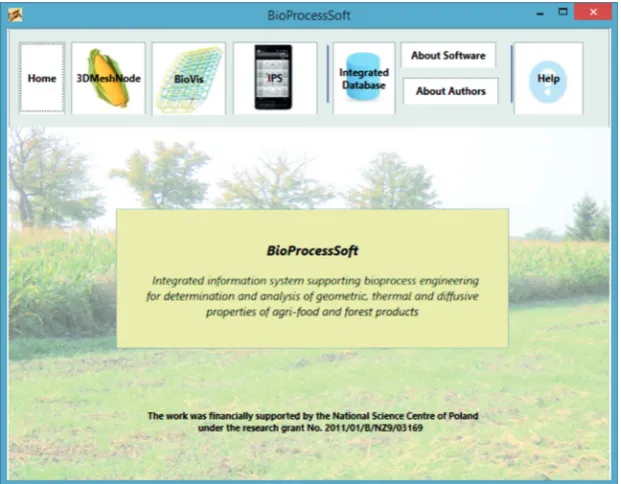
The integrated software system was developed fol-lowing the methods described in the section Materials and Methods. After specifying multi-purpose requirements, ana-lysing and diagramming the problem domain and designing the subsystems, the user interfaces were implemented at the top level and operational functions and components were coded at the bottom level. Subsequently, the unit tests were performed and the system was integrated, verified and vali-dated. The startup interface of the BioProcessSoft software system (Fig. 1) enables access to the subsystem interfaces (3DMeshNode, IPS and BioVis).
The heat conduction and water diffusion processes were analysed in biomaterials listed in the section Materials and Methods. Data were processed following the scheme shown in Fig. 2.
Product samples were cut and photographed. Images of product layers were processed, boundaries were detect-ed, isoparametric finite element meshes were generated for the layers and automatically assembled into a single 3D mesh, and the nodal coordinates were saved as the output of the 3DMeshNode. Experiments were performed and data
on temperature in selected locations and time instants, and mass changes in time for selected products were collected according to the experimental procedures described in the section Materials and Methods.
The novel version of the IPS subsystem is an inverse problem solver combining the authors finite element algorithms for solving direct parabolic problems of heat conduction and matter diffusion (Weres and Olek, 2005; Weres et al., 2009) with algorithms for solving local and global optimization problems with constraints (Weres et al., 2009). The subsystem is suitable for analysing com-plex, transient, three-dimensional, quasi-linear, inverse and direct problems of heat and matter transport in non-homo-geneous and anisotropic biological materials of irregular shape and with initial and boundary conditions of the first, second and third kind at different parts of the product sur-face. Identification procedures were used to estimate the thermal conductivity for the heat conduction problems and – in the case of the water diffusion problems – the coef-ficient of water diffusion and the convective water transfer coefficient in the boundary layer.
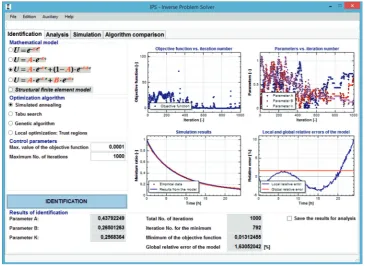
The constraint optimization algorithms available in the IPS subsystem (trust region, variable metric, tabu search, simulated annealing, genetic algorithm, and hybrid algo-rithms) were analysed for each inverse problem under analysis, and the most suited algorithm was selected to minimize the objective function (Figs 3, 4). The estimated property values were used to simulate the examined pro-cesses. The uncertainty of modelling emerges from the quality of representing geometry and coefficients in the mathematical model, and it was assessed by computing the global and local relative error values.
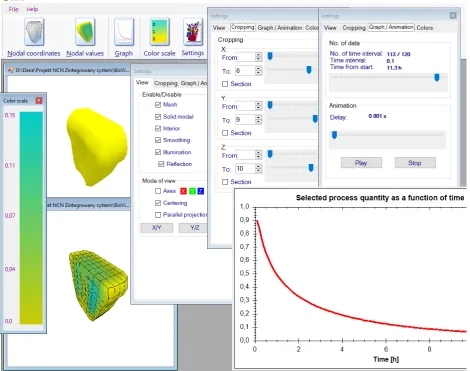
The identified geometry data and predicted process performance were used in the BioVis subsystem to visu-alize the examined products and to visuvisu-alize changes in product properties. The selected quantity, characteristic for the heat and water transport and resulting from the com-puter predictions, can be presented as a function of time either in the form of a curve for a selected node or in the form of an animation for the whole product or for a selected
portion. It enables a deeper insight into the structure and shows changes in a selected property inside an investiga- ted product. In the models of a maize kernel and a carrot root segment (Fig. 5) the following options were enabled: the NURBS smoothing, illumination, reflection, transla-tion, scaling and layer cropping. A process quantity – the moisture content in a selected node of the kernel – is also presented as a function of time.
Fig. 2. Scheme of the data input and output for the BioProcessSoft software system.
Fig. 3. Selection of a mathematical model and an optimization algorithm, input of control parameters and identification results for the
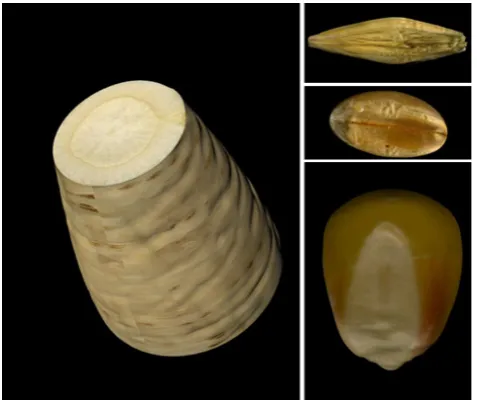
A complementary approach was implemented to con-struct models of the agri-food products on the basis of parametric modelling in the 3ds Max (Fig. 6), with the use of geometry data acquired in experiments and in the 3DMeshNode subsystem.
A reduction in the uncertainty of modelling of heat con-duction and water diffusion in the investigated biomaterials was achieved, measured by the values of the global and relative errors of predictions. Both the efficiency and the performance of the software were assessed at subsystem and system levels, design modifications were incorporated into the prototypes until the requirements were met, and finally the geometry and the thermal and diffusive proper-ties of selected products were identified with the use of the novel software system termed BioProcessSoft. Exemplary results are given below.
In the case of identification of the temperature-depend-ent thermal conductivity in the three anatomic directions of European beech (Fagus sylvatica L.) and Scots pine
Fig. 4. Menu for optimization methods in the IPS subsystem after
selecting identification of coefficients of the structural finite ele-ment model as the mathematical model.
Fig. 5. Visualization of models of a corn kernel and a carrot root segment, and moisture content changes in the kernel prepared in the
(Pinus sylvestris L.) the global relative error of prediction was reduced to the range of 1-2%, which was a significant improvement in modelling the heat conduction in wood in relation to results reported in the literature (Olek et al., 2003). The results were obtained for the model in which thermal properties were related to temperature and mois-ture content. When this dependency was neglected and constant values of thermal properties were used, the global relative error reached 20%.
For investigating heat conduction in wood-based pa- nels (particleboard, MDF and OSB), the specific heat was measured in a water calorimeter originally developed to reduce the uncertainty, and the thermal conductivity was identified. The global relative error values for predicting the temperature were in the range from 0.5 to 0.9%. For predictions based on data found in the literature the error ranged from 11.5 to 25.0% (Czajkowski et al., 2016).
In the analysis of the transient bound water transport (processes of adsorption and desorption) in Scots pine (Pinus sylvestris L.) and European beech (Fagus sylvatica L.), the identification was performed for the two coefficients expressing the dependency of water diffusion on bound water content, and for the three coefficients expressing the expanded convective boundary condition in terms of the equilibrium water content dependent on time. The coeffi-cient of water diffusion was identified for the radial and tangential directions. The global relative error of predic-tions was in the range from 0.63 to 2.15%, and in the case of neglecting the dependency of the coefficient of bound water diffusion on the water content, the respective error values were up to 5.3%. In the case of traditional methods for determination of the coefficient of water diffusion for
wood, based on the boundary condition of the first kind, the local relative error values were reaching 60%. In the case of traditional methods based on the convective boundary condition, the global relative error values approached 20% (Olek and Weres, 2007; Olek et al., 2011).
In the case of water diffusion processes in dried maize kernels, the experimental data on moisture content changes in time were generalized with a three-parameter empirical formula as an input to the procedure of identifying the coef-ficients of the structural finite element model. Empirical, non-structural models are implemented in the IPS sub-system, as well as the metaheuristic global optimization algorithms, and they were used to estimate the coefficients of the empirical formula. The lowest uncertainty was for the genetic algorithm, but due to computational complexity its performance was unacceptable. The simulated annealing was the best in terms of the runtime performance, but due to the uncertainty of results it was unsatisfactory. The tabu search was used as a compromise between the coefficient estimation running time and the uncertainty of the results – the global relative error was in the range from 1.15 to 1.34%. For large-scale computation in identifying coeffi-cients of the structural finite element model the trust region algorithm was the most satisfactory with respect both to the performance and to the uncertainty of results for all investigated instances. Similar uncertainty was achieved in the case of the global optimization metaheuristics and the hybrid algorithms, but their runtime performance was distinctly worse. The global relative error for the predicted moisture content was in the range from 5.32 to 6.82%, and in the case of taking the coefficient values from the litera-ture it was between 21.46 and 32.72%.
CONCLUSIONS
1. An integrated software system was developed to en- hance the identification and analysis of the geometric, ther-mal and diffusive properties of agri-food and forest products, and to predict the heat and water transport processes during heating, cooling, drying, and rewetting operations, and dur-ing storage of the products. Original enhanced algorithms for image analysis, finite element inverse and direct model-ling, and for modelling and visualising product geometry and changes in the properties were used.
2. The system components were verified and validated in relation to experimental results for various biomaterials. The functional requirements were met, and the functionali- ty, usability, effectiveness and efficiency were acceptable.
3. An improvement was achieved in computational accuracy and performance, and a reduction of uncertainty of predictions was attained due to estimation of more re- liable data on product properties. The software system offers essential support in investigating heat and water transport in agri-food and forest products.
Fig. 6. Visualization of models of a parsley root segment, oat,
REFERENCES
Balcerzak K., Weres J., Górna K., and Idziaszek P., 2015. Modeling of agri-food products on the basis of solid geo- metry with examples in Autodesk 3ds Max and finite ele-ment mesh generation. J. Research Applications Agric. Eng., 60(2), 5-8.
Chen G., Maier D.E., Campanella O.H., and Takhar P.S.,
2009. Modeling of moisture diffusivities for components of
yellow-dent corn kernels. J. Cereal Sci., 50(1), 82-90. Czajkowski Ł., Olek W., Weres J., and Guzenda R., 2016.
Thermal properties of wood-based panels – thermal con-ductivity identification with inverse modeling. European J. Wood Wood Products (In press DOI: 10.1007/ s00107-016-1021-6).
Fanta S., Abera M., Aregawi W., Ho Q., Verboven P., Carmeliet
J., and Nicolaï B., 2014. Microscale modeling of coupled
water transport and mechanical deformation of fruit tissue during dehydration. J. Food Eng., 124, 86-96.
Frączek J. and Wróbel M., 2009. Using computer graphics for
3D reconstruction of seeds (in Polish). Inżynieria Rolnicza, 6(115), 87-94.
Gomaa H., 2011. Software Modeling and Design: UML, Use
Cases, Patterns, and Software Architectures. Cambridge University Press, Cambridge, UK.
Klaas O., Beall M.W., and Shephard M.S., 2013. Construction
of models and meshes of heterogeneous material micro-structures from image data. In: Image-based Geometric Modeling and Mesh Generation (Ed. Y. Zhang). Springer, Dordrecht, NL.
Leng J., Xu G., Zhang Y., and Qian J., 2013. Quality
improve-ment of segimprove-mented hexahedral meshes using geometric flows. In: Image-based Geometric Modeling and Mesh Generation (Ed. Y. Zhang). Springer, Dordrecht, NL.
Nguyen T.D. and Boyce B.L., 2011. An inverse finite element
method for determining the anisotropic properties of the cornea. Biomechanics Modeling Mechanobiol., 10(3), 323-337.
Nowakowski K., Raba B., Tomczak R.J., Boniecki P., Kujawa
S., Nowak P.J., and Matz R., 2013. Identification of
physi-cal parameters of cereal grain using computer image analysis and neural models. Proc. SPIE 8878, 5th Int. Conf. Digital Image Processing (Eds Yulin Wang, Xie Yi), doi: 10.1117/12.2030769, SPIE Press, Beijing, China.
Olek W., Perré P., and Weres J., 2005. Inverse analysis of the
transient bound water diffusion in wood. Holzforschung, 59(1), 38-45.
Olek W., Perré P., and Weres J., 2011. Implementation of a re-
laxation equilibrium term in the convective boundary con-dition for a better representation of the transient bound water diffusion in wood. Wood Sci. Technol., 45, 677-691.
Olek W. and Weres J., 2007. Effects of the method of
identifica-tion of the diffusion coefficient on accuracy of modeling bound water transfer in wood. Transport Porous Media, 66(1-2), 135-144.
Olek W., Weres J., and Guzenda R., 2003. Effects of thermal
conductivity data on accuracy of modelling heat transfer in wood. Holzforschung, 57(3), 317-325.
Perré P. and Turner I., 2007. Coupled heat and mass transfer. In:
Fundamentals of Wood Drying (Ed. P. Perré). A.R.BO. LOR., Nancy, France.
Pieczywek P.M., Zdunek A., and Umeda M., 2011. Study on
parameterisation of plant tissue microstructure by confocal microscopy for finite elements modelling. Comput. Electron. Agric., 78(1), 98-105.
Rogge S., Beyene S., Herremans E., Hertog M., Defraeye T.,
Verboven P., and Nicolaï B., 2014. A geometrical model
generator for quasi-axisymmetric biological products. Food Bioprocess Technol., 7, 1783-1792.
Ruggiero L., Sol H., Sahli H., Adriaenssens S., and Adriaens-
sens N., 2011. An inverse method to determine material
properties of soft tissues. In: Mechanics of Biological Systems and Materials (Ed. T. Proulx). Springer, New York, USA.
Siatkowski M., Weres J., and Kujawa S., 2010a. Comparison of
global optimization algorithms in inverse modeling of dry-ing processes of agricultural products (in Polish). Inżynieria Rolnicza, 7(125), 191-198.
Siatkowski M., Weres J., Kujawa S., Szabelska A., and
Zyprych J., 2010b. Growth curve functions in modeling
the thin-layer drying of corn. Inżynieria Rolnicza, 6(124), 89-95.
Szczypiński P.M., Klepaczko A., and Zapotoczny P., 2015. Identifying barley varieties by computer vision. Comput. Electron. Agric., 110, 1-8.
Weres J. and Jayas D.S., 1994. Effects of corn kernel properties
on predictions of moisture transport in the thin-layer drying of corn. Transactions of the ASAE, 37(5), 1695-1705.
Weres J., Kiecana M., and Balcerzak K., 2014a. Two approa-
ches to representing agri-food product geometry – an origi-nal software for constructing finite element models and the 3ds Max approach. J. Res. Applications Agric. Eng., 59(1), 155-158.
Weres J., Olek W., Kujawa S., and Siatkowski M., 2014b. Integration of software components for determination and analysis of properties of agri-food and forest products. J. Res. Applications Agricultural Eng., 59(1), 159-163.
Weres J. and Olek W., 2005. Inverse finite element analysis of
technological processes of heat and mass transport in agri-cultural and forest products. Drying Technol., 23(8), 1737-1750.
Weres J., Olek W., and Kujawa S., 2009. Comparison of
optimi-zation algorithms for inverse FEA of heat and mass transport in biomaterials. J. Theoretical Applied Mechanics, 47(3), 701-716.
Wu B., Yang W., and Jia C., 2004. A Three-dimensional
numeri-cal simulation of transient heat and mass transfer inside a single rice kernel during the drying process. Biosystems Eng., 87(2), 191-200.
Zhang Y., 2013. Challenges and advances in image-based