Vol.8 (2018) No. 4-2
ISSN: 2088-5334
Implications for Activating 3D printer Use for Education
in Elementary and Secondary Schools
Hyojae Choi
#, JaMee Kim
* #Major of Educational Information System, Graduate School of Education, Korea University, 145 Anam-ro, Seongbuk-gu, Seoul, 02841, South Korea
E-mail: [email protected]
*Major of Computer Science Education, Graduate School of Education, Korea University 145 Anam-ro, Seongbuk-gu, Seoul, 02841, South Korea
E-mail:[email protected](Corresponding Author)
Abstract— This research aims at analyzing the usage of 3D Printing in education for school grades and suggests a way to encourage schools to use 3D Printers in Education. For this, a survey was done for 3,247 teachers in Gyeonggi Province on September. Usually, schools are trying to buy 3D Printers to use it with software education courses. However, by this survey, it turns out that teachers use 3D Printer with after-school activities, creativity, and experiential activities more than regular courses. This is because there are not many teaching and learning materials for 3D Printers to be used with regular courses and it is hard for teachers to use 3D printers with professionally because lack of the training. Therefore, to activate 3D printers in schools, not only budget support but also training for teachers and developing teaching and learning materials should be involved.
Keywords— 3D Printer; new technology; usage; curriculum; education; training; learning materials.
I. INTRODUCTION
Nowadays, many schools are interested in purchasing and using 3D printers in classes to provide various experiences for students. Although the 3D printer is not developed, as a tool for education, it seems very attractive to schools in that 3D printer can provide visible output.
In addition, as the process of dealing with 3D modeling tools for students to design themselves, is regarded as a gamification factor, which can increase students’ motivation, and provide enjoyable learning environment during the lecture [9]. Furthermore, if the output does not come out properly, it can also improve students’ learning areas related to design, and creativity in the process of finding and solving problems, which is regarded as a problem, based learning [2].
By this recognition, the Department of Education in the United Kingdom has conducted a 3D printer project from 2012 to 2013 to explore the possibility of enriching the classroom performance with 3D printers by managing 21 pilot schools [4]
In conjunction with this, the Ministry of Science and ICT has announced a strategy for 3D printer vitalization, which includes providing 3D printers to schools in connection with software education [12], [16]. In fact, in cooperation with
the Seoul Metropolitan Office of Education, it announced plans to provide around 500 3D printers in schools and gradually expand the distribution of 3D printers in schools by 2020 [16].
In order to make good use of 3D printers in school, it is necessary to figure out the status of 3D printer utilization first and make an effort to strengthen the teacher capacity to apply 3D printer with each subject for the rapidly changing technology [10].
However, unlike these movements as mentioned above, it is difficult to see 3D printer has been activated yet. Therefore, in this study, it aims to present how to activate 3D printer usage in school in the future because of the survey on the use of the 3D printer in elementary, middle and high schools in Korea.
II. MATERIAL AND METHOD
A. Related Works
1) 3D printing and Technologies
creating improvement through modeling has become magnified, there are some trials to use 3D printers in Education. Furthermore, in education, a 3D printer is regarded as a sufficient tool to apply software education, maker education, and technical subject. In particular, 3D printer, which is ICT technology can provide a means for individual and groups to develop and implement new educational ideology; it is believed to be able to play a role as a new tool for education [13]-[15].
Indeed, according to the Horizon report (2015), advances in technology can lead to innovative changes in education. Also, in the case of applied learning tools such as 3D
printing, it is said that students can create an environment in which they have a sense of ownership through learning and creative activities that they take part in. In next 2 or 3 years, it was expected that 3D printing could be spread into the educational area [8].
On the other hand, at the hypercycle in the educational field suggested by Gartner [5], a 3D printer is considered to be one of the most important technologies that can be used in school curricula [5]. According to this hypercycle, 3D printing in the classroom is at the heightened level of interest, and by 2020, 3D printer use in the classroom will become commonplace.
Fig. 1 Hyper Cycle of Gartner [5]
2) 3D printer in Education Related Studies
There are three main types of research related to the educational use of the 3D printer.
The first is related to the methodology and curriculum development for the application of the 3D printer to the subject, the second is teacher training for the 3D printer in school, and the last one is the effectiveness of using the 3D printer in education.
Chein (2017) suggested curriculum development in the pre-engineering curriculum for 3D printing skills for high school [3]. According to this research, STEM-oriented engineering curriculum with 3D printer and modeling helps students to do self-directed learning. As 3D printer can be used to visualize a virtual object and create visual and concrete models, it is useful for students to recognize and experience abstract concepts. In fact, in this research, the results showed that students who made output with 3D printer had higher scores than those who made hand-made works. Not only in the engineering curriculum, but also in
geoscience education, 3D printer can play a significant role in the curriculum. For example, it provides learning materials for small universe such as the moon and planet, which allows creating a library of accessible physical objects [6].
Regarding teacher training, according to the research of the Royal Academy of Engineering (2013), teachers are reluctant to apply 3D printer into the classroom because they do not understand 3D printer technology. That is why there should be a teacher training on the use of 3D printing. This paper warns that lack of training and skill is an obstacle to 3D printer activation [1]. About this, teacher training, Department of Education in the United Kingdom (2013) also mentioned that to recognize the potential of the 3D printer as an educational resource, it is necessary to share ideas regarding the competence of teachers and teacher training and technical support are required [4].
can not only broaden their knowledge but also convey their ideas to reality. With 3D printer, the student can physically examine their outputs, and that makes students enthusiastically participate in the class, which can be effective, simulate their imagination [17]. The other research also suggested that during the modeling process, students can discuss the problem and make the necessary corrections in real time, which enable students to experience the creative interaction between peers [11]. According to RepRap 3D printer workshop in the K-12 STEM, the majority of respondents answered that 3D printer helped students understand the engineering design process and the workshop itself strengthened the ability to solve the problem of projects that previously perceived that it is beyond their skills [7].
However, those studies are not dealing with the current status of 3D printers in school, and the situation is somewhat different from Korea’s one.
B. Subject of Study
This study was conducted to investigate the current status of 3D printer usage at each school level. As Gyeonggi Province is the largest among 17 provinces, it was selected as the survey target. The questionnaire was requested to cooperate with 1,227 elementary schools, 619 middle schools, and 470 high schools in Gyeonggi Province and teachers who are going to buy or use 3D printers in school or are now using it during the classes answered to the questions
C. Research Tools and Methods
The purpose of this study is to analyze how 3D printers are used at each school level and how effective and difficult it is to use 3D printers. The questionnaire was constructed by the researchers who were involved in similar papers, and the detailed contents are reconstructed in consider with a feature of this research.
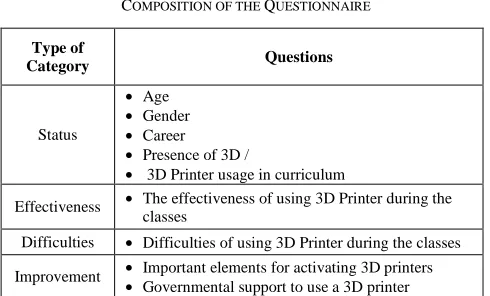
The questionnaires used in this study are as follows: the first section is about personal information and backgrounds about the survey subjects, the second section includes the status of 3D printer distribution, the third section is about the effectiveness and difficulties of using 3D printers and the last part is about ways to activate 3D printers in schools. Table 1 shows the composition of the questionnaire.
TABLEI
COMPOSITION OF THE QUESTIONNAIRE
D. Research Procedure
This survey was conducted on online from September 7, 2017, to September 19 for 12 days. In this online survey, the total number of respondents was 3,247, and among them, only 529 respondents answered that they have 3D printers and use it during the classes were 529. In this survey, the answer of 529 respondents is analyzed.
III.RESULTS AND DISCUSSION
The results of the survey show how many 3D printers are equipped in each school level and how many schools use 3D printers during the classes and what kind of subjects are applying 3D printers. Also, the effectiveness of using 3D printers during the classes and the difficulties of using 3D printers in class as also analyzed. Lastly, what effort should be made to put 3D printers in schools for the better use in the future is suggested.
A. Current Status of Having and Using 3D printers
Table 2 shows the results of respondents who have 3D printers, and they use the 3D printers in their classes. According to Table 2 below, 4.6 % of elementary school teachers 16.2% of middle school teachers, and 33.2% of high school teachers answered that they have a 3D printer in Schools. It seems that the 3D printer showed the highest penetration rates in the high school. In response to the question about “Do you use 3D printers during the class?” 35.7% of elementary school teachers, 63.0% of middle school teachers and 53.9% of high school teachers were answered to their use of 3D printers for teaching. Except for elementary school, middle school and high school have more than 50% of utilization rates, but they also recorded a low figure, just over half.
TABLEII
PRESENT POSSESSION OF 3D PRINTERS IN SCHOOL
UNIT: FREQUENT (%)
Having 3DPrinter at School
Using 3Dprinter During Class
Elementary School (Total)
4.6 (70)
35.7 (25)
Middle School (Total)
16.2 (162)
63.0 (102) High School
(Total)
33.2 (297)
53.9 (160)
B. Curriculum Using 3D printers
In table 3 below summarizes the top five subjects which teachers use 3D printer most during the classes. The detailed rankings are slightly different in each school levels; it can be said that 3D printers are applied to creative experiential activities club activities and after-school programs most. Except that courses, 3D printers are also utilized in informatics, mathematics, and technology subjects.
Type of
Category Questions
Status
• Age • Gender • Career • Presence of 3D /
• 3D Printer usage in curriculum
Effectiveness • The effectiveness of using 3D Printer during the classes
Difficulties • Difficulties of using 3D Printer during the classes
TABLEIII SUBJECTS USING 3D PRINTER
UNIT: FREQUENT (%)
Rank. Elementary School
Middle School
High School
1
Creative experiential activities
(32.1)
Club Activities
(23.6)
Club Activities (29.6)
2 Club Activities
(15.1)
After School Program
(21.4)
Science (14.6)
3 After School Program
(13.2)
Free Semester
(13.2)
After School Program
(14.2)
4 Mathematics
(11.3)
Technology (11.0)
Major (10.7)
5 Arts
(9.4)
Informatics (9.9)
Informatics (9.9)
Although commonly answered subjects such as creative experiential activities, club activities, and after-school program are also organized in regular class time, it is more likely to be regarded as an autonomic subject rather than a regular course. In other words, it is still not easy to utilize 3D printers for regular courses such as mathematics, sciences technology and so on.
Fig. 2 Free semester activities using 3D Printer
Fig. 3 Class output by using 3D Printer
C. Effectiveness and Difficulties of Using 3D printers
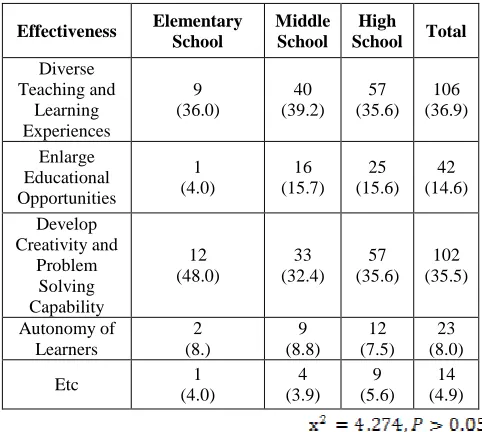
1) The effectiveness of Using 3D printers During the Class: In response to the question that what is the effect of
using 3D printers during the classes, respondents answered in order of providing diverse learning experiences, increasing creativity and problem-solving ability, enlarging educational opportunities, enhancing the autonomy of learners.
This study found that there is no significant difference between the results of each school levels. In elementary school, increasing creativity and problem-solving ability got the most choice. However, in the case of high school, providing various teaching and learning experiences and increasing creativity and problem-solving ability showed the same response. The detailed results are given in Table 4.
TABLEIV
THE EFFECTIVENESS OF USING 3D PRINTERS DURING THE CLASS
UNIT: FREQUENT (%)
Effectiveness Elementary School
Middle School
High
School Total Diverse
Teaching and Learning Experiences
9 (36.0)
40 (39.2)
57 (35.6)
106 (36.9)
Enlarge Educational Opportunities
1 (4.0)
16 (15.7)
25 (15.6)
42 (14.6)
Develop Creativity and
Problem Solving Capability
12 (48.0)
33 (32.4)
57 (35.6)
102 (35.5)
Autonomy of Learners
2 (8.)
9 (8.8)
12 (7.5)
23 (8.0)
Etc 1
(4.0)
4 (3.9)
9 (5.6)
14 (4.9)
2) Difficulties in Using 3D printers in Class
Table 5 shows the results of the difficulties in using the 3D printer in the classroom. In the results of total, which did not distinguish between each school levels, the highest response rates were expensive equipment cost (37.3%), followed by lack of professional manpower (24.7%), lack of teaching and learning materials(17.1%), equipment maintenance cost (15.3%) and repair cost(5.6%) were occupied.
TABLEV
DIFFICULTIES IN USING 3D PRINTERS IN CLASS
UNIT: FREQUENT (%)
Difficulty
Eleme ntary Scho ol
Middle School
High
School Total
Expensive Equipment Cost
9 (36.0)
40 (39.2)
58 (36.3)
107 (37.3)
Equipment Maintenance Cost
3 (12.0)
17 (16.7)
24 (15.0)
44 (15.3)
Repairing Cost 2
(8.0) 5 (4.9)
9 (5.6)
16 (5.6)
Professional Manpower
6 (24.0)
18 (17.6)
47 (29.4)
71 (24.7)
Lack of Teaching and Learning
Materials
5 (20.0)
22 (21.6)
22 (13.8)
49 (17.1)
D. Ways to Activate 3D printers in School
1) Essential Things to Activate 3D printer: Teachers who
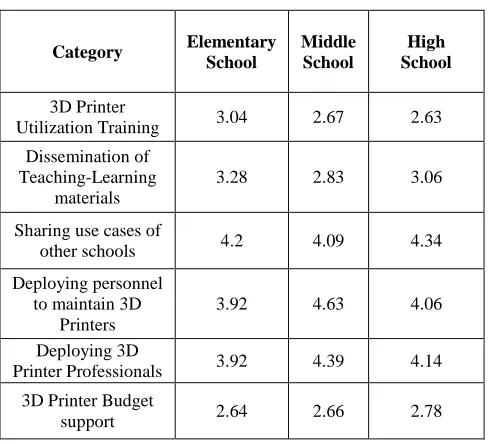
are using 3D printers in their current classroom are asked to rank six options, which should be the top priority. The responses are shown in Table 6 below. Although answers of each school level did not match the rankings, most respondents cited 3D printer budget support, 3D printer utilizes training, providing teaching and learning materials as an essential support for 3D printer activation in schools.
TABLEVI
THE WAY TO ACTIVATE 3D PRINTER FOR TEACHERS (AVERAGE)
Category Elementary School
Middle School
High School
3D Printer
Utilization Training 3.04 2.67 2.63
Dissemination of Teaching-Learning
materials
3.28 2.83 3.06
Sharing use cases of
other schools 4.2 4.09 4.34
Deploying personnel to maintain 3D
Printers
3.92 4.63 4.06
Deploying 3D
Printer Professionals 3.92 4.39 4.14
3D Printer Budget
support 2.64 2.66 2.78
Table 6 above represents the mean value of the responses divided by the total respondents; Table 7 shows the results of the first choice responses selected by each school level.
Similar to Table 6 above, it can be seen that providing 3D printer training, supporting 3D printer budget support and
developing teaching and learning materials were selected as the first choice.
TABLEVII
THE WAY TO REVITALIZE 3DPRINTER FOR TEACHERS
UNIT: FREQUENT (%)
Category Elementary School
Middle School
High School
3D Printer
Utilization Training 4(16.0) 30(29.4) 53(33.1)
Dissemination of Teaching-Learning
materials
4(16.0) 14(13.7) 18(11.3)
Sharing use cases
of other schools 1(4.0) 4(3.9) 4(2.5)
Deploying personnel to maintain 3D
Printers
1(4.0) 2(2.0) 14(8.8)
Deploying 3D Printer Professionals
3(12.0) 3(2.9) 10(6.3)
3D Printer Budget
support 12(48.0) 48(47.1) 61(38.1)
Total 25(100) 102(100) 160(100
)
Although budget support for a 3D printer is generally high, in order to use 3D printer more efficiently, in addition to budgeting for a 3D printer, it can be said that it must be accompanied by operating appropriate training for teachers and spread of related teaching and learning materials.
2) Administrative Support to Activate 3D printers: In
addition to the essential things to activate 3D printer utilization, respondents answered the question that the administrative support that government department such as the ministry of science and ICT, the ministry of education should provide. In the results, it shows that support of purchasing 3D printer budget is overwhelmingly high and teacher training and 3D printer manpower support is followed.
As ministries are usually in charge of budgeting and training, respondents suggested that in order to activate the 3D printer, it is necessary to secure budgets for the supply of equipment and to train teachers to become specialists who can handle the 3D printers and its modeling tools.
TABLEVIII
ADMINISTRATIVE SUPPORT TO ACTIVATE 3D PRINTERS
UNIT: FREQUENT (%)
Category Elementary School
Middle School
High School
Budget Support for buying 3DPrinters
15(60.0) 58(58.0) 81(50.6)
Training Program for
Teachers
3(12.0) 26(26.0) 35(21.9)
Personnel for Maintenance of
3DPrinters
2(8.0) 5(5.0) 14(8.8)
Experts for using 3D
Printers
4(16.0) 7(7.0) 20(12.5)
Developing 3DPrinter using
materials
1(4.0) 4(4.0) 10(6.3)
Total 25(100) 100(100) 160(100)
IV.CONCLUSIONS
It is true that in order for the 3D printer to be active in schools, there must be enough budget support to buy a 3D printer at the school. However, just buying a 3D printer, without a skilled teacher to handle it, a 3D printer can become useless. It was found through the survey that reasonably high percentage of schools do not use the 3D printer even though school is equipped with 3D printers to use.
Also, respondents answered that they use 3D printers in class, but the most of the subjects ranked to upper classes were somewhat inappropriate to say that they were regarded as regular courses. This is a result of lack of sufficient teaching and learning materials to use the 3D printer in conjunction with regular curriculum and lack of professional teachers (or lack of training for teachers) to handle curriculum and 3D printer at the same time.
Therefore, in order to popularize 3D printer in school shortly, it should be accompanied by the development and dissemination of diverse teaching and learning materials that can be applied to the class as well as teacher training that can cultivate teacher of talent in using 3D printers.
ACKNOWLEDGMENT
The survey was supported by Gyeonggi province Education Information Archive. I would like to thank this organization and teachers who took part in the survey for the research.
REFERENCES
[1] Antoniw, S., McCarthy, N., Pacey, E., Parkin, B., & Shelton, P. (2013). Additive Manufacturing: Opportunities and Constraints. [2] Bawamohiddin, A. B., & Razali, R. (2017). Problem-based Learning
for Programming Education. International Journal on Advanced
Science, Engineering and Information Technology, 7(6), 2035-2050.
[3] Chien, Y. H. (2017). Developing a Pre-engineering Curriculum for 3D Printing Skills for High School Technology Education. Eurasia
Journal of Mathematics, Science and Technology Education, 13(7),
2941-2958.
[4] Department for Education (2013). 3D printers in schools: uses in the curriculum.
[5] Gartner (2016). Hype Cycle for Education, 2016.
[6] Horowitz, S. S., & Schultz, P. H. (2014). Printing space: Using 3D printing of digital terrain models in geosciences education and research. Journal of Geoscience Education, 62(1), 138-145. [7] Irwin, J. L., Pearce, J. M., & Anzalone, G. (2015, June). Evaluation
of RepRap 3D printer workshops in the K-12 STEM. In 2015 ASEE
Annual Conference & Exposition (pp. 26-696).
[8] Johnson, L., Becker, S. A., Estrada, V., & Freeman, A. (2015). NMC
horizon report: 2015 K (Vol. 6101). New Media Consortium.
[9] Khaleel, F. L., Wook, T., Meriam, T. S., & Ismail, A. (2016). Gamification elements for learning applications. International
Journal on Advanced Science, Engineering and Information Technology, 6(6), 868-874.
[10] Ko, Y., Lee, Y., Kim, D., & Kim, H. (2017). Analysis of Recognition and Educational Needs on Competency of Secondary School Informatics Teachers. International Journal on Advanced Science,
Engineering and Information Technology, 7(5), 1632-1637.
[11] Kostakis, V., Niaros, V., & Giotitsas, C. (2015). Open source 3D printing as a means of learning: An educational experiment in two high schools in Greece. Telematics and informatics, 32(1), 118-128. [12] Ministry of Science and ICT(2017), 3D printing mainstreaming
strategy
[13] Papert, S., 1980a. Mindstorms. Children, Computers and Powerful Ideas. Basic Books, New York.
[14] Papert, S., 1980b. Teaching children thinking. In: Taylor, R.P. (Ed.), The Computer in the School: Tutor, Tutee, Tool. Teachers College Press, New York. Papert, S., 1993. The children’s machine: rethinking school in the age of the computer. Basic Books, New York. [15] Papert, S., 1997. Why school reform is impossible. J. Learn. Sci. 6
(4), 417–427.
[16] Seoul Metropolitan Office of Education(2017), Mid and long-term development plan of maker education
[17] Szulżyk-Cieplak, J., Duda, A., & Sidor, B. (2014). 3D printers–new possibilities in education. Advances in Science and Technology
![Fig. 1 Hyper Cycle of Gartner [5]](https://thumb-us.123doks.com/thumbv2/123dok_us/10003375.1987748/2.595.54.549.218.504/fig-hyper-cycle-of-gartner.webp)