http://ejplantbreeding.com
414
Discriminant function method of selection in Vegetable Cowpea
[
Vigna unguiculata
(L.)
Walp
.]
S. V. Khanpara1, L. L. Jivani2*, J. H. Vachhani3 and A. S. Jethva2
1. M. Sc. (Agri.) student, Dept. of Genetics and Plant Breeding, JAU, Junagadh 2. Vegetable Research Station, JAU, Junagadh
3. Main Oilseeds Research Station, JAU, Junagadh
E-mail:[email protected]
(Received: February 2015, Accepted: July 2015)
Abstract
Sixty diverse genotypes of vegetable cowpea were evaluated for twelve characters in order to construct selection indices. The characters, which had desirable correlation as well as moderate to high direct effect on green pod yield per plant were considered as selection index criterion. The green pod yield per plant (X1) along with its
three components viz., number of pods per plant (X2), pod length (X3) and ten pod weight (X4) were utilized for
the construction of selection indices. The discriminant function had higher genetic gain and relative efficiency over straight selection for green pod yield per plant alone. The relative efficiencies of selection indices constructed in combinations of two or more characters were ranged from 3.99 to 136.46%, while genetic advance ranged from 3.99 to 136.28g. There was an increase in genetic gain and relative efficiency with inclusion of an additional trait in the character combination. A selection index involving green pod yield per plant, number of pods per plant, pod length and ten pod weight (X1.X2.X3.X4) followed by green pod yield per
plant, number of pods per plant and ten pod weight (X1.X2.X4) or green pod yield per plant, pod length and ten
pod weight (X1.X3.X4) could be advantageously exploited in the vegetable cowpea breeding programmes.
Key words: Vegetable cowpea, selection indices, relative efficiency, discriminant function.
Introduction
Vegetable cowpea is called as poor man’s meat or vegetable meat due to its high amount of protein in grain with better biological value on dry weight basis. Green tender pods form an excellent nutritious vegetable and have got a potential to solve the protein problem of human diet. Yield in crops is a quantitative trait and has a complex genetic control mechanism and hence, direct selection is not much effective on it. The most desirable approach to improve characteristics such as green pod yield is simultaneous selection based on related traits (Bos and Caligari, 2007). This can be done using selection index, which is multiple regressions of genotypic values on phenotypic values of several traits (Falconer, 1989). The use of selection index is superior in improving complex traits (Hazel and Lush, 1942). Further more, the selection indices approach aimed at determining the most suitable combination of traits with the intention of indirectly improving the pod yield in vegetable cowpea was well documented (Singh and Mehndiratta, 1970; Kumar et al., 1976 and Tikka et al., 1978).
The plant breeder has certain desired plant characteristics in his mind while selecting for particular genotype and for this he applies various weights to different traits for arriving on decisions. The better way of exploiting genetic correlations with several traits having high heritability is to
construct an index which combines information on all the characters associated with yield. This suggests the use of selection index, which gives proper weight to each of the two or more characters to be considered. Selection index was proposed for the first time by Smith (1936) on the basis discriminant function of Fisher (1936). Hazel and Lush (1942) and Robinson et al. (1951) showed that the selection based on such an index is more efficient than selecting individually for the various characters. Keeping these facts in view the present study was undertaken in order to construct selection indices for efficient selection in vegetable cowpea breeding programme.
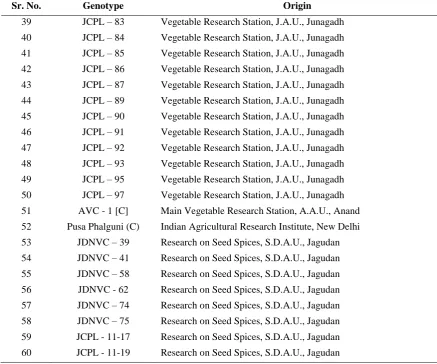
The experimental material comprised of sixty genotypes of vegetable cowpea. The list of genotypes along with their source is given in Table 1. The genotypes were evaluated in a Randomized Block Design with three replications at Vegetable Research Station, Junagadh Agricultural University, Junagadh during summer 2013. Each entry was sown in a single row of 3.0 m length with a spacing of 150 x 30 cm. The observations were recorded on five randomly selected plants from each entry in each replication and their mean values were used. The observations were recorded on five randomly selected competitive plants from each genotype in each replication for twelve characters
http://ejplantbreeding.com
415
picking, pod length, number of primary branches per plant, pod width, hundred fresh seed weight, ten pod weight, number of pods per cluster, number of pods per plant and green pod yield per plant.
Application of discriminant function as a basis for making selection on several characters simultaneously is aimed at discriminating the desirable genotypes from undesirable ones on the basis of their phenotypic performance. A model suggested by Robinson et al. (1951) was used for the construction of selection indices and the development of a required discriminant function. For the construction of selection indices, the characters, which had desirable correlation as well as moderate to high direct effect on pod yield per plant, were considered. In this context, green pod yield per plant (X1) along with its three components
viz., number of pods per plant (X2), pod length (X3)
and ten pod weight (X4) were identified and considered for the construction of selection indices.
Fifteen selection indices were constructed in all possible combinations of three yield contributing characters and green pod yield per plant. Their respective genetic advances were calculated and relative efficiency of different discriminant functions in relation to the straight selection for green pod yield was compared.
A total of fifteen selection indices (Table 2) based on four characters constructed in all possible combinations revealed that the selection efficiency was not higher over straight selection for green pod yield per plant when selection was based on individual components. The results suggested that the selection indices containing single trait were not efficient to bring genetic improvement in vegetable cowpea for green pod yield per plant. This is due to the fact that yield is a cumulative effect of several traits and hence, selection for single trait is not expected to explain fully the genotypic variation for green pod yield per plant. However, it was believed that when two or more single-trait based indices were merged, the relative efficiency of the resulted index was better than using each of the single traits independently. Hazel and Lush (1942) also stated that the superiority of selection based on index increased with an increase in the number of characters under selection. In the present study also, the genetic advance and relative efficiency assessed for different indices increased considerably when selection was based on two or more characters. The relative efficiencies of selection indices constructed in combinations of two or more characters were ranged from 3.99 to 136.46%, while genetic advance ranged from 3.99 to 136.28g. The maximum genetic advance (GA) and relative efficiency (RI) in single character discriminant function were 99.87g and 100%, respectively which however, increased to 122.22g and 122.38%, respectively in two character combinations and 134.90g and 135.08%,
respectively in three character combinations. Thus, there was an increase in the genetic gain as well as relative efficiency with inclusion of an additional trait in the character combinations. In four character combinations, the highest genetic advance and relative efficiency were 136.28g and 136.46%, respectively. Singh and Mehndiratta (1970), Kumar et al. (1976) and Tikka et al. (1978) were also with the same opinion that an increase in characters results in an increase in genetic gain and that the selection indices improve the efficiency of selection than the straight selection for yield alone. Further, there was a consistent increase in the relative efficiency of the succeeding index with simultaneous inclusion of each character. Ideally all possible combinations of traits have to be examined so as to identify the combinations that contribute the most to the selection index. However, in practice, the plant breeder might be interested in maximum possible gain and relative efficiency with minimum number of characters in a selection index. From practical plant breeding point of view, however, the easiest and a relatively efficient index is the one which contains traits that are relatively easier to record in a better precision in the field and these records are collected in routine activity of research (Bos and Caligari, 2007).
The best selection index identified for three character combination included green pod yield per plant, number of pods per plant and ten pod weight (X1+X2+X4) having expected genetic gain of
134.90g and a relative efficiency of 135.08% as compared to the straight selection for green pod yield per plant. However in practice, the plant breeder might be interested in maximum gain with minimum number of characters. In such a case, selection index involving green pod yield per plant, number of pods per plant, pod length and ten pod weight (X1.X2.X3.X4) followed by green pod yield
per plant, number of pods per plant and ten pod weight (X1.X2.X4) or green pod yield per plant, pod
length and ten pod weight (X1.X3.X4) could be
advantageously exploited in the vegetable cowpea breeding programmes. The results of the present study also revealed that, the discriminant function method of making selection in plants appeared to be the most useful than the straight selection for green pod yield alone and hence, due weightage should be given to the important selection indices while making selection for yield advancement in vegetable cowpea.
References
Bos, I. and Caligari, P. 2007. Selection methods in plant breeding. (2nd edition), Germany: Springer Science & Business Media B. V.
http://ejplantbreeding.com
416
Fisher, R. A. 1936. The use of multiple measurements in taxonomic problems. Ann. Eugen., 7: 179. Hazel, L. N. and Lush, J. L. (1942). The efficiency of
three methods of selection. J. Hered.,
33(11): 393-399.
Kumar, P., Prakash, R. and Haque, M. F. 1976. Interrelationship between yield components in cowpea (Vigna sinensis
L.). Proceedings of Bihar Academy of Agricultural Sciences. 24(2), 13-18. Robinson, H. F., Comstock, R. E. and Harvey, P. H.
1951. Genotypic and phenotypic
correlations in corn and their implications in selection. Agron. J., 43: 282-287. Singh K. B. and Mehndiratta P. D. 1970. Path analysis
and selection indices for cowpea. Indian J. Genet., 30(2): 471-475.
Smith, H. F. 1936. A discriminant function for plant selection. Ann. Eugen., 7: 240-250. Tikka, S. B. S. and Asawa, B. M., 1978. Selection
indices in cowpea. Indian J. Agric. Sci.,
http://ejplantbreeding.com
417
Table 1. List of genotypes and their sourceSr. No. Genotype Source
1 JCPL – 03 Vegetable Research Station, J.A.U., Junagadh 2 JCPL – 04 Vegetable Research Station, J.A.U., Junagadh 3 JCPL – 05 Vegetable Research Station, J.A.U., Junagadh 4 JCPL – 06 Vegetable Research Station, J.A.U., Junagadh 5 JCPL – 07 Vegetable Research Station, J.A.U., Junagadh 6 JCPL – 10 Vegetable Research Station, J.A.U., Junagadh 7 JCPL – 11 Vegetable Research Station, J.A.U., Junagadh 8 JCPL – 12 Vegetable Research Station, J.A.U., Junagadh 9. JCPL – 14 Vegetable Research Station, J.A.U., Junagadh 10 JCPL – 15 Vegetable Research Station, J.A.U., Junagadh 11 JCPL – 16 Vegetable Research Station, J.A.U., Junagadh 12 JCPL – 17 Vegetable Research Station, J.A.U., Junagadh 13 JCPL – 19 Vegetable Research Station, J.A.U., Junagadh 14 JCPL – 20 Vegetable Research Station, J.A.U., Junagadh 15 JCPL – 35 Vegetable Research Station, J.A.U., Junagadh 16 JCPL – 36 Vegetable Research Station, J.A.U., Junagadh 17 JCPL – 37 Vegetable Research Station, J.A.U., Junagadh 18 JCPL – 40 Vegetable Research Station, J.A.U., Junagadh 19 JCPL – 43- Vegetable Research Station, J.A.U., Junagadh 20 JCPL – 44 Vegetable Research Station, J.A.U., Junagadh 21 JCPL – 45 Vegetable Research Station, J.A.U., Junagadh 22 JCPL – 49 Vegetable Research Station, J.A.U., Junagadh 23 JCPL – 53 Vegetable Research Station, J.A.U., Junagadh 24. JCPL – 55 Vegetable Research Station, J.A.U., Junagadh 25 JCPL – 56 Vegetable Research Station, J.A.U., Junagadh 26 JCPL – 62 Vegetable Research Station, J.A.U., Junagadh 27 JCPL – 63 Vegetable Research Station, J.A.U., Junagadh 28 JCPL – 64 Vegetable Research Station, J.A.U., Junagadh 29 JCPL – 69 Vegetable Research Station, J.A.U., Junagadh 30 JCPL – 72 Vegetable Research Station, J.A.U., Junagadh 31 JCPL – 74 Vegetable Research Station, J.A.U., Junagadh 32 JCPL – 75 Vegetable Research Station, J.A.U., Junagadh 33 JCPL – 76 Vegetable Research Station, J.A.U., Junagadh 34 JCPL – 77 Vegetable Research Station, J.A.U., Junagadh 35 JCPL – 78 Vegetable Research Station, J.A.U., Junagadh 36 JCPL – 80 Vegetable Research Station, J.A.U., Junagadh 37 JCPL – 81 Vegetable Research Station, J.A.U., Junagadh 38 JCPL – 82 Vegetable Research Station, J.A.U., Junagadh
http://ejplantbreeding.com
418
Table 1. (Contd.)Sr. No. Genotype Origin
http://ejplantbreeding.com
419
Table2. Selection index, discriminant function, expected genetic advance in yield and relative efficiency from the use of different selection indices in vegetable cowpea
Sl. No. Selection indices Discriminant function Expected genetic advance Relative efficiency (%)
1 X1(Green pod yield per plant) 0.8794X1 99.87 100.00
2 X2 (Number of pods per plant) 0.9099X2 25.89 25.92
3 X3(Pod length) 0.8458X3 3.99 3.99
4 X4(Ten pod weight) 0.9557X4 31.26 31.30
5 X1+X2 0.835451X1 + 1.10831X2 122.22 122.38
6 X1+X3 0.873746X1 + 1.637561X3 101.22 101.36
7 X1+X4 0.873258X1 + 1.095571X4 114.43 114.58
8 X2+X3 0.906483X2 + 0.815452X3 25.42 25.45
9 X2+X4 0.916927X2 + 0.963543X4 42.16 42.21
10 X3+X4 0.945888X3 + 0.958477X4 33.37 33.41
11 X1+X2+X3 0.746518X1 + 1.455941X2 + 2.859268X3 123.30 123.46
12 X1+X2+X4 0.80583X1 + 1.199295X2 + 1.153096X4 134.90 135.08
13 X1+X3+X4 0.871258X1 + 1.439195X3 + 1.072236X4 116.11 116.26
14 X2+X3+X4 0.915352X2 + 0.894989X3 + 0.969316X4 43.28 43.37