Nigerian Journal of Technology (NIJOTECH) Vol. 31, No. 3, November, 2012, pp. 277–287. Copyright©2012 Faculty of Engineering, University of Nigeria. ISSN 1115-8443
EFFECT OF FINES CONTENT ON THE ENGINEERING
PROPERTIES OF RECONSTITUTED LATERITIC SOILS IN
WASTE CONTAINMENT APPLICATION
K.J. Osinubia,A.O. Eberemub,A.O. Belloc,A. Adzegah
Department of Civil Engineering, Ahmadu Bello University Zaria, Nigeria.
Emails: a[email protected];b[email protected];c[email protected]
Abstract
A lateritic soil reddish brown in colour was reconstituted with inclusion of fines content in 0, 20, 40, 60, 80 and 90% to form six (6) different soil mixes (S1, S2, S3, S4, S5 and S6, respectively). These soils were analysed to determine the effect of fines content on their engineering proper-ties. Tests were carried out to determine index properties, compaction characteristics, strength properties (unconfined compressive strength (UCS) and undrained shear strength parameters) and
hydraulic properties of the reconstituted soils. Specimens used for the determination of UCS,
undrained shear strength parameters and hydraulic properties were prepared at the optimum mois-ture content (OMC) and compacted using the British Standard light, BSL (standard Proctor) energy. Reconstitution of the natural soil (0% fines content) yielded soil samples having fines content between 61 and 93%, and grading modulus that decreased with higher fines content. The specific gravity of the reconstituted soils decreased, while the Atterberg limits as well as derived plasticity parameters increased with higher fines content. The maximum dry density (MDD) and
OMC decreased and increased, respectively, with higher fines content. The UCS and angle of
shearing resistance generally decreased while cohesion increased with increase in fines content. The hydraulic properties improved with higher fines content. Test results indicate that the recon-stituted lateritic soil samples meet the relevant requirements for materials to be used as hydraulic barrier in waste containment structures.
Keywords: compaction, derived plasticity parameters, hydraulic barrier, hydraulic conductivity, reconstituted lateritic soil
1. Introduction
Fine-grained soils are the most common materials used in the construction of compacted clay liners (hy-draulic barrier) in waste disposal facilities because of their ready availability, good engineering properties when compacted and they are relatively economical. Significant pollutant retention capacity has also been observed for lateritic soils with a large percentage of fines [1-3].
For a lateritic soil to be effective as a barrier mate-rial in waste disposal facilities, it is expected to con-tain appreciable quantities of fines that enables the soil in its compacted state to yield low hydraulic con-ductivity values (k) generally less than 1×10⁻⁹ m/s.
Daniel [4] also stated that the minimum requirements recommended in achieving a hydraulic conductivity
≤1.0×10⁻⁹ m/s for most soil liner materials are as
follows: Percentage fines≥20 – 30% ; Plasticity index
≥7 – 10% ; Percentage gravel≤30% ; Maximum par-ticle size: 25 – 50 mm. Compacted soils used for liners should also have adequate shear strength even when placed on the wet side of optimum. Some researchers [5] suggested that the minimum shear strength of the material should be 200 kPa (30 psi.) based on the lowest value for a very stiff clay soil [6].
Lateritic soils found in some areas in the tropics might not meet the properties listed for their use in waste containment applications and haulage distance of suitable material might not be economically vi-able; hence reconstitution of soil might be necessary to make the material useable for the intended purpose. The potential of reconstituted soil for use in construc-tion of compacted soil liners and covers as well as their field performance would be greatly affected by the
278 K.J. OSINUBI, A.O. EBEREMU, A.O. BELLO & A. ADZEGAH
gree of reconstitution with the fines content.
Several researchers have worked on the effect of fines on different engineering properties of soils. Research works have shown that fines content affect the com-pression and compaction behavior of soils [7, 8]. Also, its effects on instability and strength of soils have been investigated [9 - 11]. Furthermore, its influence on soils to be used as a highway material was investi-gated [12 - 14] but not much work has been done on the effect of fines on reconstituted lateritic soils for use as hydraulic barriers in waste containment sys-tems. Hence, this study was aimed at the evaluation of the effect of fines content on the engineering prop-erties of reconstituted lateritic soil to be used in waste containment applications.
2. Background
The geotechnical characteristics and field perfor-mance of reconstituted lateritic soils as well as their re-action to different stabilizing agents are better under-stood through their index properties. The interaction of the soil particles at the micro scale is reflected in the Atterberg limits of the soil that provides a better understanding of the strength, compressibility, swell potential of the soil or the water holding capacity of the soil and it is dependent on the type of clay mineral present along with the content.
Soil compaction is the mechanical process of in-creasing the density of a soil thereby eliminating the air voids within the soil matrix. The increase in den-sity due to a reduction in void ratio, results in a sub-stantial increase in shear strength of the soil and a marked decrease in its compressibility as well as per-meability [15]. The reason for compaction test is to reduce the sensitivity of strength and volume change to environmental changes, especially those affected by moisture.
Field and laboratory experiments in the evaluation of compaction characteristics of lateritic soils indicate that two important factors influence the compaction test result of lateritic soils [16]. These are factors de-rived from processes of lateritic soil formation and fac-tors derived from preparation and test method. In the first group, factors such as nature and mineralogical composition, grading characteristics, plasticity of fines and amount of clay size content in the fine-grained lat-eritic soil affect the MDD and OMC values and conse-quently permeability of the soil. In the second group, natural moisture content, method of drying and effect of fresh and reused (recompacted) sample have been shown to affect the value of MDD and OMC.
Furthermore, compaction characteristics are af-fected by their grading characteristics along with plas-ticity of the fines. Placement variables such as the moisture content, amount of compaction, type of com-pactive effort also affect the compaction
characteris-tics. Varying each of these placement variables has an effect on permeability, compressibility, swell potential, strength and stress-strain characteristics of the mate-rial.
3. Materials and Methods
3.1. Soil
The soil used in this study is a reddish brown la-teritic soil which was collected from a borrow pit in Shika, Zaria (Latitude 11◦150 N and Longitude 7◦450 E), Nigeria, by method of disturbed sampling. A study of the soil and geological maps of Nigerian [17, 18] show that the soil samples from the borrow pit belong to the group of ferruginous tropical soils de-rived from acid igneous and metamorphic rocks [19, 20]. Soils from the study area contain kaolinite as the dominant clay mineral [21].
3.2. Reconstitution of the soil
The soil used in this study was air-dried and crushed by using a metal roller. Materials that passed through BS No 200 sieve (75µm aperture) were collected as fines. The natural soil was then mixed thoroughly with 0, 20, 40, 60, 80 and 90% fines content by weight of dry soil, to form six independent reconstituted soil samples S1, S2, S3, S4, S5 and S6, respectively.
3.3. Index properties
Tests carried out on the six reconstituted soil sam-ples were in accordance with procedures outlined [22]. Sodium hexametaphosphate was used as dispersant during hydrometer tests. The grading modulus (GM), was computed by using equation (1):
GM = 300−% passing 2.4mm + %<0.425mm + %<0.075mm 100
(1)
% passing 2.4mm = Percentage of particle sizes passing sieve with 2.4mm aperture; % < 0.425mm = Percentage of particle sizes less than 0.425mm; %
< 0.075mm = Percentage of particle sizes less than 0.075mm.
3.4. Derived plasticity parameters
Derived plasticity parameters such as plasticity modulus (PM), plasticity product (PP) and shrink-age modulus (SM) are used to represent the effective contribution of the plasticity of the fines to the per-formance of the whole material and they depend on the proportion of fines in the material [23].
Plasticity Modulus (PM) is defined as the product of plasticity index (PI) and percentage of soil fraction passing BS No 40 sieve (i.e., % <425µm):
Fines Content Effect on Engr’g. Props. Of Reconstituted Lateritic Soils 279
% < 425µm = percentage of particle sizes less than 0.425mm.
Plasticity Product (PP) is defined as the product of plasticity index (PI) and percentage of fines less than BS No 200 sieve (i.e., %<75µm): %<75µm = percentage of particle sizes less than 0.075mm
PP = PI×(%<75µm) (3)
Shrinkage Modulus (SM) is defined as the product of linear shrinkage (LS) and percentage passing BS No 40 sieve (i.e., % <425µm):
SM = LS×(%<425µm) (4)
3.5. Compaction
Tests involving the moisture-density relationship, unconfined compression and hydraulic conductivity were carried out using air dried soil samples com-pacted with the BSL energy in accordance with BSI [22]. The reconstituted soil mixtures (S1 to S6) used for all the compaction tests were obtained by first thoroughly mixing dry predetermined quantities of pulverized soil with the respective fines contents to obtain uniform mixtures.
3.6. Unconfined compression
This test was carried out in accordance with BS 1377 [22]. Air dried reconstituted soils (S1 to S6) were compacted at their optimum moisture content using the BSL energy level in 1000 cm3 mould. Af-ter compaction the specimen was extruded from the mould, placed in airtight polythene bags and kept in the humidity room for a period of 48 hours to allow for uniform distribution of moisture at a constant tem-perature of 24±2. After curing, the samples were trimmed into cylindrical undisturbed specimens that were placed in a load frame machine driven strain con-trolled at 0.10 %/min until failure occurred. Three specimens were used for each test and the average re-sult taken.
3.7. Triaxial compression
The triaxial test was carried out in accordance with the procedure outlined in BS 1377 [22]. The same size of cylindrical specimen was prepared as explained under unconfined compression test. However, in this case, axial compression was applied on a set of three specimens A, B and C that were subjected to differ-ent confining cell pressures (103, 206 and 310 kN/m2) respectively, to obtain the undrained shear strength and its parameters.
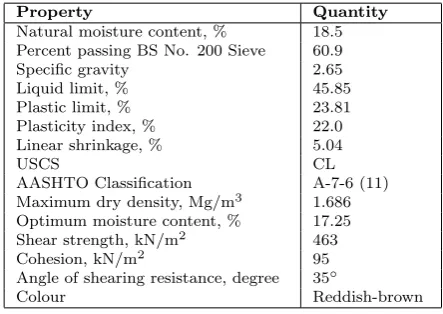
Table 1: Basic geotechnical properties of the natural soil.
Property Quantity
Natural moisture content, % 18.5 Percent passing BS No. 200 Sieve 60.9
Specific gravity 2.65
Liquid limit, % 45.85
Plastic limit, % 23.81
Plasticity index, % 22.0
Linear shrinkage, % 5.04
USCS CL
AASHTO Classification A-7-6 (11) Maximum dry density, Mg/m3 1.686 Optimum moisture content, % 17.25 Shear strength, kN/m2 463
Cohesion, kN/m2 95
Angle of shearing resistance, degree 35◦
Colour Reddish-brown
3.8. Hydraulic conductivity
The hydraulic conductivity was measured using rigid wall permeameter under falling head condition [24]. The reconstituted soils (S1 to S6) were com-pacted at their respective BSL maximum dry den-sity (MDD). After compaction, each sample with the mould was soaked in distilled water for a minimum period of 96 hours to allow for full saturation without vertical swelling. The fully saturated test specimen was then connected to a permeant liquid (distilled wa-ter). During permeation, test specimens were free to swell vertically (i.e., no vertical stress was applied). Hydraulic gradient ranged from 5 to 15. Tests lasted for 2 to 4 days and were only discontinued when steady flow was established.
4. Results and Discussion
4.1. Index properties
The natural soil is classified as fine-grained soils, inorganic lean clays of low to medium plasticity (CL) based on the Unified Soil Classification System (USCS). Based on AASHTO classification system, the soil is classified as A-7-6 (11). The basic geotechnical properties of the natural soil are summarized in Table 1. The particle size distribution of the natural and reconstituted soils is shown in Fig. 1.
Reconstitution of the natural soil yielded soil sam-ples with varying fines contents. The percentage fines increased from 60.9 to 93.2% for S1 to S6, respectively. The relationship between the grading modulus (GM) determined using eq. (1) and fines content depicted in Fig. 2 shows that GM decreases with higher fines content. It implies that GM is inversely related to the fines content of the reconstituted soils.
4.2. Specific gravity
The variation of specific gravity with fines content is shown in Fig 3. A trend of decrease in specific grav-ity from 2.65 for S1 (natural soil with least amount of
280 K.J. OSINUBI, A.O. EBEREMU, A.O. BELLO & A. ADZEGAH
Figure 1: Particle size distribution curves of the natural and reconstituted soils..
fines) to 2.53 for S6 (reconstituted soil with maximum fines content) with higher fines content was observed. The observed trend was due to the increased replace-ment of particles of the natural soil with finer particles that were less dense.
4.3. Atterberg limits
The variation of Atterberg limits (i.e., the liquid limit (LL), plastic limit (PL), plasticity index (PI) and linear shrinkage (LS)) of the reconstituted soils with fines content is shown in Fig. 4. Generally, the Atterberg limits of the samples obviously increased with higher fines content and this is in agreement with the results reported [25]. The results show that as the amount of fines increased, the resultant specific surfaces and activity of the material also increased, that was reflected in the increase in Atterberg limit values. This was so because the Atterberg limit values were proportional to the specific surfaces provided by the fines content [15].
The liquid limit and the plastic limit provide the most useful way of identifying and classifying the fine-grained cohesive soils [24]. Soils with high liquid limit generally have low hydraulic conductivity. It was rec-ommended [26] that the liquid limit of a liner ma-terial be at least 20%. However, clay soils with too high liquid limit (LL) are more susceptible to desicca-tion cracking, whereas clay soils with too low plastic limit (PL) and plasticity index (PI) are less workable resulting in a higher probability of the existence of macropores and poor interlift bonding [27]. In gen-eral soils with very high liquid limit have poor volume stability and high shrink-swell potentials.
As long as it does not create any working problem (being workable and easy for machine to handle), soils with higher liquid limit are preferred for their low hy-draulic conductivity in landfill liners [4]. High plas-ticity clays are more difficult to compact when used as fill material [24]; this is because they form hard lumps when dry and is difficult to break down during compaction thereby forming zones of higher hydraulic conductivity. More so, very high plasticity soil be-comes sticky when wet and bebe-comes difficult to work with in the field.
Linear shrinkage values ranged from 5 to 7% as shown in Fig. 4. The trend shows that shrinkage is highly dependant on the amount of fines in the soil. Linear shrinkage occurs as the water surrounding the individual soil particles of the specimens is removed, the soil particles move closer together. More move-ments are experienced in finer particles than coarser particles, which explain the trend. The shrinkage limit and shrinkage ratio of a clay soil, considered in relation to the field moisture content, can indicate whether it is likely to shrink on drying and if so, by how much [24]. Cracks provide pathways for moisture migration into a landfill cell, which increases the generation of leachate and ultimately increases the potential for the soil and ground water contamination.
4.4. Derived plasticity parameters
Fines Content Effect on Engr’g. Props. Of Reconstituted Lateritic Soils 281
Figure 2: Variation of grading modulus with fines content.
in Fig 5. Generally, the derived parameters increased with higher fines content.
4.5. Compaction characteristics
In the construction of soil liners, compaction is done to achieve a soil layer of improved engineering prop-erties. Compaction of soils results into a homogenous mass that is free of large continuous inter-clods voids; increases their density and strength, and reduce their hydraulic conductivity. The variation of maximum dry density (MDD) and optimum moisture content (OMC) of the reconstituted soils with fines content is shown in Fig. 6. Generally, MDD decreased while OMC increased with increase in fines content. The MDD decreased because of decrease in specific grav-ity of the reconstituted due to increase in fines con-tent. This result is consistent with the results other researcher [16] for fine-grained residual lateritic soils. On the other hand, the OMC increased due to in-crease in fines content resulting in inin-creased total spe-cific surface that required more water to achieve the mobilization of soil particles during the compaction process. The result is in agreement with the findings reported by other researchers [28–30].
4.6. Strength characteristics
4.6.1. Unconfined compressive strength
Durability and resistance to weathering is the qual-ity of bonding in the material, which should be strong enough to withstand the destructive forces of environ-mental elements and equipment that will work over such materials; a minimum unconfined compressive strength of 200 kN/m2 is required for a material to be suitable for use as a liner in waste containment systems [4, 5].
The variation of unconfined compressive strength (UCS) with fines content is shown in Fig. 7. The
UCS values ranged from 463 kN/m2 for the natural
soil to 359 kN/m2 for reconstituted soil containing
90% fines. Generally, UCS of the soil samples de-creased with higher fines content. The main factors responsible for the strength of soil are the cohesion and frictional resistance between the soil particles in contact. As the fines content increase, the soil matrix changes with the presence of excess fines; leading to a more slippery state and hence a reduction in the UCS of the soil.
Furthermore, this trend could be attributed to the reduction in density of the soil samples and the in-creased affinity for water by the increasing fines con-tent, which results in loss of cementation between the particles leading to loss in strength (reduced cohesive resistance).
Regardless of the observed trend, even at 90% fines content, the UCS recorded is more than the minimum 200 kN/m2 strength requirement for a liner material
suggested [5].
4.6.2. Undrained shear strength parameters
The relationship between cohesion (c) and angle of shearing resistance (φ) of the reconstituted lateritic soil samples and fines content is shown in Fig. 8. Cohesion increased, from 95 to 200 kN/m2 while
an-gle of shearing resistance decreased from 35◦ to 16.5◦ for the natural soil and soil with 90% fines content, respectively. The basic intrinsic strength properties of soils are the cohesion and angle of shearing resis-tance. Increase in fine particles make soils to become less dense, increasing the inter particle bond between the particles due to larger surface area in contact and eventually increasing the cohesion.
Also, the angle of shearing resistance which depends on the grading, particle shape, void ratio but unaf-fected by the degree of saturation, decreases with in-crease in fines content because of the platy or fine
282 K.J. OSINUBI, A.O. EBEREMU, A.O. BELLO & A. ADZEGAH
Figure 3: Variation of specific gravity with fines content.
Figure 4: Relationship between Atterberg limit values and fines content.
Fines Content Effect on Engr’g. Props. Of Reconstituted Lateritic Soils 283
Figure 6: Variation of maximum dry density and optimum moisture content with fines content.
Figure 7: Variation of unconfined compressive strength (UCS) with fines content.
Figure 8: Variation of angle of cohesion and angle of shearing resistance with fines content.
284 K.J. OSINUBI, A.O. EBEREMU, A.O. BELLO & A. ADZEGAH
Figure 9: Variation of hydraulic conductivity with fines content.
ture of the soils, which reduces the interlocking forces between the particles [16].
4.7. Hydraulic properties
Hydraulic conductivity is the key design parame-ter when evaluating the acceptability of a maparame-terial in waste containment barrier application, since water re-tention is the primary aim of the containment barrier system. The impact of a waste disposal facility on ground water quality depends on the presence of a dominant flow path, and most importantly the nature of the barrier, which is intended to limit and control contaminant migration [31].
The variation of hydraulic conductivity with fines content is shown in Fig. 9. The coefficient of perme-ability (k) (hydraulic conductivity) values decreased from 6.573E-10 m/s for the natural soil (S1) to 2.985E-10 m/s for soil with 90% fines content (S6). The hydraulic conductivity decreased between the natu-ral soil (S1) and 20% fines content (S2) by 1.08 orders of magnitude; it decreased by 1.15 orders of magni-tude between 20% fines content (S2) and 40% fines content (S3). Between 40% fines content (S3) and 60% fines content (S4), the hydraulic conductivity value decreased by 1.10 orders of magnitude; it fur-ther decreased by 1.06 orders of magnitude between 60% fines content and 80% fines content (S5). Finally it decreased by the highest margin of 1.51 orders of magnitude between 80% fines content (S5) and 90% fines content (S6). These results were expected, as the voids were filled with smaller particles (fines) that reduced the volume of voids present and flow of water through the interconnected voids. This is in agree-ment with the findings reported [32].
The relationship between the degree of saturation and fines content is shown in Fig. 10. The initial degree of saturation at compaction ranged from 78 to 92%, while the final degree of saturation (at the end of permeability test) ranged from 79 to 100%.
This trend shows that degree of saturation increased with higher fines content. This was due to increased capillary action of closely packed fine particles with higher matric suction ability, that had more contact areas and can easily absorbed water [33, 34].
The relationships between the hydraulic conductiv-ity and the grading modulus as well as the plastic-ity characteristics (plasticplastic-ity modulus and plasticplastic-ity product) are shown in Figs.11 and 12 respectively. The hydraulic conductivity generally increased with increasing grading modulus (GM), which is so because increased (GM) is associated with less fines which will allow more flow to be conducted through the pore spaces. The hydraulic properties decreased with increased plasticity characteristics (plasticity modu-lus and plasticity product) values as expected for in-creased fines content, thus making the material better for use as hydraulic barrier in waste containment sys-tems.
5. Conclusion
A lateritic soil classified as CL under USCS was reconstituted with inclusion of fines content in 0; 20; 40; 60; 80; and 90% to form six (6) different soil mixes (S1, S2, S3, S4, S5 and S6, respectively). Tests on its engineering properties gave the following results:
The particle sizes of the reconstituted soils gener-ally increased with increasing fines content resulting in a decrease in grading modulus. The specific gravity decreased with increased fines from 2.65 to 2.53. The Atterberg limits (plastic limit, liquid limit, plastic-ity index, and linear shrinkage) values increased with higher fines content. Also, the values of derived ticity characteristics such as plasticity modulus, plas-ticity product, and shrinkage modulus increased with higher fines content.
Fines Content Effect on Engr’g. Props. Of Reconstituted Lateritic Soils
285Figure 10: Variation of degree of saturation and fines content of reconstituted soil samples.
Figure 11: Variation of hydraulic conductivity with grading modulus.
Figure 12: Variation of hydraulic conductivity with plasticity characteristics.
286 K.J. OSINUBI, A.O. EBEREMU, A.O. BELLO & A. ADZEGAH
increased with higher fines content. The unconfined compressive strength decreased with higher fines con-tent although recorded values are higher than the per-missible 200 kN/m2 required for hydraulic barriers.
The cohesion increased while the angle of shearing re-sistance reduced with increase in fines content.
The hydraulic properties of the reconstituted soils improved with increased fines content up to 90% fines treatment. The initial degree of saturation at com-paction and final degree of saturation after perme-ability test increased with higher fines content. Hy-draulic conductivity increased with higher grading modulus which is associated with fewer fines while it decreased with increased plasticity characteristics (plasticity modulus, plasticity product) values.
The recorded test results of the reconstituted lat-eritic soils show that they can be used in constructing hydraulic barriers for waste containment facilities par-ticularly in places where lateritic soil deposits do not meet the basic requirement for use as hydraulic barrier material.
References
1. Osinubi, K.J. and Nwaiwu, C.M.O. Compacted
lat-eritic soils as hydraulic barriers in waste containment systems. Proc. 4th International Congress on Envi-ronmental Geotechnics. Rio de Janeiro Brazil, Ash-gate San Diego, August 11–15, 2002, pp. 225–230.
2. Osinubi, K.J. and Nwaiwu, C.M.O.Compatibility of compacted lateritic soils with municipal solid waste leachate. Proc. ISSMGE. 5th International Congress on Environmental Geotechnics, Cardiff, U.K., June 26–30, 2006, pp. 608–615.
3. Gabas, S.G., Boscov, M.E.G and Sarkis, J.E.S. Cad-mium and lead adsorption in a compacted lateritic soil. C.D ROM of Presentations at the First Interna-tional Conference on Environmental Research, Tech-nology Policy ERTEP 2007 Ghana. Session E3.18. State-of-the-Art Technologies for Environmental Per-formance and Protection, July 16 -19, 2007, pp.1–12.
4. Daniel, D.E. Clay liners, inGeotechnical Practice for Waste Disposal. D.E. Daniel (Ed.), Chapman and Hall, London, 1993, pp. 137–163.
5. Daniel, D.E. and Wu, Y.K. Compacted clay liners and covers for arid site. J. Geotech. Engrg. ASCE., Vol.119, No. 2, 1993, pp. 223–237.
6. Peck, R.B., Hanson, W.E. and Thornburn, T.H.
Foundation Engineering. 2nd Ed., John Wiley and Sons Inc., New York, 1974.
7. Monkul, M.M. and Ozden, G. Compressional behav-ior of clayey sand and transition fines content. Engi-neering Geology, Vol. 89, 2007. Issues 3-4, pp 195– 205.
8. Wang, S.D., Chan, K. and Lam, C. Experimental study of the effect of fines content on dynamic com-paction grouting in completely decomposed granite
of Hong Kong. Construction and Building Materials, Vol. 23, No.3, 2009, pp. 1249–1264.
9. Abedi, M.S. and Yasrobi, S. Effects of plastic fines on the instability of sand. Soil Dynamics and Earth-quake Engineering, Vol. 30, No. 3, 2010, pp. 61–67. 10. Naeini, S.A. and Baziar, M.H. Effect of fines
con-tent on steady-state strength of mixed and layered
samples of a sand. Soil Dynamics and Earthquake
Engineering, Vol. 24, No. 3, 2004, pp 181-187. 11. Lee, K., Jeong, S. and Kim, T. Effect of Fines on
the Stability of Unsaturated Soil Slopes. Jour. of the KGS, Vol. 23, No. 3, 2007, pp. 101–109.
12. Bera, K.A. Effect of sand content on engineering properties of fine-grained soil mixed with sand. Elec-tronic Journal of Geotechnical Engineering, Vol. 16, Bundle O, 2011, pp.1275–1286.
13. Cabalar, F.A. Effect of Fines Content on the Behavior of Mixed Samples of a Sand. Electronic Journal of Geotechnical Engineering, Vol. 13, Bundle D, 2008, pp 1–11.
14. Ayodele, A.L., Falade, F.A. and Ogedengbe, M.O. Effect of fines content on some engineering properties of lateritic soil in Ile-Ife, Nigeria. Journal of Engi-neering Research, 9(32), 2009, pp. 1–16.
15. Azizi, F. Applied Analyses in Geotechnics. 1st edi-tion, E & FN Spon, London, 2000..
16. Gidigasu, M.D. Laterite Soil Engineering
Pedo-Genesis and Engineering Principles. Amsterdam El-sevier Scientific, 1976.
17. Areola O. Soils: Nigeria in Maps. R.M. Barbour
(Ed.), Hodder and Stoughton, London, 1982.
18. Akintola, F.A. Geology and Geomorphology,
Nige-ria in Maps. R.M. Barbour (Ed.), Hodder and Stoughton, London, 1982.
19. Obeahon, S.O.The effect of Elapsed Time after mix-ing on the properties of modified laterite. Unpub-lished M.Sc. Thesis. Civil Engrg. Dept. Ahmadu Bello University Zaria, Nigeria, 1993.
20. Osinubi, K.J. Influence of compactive efforts and compaction delays on lime treated soils. J. of Transp. Engrg. ASCE Vol. 124, No.2, 1998, 149–155. 21. Osinubi, K.J. Permeability of lime treated lateritic
soil. J. of Transp. Engrg. ASCE Vol. 124, No. 5, 1998, 465–469.
22. British Standard Institute. Methods of testing soils for civil engineering purposes. BS 1377, London, 1990.
23. CIRIALateritic in road pavements. construction In-dustry Research and Information Association special publication 47, TRRL, London, 1988.
24. Head, K.H. Manual of Soil Laboratory Testing Vol. 2. Permeability, Shear Strength and Compressibility Tests. Pentech Press, London, 1992.
Fines Content Effect on Engr’g. Props. Of Reconstituted Lateritic Soils 287
26. Benson, C.H., Zhai, H. and Wang, X. Estimating hydraulic conductivity of compacted clay liners. J. Geotech. Engrg. ASCE, Vol. 120, No. 2, 1994, pp. 366–387.
27. Daniel, D.E. Earthen liners for land disposal facilities. In R.E. Woods (Ed)Geotechnical Practice for Waste Disposal. Geotechnical Special Publication, No. 13, ASCE New York, N.Y., 1987, pp. 21–39.
28. Osinubi, K.J., Nwaiwu, C.M.O. and Ochepo, J. Effect of Fines Content on the Compaction Characteristics of Laterite Soils. NSE Technical Transactions, Vol. 37, No 4, 2002, pp. 10–27.
29. Eberemu, A.O. and Osinubi, K.J.Geotechnical prop-erties of laterite treated with blast furnace slag (BFS). Proceedings of Bi-Monthly Meetings/Workshops. Materials Society of Nigeria (MSN) Zaria Chapter, 2006, pp. 10–20.
30. Osinubi, K.J., Eberemu, A.O. and L. S. Kasham.
Influence of bagasse ash content on the hydraulic conductivity of compacted lateritic soils at reduced Proctor effort. Proceedings of Bi-Monthly Meet-ings/Workshops. Materials Society of Nigeria (MSN) Zaria Chapter. A.B.U. Zaria, 2007, pp. 17–25.
31. Rowe, R.K., Quigley, M.R. and Booker, R.J.Clayey Barrier Systems for Waste Disposal Facilities. E & FN Spon. An imprint of Chapman & Hall, London, 1995, pp.1390.
32. Craig, R.F. Soil Mechanics. Van Nastrand Reinholl (International), London EC4P4EE, 1987.
33. Lu, N. and Likos, W.J. Rate of capillary rise in soil.
J. of Geotech and Geoenviron. Engrg. ASCE, Vol. 130, No. 6, 2004, pp 646–650.
34. Li, J., Yang. Q., Li, P. and Yang, Q.I. Experimen-tal research on soil water characteristic curve of re-moulded soils. Electronic Journal of Geotechnical En-gineering, Vol 14, Bundle L, 2009, pp. 1–12.